Kicking Back

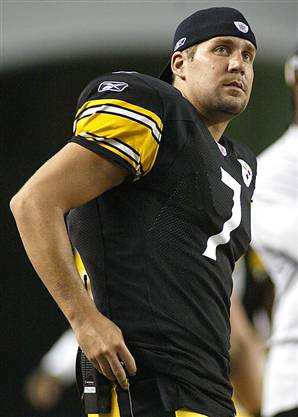
They’re doing terribly this year.  My fantasy football team, that is.  Last weekend, my quarterback, Ben Roethlisberger, scored an underwhelming grand total of fourteen points.  My wide receivers are putting more points on the board than he is.  To add insult to injury, the other day, I caught a few minutes of a game on ESPN Classic when Roethlisberger was still in college playing for Miami University in 2003.  I wish he played now the way he played then.

Most people know that I am a football fan.  There is nothing like kicking back on a Sunday afternoon taking in an NFL game or two, dozing in an out of consciousness, especially since my Sunday mornings, as a pastor, are generally action-packed!  And of course, I love watching my beloved Longhorns take on their toughest rivals.  The pageantry and suspense of college football is unlike anything else.

I’m not the only one who loves a good football game.  The NFL’s popularity has been rising steadily and startlingly over the years, this year reaching an all time high of 59 percent of Americans who say that they follow professional football according to an annual Harris Poll.[1]

As a football fan, I would be the first to say that there’s nothing wrong with following the game.  I would also add that there’s nothing wrong with all sorts of other things people do to kick back and relax – from golfing to finding your favorite movie on Netflix to fishing to surfing the internet.  And yet, if these are the only ways we spend our leisure time, we are cheating ourselves out of something transcendent.

The Lutheran theologian Gene Edward Veith wrote an article recently titled, “The Purpose of Work.”  In it, he noted a disturbing trend in the way Americans view their leisure time:

In our culture today…most people probably do not use their leisure to contemplate the good, the true, and the beautiful.  Our leisure is filled with more entertainment than contemplation.[2]

Veith’s last line is key.  When we find leisure only in what entertains us – be that a football game or a golf outing or a movie or a fishing expedition or a favorite internet site – we miss the more profound blessings that leisure has to offer.  For a bit of contemplation – on family, on work, on friends, and, most importantly, on God – can yield key and transformative insights for life and engender a thankful heart for all the blessings God has given.  But first, we need to take time away from being entertained to think and to thank God.

The Bible’s portrait of leisure can guide our us on our journey from liesure as solely entertainment to liesure that includes contemplation:

Observe the Sabbath day by keeping it holy, as the LORD your God has commanded you.  Six days you shall labor and do all your work, but the seventh day is a Sabbath to the LORD your God.  On it you shall not do any work, neither you, nor your son or daughter, nor your manservant or maidservant, nor your ox, your donkey or any of your animals, nor the alien within your gates, so that your manservant and maidservant may rest, as you do.  Remember that you were slaves in Egypt and that the LORD your God brought you out of there with a mighty hand and an outstretched arm. Therefore the LORD your God has commanded you to observe the Sabbath day. (Deuteronomy 5:12-15)

Notice that in Israel, the celebration of the Sabbath – a day to rest from the work of the week – is specifically tied to contemplation.  The Israelites are to remember their slavery in Egypt and how God brought them out.  For Israel, leisure was not just time to be entertained, it was time to spend with God.

How do you spend the bulk of your leisure time?  Entertainment is good, but not when it comes at the expense of reflecting on your life and on your Lord.  After all, He is the One who gave you that leisure time in the first place.  As the Psalmist reminds us, “God gives rest to His loved ones” (Psalm 127:2).  Maybe you should use your leisure rest not just to be entertained, but to say “thank you” to God.


[1] Michael David Smith, “Poll finds NFL more popular than ever,” NBC Sports (10.6.2012).

[2] Gene Edward Veith, “The Purpose of Work,” The Gospel Coalition (10.7.2012).
ABC Extra – You Need A Break!

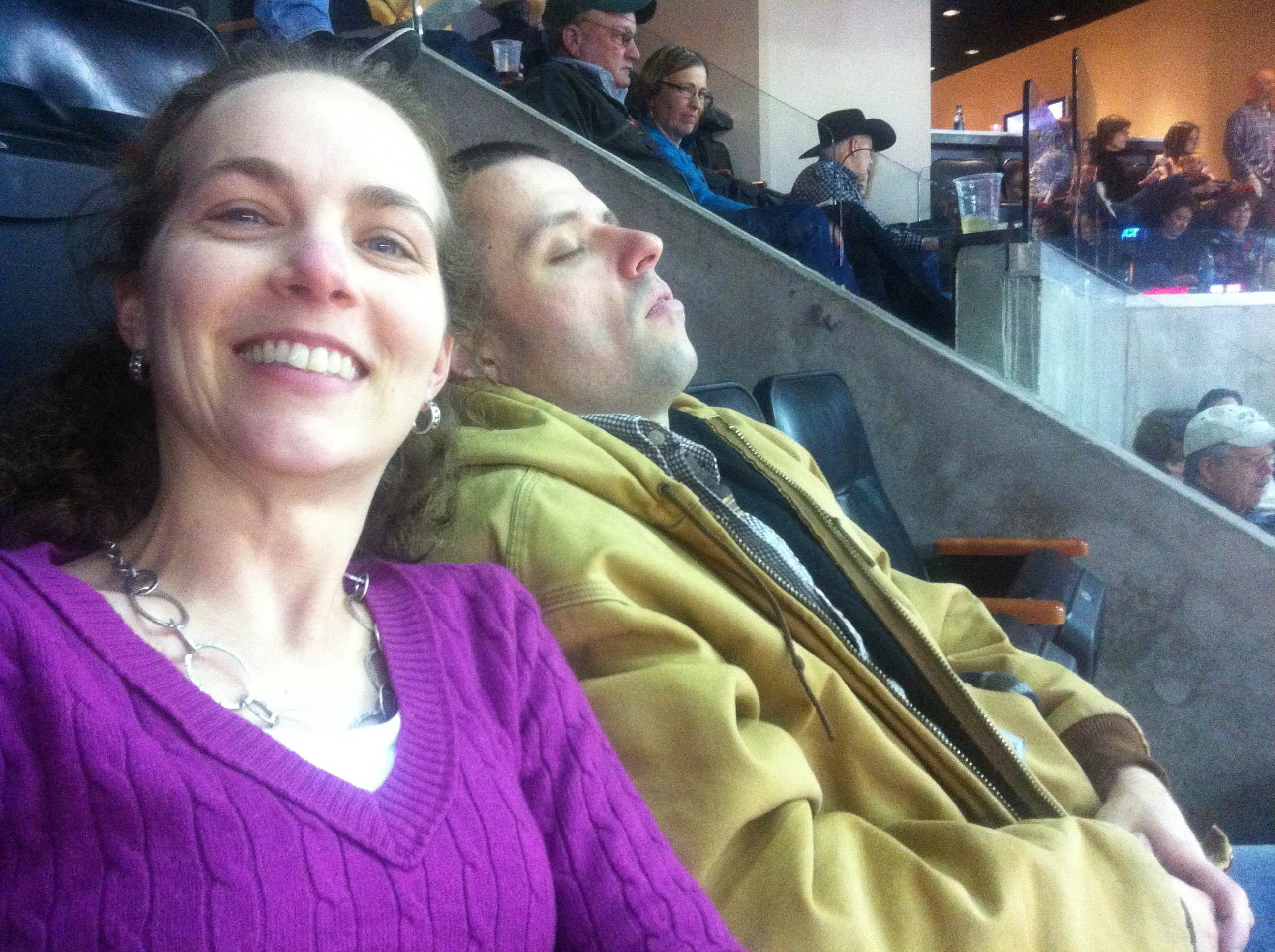
Yes, this is a picture of me.  This is when we were at the rodeo in January, seeing MercyMe in concert.  Well, our friends and my wife were seeing MercyMe.  I, on the other hand, was a little tired that evening.  So I took a little nap in the middle of a big concert.

I am one of those people who can sleep anytime and anywhere.  If I’m tired, my eyes begin to close and my head begins to nod.  It doesn’t matter if it is at night or during the day, at a public place or when I’m at home.  I can even doze at a rodeo.  My wife, on the other hand, needs everything to be just right before she can fall asleep.  The room must be pitch black.  The ambience must be dead quiet.  Even the slightest noise in the middle of the night can startle her awake.

This past weekend in worship and ABC, we talked about gift and glory of rest.  But in a world full of appointments, tasks, meetings, and errands, rest can be hard to come by.  Especially during this holiday season, when we have parties to host and presents to buy and relatives to visit, the specter of a restful Christmas can seem to be nothing but a cruel illusion.

So how do we get the rest we need when the world around us never seems to slow down?  First, to rest, we must intentionally slow ourselves down.  I shared this quote in ABC, but it is so insightful, I want to share it here again.  It concerns the biblical day of rest, otherwise known as the Sabbath:

Most people mistakenly believe that all you have to do to stop working [and rest] is not work. The inventors of the Sabbath understood that it was a much more complicated undertaking. You cannot downshift casually and easily, the way you might slip into bed at the end of a long day. As the Cat in the Hat says, “It is fun to have fun but you have to know how.” This is why the Puritan and Jewish Sabbaths were so exactingly intentional, requiring extensive advance preparation – at the very least a scrubbed house, a full larder and a bath. The rules did not exist to torture the faithful. They were meant to communicate the insight that interrupting the ceaseless round of striving requires a surprisingly strenuous act of will.[1]

Resting “requires a surprisingly strenuous act of will.”  In other words, rest isn’t easy!  It must be intentional.  You must schedule rest, prepare for rest, and then stubbornly take a rest, even if it spites a calendar which clamors for your every waking moment.

Second, to rest, we must examine our hearts.  The apostle John writes, “We set our hearts at rest in God’s presence whenever our hearts condemn us. For God is greater than our hearts, and He knows everything” (1 John 3:19-20).  Rest, John reminds us, goes deeper than just how many appointments we have scheduled.  It goes down to the state of our hearts.  Thus, even when our schedules are packed full and our lives are running at high speed, our hearts can be at rest because our hearts are held by the Lord.  The stress our world does not have to ruin the rest of our hearts.  Thus, even when we feel as though our hearts are overwhelmed by this world’s demands, we can cling to this promise:  “God is greater than our hearts.”  God’s power and grace far outweigh, outlast, and outdo the anxiety and unrest we can harbor in our hearts.  So find your rest in Him.  He’s just the break you need.

Want to learn more? Go to
www.ConcordiaLutheranChurch.com
and check out audio and video from Pastor Tucker’s
message or Pastor Zach’s ABC!


[1] Judith Shulevitz, “Bring Back the Sabbath,” The New York Times (3.2.2003).

Weekend Extra – A Storm Before The Calm

A few weeks back, San Antonio was struck by a bout of severe weather.  Lightning, strong winds, torrential rain, and even some hail all contributed to one of the most damaging storm systems this city has seen in a while.  When the storm rolled into the area, I was on Concordia’s campus with our youth, leading our Fusion service.  I can remember strolling onto campus early in the evening, enjoying the warm and balmy air, and feeling the hot sun beat down on me with nary a cloud in sky.  But when I left an hour and a half later, it was a completely different story.  The sky was full of clouds tinted by sinister shades of green, the smell of rain hung in the air, and everything was dead calm.  But I knew this dead calm wouldn’t last for long. “It’s the calm before the storm,” I thought to myself.  So I hopped in my truck and put the pedal the metal to try to beat the storm back to my house.  I arrived at my front door just as the rain was beginning to fall.

It is not unusual, shortly before a storm, to experience an eerie calm.  But in our reading for this weekend from Hebrews 4, we find the opposite to be true.  The preacher of Hebrews says that when it comes to our lives in this world, there is not a calm before the storm, but a storm before the calm.  As the chapter opens, we read a promise of our coming calming rest.  “The promise of entering God’s rest still stands,” the preacher muses (verse 1).  But right now, we are in the midst of a storm.  For in this world, there is trouble, torrent, tribulation, and trial.  Indeed, the apostle Paul says that we are engaged in a struggle:

Against the rulers, against the authorities, against the powers of this dark world and against the spiritual forces of evil in the heavenly realms. Therefore put on the full armor of God, so that when the day of evil comes, you may be able to stand your ground, and after you have done everything, to stand. (Ephesians 6:12-13)

We are engaged in a storm before the calm.  How are we to engage with this storm of sinfulness and fight this battle of banality?  Paul answers: “Take the sword of the Spirit, which is the Word of God” (Ephesians 6:17).  Or, as the preacher of Hebrews declares, “The Word of God is living and active. Sharper than any double-edged sword, it penetrates even to dividing soul and spirit, joints and marrow; it judges the thoughts and attitudes of the heart” (verse 12).  God’s Word is our weapon of choice to fight against the storms of this life and world.

For those who refuse to trust the sword of God’s Spirit, the preacher of Hebrews has a stark warning, drawn from the disobedience of the ancient Israelites: “For we have had the gospel preached to us, just as the Israelites did; but the message they heard was of no value to them, because those who heard did not combine it with faith” (verse 2).  Without faith in God’s Word, God’s promise of a coming calm is of no value, for it must be believed to be received.

In this world, we fight many battles and endure many storms.  There are battles over our finances, our relationships, our politics, our nation’s security, and our cultural winds.  But none of these battles are nearly as fierce as the battle which rages for our souls.  Make no mistake about it, Satan desires to drag us away from God and dissuade and prevent us from entering God’s eternal rest.  But we cannot win this battle against Satan by the strength of our bodies, or the whit of our intellects, or the resolve of our wills.  No, Satan can only be beaten by wielding the Word of God.  And so, take up sword of Scripture so that “you can take your stand against the devil’s schemes” (Ephesians 6:11).  For Satan cannot stand against God’s Word.  As Luther reminds us:

Nothing is so powerfully effective against the devil, the world, the flesh, and all evil thoughts as to occupy one’s self with God’s Word, to speak about it and meditate upon it…Without doubt, you will offer up no more powerful incense or savor against the devil than to occupy yourself with God’s commandments and words and to speak, sing, or think about them…For the devil cannot bear to hear God’s Word. (LC 10-11)

Trust God’s Word!  For after this world’s brief storm of sin, you will enjoy God’s eternal calm of salvation.

Want to learn more on this passage? Go to
www.ConcordiaLutheranChurch.com
and check out audio and video from Pastor Nordlie’s
message or John Kammrath’s ABC!