Every Day Can Be Christmas

Gerard_van_Honthorst_-_Adoration_of_the_Shepherds_(1622)
Adoration of the Shepherds by Gerard van Honthorst, 1622

The first Christmas was a work day.

These days, Christmas is one of the few days of the year widely marked by time off.  But for the first people to hear of Christ’s birth, Christmas day was not a holiday, but a normal day:

And in the same region there were shepherds out in the field, keeping watch over their flock by night. And an angel of the Lord appeared to them, and the glory of the Lord shone around them, and they were filled with great fear. And the angel said to them, “Fear not, for behold, I bring you good news of great joy that will be for all the people. For unto you is born this day in the city of David a Savior, who is Christ the Lord.” (Luke 2:8-11)

There was no glistening tree, no holiday feast, no gift exchange, no melodic carols, and no time off to be with family when an angel appeared to some shepherds that first Christmas night.  There was only another day at the office of the open field, with lots of sheep milling about.  The first Christmas was a work day.

The holiday of Christmas is, of course, precious.  I love to open gifts with my family and enjoy all the traditions and accoutrements that accompany this time of year.  But if the message of Christmas is kept within the boundaries of the actual holiday of Christmas, the truth of Christmas will be quickly lost.

The heart of the Christmas message is that God became human in the person of Jesus Christ.  He “took and flesh and made His dwelling among us” (John 1:14).  But Jesus did not become human to give us a holiday, as wonderful as that holiday may be, but to change our everyday.   This is why Jesus poured Himself into twelve men for three years.  This is why He healed the sick and fed the masses.  This is why He taught the curious and rebuffed the self-righteous.  He poured Himself into the everyday lives, struggles, and sins of people not to give them another holiday, but to show them that He was for and with them every day.

Assuming the traditional chronology of Jesus’ crucifixion and resurrection is correct, I find it telling that the climax of Jesus’ work – His death and resurrection – occurred between holidays.  The Thursday night before Jesus died, He celebrated the high holy Jewish holiday of Passover with His disciples.  The Saturday Jesus was in the grave was the holiday of a Sabbath.  Jesus died on a Friday and rose on a Sunday.  He accomplished His mission not on important holidays, but during two common days.

The message of Christmas extends long beyond the holiday of Christmas, for the message of Christmas reminds us that Christ is with us not just during a day full of carols, decorations, presents, and food, but “always, to the very end of the age” (Matthew 28:20).  So, as we celebrate Christmas today, let’s not forget why need Christmas tomorrow – and all year long.

The Price of Mercy

King DavidIf I was David, I would have been tempted to say, “The devil made me do it.”

When “Satan rises up against Israel and incites David to take a census of Israel” (1 Chronicles 21:1), David can’t resist the opportunity to figure out just how big and powerful his empire really is.  David, it seems, has become more prone to glorifying his nation than he is to glorifying his God.  But the Lord is not pleased.  So “He punishes Israel” (1 Chronicles 21:7).

David may be easily conned by folly, but, in this instance, he is also a man of quick repentance:  “I have sinned greatly by doing this.  Now, I beg you, take away the guilt of your servant.  I have done a very foolish thing” (1 Chronicles 21:8).  God answers by giving David three options for punishment.  Israel can (1) endure three years of famine; (2) endure three months of attacks from surrounding enemies; or (3) suffer three days of attacks by the Lord Himself against Israel.  David chooses option three, citing this reasoning: “Let me fall into the hands of the LORD, for His mercy is very great; but do not let me fall into human hands” (1 Chronicles 21:13).

God gets to work.  In a flash, 70,000 people die.  David’s census numbers must be amended.  God then sends His angel to destroy Jerusalem, but “as the angel was doing so, the LORD saw it and relented concerning the disaster and said to the angel who was destroying the people, ‘Enough! Withdraw your hand’” (1 Chronicles 21:15).  It is at this point that it becomes clear that what David has said about God is true of God:  His mercy really is very great.  Three days would have been more than enough time for God to destroy everything.  But instead, God preserves most things.

David, however, is not convinced that God’s tour of destruction has ended.  So he cries out to God, “Was it not I who ordered the fighting men to be counted? I, the shepherd, have sinned and done wrong. These are but sheep. What have they done? LORD my God, let Your hand fall on me and my family, but do not let this plague remain on Your people” (1 Chronicles 21:17).  To a God who David has just called “merciful,” David offers his blood.  David may say God is merciful, but he doesn’t really seem to trust in His mercy.

But God does have mercy – even for David.  Indeed, God, mercifully, does not ask for David’s blood.  But He does ask for an altar and a sacrifice: “Then the angel of the LORD ordered Gad to tell David to go up and build an altar to the LORD on the threshing floor of Araunah the Jebusite” (1 Chronicles 21:18).  So David goes to Araunah who offers both his land and all the materials needed as a gift to David so he can make his offering.  But David refuses Araunah’s gift: “No, I insist on paying the full price. I will not take for the LORD what is yours, or sacrifice a burnt offering that costs me nothing” (1 Chronicles 21:24).  David deems it unacceptable to offer to God a sacrifice that costs him nothing.

But why?

Abraham didn’t seem to have any problem offering God a sacrifice that cost him nothing when, in place of his son Isaac, he offered a ram caught in the thicket – a ram that God Himself provided.  And the very sacrifice to end all sacrifices – the sacrifice of God’s Son – cost humanity nothing even as it cost God everything.  The best sacrifices, it seems, are the ones that come as gifts.

God acts mercifully toward David when He tells him to go the field of a man who will offer everything David needs to make a sacrifice, but David can’t quite bring himself to receive the gift.  He’d rather pay.  David may call God merciful, but again, he doesn’t really seem ready to rejoice in His mercy.

It is true that sacrifices can be costly for those who offer them.  Indeed, sometimes, sacrifices should be costly for those who offer them.  Such sacrifices can stretch us and help us grow in our faith.  But sacrifices can also come as free gifts.  And it’s not wise to despise a gift.

How often do we, like David, confess God to be merciful as a matter of doctrinal truth, but then refuse the very mercy that God tries to give?  We’d rather pay.

God received David’s sacrifice, even though David did not receive Araunah’s gift: “The LORD answered David with fire from heaven on the altar of burnt offering” (1 Chronicles 21:26).  But I can’t help but wonder what would have happened if rather than saying to Araunah, “Let me pay!” David simply said, “Thank you.”  I can’t help but wonder if God would have been pleased with David’s sacrifice just the same.

The apostle Paul writes, “I urge you, brothers and sisters, in view of God’s mercy, to offer your bodies as a living sacrifice, holy and pleasing to God – this is your true and proper worship” (Romans 12:1).  A holy and pleasing sacrifice does not require a payment from us.  Rather, a holy and pleasing sacrifice can simply flow from the mercy of God.

So the next time God is merciful to you (which should be in no time at all), remember to receive His mercy.  You don’t need to pay.  You can just say, “Thank you.”

How Starbucks (Didn’t) Steal Christmas

Credit: Starbucks
Credit: Starbucks

It was the coffee kerfuffle that wasn’t. When a story about Christian outrage over Starbucks’ plain red holiday cups began trending on social media, something about it seemed off to me. Sure, there was a video of a self-styled evangelist shoving a red Starbucks cup into the camera and shouting about how Starbucks employees are not allowed to say Merry Christmas and explaining in a Facebook post that “Starbucks REMOVED CHRISTMAS from their cups because they hate Jesus.” And sure, there were the stories about all the controversy it was igniting in the Twittersphere. But as I checked my own social media feeds, what I saw was not Christian outrage over the Starbucks’ minimalist holiday cups, but outrage over the fact that there was so much outrage over something as inane as a coffee cup. Outrage over outrage. Is it just me, or does this all seem, well, outrageous?

I have a funny feeling that the evangelist who opined his offense at Starbucks’ holiday cups on Facebook may have done so more for clicks and shares than out of earnest conviction. In my opinion, this is little more than a shoddily manufactured controversy. But even if I am right and this controversy is manufactured, I am grateful that commentary by Christians on the controversy has been largely thoughtful. Take this from Ed Stetzer:

Folks, we really need to calm down. If you’ve posted an outraged Facebook update, take it down.

Starbucks cups are red because of the Christmas season. Starbucks is not persecuting you. Starbucks may be attempting to respect those who don’t celebrate Christmas – and that’s OK. That’s their choice. They’re a business that exists to serve all customers without preference, regardless of what winter holidays they do or do not celebrate. If they choose to do that by means of a plain, red cup, that’s their call …

Here’s what I would say – this is the wrong fight and being done in the wrong way. And, it’s just making Christians look silly, like so many of these fake controversies do.

We have a better story to tell than one of faux outrage. So let’s tell it. It’s not the job of your barista to share the gospel. It’s your job to share the gospel.[1]

Ed Stetzer is exactly right. It’s ridiculous and embarrassing when a man trying to start a faux movement to protest red coffee cups gets more attention than the Church who has been charged to be an ongoing movement to spread the gospel.

Setting coffee cups aside for a moment, it is important to understand that this kind of unhelpful outrage has implications far beyond the clear-cut inanity of supposedly, but not really, offensive coffee cups. Far more serious ethical and cultural issues like abortion and same-sex marriage and stewardship of creation and treatment of the poor have ignited no small amount of outrage. And make no mistake about it: we, as Christians, should have plenty to say about these issues. But if we become so embroiled in outrage over these issues that we lose sight of the joy of sharing the gospel of Christ’s death for sinners, we have become lovers of issues rather than people. And when this happens, we lose sight of the gospel.

It is interesting to me that for all the well-documented differences between conservative and liberal Christians, they can both often fall into the same trap. Sure, more conservative-leaning Christians may beat the drum about issues like abortion and same-sex marriage (and they should) while more liberal-leaning may beat the drum about issues like stewardship of creation and treatment of the poor (and they also should). But in both instances, each side can easily wind up becoming so obsessed with current ethical and cultural issues that they lose sight of the evangelical and soteriological cross of Christ. In this regard, both sides, whether conservative or liberal, have traded Billy Graham for Walter Rauschenbusch. The soteriological gospel has been sacrificed to the social gospel.

It is this that takes us back to the Starbucks, ahem, brew-haha. The evangelist who posted his now viral Facebook tirade suggested that customers tell baristas their name is “Merry Christmas” so servers will be forced to write “Merry Christmas” on their holiday symbol-less cups. Besides the fact that I am pretty sure that this will do little to nothing to shift cultural sentiment concerning Christmas and what it represents, I am even surer that it adds nothing to the proclamation of Christ and Him crucified. Thankfully, most Christians already know this. That’s why they have rejected his strategy.

So let’s take this lesson from a bout of Starbucks silliness about what’s most important and use it to keep our priorities straight as we engage our world on much more pressing topics. Our witness to the world on these topics must never be only ethical and cultural. It must be first and foremost evangelical and soteriological. For without Christ and Him crucified, ethics and culture become nothing because they save no one.

Crux sola est nostra theologia.

________________________________

[1] Ed Stetzer, “When We Love Outrage More Than People: Starbucks Cups and You,” Christianity Today (11.9.2015).

Charleston

A view ofthe Emanuel AME Church is seen June 18, 2015 in Charleston, South Carolina, after a mass shooting at the church on the evening of June 17, 2015.  US police on Thursday arrested a 21-year-old white gunman suspected of killing nine people at a prayer meeting in one of the nation's oldest black churches in Charleston, an attack being probed as a hate crime. The shooting at the Emanuel African Methodist Episcopal Church in the southeastern US city was one of the worst attacks on a place of worship in the country in recent years, and comes at a time of lingering racial tensions. AFP PHOTO/BRENDAN SMIALOWSKI        (Photo credit should read BRENDAN SMIALOWSKI/AFP/Getty Images)
Credit: Brendan Smialowski/AFP/Getty Images

There have been plenty of tears in Charleston these past few days. When 21-year old Dylann Roof first walked into the Emanuel African Methodist Episcopal Church, he appeared as though he came to join the congregation in its Wednesday evening Bible study. But after nearly an hour, he opened fire, killing nine people, including the church’s pastor, the Reverend Clementa Pinckney. According to reports, he announced as he stood up and drew his gun that he was there “to shoot black people.” Survivors said Roof also told the congregation, “You rape our women and you’re taking over our country. And you have to go.”

I wish I could attribute what happened in Charleston to the simple fact that Roof is a deranged lunatic, which, if preliminary reports are any indication, he probably is. But there is more at work here than just Roof’s psychological health. What happened in Charleston is also a reminder that ideas have consequences. Good ideas have good consequences. And yes, bad ideas can have devastating consequences. Roof, as insane as he may be, is a man with ideas – deeply racist ideas. And these ideas have now left a church, a town, and a nation in mourning. This is why, in today’s blog, I want to take a moment to remind you of what the gospel has to say about racism. For the bad ideas of racist hatred can never be allowed to trump the holy ideals of perfect love.

Acts 10 tells the story of a Roman soldier named Cornelius and one of Jesus’ apostles, a Jew named Peter. Generally, Jews and Romans did not get along. This had to do in part with the fact that the Romans were the occupying force in Israel at this time. It also had to do with the fact that Romans were Gentiles, and Jews and Gentiles despised each other. One of the prayers many pious Jews of this day would pray was, “Blessed art Thou, [O God], who did not make me a Gentile.” So you can imagine that Peter must have been more than a little uncomfortable when three men came to his door and said, “We have come from Cornelius the centurion” (Acts 10:22). Just the mention of a Gentile soldier, especially when that Gentile soldier happens to be working for the army that is occupying your nation, would have turned Peter’s stomach. But this group of men had a special request of the apostle: “A holy angel told him to have you come to his house so that he could hear what you have to say” (Acts 10:22).

It is at this point that Peter had a decision to make: does he turn his nose up in disgust at these men because of their racial and political differences, or does he welcome them and honor their request?

“Then Peter invited the men into the house to be his guests. The next day Peter started out with them” (Acts 10:23).

Peter, rather than walking the well-worn and socially accepted road of the racism of his day, instead chose the road of racial reconciliation. Indeed, when Peter finally does talk to Cornelius, he announces, “I now realize how true it is that God does not show favoritism but accepts men from every nation who fear Him and do what is right” (Acts 10:34-35). God, Peter explains, loves people without regard to race. He loves people “from every nation.” This is why, when another apostle named John sees a vision of heaven, he sees people “from every nation, tribe, people and language, standing before the throne and in front of the Lamb” (Revelation 7:9).

Peter’s words, then, cut the core of the problem with racism. Racism says, “Even if God accepts people from every nation, I will not.” And to not accept someone that God has is not only hateful, it is wicked.

In my mind, the most eerie, yet poignant, part of this tragedy at Charleston is that Roof, when he first entered the church building, walked up and sat next to Pastor Pinckney. In a predominantly black congregation, and as someone who had not been there before, he would have surely stuck out. The pastor could have shunned him, or, at the very least, ushered him to a more “appropriate” spot that wasn’t right next to the church’s leader. But Pastor Pinckney welcomed him. He gladly let him sit next to him. He, as Jesus said, loved his enemies even though, at the time, he didn’t know Roof was his enemy.  Indeed, in one of Roof’s most chilling confessions, he said he “almost didn’t go through with it because everyone was so nice to him.”  Now that’s amazing love from a congregation who has every reason to hate.

Oh, that we would all have a double portion of Emanuel African Methodist Episcopal’s spirit. For a spirit like that is just what we need to prevent tragedies like this.

+ IN MEMORIAM +

Cynthia Hurd
Susie Jackson
Ethel Lance
Rev. DePayne Middleton-Doctor
Rev. Clementa Pinckney
Tywanza Sanders
Rev. Dr. Daniel Simmons
Rev. Sharonda Singleton
Myra Thompson

The Greatest Show On Earth

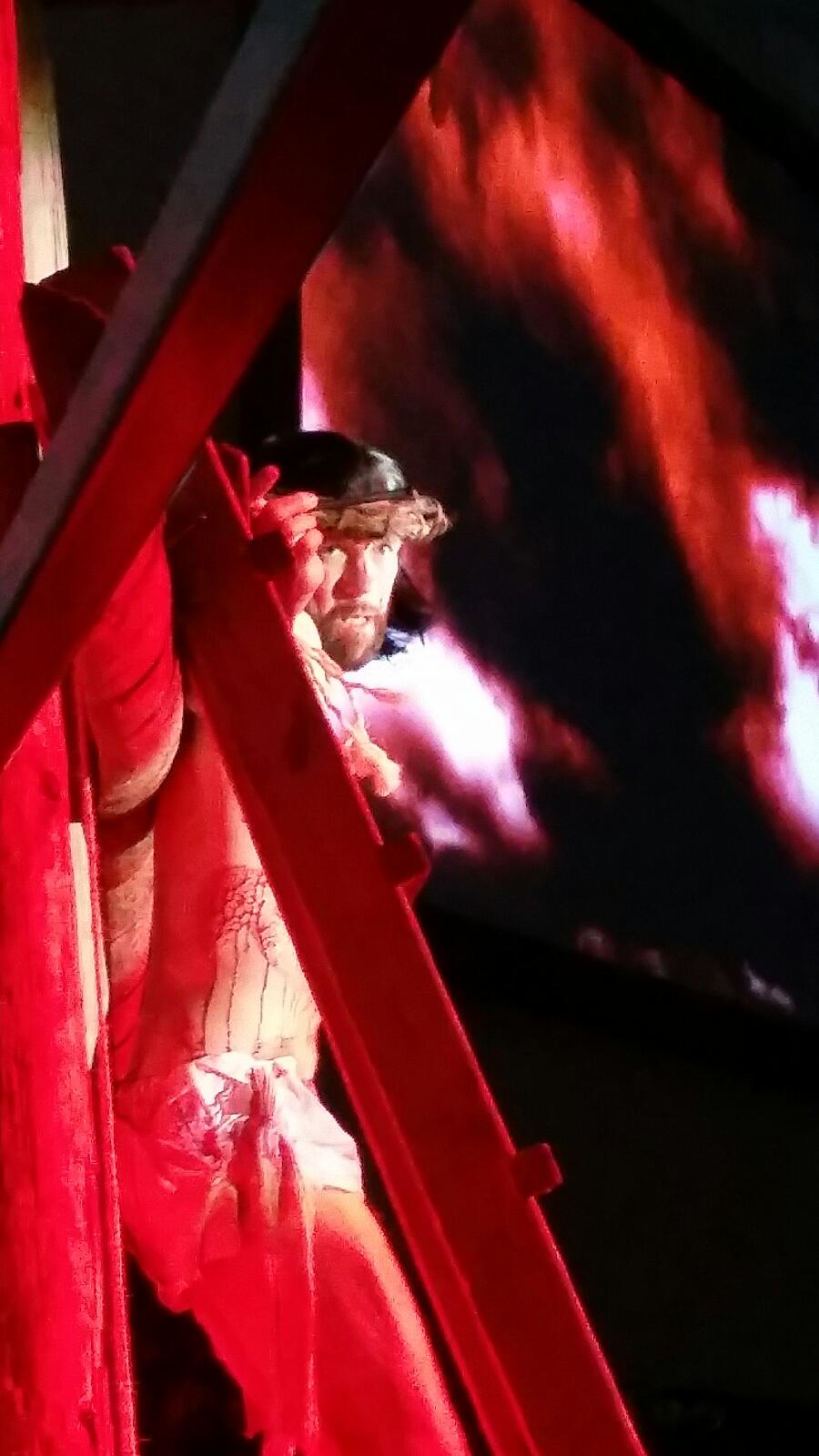
20150329_100138This past weekend at the church where I serve, we presented our annual Palm Sunday pageant depicting the birth, life, death, and resurrection of Jesus Christ. It is a lot of work for all involved, but I always come out of the pageant with a deep sense of satisfaction and awe, for I have the privilege of working with amazing people who have amazing gifts and know how to use them in amazing ways.  I am deeply thankful for the people with whom I get to work.  They are a blessing to me.

In one way, our pageant can be characterized as a spectacle. It has moving music featuring a live orchestra and choir, well-choreographed lights, lots of actors, and a graphic enough depiction of Christ’s death that we make available an alternative worship service for small children who may be unsettled by what they see. But, of course, it isn’t the spectacle of our Palm Sunday pageant that makes it valuable and powerful. It’s the message. There is simply no better message than the gospel message – that Christ was crucified for sinners. Our prayer is that this message – as it is presented in the pageant – leads hearts to repentance and faith, even as God has promised in His Word.

In Luke’s account of Jesus’ crucifixion, there is an interesting reaction to His death from the bystanders: “All the crowds that had assembled for this spectacle, when they saw what had taken place, returned home beating their breasts” (Luke 23:48). The word for “spectacle” in Greek is theoria, related to our English word “theatre.” This is a most appropriate word because crucifixions were indeed gory theatre. If someone was an enemy of the Roman State, the governing officials, though they could have executed such a person in other, more efficient and less gruesome ways, chose crucifixion. Why? Because crucifixion served as a public, humiliating spectacle. In fact, most criminals were crucified naked so as to shamefully expose them. Jesus is no exception. His crucifixion is meant to be theatre. It is meant to be spectacle. It is meant to be theoria, just as Luke says.

But in the middle of this spectacle, something unexpected happens.

When the crowds see the darkness that covers the land, when they hear the news that the curtain of Jerusalem’s temple has been torn in two, when they hear Jesus commend Himself into His Father’s hands, and when they are startled by the testimony of one of Jesus’ executioners saying, “Certainly this man was innocent” (cf. Luke 23:44-47), they “return home beating their breasts.” In Jewish piety, this is a sign of repentance (e.g., Luke 18:13). What begins as theatre and spectacle becomes a life-changing event that testifies to the truth of Jesus’ identity and to the promise of God’s salvation.

At many churches this Holy Week, there will be a certain amount of spectacle. There will be Maundy Thursday services that conclude dramatically with a reading of Psalm 22 and a stripping of the church’s altar to remind us of Christ’s humiliation on the cross. There will be moving Good Friday Tenebrae services that turn sanctuaries black with darkness to remind worshipers of the darkness of sin and of Jesus’ death. And, of course, there will be energetic Easter services, complete with Easter lilies, rafter-shaking music, and the historic, thrilling Easter greeting, “Christ is risen!” to which the congregation will respond, “He is risen indeed! Alleluia!” Yes, there will be plenty of spectacle this week. And this, I would note, is great. I love the spectacle of this time of year.

My prayer, however, is that even as spectacle may be an inevitable and helpful part of Holy Week, we remember that it is not all of Holy Week. For the spectacle is meant to point to something better – and to Someone greater. The spectacle is meant to point us to the cross – and to the One who died on it. And Jesus is more than a spectacle. He is your Savior. That’s what those bystanders at Jesus’ cross discovered as they beat their breasts. And that’s what we are called to believe.