Tornadoes and Satan

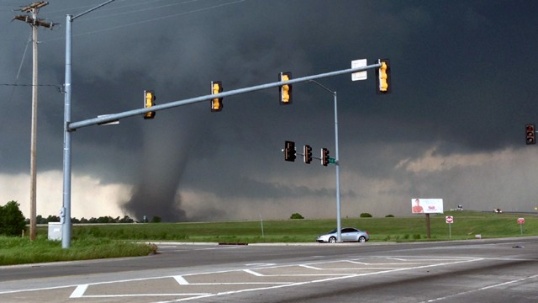
Moore TornadoCrises have a strange way of calling people to faith.  In a day and age where many are bemoaning that our nation is becoming increasingly secular, the devastating EF 5 tornado that struck Moore, Oklahoma on May 20 gave rise to an abundance of prayers and cries to God.  Ed Stetzer paints the scene well in his article for USA Today, which is worth quoting at length:

Times of grief reaffirm our identity as a religious nation. Shortly after the horrific news of the tornado devastation in Oklahoma, “#PrayforOklahoma” quickly rose to the top of Twitter’s trending list as millions shared their prayers for the people who lost loved ones and had their homes destroyed.

In times of prosperity, far removed from tragedies, many people in our culture reject expressions of faith. In the moments of hopelessness, however, the desire to reach out to a higher power is an instinctive reflex.

Some may say, “But that’s Oklahoma – it’s the Bible Belt.” Yet, after the Sandy Hook tragedy, I was struck by the comment made by Connecticut Gov. Dan Malloy referencing our collective religious heritage:

“In the coming days, we will rely upon that which we have been taught and that which we inherently believe: that there is faith for a reason, and that faith is God’s gift to all of us.”

Many are embarrassed by this national identity – until it is time to grieve.  Then, politicians, celebrities and reporters can unashamedly say they are praying for those affected.  News networks will show church bells ringing in memory of those lost.  Nightly news shows feel the need to broadcast excerpts from sermons delivered by pastors in the area.  Journalists interview religious leaders about how God can help us through.

And yes, that is where the discussion often begins. We consider why this would happen. Some people representing faith groups may speak quickly (and unwisely), assuming they can connect the dots between something in our culture and the most recent tragedy.

Others simply ask the question, “How could God allow this to happen?”[1]

Tragedies of the sort that struck Moore, no matter how supposedly “secularized” our nation has become, call forth faith.  And, as Stetzer duly notes, they also call forth questions.  Most often, tragedies like the one in Moore call forth the question that Stetzer poses:  “How could God allow this to happen?”  But in the wake of the tragedy at Moore, I received another question that, though less common, is certainly worthy of a moment of our reflection:  “Can Satan cause a tornado?”  When a tragedy strikes, most people wonder about God’s power to prevent tragedies and His ultimate purpose in allowing them.  But it is also worth asking what kind of prerogative Satan has to wreak havoc in our world.

Satan does seem to have some power to cause trouble in our world.  One needs to look no farther than the story of Job.  In nearly an instant, Job’s life goes from riches to rags.  A quick sequence of four calamities, instigated by Satan himself, robs Job of nearly everything he has.  The fourth of these calamities is especially instructive for our purposes:  “Yet another messenger came and said, ‘Your sons and daughters were feasting and drinking wine at the oldest brother’s house, when suddenly a mighty wind swept in from the desert and struck the four corners of the house.  It collapsed on them and they are dead, and I am the only one who has escaped to tell you’” (Job 1:18-19)!  Notice that it is a windstorm that Satan sends to destroy Job’s family.  Satan, it seems, does seem to have limited power to incite natural disasters.

It is important to note that, as the story of Job clearly delineates, Satan incites calamities on a person not because a person is somehow particularly sinful or deserving of such calamities, for Job was “was blameless and upright; he feared God and shunned evil” (Job 1:1).  No, Satan incites calamities out of depraved delight – he enjoys watching people suffer.

Certainly we cannot know, nor should we speculate on, the transcendental cause of Moore’s devastating tornado.  The most we can say is that natural disasters are part of living in a sinful, fallen world and Satan takes cynical delight in the effects of sin on our world.

But there is hope.  For even if Satan can incite calamities, his ability to do so is severely – and blessedly – limited.  Jesus describes Satan as a “strong man” whose fate is sealed:  “How can anyone enter a strong man’s house and carry off his possessions unless he first ties up the strong man” (Matthew 12:29)?  Satan may be a strong man.  But Jesus is the stronger man.  And He came to tie up Satan by defeating his favorite calamity – death – on the cross.

Ultimately, then, no matter what the spiritual causes of the natural disasters that plague our world may be, in this we can take consolation:  no matter how much strength sin and Satan may have for ill, Jesus is stronger.  He’s so strong, in fact, that “even the wind and the waves obey Him” (Matthew 8:27).  He has things under control.  And He holds Moore’s victims in His heart and hands.  May we hold them in our prayers.


[1] Ed Stetzer, “We still cry out to God when tragedy strikes: Column,” USA Today (5.22.2013).

Remembering the Lost

Memorial Day 1Today, we remember those who sacrificed their lives in service to their country.  Memorial Day is always a day full of mixed emotions.  On the one hand, we celebrate the bravery, valor, and commitment of these soldiers who were willing to suffer all – even death – to serve our nation.  On the other hand, as with any loss of life, we mourn.  And we should.  After all, in the words of the apostle Paul, death is not only an enemy, but the enemy (cf. 1 Corinthians 15:26).  We want death to be defeated.  We do not want it to defeat us.  But even as we mourn the loss of those we love, we can take heart in the promise of the Gospel that death’s defeat of us is only partial and temporary.  It is partial because death destroys only our bodies and not our souls.  And it is only temporary because when Jesus returns, He will raise our bodies to live with Him forever.

On this Memorial Day, as we remember our fallen, I would point you to some words from one of our nation’s founding fathers, John Hancock:

I hereby call upon ministers and people of every denomination, to…devoutly and sincerely offer to almighty God, the gratitude of our hearts, for all His goodness towards us; more especially in that He has been pleased to continue to us so a great a measure of health, to cause the earth plentifully to yield her increase so that we are supplied with the necessaries and the comforts of life, to prosper our merchandise and fishery, and, above all, not only to continue to us the enjoyment of our civil rights and liberties, but the great and most important blessing, the gospel of Jesus Christ.  And together with our cordial acknowledgments, I do earnestly recommend, that we may join the penitent confession of our sins, and implore the further continuance of the divine protection, and blessings of heaven upon this people; especially that He would be graciously pleased to direct, and prosper the administration of the federal government, and of this, and the other states in the Union, to afford Him further smiles on our agriculture and fisheries, commerce and manufactures, to prosper our university and all seminaries of learning, to bless the virtuously struggling for the rights of men…and to afford his almighty aid to all people, who are established in the world; that all may bow to the scepter of our Lord Jesus Christ, and the whole earth be filled with His glory.[1]

A few things are notable about Hancock’s words here.  First, as Hancock would guide us, it is important that we always remember to give thanks.  We are called by our Lord, even when times are trying and tenuous, to give thanks to Him for His blessings to us, His presence with us, and, most importantly, His gospel for us.  No amount of sin or tragedy can circumvent the good and sturdy promises of almighty God – even the tragedy of losing a loved one in battle.  For this, we can be thankful.

Second, Hancock encourages all of us to acknowledge our sinfulness.  After all, the sinfulness and brokenness of this world is the reason there are wars.  History is littered with tyrants who, rife with evil intent, needed to be defeated in battle so they could not carry out – or, in most instances, continue to carry out – their wicked agendas. When we confess our sins, we do so with the knowledge that the whole earth is broken by sin and needs healing.  We also acknowledge that even if we can curb and contain evil thanks to the valiant efforts of our brave troops, we cannot finally defeat it.  This can only be done by Christ.

Third, Hancock desires that we pray for the safety and protection of our troops.  On a day when we remember lives that have been lost, it is most certainly appropriate to pray that no more will be lost.

Finally, Hancock points us toward the Christian’s hope that, on the Last Day, “all may bow to the scepter of our Lord Jesus Christ, and the whole earth be filled with His glory.”  One day, wars will cease.  One day, tyrants will be no more.  One day, nations will not take up arms against nations.  Because one day, all will bow to Jesus and the whole earth will be filled with His glory.

As we remember those who have died waiting and longing for this day, may we ourselves pray that it would come soon so that we may be reunited with those we have lost and celebrate the final defeat of evil in the presence of our Savior.

Our Leadership Lacuna

Screen Shot 2013-05-15 at 5.13.27 PMThe headlines speak for themselves.  “Exclusive: Benghazi Talking Points Underwent 12 Revisions, Scrubbed of Terror Reference.”[1]  “IRS Admits To Targeting Conservative Groups Over Tax Status.”[2]  “Gov’t Obtains Wide AP Phone Records In Probe.”[3]  It has not been a good week for our nation’s leaders.  And there has been much shock and dismay expressed from people of all political persuasions and stripes.  And yet, no matter how large these scandals may loom, there remains a subtle subtext that underscores these immense ignominies.  To quote the words of the great George Strait in summary of this subtext:  “I’ve come to expect it from you.”  This, sadly, is the kind of behavior that we expect from our leaders.  It may be scandalous, but it isn’t all that surprising.

So how does the general public respond to these salacious, but unsurprising, scandals?  Consider this from TIME’s  Zeke Miller and Michael Crowley in response to the AP phone records story:

Conservatives are not often fierce defenders of the media. But Monday’s news that the Justice Department obtained phone records for several Associated Press reporters as part of a national security leak probe raised a furor on the right, causing numerous Republicans to harshly criticize the Obama administration. While some may have genuine concerns about First Amendment protections, the right’s response also spotlighted an emerging Republican critique of Barack Obama as a Big Brother-style tyrant in charge of a power-abusing surveillance state…

Conservatives are now in the odd position of implicitly defending the media’s rights against the imperative of national security secrecy, a cause that didn’t interest them much when the FBI sought media phone records during the Bush years.[4]

Miller and Crowley’s argument runs like this:  Republicans defended their own when President Bush went after media phone records, so Democrats may do the same with President Obama.  After all, every president and politician bends the rules and compromises on ethics.  We simply have to accept this and then back the horse of our own political persuasion while also working to discredit the opposition.  After all, that’s the formula for winning elections.  One need look no farther than the recent victory of Mark Sanford, just sworn in as South Carolina’s newest Republican congressman, even though a few years earlier he engaged in an illicit affair with an Argentinian woman, insisting that she was his “soul mate,” all while serving as South Carolina’s governor.

Hopefully, a Christian can see right through this kind of shameful political jockeying.  As my mother used to tell me, “Two wrongs don’t make a right.”  You can’t justify your group’s bad behavior by pointing to the bad behavior of another group.

So then, how should the Christian react and respond when corruption and scandal among our rock our nation’s leaders?  First, no matter what our political persuasion, we can honestly, but also compassionately, call these types of scandals what they are:  sinful.  Second, rather than buying into the talking points, spin rooms, and damage control strategies, we can honestly, but also compassionately, call for repentance from our leaders.  The best way to deal with sin is not to minimize or excuse it, but to confess it!  Finally, even if our leaders in Washington are not the kind of leaders our nation and world needs, we can be the kind of leaders our nation and world needs.  We can lead in our sphere of influence with integrity and character and with repentance when we falter and fail.  We can seek to lead the way King David sought to lead Israel:  “And David shepherded them with integrity of heart; with skillful hands he led them” (Psalm 78:72).

Even though we cannot control how our leaders lead us, we can control the way we lead others – and ourselves.  With God’s help, may we diligently guard the quality and character of our leadership.  Our world needs all the faithful leaders it can get.


[2] Zeke J Miller & Alex Altman, “IRS Admits To Targeting Conservative Groups Over Tax Status,” TIME Magazine (5.10.2013).

[3] Mark Sherman, “Gov’t Obtains Wide AP Phone Records In Probe,” The Associated Press (5.13.2013).

[4] Zeke Miller & Michael Crowley, “The New GOP Case Against Obama: He’s Cheney!” TIME Magazine (5.14.2013).

Adam Is For Real

Adam and Eve 1 editIn 1906, theologian and philanthropist Albert Schweitzer published The Quest of the Historical Jesus, surveying theologians’ attempts to understand who Jesus was historically apart from what Schweitzer thought to be the layers of mythologizing that had been overlaid on Him by the Bible.  Schweitzer finally concluded that Jesus saw Himself as One whose suffering and death would bring in the Parousia, or the final appearance of God.  In Schweitzer’s own words:  “He must suffer for others…that the Kingdom might come.”[1] But Jesus proved mistaken in His imminent expectations of God’s Kingdom and Christianity has been grappling with Jesus’ failed apocalyptic expectations ever since:

The whole history of “Christianity” down to the present day, that is to say, the real inner history of it, is based on the delay of the Parousia, the non-occurrence of the Parousia, the abandonment of eschatology, the progress and completion of the “de-eschatologising” of religion which has been connected therewith.[2]

Interestingly, Schweitzer later abandoned his quest for the historical Jesus, considering it futile.  After all, reconstructing who Jesus was apart from and skeptical toward the record of Jesus in the Bible is a tall order!

Over one hundred years after Schweitzer’s quest, Christianity Today published an article titled “The Search for the Historical Adam.”[3]  Much like the quest for the historical Jesus a century earlier, this quest seeks to reconstruct who Adam was quite apart from the biblical record of him.  But this quest questions not only what Adam did and did not do – for example, “Did he really eat some forbidden fruit?” – this quest questions whether Adam even existed.  The argument against Adam’s existence, which is where the shining stars of this quest have broadly landed, runs thusly:  because evolution is true, a historical Adam cannot be.  Instead, the human race emerged out of the chaos of natural selection, albeit this natural selection was guided by the detached hand of theism, rather than according to the simple and succinct word of the personal Creator.

It is important to note that cries to dispense with a historical Adam are not few and far between, nor are they outside the mainstream of Evangelical Christianity.  Consider this argument against the existence of a historical Adam:

What is a “given” for Paul is the saving event of Jesus’ death and resurrection. The other things he says, especially about sin, the Law, and eschatology, are reinterpretations that grow from the fundamental reality of the Christ event. Recognizing this relieves the pressure that sometimes builds up around a historical Adam…We can now recognize that Adam is not the foundation on which the system of Christian faith and life is built, such that removing him means that the whole edifice comes crashing down. Instead, the Adam of the past is one spire in a large edifice whose foundation is Christ. The gospel need not be compromised if we find ourselves having to part ways with Paul’s assumption that there is a historical Adam, because we share Paul’s fundamental conviction that the crucified Messiah is the resurrected Lord over all.[4]

From where does such an argument against the historicity of Adam arise?  From J.R. Daniel Kirk, and associate professor at Fuller Theological Seminary, a one-time bastion of classic evangelical orthodoxy.  Denying the historical existence of Adam has gone mainstream.

Contrary to the sentiments of many, I would argue that it is theologically and logically necessary for the historical Adam to have existed.  It is theologically necessary because no mythical character can account for real sin.  And the apostle Paul identifies Adam as the original sinner:  “Sin entered the world through one man, and death through sin, and in this way death came to all men, because all sinned” (Romans 5:12).  It is logically necessary because it is incoherent to make an argument for Christ’s death and resurrection, boldly contradicting the consensus of the scientific community that dead people do not come back to life, on the one hand while arguing against the historicity of Adam because of the general consensus of the scientific community concerning evolution by natural selection on the other hand.

What Professor Kirk engages in is nothing less than a full on gospel reductionism.  That is, Professor Kirk is willing to cede the integrity and veracity of the biblical record on whether or not Adam really existed as long as he can hold on to the gospel that Christ died and rose again.  But once one lets go of what the Bible says in general, he will not be able to hold on to what the Bible says about the gospel in specific for long!  The church body of which I am a part, the Lutheran Church – Missouri Synod, has explained it this way:

The Gospel is not normative for theology in the sense that beginning with it as a fundamental premise, other items of the Christian system of doctrine are developed as provisional, historically conditioned responses to a given situation which will need to be revised for another situation.[5]

This is precisely what Professor Kirk does in his article.  He assumes that we can reinterpret the historicity of Adam for our situation because Paul’s insistence on a historical Adam was only a “provisional, historically conditioned response to a given situation.”  But this false view of Adam can only lead to a false view of the gospel.  In the words of G.E. Ladd, who was addressing those who were undermining the historicity of the Gospels’ accounts of Jesus’ life:

Jesus was a historical person.  His words were historical events.  His deeds involved other people; but they were far larger than the boundaries of personal existence.  His deeds included interpersonal fellowship, healings of bodies as well as minds.  His mission created a new fellowship of men; and this fellowship after the resurrection because the Christian church which has become one of the most influential institutions in Western culture.  All of this happened in history; and it is only because certain events first happened in history that other results were experienced in their existential dimension.  Existential import results only from historical event.[6]

What is true of Jesus is true of Adam.  The existential reality of sin can only be meaningfully explained by an existentially historical Adam.  Evangelically orthodox Christians must settle for nothing less.


[1] Albert Schweitzer, The Quest of the Historical Jesus (Mineola, Dover Publications, Inc., 2005), 387.

[2] The Quest of the Historical Jesus, 358.

[3] Richard N. Ostling, “The Search for the Historical Adam,” Christianity Today (6.3.2011).

[4] J.R. Daniel Kirk, “Does Paul’s Christ Require a Historical Adam?” Fuller Theology News & Notes (Spring 2013).

[5] The Commission on Theology and Church Relations of the Lutheran Church – Missouri Synod, “Gospel and Scripture” (November 1972), 9.

[6] G.E. Ladd, The Pattern of New Testament Truth (Grand Rapids:  Eerdmans, 1968), 64.

The Big Picture

Micro Macro 1I have often made the point, when teaching various Bible classes, that, in Christianity, theology and anthropology are inextricably intertwined.  You can’t really understand anthropology if you don’t understand theology and you can’t really understand theology if you don’t understand anthropology.

Here’s why.  Theology without anthropology undermines the gospel.  After all, the heart of the gospel is what God has done for us!  He sent Jesus to die and rise for us!  Without understanding the anthropological “for us” of the gospel, we are left with a system of theology that is more akin to Deism than it is to Christianity.  For without the gospel’s anthropological association, God is left distant and detached from the creation He formed.  Conversely, anthropology without theology also undermines the gospel.  It is theology, after all, that tells us who we are anthropologically and why we need Jesus.  And the verdict on who we are anthropologically is not good:

“There is no one righteous, not even one; there is no one who understands, no one who seeks God. All have turned away, they have together become worthless; there is no one who does good, not even one.” (Romans 3:10-12)

Apart from an understanding of God’s verdict on us as sinners, we are all too readily tempted to think of ourselves as better, nobler, and loftier than we really are.  Thus, in order to truly understand the peril of our sinful state, we must understand what the Bible says theologically about our brokenness anthropologically.

I bring all of this up because I have been doing some thinking lately about the anthropological side of Christianity.  And what I have come to realize is that while Christian authors, pastors, and leaders will spend a lot of time addressing the anthropological side of Christianity on a micro scale, sometimes, macro anthropological concerns can get marginalized.

Here’s what I mean.  The Christian arena is replete with resources on marriage, addiction, finances, relationships and other personal, or micro, concerns.  And these resources are needed and, I would add, popular!  What is less popular in our day, however, are resources that address macro anthropological issues of cultural trends, power structures, injustice, and societally systemic sins as well as their broad historical and philosophic foundations.  Part of the reason I would guess these resources are less popular is because addressing macro anthropological issues is an inevitably more complex, convoluted, and academic exercise than addressing micro anthropological issues due to the sheer size and the extended historical timelines of these macro anthropological issues.  Furthermore, because it is the micro anthropological concerns that most directly and immediately affect us, it is easy to look at what only directly affects us right now than consider the broader concerns of our world over time.

But Christianity calls us to consider both ourselves and our world.  For Christianity, among other things, is a worldview.  And without understanding Christianity’s anthropological entailments on a macro scale and their insights into how we, knowingly or unknowingly, are shaped by the history, philosophy, and culture to which we are heirs and of which we are a part, we will inevitably have trouble, and ultimately be unsuccessful, in addressing and resolving our own micro concerns.  This is why so much of the language of the Bible is cosmic.  For God’s final promise is not only that He will only fix our personal problems, but that He will redeem our world.  In the words of the apostle John:

Then I saw a new heaven and a new earth, for the first heaven and the first earth had passed away, and there was no longer any sea.  I saw the Holy City, the new Jerusalem, coming down out of heaven from God, prepared as a bride beautifully dressed for her husband.  And I heard a loud voice from the throne saying, “Now the dwelling of God is with men, and he will live with them. They will be his people, and God himself will be with them and be their God.  He will wipe every tear from their eyes. There will be no more death or mourning or crying or pain, for the old order of things has passed away.” He who was seated on the throne said, “I am making everything new!” (Revelation 21:1-5)

Make no mistake about it:  God cares about the micro.  He cares about your tears and your pain and your worries and your regrets.  But He will fix your micro concerns in His macro way: He will make everything new.  So perhaps we should spend a little more time thinking about “everything” that God will make new and a little less time thinking only about our micro concerns.