Permitting and Preventing Suffering

Credit: Job and His Friends by Ilya Repin (1869)

Last week on this blog, I referenced Job and his yearning for resurrection after all the suffering he had experienced. Resurrection to new life after and apart from all the trials and pain we encounter in this life is our ultimate hope. But in the meantime, we still need strength to endure the trials and pain we encounter in this life.

At the beginning of Job’s story, Satan accuses this righteous man before God of only living for God because of what he gets from God:

Does Job fear God for nothing? Have You not put a hedge around him and his household and everything he has? You have blessed the work of his hands, so that his flocks and herds are spread throughout the land. But now stretch out Your hand and strike everything he has, and he will surely curse You to Your face. (Job 1:9-11)

In response, God, instead of striking Job, leaves it to Satan, but adds one critical caveat:

Everything he has is in your power, but on the man himself do not lay a finger. (Job 1:12)

God sets up a tension with these words. At the same time He permits suffering, He also prevents suffering. Later, when Satan wants to kill Job, God responds:

He is in your hands; but you must spare his life. (Job 2:6)

Again, God permits suffering while also preventing suffering – the ending of Job’s life.

When we suffer, this tension can give us tenacity. While we may remain confused as to why God permits some suffering, we can also rest assured that God is also preventing some suffering. The trouble we have when God prevents suffering is that we don’t know that God has prevented it because we never had to endure it. But even if we cannot immediately know or see when God has prevented suffering, we can be thankful that God does, in fact, prevent suffering. He has told us He does in Job’s story.

It is tempting for us to complain and even curse God when He permits suffering. But as with Job, when God permits suffering, He also has a purpose in suffering. In Job’s case, when he refuses to curse God amid his pain, Satan is proven wrong. His accusation against Job – that Job loves God only because of what God has given him – goes down in defeat. Thus, the suffering that Satan brings on Job is the same suffering that defeats his accusation against Job. So it is with Christ. The suffering that Satan delighted in when Jesus was in agony on a cross is the same suffering that defeated him – along with sin and death – when Christ died on the cross.

May we, in our suffering, pray for God’s purpose when God permits it and give thanks to God when He prevents it. He really does know what He’s doing.

In and After the Storm

File:Hurricane Dorian (peak intensity), September 1, 1240Z.png
Credit: Wikipedia

The Bible has a lot of stories of storms.  When God appears to Moses on Mount Sinai’s summit to give him the Ten Commandments, the mountaintop is covered in “darkness, gloom, and storm” (Hebrews 12:18).  When Job endures great suffering, he complains: “God would crush me with a storm” (Job 9:17).  When God speaks to Job after his trials, it says, “The LORD spoke to Job out of the storm” (Job 38:1).  When God calls Jonah to preach to the Assyrian city of Nineveh, but the prophet instead hops a ship heading the opposite direction, the Lord sends “a great wind on the sea, and a violent storm” (Jonah 1:4).  When Jesus is sailing with His disciples across the Sea of Galilee one day, out of nowhere comes “a furious storm” (Matthew 8:24).  The Bible has a lot of stories of storms.

These days, our headlines have been plastered with stories of a storm.  The pictures that have come out of the Bahamas in the wake of Hurricane Dorian are horrible.  Halves of islands are underwater.  Debris fields stretch for miles.  And the death toll has yet to be fully counted.  And, of course, Dorian’s destruction did not end with these islands.  The storm carved a path up our nation’s eastern seaboard, dumping rain, flooding communities, and disrupting and endangering countless lives.

Whenever we face a storm like this, a common question arises: Where is God?  Though there is no complete answer to this question, here are a couple of thoughts Scripture invites us to consider.

First, God is in the storm.  When God speaks to Job after all his trials, he speaks to him “out of the storm” (Job 38:1).  This means that in all of Job’s trials, God was right there, even though Job did not know it.  When Jesus’ disciples sail across the Sea of Galilee, Jesus does not avoid the storm they sail into, but is there with them in the storm.  And when Jesus dies on a cross, He does so in the midst of storm clouds so dark that they black out the sun: “From noon until three in the afternoon darkness came over all the land” (Matthew 27:45).  God, then, does not avoid our storms even if He does not still every storm.  He is with us in the storms.

Second, God is after the storm.  When the prophet Elijah, at God’s behest, goes to meet with God on a mountain, instead of finding God, he experiences a storm:

The LORD said, “Go out and stand on the mountain in the presence of the LORD, for the LORD is about to pass by.” Then a great and powerful wind tore the mountains apart and shattered the rocks before the LORD, but the LORD was not in the wind. After the wind there was an earthquake, but the LORD was not in the earthquake. After the earthquake came a fire, but the LORD was not in the fire. (1 Kings 19:11-12) 

Elijah goes to meet with God.  But he finds only hurricane force winds, an earthquake, and fiery lighting.  It seems like God is nowhere to be found in these storms.  But then:

After the fire came a gentle whisper.  When Elijah heard it, he pulled his cloak over his face and went out and stood at the mouth of the cave.  (1 Kings 19:12-13)

It turns out that God was there for Elijah after the storms.

Dorian’s destructive path has now been cut.  The damage has been done.  People’s lives and livelihoods have been uprooted.  But God did not run from this storm.  He was in the storm with those who suffered from it.  But, perhaps even more importantly, now, He is still standing tall after the storm with those who have come out of the storm.  The question is: as God’s people, will we also be there for those who need us after the storm?  There are multiple ways to help the victims of Dorian.  I pray that you will.  After all, God is there after the storm.  So, we should be, too.

The Psalmist famously writes:

God is our refuge and strength, an ever-present help in trouble. Therefore we will not fear, though the earth give way and the mountains fall into the heart of the sea, though its waters roar and foam and the mountains quake with their surging.  There is a river whose streams make glad the city of God, the holy place where the Most High dwells. (Psalm 46:1-4)

The Psalmist reminds us that God is in the storm.  He is “an ever-present help in trouble.”  But he also reminds us that God is after the storm.  For He has prepared for us and now dwells in a celestial city, not with waters that are destructive like a storm surge, but with waters that bubble and babble with gladness.  In other words, God is not only in the storm, nor is He even only after the storm, He is there even after this life, waiting to welcome those who have lost their lives – including those believers who have lost their lives in storms like Dorian – into His eternal city.  A storm may end this life – but it cannot drown out eternal life.

Pain, Suffering, and Morality

AuschwitzI’ve been doing a fair amount of thinking lately on suffering and its effect on faith.  In one way, I can’t help but believe and even assert that there is every reason to question God in the face of great suffering.  Elie Wiesel’s gut-wrenching account of his time in a Nazi concentration camp comes to mind not only as a natural response to pain and suffering, but as a needed one:
Never shall I forget that night, the first night in camp, that turned my life into one long night seven times sealed. Never shall I forget that smoke. Never shall I forget the small faces of the children whose bodies I saw transformed into smoke under a silent sky. Never shall I forget these flames that consumed my faith forever.[1]

Elie’s description of his first night in a concentration camp should arouse in us nothing other than horror, grief, and sympathy.  Although I don’t know precisely how I would react to such an experience, I would be naïve to think that Elie’s reaction could never be my reaction.  The scene is just too jarring.  The brutality is just too disgusting.  The deaths are just too agonizing.  I too could question God.

And yet…

Some did not respond to the concentration camps the way Elie Wiesel did.  One survivor of the camps, Alex Seidenfeld, in an interview with the Associated Press, said simply, “We stayed alive.  We survived.  How could this have happened without the almighty?”[2]

Elie looked at all those who died and asked, “How can God be?”  Alex looked at all those who survived and asked, “How can God not be?”  Elie looked at all those who died and angrily shouted, “God didn’t stop this!”  Alex looked at all those who survived and declared, “But God did save some of us from this!”

The question of where God is in the face of suffering is really a question of God’s role in the midst of suffering.  Is God’s role to stop us from suffering or to save us through suffering?  In one sense, it is both.  But the first role, at least according to Scripture, doesn’t find its full expression until later, at the end of days.

Ultimately, I would argue that, even if God does not stop all suffering, it is difficult to surmise from the existence of suffering that God does not exist.  C.S. Lewis famously explains why:

My argument against God was that the universe seemed so cruel and unjust. But how had I gotten this idea of just and unjust? A man does not call a line crooked unless he has some idea of a straight line. What was I comparing this universe with when I called it unjust? … Of course I could have given up my idea of justice by saying it was nothing but a private idea of my own. But if I did that, then my argument against God collapsed too – for the argument depended on saying that the world was really unjust, not simply that it did not happen to please my private fancies. Thus in the very act of trying to prove that God did not exist – in other words, that the whole of reality was senseless – I found I was forced to assume that one part of reality – namely my idea of justice – was full of sense.[3]

C.S. Lewis puts his finger on the reality that the problem we have with suffering is that we believe and perceive that it is, in some sense, wrong.  It is unjust.  But if we reject God, we lose the privilege of saying that anything is wrong or unjust because, without God and His ordering of the universe, standards of organized morality disappear into the ether of a universe that coalesced around the free-for-all of chance.  This world and all that is in it, to borrow a phrase from the famous atheist philosopher Bertrand Russell, is nothing more than “the outcome of accidental collocations of atoms.”[4]  In this view, suffering exists in the same way that a ball that lands on black 22 on a roulette wheel exists.  It just happens to happen sometimes.  There is nothing more to be said about it, at least not morally.

Arguing against a moral God in light of what is perceived to be immoral suffering, then, is an argument that collapses on itself.  You can’t argue against God using a framework that has its basis in God.  Either suffering just is, or it is somehow just wrong.  To question how there can be a good God who allows bad things assumes that, even if implicitly, there is a God and that, in some regard, He is not playing by His own rules, or at least by what we perceive to be His rules.  If this is the case, it may be fair to ask Him, “Why?”   But, as a Christian, I would propose that it might be even better to ask Him for help.  From what I hear, even if God doesn’t always stop suffering, He is quite adept at blessing people in suffering.

_____________________

[1] Elie Wiesel, Night (New York:  Hill and Wang, 2006), 33.

[2] Aron Heller, “Observant survivors keep the faith after Holocaust,” The World Post (1.26.2016).

[3] C.S. Lewis, Mere Christianity (New York:  Harper Collins Publishers, 1980), 38

[4] Bertrand Russell, “A Free Man’s Worship,” The Collected Papers of Bertrand Russell, vol. 12 (London: Routledge, 1985).

Tornadoes and Satan

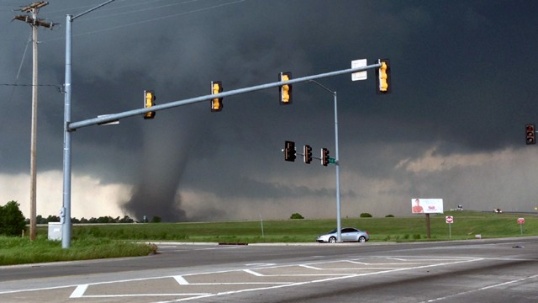
Moore TornadoCrises have a strange way of calling people to faith.  In a day and age where many are bemoaning that our nation is becoming increasingly secular, the devastating EF 5 tornado that struck Moore, Oklahoma on May 20 gave rise to an abundance of prayers and cries to God.  Ed Stetzer paints the scene well in his article for USA Today, which is worth quoting at length:

Times of grief reaffirm our identity as a religious nation. Shortly after the horrific news of the tornado devastation in Oklahoma, “#PrayforOklahoma” quickly rose to the top of Twitter’s trending list as millions shared their prayers for the people who lost loved ones and had their homes destroyed.

In times of prosperity, far removed from tragedies, many people in our culture reject expressions of faith. In the moments of hopelessness, however, the desire to reach out to a higher power is an instinctive reflex.

Some may say, “But that’s Oklahoma – it’s the Bible Belt.” Yet, after the Sandy Hook tragedy, I was struck by the comment made by Connecticut Gov. Dan Malloy referencing our collective religious heritage:

“In the coming days, we will rely upon that which we have been taught and that which we inherently believe: that there is faith for a reason, and that faith is God’s gift to all of us.”

Many are embarrassed by this national identity – until it is time to grieve.  Then, politicians, celebrities and reporters can unashamedly say they are praying for those affected.  News networks will show church bells ringing in memory of those lost.  Nightly news shows feel the need to broadcast excerpts from sermons delivered by pastors in the area.  Journalists interview religious leaders about how God can help us through.

And yes, that is where the discussion often begins. We consider why this would happen. Some people representing faith groups may speak quickly (and unwisely), assuming they can connect the dots between something in our culture and the most recent tragedy.

Others simply ask the question, “How could God allow this to happen?”[1]

Tragedies of the sort that struck Moore, no matter how supposedly “secularized” our nation has become, call forth faith.  And, as Stetzer duly notes, they also call forth questions.  Most often, tragedies like the one in Moore call forth the question that Stetzer poses:  “How could God allow this to happen?”  But in the wake of the tragedy at Moore, I received another question that, though less common, is certainly worthy of a moment of our reflection:  “Can Satan cause a tornado?”  When a tragedy strikes, most people wonder about God’s power to prevent tragedies and His ultimate purpose in allowing them.  But it is also worth asking what kind of prerogative Satan has to wreak havoc in our world.

Satan does seem to have some power to cause trouble in our world.  One needs to look no farther than the story of Job.  In nearly an instant, Job’s life goes from riches to rags.  A quick sequence of four calamities, instigated by Satan himself, robs Job of nearly everything he has.  The fourth of these calamities is especially instructive for our purposes:  “Yet another messenger came and said, ‘Your sons and daughters were feasting and drinking wine at the oldest brother’s house, when suddenly a mighty wind swept in from the desert and struck the four corners of the house.  It collapsed on them and they are dead, and I am the only one who has escaped to tell you’” (Job 1:18-19)!  Notice that it is a windstorm that Satan sends to destroy Job’s family.  Satan, it seems, does seem to have limited power to incite natural disasters.

It is important to note that, as the story of Job clearly delineates, Satan incites calamities on a person not because a person is somehow particularly sinful or deserving of such calamities, for Job was “was blameless and upright; he feared God and shunned evil” (Job 1:1).  No, Satan incites calamities out of depraved delight – he enjoys watching people suffer.

Certainly we cannot know, nor should we speculate on, the transcendental cause of Moore’s devastating tornado.  The most we can say is that natural disasters are part of living in a sinful, fallen world and Satan takes cynical delight in the effects of sin on our world.

But there is hope.  For even if Satan can incite calamities, his ability to do so is severely – and blessedly – limited.  Jesus describes Satan as a “strong man” whose fate is sealed:  “How can anyone enter a strong man’s house and carry off his possessions unless he first ties up the strong man” (Matthew 12:29)?  Satan may be a strong man.  But Jesus is the stronger man.  And He came to tie up Satan by defeating his favorite calamity – death – on the cross.

Ultimately, then, no matter what the spiritual causes of the natural disasters that plague our world may be, in this we can take consolation:  no matter how much strength sin and Satan may have for ill, Jesus is stronger.  He’s so strong, in fact, that “even the wind and the waves obey Him” (Matthew 8:27).  He has things under control.  And He holds Moore’s victims in His heart and hands.  May we hold them in our prayers.


[1] Ed Stetzer, “We still cry out to God when tragedy strikes: Column,” USA Today (5.22.2013).

A Week of Tragedies

Boston West TexasWhat a week it’s been.  Monday the headline was carnage at the Boston Marathon as a pair of terrorists planted and detonated two bombs, though they planted more, at the race’s finish line.  Three lost their lives.  More than 170 were injured.  I awoke Wednesday morning to the news that the tiny town of West, Texas, north of Waco, erupted in a fireball in an explosion in a fertilizer plant.  Dozens lost their lives because of this tragic accident.

On the heels of so much tragedy and loss of life, two questions inevitably arise, both consisting of just one word:  “How?” and “Why?”

“How did these two terrorists manage to plant numerous bombs at the finish line of a major race in seemingly plain sight with so many law enforcement officials standing by for any sign of trouble?”  “How did a small blaze at a fertilizer plant get so out of control in a literal split second?”  Investigators specialize in answering these “How?” questions.  Already, expansive and detailed investigations have been launched to try to figure out how these tragedies happened.

The “Why?” questions are a little tougher to answer.  “Why would someone premeditatedly work to cause so much pain and anguish in the bodies, hearts, and lives of so many?”  “Why would God allow any of this to happen?”

Though we have partial answers to our perennial “Why?” questions, our answers are inevitably incomplete because of our finite perspective.  But there are some things we can know and say in tragic times like these nonetheless.

First, we must say that tragedies like these are spawned because of sin.  The attacks in Boston are an example of the darkest corners of human depravity on display.  Two individuals took it upon themselves to actively break God’s law and our nation’s laws in order to coldly calculate a catastrophe.  The fertilizer plant explosion in West is an example of creation’s sinful brokenness.  Because we live in a world that has gone wrong (cf. Genesis 3:17-19, Luke 13:1-5), wrong things happen.

Second, we can also say that tragedies like these testify to God’s patience, albeit in a strange and backwards way.  After all, God is under no particular compulsion to allow this sinful world to continue on.  But He does.  Why?  Because He loves the people He has made and wants to give them as much time as possible to repent of their sinful state and turn toward Him.  As the apostle Peter reminds us, “Bear in mind that our Lord’s patience means salvation” (2 Peter 3:15).

In the days ahead, steps will no doubt be taken to try to assure that the tragedies of this week will not be repeated.  This is good!  We ought to learn from tragedies like these for the sake of everyone’s safety and wellbeing.  But no matter how many steps we might take to try to guard against similar situations in the future, no human being can root out the underlying cause of all such situations:  sin.  Though we might be able to prevent a particular tragedy from happening again, we cannot take out tragedy’s foundation of sin. Only Jesus can do this.  Only Jesus can conquer the wickedness of this world and restore His creation and His people back to the way He originally dreamed and designed them:  perfect.