Where Human Justice Cannot Tread: The Case of Trayvon Martin & George Zimmerman

Martin Zimmerman
Credit: The Associated Press

We will never know for sure what happened.

Well, we will never know for sure all that happened.  There are a few things we do know.  We do know that on the night of February 26, 2012 in Sanford, Florida, an altercation took place between Trayvon Martin and George Zimmerman.  We do know that this altercation left Trayvon Martin dead of a single gunshot wound, fired at intermediate range.  We do know that George Zimmerman was the shooter.  And we do know that on Saturday, July 13, Zimmerman was found “not guilty” of both the charges of second-degree murder and of manslaughter.

As the trial of George Zimmerman unfolded before a nation of breathless spectators, it became clear to many pundits and reporters – regardless of how these pundits and reporters hoped this case would turn out – that the prosecution was in trouble.  Consider this from ABC News:

Prosecutors started strong with a powerful, concise opening statement from Assistant State Attorney John Guy, in contrast to the silly knock-knock joke and seemingly disorganized and meandering defense argument …

But then something happened that many would have thought improbable as this case received wall to wall coverage leading up to Zimmerman’s arrest.

What the state hoped would be proof that Zimmerman initiated the altercation and that he, not Martin, was on top as they grappled on the ground, did not appear to proceed as planned …

With each witness there were either facts that we now know are not true (like hearing three shots, when there was only one) or indications that their memories have somehow become clearer since the incident itself.[1]

The prosecution’s witnesses, in their testimonies of what happened that night, gave conflicting and confusing accounts.  Coupled with the fact that the burden to prove that Zimmerman shot Martin in something other than self-defense rested on the prosecution, the prospects for a conviction were grim for the state.  Again, ABC News summarized the prosecution’s problem well:

Prosecutors still have to prove beyond a reasonable doubt that Zimmerman did not “reasonably believe” he was “in imminent danger of death or great bodily harm” during their altercation. That is a heavy burden to bear.

It turns out, as the verdict this past Saturday revealed, that it was a burden too heavy to bear.

Along with the wide range of human emotions that a trial such as this one elicits, this trial has also exposed the limits of human justice.  The jury found George Zimmerman “not guilty.”  This does not necessarily mean that Zimmerman committed no crime.  It simply means that, in the opinions of the jurors, there was not enough evidence to demonstrate beyond a reasonable doubt that he was guilty of a crime.  The jurors’ verdict does not pretend or presume to rule on George Zimmerman’s guilt or innocence as a matter of fact.  It simply says that Zimmerman will not be incarcerated as a matter of the law.

The justice of our God is much more comprehensive and, as strange as it sounds, just than the justice of our courts.  For our God is concerned with infinite transcendent justice rather than with limited legal justice.  Indeed, our God is passionate about justice.  God shouts in Amos 5:24:  “But let justice roll on like a river, righteousness like a never-failing stream!”  Where human justice falls short, God’s justice does not.

Ultimately, regardless of the verdict, the justice rendered in that Florida courtroom can only be provisionary and incomplete.  Even if George Zimmerman had been found guilty, his incarceration would not have undone the painful problem of death, which is finally what this case – and every murder case – is all about.  But the painful problem of death cannot be solved in any courtroom; it can only be solved on a cross.  Only Jesus can bring justice to death by conquering it with His life – a life that will finally and fully be revealed on the Last Day.

So while a Florida court has ruled, we are still waiting for Jesus to rule – or, to put it more clearly, to reign – when He returns on the Last Day.  And, blessedly, the justice He will bring on that day will be far better than the justice we have in these days.  For His justice does much more than merely rule on tragedies; His justice fixes them.


[1] Dan Abrams, “George Zimmerman’s Prosecution Woes: Analysis,” ABC News (7.1.2013).

Righteous

Crucifixion 1This weekend in worship and ABC, we learned about the doctrine of justification which teaches that our righteousness before God is not a product of ourselves and our works; rather, it is a free gift from God, given to us by the work of Christ on the cross.  As the apostle Paul writes, “[We] are justified freely by [God’s] grace through the redemption that came by Christ Jesus” (Romans 3:24).

Throughout the history of the Church, some have tried to undercut this doctrine of God’s work with human works.  The Pelagians, for instance, taught that by obeying God’s commands, people could gain favor in God’s sight.  The Synergists taught that justification was not a gift of God’s righteousness exclusively, but a comingling of God’s righteousness with human righteousness.  In the face of such unbiblical teachings, Martin Luther offers this important reflection on justification as God’s work and not as ours:

The world wants to win heaven from our Lord God by right, although He is causing the message to be proclaimed aloud throughout the world that He wants to give it to us for nothing.  He says:  “I want to be your God; out of grace and for nothing I want to save you … I will not let you win heaven from Me.  Therefore make no other gods, do not invent things that you do for yourself … Do not begin with your good works; allow Me to have mercy on you.”  It certainly is a shame that people must accuse us being unwilling to accept heaven for nothing, nay, of actually wanting to earn it and of proposing to give to God, to Him who desires to offer everything to us in plenty.  Such fools are we:  we want to give what we ought to take.[1]

We bring nothing to our righteous standing before God – no good work, no pious thought, no warm heart.  Instead, God supplies any and all righteousness we need through His Son.  This is the doctrine of justification.  This is the promise of the gospel.  And this is the cornerstone of our faith.

May we never seek to add our works to God’s work.  After all, it is God’s work – and His work alone – that saves us.


[1] Martin Luther, What Luther Says, Ewald M. Plass, comp. (St. Louis:  Concordia Publishing House, 1959), §2207.

Dodging Dating Disasters

Date 1Recently, I was talking to a friend who is in the throws of the dating scene.  Over the course of our conversation, it began to strike me just how complicated, frustrating, and frightening dating really can be.  Her past few dates had not gone so well.  And she was beginning to lose hope.  “All the good ones are taken,” she said with a definite edge of resignation.  “I’m just going to have to take what I can get.”

The more I pondered her statement, the more concerned I became.  Her willingness to just “take what she can get” seemed to be nothing but a setup for a let down.  After all, if her past few dates had ended poorly because she just settled for what she could get, how much worse would things go if she married someone just because he was all she thought she could get at the time?

Over the years, I have shared with people a taxonomy that helps them consider who to date and who not to date.  The interesting thing about this taxonomy is that it is one we all use or have used, but we often use it only subconsciously.  Pulling this taxonomy from our subconscious to our conscious, however, can help us identify our patterns of thinking and, hopefully, save us from dating disaster.  So it is with this in mind that, if you are dating or would like to date, I would encourage you take a moment and create a three-column list.

Column 1: What I want.

In this column, simply write honestly what you would like in a companion.  And don’t sugarcoat it. If you’re a lady who wants the guy who looks like a cross between The Rock and Vin Diesel, write that down.  If you’re a guy who wants the girl with the perfect hourglass shape, write that down.  Hopefully, you also have some more modest and meaningful desires for a companion as well – someone who has a good sense of humor, a deep intuition, or a knack for solving big problems.

Column 2: What I need.

In this column go the non-negotiables.  The non-negotiables include items such as faithfulness, forgiveness, commitment, and, of course, a hearty trust in the Lord.  Think long and hard about this column and try not to confuse what you actually need with what you think you need.  For instance, you may think you need someone who meets some predetermined standard of outward beauty so that you will be intensely physically attracted to them.  But though physical attraction is important, outward beauty inevitably changes and fades.  Thus, striking outward beauty is not really needed – even if you think it is – because it cannot be kept.

Column 3:  What I’ll settle for.

In this column go the compromises you are willing to make.  And as I did in the first column of what you want, I would encourage honesty.  Sadly, many people are willing to make compromises morally to try to make a dating relationship work, engaging in intimate acts that are rightly reserved for marriage.  But, of course, not every compromise is immoral or embarrassing.  Some compromises are neutral.  For instance, if you want a person with a good sense of humor, but wind up dating someone who couldn’t deliver the punch line to a joke to save their life, that’s a compromise, but can your significant other’s lack of humor can also become endearing in its own right.

Now, think about each of your three columns and consider these questions:

  • How does column three affect column one?  Are there any things you want in a mate that you could live without?  If so, this is good!  This means that you know your wants are just that – wants – and not necessities.
  • How does column one affect column three?  Are there any wants on which you should be willing to at least consider a compromise, but you’re not, thereby treating a want from column one like a need from column two?  If so, you are in a danger zone.  For when you refuse to even think about compromising on a want, you are putting your desires ahead of another person.  And this is selfishness, which leads only to relationship breakdown.
  • How does column three affect column two?  Are there any things you know you need on which you are willing to compromise?  If so, you are in a danger zone.  Compromising on things like integrity, faithfulness, or faith is a recipe for a relationship disaster and great emotional and spiritual harm.
  • How does column one affect column two?  Are there any things that you want in a relationship that are opposed to what you need?  For instance, if you want someone with good looks, does this tempt you to become shallowly infatuated over how a person looks on the outside rather than being committed to who they are on the inside?  If so, you are again in a danger zone.  The righteous needs in column two should always trump the desired wants in column one.

As you can see, what matters most is column two.  Columns one and three are both negotiable.  This is why when I counsel those who are dating, I encourage them to give on columns one and three, but not on column two.  For column two holds the keys to long-lasting relationships.

So if you’re dating, or getting ready to enter the dating scene, think on these things.  Taking just a few moments to fill out these columns now can save you a lot of pain and heartache in the future because these columns can help you keep your priorities straight.  And keeping your priorities straight can help keep your heart in tact.

The Bible Is All About ___________

Bible 1The Bible is all about __________.

How you fill in this blank makes a big difference in how you approach not only the Bible, but your life as a believer in Christ.

I have no doubt that most Christians would fill in the blank with “Christ.”  After all, a respectably orthodox theology demands no other answer.  “The Scriptures…testify about Me,” Jesus declares (John 5:39).  But what we say about the Bible and what we want to know from the Bible are often two very different things.

I once had a lady who felt the need to give me some preaching advice following one of my sermons.  “The problem with you,” she began, “is that you always end your sermons the same way:  by talking about Jesus.  I already know what Jesus did,” she continued. “I want to hear about what I need to do to live a better and successful life!”  She expressed publicly the way a lot of people feel secretly.  To learn about Jesus is fine and good, but what we really want is to learn about ourselves – how we can be successful.

Tullian Tchividjian, pastor of Coral Ridge Presbyterian Church, calls such a desire “reading the Bible narcissistically.”  He explains:

We often read the Bible as if it were fundamentally about us: our improvement, our life, our triumph, our victory, our faith, our holiness, our godliness. We treat it like a book of timeless principles that will give us our best life now if we simply apply those principles. We treat it, in other words, like it’s a heaven-sent self-help manual…Even our devout Bible reading can become fuel for our own narcissistic self-improvement plans, the place we go for the help we need to “conquer today’s challenges and take control of our lives.”[1]

But this is not the purpose of the Good Book.  The Bible is not about us being better.  It’s about Jesus being perfect.

“But what about me?” someone may protest.  “I have concerns I need answered!  And they’re not just concerns about how I can go to heaven after I die, they’re concerns about how to deal with things while I’m still alive!”

This is where we can modify how we fill in the blank a little bit.  Because the Bible is indeed all about Jesus.  But Jesus came for us.  Jesus lived for us.  Jesus died for us.  And Jesus rose for us.  The Bible is all about Jesus who just happens to be for us.

Tchividjian continues:

The Bible is one long story of God meeting our rebellion with His rescue; our sin with His salvation; our failure with His favor; our guilt with His grace; our badness with His goodness.

The problem with the way so many people approach the Bible is that they skip over Jesus to get to themselves.  The Bible is indeed about us, but it’s about us in light of Jesus.   And it is when we read the Bible in light of Jesus that we discover that we are more deeply sinful than we ever thought, unable to improve our lives under our own power and will, and Jesus is more magnificently gracious than we ever imagined, able to save us from our sin and our selves.  You see, Jesus is not only the key to reading the Bible correctly, He is the key to reading ourselves correctly – as sinners in need of a Savior.  It is when we see Him as the center of the Scriptures that we find we need Him as the Savior of our lives.


[1] Tullian Tchividjian, “Reading The Bible Narcissistically,” The Gospel Coalition (6.10.2013).

The Law of Retaliation

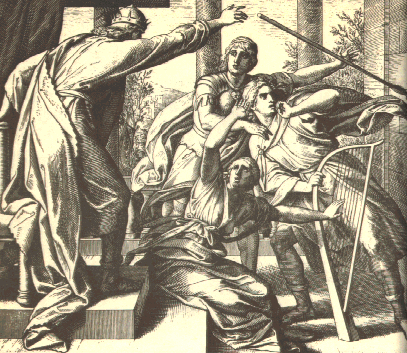
"Saul Tries to Kill David" by Julius Schnorr von Karolsfeld, 1850's, Wikimedia Commons
“Saul Tries to Kill David” by Julius Schnorr von Karolsfeld, 1850’s, Wikimedia Commons

This past weekend in worship and ABC, we discussed the importance of friendship.  Every person needs a friend for encouragement, for challenge, and for consolation. In the words of Proverbs 17:17:  “A friend loves at all times, and a brother is born for adversity.”  For good times and for bad, everyone needs a friend.

Perhaps the most famous example of friendship in the Bible is that of David and Jonathan.  These two guys far more than just bar buddies.  1 Samuel 18:1 describes their relationship like this:  “The soul of Jonathan was knit to the soul of David.”

Though David and Jonathan’s friendship was strong, it was also fraught with peril.  Jonathan’s dad, Saul, the king of Israel, hated David and wanted to kill him.  But Jonathan was so deeply devoted to his friend that he went to bat for him, telling his father:

“Let not the king sin against his servant David, because he has not sinned against you, and because his deeds have brought good to you.  For he took his life in his hand and he struck down the Philistine, and the LORD worked a great salvation for all Israel. You saw it, and rejoiced. Why then will you sin against innocent blood by killing David without cause?” (1 Samuel 19:4-5)

In my sermon, I talked about how Jonathan, in order to defend his friend, appeals to the lex talionis, a Latin phrase referring to the “law of retaliation.”  This law is classically expressed in Leviticus 24:19-20:  “If anyone injures his neighbor, as he has done it shall be done to him, fracture for fracture, eye for eye, tooth for tooth; whatever injury he has given a person shall be given to him.”  This law, of course, is not meant to promote violence, but to contain it.  The lex talionis stipulates that “the punishment must fit the crime.”  If someone takes your eye, you can’t take his arm.  The example I used in my sermon is, “If someone steals $100 from you, you can’t sue him for $1 million because of emotional pain and suffering.”

The way Jonathan uses the lex talionis in 1 Samuel 19 is especially fascinating.  For rather than appealing to the lex talionis responsively to punish a crime, he appeals to it preemptively to prevent a crime.  Jonathan’s essential argument to his father is this:  “You can’t kill David!  The law of retaliation says you can only hurt someone if he first hurts you!  And David hasn’t hurt you!”

I have gained a deep appreciation for Jonathan’s argument to his father because Jonathan essentially turns the lex talionis into a catch 22.  You can hurt someone, but only if he hurts you first.  Someone else can hurt you, but only if you hurt him first.  This means no one can hurt anyone because no one can make the first move to hurt someone because, by sheer chronological necessity, there would be no prior just cause for such an injury, thus breaking the lex talionis!  Far more than regulating violence, the lex talionis prevents it.

This use of the lex talionis is nicely in line with Jesus’ commentary on the rule:  “You have heard that it was said, ‘An eye for an eye and a tooth for a tooth.’ But I say to you, Do not resist the one who is evil. But if anyone slaps you on the right cheek, turn to him the other also” (Matthew 5:38-39).  Jesus essentially says, “Even if you are unjustly wounded, never give anyone a reason to use the lex talionis on you.  Self-control, even in the midst of terrible adversity, is paramount.  If you don’t hurt someone else, then that other person has no ground on which to stand if he hurts you.”

What tensions and quarrels do you have with others?  The best way to end them is to refuse to give the person with whom you are in conflict any reason to retaliate.  Your cool and collected response to someone who is angry may just be what diffuses a fight, ends a conflict, and restores a friendship.