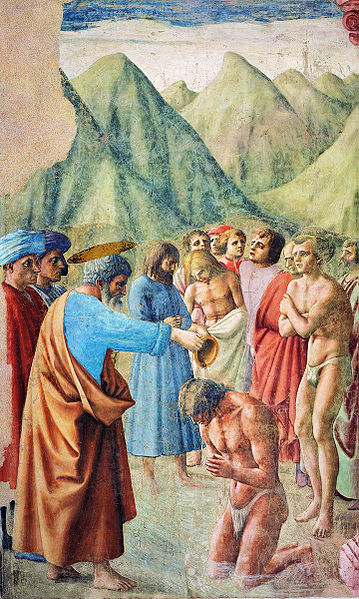
When God is first ordering creation, He begins with a formless, watery blob:
Now the earth was formless and empty, darkness was over the surface of the deep, and the Spirit of God was hovering over the waters. (Genesis 1:2)
But the watery blob does not last long. He separates the waters up above from the waters down below, and He separates the waters below into land and water:
And God said, “Let there be a vault between the waters to separate water from water.” So God made the vault and separated the water under the vault from the water above it. And it was so. God called the vault “sky.” … And God said, “Let the water under the sky be gathered to one place, and let dry ground appear.” And it was so. God called the dry ground “land,” and the gathered waters he called “seas.” And God saw that it was good. (Genesis 1:6-8)
The separation of these waters eventually sets the stage for God to give life to human beings:
God said, “Let Us make mankind in Our image, in Our likeness, so that they may rule over the fish in the sea and the birds in the sky, over the livestock and all the wild animals, and over all the creatures that move along the ground.” So God created mankind in His own image, in the image of God He created them; male and female He created them. (Genesis 1:26-27)
When God rescues the Israelites from their slavery in Egypt, they quickly find themselves backed up against the banks of the Red Sea, being pursued by the full force of the Egyptian army, and being terrified at the prospect of their impending slaughter:
“Was it because there were no graves in Egypt that you brought us to the desert to die? What have you done to us by bringing us out of Egypt? Didn’t we say to you in Egypt, ‘Leave us alone; let us serve the Egyptians’? It would have been better for us to serve the Egyptians than to die in the desert!” (Exodus 14:11-12)
But then God steps in and redoes what He did at creation – He separates the waters of the Red Sea and forms dry land:
The waters were divided, and the Israelites went through the sea on dry ground, with a wall of water on their right and on their left. (Exodus 14:21-22)
The separation of these waters sets the stage for God to rescue His people and give them a new life.
Over the past few months at the church where I serve, I have been privileged to witness and be a part of many baptisms. In baptism, God does once again what He did at creation and at the Red Sea. Waters are separated by pouring or dipping, and the separation of these waters is the stage on which God promises to give people life – new life as His children:
We were therefore buried with Christ through baptism into death in order that, just as Christ was raised from the dead through the glory of the Father, we too may live a new life. (Romans 6:4)
With water, God not only creates, He recreates. And He does so intimately – personally – for you. If you have not been baptized, now is your time! If you have been, give thanks to God for His creative work in you. It’s a beautiful gift of His love for you.
Oh, that You would tear open the heavens and come down. (Isaiah 64:1)
As Isaiah makes his request, he is remembering when God met with Moses on Mount Sinai, giving him His law, and the mountain trembled in fire and smoke:
When You did awesome things that we did not expect, You came down, and the mountains trembled before You. (Isaiah 64:3)
Though the people trembled when God gave His law, they did not obey His law, and so God has hidden Himself from people:
All of us have become like one who is unclean, and all our righteous acts are like filthy rags; we all shrivel up like a leaf, and like the wind our sins sweep us away. No one calls on Your name or strives to lay hold of You; for You have hidden Your face from us and have given us over to our sins. (Isaiah 64:6-7)
Because of Israel’s sin, rather than rending open the heavens and coming down, God has closed up the heavens and gone home. So, Isaiah ruefully asks:
Around 730 years after Isaiah mourns God’s hiddenness in heaven, the Gospel writer Mark records:
Jesus came from Nazareth in Galilee and was baptized by John in the Jordan. Just as Jesus was coming up out of the water, He saw heaven being torn open and the Spirit descending on Him like a dove. And a voice came from heaven: “You are My Son, whom I love; with You I am well pleased.” (Mark 1:9-11)
In Christ, the heavens are torn open once again as God returns to His people once again. But that is not all that is torn.
When Christ dies on a cross, Mark recounts this scene:
The curtain of the temple was torn open in two from top to bottom. (Mark 15:38)
The curtain in question is the curtain that guarded the Holy of Holies – the place where the ancient Israelites believed God dwelled. When Christ died, it was torn open so God’s inner sanctum could be seen by all and any.
It turns out that God does eventually answer Isaiah’s prayer. But He answers the prophet’s prayer in a greater way than he could have ever imagined. Not only does God tear open the heavens and come down, as is revealed when Jesus is baptized, He also tears open the curtain to His own inner sanctum so that we may go in, as is revealed at Jesus’ death. Because of the cross, we can walk right into the place of salvation.
The heavens that once separated us and God separate us no more. God is with us – and, one day, we will be with Him.
This Friday, Christians around the world will commemorate the death of Jesus Christ. At the church where I serve, we will hold services centering around the traditional seven final phrases that Jesus speaks from the cross. Many of these phrases are extraordinarily well-regarded and famous. For instance, when Jesus prays for His executioners, saying, “Father, forgive them, for they do not know what they are doing” (Luke 23:34), we are treated to a tour de force in what true forgiveness looks like. When Jesus cries out, “My God, My God, why have You forsaken Me?” (Mark 15:34) we hear in His words both an ache for God’s presence in suffering as well as a separation from God because of sin.
One of my favorite phrases from Jesus on the cross is one that can sometimes be overlooked:
This hardly seems like a profound statement. It seems more like a mundane request. A man who is baking in the hot ancient Near Eastern sun while hanging exposed on a cross has developed a case of cotton mouth. And yet, these words represent not only the cry of a parched mouth, but the yearning of a scorched soul.
The Psalmist once said:
As the deer pants for streams of water, so my soul pants for You, my God. My soul thirsts for God, for the living God. When can I go and meet with God? (Psalm 42:1-2)
The Psalmist describes his desperate thirst for God. And how does God respond to his thirst?
Deep calls to deep in the roar of Your waterfalls; all Your waves and breakers have swept over me. (Psalm 42:7)
God not only gives the Psalmist’s soul spiritual water, He offers the Psalmist a superabundance of this water in the form of waves and breakers.
Jesus invites anyone who has a thirst like the Psalmist’s:
“Let anyone who is thirsty come to Me and drink. Whoever believes in Me, as Scripture has said, rivers of living water will flow from within them.” (John 7:37-38)
But this takes us back to Jesus’ words from the cross. For when Jesus, who offers all men refreshment for their souls, Himself complains of thirst, how do men respond to Him?
A jar of wine vinegar was there, so they soaked a sponge in it, put the sponge on a stalk of the hyssop plant, and lifted it to Jesus’ lips. (John 19:29)
God responds to human thirst with refreshing water. Humans respond to God’s thirst with bitter vinegar. What a contrast.
And yet, the incredible thing about Jesus’ death on the cross is that sin’s vinegar never quite manages to strip Him of His life-giving water:
One of the soldiers pierced Jesus’ side with a spear, bringing a sudden flow of blood and water. (John 19:34)
The water of life stubbornly remains, flowing from the side of the One who died.
This week, as we reflect on and remember Jesus’ death, may we drink deeply from the water of His life. For the water of His life gives us eternal life.
Yesterday, I got to preach on an encounter that a disciple of Jesus named Philip had with an Ethiopian eunuch on a desert road. Through Philip’s witness, this eunuch was moved to faith and to baptism. In my message, I answered some common questions people have about baptism, but there was much I wanted to say about baptism that I didn’t get a chance to. So, in the interest of further exploring the richness of what baptism offers, I figured I’d repost some thoughts on baptism that I wrote several years ago. I hope you enjoy!
What is baptism?
Baptism is a divine ordinance, instituted by Christ Himself, whereby He makes disciples through water combined with God’s name. Jesus says, “Go and make disciples of all nations, baptizing them in the name of the Father and of the Son and of the Holy Spirit” (Matthew 28:19). The participle “baptizing” can be translated as a participle of means. Baptism, therefore, can be seen as a means by which disciples are made.
It is important to recognize that baptism is something God does for us and not something we do for God. This is why Paul says of baptism, “We were therefore buried with Christ through baptism into death in order that, just as Christ was raised from the dead through the glory of the Father, we too may live a new life” (Romans 6:4). Notice the passive voice of the verbs: “buried,” “raised.” These are divine passives, indicating that God is the One burying our old, sinful natures and raising us to new life in Christ. We are passive in the matter. This runs contrary to the teaching of some who describe baptism merely as an act of obedience while denying its divine power. Consider this quote from a large denomination’s confessional statement: “Baptism is an act of obedience symbolizing the believer’s faith in a crucified, buried, and risen Saviour, the believer’s death to sin, the burial of the old life, and the resurrection to walk in newness of life in Christ Jesus.”[1] Two things are especially notable about this statement. First, while obedience is emphasized, the blessings of baptism are not mentioned. Second, this statement references Romans 6:4, but relegates Paul’s language concerning burial and resurrection to that of symbolism, emphasizing the believer’s faith rather than God’s action. Paul, however, nowhere indicates that he is speaking symbolically in this verse. Rather, his language indicates that he has a lively confidence in an actual new life, offered by God through baptism.
Does baptism save?
Yes, baptism does save. Peter writes, “Baptism now saves you also – not the removal of dirt from the body but the pledgeof a good conscience toward God. It saves you by the resurrection of Jesus Christ, who has gone into heaven and is at God’s right hand – with angels, authorities and powers in submission to Him” (1 Peter 3:21-22). Peter could not be clearer: Baptism saves you. However, it is important to note not only that baptism saves you, but how baptism saves you. It saves you “by the resurrection of Jesus Christ.” Without the resurrected Christ, baptism is emptied of its power and promise.
There are some who object to the teaching that baptism saves, saying, “Faith in Christ alone saves you!” They often quote Scripture passages such as Romans 10:9: “If you confess with your mouth, ‘Jesus is Lord,’ and believe in your heart that God raised him from the dead, you will be saved.” They then argue: “Paul says that faith in Christ saves you and nowhere mentions baptism in Romans 10:9. Therefore, faith in Christ, and not baptism, saves you.” This type of argument engages in what I call “Bible Verse Battleship.” In this game, people line up their favorite Bible verses to support their favorite pet positions and then, when shown Scriptural testimony which calls into question their position, rather than seeking to reconcile the verses and take into account the whole counsel of God’s Word, they simply declare, “Because my pet Bible verse is true, you must be incorrect! My Bible verse sunk your Bible verse!” We should never use Bible verses to “sink” other Bible verses. Rather, we should assume that all Scripture speaks with one, harmonious, voice concerning the one, true Christian faith. Thus, when Peter says, “Baptism now saves you” in 1 Peter 3:21, we ought to take his words as complimentary, and not contradictory, to what Paul says in Romans 10:9.
So then, how do we understand Romans 10:9 and 1 Peter 3:21 harmoniously? Like this: baptism does not save simply because it’s baptism, but because it has the promise of Jesus’ presence attached to it (cf. Matthew 28:19-20). This is why baptism is regularly referred to as a “means of grace.” God works through simple things such as water in baptism, bread and wine in the Lord’s Supper, and words on a page in Holy Scripture to speak to, meet with, and provide gifts for His people. Martin Luther explains wonderfully: “Without God’s word the water [of baptism] is plain water and no baptism. But with the word of God it is a baptism, that is, a life-giving water, rich in grace, and a washing of the new birth in the Holy Spirit.”[2] Thus, to say that baptism saves you is simply to say that Jesus saves you because Jesus is doing His work in and through baptism!
Why do Lutherans baptize infants?
Lutherans are not so interested in baptizing infants as we are interested in baptizing all people in accordance with Christ’s commands to baptize “all nations” (Matthew 28:19). The Bible teaches that all are born into sin and deserve God’s condemnation (cf. Psalm 51:5). Therefore, babies need the salvation Jesus gives in baptism just as much as adults do. The Bible nowhere prohibits baptizing babies. In fact, we are told specifically that the promise of baptism is indeed for children: “The promise [of baptism] is for you and your children and for all who are far off – for all whom the Lord our God will call” (Acts 2:39).
There are some who maintain that a profession of faith must precede baptism. And because a baby cannot profess his faith in Christ, he should not be baptized until he is old enough to make such a profession. In response to this objection, I would point out three things. First, I would question the assumption that a profession of faith is a necessary prerequisite of baptism. It often happens that that a person in Scripture confesses his faith before he is baptized, but common occurrence doesn’t always necessarily indicate a divine mandate. Just because the Bible offers a description of certain things and events (e.g., a person offering a profession of faith before baptism) does not necessarily mean that the Bible is mandating a universal prescription. Second, I would question the assumption that children cannot confess their faith. The Psalmist reminds us, “From the lips of children and infants You have ordained praise” (Psalm 8:2, cf. Matthew 21:16). Children can and do praise God, even if it is with broken grammar and babble. Finally, from a historical perspective, from the early days of the Christian Church, it was common practice to have parents or sponsors confess the Christian faith on behalf of their children. The Roman theologian Hippolytus writes this concerning baptism in AD 215: “The children shall be baptized first. All of the children who can answer for themselves, let them answer. If there are any children who cannot answer for themselves, let their parents answer for them, or someone else from their family.”[3]
Baptism is a joyous gift from God. For through it, God meets us with His gifts. Luther sums up the joy and promise of baptism nicely when he writes: “We see what a very splendid thing baptism is. It snatches us from the jaws of the devil, makes us God’s own, restrains and removes sin, and then daily strengthens the new man within us.”[4] Thus is the blessing and gift of baptism!
“Why can’t women be ordained in the Lutheran Church – Missouri Synod?” “How does evolution square with the biblical record of creation?” “We confess in the Apostles’ Creed that Christ ‘descended into hell.’ Where does it teach that in the Bible?” I receive questions such as these – as well as many others – about why Lutherans believe and teach what they believe in teach. So periodically, over the course of the next several weeks and months, I will be taking some time to answer some of the most common questions I regularly receive about Lutheran doctrine.
Today, we begin with a question that is perhaps the most ubiquitous of all: “What’s the deal with the Lutheran doctrine of baptism?” Before we dive into this doctrine, it is important to clarify two things. First, I believe the Lutheran doctrine of baptism is the Christian doctrine of baptism. That is, I believe that the Lutheran doctrine of baptism is what Scripture itself teaches. Second, I am fully aware that many sincere and godly Christians differ over the doctrine of baptism. As I discuss this doctrine, then, I do so in a spirit of humility, respecting and loving those with whom I disagree. I do not, however, discuss this doctrine with a spirit of relativism, believing that different teachings on baptism are equally true or that what we believe and teach about baptism makes no difference. Quite the contrary. If the doctrine of baptism matters to the authors of Scripture, it should matter to us. Therefore, we should consider carefully what they teach.
What is baptism?
Baptism is a divine ordinance, instituted by Christ Himself, whereby He makes disciples through water combined with God’s name. Jesus says, “Go and make disciples of all nations, baptizing them in the name of the Father and of the Son and of the Holy Spirit” (Matthew 28:19). The participle “baptizing” can be translated as a participle of means. Baptism, therefore, is a means by which disciples are made.
It is important to recognize that baptism is something God does for us and not something we do for God. This is why Paul says of baptism, “We were therefore buried with Christ through baptism into death in order that, just as Christ was raised from the dead through the glory of the Father, we too may live a new life” (Romans 6:4). Notice the passive voice of the verbs: “buried,” “raised.” These are divine passives, indicating that God is the One burying our old, sinful natures and raising us to new life in Christ. We are passive in the matter. This runs contrary to the teaching of some who describe baptism merely as an act of obedience while denying its divine power. Consider this quote from a large denomination’s confessional statement: “Baptism is an act of obedience symbolizing the believer’s faith in a crucified, buried, and risen Saviour, the believer’s death to sin, the burial of the old life, and the resurrection to walk in newness of life in Christ Jesus.”[1] Two things are especially notable about this statement. First, while obedience is emphasized, the blessings of baptism are not mentioned. Second, this statement references Romans 6:4, but relegates Paul’s language concerning burial and resurrection to that of symbolism, emphasizing the believer’s faith rather than God’s action. Paul, however, nowhere indicates that he is speaking symbolically in this verse. Rather, his language indicates that he has a lively confidence in an actual new life, offered by God through baptism.
Does baptism save?
Yes, baptism does save. Peter writes, “Baptism now saves you also – not the removal of dirt from the body but the pledgeof a good conscience toward God. It saves you by the resurrection of Jesus Christ, who has gone into heaven and is at God’s right hand – with angels, authorities and powers in submission to Him” (1 Peter 3:21-22). Peter could not be clearer: Baptism saves you. However, it is important to note not only that baptism saves you, but how baptism saves you. It saves you “by the resurrection of Jesus Christ.” Without the resurrected Christ, baptism is emptied of its power and promise.
There are some who object to the teaching that baptism saves, saying, “Faith in Christ alone saves you!” They often quote Scripture passages such as Romans 10:9: “If you confess with your mouth, ‘Jesus is Lord,’ and believe in your heart that God raised him from the dead, you will be saved.” They then argue: “Paul says that faith in Christ saves you and nowhere mentions baptism in Romans 10:9. Therefore, faith in Christ, and not baptism, saves you.” This type of argument deeply disturbs me because it engages in what I call “Bible Verse Battleship.” In this sad game, people line up their favorite Bible verses to support their favorite pet positions and then, when shown Scriptural testimony which calls into question their position, rather than seeking to reconcile the verses and take into account the whole counsel of God’s Word, they simply declare, “Because my pet Bible verse is true, you must be incorrect! My Bible verse sunk your Bible verse!” We should never use Bible verses to “sink” other Bible verses. Rather, we should assume that all Scripture as speaks with one, harmonious, voice concerning the one, true Christian faith. Thus, when Peter says, “Baptism now saves you” (1 Peter 3:21), we ought to take his words as complimentary, and not contradictory, to what Paul says in Romans 10:9.
So then, how do we understand Romans 10:9 and 1 Peter 3:21 harmoniously? Like this. Baptism does not save simply because it’s baptism, but because it has the promise of Jesus’ presence attached to it (cf. Matthew 28:19-20). This is why baptism is regularly referred to as a “means of grace.” God works through simple things such as water in baptism, bread and wine in the Lord’s Supper, and words on a page in Holy Scripture to speak to, meet with, and provide gifts for His people. Martin Luther explains wonderfully: “Without God’s word the water [of baptism] is plain water and no baptism. But with the word of God it is a baptism, that is, a life-giving water, rich in grace, and a washing of the new birth in the Holy Spirit.”[2] Thus, to say that baptism saves you is simply to say that Jesus saves you because Jesus is doing His work in and through baptism!
Why do Lutherans baptize infants?
Lutherans do not baptize infants. Rather, we baptize people in accordance with Christ’s commands to baptize “all nations” (Matthew 28:19). The Bible teaches that all are born into sin and deserve God’s condemnation (cf. Psalm 51:5). Therefore, babies need the salvation Jesus gives in baptism just as much as adults do. The Bible nowhere prohibits baptizing babies. In fact, we are told specifically that the promise of baptism is indeed for children: “The promise [of baptism] is for you and your children and for all who are far off – for all whom the Lord our God will call” (Acts 2:39).
There are some who maintain that a profession of faith must precede baptism. And because a baby cannot profess his faith in Christ, he should not be baptized until he is old enough to make such a profession. In response to this objection, I would point out two things. First, I would question the assumption that a profession of faith is a necessary prerequisite of baptism. It often happens that that a person in Scripture confesses his faith before he is baptized, but common occurrence doesn’t always necessarily indicate a divine mandate. Just because the Bible offers a description of certain things and events (e.g., a person offering a profession of faith before baptism) does not necessarily mean that the Bible is mandating a universal prescription. Second, I would question the assumption that children cannot confess their faith. The Psalmist reminds us, “From the lips of children and infants You have ordained praise” (Psalm 8:2, cf. Matthew 21:16). Children can and do praise God, even if it is with broken grammar and babble. Finally, from a historical perspective, from the early days of the Christian Church, it was common practice to have parents or sponsors confess the Christian faith on behalf of their children. The Roman theologian Hippolytus writes this concerning baptism in AD 215: “Baptize first the children, and if they can speak for themselves let them do so. Otherwise, let their parents or other relatives speak for them.”[3] I have written more about infant baptism here: http://bit.ly/qHp97b.
Baptism is a joyous gift from God. For through it, God meets us with His gifts. Luther sums up the joy and promise of baptism nicely when he writes: “We see what a very splendid thing baptism is. It snatches us from the jaws of the devil, makes us God’s own, restrains and removes sin, and then daily strengthens the new man within us.”[4] Thus is the blessing and gift of baptism!