Why I Don’t Read The Bible Literally (But I Do Take It Seriously)

Bible in PewIt never ceases to amaze me how misunderstood the orthodox Christian belief concerning Holy Scripture is.  Even The New York Times can’t seem to figure it out.  Take Charles Blow, an op-ed columnist for the Times, who stands stunned at the views of many Americans on the Bible.  With a mixture of disbelief and disdain, he reports:

One Gallup report issued last week found that 42 percent of Americans believe “God created humans in their present form 10,000 years ago.”

Even among people who said that they were “very familiar” with the theory of evolution, a third still believed that God created humans in their present form 10,000 years ago.

It’s not clear what the respondents meant by being “very familiar” – did they fully understand the science upon which evolution’s based, or was their understanding something short of that, as in, very familiar with it as being antithetical to creationist concepts?

Whatever the case, on this issue as well as many others in America, the truth is not the light.[1]

Blow goes on to cite people’s opinions on the Bible itself according to this same Gallup pole:

Nearly a third of Americans continue to believe that the Bible “is the actual word of God and is to be taken literally, word for word.”

Furthermore, nearly half believe that it is “the inspired word of God but not everything in it should be taken literally.”

About a fifth of Americans said they believe the Bible is “an ancient book of fables, legends, history, and moral precepts recorded by man.”

The questions Gallup asks concerning the nature and character of the Bible frustrate me.  Gallup wants to know, “Do you believe the Bible is the actual word of God and is to be taken literally, word for word?”  Personally, I would have to answer “yes” and “no.”  Do I believe the Bible is “the actual word of God”?  Yes.  Do I believe it is to be “taken literally, word for word”?  No.  But this is not because I want to discredit the Bible’s veracity, authority, or inerrancy.  Rather, this is because I follow the Bible’s lead when it interprets itself non-literally in some places.  The Bible is full of metaphors, symbols, and other figures of speech as even an elementary reading of it will uncover. One need look no farther than “The LORD is my shepherd” (Psalm 23) to find a metaphor – and a beautiful metaphor, I would add – of Scripture.  Thus, I would find myself more at ease with Gallup’s second position:  “The Bible is the inspired word of God but not everything in it should be taken literally.”

Blow, however, summarily dismisses this second position:

I am curious which parts would get a pass from most of these respondents and which wouldn’t. Would the origins of the world fall into the literal camp? What about the rules – all or some – in books like Deuteronomy?

Perhaps Blow has not yet discovered the difference between reading something literally and reading something contextually.  Just because I don’t practice, for instance, the sacrifices outlined in Deuteronomy doesn’t mean I don’t understand them literally.  It just means that I read them in light of Hebrews 10:10:  “We have been made holy through the sacrifice of the body of Jesus Christ once for all.”  Christ’s sacrifice for sin put an end to all those Old Testament sacrifices for sin.  For me to try to follow those laws would be like me taking a ticket for an Elvis concert, going to the venue listed thereon, and expecting a concert usher to let me in!  Though I may read the ticket “literally,” that ticket’s time is past.  So it is with the Old Testament sacrificial system.  Its time too is past because it has been fulfilled by Christ.  But that isn’t me reading the Bible non-literally.  That’s just me reading the Bible contextually.

I suspect part of the reason Blow disparages option two when it comes to reading and interpreting the Bible is because, for him, only option three, which says the Bible is “an ancient book of fables, legends, history, and moral precepts recorded by man,” is viable.  He writes:

I don’t seek to deny anyone the right to believe as he or she chooses. I have at points in my own life been quite religious, and my own children have complicated views about religion. As my oldest son once told me, “I’d hate to live in a world where a God couldn’t exist.”

That is his choice, as it is every individual’s choice, and I respect it.

What worries me is that some Americans seem to live in a world where facts can’t exist.

Facts such as the idea that the world is ancient, and that all living things evolved and some – like dinosaurs – became extinct. Facts like the proven warming of the world. Facts like the very real possibility that such warming could cause a catastrophic sea-level rise.

Ah yes, facts.  Facts like the Bohr model of the atom or the rallying cry of biogenetics: “Ontogeny recapitulates phylogeny.”  Oh, wait.  Those “facts” turned out to be not quite as factual as we once thought.  Contrary to Blow, I’m not so sure that a great uprising of people who want facts to not exist is the problem.  The problem is there are people who disagree with him on what the fullness of the facts are and how the data that form the facts should be interpreted.  Now, I’m not saying these other people are correct on the facts.  I’m just saying these other people with other thoughts on what the facts are that contradict Blow’s thoughts on what the facts are not necessarily rejecting facts themselves.

Blow says he is “both shocked and fascinated by Americans’ religious literalism.”  I don’t think he even understands what “religious literalism” is.  Nor do I think he understands that many serious people of faith understand and trust the Bible theologically, morally, and historically without always reading it literally.  No wonder he’s so shocked and fascinated.  He simply doesn’t understand.  Then again, I’m not so sure he wants to.

__________________________

[1] Charles Blow, “Religious Constriction,” The New York Times (6.8.2014).

#Blessed

Credit:  socialmediaexaminer.com
Credit: socialmediaexaminer.com

I don’t know how many times I’ve received the prayer request.  But it’s definitely more times than I can remember.  “Pray that God will bless my…” and then fill in the blank.  “Finances.”  “Job Search.”  “Move.”  “Golf Game.”  “Baby Shower.”  And the list could go on and on.

Now, on the one hand, I have no particular problem with these kinds of prayer requests per se.  Indeed, when people come to me with these kinds of prayers, I gladly oblige.  But on the other hand, even though we pray to be blessed, I’m not so sure we always understand what it truly entails to be blessed, at least not biblically.

The other day, I came across an article by Jessica Bennett of The New York Times chronicling all the blessings she has stumbled across on social media.  She opens:

Here are a few of the ways that God has touched my social network over the past few months:

S(he) helped a friend get accepted into graduate school. (She was “blessed” to be there.)

S(he) made it possible for a yoga instructor’s Caribbean spa retreat. (“Blessed to be teaching in paradise,” she wrote.)

S(he) helped a new mom outfit her infant in a tiny designer frock. (“A year of patiently waiting and it finally fits! Feeling blessed.”)

S(he) graced a colleague with at least 57 Facebook wall postings about her birthday. (“So blessed for all the love,” she wrote, to approximately 900 of her closest friends.)

God has, in fact, recently blessed my network with dazzling job promotions, coveted speaking gigs, the most wonderful fiancés ever, front row seats at Fashion Week, and nominations for many a “30 under 30” list. And, blessings aren’t limited to the little people, either. S(he) blessed Macklemore with a wardrobe designer (thanks for the heads up, Instagram!) and Jamie Lynn Spears with an engagement ring (“#blessed #blessed #blessed!” she wrote on Twitter). S(he)’s been known to bless Kanye West and Kim Kardashian with exotic getaways and expensive bottles of Champagne, overlooking sunsets of biblical proportion (naturally).[1]

Apparently, Bennett has a lot of extraordinarily “blessed” friends.  She even tells the story of a girl who posted a picture of her posterior on Facebook with the caption, “Blessed.”  Really?

The theology behind the kind of blessing Bennett outlines is shallow at best and likely heretical in actuality.  The so-called “god” who bestows these social media blessings is ill-defined and vacuous, as Bennett intimates with her references to “god” as “s(he),” and the blessings from this divine turn out to be quite petty.  Frocks that fit, birthday wishes on Facebook, and financial windfalls all qualify to be part of the “blessed” life.

All this leads Bennett to suspect that these “blessings” are really nothing more than people cynically

… invoking holiness as a way to brag about [their] life … Calling something “blessed,” has become the go-to term for those who want to boast about an accomplishment while pretending to be humble, fish for a compliment, acknowledge a success (without sounding too conceited), or purposely elicit envy.

That sounds about right.  “Blessed” is just a word people use to thinly disguise a brag.

True biblical blessing, of course, is quite different – and much messier.  Jesus’ list of blessings sounds quite different from what you’ll find on Facebook:

Blessed are you who are poor, for yours is the kingdom of God.  Blessed are you who hunger now, for you will be satisfied. Blessed are you who weep now, for you will laugh. Blessed are you when men hate you, when they exclude you and insult you and reject your name as evil, because of the Son of Man. (Luke 6:20-22)

Poverty, hunger, mourning, and persecution all qualify to be part of the blessed life.  Why?  Because true blessing involves much more than what happens to you in this life.  It involves God’s promises for the next.

All this is not to say that the good gifts we receive in this life are not blessings.  But such blessings must be received with a proper perspective – that they are blessings not just because we happen to like them, but because it is God who gives them.  Indeed, one of the most interesting features of the Hebrew word for “blessing,” barak, is that it can be translated either as “bless” (e.g., Numbers 6:24) or as “curse” (e.g., Psalm 10:3), depending on context.  What makes the difference between whether something is a blessing or a curse?  Faith – a confidence that a blessing is defined not in terms of what something is, but in terms of who gives it.  This is why when we are poor, hungry, mourning, and persecuted, we can still be blessed.  Because we can still have the Lord.  And there is no better blessing than Him.

Put that on Instagram.

__________________________

[1] Jessica Bennett, “They Feel ‘Blessed,’” The New York Times (5.2.2014).

Divorce, Remarriage, Communion, and the Catholic Church’s Existential Crisis

Credit: Wikipedia
Credit: Wikipedia

I have to admit, I’d be in awe if I got the phone call Jaqui Lisbona did.  On a Monday, a couple of weeks ago, Jaqui’s phone rang.  Her husband picked it up and was greeted by a man who introduced himself as Father Bergoglio.  You may know him better as Pope Francis.  He asked to speak with Jaqui.  Apparently, several months back, she had written a letter to the pontiff asking him if she could take Communion even though she was divorced.  Apparently, her priest had been refusing her Communion for some time now according to the provisions of the Catechism of the Catholic Church:

Today there are numerous Catholics in many countries who have recourse to civil divorce and contract new civil unions … The Church maintains that a new union cannot be recognized as valid, if the first marriage was.  If the divorced are remarried civilly, they find themselves in a situation that objectively contravenes God’s law.  Consequently, they cannot receive Eucharistic Communion as long as this situation persists.[1]

In contradistinction to her priest’s ban, The Washington Post reports that the Pope told Jaqui “‘there was no problem’ with her taking Communion, and that he was ‘dealing with the issue’ of remarried divorcees.”[2]  Predictably, this set off a firestorm of controversy with the Vatican ultimately having to respond:

Several telephone calls have taken place in the context of Pope Francis’ personal pastoral relationships. Since they do not in any way form part of the Pope’s public activities, no information or comments are to be expected from the Holy See Press Office. That which has been communicated in relation to this matter, outside the scope of personal relationships, and the consequent media amplification, cannot be confirmed as reliable, and is a source of misunderstanding and confusion. Therefore, consequences relating to the teaching of the Church are not to be inferred from these occurrences.

I like Ross Douthat’s analysis of this response:  “This formulation may be technically correct, but it’s also a little bit absurd. Even in ‘private’ conversation, the Pope is, well, the Pope.”[3]  Exactly.  You can’t claim the Pope is the vicar of Christ on the one hand while having him contradict what other vicars of Christ before him have taught on the other.

With that being said, there is something to be commended in the stance that The Catechism of the Catholic Church, and even this woman’s priest, has taken with regard to remarried divorcees and Communion.  In a world that all too readily sanctions divorce and remarriage for reasons as debase and selfish as “I’m in love with someone else and I want to marry them,” The Catechism of the Catholic Church helps to remind us of the gravity of divorce as a sin in God’s eyes.

Still, it has been interesting to watch Catholics struggle to respond to this situation.  They are struggling with how to make a proper distinction between, oddly enough, the Law and the Gospel!  Consider this by Pascal-Emmanuel Gobry:

The question of the divorced-remarried and the sacraments is taking up a lot of our time. How should we look at this?

One of the many confounding things about the Jesus of the Gospels is that He fulfills the law, even strengthens the law, and yet extends mercy to literally anyone who wants it, no matter how deep their transgressions, and adopts a resolutely passionate attitude with sinners. This is encapsulated by His words to the adulterous woman: “I do not condemn you. Go and sin no more.”

As with all aspects of our faith, structured with paradox as it is, the temptation is always to strengthen one side of the “equation” too much at the expense of the other … Jesus says, “I do not condemn you. Go and sin no more.” One camp will say, “He said ‘I do not condemn you’!!!!!” One camp will say, “He said ‘Go and sin no more’!!!!!” …

It seems to me that the excesses go in these ways. The progressive excess is to use mercy as a (however well-intentioned) pretext to amend the law. The conservative excess is to use the law as a (however well-intentioned pretext) to refuse mercy.

Yes, God lays down the law. But God provides infinite mercy.[4]

It sounds to me like Gobry is having the existential crisis of a Lutheran and he doesn’t even know it!  He is taking seriously the full weight of God’s law against divorce on the one hand while leaning on His sweet mercy for divorcées on the other.

Gobry even seems to suspect that the partaking of Communion to a divorcée’s blessing and benefit is not as simple as a humanly contrived promise to sin no more based squarely in a person’s will:

The juridical Gordian knot here is the necessary “firm resolve” not to commit the sin again. But it is not licentious to note that for all of us this firm resolve will be imperfect. Obviously, we don’t want to throw out the baby with the bathwater. But if we search our hearts, do we not find that “firm resolve” is drawn in shades of gray, rather than black or white? …

God’s law is as hard as His mercy is infinite. And none of us are righteous under the law. And none of us, if we are honest, can even be said to want to be righteous under the law, in every single dimension of our life. But, particularly in these delicate and demanding aspects of sexual life and life situations, the grace of wanting to want God’s will is already very precious and important. And is it not in those phases, where we are broken down, and all we can muster the strength to pray for is to want to want, or even to want to want to want, that the Church should be most present with the succor of her sacraments?

Gobry knows that rooting anything salvific and divinely beneficial in our actions or will is a fool’s errand.  It’s not just that we aren’t righteous, it’s that we don’t even want to be righteous.  Indeed, any righteous desire in our will is doomed to an infinite regress, rendered impotent because of sin.  We only want to want to be righteous, or even want to want to want to be righteous.  And even this is giving us too much credit.

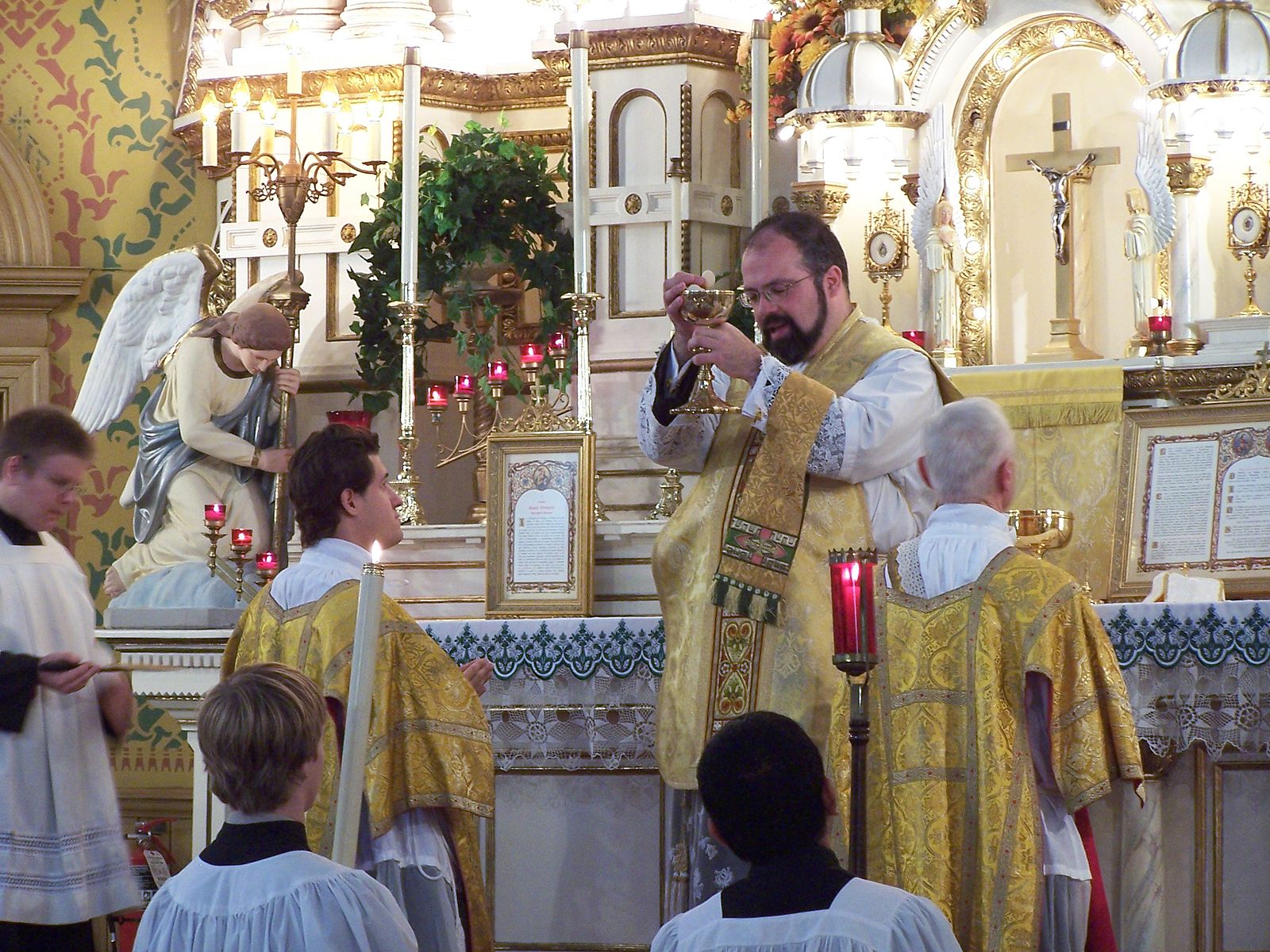
So, what is the way out of this morass over who may worthily partake of Communion?  Martin Luther would say, “That person is truly worthy and well prepared who has faith in these words: ‘Given and shed for you for the forgiveness of sins.’”[5]  Our worthiness to partake of Communion is not and cannot be based in our freedom from sin, our reparations for sin, or the fullness and genuineness of a promise not to commit more sin.  With regard to the Catholic Church’s current quandary over divorce and remarriage specifically, worthiness for Communion cannot be the result of trying to fix the sin of divorce by, after remarrying, getting another divorce, for this is also a sin.  No, our worthiness to partake on Communion can only be based on faith in the One who gives us His body and blood to remedy our unworthiness.  Our worthiness must be based in Jesus because our worthiness is Jesus.

Existential crisis…remedied.

______________________________

[1] The Catechism of the Catholic Church (Collegeville, MN:  The Liturgical Press, 1994), § 1650.

[2] Terrence McCoy, “Did Pope Francis just call and say divorced Catholics can take Communion?” The Washington Post (4.24.2014).

[3] Ross Douthat, “The Pope’s Phone Call,” The New York Times (4.26.2014).

[4] Pascal-Emmanuel Gobry, “On Divine Mercy Sunday, Some Thoughts On Communion And Divorced-Remarried,” patheos.com (4.27.2014).

[5] Martin Luther, Large Catechism, “The Sacrament of the Altar,” Section 1.

A Camel Controversy

Camels 1And you thought it was it only impossible for a camel to go through the eye of a needle.

As it turns out, threading camels isn’t the only thing that’s impossible according to some archaeologists.  Domesticating them before the tenth century B.C. also turns out to be quite the trick.  Writing for the New York Times, John Noble Wilford provocatively declares, “Camels Had No Business in Genesis.”[1]  Wilford explains:

There are too many camels in the Bible, out of time and out of place.

Camels probably had little or no role in the lives of such early Jewish patriarchs as Abraham, Jacob and Joseph, who lived in the first half of the second millennium B.C., and yet stories about them mention these domesticated pack animals more than 20 times. Genesis 24, for example, tells of Abraham’s servant going by camel on a mission to find a wife for Isaac.

How does Wilford know that camels had no role in the era of the biblical patriarchs?  He cites a study, recently published by two archaeologists from Tel Aviv University, which employed radiocarbon dating to test some camel bones found in the Aravah Valley.  This study found the bones to be from the last third of the tenth century B.C., which, Wilford notes, is “centuries after the patriarchs lived and decades after the kingdom of David, according to the Bible.”  So there you have it.  Thanks to some late breaking bones, Genesis is discredited – at least the parts that talk about camels.

Now, before we fall prey to camel chaos, a few things should be noted.  First, the Tel Aviv archaeologists, by declaring that camels could not have been used in the way Genesis 24 describes them, are making an argument from silence.  Their assumption runs like this:  because we do not have domesticated camel fossils dating before first millennium B.C., there must have been no domesticated camels before the first millennium B.C.  The Bible must be wrong.  But a lack of evidence does not necessitate a lack of existence.  One need to only think back to 1961.  This was the year the “Pilate Stone” was discovered at Caesarea Maritima.  It had an inscription dedicated to the emperor of Rome at the time, Tiberius Caesar:  “To the Divine Augustus Tiberieum:  Pontius Pilate, prefect of Judea has dedicated this.”  Before this stone was discovered, because there was no hard archaeological evidence of Pontius Pilate, many assumed that Pilate was a fictional character, made up out of the sacred authors’ over-active imaginations.  Whoops.  So much for that argument from silence.

It should also be noted that the archaeologists who discovered these bones do not even have complete silence in favor of their argument against camels during the time of the biblical patriarchs.  They only have archaeological silence.  There are extra-biblical references to domesticated camels prior to the first millennium B.C.  Titus Kennedy, adjunct professor at Biola University, notes that a camel is mentioned in a list of domesticated animals from Ugarit, dating anywhere from 1950 to 1600 B.C.  In an interview with Christianity Today, Kennedy explains:

For those who adhere to a twelfth century B.C. or later theory of domestic camel use in the ancient Near East, a great deal of archaeological and textual evidence must be either ignored or explained away …

[Israel] doesn’t have much writing from before the Iron Age, 1000 B.C. … So there aren’t as many sources to look at. Whereas in Egypt, you have writing all the way back to 3000 B.C. and in Mesopotamia the same thing.[2]

Kennedy concludes that there were not only domesticated camels at the time of the biblical patriarchs, but before the time of the biblical patriarchs.  Thus, the biblical record is quite believable.  There is no reason that Abraham could not have acquired “sheep and cattle, male and female donkeys, male and female servants, and camels” (Genesis 12:16), just as Genesis says.

Ultimately, the difficulties with the premature conclusions drawn from this discovery reach much deeper than simply whether camels were around in the second millennium B.C.  These difficulties are summed up in Wilford’s conclusion:

These anachronisms are telling evidence that the Bible was written or edited long after the events it narrates and is not always reliable as verifiable history. These camel stories “do not encapsulate memories from the second millennium,” said Noam Mizrahi, an Israeli biblical scholar, “but should be viewed as back-projections from a much later period.”

In other words, the Bible cannot be trusted to get its facts straight – at least not all of them.  When reading the Bible, then, skepticism must be given preference over faith.

Finally, if I assume camels could not have been in Genesis based on an argument from paleontological silence, it is only reasonable for me to assume that a Savior cannot rise from death based on medical science.  After all, doctors have long known that dead people tend to stay that way.  Thus, Jesus’ resurrection must have never happened.   But if this is true, then my “faith is futile; I am still in my sins … [and] I am to be pitied more than all men” (1 Corinthians 15:17, 19).  Wow, that’s a downer.

Let’s hope the archaeologists are wrong on this one.  After all, I don’t really like to be pitied.


[1] John Noble Wilford, “Camels Had No Business in Genesis,” New York Times (2.10.2014).

[2] Gordon Govier, “The Latest Challenge to the Bible’s Accuracy:  Abraham’s Anachronistic Camels?” Christianity Today (February 2014).

Explaining Our Existence

Creation HandsI recently came across two articles – both dealing with gender concerns – that caught my attention.  The first article is by Lisa Wade of Salon and addresses the deep friendships – or the lack thereof – between men.  Wade opens her article:

Of all people in America, adult, white, heterosexual men have the fewest friends. Moreover, the friendships they have, if they’re with other men, provide less emotional support and involve lower levels of self-disclosure and trust than other types of friendships. When men get together, they’re more likely to do stuff than have a conversation …

When I first began researching this topic I thought, surely this is too stereotypical to be true. Or, if it is true, I wondered, perhaps the research is biased in favor of female-type friendships. In other words, maybe we’re measuring male friendships with a female yardstick. It’s possible that men don’t want as many or the same kinds of friendships as women.

But they do. When asked about what they desire from their friendships, men are just as likely as women to say that they want intimacy. And, just like women, their satisfaction with their friendships is strongly correlated with the level of self-disclosure.[1]

Men want friends, Wade contends – real friends, with whom they can share real cares, concerns, and fears.  But most do not have these kinds of friends.  Why is this?  Wade chalks it up to society’s assertions concerning what it means to be a “real man.”  She explains:

[Real men] are supposed to be self-interested, competitive, non-emotional, strong (with no insecurities at all), and able to deal with their emotional problems without help. Being a good friend, then, as well as needing a good friend, is the equivalent of being girly.

Real men, our society says, keep their emotions hermetically sealed.  This is why so many men eschew forming deep and abiding friendships.  But as many men seek to be really masculine through sensitivity sequestration, they only wind up being really isolated.

The second article I found interesting is by Sarah Elizabeth Richards of the New York Times. Richards tells the story of Andy Inkster – a woman who underwent surgery and took testosterone to become a man, but has now stopped taking testosterone because she wants to get pregnant.  As it turns out, Andy had trouble getting pregnant and sought fertility treatments from Baystate Reproductive Medicine.  Baystate denied her request.  She received help from another clinic and got pregnant, but sued Baystate for discrimination.

Such a desire of transgendered people to have children is not unique to Andy:

One study published last year in the journal Human Reproduction of 90 transgender men in Belgium found that 54 percent wished to have children … Other research, published in 2002, by Belgian fertility doctors with Western European transgender women found that 40 percent wanted to have children, and 77 percent felt they should have the option to preserve their sperm before hormone treatment. As fertility technology improves and becomes more widely available, transgender people are realizing that they will have more options in the future.[2]

Transgendered people apparently have a strong desire to have children in biologically traditional ways despite their deep reservations with their biologically assigned genders.

At first glance, these two articles seem to address phenomena on opposite ends of the cultural spectrum.  The first has to do with entrenched machismo while the second has to do with blurred gender identity.  But for all their differences, there exists a common theological root:  the divorce of human existence from divine creation.

Foundational to the Christian conception of the cosmos is the belief that everything came from somewhere.  Or, to put it more precisely, Christians believe that everything came from someone.  We do not just exist.  We were created.

It is from the Scriptural story of creation that we learn not just that we are, but who we are.  We are creatures and not the Creator (cf. Genesis 3:5).  We are fashioned in the image of God (cf. Genesis 1:27).  We are fearfully and wonderfully made (cf. Psalm 139:14), which is to say that God intentionally and lovingly fashioned us to be a certain kind of person, the corruption of sin notwithstanding.  In the old “nature versus nurture” debate, the story of creation tells us that nature does indeed shape us, but not by naturalistic means.  Rather, we are shaped through nature by the One who made nature.

Both of the articles above exemplify with a convicting candor what happens when people forget this story.  Men who try to play the role of the sturdy and strong lone ranger forget the part of the story where God says, “It is not good for the man to be alone” (Genesis 2:18).  People who undergo surgeries and treatments in an effort to change their gender forget the part of the story where God revels in how He has created us “male and female” (Genesis 1:27).

The apostle Peter warns there will come a time when people will “deliberately forget that long ago by God’s word the heavens existed and the earth was formed” (2 Peter 3:5).  They will forget their existence is a product of God’s creative word.  And they will forget their existence is to be guided by God’s sacred Word.  May it never be so of us.  May we always be able to say:  “I believe in God, the Father Almighty, creator of heaven and earth…and of me.”


[1] Lisa Wade, “American men’s hidden crisis: They need more friends!” Salon (12.7.2013).

[2] Sarah Elizabeth Richards, “The Next Frontier in Fertility Treatment,” New York Times (1.12.2014).