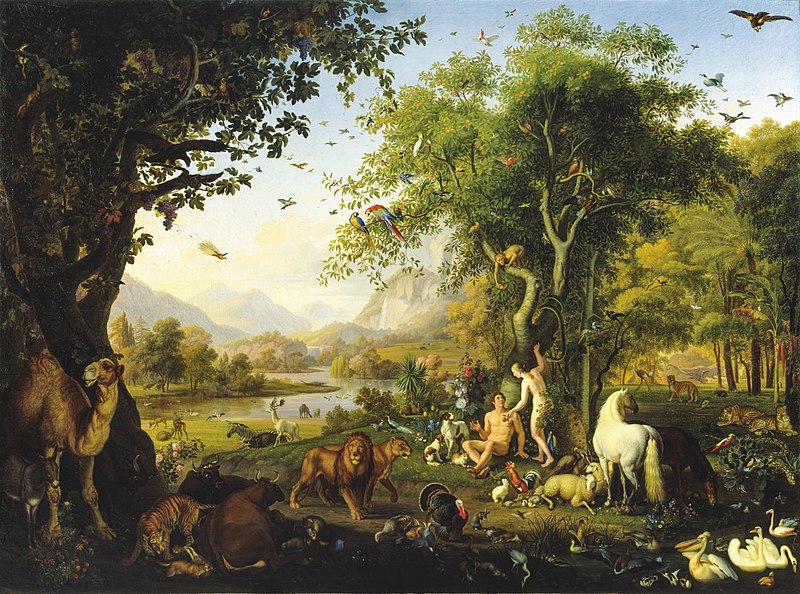
God Is With Us

File:Johann Wenzel Peter - Adam and Eve in the earthly paradise.jpg
Credit: “Adam and Eve in the Garden of Eden by Johann Wenzel Peter (c. 1815) / Wikimedia

God has a funny way of defying the expectations people put on His presence.

When God appears to the first two humans, Adam and Eve, we find Him searching for them by “walking in the garden in the cool of the day” (Genesis 3:8). But this paradisical picture soon turns ugly when He finds out they have fallen into sin by eating fruit from His forbidden Tree of the Knowledge of Good and Evil. In punishment, God casts the couple out of the cool and lush Garden of Eden with a warning to Adam that now “by the sweat of your brow you will eat your food” (Genesis 3:19). The refreshing cool of the garden is shut off to humans and exchanged for a sweltering sweat. And it feels like God has barred humanity from His presence.

But He hasn’t.

In Genesis 18, we meet a man named Abraham who is “near the great trees of Mamre…sitting at the entrance to his tent in the heat of the day” (Genesis 18:1). Because “the cool of the day” of the Garden of Eden has gone, Abraham tries to shade himself by some trees and with his tent in “the heat of the day.” But in the middle of this sweaty scene, we read:

The LORD appeared to Abraham near the great trees of Mamre while he was sitting at the entrance to his tent in the heat of the day. (Genesis 18:1)

It turns out that God shows up not only in the cool of the day, but in the heat of the day – not only in a garden, but in a desert.

Too often, we harbor unexamined assumptions about how God’s presence has manifested itself in our lives:

“I got new job because God was with me.”
“I didn’t get the virus because God was with me.”
“I won the award because God was with me.”
“My life has turned out well because God was with me.”

All these statements may well be true. But their inverses are most certainly not:

“I didn’t get the new job because God wasn’t with me.”
“I did get the virus because God doesn’t care for me.”
“I didn’t win the award because God is against me.”
“My life has turned out tragically because God has forsaken me.”

God is with us in the garden and in the desert – in the cool of the day and in the heat of the day.

God’s presence with us even when life makes us sweat should come as no surprise to us. The word “sweat” is found twice in the Bible – once when Adam is cursed in a garden and once when Jesus is struggling in a garden:

Being in anguish, He prayed more earnestly, and His sweat was like drops of blood falling to the ground. (Luke 22:44)

Jesus knows what it’s like to sweat. And He’s promised to be with us when we sweat, too. Our circumstances – even when they are difficult and tempt us to become despondent – are not barometers of His presence. He is present with us because He has promised to be. Period.

Hagar, Sarah, Abraham, and Circumcision

File:Sarah presenting Hagar to Abraham, who sits at the foot of a bed, from the series 'The Story of Abraham' MET DP828535.jpg
Credit: Sarah presenting Hagar to Abraham (c. 1543) / Wikimedia

We all have concocted a harebrained scheme a time or two to try to solve some problem or get ourselves out of some jam. The people of the Bible were no different.

When God appears to Abraham and Sarah and promises them that they will have a son who will be the progenitor of a great nation even though they are both well past their childbearing and childrearing years, Abraham, at first, responds with incredible faith:

Abram believed the LORD, and He credited it to him as righteousness. (Genesis 15:6)

But after years of waiting and no baby on the way to show for their patience, Abraham and Sarah decide to take matters into their own hands:

Sarai said to Abram, “The LORD has kept me from having children. Go, sleep with my slave Hagar; perhaps I can build a family through her.” Abram agreed to what Sarai said. (Genesis 16:2-3)

This is a shocking turn of events and rightly should be repulsive to us. Predictably, Abraham and Sarah’s scheme does not work out well for them:

Abraham slept with Hagar, and she conceived. When she knew she was pregnant, she began to despise her mistress. Then Sarai said to Abram, “You are responsible for the wrong I am suffering. I put my slave in your arms, and now that she knows she is pregnant, she despises me. May the LORD judge between you and me.” “Your slave is in your hands,” Abram said. “Do with her whatever you think best.” Then Sarai mistreated Hagar; so she fled from her. (Genesis 16:4-6)

Jealousy and abuse are the fruit of a pitifully and pathetically sexually disordered relationship, leaving the reader to wonder: Is there any way forward? Can any of this be repaired or restored?

In response to Abraham’s sexually disastrous choices, God announces:

You are to undergo circumcision, and it will be the sign of the covenant between Me and you. (Genesis 17:11)

I have been asked many times why God chose circumcision as the sign of the covenant He made with Abraham. It seems strange until one realizes that God takes the very spot Abraham had used to deny and disparage God’s covenant promise of a son and turns it into the very sign of His covenant. Circumcision, it turns out, is a bit of strategic sanctification. It is certainly painful, which Abraham certainly deserves in punishment for his sin. But it is also a sign to Abraham that God’s covenant promises to him still stand. In other words, Abraham’s circumcision is a surgery of grace. And grace is what Abraham needs to cover his sin.

It is no secret that sexual sin runs rampant in our world. But this is nothing new. Just ask Abraham, Sarah, and Hagar. And yet, when such sin works to betray trust, shatter promises, separate marriages, and break hearts, God is right there with His grace – working to redeem sexual sinners in their brokenness and restore those who have been sinned against sexually from their shame and pain. The sign God gave to Abraham is a testament to this – and a promise for us. God’s grace meets us when we sin sexually and when we are sinned against sexually.

If you are struggling with either sexual sin or being sinned against sexually, you can ask for help – from God and from others. Even after his sexual sin, God made Abraham the father of a great nation – Israel. And even after being sinned against by her husband, Sarah went on to become the mother of that same great nation. And even after Hagar was sinned against by both Abraham and Sarah, she and her son Ishmael, who also became a great nation, were protected and cared for by God.

God did all that with a giant mess of sexual sin. What can God do with you? It’s a question worth asking – and a hope worth holding.

“Let us” vs. “I will”

Pieter Bruegel the Elder - The Tower of Babel (Vienna) - Google Art Project - edited.jpg
The Tower of Babel by Pieter Bruegel (c. 1563) / Wikipedia

Human arrogance is nothing new. It’s as old as sin itself. Adam and Eve, after all, were tempted into sin by a delusion of grandeur – if they broke a command of God, they could “be like God” (Genesis 3:5).

Another early instance of human arrogance comes in the form of an infamous building project:

Now the whole world had one language and a common speech. As people moved eastward, they found a plain in Shinar and settled there. They said to each other, “Come, let us make bricks and bake them thoroughly.” They used brick instead of stone, and tar for mortar. Then they said, “Come, let us build ourselves a city, with a tower that reaches to the heavens, so that we may make a name for ourselves; otherwise we will be scattered over the face of the whole earth.” (Genesis 11:1-4)

The arrogance of humanity in this project can be summed up in two words:

“Let us.”

“Let us make bricks and bake them thoroughly,” they say. “Let us build ourselves a city, with a tower that reaches to the heavens, so that we may make a name for ourselves,” they plan. They believe that there is nothing they can’t do. They don’t need God when they have a “Let us.”

When God discovers the people’s plot, He stops them by confusing their language so they can no longer communicate with each other, which is why we now call this building project “Babel – because there the LORD confused the language of the whole world” (Genesis 11:9). But God does not merely judge these people by confusing their communication. He does something else. He does something more. He tries something better.

In the very next chapter of Genesis, God calls a man named Abraham and says to him:

Go from your country, your people and your father’s household to the land I will show you. I will make you into a great nation, and I will bless you; I will make your name great, and you will be a blessing. I will bless those who bless you, and whoever curses you I will curse; and all peoples on earth will be blessed through you. (Genesis 12:1-3)

God is not only promising to bless Abraham here, He is also working to undo the calamity of Babel by responding to humanity’s arrogant “Let us” with two words of His own:

“I will.”

“I will give you a new land,” God explains. “I will make you into a great nation,” God declares.

On the one hand, the words “I will” can trouble us, because what God will do always outdoes and overcomes what we might want to do. On the other hand, these words of God are a great promise for us. They remind us that our accomplishments, our worth, and our lives are not in our hands. We do not live by what we do. We live because of what God has done – and will do – for us.

At a time like this, the temptation to say “Let us” can become overwhelming. “Let us get a raise so we can live more comfortably.” “Let us airbrush our lives on social media so we can present ourselves perfectly.” “Let us win this presidential election so we can beat our opponents into submission politically.” What we need most at a moment like this, however, is not another “Let us.” We need God’s “I will.” “I will provide for you.” “I will grant you My perfect righteousness.” “I will be your perfect king and your loving heavenly Father.” His “I will” always works better than our “Let us.”

The One who calls you is faithful, and He will do it. (1 Thessalonians 5:24)

The U.S. Moves Its Embassy

800px-Western_Wall,_Jerusalem,_Shavuot
Credit: Daniel Majewski

This past week, a piece of legislation first passed in 1995 under President Clinton was finally implemented.  The Congress at that time passed the Jerusalem Embassy Act, which recognized Jerusalem as the capital city of Israel and made plans to move the U.S. embassy to Jerusalem from Tel Aviv.  Since that time, Presidents Clinton, Bush, and Obama have delayed the move, citing national security concerns.  President Trump decided it was finally time to make the move.  So, a week ago Monday, the new U.S. embassy opened in Jerusalem.

While celebrations were taking place at the new embassy, only miles away, along Israel’s border at the Gaza Strip, members of Hamas were protesting the move, seeking to storm the border into Israel while flying incendiary kites across the border into Israel.  50 of these rioters were killed by Israeli forces.  Some other Palestinians were also killed, including an eight-month-old girl.

The antipathy between the Israelis and Palestinians is nothing new.  Both groups claim rights to this region and look suspiciously at the intentions and activities of the other.  The terrorist provocations of Hamas serve only to heighten tensions.

To some Christians, unalloyed support for the modern-day nation of Israel by the U.S. is a theological necessity, for they believe that anything less is a direct affront to the covenant that God made with Abraham to give him and his ancestors land in this region.  Other Christians, among whom I would include myself, do not see a one-to-one correlation between the ancient theocracy of the people of Israel and the modern democracy of the nation of Israel.  The true heirs of Abraham are not ethnic Jews living in a particular region of the world, but all those who, by faith, call on Abraham’s God – whether these people be ethnically Jewish or ethnically Gentile.  Abraham’s true heirs do not so much concern themselves with a particular piece of land in the Middle East as they do with an all-encompassing kingdom of God.

This second view does not mean, of course, that Christians should not be concerned with the events that are unfolding in the Middle East.  It is standard practice for sovereign nations to be able to name their own capitals and it is standard protocol for other nations to respect and recognize these capitals and place embassies in them, as the U.S. has now done with Israel.  Geopolitically, Israel’s status as a democracy in a region that is widely known for oppressive regimes is an important and stabilizing influence.  It is also essential to have a safe haven for ethnic Jews in an area of the world that has proven to be widely and often vociferously anti-Semitic.

At the same time, we cannot forget or overlook the struggle and suffering that many Palestinians face.  Living under Hamas has never been easy.  The small number of Christians in this region are doing yeoman’s work as they open their churches and homes to their Muslim neighbors who have been displaced by riots and bombings.  They are shining examples of Christ’s love in an area of our world that is regularly marked by hate and unrest.  These faithful people deserve our prayers and support.  They too need safe places to live and free communities in which to thrive.

The unrest and violence that has been sparked by the move of the U.S. embassy from Tel Aviv to Jerusalem is a reminder of the volatility in civilization’s cradle and the fragility of human life.  Every U.S. president for the past 70 years has sought to broker peace in the Middle East and, sadly, every U.S. president has failed.  This is because, more than a president, we need a Prince – a Prince who knows how to bring peace.  He is the One in whom Israel once hoped.  He is the One who Palestinian Christians now proclaim.  And He is the One the whole world still needs.

Last week, a president kept a promise to move an embassy.  On the Last Day, a Prince will keep His promise to bring peace.  That’ll be a day to behold.

Common Question: How Were People Who Lived Before Jesus Saved?

Credit: Anthony van Dyck, 1622

Last weekend at the church where I served, we talked about Jesus’ audacious claim that faith in Him and Him alone is the way to salvation. “I am the way and the truth and the life,” Jesus says. “No one comes to the Father except through Me” (John 14:6).

The truth that salvation is through faith in Christ alone raises a perennial theological question – one that, once again, came to my attention in an email I received after last weekend’s services:  If people can be saved only by faith in Christ, how were those people who lived before Christ saved?

At the heart of this question lies an assumption – that people before who lived before Christ were somehow saved in a different way than those who lived after Him. The apostle Paul, however, would beg to differ. He points to one of the most famous characters in the Old Testament, Abraham, and specifically asks the question, “How was Abraham saved?” His answer is unmistakably clear:

Consider Abraham: “He believed God, and it was credited to him as righteousness.” Understand, then, that those who believe are children of Abraham. The Scripture foresaw that God would justify the Gentiles by faith, and announced the gospel in advance to Abraham: “All nations will be blessed through you.” So those who have faith are blessed along with Abraham, the man of faith. (Galatians 3:6-9)

Paul announces, “Here is how Abraham, perhaps the most famous character in the Old Testament, was saved: by faith.” How does Paul know this? Genesis 15:6, of course: “Abram believed the LORD, and He credited it to him as righteousness.” Importantly, Paul says that God “announced the gospel in advance to Abraham.” In other words, before Jesus came to save sinners, God announced that Jesus would come to save sinners.  For example, the prophet Isaiah, some 700 years before Jesus’ advent, speaks of a servant who will be sent by God to take away the sins of the world:

Surely He took up our infirmities and carried our sorrows, yet we considered Him stricken by God, smitten by Him, and afflicted. But He was pierced for our transgressions, He was crushed for our iniquities; the punishment that brought us peace was upon Him, and by His wounds we are healed. (Isaiah 53:4-5)

So how were people saved, forgiven, and made righteous before Jesus? By believing that Jesus would come to save, forgive, and make them righteous. How are people saved, forgiven, and made righteous now? By believing that Jesus has come to save, forgive, and make them righteous. In other words, people both before Jesus had come and now that Jesus has come are saved in the same way. They are saved by Jesus.

Oftentimes, people harbor a misconception that people who lived before Christ were saved by following God’s Law while people living after Christ’s advent are now saved through faith in Him. Nothing could be further from the truth. People have always and only been saved by Jesus Christ and His work, even as Jesus Himself says: “I am the way and the truth and the life. No one comes to the Father except through Me.” God’s gospel has always been the only plan for our salvation.

If your life is anything like mine, plans are constantly changing. While writing this blog, I had to move an appointment because things on my calendar changed. Last week, as I was coming home from a trip to Dallas with some friends, we got a flat tire and plans, due to circumstances beyond our control, changed – we got home later than we expected.  Plans are constantly changing. And oftentimes, it can be frustrating.

The promise of the gospel is that even if our plans change, God’s plans are sure and certain. The plan for our salvation always was, is, and will continue to be Jesus. There’s no need to look for another plan.