Looking for a Messiah

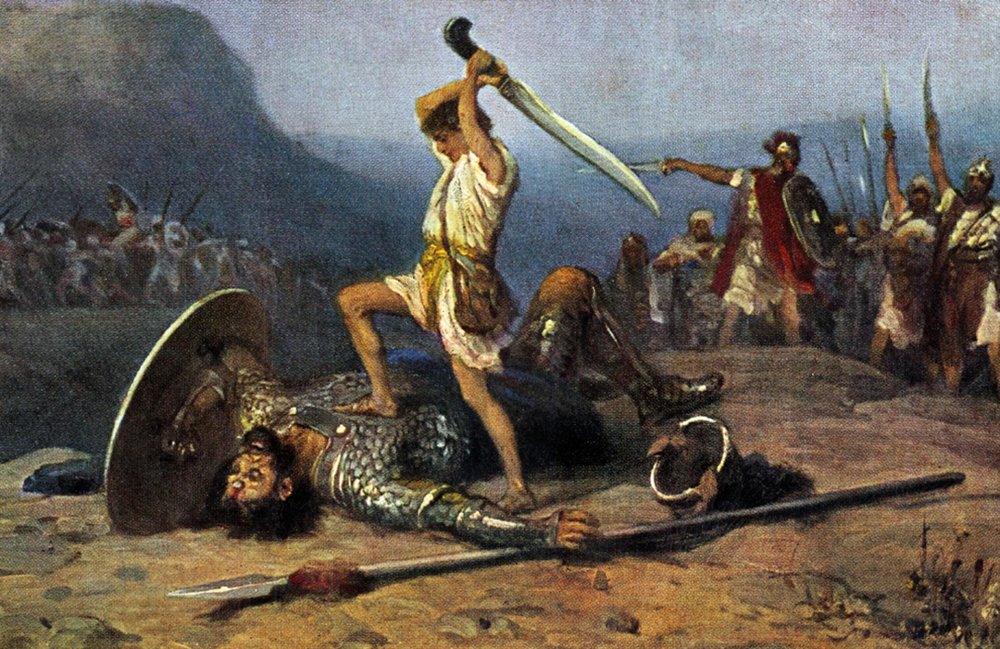
The story of David and Goliath is a favorite of children’s bibles. It features a shepherd boy named David and a Philistine giant and nemesis of Israel named Goliath who fancies himself invincible. The Israelite army is so terrified of Goliath that no one will sign up to fight him. David, however, indicates his willingness to fight Goliath to King Saul, who tries to outfit David in his armor for the battle, only to find out that he is a 42 long while David is a 34 short. So David goes to fight Goliath with nothing but a sling and some stones. But with these unassuming homespun tools, the little boy takes the big bully out:

Reaching into his bag and taking out a stone, David slung it and struck the Philistine on the forehead. The stone sank into his forehead, and he fell facedown on the ground. So David triumphed over the Philistine with a sling and a stone; without a sword in his hand he struck down the Philistine and killed him. David ran and stood over him. He took hold of the Philistine’s sword and drew it from the sheath. After he killed him, he cut off his head with the sword. David took the Philistine’s head and brought it to Jerusalem; he put the Philistine’s weapons in his own tent.  As soon as David returned from killing the Philistine, Abner took him and brought him before Saul, with David still holding the Philistine’s head. (1 Samuel 17:49-51, 54, 57)

One of the fascinating features of this story is not just that a young boy kills a towering warrior, but how David does it – he does it by striking Goliath in the head. The author of 1 Samuel seems to be quite taken by this because he uses the word “head” or “forehead” five times in these verses. Goliath’s head is so central to the image of David’s victory, that he carries the head around!

When Adam and Eve fall into sin, God curses the couple, but He also curses the one who tempted them into sin – Satan, who appears in the form of a snake. God warns Satan that there will come an offspring of Eve who will one day defeat him. But what is striking about God’s curse is not only that this offspring will crush Satan, but how he will do it. God says to the snake:

I will put enmity between you and the woman, and between your offspring and hers; he will crush your head, and you will strike his heel. (Genesis 3:15)

The offspring of this woman will crush Satan’s head.

This promise from God led the ancient Israelites to look for the fulfillment of this promise – someone who would come to save them from the sinful mess of this world by crushing the head of their enemies. They centered their hope around what they called the “Messiah,” which in Hebrew means, “anointed one.” The Israelites were looking for someone chosen and anointed by God to save them.

One chapter before the story of David and Goliath, God chooses a new king of Israel, who, unbeknownst to Saul, is Saul’s replacement. Who is this king? The giant-slayer David. God sends his prophet Samuel right before David kills Goliath to anoint him as the next king of Israel:

Samuel took the horn of oil and anointed David in the presence of his brothers, and from that day on the Spirit of the LORD came powerfully upon David. (1 Samuel 16:13)

Just a chapter later, after becoming Israel’s new “anointed one,” David crushes the head of Israel’s greatest enemy with a stone, which begs a question: Could David be the one? Could he be the Messiah?

We know from the rest of David’s story that he was not “the one.” The one who crushes Goliath’s head with a stone is crushed by his own sin when he has an affair with a woman who is not his wife and then has her husband murdered to cover up their relationship. David may have crushed the head of Goliath, but the head of the ancient snake was still spitting its poison of sin and death. The Messiah who would crush Satan’s head was still to come.

So often, when we see amazing people do amazing things – as David did with Goliath – we wonder: Could they be the one? Could they be the doctor who wipes out cancer? Could they be the politician that fixes our nation’s ills? Could they be the soulmate who mends our heart? Could they be the financial advisor who makes us rich? Could they be “the one”?

David’s story reminds us that there is only one who is “the one.” Placing our hopes in the wrong one will eventually and inevitably lead to disappointment and anger. Placing our hopes in Christ, however, will lead to salvation and peace. He is the one we’re looking for.

Dirt to Stars

Credit: Juan / Pexels.com

At the church where I serve, we end each service with a commission from the apostle Paul:

Shine like stars in the universe as you hold out the word of life. (Philippians 2:15-16)

This picture from Paul is tied to the very beginning of history.

When God creates the cosmos, He fashions a couple of ruling bodies. On creation’s fourth day, He speaks into existence the ruling bodies in the sky:

God said, “Let there be lights in the vault of the sky to separate the day from the night, and let them serve as signs to mark sacred times, and days and years, and let them be lights in the vault of the sky to give light on the earth.” And it was so. God made two great lights – the greater light to govern the day and the lesser light to govern the night. He also made the stars. God set them in the vault of the sky to give light on the earth, to govern the day and the night, and to separate light from darkness. And God saw that it was good. (Genesis 1:14-18)

The stars, moon, and sun, Genesis says, “govern” the day and night. They are heavenly ruling bodies.

Then, on the sixth day, He creates some more ruling bodies on the earth:

God said, “Let Us make mankind in Our image, in Our likeness, so that they may rule over the fish in the sea and the birds in the sky, over the livestock and all the wild animals, and over all the creatures that move along the ground.” So God created mankind in His own image, in the image of God He created them; male and female He created them. God blessed them and said to them, “Be fruitful and increase in number; fill the earth and subdue it. Rule over the fish in the sea and the birds in the sky and over every living creature that moves on the ground.” (Genesis 1:26-28)

Human beings, Genesis says, “rule” over all creatures. They are earthly ruling bodies.

As Genesis goes on to explain, these human beings who rule over the earth come from the earth:

The LORD God formed a man from the dust of the ground and breathed into his nostrils the breath of life, and the man became a living being. (Genesis 2:7)

And yet, there is this hope that human beings, like the heavenly ruling bodies, will not just be dirty and dark, but will shine like the lights in the sky. Sin, of course, dashes this hope when God tells Adam that He will return to the dirt:

Dust you are and to dust you will return. (Genesis 3:19)

But Paul restores this hope. He says we will “shine like stars in the universe” (Philippians 2:15). But how? Paul explains:

Do everything without grumbling or arguing, so that you may become blameless and pure, “children of God without fault in a warped and crooked generation.” (Philippians 2:14-15)

Paul says when we live without grumbling or arguing, we shine. We go from being dirt from the world to offering light and hope for the world.

This world is full of dirty stuff. Let’s not add to it by our grumbling and arguing. Let’s shine light on it by our joy and peacefulness. This is our world’s need – and the Church’s call.

Why We Need Easter

Credit: Anna Shvets / Pexels.com

In an article for The Washington Post, Emma Pattee writes about how the COVID-19 pandemic has brought us face-to-face with the reality of our mortality:

You probably remember where you were that day in March when you first realized that the novel coronavirus was something …

I remember where I was: driving to the gym for a Mommy & Me boot camp.

I pulled up to a red light and locked eyes with my 6-month-old baby in the rearview mirror. I felt unsettled and scared. I had an inexplicable urge to go home, and also to call everyone I knew and check on them. Yet nothing had happened. I was safe, healthy and employed. At that point, in mid-March, I was more likely to die of a car accident than of contracting covid-19 …

That eerie uncomfortable feeling has been described as grief. As fear. Or anxiety. But Sheldon Solomon, a social psychologist and professor at Skidmore College, has a more robust explanation: It is the existential anxiety caused by reminders of our own mortality.

Simply put, to function as a conscious being, it’s imperative that you be in denial about your impending death. How else would you go about the mundane aspects of your daily life – cleaning the gutters, paying the bills, sitting in traffic – if you were constantly aware of the inevitability of your own death?

Ms. Pattee goes on to cite studies that have found that we seem to be hardwired to fear death and to avoid thinking about it:

neurological study was published in 2019 about a mechanism in the brain that avoids awareness of a person’s own mortality and that categorizes death as something unfortunate that happens to other people. …

An Israeli study showed some participants a flier about death anxiety and others one about back pain. When subjects were then offered an alcoholic beverage, one-third of the death flier group bought alcohol vs. one-tenth of the back-pain group.

We don’t like death. And the day we celebrated yesterday – Easter – gives us an answer as to why.

Scripture’s story is that we were created not to die, but to live. But when our first parents, Adam and Eve, fell into sin, they reaped the wage of sin, which is death (Romans 6:23). But this wage disordered the way creation was designed to be. It was designed to be filled with life – not marred by death.

Our dislike and fear of death, then, can be rightly said to be a yearning for the way we know things “should be.” We should not have to mourn the loss of our loved ones. We should not have to struggle and suffer through a pandemic. We should not have to endure horrific acts of violence that lead to death like wars and mass shootings. We should not have to deal with death. We can sense that dealing with death is, in some way, profoundly unnatural.

This is why we need Easter. Easter is the beginning of a return to the way they were always supposed to be. As Timothy Keller puts it in his book Hope in Times of Fear:

The resurrection was indeed a miraculous display of God’s power, but we should not see it as a suspension of the natural order of the world. Rather it was the beginning of the restoration of the natural order of the world, the world as God intended it to be.

In other words, death is wrong. Resurrection is right. Life is what the world was designed for, which is why it’s what we yearn for. And our yearnings will be fulfilled.

Christ’s resurrection is not only a feat against death, but a forecast that death will not have the last word. Christ’s resurrection, the apostle Paul says, is a “firstfruits” of our own resurrections (1 Corinthians 15:20). As Christ is risen, we will rise. And death will die. This is the message and the promise of Easter.

I hope you celebrated Easter well yesterday. And I hope you’ll hold on to all that Easter is today – and every day.

A Texas Snowstorm

That was interesting.

I’ve lived in the Lonestar State since the mid-90s and I’ve never seen anything even close to what Texas just experienced. The snow in San Antonio – where I live – was beautiful. The power outages, frozen pipes, icy streets, and water pump failures that followed were not. An arctic air mass pushed way south and brought Texas record-shattering low temperatures that, in many areas, dipped into the single digits. The rock bottom temperatures managed to freeze out coal and gas power plants, a nuclear power plant, and a host of west Texas windmills, which forced the Electric Reliability Council of Texas, which manages the power for the state, to quickly ration power in order to prevent a catastrophic blackout that could have stretched on for months. Everyone who was not part of a grid that provided power to critical services like hospitals was left in the dark – and in the cold.

A natural disaster like this is certainly perspective-shifting. On the one hand, this kind of weather, and the havoc it brings, can make you feel powerless. Human ingenuity can constrain – but it cannot restrain – the effects of the natural world. On the other hand, a disaster like this can remind you of the things for which you should be thankful, but that you also usually overlook. Reliable power. Running water. Climate control. You don’t notice these things until you don’t have them.

Of course, a time like this can bring out the best in people. Neighbors did help neighbors. People who had power opened their homes to those who did not. The long line I waited in to buy groceries at a dark H-E-B that had only enough generator power to operate a few checkout lines was full of generally chipper and friendly people who were thankful that the chain was doing everything it could to provide Texans with the staples they needed.

In Acts 27, the apostle Paul is sailing for Rome when he encounters a massive storm. For fourteen days, Paul and the crew on the ship hang on for dear life. They finally wash ashore on the island of Malta, where they encounter some friendly residents:

The islanders showed us unusual kindness. They built a fire and welcomed us all because it was raining and cold. (Acts 28:2)

I’ve come to appreciate a good fire when it’s cold.

But just when it looks like Paul’s luck is finally changing, tragedy strikes again:

Paul gathered a pile of brushwood and, as he put it on the fire, a viper, driven out by the heat, fastened itself on his hand. When the islanders saw the snake hanging from his hand, they said to each other, “This man must be a murderer; for though he escaped from the sea, the goddess Justice has not allowed him to live.” But Paul shook the snake off into the fire and suffered no ill effects. The people expected him to swell up or suddenly fall dead; but after waiting a long time and seeing nothing unusual happen to him, they changed their minds and said he was a god. (Acts 28:3-6)

Of course, Paul is neither a murderer nor a god. But he does serve the one, true God – the God who saw him through this terrible storm. And this is what Christians still believe – that for every crisis, every storm, and every difficulty, there is a God who sees us through. And even though He doesn’t protect us from every tragedy, He is present with us through every tragedy.

As Texas’s power grid continues to stumble back online, there will be changes to the grid that will need to be made, officials who will need to be held accountable, heroes who will need to be thanked, and people who will need our help. But through it all, we can be thankful that the God who made the world – and us – cares for us. This is why He sent the One the prophet Malachi called “the sun of righteousness” (Malachi 4:2) – Jesus Christ – to us.

The “sun” sounds awfully nice right now.

A March for Life

This past Friday was the 48th annual March for Life. As with many other events, this year’s march looked different from every previous year. It was held virtually in response to the continued spread of COVID-19. The virtual nature of the march, however, did not mute its message. Since abortion was legalized in 1973, an estimated 62 million babies have been lost. And though the number of abortions is going down overall, there have been some pockets of increases.

The fierce fights over abortion show no sign of abating. Sadly, the topic has often been treated more as ammunition in a culture war instead of a pressing moral question with life and death consequences. So many pay a hefty price each time an abortion is performed.

First, there is a baby who pays the price of his or her very life. The heartbeat of a child in utero can usually be detected between the third and fourth week of development. This means that any abortion performed after this stops a beating heart. Scientifically, there is a broad consensus that the life of a human organism begins even earlier – right at conception. In a recent study at the University of Chicago, 95 percent of biologists surveyed, many of whom self-identified as pro-choice, agreed that life begins at fertilization. Many Christians believe that life begins at conception because, Scripturally, life is celebrated and sacralized throughout a child’s development in utero. As the Psalmist says to God about his own creation and gestation:

You created my inmost being; You knit me together in my mother’s womb. I praise You because I am fearfully and wonderfully made; Your works are wonderful, I know that full well. My frame was not hidden from You when I was made in the secret place, when I was woven together in the depths of the earth. Your eyes saw my unformed body; all the days ordained for me were written in Your book before one of them came to be. (Psalm 139:13-16)

Second, there is the mother who pays a price. For every high profile incident of people celebrating abortion, there are other instances of women who struggle with regret or outright emotional trauma. And these struggles can present themselves long after the event – often 10 to 15 years later. The price of a broken or guilt-ridden heart cannot and must not be overlooked.

Third, low-income communities pay a price. Half of all women who get abortions live below the poverty line, and 75 percent of women who get abortions are low-income. Many of these women choose to abort because they know they will be single mothers if they carry their babies to term and they are scared that they will not have the resources or support needed to raise a child. Their decision to abort, then, is less of a freely-willed choice and more of a perilous predicament that forces the hands of already hurting women.

We must count the cost of abortion. We must stand up for those who bear the burden of abortion. We can stand up for children in utero and advocate for their lives. We can stand up for women who struggle and lovingly present alternate ways forward if they are considering an abortion or offer grace and support to those who are struggling with the decision they made to have an abortion. We must stand up for impoverished communities by promoting the value of families, by holding men who would run from their responsibilities as fathers accountable, and by offering what we can in the way of financial resources, friendships, and modeling to demonstrate different and more hopeful paths forward for at-risk women who become pregnant.

For me, abortion is personal. I have two children because of the choice of two incredible women to put their babies up for adoption. I have a family because two women chose life. To them, I offer a teary-eyed “thank you.” Your choice for life changed my life. And the chain can continue. More choices for life can change more lives.

What a great choice to make.