Obergefell v. Hodges

Arguments at the United States Supreme Court for Same-Sex Marriage on April 28, 2015When the Supreme Court ruled on Obergefell v. Hodges[1] a little over a week ago, the verdict was not a surprise, but the reaction was fierce. Facebook profiles and even the White House went rainbow. Crowds gathered to celebrate and shed tears of joy. Others were not nearly so jubilant. Jonathan Saenz, President of Texas Values, issued this statement:

This decision is the most egregious form of judicial activism of our time, overriding the votes of over 50 million voters, including millions in Texas. The freedom to democratically address society’s most fundamental institution is central to ordered liberty. The Court has taken that freedom from the people.

This decision has no basis in the text of the Constitution and will never be accepted by millions of Americans and Texans that understand that marriage, by nature and God’s design, can only be the union of a man and woman, husband and wife, mother and father. No decision by five judges can ever alter this fundamental truth.[2]

As Christians, it can be hard to know what to say or where to stand. The day the Supreme Court’s decision came down, I offered some initial reflections with the promise of more to come. These are those further reflections.  Though these reflections will not address every concern, they will hopefully give us a way to begin to think theologically and pastorally about what has transpired and help us live together peacefully and in love.

What Scripture Says

As I said in my original blog on the Supreme Court’s decision, we need to remain committed to what Scripture says about all our relationships and, specifically, those that are deeply intimate in nature. But we also must remember that our understanding of Scripture can prove fallible. It is easy to fall prey to foolish and sloppy readings of what the Bible has to say on sexual ethics, making assumptions that are based more in our cultural biases than in careful exegetical study. As William Eskridge explains in an article for The New York Times:

Biblical support for slavery, segregation and anti-miscegenation laws rested upon broad and anachronistic readings of isolated Old Testament passages and the Letters of Paul, but without strong support from Jesus’ teachings in the Gospels … The current … view that God condemns “homosexual behavior” and same-sex marriages comes from the same kind of broad and anachronistic scriptural readings as prior support for segregation.[3]

Although Eskridge’s assumed contradiction between what Jesus taught and what the rest of the Bible has to say is problematic, he does have a point: we have not always gotten things right.

So how do we avoid misreading Scripture on gay marriage? To begin with, we must never handpick proof texts without context. Arguments made in this way against gay marriage are not only not persuasive theologically, they’re also not solid methodologically.  A better hermeneutical case for traditional marriage can be made by looking at the sweep and scope of Scripture. Scripture begins (Genesis 2:24) and ends (Revelation 19:7) with the wedding of a bride and her groom. Jesus affirms both God’s creational and eschatological pattern for this staid institution as one that involves a husband and a wife (Matthew 19:4-6). Furthermore, when this pattern for marriage is abandoned, the results never seem to be good (e.g., Genesis 29:30; 1 Kings 11:1-4; Proverbs 6:32; 1 Corinthians 5:1-2).

The Bible does not seem to be nearly so concerned with condemning gay marriage specifically as it is with affirming God’s design for marriage generally – and not just because deviating from God’s design is morally wrong, though, in fact, it is, but because it is personally hurtful. Marriage has not only a moral design; it has a compassionate intent. This is why God institutes it as gracious gift (cf. Genesis 2:18).  The biblical authors do not want people to miss out on God’s gracious gift by not receiving it as God intended it.

How We Say What Scripture Says

When speaking about same-sex marriage, we must stop embracing and employing over-the-top rhetoric. A pastor who threatens, even if figuratively, to immolate himself if the Supreme Court allows for nationwide gay marriage sounds, and perhaps is, insane. A preacher who drops the Supreme Court’s ruling to the ground while holding up the Bible in the middle of his sermon may garner some applause from the faithful, but such grandstanding does nothing to contribute to civil and important conversation.

I can’t help but wonder if the reason we are sometimes tempted by such silly stunts is because we live with a kind of Chicken Little apocalypticism. We really are afraid the sky is falling. But it is not.

Chief Justice John Roberts, in his dissenting opinion, writes:

The Court today not only overlooks our country’s entire history and tradition but actively repudiates it, preferring to live only in the heady days of the here and now. I agree with the majority that the “nature of injustice is that we may not always see it in our own times.” … As petitioners put it, “times can blind.” … But to blind yourself to history is both prideful and unwise.

This is well stated. As Justice Roberts notes, the ethical stances of yesteryear are by no means unimpeachable, but they are also not meant to be thoughtlessly discardable in an assumed inexorable evolutionary advancement toward ethical nirvana. C.S. Lewis would remind us that there is a “great cataract of nonsense that pours from the press and the microphone of [our] own age.”[4] In other words, we’re not as enlightened or as advanced as we think we are.

Thus, we need not fear. What is happening now does not mean the sky is falling. It simply means that history is marching – sometimes wisely and sometimes foolishly. Waiting and watching to see what comes of “the heady days of the here and now” is a much smarter – and, I would add, much less stressful – option than opining about the doom and gloom that lurks around the corner.

Religious Liberty and Pastoral Care

Sadly, the Supreme Court’s decision does raise real concerns over religious liberty. In the majority opinion, Justice Kennedy addresses these concerns, writing:

It must be emphasized that religions, and those who adhere to religious doctrines, may continue to advocate with utmost, sincere conviction that, by divine precepts, same-sex marriage should not be condoned. The First Amendment ensures that religious organizations and persons are given proper protection as they seek to teach the principles that are so fulfilling and so central to their lives and faiths, and to their own deep aspirations to continue the family structure they have long revered.

Justice Kennedy’s synopsis of the First Amendment is interesting – and troubling. He sees the First Amendment as protection to “teach the principles that are so fulfilling and so central to … lives and faiths.” This is well and good. But what happens when teaching faith translates into living faith?  What happens when those living their faith intersect with others who do not share their faith? Does religious protection now extend only to what one says?

The dissenting justices are rightfully skeptical of the majority’s nod to and definition of religious liberty. Justice Thomas Roberts warns:

Religious liberty is about more than just the protection for “religious organizations and persons … as they seek to teach the principles that are so fulfilling and so central to their lives and faiths.” … Religious liberty is about freedom of action in matters of religion generally, and the scope of that liberty is directly correlated to the civil restraints placed upon religious practice.

It is not just paranoid, martyrly Christian activists who have concerns about the narrowing parameters for religious liberty; it is a sitting justice of the Supreme Court. So how are we to respond?

I would argue that the best way to respond to threats against religious liberty is not politically, but pastorally. This is not to say that Christians should never be involved in politics; it is only to say that politics must take the backseat to love. So rather than offering a political strategy, allow me to share a few pastoral thoughts.

What makes same-sex marriage an ethically thorny issue is that it simultaneously aches for something that deserves our compassion while also promoting something that calls for our repudiation. On the one hand, the desire to marry someone to whom you are attracted, whether that person is of the same or opposite sex, represents an ache for companionship. This is why, in the majority opinion, Justice Kennedy writes:

From their beginning to their most recent page, the annals of human history reveal the transcendent importance of marriage. The lifelong union of a man and a woman always has promised nobility and dignity to all persons, without regard to their station in life. Marriage is sacred to those who live by their religions and offers unique fulfillment to those who find meaning in the secular realm. Its dynamic allows two people to find a life that could not be found alone, for a marriage becomes greater than just the two persons. Rising from the most basic human needs, marriage is essential to our most profound hopes and aspirations.

Such an ache for companionship not only ought to be acknowledged, it ought to be affirmed by all Christians. God did, after all, create us as relational beings (cf. Genesis 2:18). Desire for companionship, regardless of whether you are gay or straight, is perfectly normal and natural.

At the same time the Bible affirms the human ache for companionship, however, it also puts boundaries on how such companionship is expressed erotically and, ultimately, maritally. Again and again, the Bible calls upon us to control our desires – erotic and otherwise (cf. James 1:14-15). Though such a call runs quite contrary to the spirit and sensibilities of our age, Christians must continually uphold this call in their speaking and living.

Tragically, many Christians have spent so much time proclaiming that people must control their desires that they have forgotten to empathize with them in their loneliness. People who are romantically attracted to the same sex have much deeper and more profound needs than just sex. They, like everyone, need love, which we must be prepared to show, lest we defy the command of Christ: “By this all men will know that you are My disciples, if you love one another” (John 13:35).

Ultimately, we must never forget that same-sex marriage involves people. Indeed, though nearly everyone knows the Supreme Court has now legalized nationwide same-sex marriage, few know the particulars of the plaintiff who brought the case. Jim Obergefell married John Arthur three months and 11 days before John died. Jim knew their marriage would not last long because, when they wed, John was in the dying throws of ALS. Jim brought a case to the Supreme Court because he wanted to be listed as the surviving spouse on John’s death certificate in Ohio, a state that heretofore did not allow for gay marriage. Their story, then, is not just about gay marriage. It’s also about sickness, sadness, and caregiving – all universal themes to the human experience. Even as we express concerns over same-sex marriages, we must also recognize that the people in them do things that are noble and hold values that we share.

Decrying same-sex marriage with protests, rallies, and votes will not change hearts. Love, however, just might. So let’s focus on what people actually need – not a vote against them, but love for them. In today’s milieu of broad and fierce political support for same-sex marriage, it is probably our only option. But that’s okay. Because it just so happens that it’s also our best option.

_________________________________

[1] Obergefell v. Hodges, 576 U.S. (2015).

[2] William Eskridge cited by David Walls, “Supreme Court’s Marriage Ruling Is Egregious Attack On Democracy, Will Never Be Accepted,” Texas Values (6.26.2015).

[3] William Eskridge, “It’s Not Gay Marriage vs. the Church Anymore,” The New York Times (4.25.2015).

[4] C.S. Lewis, “Learning in War-Time,” The Weight of Glory, Walter Hooper, ed. (San Francisco: HarperSanFrancisco, 2001), 59.

A Pastoral Statement on Today’s Supreme Court Decision

Supreme Court InteriorAs you have no doubt probably heard by now, the Supreme Court of the United States has legalized same-sex marriage in all 50 states. At the church where I serve, the pastoral team is working to address some of the issues involved in this ruling, including potential repercussions for religious liberty, but for now, I want to offer three brief thoughts.

First, as Christians, we need to continue to be committed to what God’s Word has to say about all our relationships and, specifically, those relationships that are deeply intimate in nature. Sexual integrity is a much bigger issue than whether or not you support same-sex marriage. Sexual integrity touches nearly every aspect of our lives – from how we guard our purity if we are single to how we appropriately relate to our coworkers and friends to how we hold sacred our most intimate moments if we are married.  God has put boundaries on sexuality and intimacy not to needlessly constrict us, but to lovingly protect us.

Second, as with any major cultural shift, reactions to the Supreme Court ruling have been instantaneous and, in many cases, extreme. Some are unfettered in their celebration. Others are paralyzed by deep trepidation. As Christians, we are called to be measured in our words and peaceful in our hearts, always and fully trusting in God’s providence. We do not need to join our culture in its emotionally charged reactions. We have nothing to fear.

Third, please remember to be kind in any reactions and responses you may offer to the Supreme Court ruling. Chief Justice John Roberts, in his dissenting opinion, expressed concern about how we regularly feel “compelled to sully those on the other side of the debate.” As Christians, we should never sully others. We can disagree with others without hating them. On Facebook, I saw a simple thought that expresses well how we ought to dialogue about the Supreme Court ruling on same-sex marriage: “We don’t have to agree on anything to be kind to one another.” This is exactly right. For this reflects the very character of our God. As the Psalmist says, “God’s merciful kindness is great toward us: and the truth of the LORD endures forever” (Psalm 117:2). Like our Lord, may we be people of merciful kindness and truth. It’s what our world needs – now, more than ever.

S.B. 1062

Credit:  LA Times
Credit: LA Times

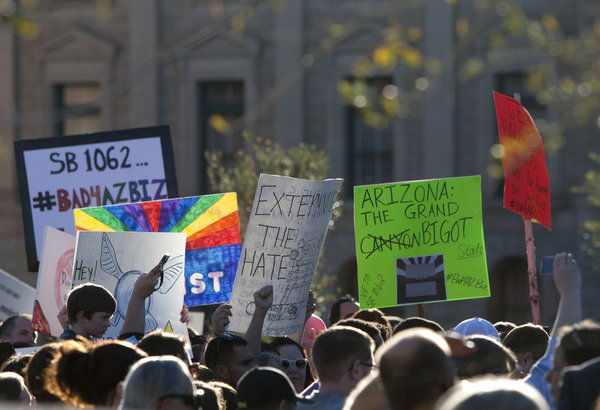
A funny thing happened on my way back from a recent trip I took to Arizona.  The state became embroiled in a heated political battle over Senate Bill 1062.[1]  Okay, it may not have been funny.  But these kinds of battles are common.

According to some, S.B. 1062 championed religious liberty, allowing business owners with religious convictions to deny service to a party if the business owner felt that serving that party would substantially burden or contradict his religious convictions.  According to others, S.B. 1062 violated the civil rights of homosexuals by formally and legally legitimatizing discrimination against them.

Last Wednesday, Governor Jan Brewer vetoed the bill, explaining, “I have not heard of one example in Arizona where business owners’ religious liberty has been violated … The bill is broadly worded and could result in unintended and negative consequences.”[2]  Of course, the political pressure on Governor Brewer was hot:

Companies such as Apple Inc. and American Airlines, and politicians including GOP Sen. John McCain and former Republican presidential nominee Mitt Romney were among those who urged Brewer to veto the legislation. The Arizona Super Bowl Host Committee, which is overseeing preparations for the 2015 game, came out with a statement against the legislation. The Hispanic National Bar Association on Wednesday said it canceled its 2015 convention in Phoenix over the measure.[3]

In observing the volley between supporters and detractors of this bill, two things strike me.

First, homosexuality – and, specifically, gay rights – is not only a hot topic in our society, it is the hot topic in our society.  Interestingly, nowhere does S.B. 1062 mention homosexuality.  It simply speaks of “the free exercise of religion.”  Yet, USA Today reported on Governor Brewer’s veto of the bill with this headline:  “Arizona governor vetoes anti-gay bill.”[4]  These days, how a piece of legislation will affect the gay community is the litmus test as to whether or not a bill can or should pass, even if that bill does not specifically mention the gay community.  Gay rights, then, are front and center.  They are the battleground du jour of our society.

Second, there are a lot of homosexuals who deeply despise Christians with orthodox beliefs concerning the sinfulness of homosexual activity and will go to great – and even duplicitous – lengths to paint Christians as homophobic bigots.  Stories abound of people who have concocted heinous hate crimes against themselves.  Take, for instance, the lesbian couple that spray-painted their own garage with the message “Kill the gay.”[5]  Or how about the Tennessee man who falsely claimed that three men beat him and robbed his store in an anti-gay attack?[6]  Then, of course, there was the famed incident of the waitress who falsely claimed she was stiffed on a tip because she was a lesbian.[7]  Personally, I don’t want to think of anyone in the homosexual community as my enemy.  Life is too short to keep an enemies’ list.  But I am not so naïve as to believe that there aren’t some in the homosexual community who think of me as their enemy.

So what am I to do?

Jesus’ admonition to pray for those who are on the outs with you (cf. Matthew 5:44) seems to be especially apropos for a time such as this.  To this end, I would invite you to join me in praying for three things as the culture war over sexual rights continues to rage.

First, pray for forgiveness.  Though it is painful to admit, it was not too long ago that it was exponentially more likely for a message like “Kill the gay” to be spray painted not by someone self-imposing a hate crime, but by someone committing one.  And sometimes, that someone was even a self-professed Christian.  This, of course, directly defies a myriad of biblical commandments concerning our conduct as Christians.  Our call to tell the truth about sin must never be a license to commit sin – especially the sin of hate.  We need forgiveness for our missteps – which are plenty – in this debate.

Second, pray for understanding.  I want to be understood.  I want people to understand and believe that I am not a homophobic hate monger who wants to oppress, humiliate, and exile those who do not share my same faith and ethical commitments.  But if I want this for myself, it is only fair that I afford the same courtesy to others.  Martin Luther summarized the Eighth Commandment by saying that, when dealing with our neighbors, we should “put the best construction on everything.”[8]  I can think of no better way to respond to those who put the worst construction on Christians’ intentions than by putting the best construction on theirs.  Generous understanding offers our greatest hope for peace in the midst of a hotly contested and, sadly, dirtily fought culture war.

Third, pray that true love would prevail.  The “true” is just as important as the “love” here, for our society has settled for a counterfeit love that reduces love to nothing more than tolerance.  Just the other day, I heard a caller to a radio talk show explain how one of the primary virtues of Christianity is tolerance.  Really?  A quick search of the word “tolerate” in the Bible brings up verses like these:

  • Whoever slanders their neighbor in secret, I will put to silence; whoever has haughty eyes and a proud heart, I will not tolerate. (Psalm 101:5)
  • Your eyes are too pure to look on evil; You cannot tolerate wrongdoing. Why then do You tolerate the treacherous? (Habakkuk 1:13)
  • It is actually reported that there is sexual immorality among you, and of a kind that even pagans do not tolerate: A man is sleeping with his father’s wife. (1 Corinthians 5:1)

Tolerance does not seem to be the high brow Scriptural virtue that some would like to peddle it as.  This is not to say that we shouldn’t live with, work alongside with, and care for people who do not share our same moral commitments.  In this way, we should indeed be tolerant.  But tolerance does not necessarily entail endorsement.

Ultimately, as Christians, we ought to aspire to a much higher value than that of tolerance.  We ought to aspire to love.  “Love,” the apostle Paul reminds us, “does not delight in evil but rejoices with the truth” (1 Corinthians 1:6).  To love someone well, we must tell him the truth, even when the truth is unpopular.  This is our calling with all sin – sexual and otherwise.

So these are my prayers.  Now, it’s your turn.  Will you join me in praying the same?


[1] S.B. 1062, 51st Leg., 2nd sess. (Ariz. 2014).

[2] Aaron Blake, “Arizona governor vetoes bill on denying services to gays,” The Washington Post (2.26.2014).

[3] Bob Christie, “Arizona Religious Bill That Angered Gays Vetoed,” ABC News (2.27.2014).

[4] Dan Nowicki, Yvonne Wingett Sanchez and Alia Beard Rau, “Arizona governor vetoes anti-gay bill,” USA Today (2.26.2014).

[5] Alyssa Newcomb, “Lesbian Couple Charged With Staging Hate Crime,” ABC News (2.19.2012).

[6] Chuck Ross, “Report: Man falsified police report in alleged anti-gay attack,” The Daily Caller (12.26.2013).

[7]  Cavan Sieczkowski, “New Jersey Waitress In Anti-Gay Receipt Saga Reportedly Let Go From Job,” The Huffington Post (12.9.2013).

The Downfall of DOMA

Supreme Court 1The headline was welcomed with both cheers and tears:  “Supreme Court strikes down Defense of Marriage Act.”[1]  For some, this ruling was a welcomed vindication – and indication that the argument for same-sex marriage had not only won the day in the Supreme Court, but in the court of public opinion.  Others were saddened and even embittered.  Former Arkansas Governor and presidential candidate Mike Huckabee tweeted:  “My thoughts on the SCOTUS ruling that determined that same sex marriage is okay:  ‘Jesus wept.’”[2]

So how is a Christian to respond to this ruling?  There are two things I believe that are paramount to any Christian’s response.

The first is humility.  Responding with bravado – either for or against this ruling – is not helpful.  Whether it be the raucous celebrations of many of this ruling’s supporters or the vitriolic denouncements of many of this ruling’s detractors, anything less than a humble and gentle spirit leads to combat rather than conversation.   And as I have written elsewhere, simply trying to win against each other rather than listening to each other means that no matter who supposedly “wins,” everybody loses.[3]

The second thing needed is honesty.  Christians need not compromise moral conviction when it comes to human sexuality.  We simply must hold to our convictions humbly rather than haughtily.  The biblical moral vision for human sexuality is clear:  sexual intimacy is to be reserved for a husband and wife in the lifelong covenant of marriage (cf. Genesis 2:24-25).  Deviations from this – be they fornication, adultery, or homosexuality – are prohibited by Holy Writ.  It’s okay to say this.  It’s okay to stand up for this.  It’s okay to make a moral pronouncement on marriage.

Indeed, as I have thought through the court’s ruling on DOMA, I find Justice Kennedy’s majority opinion to have far reaching moral implications:

The avowed purpose and practical effect of the law here in question are to impose a disadvantage, a separate status, and so a stigma upon all who enter into same-sex marriages made lawful by the unquestioned authority of the States.

The history of DOMA’s enactment and its own text demonstrate that interference with the equal dignity of same-sex marriages, a dignity conferred by the States in the exercise of their sovereign power, was more than an incidental effect of the federal statute. It was its essence. The House Report announced its conclusion that “it is both appropriate and necessary for Congress to do what it can to defend the institution of traditional heterosexual marriage. … H. R. 3396 is appropriately entitled the ‘Defense of Marriage Act.’ The effort to redefine ‘marriage’ to extend to homosexual couples is a truly radical proposal that would fundamentally alter the institution of marriage.”… The House concluded that DOMA expresses “both moral disapproval of homosexuality, and a moral conviction that heterosexuality better comports with traditional (especially Judeo-Christian) morality.” … The stated purpose of the law was to promote an “interest in protecting the traditional moral teachings reflected in heterosexual-only marriage laws.”[4]

In Justice Kennedy’s opinion, DOMA was drafted and passed into law with the express purpose of interfering “with the dignity of same-sex marriages.”  How does he know this?  Because DOMA demonstrates “both moral disapproval of homosexuality, and a moral conviction that heterosexuality better comports with traditional (especially Judeo-Christian) morality.”  In other words, Justice Kennedy claims that the Judeo-Christian morality in which DOMA is grounded diminishes the dignity of same-sex marriages.  Such a diminishment cannot be tolerated.  It is, in a word, illegal.  This is why DOMA must be overturned.

The duty of the Supreme Court justices is to render legal decisions.  But every legal decision carries with it an indissoluble moral component.  In this instance, this legal decision’s moral component is in the declaration that a law based on the Judeo-Christian sexual moral standard is discriminatory and illegal.  Such a pronouncement replaces the Judeo-Christian sexual moral standard with a sexual moral standard of its own – one that is open to same-sex marriage while still, interestingly enough, discriminating against other forms of marriage (e.g., polygamy).  Thus, what Justice Kennedy and the Supreme Court majority have done is issued not only a legal opinion, but a moral valuation.

Laws are irreducibly moral.  Laws against murder or perjury or theft inevitably promote some vision of what morality is and means. Thus, even the justices of the Supreme Court cannot render a strictly amoral legal verdict on whether or not to federally recognize same-sex marriages.  What they declare on this issue will always, in some way, involve judgments of and on morality.  The question we must ask ourselves is, “Is the morality of the Supreme Court majority the right morality?”

Justice Kennedy has given his answer.  What’s yours?


[2] Mike Huckabee, twitter.com/govmikehuckabee (6.26.2013).

[3] Zach McIntosh, “The State Of Our Public Debate: Same-Sex Marriage As A Test Case,” zachmcintosh.com (4.8.2013).

[4] United States v. Windsor, 570 U. S. 1 (2013).

The State Of Our Public Debate: Same-Sex Marriage As A Test Case

Red Equal SignWhen the Facebook page of the Human Rights Campaign changed their profile picture to a red and pink equal sign on March 25 in anticipation of the Supreme Court hearing cases on the constitutionality of Proposition 8, which prohibits same-sex marriage in California, and the Defense of Marriage Act, which restricts federal marriage benefits to only opposite sex marriages, the response of many in the Facebook universe was nearly instantaneous.  By the time the Supreme Court was listening to arguments for and against Proposition 8 the next day, roughly 2.7 million people had changed their profile pictures to the red and pink equal sign.[1]

Welcome to the way we debate and discuss watershed issues in the digital age.  We post a profile picture.

As I have watched the national debate over same-sex marriage unfold, I have been struck by the daftness of so many of the arguments concerning such a monumental issue.  As a Christian, I have grave theological and moral concerns with same-sex marriage, but others have registered cogent concerns with same-sex marriage quite apart from the traditional moorings of biblical Christianity.  For instance, in their book What Is Marriage? Man and Woman: A Defense, Sherif Girgis, Ryan Anderson, and Robert George offer an excellent argument for traditional or, as they call it, conjugal marriage over and against a revisionist view of marriage.  The heart of their argument is this:

If the law defines marriage to include same-sex partners, many will come to misunderstand marriage.  They will not see it as essentially comprehensive, or thus (among other things) as ordered to procreation and family life – but as essentially an emotional union…If marriage is centrally an emotional union, rather than one inherently ordered to family life, it becomes much harder to show why the state should concern itself with marriage any more than with friendship.  Why involve the state in what amounts to the legal regulation of tenderness?[2]

The authors’ argument is simple, yet brilliant.  Those who argue for same-sex marriage seem to define marriage based strictly on affection.  But there are many relationships that are affectionate, such as friendships, and yet are not state-regulated.  So marriage must be something more than simple affection.  But what more is it?  This is a question that proponents of same-sex marriage have a difficult time answering with any uniformity.

Sadly, the work of these authors has not been well received or responded to.  Ryan Anderson, appearing on the Piers Morgan Show to explain the arguments of his book, was attacked by Suze Orman who dismissed him as “very, very uneducated in how it really, really works.”[3]  Considering that Anderson is a fellow at the Heritage Foundation who received his degree from Princeton and is currently working on a Ph.D. from the University of Notre Dame, I find it hard to believe that he is “very, very uneducated.”

In another example of supporters of traditional marriage being flippantly dismissed, Kevin Drum of Mother Jones took Ross Douthat of the New York Times to task for daring to suggest that an orientation toward procreation ought to be part of the definition of what constitutes a marriage:

It was opponents [of same-sex marriage], after realizing that Old Testament jeremiads weren’t cutting it any more, who began claiming that SSM should remain banned because gays couldn’t have children. This turned out to be both a tactical and strategic disaster, partly because the argument was so transparently silly (what about old people? what about women who had hysterectomies? etc.) and partly because it suggested that SSM opponents didn’t have any better arguments to offer. But disaster or not, they’re the ones responsible for making this into a cornerstone of the anti-SSM debates in the aughts.[4]

In his response, Douthat questions Drum’s account of the origin of the procreation argument for traditional marriage:

If gay marriage opponents had essentially invented a procreative foundation for marriage in order to justify opposing same-sex wedlock, it would indeed be telling evidence of a movement groping for reasons to justify its bigotry. But of course that essential connection was assumed in Western law and culture long before gay marriage emerged as a controversy or a cause. You don’t have to look very hard to find quotes…from jurists, scholars, anthropologists and others, writing in historical contexts entirely removed from the gay marriage debate, making the case that “the first purpose of matrimony, by the laws of nature and society, is procreation” (that’s a California Supreme Court ruling in 1859), describing the institution of marriage as one “founded in nature, but modified by civil society: the one directing man to continue and multiply his species, the other prescribing the manner in which that natural impulse must be confined and regulated” (that’s William Blackstone), and acknowledging that “it is through children alone that sexual relations become important to society, and worthy to be taken cognizance of by a legal institution” (that’s the well-known reactionary Bertrand Russell).

Douthat ends his response to Drum with a brilliant one-liner:  “Once you’ve rewritten the past to make your opponents look worse, then you’re well on your way to justifying writing them out of the future entirely.”[5]

This line, more than any I have read in a long time, encapsulates the problem with our public debates – not just over same-sex marriage, but over many controversial issues.  No longer are people interested in debating a big issue with the kind of intellectual rigor or careful thought such issues deserve. Instead, we change our Facebook profiles to an equal sign.  Or we ridicule a Notre Dame Ph.D. candidate as “uneducated.”  Or we make patently false claims about the historical origins of our opponents’ arguments.  We try to write our opponents out of the future entirely.

We, it seems, are much less interested in intelligently discussing and debating an issue and much more interested in asserting our will on an issue.  We no longer care whether or not we arrive at the right position on an issue as long as others bow to our position on an issue.  And, lest I be accused of intimating that only proponents of same-sex marriage engage in such dubious debate tactics, let me be clear that I have seen opponents of same-sex marriage pull these same kinds of sorry tricks.  After all, they’re on Facebook too.  They host cable news shows too.  They write less than thoughtful columns too.

The nihilist Nietzsche seemed to take special delight in laying bare the basest corners of human nature.  In his seminal work Beyond Good and Evil, he summarizes his thoughts on the heart of humanity:  “A living thing seeks above all to discharge its strength – life itself is Will to Power.”  Nietzsche purported that people, at their cores, desire to assert Machiavellian power over others much more than they ever desire to converse with others.  This is why Nietzsche saw “slavery in some sense or other”[6] as necessary to human advancement.  Those who are strong must assert their wills over those who are weak.

As I have watched the debate over same-sex marriage unfold, I have become worried that Nietzsche just might be right.  In this debate, winning against the other side has become more important than discussing and reasoning with the other side to arrive at the right side.  And because of that, I can’t help but think that, no matter who wins, we might just all lose.


[1] Alexis Kleinman, “How The Red Equal Sign Took Over Facebook, According To Facebook’s Own Data,” The Huffington Post (3.29.2013).

[2] Sherif Girgis, Ryan Anderson & Robert George, What Is Marriage?  Man and Woman:  A Defense (New York:  Encounter Books, 2012), 7, 16.

[5] Ross Douthat, “Marriage, Procreation and Historical Amnesia,” The New York Times (4.2.2013).

[6] Friedrich Nietzsche, Beyond Good and Evil (New York:  The Macmillan Company, 1907), 20, 223.