You Don’t Want To Be Number One

"Moses with the Tablets of the Law" by Rembrandt, 1659 Credit: Wikipedia
“Moses with the Tablets of the Law” by Rembrandt, 1659
Credit: Wikipedia

Idolatry is rampant in our society.  And this is no surprise.  After all, people have loved to worship, serve, and trust in gods of their own making for millennia now.  From money to sex to power to education to an obsession with whatever rights we think we’re supposed to have, we have no shortage of gods on hand and in our hearts.  And idolatry begins when we are young.

I remember a chapel service I conducted for a childcare center at the church I used to serve.  I was talking to the kids about the First Commandment, which I paraphrased like this:  “God is number one.”  It was with this paraphrase that I heard a little two year old voice pipe up from the back of the room:  “No!” the voice protested, “I’m number one!”  I was taken aback.  So I tried to clarify:  “You are special and important,” I said, “But God is number one.  He’s number one over everything.”  The voice, however, wasn’t buying it.  “No!  I’m number one!” it fired back.

By the end of my chapel message, it was almost comical.  Whenever I said, “God is number one,” this little voice would respond, “No!  I’m number one!”  It seems the idolatrous desire to take God’s place is ingrained in us from the earliest of years.

Martin Luther comments on the First Commandment:

Now this is the work of the First Commandment, which enjoins, “Thou shalt have no other gods.” This means, “Since I alone am God, thou shalt place all thy confidence, trust, and faith in Me alone and in no one else.”[1]

I love how Luther describes the spirit of the First Commandment not in terms of obedience, but in terms of faith.  In the First Commandment, Luther explains, God invites us to trust in Him rather than in the idols we make for ourselves.  Why?  Because the idols we make for ourselves take from us, hurt us, and condemn us. The true God, however, gives to us, blesses us, and saves us.  Idols pain us.  The true God comforts us.

The pain of idolatry becomes especially acute when the idols we make for ourselves happen to be ourselves.  When we are our own gods, we are inevitably left disparaging and hating ourselves, for we fail ourselves and find that we are not the kinds of gods we need ourselves to be.

The First Commandment, then, is not just a dictate, but a promise – a promise that we do not have to worry about running everything as number one gods.  The real God already has that number one spot – and all the responsibility and peril that comes with it – covered.  So don’t just obey the First Commandment, have faith in the One who issues it.  For it is only by faith that this commandment is kept.


[1] Martin Luther, Luther’s Works, vol. 44, J. J. Pelikan, H. C. Oswald & H. T. Lehmann, eds. (Philadelphia: Fortress Press, 1966), 30.
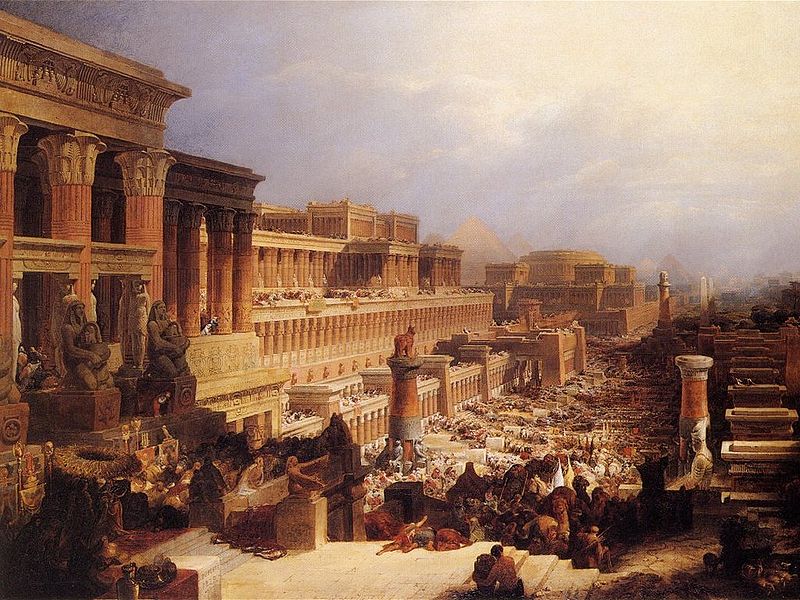
The Exodus Belongs To Jesus

“The Israelites Leaving Egypt” by David Roberts (1830)

One of the things for which I am deeply grateful is the hard work of New Testament textual scholars who search out and study ancient copies of biblical manuscripts, comparing and contrasting their little differences, in order to try to discern what the oldest, best, and, hopefully, original reading of a biblical text may have been.  The standard for wading through the myriad of texts out there for pastors and scholars alike is the Nestle-Aland Novum Testamentum Graece.  Your English Bible, if it is of recent translation, is more than likely based on this Greek text.

When I was in seminary, Nestle-Aland’s Greek New Testament was on its twenty-seventh edition.  Recently, the twenty-eighth addition hit the presses.  And though there are many notable changes and improvements, one change rises above the rest.  It is in Jude 5.  The NIV translates the verse this way:  “I want to remind you that the Lord delivered His people out of Egypt, but later destroyed those who did not believe.”  Here, Jude hearkens back to God’s rescue of His people out of Egypt as well as their unfortunate subsequent destruction because of their rebellion.  He references the exodus to warn his readers against those “who change the grace of our God into a license for immorality and deny Jesus Christ our only Sovereign and Lord” (Jude 4).

Interestingly, there has been a fair amount of dispute over the text of Jude 5.  The NIV translates it according to the preferred reading of Nestle-Aland’s twenty-seventh edition.  But the twenty-eighth edition makes an important change:  “I want to remind you that Jesus delivered His people out of Egypt.”  Rather than having “the Lord,” a title for God generically, deliver His people out of Egypt as the NIV translates it, the twenty-eighth edition of Nestle-Aland says this verse should read that it was Jesus specifically who led the people out of Egypt.  Bruce Metzger, a world renowned textual scholar, notes that “critical principles seem to require the adoption of ‘Jesus,’ which admittedly is the best attested reading among Greek and versional witnesses.”[1]

The change from “the Lord” to “Jesus” is of inestimable significance, for it gives us an important window into the way first century Christians understood God’s work in Christ.  Christ was no one new when He was born in Bethlehem; rather, He was older than creation itself.  Indeed, He was active in creation itself (cf. John 1:1-3).  And He has been active throughout the course of redemptive history, long before His incarnation.

Thus, wherever there is rescue, wherever there is salvation, wherever there is freedom, wherever there is hope – be that in the Old Testament or in the New Testament – there is Christ.  Christ is present and active throughout all of Scripture.  Christ led the charge out of slavery in Egypt for the Israelites and He leads the charge out of slavery in sin for us.  Jude 5 says so.


[1] Bruce Metzger, A Textual Commentary on the New Testament, 3rd ed. (New York:  United Bible Societies, 1971), 726.