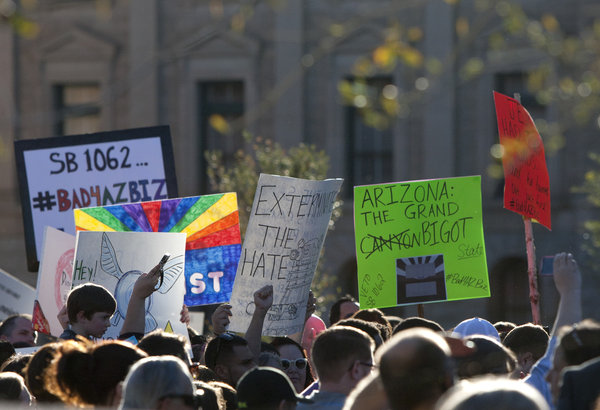
S.B. 1062

Credit:  LA Times
Credit: LA Times

A funny thing happened on my way back from a recent trip I took to Arizona.  The state became embroiled in a heated political battle over Senate Bill 1062.[1]  Okay, it may not have been funny.  But these kinds of battles are common.

According to some, S.B. 1062 championed religious liberty, allowing business owners with religious convictions to deny service to a party if the business owner felt that serving that party would substantially burden or contradict his religious convictions.  According to others, S.B. 1062 violated the civil rights of homosexuals by formally and legally legitimatizing discrimination against them.

Last Wednesday, Governor Jan Brewer vetoed the bill, explaining, “I have not heard of one example in Arizona where business owners’ religious liberty has been violated … The bill is broadly worded and could result in unintended and negative consequences.”[2]  Of course, the political pressure on Governor Brewer was hot:

Companies such as Apple Inc. and American Airlines, and politicians including GOP Sen. John McCain and former Republican presidential nominee Mitt Romney were among those who urged Brewer to veto the legislation. The Arizona Super Bowl Host Committee, which is overseeing preparations for the 2015 game, came out with a statement against the legislation. The Hispanic National Bar Association on Wednesday said it canceled its 2015 convention in Phoenix over the measure.[3]

In observing the volley between supporters and detractors of this bill, two things strike me.

First, homosexuality – and, specifically, gay rights – is not only a hot topic in our society, it is the hot topic in our society.  Interestingly, nowhere does S.B. 1062 mention homosexuality.  It simply speaks of “the free exercise of religion.”  Yet, USA Today reported on Governor Brewer’s veto of the bill with this headline:  “Arizona governor vetoes anti-gay bill.”[4]  These days, how a piece of legislation will affect the gay community is the litmus test as to whether or not a bill can or should pass, even if that bill does not specifically mention the gay community.  Gay rights, then, are front and center.  They are the battleground du jour of our society.

Second, there are a lot of homosexuals who deeply despise Christians with orthodox beliefs concerning the sinfulness of homosexual activity and will go to great – and even duplicitous – lengths to paint Christians as homophobic bigots.  Stories abound of people who have concocted heinous hate crimes against themselves.  Take, for instance, the lesbian couple that spray-painted their own garage with the message “Kill the gay.”[5]  Or how about the Tennessee man who falsely claimed that three men beat him and robbed his store in an anti-gay attack?[6]  Then, of course, there was the famed incident of the waitress who falsely claimed she was stiffed on a tip because she was a lesbian.[7]  Personally, I don’t want to think of anyone in the homosexual community as my enemy.  Life is too short to keep an enemies’ list.  But I am not so naïve as to believe that there aren’t some in the homosexual community who think of me as their enemy.

So what am I to do?

Jesus’ admonition to pray for those who are on the outs with you (cf. Matthew 5:44) seems to be especially apropos for a time such as this.  To this end, I would invite you to join me in praying for three things as the culture war over sexual rights continues to rage.

First, pray for forgiveness.  Though it is painful to admit, it was not too long ago that it was exponentially more likely for a message like “Kill the gay” to be spray painted not by someone self-imposing a hate crime, but by someone committing one.  And sometimes, that someone was even a self-professed Christian.  This, of course, directly defies a myriad of biblical commandments concerning our conduct as Christians.  Our call to tell the truth about sin must never be a license to commit sin – especially the sin of hate.  We need forgiveness for our missteps – which are plenty – in this debate.

Second, pray for understanding.  I want to be understood.  I want people to understand and believe that I am not a homophobic hate monger who wants to oppress, humiliate, and exile those who do not share my same faith and ethical commitments.  But if I want this for myself, it is only fair that I afford the same courtesy to others.  Martin Luther summarized the Eighth Commandment by saying that, when dealing with our neighbors, we should “put the best construction on everything.”[8]  I can think of no better way to respond to those who put the worst construction on Christians’ intentions than by putting the best construction on theirs.  Generous understanding offers our greatest hope for peace in the midst of a hotly contested and, sadly, dirtily fought culture war.

Third, pray that true love would prevail.  The “true” is just as important as the “love” here, for our society has settled for a counterfeit love that reduces love to nothing more than tolerance.  Just the other day, I heard a caller to a radio talk show explain how one of the primary virtues of Christianity is tolerance.  Really?  A quick search of the word “tolerate” in the Bible brings up verses like these:

  • Whoever slanders their neighbor in secret, I will put to silence; whoever has haughty eyes and a proud heart, I will not tolerate. (Psalm 101:5)
  • Your eyes are too pure to look on evil; You cannot tolerate wrongdoing. Why then do You tolerate the treacherous? (Habakkuk 1:13)
  • It is actually reported that there is sexual immorality among you, and of a kind that even pagans do not tolerate: A man is sleeping with his father’s wife. (1 Corinthians 5:1)

Tolerance does not seem to be the high brow Scriptural virtue that some would like to peddle it as.  This is not to say that we shouldn’t live with, work alongside with, and care for people who do not share our same moral commitments.  In this way, we should indeed be tolerant.  But tolerance does not necessarily entail endorsement.

Ultimately, as Christians, we ought to aspire to a much higher value than that of tolerance.  We ought to aspire to love.  “Love,” the apostle Paul reminds us, “does not delight in evil but rejoices with the truth” (1 Corinthians 1:6).  To love someone well, we must tell him the truth, even when the truth is unpopular.  This is our calling with all sin – sexual and otherwise.

So these are my prayers.  Now, it’s your turn.  Will you join me in praying the same?


[1] S.B. 1062, 51st Leg., 2nd sess. (Ariz. 2014).

[2] Aaron Blake, “Arizona governor vetoes bill on denying services to gays,” The Washington Post (2.26.2014).

[3] Bob Christie, “Arizona Religious Bill That Angered Gays Vetoed,” ABC News (2.27.2014).

[4] Dan Nowicki, Yvonne Wingett Sanchez and Alia Beard Rau, “Arizona governor vetoes anti-gay bill,” USA Today (2.26.2014).

[5] Alyssa Newcomb, “Lesbian Couple Charged With Staging Hate Crime,” ABC News (2.19.2012).

[6] Chuck Ross, “Report: Man falsified police report in alleged anti-gay attack,” The Daily Caller (12.26.2013).

[7]  Cavan Sieczkowski, “New Jersey Waitress In Anti-Gay Receipt Saga Reportedly Let Go From Job,” The Huffington Post (12.9.2013).
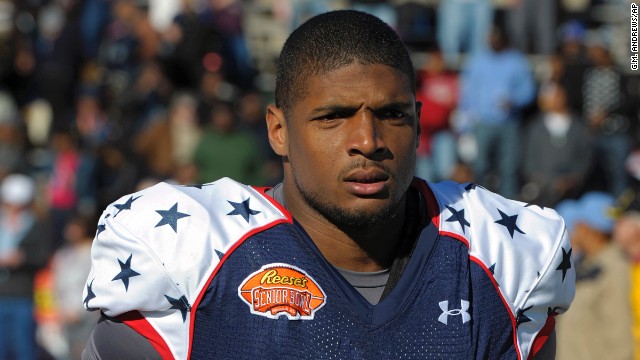
Michael Sam Makes It Public

Credit: cnn.com
Credit: cnn.com

“Does the NFL have any gay players?” my wife asked me last Sunday.  She was watching a Hallmark Valentine movie where one of the characters, an NFL quarterback, came out as homosexual.  “No, sweetie,” I responded.  “The NFL does not have any openly gay players.  There have been some players who have come out after they left the NFL, but to date, no players currently in the NFL are openly homosexual.”

It didn’t take long for that to change.

The next morning, while I was working out and watching ESPN, there was Michael Sam, former Missouri Defensive End and candidate in the NFL draft, coming out on national TV as a gay football player.   “I am an openly, proud gay man,” Sam told ESPN’s “Outside the Lines.”  Granted, Sam is not an NFL player…yet.  But his prospects are good.

I am surprised – pleasantly so – by how muted the negative response to Sam’s announcement has been.  Some journalists have hinted that responses could turn negative, but to date there is no swell of detractors decrying Sam as a dangerous degenerate.  By the same token, those who are writing and speaking about him are hailing him as a hero.  Brendon Ayanbadejo, a former linebacker who is currently a free agent, was effusive about Sam’s announcement, comparing him to Jackie Robinson and Rosa Parks.  To cap off his feelings concerning Sam, he said, “To borrow from Neil Amstrong, this is one small step for gay men and one giant leap for the LGBTQ community.”[1]  Juliet Macur of the New York Times wrote a manifesto demanding that an NFL team draft Sam.  She begins by writing, “It’s time,” and ends by declaring, “Sam must be drafted. It’s time to move forward. The teams and the league are on the clock.”[2]  For Macur, Sam’s status as a future NFL star is not a matter of his talent, but of a moral imperative that says the NFL must have an openly gay player.

For orthodox Christians, all of this can be hard to sort out.  On the one hand, there is something to be celebrated here.  It is refreshing to see so many display a measured sensitivity to and deep compassion for those with same-sex attractions and those in same-sex relationships.  The gay slurs, gay jokes, and gay bashing of yesteryear have drastically dissipated and, for my part, I say, “Good riddance.”  Such speech is diametrically opposed to the biblical command to love, which Paul says is the fulfillment and summation of all biblical commandments (cf. Romans 13:8-9).  On the other hand, Christians cannot pretend that our society’s sexual free-for-all, which demands not only the toleration of, but the celebration of sexual practices that are far from biblical standards for human sexuality, is nothing more than an issue of civil rights.  Whether it’s Michael Sam touting his homosexuality or Richie Incognito and Jonathan Martin exchanging texts about how many women they have slept with and the use of prostitutes,[3] the spacious sexual ethic of our society is simply not something Christians can endorse.  Partly because it’s immoral and Scripturally forbidden, yes.  But also because it hurts, belittles, and objectifies people, which, in and of itself, is tragic, no matter what your ethical worldview.

Ultimately, the loose sexual standards of our society are nothing new.  The path of sexual salaciousness is well worn – not only in twenty-first century America, but in all the societies that have come before her.  But we can choose a different path.  We can choose the path of sexual commitment in marriage while walking “humbly with our God” (Micah 6:8).  I pray that we do.  For when we do, we not only live out God’s sexual standard in our commitments, we show God’s lavish love by our humility.

Let Freedom Ring…Temperately

Beyonce and Jay Z 1It was Jean-Jacques Rousseau who wrote, “Man was born free, and everywhere he is in chains.”[1]  Of course, Rousseau’s conception of freedom was one where man was free from all restraints, most especially moral and social restraints. Rousseau argued that man’s ideal state is one where he is not reliant on morals or on others.  Reliance on morals and others rather than self-reliance, Rousseau opined, threatens man’s very survival and existence.

Rousseau wrote his words concerning man’s freedom in 1762.  We’ve been trying to decide whether or not he was right ever since.

Case in point:  Beyoncé’s performance at the Grammy’s.  Anand Giridharadas of the New York Times, in an article on her Grammy appearance, characterized Beyoncé like this:  “God-fearing girl from Texas, scantily clad and sexualized vixen, mononymous superstar and feminist icon, the wife who took Jay-Z’s last name, Carter.”[2]  What an interesting combination of characteristics.  She’s a sexualized vixen and a God-fearing girl.  And both were on display in her Grammy performance.  On the one hand, Beyoncé sang a truly blush-worthy and downright raunchy song in an outfit that defied common decency.  On the other hand, she performed with her husband, Jay-Z, as together they extolled the pleasures of sex within marriage.  Extolling the pleasures of sex within marriage is solidly Christian.  Grinding in front of 28.5 million viewers is crass voyeurism.  Marital intimacy is solidly moral and, I would point out, biblically commanded (cf. 1 Corinthians 7:5).  Dropping your bedroom onto a national stage is a Rousseauian dream.

The apostle Paul writes, “It is for freedom that Christ has set us free. Stand firm, then, and do not let yourselves be burdened again by a yoke of slavery” (Galatians 5:1). Rousseau’s freedom was a freedom to sin.  Paul’s freedom was a freedom from sin:  “You, my brothers, were called to be free. But do not use your freedom to indulge the sinful nature; rather, serve one another in love” (Galatians 5:13).  Rousseau abhorred the notion that man would rely on others.  Paul called Christians to be people on which others could happily rely.

Thomas Jefferson once noted, “It would be a miracle were [people] to stop precisely at temperate liberty.”[3]  Jefferson feared that, left to their own devices, people would all too easily and quickly lapse into “unbounded licentiousness,” running headlong for the unbridled freedom of Rousseau rather than toward the virtuous liberty of Paul.  And this is, sadly, what has happened.

But not completely.

There are still some who understand that true freedom is not so much about the moral bounds you can break, but about the responsibility you can take.  There are still some who understand that freedom is not so much about the selfish hedonism in which you can engage, but about the loving service you can offer.  That’s true freedom.  That’s real freedom.  And, by God’s grace, we can still carry forth in that freedom.  We must carry forth in that freedom.

Anything else is just “a yoke of slavery.”


[1] Jean-Jacques Rousseau, The Social Contract, Christopher Betts, trans. (Oxford:  Oxford University Press, 1994), 45

[2] Anand Giridharadas, “Beyoncé and Jay-Z’s Sultry Dance Makes a Case for Marriage,” New York Times (2.3.2014).

[3] Esther Franklin, Thomas Jefferson: Inquiry History for Daring Delvers (Esther Franklin, 2012).

Pluralistic Ignorance, a.k.a., “Everybody’s Doing It”

Couple 1“Everybody’s doing it.”  Before this line was used by teenagers in attempts to strong-arm their parents into allowing them to engage in all manner and kind of youthful foolishness, it was the title of a 1938 movie about an alcoholic who creates picture puzzles for a national contest only to get kidnapped before he can deliver the final batch of puzzles.  From the reviews I’ve read, the movie wasn’t very good or very believable.[1]

“Everybody’s doing it.”  Long after the movie, I remember using this line on my parents – with slight modifications, of course.  If I wanted to go to a party, I’d tell my parents, “But everyone will be there!”  Or if I wanted my parents to buy me something, I’d tell them, “But everyone else has one!”

“Everybody’s doing it.”  This is more than just a teenager’s favorite line.  It’s also a dangerous state of mind.

A few years ago, two researchers from Binghamton University in New York, Chris Reiber and Justin Garcia, published a paper titled, “Hooking Up: Gender Differences, Evolution, and Pluralistic Ignorance.”[2]  In this paper, they explored the differences between the real and perceived comfort levels with different types of sexual activity among young adults.  They discovered what psychologists refer to as “pluralistic ignorance.”  They explain:

Pluralistic ignorance (PI) has been demonstrated to play a role in hook-up behavior.  PI is characterized by individuals behaving in accordance with (generally false) beliefs attributed to the group, regardless of their own beliefs … Young adults routinely believe that others are more comfortable with various sexual behaviors than they, themselves, are.  This leads them to behave as if they were more comfortable than they actually are, and engage in behaviors with which they are not actually comfortable.

After a myriad of charts and graphs illustrating this thesis, the researchers conclude, “Individuals of both genders attributed to others of the same gender higher comfort levels [with different kinds of sexual activity] than they themselves had.”  In other words, those surveyed thought that “everyone was doing it,” but, as it turns out, they’re not.  And if you think they are, you’re ignorant about what’s going on in the bedrooms of the plurality of people in our world.

Tragically, this perception of the nature and type of sexual activity among one’s peers often leads to the violation of one’s own ethical sensibilities.  Thus, far too many people wind up breaching moral boundaries for the farcical, mistaken impression that “everyone is doing it.”

In his epistle to the Romans, the apostle Paul speaks of how “the requirements of [God’s] law are written on [people’s] hearts, their consciences also bearing witness, and their thoughts sometimes accusing them and at other times even defending them” (Romans 2:4).  The apostle here contends that all people, whether or not they are Christian, have a conscience – a foundational moral compass that helps them distinguish right from wrong.  My contention is that we ought to spend more time listening to our consciences and less time worrying and wondering about what “everybody else” is doing.  As the research shows, we don’t really know what everybody else is doing and when we try to guess, we guess wrong.

So, to those who are thinking of breaching an ethical boundary so you can roll with a cultural tide, you need to know:  the cultural tide will only roll you.  Others are not doing what they say they’re doing and you don’t really know what they’re doing anyway.  So listen to your conscience, not to them.  Or, better yet, listen to God’s Word. You’ll wind up much less morally anguished and much more joyfully fulfilled.


[1] “Everybody’s Doing It,” imdb.com

[2] Chris Reiber & Justin R. Garcia “Hooking Up: Gender Differences, Evolution, and Pluralistic Ignorance,” Evolutionary Psychology 8, no. 3 (2010): 390-404.

The Court of Public Opinion

Credit: rmsbunkerblog.wordpress.com

We are a nation of polls.  We poll public opinion on just about everything imaginable – from how Congress is doing their jobs to how the president is doing his job to how many people support gay marriage to how many people support tougher gun control laws to how many people support the legalization of marijuana.

It’s this last bit of polling data that formed the focus of an L.A. Times article by Robin Abcarian, which chronicled the shifting tide of public opinion on our culture’s most famous controlled substance:

The Gallup organization released a poll showing that for the first time in 44 years, a wide margin of Americans – 58% to 39% – believe marijuana should be legalized.

Less than a year ago, only 48% said pot should be legal. That is an astonishing leap of 10 points in the last 11 months alone.[1]

The article explains that Colorado and Washington have led the curve by legalizing recreational marijuana use and their progressive policies, in turn, are moving the country forward:  “Like gay marriage, pot is here to stay.  And just like gay marriage, it seems like the rest of the country is finally starting to catch on.  Or light up.”

Personally, I find it ironic and more than a little medically disingenuous that at the same time cigarettes are increasingly controlled and decried because of the health risks associated with inhaling nicotine, tar, and smoke, using marijuana, which impairs motor abilities and adversely affects cardiopulmonary health, is increasingly accepted.

Regardless of the medical and, for the matter, moral arguments against the legalization of marijuana, I nevertheless must agree with Abcarian’s conclusion:  “Like gay marriage, pot is here to stay.”

Why do I concur with Abcarian’s conclusion?  Because we live in a society obsessed with and ruled by public opinion.  Our working presupposition is that if the majority of people approve of something, that something ought to be implemented societally.  And if the majority of people approve of something, that something ought to be considered good and right.  Public opinion, then, shapes far more than our federal policy; it guides our society’s morality.

But there is a problem with public opinion.  Because the people who proffer it are sinful, public opinion can be sinful.  One need look no farther than Pontius Pilate’s opinion poll:  “What shall I do, then, with Jesus who is called the Messiah” (Matthew 27:22)?  I’m not sure the public was right or righteous when they gave their opinion on Jesus’ sentence.

The apostle Paul reminds us of the stark sinfulness that can sometimes mark public opinion when he writes:

[People] have become filled with every kind of wickedness, evil, greed and depravity. They are full of envy, murder, strife, deceit and malice. They are gossips, slanderers, God-haters, insolent, arrogant and boastful; they invent ways of doing evil; they disobey their parents; they are senseless, faithless, heartless, ruthless.  Although they know God’s righteous decree that those who do such things deserve death, they not only continue to do these very things but also approve of those who practice them. (Romans 1:29-32)

According to Paul, the public delights in sanctioning sin.  Far from being good and moral, the public is sinful and wicked.  And lest we think we are somehow immune to the depravity of the general public, Paul reminds us that we too play a role in society’s degeneracy:

You, therefore, have no excuse, you who pass judgment on someone else, for at whatever point you judge the other, you are condemning yourself, because you who pass judgment do the same things. (Romans 2:1)

It’s not just that public opinion “out there” can be wrong, it’s that our own opinions can be wrong because our opinions are stained and maimed by sin.

In a culture where public opinion shapes nearly everything, Christians have a countercultural message:  what is moral and best is not always what is popular and promoted.  Instead, what is moral and what is best is that which is revealed by God.

So what does this mean for the debate over legalizing marijuana?  It means that a debate such as this one cannot be settled by a poll.  Instead, we, as Christians, need to think about this issue in light of God’s Word.  Perhaps what Paul says in 1 Corinthians 6:20 is a good place to begin:  “Therefore honor God with your body.”


[1] Robin Abcarian, “Like gay marriage, medical marijuana is here to stay,” L.A. Times (10.23.2013).