What’s So Great About God?

Credit: Pixabay / Pexels.com

In Hebrew, the name “Micah” means “Who is like the Lord?”

In the Old Testament, the prophet Micah concludes the book that bears his name with the question his name asks:

Who is a God like You? (Micah 7:18)

Right before he asks this question, Micah speaks of God’s unmatched power on behalf of Israel:

“As in the days when you came out of Egypt, I will show them My wonders.” Nations will see and be ashamed, deprived of all their power. They will put their hands over their mouths and their ears will become deaf. They will lick dust like a snake, like creatures that crawl on the ground. They will come trembling out of their dens; they will turn in fear to the LORD our God and will be afraid of you. (Micah 7:15-17)

Just as God dazzled the world when He rescued the people of Israel out from under their slavery to the world’s preeminent superpower at that time – Egypt – God will do so again during Micah’s day when, again, He rescues His people out from under their oppression under the likes of the Assyrians and Babylonians.

But this unlimited and unmatched power is not what makes Micah’s God unique. It is not just that Micah’s God can “beat up” on other nations’ gods.

Instead, what makes Micah’s God truly unequaled is something other than His power:

Who is a God like You, who pardons sin and forgives the transgression of the remnant of His inheritance? You do not stay angry forever but delight to show mercy. You will again have compassion on us; You will tread our sins underfoot and hurl all our iniquities into the depths of the sea. (Micah 7:18-19)

What makes God matchless, according to Micah, is His mercy. All other religions and gods find their foundations in merit – you do your best, and the gods will perhaps sweep in and do the rest. But Micah reminds us that even when we do our worst, God, though He may discipline us, ultimately takes our worst and hurls it down into the deepest ocean trench and, in exchange, gives us His compassion.

Power, then, is not what foundationally makes God, God. Mercy is. Yes, we should fear God’s judgment on our sin. But we can actually see God’s mercy for our sin. Because “we do see Jesus” (Hebrews 2:9). And there is no one like Him – One who would die for our sin.

Fair-Weather Faith

Credit: “King David Playing the Harp” by Gerard van Honthorst (1622) / Wikimedia

In 2 Samuel 7, David, king of Israel, comes to the prophet Nathan with a concern:

Here I am, living in a house of cedar, while the ark of God remains in a tent. (2 Samuel 7:2)

David wants to build a temple for God, whose place of residence has, up until this point, been a tent that the Israelites took with them across the wilderness on their way from Egypt to the Promised Land.

In Psalm 132, we learn more about just how committed David was to procuring a more permanent residence for God:

He swore an oath to the LORD, he made a vow to the Mighty One of Jacob: “I will not enter my house or go to my bed,I will allow no sleep to my eyes or slumber to my eyelids, till I find a place for the LORD, a dwelling for the Mighty One of Jacob.” (Psalm 132:2-5)

The oath that David swears as he is considering building a temple for God is the same oath that David will hear just chapters later after he has committed adultery with another man’s wife.

When David sleeps with Bathsheba, the wife of one of his military commanders named Uriah, and gets her pregnant, he tries to cover up the affair by summoning Uriah in from the battlefield and encouraging him to go home and “enjoy” his wife so that no one will suspect she has been forced into sleeping with another man. But Uriah refuses, telling David:

The ark and Israel and Judah are staying in tents, and my commander Joab and my lord’s men are camped in the open country. How could I go to my house to eat and drink and make love to my wife? As surely as you live, I will not do such a thing! (2 Samuel 11:11)

Like David four chapters earlier, Uriah refuses to go to his home while the ark of God is in a tent and his men are on a battlefield. But the same oath that David once made has now become a liability that David has. So, David commands his general, Joab:

“Put Uriah out in front where the fighting is fiercest. Then withdraw from him so he will be struck down and die.” So while Joab had the city under siege, he put Uriah at a place where he knew the strongest defenders were. When the men of the city came out and fought against Joab, some of the men in David’s army fell; moreover, Uriah the Hittite died. (2 Samuel 11:15-17)

It turns out that David’s oath to God was a fair-weather oath. It was fine for a building project that would make David look good, but it was discarded when David was caught in a sin that made him look bad.

We are called to be more than fair-weather fans of God. Our faith in Him is refined not when it’s easiest to commit to Him, but when it’s hardest. In the words of one of Jesus’ followers named Peter, who himself struggled to stick with his faith when things got tough:

Trials have come so that the proven genuineness of your faith – of greater worth than gold, which perishes even though refined by fire – may result in praise, glory, and honor when Jesus Christ is revealed. (1 Peter 1:7)

May the oaths that we make be the oaths that we keep. May we be faithful. After all, God has been, is, and will continue to be faithful to us.

God Is With Us

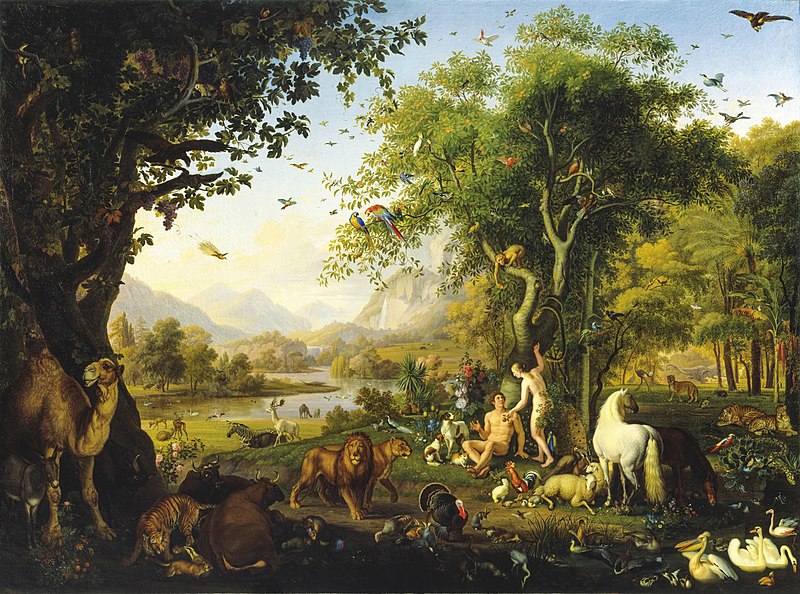
File:Johann Wenzel Peter - Adam and Eve in the earthly paradise.jpg
Credit: “Adam and Eve in the Garden of Eden by Johann Wenzel Peter (c. 1815) / Wikimedia

God has a funny way of defying the expectations people put on His presence.

When God appears to the first two humans, Adam and Eve, we find Him searching for them by “walking in the garden in the cool of the day” (Genesis 3:8). But this paradisical picture soon turns ugly when He finds out they have fallen into sin by eating fruit from His forbidden Tree of the Knowledge of Good and Evil. In punishment, God casts the couple out of the cool and lush Garden of Eden with a warning to Adam that now “by the sweat of your brow you will eat your food” (Genesis 3:19). The refreshing cool of the garden is shut off to humans and exchanged for a sweltering sweat. And it feels like God has barred humanity from His presence.

But He hasn’t.

In Genesis 18, we meet a man named Abraham who is “near the great trees of Mamre…sitting at the entrance to his tent in the heat of the day” (Genesis 18:1). Because “the cool of the day” of the Garden of Eden has gone, Abraham tries to shade himself by some trees and with his tent in “the heat of the day.” But in the middle of this sweaty scene, we read:

The LORD appeared to Abraham near the great trees of Mamre while he was sitting at the entrance to his tent in the heat of the day. (Genesis 18:1)

It turns out that God shows up not only in the cool of the day, but in the heat of the day – not only in a garden, but in a desert.

Too often, we harbor unexamined assumptions about how God’s presence has manifested itself in our lives:

“I got new job because God was with me.”
“I didn’t get the virus because God was with me.”
“I won the award because God was with me.”
“My life has turned out well because God was with me.”

All these statements may well be true. But their inverses are most certainly not:

“I didn’t get the new job because God wasn’t with me.”
“I did get the virus because God doesn’t care for me.”
“I didn’t win the award because God is against me.”
“My life has turned out tragically because God has forsaken me.”

God is with us in the garden and in the desert – in the cool of the day and in the heat of the day.

God’s presence with us even when life makes us sweat should come as no surprise to us. The word “sweat” is found twice in the Bible – once when Adam is cursed in a garden and once when Jesus is struggling in a garden:

Being in anguish, He prayed more earnestly, and His sweat was like drops of blood falling to the ground. (Luke 22:44)

Jesus knows what it’s like to sweat. And He’s promised to be with us when we sweat, too. Our circumstances – even when they are difficult and tempt us to become despondent – are not barometers of His presence. He is present with us because He has promised to be. Period.

Sneaky Polytheism

File:Mt-olympus gods.jpg
Credit: Mt. Olympus gods / Wikimedia

One of the most startling religious claims made by the ancient Israelites was that their God was the only true God. God Himself argues for His singularity when He says through the prophet Isaiah:

 I am the LORD, and there is no other; apart from Me there is no God. (Isaiah 45:5)

This echoes the command God gives to the children of Israel through Moses:

You shall have no other gods besides Me. (Exodus 20:3)

In our religious milieu, unlike in the ancient world, the majority of people of faith are monotheists – that is, they believe there is only one God.

Yet, even if monotheism is common to believe, it is much harder to practice. Isaiah explains why when he speaks of the fall of Babylon:

Now then, listen, you lover of pleasure, lounging in your security and saying to yourself, “I am, and there is none besides me. I will never be a widow or suffer the loss of children.” Both of these will overtake you in a moment, on a single day: loss of children and widowhood. They will come upon you in full measure, in spite of your many sorceries and all your potent spells. You have trusted in your wickedness and have said, “No one sees me.” Your wisdom and knowledge mislead you when you say to yourself, “I am, and there is none besides me.” (Isaiah 47:8-10)

God’s judgment on Babylon feels horrifyingly harsh to us. But notice what God’s judgment is in response to. It is in response to those who say of themselves:

I am, and there is none besides me. (Isaiah 47:8, 10)

Sound familiar – like what God has just claimed for Himself two chapters earlier in Isaiah?

It turns out that the Babylonians were not just worshiping many gods, they were putting themselves in the place of God, claiming, “We are all who matter! We are all we need! There is no one else who can do what we do!”

Even if theological polytheism no longer appeals to many of us, sociological polytheism is just as prevalent in our day as it was in Isaiah’s. We are incessantly tempted to believe that our moment in history is the pinnacle of history. We understand what those who have gone before us did not and could not. We can solve the problems of the world – and, indeed, must solve the problems of the world – because our forebearers were too doddering to do so. We are quick to quip: “I am, and there is none besides me.”

This kind of arrogance is what leads Isaiah to say: “Your wisdom and knowledge mislead you” (Isaiah 47:10). Our forbearers were not as incompetent as we can sometimes think they were, and we are not as smart as we can sometimes think we are.

So, what do we need? We who declare “I am” need to humble ourselves before the true and great “I AM” (Exodus 3:14). We need to realize that having “none beside me” is not desirous, but disastrous. We, in short, need to know our place. We are under God and beside each other. That’s right where we’re supposed to be. And that’s a great place to be.

Celebrating Christmas Slowly

File:The Angel Appearing to Zacharias MET DP164838.jpg
Credit: “The Angel Appearing to Zacharias” by William Blake (1800) / Wikimedia

When the angel Gabriel appears to Zechariah in Luke 1 while he is performing his ritual duties at the incense altar in the Holy Place at the temple in Jerusalem to announce that he and his wife Elizabeth will have a son who will prepare the way for Jesus, it signals a remarkable turning point in the history of the nation of Israel. The Old Testament ends with a dangling prophecy:

See, I will send the prophet Elijah to you before that great and dreadful day of the LORD comes. He will turn the hearts of the parents to their children, and the hearts of the children to their parents; or else I will come and strike the land with total destruction. (Malachi 4:5-6)

This prophetic word is both retrospective and prospective. It is retrospective because it hearkens back to Israel’s greatest prophet, Elijah, who lived over 400 years before this prophecy was proffered. It is prospective because it looks forward to another and greater Elijah who will create a new family out of the remnants of a nation that has been scattered and battered by years of exile and conquest.

And then ­­–

Gabriel shows up and announces:

Do not be afraid, Zechariah; your prayer has been heard. Your wife Elizabeth will bear you a son, and you are to call him John … And he will go on before the Lord, in the spirit and power of Elijah, to turn the hearts of the parents to their children and the disobedient to the wisdom of the righteous – to make ready a people prepared for the Lord. (Luke 1:13, 17)

This fulfillment had been a long time coming. Again, over 400 years had elapsed between the time Malachi had forecasted the coming of a new Elijah and Gabriel had announced the arrival of this new Elijah. Indeed, the last time Gabriel had shown up to anyone was over 500 years earlier to another prophet named Daniel:

While I was speaking and praying, confessing my sin and the sin of my people Israel and making my request to the Lord my God for his holy hill – while I was still in prayer, Gabriel, the man I had seen in the earlier vision, came to me in swift flight about the time of the evening sacrifice. (Daniel 9:20-21)

It is interesting to note that Gabriel appears to both men while they are making sacrifices. The angel seems to like to show up in the midst of worship.

The apostle Paul writes of Jesus’ birth:

When the set time had fully come, God sent His Son, born of a woman, born under the law, to redeem those under the law, that we might receive adoption to sonship. (Galatians 4:4-5)

It turns out that sometimes, God’s “set time” takes a long time to get here – hundreds of years, in fact. And this is one of the many things that Christmas can teach us. In a season that is known for its hustle and bustle, Christmas is best celebrated slowly and patiently – waiting for God to work in His way in His time. In a culture that prides itself on social media platforms like Instagram, cooking gadgets like Instant Pots, movie franchises that are Fast and Furious, and even Covid tests that are rapid, slowness does not find pride of place in our imaginations or priorities. And yet, it was a promise slowly but faithfully kept that changed the world – and is still changing eternities.

The name Zechariah means, “The Lord remembers.” By the time Gabriel appeared to this old priest to announce that he and his wife would have a son, it must have felt like they had been forgotten. But they had not been. God was just working slowly and patiently. May our character reflect God’s work this season – and each day.