Bearing God’s Name

The Second Commandment is not just a prohibition, but an offer. God says to Moses:

You shall not misuse the name of the Lord your God, for the Lord will not hold anyone guiltless who misuses His name. (Exodus 20:7)

Famously, the ancient Jews became so concerned with misusing God’s name that they would not even speak it. Instead of calling God “Yahweh,” the name God gave to Moses to share with Israel when He appeared to him in a burning bush (Exodus 3:13-15), they instead referred to God using a title of respect – “Lord.”

Though this instinct not to misuse the name of God is commendable, it does beg a question: Though we should not misuse God’s name, does this mean that there is no good use of God’s name? It is this question that brings to the forefront God’s offer in this commandment. Because there are most certainly many good uses of God’s name.

We can use God’s name to bless. (Numbers 6:24-26)

We can use God’s name to call to repentance. (Acts 2:38)

We can use God’s name to call to faith. (Acts 10:43)

We can use God’s name to baptize. (Matthew 28:19-20)

We can use God’s name to offer salvation. (Romans 10:13)

God’s name – even though it can be misused – is still quite useful.

In Hebrew, there are two words behind our one English word “misuse” in this commandment. There is the word sawe, which means “vanity” or “emptiness.” There is also the word nasa, which means to “take up” or “to bear.” This is why many Bible translations will render this verse: “You shall not take the name of the Lord your God in vain.” We certainly want to avoid sawe. But we also want to embrace nasa. We want to bear the name of God in our lives and through our lives. As one of Jesus’ followers, Peter, reminds us: “Praise God that you bear that name” (1 Peter 4:16).

To whom is God calling you to bear His name this week? It’s a name worth sharing because it’s a name that our world needs to hear.
Freedom and Limits

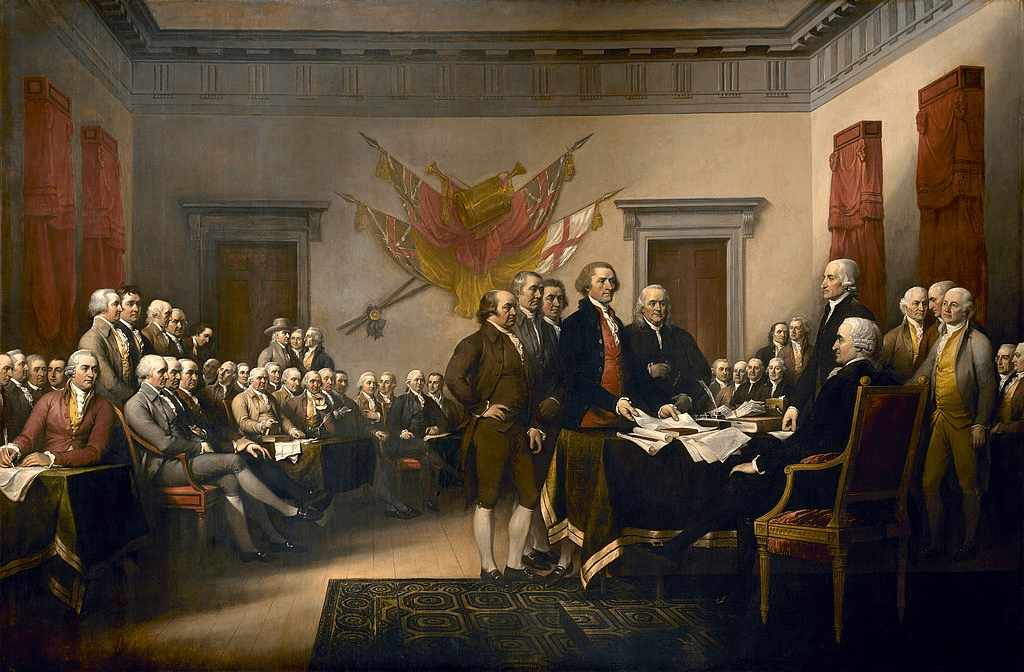
Happy 246th birthday, America.

On this date in 1776, these United States were formed when the Second Continental Congress unanimously adopted the Declaration of Independence. At the heart of the Declaration was a yearning to be free:

That these United Colonies are, and of right ought to be free and independent states; that they are absolved from all allegiance to the British Crown, and that all political connection between them and the State of Great Britain, is and ought to be totally dissolved; and that as free and independent states, they have full power to levy war, conclude peace, contract alliances, establish commerce, and to do all other acts and things which independent states may of right do.

Freedom is the bedrock of the American experiment. But freedom is also funny. Freedom is a precious gift – one that I believe ought to be granted to all people everywhere – and yet, freedom also works best when it is given limits. If you don’t believe me, ask Adam and Eve.

God gave history’s first couple tremendous freedom:

“You are free to eat from any tree in the garden.” (Genesis 2:16)

But on their freedom, He also placed a limit:

“But you must not eat from the tree of the knowledge of good and evil, for when you eat from it you will certainly die.” (Genesis 2:17)

When Adam and Eve transgressed this limit, rather than gaining freedom, they lost freedom, for they became slaves to sin and cursed by death.

In order to be freed from this slavery and curse, a perfectly free God placed limits on Himself as He became incarnate in Christ. As the French Catholic philosopher Emmanuel Falque explains in The Metamorphosis of Finitude:

What makes Christianity is not solely the extraordinary in Christ’s revelation of His glory … It is also and indeed primarily the sharing by the Word incarnate of our most ordinary human condition independent of sin (that is, human finitude and the humanization of the divine).

The phrase “human finitude” is one of the most ponderous mysteries of our faith. In Christ, the infinite became finite. The perfectly free limited Himself for you and for me. And yet, in the apostle Paul’s telling, this finitude and limitedness becomes the basis for true freedom – our freedom:

It is for freedom that Christ has set us free. (Galatians 5:1)

As we rightfully celebrate our freedoms today, let us remember that our national freedom was won by men and women who willingly gave up their freedoms as they served and sacrificed for this nation. There would be no land of the free if we were not also the home of the brave. And, as we live out of our freedom in Christ, let us also remember that our eternal freedom was won by a man who willingly gave up His freedom as He served us and sacrificed His life for us on a cross.

The Day of the Lord

Credit: eberhard grossgasteiger / Pexels.com

One of the most prominent themes in Scripture is the Day of the Lord. This is the day God will reveal Himself in His power and glory. And what a day this will be. It will be a day of awe. It will be a day of fear. It will be a day of judgment. And it is a day that is near.

The prophet Obadiah describes this day thusly:

The day of the Lord is near for all nations. As you have done, it will be done to you; your deeds will return upon your own head. (Obadiah 15)

In Obadiah’s telling, the Day of the Lord will be one of recompense. What you have done – both good and evil – will boomerang back to you on this day.

For me, this sounds terrifying. I have done some good in my life – but I have also done plenty of bad. There are things I have done to others that I would not want done to me. A day of recompense, for me, would be a day of ruin.

And this is precisely what Obadiah wants his readers to worry about. He continues:

Just as you drank on My holy hill, so all the nations will drink continually; they will drink and drink and be as if they had never been. (Obadiah 16)

God warns that the nations will “drink continually” – a metaphor for the pouring out of divine wrath. The wrath that God pours out on this day will be so intense and God’s destructive judgment so definitive, that it will be as if there had never been any nations.

But it does not have to be this way. In the middle of a day of inescapable divine judgment, there will be a refuge:

But on Mount Zion will be deliverance; it will be holy, and Jacob will possess his inheritance. (Obadiah 17)

Zion will be a place of refuge from the judgment all around it. Jacob – that is, Israel – will receive an inheritance. But how?

A parent bequeaths an inheritance to a child for the simple reason that they are a child. It is not something that is earned – and often not even deserved, for many children are scoundrels – it is simply given out of love.

The apostle Paul writes:

In Christ Jesus you are all children of God through faith. (Galatians 3:26)

This is how we are rescued from the recompense for sin that comes with the Day of Lord and, instead, given refuge in spite of our sin at the day of the Lord – through faith in Christ. Jesus is the One who turns a terrifying day into a triumphant day. He is the One who delivers us.

When the Day of the Lord comes, it will be either a day of wrath or a day of redemption in Christ. Which will it be for you?

A Prize Worth Winning

Credit: Timur Weber / Pexels.com

To say that we live in a divided society is an understatement. Everything from politics to economics to sociology to now, as researchers have discovered, geography divides us. Bill Bishop, in his book The Big Sort, explains that over the course of three decades:

People had been reshaping the way they lived. Americans were forming tribes, not only in their neighborhoods but also in churches and volunteer groups. That’s not the way people would describe what they were doing, but in every corner of society, people were creating new, more homogenous relations. Churches were filled with people who looked alike and, more important, thought alike. So were clubs, civic organizations, and volunteer groups. Social psychologists had studied like-minded groups and could predict how people living and worshiping in homogenous groups would react: as people heard their beliefs reflected and amplified, they would become more extreme in their thinking. What had happened over three decades…[was a] kind of self-perpetuating, self-reinforcing, social division. The like-minded neighborhood supported the like-minded church, and both confirmed the image and beliefs of the tribe that lived and worshiped there. Americans were busy creating social resonators, and the hum that filled the air was the reverberated and amplified sound of their own voices and beliefs.

This self-sorting into like-minded communities has often, sadly, turned these like-minded communities into closed-minded communities. This, in turn, increases polarization and fuels confrontations between different beliefs, behaviors, and worldviews – and not just in society generally, but even in families personally. More and more, more and more people are no longer interested in learning from those with whom they disagree, but instead in defeating those with whom they disagree.

Around 750 B.C., the nation of Israel was riding high. They had recently captured two Syrian cities, Lo-Debar and Karnaim, and were proudly confident in their military might. What they did not realize, however, is that the Assyrian Empire was quietly ascending and would soon sweep in to decimate and defeat their northern half of their nation. The conquerors would soon be conquered.

It is into this context that God sends a prophet named Amos who warns Israel of her impending calamity:

You who rejoice in the conquest of Lo Debar and say, “Did we not take Karnaim by our own strength?” For the Lord God Almighty declares, “I will stir up a nation against you, Israel, that will oppress you all the way from Lebo Hamath to the valley of the Arabah.” (Amos 6:13-14)

Israel’s victory over these two small towns will mean nothing when they are defeated by a powerful empire. Indeed, the name Lo Debar in Hebrew means “nothing.” Israel may have won a battle, but ultimately, she has “nothing” to show for her victory.

In a polarized moment like ours, Amos’s warning to Israel is also a warning for us. As we fight our battles, it may be worth it to ask: even if we win whatever battle we’re fighting, what are we actually winning? All too often, the answer may be Lo Debar – nothing. We may win a battle, but in our proud moment of victory only hurt others and fray feelings. The cost of our victory in battle far outstrips the value of the prize.

This week, when you feel tempted to do battle – whether culturally or personally, such as with your spouse or one of your children – ask yourself: if I win, am I actually gaining anything, or am I just hurting someone? If the answer is the latter, trade your desire for combat for a patient conversation. Who knows? If you seek to help and understand instead of to win and coerce, you might just both win by not losing a relationship. And that is a prize worth winning.

Did I Do Something to Deserve My Suffering?

Credit: elifskies / Pexels.com

People who are struggling can sometimes wonder: Is God angry with me? Is He disciplining me because of some sin in my life? Did I do something to deserve this? These questions become particularly acute when people read biblical stories of God punishing places like Sodom and Gomorrah or Jericho or Babylon or even Israel because of their sin.

The prophet Amos lived during a time of spiritual depravity in Israel. This depravity was masked, however, by general political stability and economic prosperity. Because of these conditions, the Israelites were lured into believing they were experiencing God’s favor. But God called Amos to deliver a damning declaration:

This is what the LORD says: “For three sins of Israel, even for four, I will not relent. They sell the innocent for silver, and the needy for a pair of sandals. They trample on the heads of the poor as on the dust of the ground and deny justice to the oppressed. Father and son use the same girl and so profane My holy name.” (Amos 2:6-7)

God’s judgment was coming on Israel’s sin. But at the same time such a declaration may sound unsettling, it can also be comforting.

God regularly used the ancient prophets to remove ambiguity about His judgment. People did not need to guess whether God was punishing them because of their sin because the prophets clearly revealed whether God was punishing them because of their sin. In Amos’s case, God even reveals through this prophet the specific sins for which Israel was being punished.

God leaves no ambiguity when it comes to His punishment of sin. As Amos goes on to explains:

When disaster comes to a city, has not the LORD caused it? Surely the Sovereign LORD does nothing without revealing His plan to His servants the prophets. (Amos 3:6-7)

If God brings judgment, He will make known what He is doing. He renders no judgment without revealing whether it is, in fact, His judgment.

You never have to wonder, then, in the face of some struggle or suffering, whether God is angry at you. Or whether He is disciplining you. Or whether you have done something to deserve what you are experiencing. If you are left wondering, you already have your answer: He is not angry with you. He is not lobbing suffering at you out of His wrath toward you. God’s judgment is not meant to be secret or mysterious. Instead, it is designed to be clear so that it can unambiguously call people out of their sin and back to His righteousness.

If you are suffering, God is not judging you. You can know that. But you can also know this: He is with you. He does not remain aloof from you, but comes to you through Christ. If you are suffering, remember that Christ has also suffered. He knows what suffering feels like. And He knows – and cares – what you feel like. His response to your suffering is not judgment, but love.