Punishment and Patience

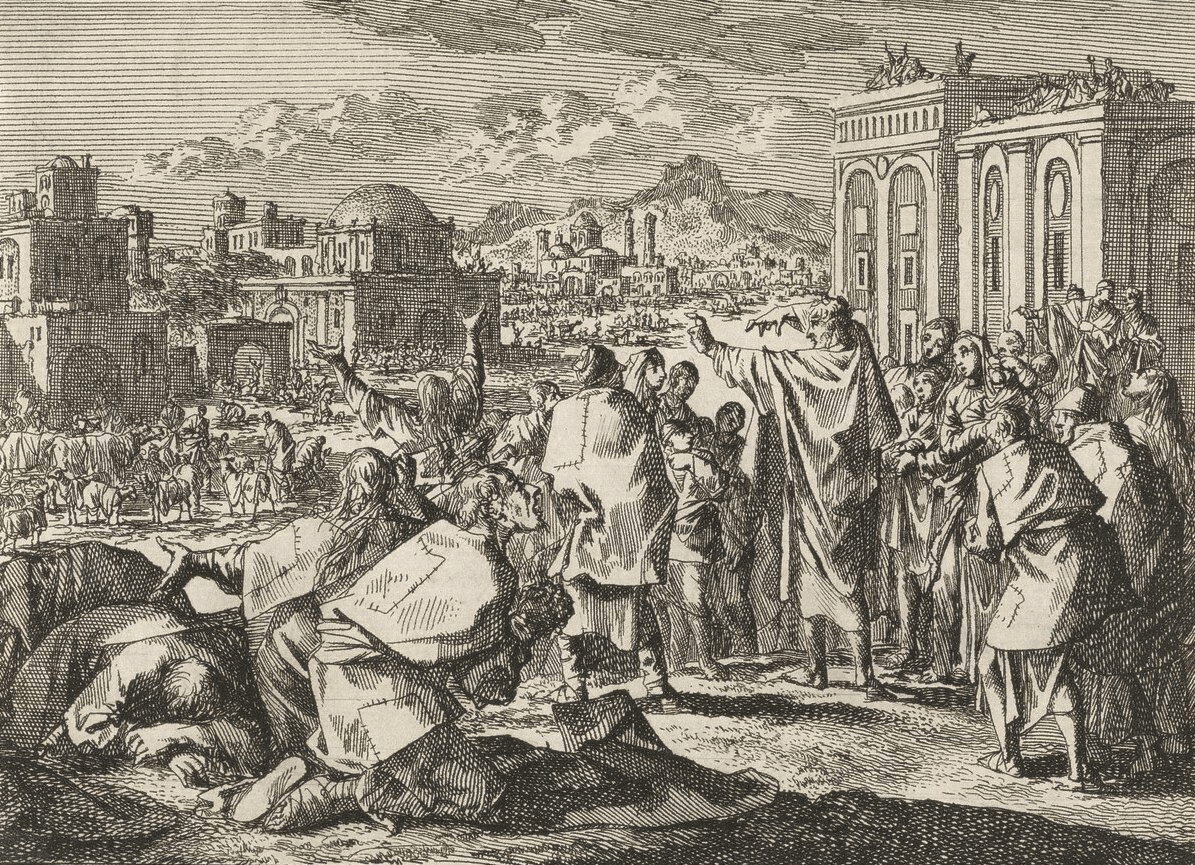
Credit: “Jonah foretells the destruction of Nineveh” by Jan Luyken (1712) / Public Domain

At the end of the book that bears his name, the prophet Jonah is seething. God has just spared city of Nineveh, the capital of Assyria, which is the arch-enemy empire of Israel. Jonah had seen this coming. In fact, he was so concerned that God might allow Israel’s arch-enemy to stand after God called the prophet to go and try to help Nineveh that he tried to hop a ship sailing the opposite direction from Nineveh to Tarshish. Jonah was not interested in giving any opportunity to God to extend mercy to the Ninevites. And he says as much:

Isn’t this what I said, Lord, when I was still at home? That is what I tried to forestall by fleeing to Tarshish. I knew that you are a gracious and compassionate God, slow to anger and abounding in love, a God who relents from sending calamity. (Jonah 4:2)

Jonah wanted the Lord to be a judgment juggernaut – not a gracious God.

And yet, around 150 years later, God’s judgment does come for Nineveh, but through a different prophet – the prophet Nahum. This is what Nahum has to say:

The Lord has given a command concerning you, Nineveh: “You will have no descendants to bear your name. I will destroy the images and idols that are in the temple of your gods. I will prepare your grave, for you are vile.” (Nahum 1:14)

It turns out that the Ninevites repented of their sin during the time of Jonah, but then fell back into their sin after the time of Jonah. And now God’s judgment will come on them.

So often, like Jonah, we want God’s judgment to come in our way and on our schedule. We want to be judge, juror, and executioner of those who have sinned against us, or even of those who are morally opposed to us. But Jonah’s experience with Nineveh echoes the apostle Paul’s words:

If it is possible, as far as it depends on you, live at peace with everyone. Do not take revenge, my dear friends, but leave room for God’s wrath, for it is written: “It is Mine to avenge; I will repay,” says the Lord. (Romans 12:18-19)

God will judge – but not always in our way and on our schedule. Indeed, as Nahum – the prophet who does announce of God’s judgment – says:

The Lord is slow to anger but great in power; the Lord will not leave the guilty unpunished. (Nahum 1:3)

The Lord does have power and punishment for sinners, but only after the Lord practices patience – lots of patience – with sinners. And for this, we should be grateful. Because God is not only patient with them, but patient with us. So, let’s be patient with God and allow Him to carry out His mercy and His judgment in His way.

I have a feeling He might know what He’s doing.

God’s Open-Door Policy

Credit: eberhard grossgasteiger / Pexels.com

In Exodus 19, as God is preparing to give Israel the Ten Commandments on the summit of Mount Sinai, He issues a stern warning to the people through Moses:

Go down and warn the people so they do not force their way through to see the Lord and many of them perish. (Exodus 19:21)

And again to the priests and the people of Israel:

The priests and the people must not force their way through to come up to the Lord, or He will break out against them. (Exodus 19:24)

Everyone, it seems, would love to have some time with God. But as the Law is being introduced, the Israelites, instead of getting time with God, are being separated from God. The people are to remain at the foot of the mountain while Moses receives God’s Law at the top of the mountain. And to try to get close to God while He is giving His Law – to try to force their way into His presence in the midst of His law – will only result in their death.

Jesus makes a fascinating, perplexing, and seemingly passing statement in Luke’s Gospel:

The Law and the Prophets were proclaimed until John. Since that time, the good news of the kingdom of God is being preached, and everyone is forcing their way into it. (Luke 16:16)

“The Law” to which Jesus refers is the Law Moses received up on Mount Sinai, and “the Prophets” are those who proclaimed the Law, up to and including John the Baptist. But now, instead of a mountain, there is a kingdom. And now, instead of being sternly warned not to force their way up the mountain, people are openly and fearlessly forcing their way into the kingdom. Why? Because while the Law separated us from God because of our sin, Jesus came to undo that separation by forgiving our sin. We can force our way right in to see God. In Christ, God has an open-door policy.

So, what do you need to see God about? A worry? A sickness? A sin? A need? Feel free to barge right in. He’ll be happy to see you – and to help you. Because He loves you.

What makes God, God?

Credit: Wilhelm Eder / Pixabay

What makes God, God? Traditionally, God’s fundamental attributes have been described as omnipotence – that God has power over all – omniscience – that He knows all – and omnipresence – that He is with all. Certainly, these are all true and critical attributes of God. But as the prophet Micah closes His book, He sees something else foundational to God.

Micah begins with an announcement from God that He will rescue Israel in power. God says to Israel:

“As in the days when you came out of Egypt, I will show them My wonders.” Nations will see and be ashamed, deprived of all their power. They will put their hands over their mouths and their ears will become deaf. They will lick dust like a snake, like creatures that crawl on the ground. They will come trembling out of their dens; they will turn in fear to the Lord our God and will be afraid of you. (Micah 7:15-17)

God’s power will overpower all the powers of the world, Micah says. This is God’s omnipotence at its most expansive. But it’s not just this traditional attribute of God that makes God, God. For Micah continues with a critical question:

Who is a God like You? (Micah 7:18)

What is it, Micah muses, that makes God so unique? What is it that sets Him apart? His answer is as stunning as it is soothing:

Who is a God like You, who pardons sin and forgives the transgression of the remnant of His inheritance? You do not stay angry forever but delight to show mercy. You will again have compassion on us; You will tread our sins underfoot and hurl all our iniquities into the depths of the sea. (Micah 7:18-19)

It is God’s mercy – and not only His power, knowledge, or even presence – that makes God, God. What makes God utterly unique is that He does not treat us as our sins deserve. Instead, He hurls our sins away and, by doing so, becomes our hope and stay.

Martin Luther spoke of two types of God’s work – His strange work and His proper work. God’s strange work is His work of judgment in power. It is a work that is meant to reprove and, if not heeded, condemn. But though God does this work, it is strange to Him. It is not His preferred mode of operation. His preferred mode of operation – His proper work – is that of mercy and grace. God’s desire is to redeem and not just to reprove – to commute the sentence of sin instead of condemning people in sin. This is what makes God, God. And for this, we can be thankful. Because it is God’s mercy that allows us to approach Him, to rely on Him, and to find our rest in Him.

In Hebrew, the name Micah means, “Who is like the Lord?” The answer is, of course, “No one.” But because of what the Lord is like, we can like the Lord. We can love the Lord. Because He loves us.

Raising Up a Remnant

Credit: Jonathan Borba / Pexels.com

The prophet Micah ministered during a dark period in the nation of Israel’s history. Externally, the Assyrians were menacing Israel, and internally, both the secular and spiritual leaders of Israel had become corrupt. The secular leaders were abusing their privilege to take advantage of the powerless:

They covet fields and seize them, and houses, and take them. They defraud people of their homes, they rob them of their inheritance. (Micah 2:2)

The spiritual leaders, in turn, were willing to overlook such gross misuses of power because they were being paid by the secular leaders to do so:

Her priests teach for a price, and her prophets tell fortunes for money. Yet they look for the Lord’s support and say, “Is not the Lord among us? No disaster will come upon us.” (Micah 3:11)

With depravity running rampant throughout the nation, it was tempting to feel as if no one righteous was left – as if evil had gotten its way and seized the day. And for a time, that looked to be the case. The Assyrians not only menaced Israel, but eventually routed Israel, followed by the Babylonians who did the same thing a little over 100 years later. Israel had fallen and righteousness had been extinguished.

But Micah knew better. Micah understood that, even amid much fallenness and darkness, God could preserve and raise up a remnant of people for Himself:

The remnant of Jacob will be in the midst of many peoples like dew from the Lord, like showers on the grass, which do not wait for anyone or depend on man. (Micah 5:7)

Micah declares that much will have been lost by the time Israel’s judgment is through, but God will nevertheless raise up a few.

It is especially important to note how Micah describes this small group. They are “like showers on the grass, which do not wait for anyone or depend on man.” The key difference between those who fall in judgment and those who are raised up in a remnant is that those who are raised up in a remnant “do not…depend on man.” Their status as part of God’s remnant does not depend on any person, any treaty, any riches, any social status, or any act of human power, but on the righteousness of God. It depends not on human efforts, but on faith in God. Their status as God’s remnant is not their achievement, but God’s gift.

In a world where we can sometimes feel isolated because we see sin all around us or we struggle with sin within us, we can rest assured that we are part of God’s people – His remnant. As Jesus put it: “Do not be afraid, little flock, for your Father has been pleased to give you the kingdom” (Luke 12:32). God’s flock may be little, but it is real. And by simple faith, anyone can be a part. May this be a promise we all take to heart.

Cleansing and Telling

Credit: Christ Healing the Leper (1534) / Wikimedia

As Matthew 8 opens, a leper comes to Jesus, desperate for healing from his chronic, and ultimately terminal, ailment:

When Jesus came down from the mountainside, large crowds followed Him. A man with leprosy came and knelt before Jesus and said, “Lord, if You are willing, You can make me clean.” Jesus reached out His hand and touched the man. “I am willing,” He said. “Be clean!” Immediately he was cleansed of his leprosy. Then Jesus said to him, “See that you don’t tell anyone. But go, show yourself to the priest and offer the gift Moses commanded, as a testimony to them.” (Matthew 8:1-4)

Jesus’ words to this man upon his healing are puzzling: “See to it that you don’t tell anyone” (Matthew 8:4). What? Why? The story opens with “large crowds” (Matthew 8:1) following Jesus. It’s not as if this healing was done in secret, so it’s not as if this man could have kept this healing a secret. Why would this leper not tell anyone about a healing that everyone had just seen?

The key comes not in who Jesus tells this man not to tell, but in who Jesus tells this man to tell: “Go, show yourself to the priest and offer the gift Moses commanded, as a testimony to them” (Matthew 8:4). The priests were the ones responsible, according to Leviticus 14, for ceremonially cleansing someone who had been cured of a skin disease. The process involved an examination, the sprinkling of blood, a guilt offering, and a sin offering. Jesus instructs the leper to go to the priest and go through the rigmarole of the cleansing ritual, but not so that he may be cleansed. For he already has been. Jesus has already ordered the leper’s skin to “be clean” (Matthew 8:3)! Instead, the leper is to do this “as a testimony to them” (Matthew 8:4) – a testimony that the One who can fully cleanse the unclean has come. Sadly, we know that the priests – along with many other Jewish religious leaders – did not receive this man’s testimony, but instead were offended by Jesus and “plotted how they might kill Jesus” (Matthew 12:14).

Who Jesus tells this leper to tell and not tell can be instructive for us, for we can all be tempted to talk about our faith in Jesus only with the crowds – with people who are predisposed to be impressed with our message. But sometimes, Jesus invites us instead to turn our attention to the skeptical and even the hostile and share our faith with them “as a testimony to them” (Matthew 8:4). This is difficult and frightening. But it is also very needed. For even the skeptical and hostile need cleansing – cleansing from guilt, shame, and sin. Who is Jesus inviting you to share your faith with today? You can’t coerce someone else’s faith. But you can share your own.

Remember, Jesus did not just come for the people who were friendly to Him. He came for everyone – even His enemies. May we share the message of that One with everyone.