Posts tagged ‘Spirituality’
It’s Not Tricky … It’s Really Not
 It seems like it’s been happening to me a lot lately.
The other day on the radio, I heard a commercial for “The Biblical Money Code,” a program that claims to be able to make millions for the person who follows it:
Imagine if you had a secret code for making money … a code buried deep within biblical text. A code that certain investment titans have quietly exploited to amass billions. And what if this code could be used by you, today, to unlock vast amounts of wealth — safely and ethically.[1]
Now, forget the fact that what the Bible has to say about money is about as straightforward and sharp as it can be. For instance: “No one can serve two masters. Either he will hate the one and love the other, or he will be devoted to the one and despise the other. You cannot serve both God and Money” (Matthew 6:24). Forget the fact that God nowhere promises that you can or will amass billions. Forget the fact that the Bible doesn’t even find it particularly desirable that a person would amass billions. All of what’s in this program has to be in the Bible. You just have to unlock the code.
But that’s not the only biblical “code” I’ve run across recently.
The other day, I received an email from a friend claiming the prophet Muhammad was identified by name in the Old Testament. Where? Song of Songs 5:16: “His mouth is sweetness itself; he is altogether lovely. This is my lover, this my friend, O daughters of Jerusalem.” How does this refer to Muhammad? The Hebrew word for “altogether lovely” is machamadim, which sounds like “Muhammad.” Now, forget the fact that, in context, this is a statement by a wife about her husband. Forget the fact that machamadim is a Hebrew word and Muhammad is an Arabic name. Forget the fact that there is nothing in this verse that would indicate this is a prophetic statement. These two words sound similar, so they must be related. You just have to unlock the code.
But that’s not the only biblical “code” I’ve run across recently.
I remember a conversation I had with some Mormon friends about the kingdoms of glory in the afterlife. “We can enter a telestial, terrestrial, or celestial kingdom,” my friends explained. From where do they get this? 1 Corinthians 15:40 (KJV): “There are also celestial bodies, and bodies terrestrial: but the glory of the celestial is one, and the glory of the terrestrial is another.” Now, forget the fact that Paul’s point here is not to talk about afterlife destinations, but to speak of the kind of body we will receive at the resurrection of the dead, as he makes abundantly clear at the conclusion of his argument:
So will it be with the resurrection of the dead. The body that is sown is perishable, it is raised imperishable; it is sown in dishonor, it is raised in glory; it is sown in weakness, it is raised in power; it is sown a natural body, it is raised a spiritual body. (1 Corinthians 15:42-44)
Forget the fact that this verse doesn’t even mention telestial bodies. Forget the fact that no one in the Church interpreted this verse in this way before Joseph Smith. Paul has to be talking about different afterlife destinations. You just have to unlock the code.
With so many so-called “religious experts” peddling so many biblical codes, it is worth it to remind ourselves of the principle of perspicuity. Perspicuity is from a Latin word meaning “clearness.” And classically, the Church has ascribed this characteristic to Holy Writ. The Lutheran dogmatician Francis Pieper summarizes biblical perspicuity thusly: “The perspicuity of Scripture consists in this, that it presents, in language that can be understood by all, whatever men must know to be saved.”[2] Pieper goes on to note that Scripture testifies to its own perspicuity in places like Psalm 19:7: “The statutes of the LORD are trustworthy, making wise the simple.” One can be simple intellectually and still gain wisdom from Scripture, for Scripture is clear. Understanding the Good Book does not take a Ph.D. in theology.
Now, this is not to say that every verse of the Bible is equally easy to understand. No less than the great preacher Chrysostom explains that some parts of the Bible can indeed be difficult to interpret:
Let us suppose … rivers … are not of the same depth. Some have a shallow bed, others one deep enough to drown one unacquainted with it. In one part there are whirlpools, and not in another … Why then art thou bent on drowning thyself in those depths?[3]
Chrysostom compares different parts of Scripture to different rivers. Some parts are shallow and easy to navigate. Other parts are deeper and more difficult to wade through. But though some parts of Scripture are richly deep, none are nefariously tricky. In other words, the biblical authors are not trying to hide things from us with a code, but reveal things to us under the guidance of God’s Holy Spirit.
The long and short of biblical perspicuity, then, is this: finding codes, mysteries, and secrets that cater to our sinful lusts like greed, play “sound like” games with words across languages, and rip words out of a text and shoehorn them into meaning something which, contextually, they clearly do not and cannot mean are not only not biblical, they’re evil. God wants us to understand and follow His Word – not be confused by it and misinterpret it.
So the next time you open your Bible, don’t pull out your decoder ring, pull out your reading glasses. They’ll work much better. And you’ll be much more edified.
[1] “The Biblical Money Code,” newsmax.com
[2] Francis Pieper, Christian Dogmatics, vol. 1 (St. Louis: Concordia Publishing House, 1950), 320.
[3] John Chrysostom, A Select Library of the Nicene and Post-Nicene Fathers of the Christian Church, series 1, vol. 13, P. Schaff, ed. (New York: Christian Literature Company, 1889), 507.
For Fathers Only
 “Fathers, do not exasperate your children; instead, bring them up in the training and instruction of the Lord” (Ephesians 6:4).
These famous words from the apostle Paul are meant to call fathers to Godliness as they raise their children. Negatively, fathers are not to “exasperate,” or anger, their children needlessly or vindictively. Positively, they are to “bring them up,” or rear them, in the Lord. The Greek word for “bring them up” is ektrepho, meaning, “to feed.” Fathers are to feed their children. But this means much more than simply “bringing home the bacon,” as it were. This also means feeding children’s souls with time, affection, discipline, and grace.
Sadly, this call to fatherhood is lost on far too many men in our society. And the effects are devastating.
Kay Hymowitz, writing for the City Journal, a quarterly affairs journal for Manhattan, recently published an article titled “Boy Trouble”[1] in which she attributes much of the dismal performance in school, in jobs, and in life of a great number of boys to absentee fathers. In other words, fathers who fail to bring their children up in the training and instruction of the Lord because of their non-presence have a profoundly negative impact on their children. Hymowitz expounds:
By the 1970s and eighties, family researchers following the children of the divorce revolution noticed that, while both girls and boys showed distress when their parents split up, they had different ways of showing it. Girls tended to “internalize” their unhappiness: they became depressed and anxious, and many cut themselves, or got into drugs or alcohol. Boys, on the other hand, “externalized” or “acted out”: they became more impulsive, aggressive, and “antisocial.” Both reactions were worrisome, but boys’ behavior had the disadvantage of annoying and even frightening classmates, teachers, and neighbors. Boys from broken homes were more likely than their peers to get suspended and arrested. Girls’ unhappiness also seemed to ease within a year or two after their parents’ divorce; boys’ didn’t.
Since then, externalizing by boys has been a persistent finding in the literature about the children of single-parent families. In one well-known longitudinal study of children of teen mothers (almost all of them unmarried), University of Pennsylvania sociologist Frank Furstenberg, a dean of family research, found “alarmingly high levels of pathology among the males.” They had more substance abuse, criminal activity, and prison time than the few boys in the study who had grown up in married-couple families.
Hymowitz goes on to consider some of the ways in which societies have sought to compensate for absentee fathers. Some societies have tried to provide robust social support programs, ensuring single mothers have all the financial resources they need to give their sons opportunities that will serve them well. But these social support programs have not stemmed the tide of troubled, fatherless boys. Others have tried to encourage male role modeling in the form of coaches, teachers, and even stepfathers. But the problem remains. Indeed, Hymowitz cites one study done on boys who were raised by their stepfathers and notes that these boys were “even more at risk of incarceration than the single-mom cohort.”
Finally, Hymowitz reaches an inevitable, even if unsurprising, conclusion: “Girls and boys have a better chance at thriving when their own father lives with them and their mother throughout their childhood—and for boys, this is especially the case.” A household needs a father.
Please understand that I do not mean to belittle or disparage the contributions that mothers – and especially single mothers – make to a household. Indeed, I know and have known many faithful single mothers who do all they can to raise their children faithfully, compassionately, and evangelically with great success. To them, I say, “Thank you.” I am saying to men, however: You are needed. The stakes are high. You cannot afford you to be derelict in your duties toward your families.
So get with it. Heed the call of the apostle Paul. You have more influence than you may ever know. Which means you have more responsibility than you could ever dream. Take that responsibility seriously. Little eyes are watching.
[1] Kay Hymowitz, “Boy Trouble,” City Journal 23, no. 4 (Autumn 2013).
Pluralistic Ignorance, a.k.a., “Everybody’s Doing It”
 “Everybody’s doing it.” Before this line was used by teenagers in attempts to strong-arm their parents into allowing them to engage in all manner and kind of youthful foolishness, it was the title of a 1938 movie about an alcoholic who creates picture puzzles for a national contest only to get kidnapped before he can deliver the final batch of puzzles. From the reviews I’ve read, the movie wasn’t very good or very believable.[1]
“Everybody’s doing it.” Long after the movie, I remember using this line on my parents – with slight modifications, of course. If I wanted to go to a party, I’d tell my parents, “But everyone will be there!” Or if I wanted my parents to buy me something, I’d tell them, “But everyone else has one!”
“Everybody’s doing it.” This is more than just a teenager’s favorite line. It’s also a dangerous state of mind.
A few years ago, two researchers from Binghamton University in New York, Chris Reiber and Justin Garcia, published a paper titled, “Hooking Up: Gender Differences, Evolution, and Pluralistic Ignorance.”[2] In this paper, they explored the differences between the real and perceived comfort levels with different types of sexual activity among young adults. They discovered what psychologists refer to as “pluralistic ignorance.” They explain:
Pluralistic ignorance (PI) has been demonstrated to play a role in hook-up behavior. PI is characterized by individuals behaving in accordance with (generally false) beliefs attributed to the group, regardless of their own beliefs … Young adults routinely believe that others are more comfortable with various sexual behaviors than they, themselves, are. This leads them to behave as if they were more comfortable than they actually are, and engage in behaviors with which they are not actually comfortable.
After a myriad of charts and graphs illustrating this thesis, the researchers conclude, “Individuals of both genders attributed to others of the same gender higher comfort levels [with different kinds of sexual activity] than they themselves had.” In other words, those surveyed thought that “everyone was doing it,” but, as it turns out, they’re not. And if you think they are, you’re ignorant about what’s going on in the bedrooms of the plurality of people in our world.
Tragically, this perception of the nature and type of sexual activity among one’s peers often leads to the violation of one’s own ethical sensibilities. Thus, far too many people wind up breaching moral boundaries for the farcical, mistaken impression that “everyone is doing it.”
In his epistle to the Romans, the apostle Paul speaks of how “the requirements of [God’s] law are written on [people’s] hearts, their consciences also bearing witness, and their thoughts sometimes accusing them and at other times even defending them” (Romans 2:4). The apostle here contends that all people, whether or not they are Christian, have a conscience – a foundational moral compass that helps them distinguish right from wrong. My contention is that we ought to spend more time listening to our consciences and less time worrying and wondering about what “everybody else” is doing. As the research shows, we don’t really know what everybody else is doing and when we try to guess, we guess wrong.
So, to those who are thinking of breaching an ethical boundary so you can roll with a cultural tide, you need to know: the cultural tide will only roll you. Others are not doing what they say they’re doing and you don’t really know what they’re doing anyway. So listen to your conscience, not to them. Or, better yet, listen to God’s Word. You’ll wind up much less morally anguished and much more joyfully fulfilled.
[2] Chris Reiber & Justin R. Garcia “Hooking Up: Gender Differences, Evolution, and Pluralistic Ignorance,” Evolutionary Psychology 8, no. 3 (2010): 390-404.
Truly God, Truly Man
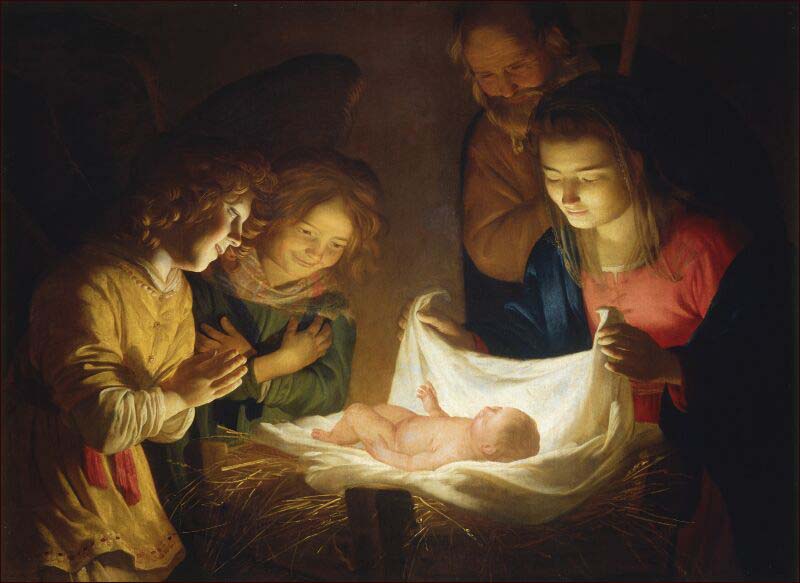
“The Adoration of the Shepherds” by Gerard van Honthorst, 1622.
During the Christmas season, it is important to focus not only on the birth of Christ, but on the person of Christ. That is, it is important for us to remember not only that Jesus was born, but who Jesus was born as. For it is not the simple fact of Jesus’ birth that gives the Christmas story significance. After all, people are born all the time. But Jesus’ identity as it is revealed in the Christmas story makes Jesus’ birth significant even 2,000 years later.
In Matthew’s Gospel, we get a clue concerning Jesus’ identity beginning with Mathew’s opening line: “A record of the genealogy of Jesus Christ the son of David, the son of Abraham” (Matthew 1:1). From here, Matthew goes on to give an extensive genealogy of Jesus’ family tree, going all the way back to Abraham. The genealogy in Luke’s Gospel goes back even farther – all the way to Adam (cf. Luke 3:23-38). These two genealogies, it should be noted, are quite different from each other, making Jesus’ family tree look quite disparate. Indeed, over the years, scholars have debated the differences between the Matthew and Luke’s genealogies of Jesus. Most often, scholars have conjectured that Matthew presents the royal genealogy of Jesus through Joseph, his stepfather, while Luke presents the biological genealogy of Jesus through Mary, His mother. What is often left out of such discussions and debates, however, is that there is actually a third Christmas genealogy that all too regularly goes unnoticed.
Where is this third genealogy? Beginning in Matthew 1:18: “This is how the birth of Jesus Christ came about: His mother Mary was pledged to be married to Joseph, but before they came together, she was found to be with child through the Holy Spirit.” The Greek word for “birth” is genesis, from which we get our English word “genealogy” In fact, this is the same word Matthew uses in 1:1 when he introduces his “genealogy [in Greek, genesis] of Jesus Christ the son of David, the son of Abraham.” Thus, in just one chapter, Matthew presents two genealogies.
So how are to understand these two genealogies? In Matthew’s first genealogy, we read of Jesus’ human origin. He is the son of David and the son of Abraham. In Matthew’s second genealogy, we read about Jesus’ divine origin. He is of the Holy Spirit. Thus, Jesus is truly man, the son of Abraham and David; but He is also truly God, conceived by the Holy Spirit and born of the virgin Mary.
Ultimately, Jesus’ status as truly man and truly God is what gives the Christmas story its significance. For as a man, Jesus can identify with us men – our weakness, struggles, and trials. But as God, Jesus can save us from our sin.
Truly man. Truly God. All of this wrapped in a manger. What an incredible story! And what a terrific reason to say, “Merry Christmas.”
Rob Bell and Inerrancy
 The other day, a friend sent me an article by pastor and provocateur Rob Bell on the subject of inerrancy. Traditionally, the term “inerrancy” has been defined as the belief that the biblical authors, guided and inspired by God’s Spirit, “are absolutely truthful according to their intended purposes.”[1] In other words, the biblical authors, under divine inspiration, produced writings that are “without error.” It is important to clarify that to say the Bible is “without error” does note preclude “a lack of modern technical precision, irregularities of grammar or spelling, observational descriptions of nature, the reporting of falsehoods, the use of hyperbole and round numbers, the topical arrangement of material, variant selections of material in parallel accounts, or the use of free citations.”[2] In other words, part of claiming biblical inerrancy is recognizing what does and does not constitute an actual “error.”
Regardless of the specifics concerning what does and does not constitute error, it is clear that “inerrancy” asserts an extraordinarily high view of the nature and reliability of Holy Writ. Some, however, including Rob Bell, are troubled by such an assertion.
Rob Bell teases out his beef with inerrancy thusly:
My 13 year old son is currently doing an education program that requires him to listen to a certain amount of classical music every day. So on the way to school each morning instead of listening to our usual Blink 182 and rap, he listens to…Mozart. Not his first choice, but just lately he admitted that classical music has grown on him. (How does a parent not smile at that?)
A few questions, then, about Mozart:Did Mozart’s music win?
Would you say that the work of Mozart is on top?
Is Mozart the MVP?
In your estimation, has Mozart prevailed?
Do Mozart’s songs take the cake?
Odd questions, right?
They’re odd because that’s not how you think of Mozart’s music. They’re the wrong categories.
Why?
Because what you do with Mozart’s music is you listen to it and you enjoy it.
Which brings us to inerrancy: it’s not a helpful category. And if you had only ever heard about Mozart as the one who wins, those arguments would probably get in the way of you actually listening to and enjoying Mozart.[3]
So Rob Bell’s problem with inerrancy is that for him it’s not a helpful category.
Though Rob may question the usefulness of the inerrancy “category,” countless followers of Christ have, do, and will continue to find this designation extraordinarily helpful. Yes, the word “inerrancy” is of fairly recent origin. But what it denotes – the trustworthiness of Scripture because of divine origin of Scripture – is as old as Christianity itself. Nichols and Brandt, in their book Ancient Word, Changing Worlds, helpfully sample some patristic evidence that indicates how the early Church saw the divine origin and inspiration of Scripture:
Clement of Rome, writing in 96, exhorted, “Look carefully into the Scriptures, which are the true utterances of the Holy Spirit.” Another Clement, Bishop of Alexandria, declared similarly, “I could produce then thousand Scriptures of which not ‘one tittle will pass away,’ without being fulfilled. For the mouth of the Lord, the Holy Spirit, has spoken these things.” As for a statement about the whole Bible, Origen once observed, “For the proof of our statements, we take testimonies from that which is called the Old Testament and that which is called the New – which we believe to be divine writings.”[4]
Jumping ahead to the sixteenth century, Nichols and Brandt note that John Calvin referred to Scripture as “the sure and infallible record,” “the inerring standard,” “the pure Word of God,” “the infallible rule of His Holy Truth,” “free from every stain or defect,” “the inerring certainty,” “the certain and unerring rule,” “unerring light,” “infallible Word of God,” “has nothing belonging to man mixed with it,” “inviolable,” “infallible oracles.”[5] Whoa. Calvin leaves no question as to where he stands on inerrancy.
Rob does offer some reasons as to why he believes inerrancy is not a helpful category, the first of which is, “This isn’t a word the Bible uses about itself.” But this is like saying “Trinity” is not a helpful term to describe God because it is not a term God uses to describe Himself. Terms can be helpful even when they’re not used in the Bible if these terms describe what the Bible itself teaches. And the Bible does indeed claim inerrancy for itself. One need to look no farther than the Word of God’s magnum opus on the Word of God, Psalm 19: “The law of the LORD is perfect, refreshing the soul. The statutes of the LORD are trustworthy, making wise the simple” (Psalm 19:7). If the word “perfect” doesn’t include being “without error,” what does it include?
Rob finally plays his hand as to why he is uncomfortable with inerrancy: “The power of the Bible comes not from avoiding what it is but embracing what it is. Books written by actual, finite, limited, flawed people.” Rob Bell takes issue with inerrancy because he takes issue with the doctrine of divine inspiration. He takes issue with what Clement of Rome, Clement of Alexandria, Origen, John Calvin, and, for that matter, the Bible itself claim about the Bible. Rather than being a book a written by God using men (cf. 1 Peter 1:21), the Bible for Rob is a book written by men who recount their experiences with God, which, by the way, could be mistaken and wrongheaded.[6] How do we know if their experiences with God are mistaken and wrongheaded? Rob answers: “Central to maturity is discernment, the growing acknowledgement that reality is not as clean and neat and simple as we’d like.” In other words, it’s up to us to figure out what in the Bible is wrong and what in the Bible is right. But if our world’s genocides, sexual promiscuity, oppression, economic injustice, and refusal to stand for truth because we’re not even sure of what truth is serve as any indication of our powers of discernment, in the words of Ricky Ricardo, we “have some splainin’ to do.”
Perhaps we’re not as discerning as we think we are. Perhaps, rather than tooting the horns of our own discernment faculties, we should ask the question of the Psalmist: “But who can discern their own errors” (Psalm 19:12)? Our blind spots are bigger and darker than most of us recognize.
I will grant that inerrancy has sometimes all too gleefully been used as a bully club against supposed – and, in some instances, presupposed – heretics. But I will not give up the word or the doctrine. For when inerrancy is properly understood, it is not meant as a club, but as a promise. It is a promise that we can trust this book – even more than we can trust ourselves. For this book is God’s book. And I, for one, delight in that promise because I delight in the Lord.
[1] James Voelz, What Does This Mean? Principles of Biblical Interpretation in the Post-Modern World, 2nd ed. (St. Louis: Concordia Publishing House, 1995), 239.
[2] “Chicago Statement on Biblical Inerrancy,” Article XIII (October 1978).
[3] Rob Bell, “What is the Bible? Part 21: In Air, In Sea,” robbellcom.tumblr.com (12.10.2013)
[4] Stephen Nichols and Eric Brandt, Ancient Word, Changing Worlds (Wheaton: Crossway Books, 2009), 78.
[5] Ancient Word, Changing Worlds, 78-79.
[6] Bell writes of the biblical authors in another post, “They had experiences. They told stories. They did their best to share those stories and put language to those experiences” (“What is the Bible? Part 17: Assumptions and AA Meetings”).
Righteousness from God

“Crucifixion of Jesus of Nazareth” by Marco Palmezzano, ca. 1490
Credit: Wikipedia
Because the gospel is the crux of our Christian faith, we can never ponder it, speak of it, or write about it too much. This is why I was delighted to stumble across this passage from Ezekiel while reading devotionally a few days ago:
The righteousness of the righteous man will not save him when he disobeys, and the wickedness of the wicked man will not cause him to fall when he turns from it. The righteous man, if he sins, will not be allowed to live because of his former righteousness. If I tell the righteous man that he will surely live, but then he trusts in his righteousness and does evil, none of the righteous things he has done will be remembered; he will die for the evil he has done. (Ezekiel 33:12-13)
What a beautiful explanation of the gospel and what kind of righteousness saves. Ezekiel is clear: you cannot be saved by your own righteousness! Indeed, even if you act righteously, just one evil act erases all memory of your righteousness. As James writes: “For whoever keeps the whole law and yet stumbles at just one point is guilty of breaking all of it” (James 2:10). To receive salvation, you need another kind of righteousness that is not your own. You need a righteousness that comes from God. The apostle Paul brings clarity to what kind of righteousness this is: “But now a righteousness from God, apart from law, has been made known, to which the Law and the Prophets testify. This righteousness from God comes through faith in Jesus Christ to all who believe” (Romans 3:21-22).
Besides reminding us that our own righteousness does not and cannot save us, Ezekiel’s words also remind us that the gospel is not confined to the New Testament. In both Testaments, the message of the gospel is consistent: it is God’s righteousness, not our own, that saves us. As God promises through the prophet Isaiah, “I am bringing My righteousness near, it is not far away; and My salvation will not be delayed.”
Godly Vision, Not Personal Agenda
 It is axiomatic that vision is integral to leadership. No less than Warren Bennis, a pioneer in the field of leadership studies, defined leadership as “the capacity to translate vision into reality.”[1] If a leader does not have a vision, he will lead aimlessly. If he cannot articulate a vision, his organization will wander aimlessly. Leadership requires vision.
But that’s not all leadership requires. Leadership also requires mission. After all, mission is what gives purpose to an organization’s very existence. Vision, then, is when the leader of an organization understands his organization’s strengths, gifts, and capacities, and capitalizes on these in ways that fulfill an organization’s mission. Thus, the mission of an organization and the vision of its leader must work in synergy with each other.
When it comes to the organization – or, better yet, the body (cf. 1 Corinthians 12:27-28) – that is the Church, her mission is clear. After all, her mission was crafted and communicated by Christ Himself: “Go and make disciples of all nations, baptizing them in the name of the Father and of the Son and of the Holy Spirit, and teaching them to obey everything I have commanded you. And surely I am with you always, to the very end of the age” (Matthew 28:19-20). The mission of the Church is to make disciples by baptizing in God’s name and teaching God’s Word, all the while exuding a lively confidence that Christ is continually with us, empowering us as we carry out His mission. How precisely this mission is accomplished from congregation to congregation is a function of the vision of a congregation’s leaders – specifically, its pastor.
Sadly, in my years of ministry, I have seen far too many pastors who, rather than casting visions that capitalize on their congregations’ strengths, gifts, and capacities, push agendas based on their own likes and dislikes, preferences and antipathies. They may say they’re casting vision to congregations that have none. But what they’re really doing is asserting agendas that bully congregations at their weakest points.
To the leaders in Christ’s Church, I offer this plea: don’t confuse your agenda – no matter how noble it may seem – with Godly vision for your congregation. One, by God’s grace, can breathe life and excitement into a congregation. The other can frustrate and deflate God’s people. And Christ’s mission is far too important to settle for that. Christ’s mission deserves true vision.
[1] Kevin Kruse, “100 Best Quotes On Leadership,” Forbes Magazine (10.16.2012).
Happy Thanksgiving!

“Freedom from Want” by Norman Rockwell, 1943.
Credit: arthistory.about.com
It’s been all over Facebook. People are posting all the reasons they are thankful. My wife has joined in the Facebook thankfulness fun. As a teacher, she’s organizing her thankfulness thoughts alphabetically – using each letter of the alphabet to call to mind something for which she is thankful. I wonder what she’ll post about when she gets to “Z”?
As we head into another Thanksgiving holiday this week, I want to share with you, as I did last year, some of my favorite thoughts on thankfulness from Abraham Lincoln:
The year that is drawing towards its close, has been filled with the blessings of fruitful fields and healthful skies. To these bounties, which are so constantly enjoyed that we are prone to forget the source from which they come, others have been added, which are of so extraordinary a nature, that they cannot fail to penetrate and soften even the heart which is habitually insensible to the ever watchful providence of Almighty God. In the midst of a civil war of unequaled magnitude and severity, which has sometimes seemed to foreign States to invite and to provoke their aggression, peace has been preserved with all nations, order has been maintained, the laws have been respected and obeyed, and harmony has prevailed everywhere except in the theatre of military conflict … Needful diversions of wealth and of strength from the fields of peaceful industry to the national defense have not arrested the plough, the shuttle or the ship; the axe has enlarged the borders of our settlements, and the mines, as well of iron and coal as of the precious metals, have yielded even more abundantly than heretofore. Population has steadily increased, notwithstanding the waste that has been made in the camp, the siege and the battlefield; and the country, rejoicing in the consciousness of augmented strength and vigor, is permitted to expect continuance of years with large increase of freedom. No human counsel hath devised nor hath any mortal hand worked out these great things. They are the gracious gifts of the Most High God, who, while dealing with us in anger for our sins, hath nevertheless remembered mercy.[1]
These words are from Lincoln’s Thanksgiving Day proclamation of 1863 and, like so many of the posts I’ve seen on Facebook, offer a myriad of reasons to be thankful. But what I appreciate so much about Lincoln’s thoughts on thankfulness – and the reason I share these words again – is that his thankfulness reaches its pinnacle not as he is talking about fruitful fields and healthful skies, or the abundant yields of plough, shuttle, ship, axe, and mines, or the population increase among the states. Rather, President Lincoln’s thankfulness reaches its pinnacle when he speaks of “the Most High God, who, while dealing with us in anger for our sins, hath nevertheless remembered mercy.” In other words, Lincoln is most thankful for what God does through Jesus Christ.
This Thanksgiving, we certainly have many things for which we can be thankful. But as we give thanks for many things, may we never forget to heartily celebrate and give thanks for the most important thing: God’s Son, Jesus Christ. He is the One who gives us reason not only to be thankful for temporal blessings now, but promises us that we will be thankful in eternal dwellings later.
[1] Abraham Lincoln, “Proclamation of Thanksgiving” (10.3.1863).
Ghana Eye Clinic – Day 5
What a week it’s been! Today we wrapped up the last day at the eye clinic with a bang. We saw 465 people, sharing the gospel with every one of them, and we gave away 355 pairs of glasses. This brings us to a grand total of 1,829 people seen and 1,420 pairs of glasses given away for the week! God has blessed us during this trip mightily!
To all of you who have been praying for us throughout the course of this week: thank you. You have been a tremendous support for us, even from thousands of miles away. Tomorrow, we will head down to the Ghana coast to see a castle that was once used for holding slaves. It is sure to be a memorable and reflective experience. Sunday morning, we will worship here in Accra and then Sunday night, we will begin our journey home! We appreciate your prayers for the remainder of our time in Ghana and for our travels home.
One more time, here are some pictures from our day!
This was our trip to the clinic each morning. And I thought San Antonio roads could get bumpy!

It began as another busy morning! There were more people lined up waiting for us to begin the clinic today than there were yesterday.

Ivan and one of the local pastors helps a woman get a new pair of glasses.

Michael is all smiles with this woman and her grandchild.

Arnold gives a man a sight test after he receives his new pair of glasses. The man was thrilled with his new crystal clear sight!

Julie poses with Joan, a local member of our team.

In addition to glasses, we also gave away crosses. Each of the colored beads reminds us of a key part of the faith. Black = sin. Red = Jesus’ blood. Blue = faith. White = holiness. Green = growth in Christ. Yellow = eternity.

Julie poses with some of the kids from the clinic.

We went through a lot of reading glasses this week!

Each evening, we would eat supper at the Baptist House, a place that hosts missionaries and other foreign travelers. There, we met a precious girl named Tyra. We looked forward to seeing her each night!
Tyra helps us sing a Concordia classic!

This is our team from this week. Soli Deo Gloria! All to the glory of God alone!
Ghana Eye Clinic – Day 4
Wow! It was a busy day! Today, we saw 442 people, shared the gospel with them, and gave away 357 pairs of glasses. The word is getting around to many communities in Accra about our eye clinic. We expect another busy day tomorrow! Check out the pictures and stories from today.

This was the scene outside this morning as we arrived. There were 100 people waiting an hour before the clinic.

This was the scene inside as soon as the clinic opened.

One of the local pastors talks with a man about his vision problems.

Our host, Ivan, is hard at work making a pair of glasses.
The kids at St. Paul Lutheran Church hosted a performance in their courtyard today. Line dancing isn’t just country dance halls, it’s for school kids in Accra too!

Tristina shares the gospel with a man and prays for him.

We have made lots of new friends and seen lots of precious smiles on this trip!

Michael works with a woman to discover just the right pair of lenses for her new glasses.

Even at the end of the day, the kids of St. Paul still had plenty of energy. They were literally doing cartwheels!

The school kids had plenty of energy, but we didn’t. Arnold, Pam, and Tristina still had smiles on their faces, though, even after a long day.

At the end of a long day, a little help is always a good thing!
There’s more to come tomorrow!


 Pastor Zach's Blog