ABC Extra – By Scripture Alone

Luther Bible from 1720

This past weekend in worship and ABC, we looked at the life and times of King Josiah.  Following the reigns of two exceedingly wicked kings, his father Amon and his grandfather Manasseh, Josiah was a much-needed breath of fresh air.  The author of Kings can barely contain his delight when he writes, “He did what was right in the eyes of the LORD” (2 Kings 22:2).  What was it that made Josiah such a noble king?  Succinctly put, Josiah was a man who followed God’s Word.  To cast Josiah’s piety in Reformation-era lingo, Josiah was a man committed to the principle of sola Scriptura – that Scripture alone should be the norm and guide for righteousness before God in faith and life.  This guiding principle comes out especially clearly when the high priest of Israel at this time, Hilkiah, discovers the Book of the Law (i.e., the Pentateuch, or first five books of the Bible) tucked away in the dusty recesses of the temple.  Heretofore, this book, with all of its guidelines for righteousness, has been lost to Israel.  When Josiah hears what the Book of the Law teaches, he immediately recognizes it as the word of the Lord and tears his robes in repentance over all the ways in which he and Israel have disobeyed God’s commands in this book.  For Josiah knows that Scripture alone should guide Israel’s life and his life.

Though the principle of sola Scriptura is clearly embraced by Josiah, it is not so eagerly welcomed by many in our day, even by those who claim the name of Christ.  A couple of weeks ago, I came across a quote on Facebook rejecting the principle of sola Scriptura, and one of its creedal texts, 2 Timothy 3:16-17:  “All Scripture is God-breathed and is useful for teaching, rebuking, correcting and training in righteousness, so that the man of God may be thoroughly equipped for every good work.”  The quote commented:

The fact is that this passage does not even hint at Scripture being the sole rule of faith. It says that Scripture is inspired and necessary – a rule of faith – but in no way does it teach that Scripture alone is all one needs to determine the truth about faith and morals in the Church.

This quote was written as part of an article by the Roman Catholic apologist Tim Staples and argues that along with Scripture, Church tradition and the ecclesial Magisterium should hold pride of place as sources and norms of doctrine.  A couple of points are necessary.

First, 2 Timothy 3:16-17 makes an explicit claim to sufficiency which, by default, is an implicit claim to sole primacy.  Paul, when describing the benefits of Scripture, notes that it thoroughly equips the Christian for every good work.  Words such as “thoroughly” and “every” leave no remainder.  Thus, Scripture is solely sufficient for teaching us all we need to know about righteousness before God in faith and life.  Second, Scripture is replete with warnings against adding to or subtracting from Holy Writ (Deuteronomy 4:2, 12:32, Proverbs 30:5-6, Revelation 22:18-19).  Such warnings, especially those against adding to Scripture, leave no doubt that Scripture considers itself a sufficient and sole source.

Finally, the difficulty with rejecting the principle of sola Scriptura is one of authority.  If Scripture is not the sole and supreme authority in one’s life, something else will be – whether that “something else” is tradition, another human, or one’s own sensibilities and desires. And these other things, as authorities, will inevitably trump Scriptural authority in some fashion.  For when one has multiple authorities, these authorities inexorably wrestle for primacy.  Thus, to hold to the principle of sola Scriptura is to hold to biblical authority over and against all other sources of authority.  And to hold to biblical authority is to hold to the doctrine of divine inspiration, for the reason Christians believe the Bible is supremely authoritative is because of its supreme and divine author.  And to hold to the doctrine of divine author is to trust in God – in this life…and for the next.

I can’t think of any one and any words I’d rather trust.  How about you?

Want to learn more? Go to
www.ConcordiaLutheranChurch.com
and check out audio and video from Pastor Tucker’s
message or Pastor Zach’s ABC!
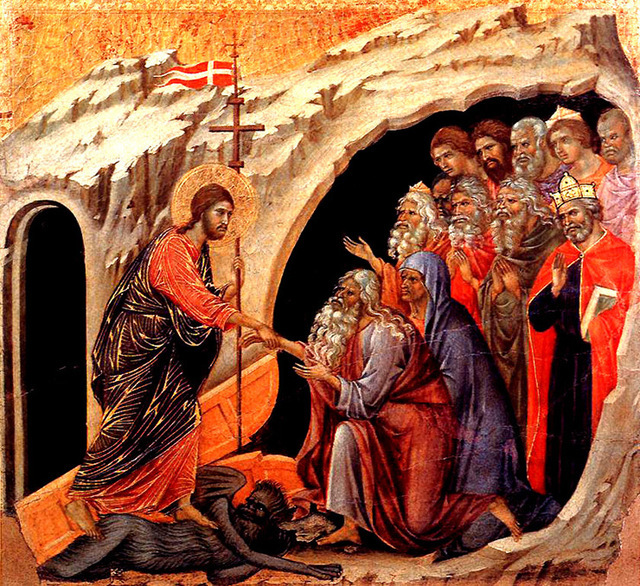
ABC Extra – The Descent Into Hell

This past weekend in worship and ABC, we continued our “Credo!” series with a look at the doctrine of the resurrection of Jesus, based on this line from the Apostles’ Creed: “Christ descended into hell.  The third day He rose again from the dead.”  The fact that Christ “rose again from the dead” is the linchpin of our faith.  Indeed, the apostle Paul says it is “of first importance” (1 Corinthians 15:3).  Without the resurrection, our “faith is futile” (1 Corinthians 15:17).  Thus, in ABC, I spent a great deal of time defending the resurrection’s historicity against skeptics would try to undermine this cornerstone of Christian doctrine.

Blessedly, most Christians believe in Christ’s resurrection.  And they appreciate its centrality to our faith.   Thus, Christians proudly confess, “The third day He rose again from the dead.”  What many Christians do not understand, however, is the line that comes before this: “Christ descended into hell.”  In fact, the most common question I receive concerning the Apostles’ Creed is, “Does the Bible really teach that Christ descended into hell?”  And, if so, “Where does the Bible teach this?”  Though I touched on it in ABC, I wanted to take a slightly more in-depth look at the doctrine of Christ’s descent into hell in today’s blog.

The line, “He descended into hell,” is a relatively late addition to the Apostles’ Creed.  It first appears as part of the Symbol of Sirmium in 359 and reads, “Christ died, and descended to the underworld, and regulated things there, whom the gatekeepers of hell saw and shuddered.”  It first appears in the Apostles’ Creed in 570.  However, just because it appears in the Creed at a late date does not mean it does not have an early origin.  Consider, for instance, these quotes, from Irenaeus (c. 180) and Tertullian (c. 200):

It was for this reason, too, that the Lord descended into the regions beneath the earth, preaching His advent there also. (Irenaeus, Against Heresies, 4.27.2)

But it was for this purpose, say they, that Christ descended into hell, that we might not ourselves have to descend thither.  (Tertullian, A Treatise on the Soul, 55)

Clearly, the church fathers had no problem with the notion that Christ descended into hell.  Nevertheless, because of its late incorporation into the Creed, the phrase, “He descended into hell,” has caused much controversy among Christians.  Indeed, some even go so far as refusing to speak this line when they recite the Creed.  For those who do speak this line, there are multiple interpretations as to what this line means.

Some interpret this line simply as meaning that Christ descended into the grave, that is, He was buried and truly dead.  The Greek of the Creed reads, “Christ descended into ta katotata,” meaning, “the lowest.”  These interpreters take this phrase simply to mean not the lowest place of hell, but the low place of a grave in the ground.  Roman Catholic interpreters believe that Christ did indeed descend into hell in the traditional sense, but did so to free virtuous people who had gone before Him, but nevertheless could not be saved because they had been born before His advent.  The Catechism of the Roman Catholic Church explains: “In His human soul united to His divine person, the dead Christ went down to the realm of the dead. He opened heaven’s gates for the just who had gone before Him” (Catechism of the Catholic Church 637).

Finally, it is probably best to understand Christ’s descent into hell as it is explained in 1 Peter 3:18-19: “For Christ died for sins once for all, the righteous for the unrighteous, to bring you to God. He was put to death in the body but made alive by the Spirit, through whom also He went and preached to the spirits in prison.”  The phrase “spirits in prison” is often taken to refer to the eternal prison of hell.  As I mentioned in ABC, the Greek word for “preached” is kerysso, a word that was used in ancient Greek games to declare the victor of a contest.  Thus, when Christ descended into hell, He did not do so to free the virtuous who had come before Him, for they had already received their salvation through faith in the promise of a coming Messiah (cf. Romans 4:3-8, 18-25).  Rather, He descended into hell to kerysso Himself the victor over sin, death, and the devil.  The descent into hell is Christ’s victory tour, for through the cross, He has conquered all things wicked.  And this is good news!

At Jesus’ empty tomb, the angels sing, “Christ has risen” (Luke 24:6)!  Perhaps it is appropriate to add as well, “Christ has descended!”  For His descent gives a reason for us to celebrate and for hell to shudder.  For Christ’s descent and resurrection, finally, point to the same promise:  Christ has conquered the cross and has secured for us eternal life.  Praise be to the One who descended and resurrected!

Want to learn more on this passage? Go to
www.ConcordiaLutheranChurch.com
and check out audio and video from Pastor Tucker’s
message or Pastor Zach’s ABC!