Practicing Patience

Patience 1The other day, I drove down to the Social Security office to apply to get a Social Security card for my daughter, Hope.  Because she is adopted, she did not get one issued to her at the hospital.  While I was on my way to visit my local friendly government agency, the skies opened up, thunder clapped, and rain poured down, slowing traffic to a crawl.

Now, usually, I hate being stuck in traffic.  I’m always looking for a way to weave in and out of traffic and find that elusive lane that is going 40 miles per hour faster than all the other lanes.  But not so on this day.  It was raining so hard that, quite frankly, I was glad traffic was moving at a snail’s pace.  I’d rather slosh down the road slowly and arrive safely at my destination than try to gun it and wind up in a wreck.

As I sat there contentedly in a sea of brake lights, my thoughts were drawn to the virtue of patience.  After all, for once in my life, I actually felt patient.  Here is what I realized in my moments spent reflecting: the virtue of patience leads to other virtues.  It is what I call a “funnel virtue.”  That is, if you practice patience, it will funnel you in to other important virtues.

For instance, take the virtue of responsibility.  At the end of the day, my wife directs Hope to clean up her toys.  But directing a one-year-old to clean up toys is never an easy – or a quick – task.  Hope will drop a toy in her toy basket only to immediately pull it out again.  But Melody knows it’s important to teach Hope responsibility.  But to teach the virtue responsibility, Melody first needs to exercise the virtue of patience (which she does marvelously, by the way).  Patience funnels into responsibility.

Or how about the virtue of joy?  The disease of road rage is well documented.  Drivers lose their minds because they feel the person in front of them is going too slow.  But what would happen if they were patient?  Perhaps they would rediscover the joy of a Sunday drive – motoring down the road more to take in the sights rater than to reach a destination.  Patience could funnel into joy.

Then, of course, there is the virtue of love.  There is perhaps no better expression of love than patience.  This is why the very first virtue that Paul uses to describe love in 1 Corinthians 13:4 is, “Love is patient.”  To be patient with someone teaches you to love someone because it forces you to put someone else’s pace and schedule above of and in front of your own.

Finally, patience also can serve as a funnel to fuller faith.  Right now, we are in the process of buying a new home.  I cannot tell you how many times I have prayed to God for an answer about something pertaining to this process…right now!  God is answering my requests in some pretty miraculous ways, just not according to my schedule.  And I am having to remember and re-learn that God really does have this all under control and I can trust Him to work things out.  But here’s the key:  the longer I have to wait on Him, the more I learn to trust Him.  Patience funnels into faith.

As it turns out, when I got to the Social Security office, I was not able to get a card for Hope.  The documentation requirements that I read in the Social Security brochure did not match the documentation requirements they had at the Social Security office.  I left empty handed with an errand list of other government agencies I had to visit to get the required documents.  I had wasted my time.  And I found I was not nearly as patient on the way back from the Social Security office as I was on the way to the Social Security office.

Perhaps my patience funnel still has room to expand.
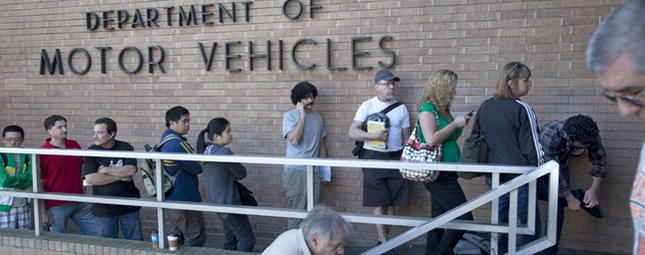
The Value of Patience

Credit: baycitizen.org

I am not a patient person.  I wish I was, but I’m not sure I really have the patience to learn patience.

The other day I had to go to the DMV to get a registration sticker for my truck.  I had renewed my registration online some two months earlier, but my registration sticker never came.  When I called inquiring about my vehicle registration, they informed me that the sticker must have gotten lost in the mail and that it was my responsibility to drive to a DMV office and purchase a replacement sticker.

So that’s what I did.

When I arrived, I found two lines.  One line took care of vehicle registration renewals and the other line took care of everything else.  I was hoping I could wait in the registration renewal line, but because I was not renewing my registration and instead getting a replacement sticker, I had to wait in the other line.  Did I mention that the other line was longer and moving much slower?

After over an hour waiting in line, I finally got my sticker.  It took less than a minute.  Needless to say, I walked out with less than a smile on my face.

I am not a patient person.  God, however, is patient.  The Bible regularly celebrates God’s patience:  “The LORD is compassionate and gracious, slow to anger, abounding in love” (Psalm 103:8).  Rather than getting upset easily and quickly, God’s patient love prevails.

For all of God’s patience, it is important to note that even His patience does not last forever.  When Israel rebels against God for centuries in wickedness, God warns:  “You have rejected me … You keep on backsliding.  So I will reach out and destroy you; I am tired of holding back” (Jeremiah 15:6).  God will only tolerate unrepentant sin for so long.  Such sin will eventually lead to divine judgment.  Thus, although we are called to trust God’s patience, we should not try God’s patience.

I got frustrated because I had to wait an hour to get my vehicle registration sticker at the DMV.  God has been waiting thousands of years so more and more people might repent and trust in Him.  And if God is can wait that long for us, maybe I can wait a little longer for others.

Weekend Extra – Tough and Weak Prayer

Recently, I heard the story of a lady whose husband was terminally ill with a heart condition.  For years, he had fought valiantly against his sickness, but now, his ability to fight was waning.  The time came when he had only days left.  He was in the hospital.  The doctors were scrambling to prolong his life.  And this man’s wife had a decision to make.  Should she advise continuing treatments for her husband, who was unable to decide for himself, or should she advise against it?  She prayed to her Lord.  A couple of hours later, word came from the nurse:  “He will not be getting better.  It’s all downhill from here.”  She took this word to be her divine answer and told the doctors to keep her beloved husband comfortable rather than to try to treat his disease.  He passed away a couple of days later.

This past weekend in worship and ABC, we took a look at Jesus’ Parable of the Unjust Judge:

In a certain town there was a judge who neither feared God nor cared about men.  And there was a widow in that town who kept coming to him with the plea, “Grant me justice against my adversary.” For some time he refused. But finally he said to himself, “Even though I don’t fear God or care about men, yet because this widow keeps bothering me, I will see that she gets justice, so that she won’t eventually wear me out with her coming!” (Luke 18:2-5)

Upfront, Luke states the purpose of Jesus’ parable when he writes, “Then Jesus told His disciples a parable to show them that they should always pray and never give up” (Luke 18:1).  This, then, is a parable about prayer.  Indeed, in this little parable are embedded some very valuable lessons that can help us tremendously in our own prayer lives.

First, we must remember that prayer is tough. The woman in Jesus’ parable is persistent in her entreaty of the judge.  We should be the same in prayer.  But being persistent is not always easy.  All too often, we can be tempted to give up when the answers to our prayers come slower than we might like.  In our quick fix, microwave, lightning fast, high speed society, we are conditioned to want answers from God and want them now!  But sometimes, God makes us wait.  And this is good.  For patience can build our character and our trust in God.  But waiting is not easy.

Prayer can also be tough when the answer we receive to a prayer is not the one we want.  I think of that lady and her husband.  Surely she was praying for a miracle.  Surely she was begging for her husband to be healed.  But her answer from God through a nurse was loud and clear: “No.  His time has come.”  To receive an answer like this in prayer and then to make a medical decision like the one she had to make is never easy.  Prayer is not easy.  This we must remember.

Second, we also must remember that prayer is for the weak. There is an interesting paradox that permeates prayer.  Prayer is tough, and yet it is for weak people.  It is for people who know that by their own devices, know-how, and strength, they cannot prop up, fix up, or wrap up their lives.  In Jesus’ parable, it is a widow who entreats a judge.  This is purposeful.  For widows were well known to be weak and vulnerable in this day.  Without a husband, a widow often had no financial resources for herself or recourse against those who would seek to take advantage of her, as did this mysterious adversary in Jesus’ parable.  Prayer, then, is for people who are weak…and know it.  It is for people who understand that the most profound things of life happen not with our cajoling and coaxing, but by God’s providence and power.  Prayer demands more trust in the supremacy of God and less trust in the supremacy of self.  Prayer is for weak people and to a powerful God.

Finally, then, the question of prayer is this:  Are you tough and weak in prayer?  Are you persistent and powerless in prayer?  The good news of our prayers is that they do not fall on the ears of an unjust judge, like the widow in Jesus’ parable, but on the ears of a righteous heavenly Father who wants to help.  We do not have to persuade Him to care about us as does the widow with the judge.  He already does.

Want to learn more on this passage? Go to
www.ConcordiaLutheranChurch.com
and check out audio and video from Pastor Tucker’s
message or Pastor Zach’s ABC!