Pray for Paris

Paris Eifell TowerI first heard the news on the radio when I was driving home from work Friday night. Phrases like “breaking news” and “continuing coverage” caught my attention. As more and more details of the ghastly attacks trickled in from across the Atlantic, I knew it was going to be a long night for the people of Paris. 129 dead. 352 injured, 99 critically. And ISIS was claiming responsibility for the coordinated attacks that hit six targets at once. After opening fire on their victims, all but one of ISIS’s operatives blew themselves up when police approached, hoping to kill even more people with suicide bombings.

Considering these attacks came just days after ISIS was suspected of downing Metrojet Flight 9268 over northern Sinai as it was on its way from Sharm el-Sheikh to St. Petersburg, it is quickly becoming apparent that ISIS will stop at nothing to intimidate the world. As of now, their tactics are working. Many, many people are very, very scared.

As Christians, we know we are commanded to be not afraid. The words of Psalmist come to mind: “God is our refuge and strength, an ever-present help in trouble. Therefore we will not fear, though the earth give way and the mountains fall into the heart of the sea” (Psalm 46:1-2). Logically, we also know that fear does us little good at a time like this. It solves nothing. It changes nothing. It only paralyzes us and clouds our judgment. But at the same time we are called not to fear, we are also called to be in prayer. Indeed, the apostle Paul addresses both fear and prayer when he writes, “Do not be anxious about anything, but in everything, by prayer and petition, with thanksgiving, present your requests to God” (Philippians 4:6). At a time like this, when the world is fearing, we should be praying.

As this tragedy continues to unfold, allow me offer four things for which I think we can and should pray. My hope is that God will not only comfort you as you pray these petitions, but that He will use these petitions to help you process what has happened. After all, what has happened affects not only the city of Paris or the nation of France; it affects the world. Nous sommes tous les Parisiens.

On to the prayers.

Pray for Paris.

In one way, this goes without saying. And, thankfully, it is already happening. A quick check of my Twitter account shows #Prayers4Paris is trending. So pray for the grieving. Pray for the fearful. Pray for the people of a city who are trying to pick up the pieces of an illusion of safety that has just been shattered. Pray for Paris.

But let me take this a step farther. Because as Christians, to pray for Paris means to pray for all of Paris – even for those who support and sympathize with the attackers. Jesus admonishes us to pray not only for those with whom we share a kinship, but even for our enemies: “Pray for those who persecute you” (Matthew 5:44). So pray for ISIS operatives in Paris and, for that matter, all over the world. Pray, yes, that any further plots would be thwarted. But also pray that their hearts would be changed. A changed heart stops evil much better than even the most sophisticated international intelligence operation.

Pray for sobriety.

The shock and sadness of yesterday’s attacks will soon dissolve into political posturing and raw outrage. Rash responses will be given. Foolhardy decisions will be made. We need to stay away from all such impulsiveness.

If history is any indication, I am especially concerned that many will fall into what logicians refer to as the fallacy of composition. This fallacy asserts that if something is true for the part, it must also be true for the whole. So in this instance, if a few radical Muslims who are part of ISIS are terrorists, then it is reasonable to be wary of any Muslim because he or she might be a terrorist.

Don’t fall for – or propagate – this fallacy!

I have many friends who own firearms. They are, of course, very responsible and cautious with their weapons. But every time a mass shooting happens – in Roseburg, in Charleston, in Fort Hood, in Sandy Hook – many of them openly worry that the actions of a few deranged lunatics will affect all firearm owners. They worry that people will take the actions of a few and use it to stifle the whole. And so they lobby not only for their rights as firearm owners, but also for their character as people.

What firearm owners do for each other, Christians can and should do for Muslims. Let’s not lose our ability to think soberly and clearly not only about these attacks specifically, but about Muslims generally. The vast majority of Muslims are people who hold much in common, especially ethically, with Christians. They love their families. They despise promiscuity. And they support traditional values like honesty, hard work, and generosity. Let’s be willing to vouch for the character of Muslims. And let’s be willing to support and love them as people.

Pray for governments.

The French government, the U.S. government, and many other governments across the world have some difficult decisions to make. ISIS must be stopped. Thankfully, God has given governments the authority to do just this. The apostle Paul explains:

He who rebels against the [governing] authority is rebelling against what God has instituted, and those who do so will bring judgment on themselves. For rulers hold no terror for those who do right, but for those who do wrong. (Romans 13:2-3)

Paul says that those who rebel against good order arranged by good governments will bring judgment on themselves. For good governments will seek to avenge and deter – often with force – evil events. The terrorists, then, have every reason to be terrified.

As governments across the world try to discern how to respond to these attacks, pray that their responses would be decisive, measured, and Godly. In short, pray that world governments would act in ways that thwart evil while honoring God’s Word.

Pray, “Come, Lord Jesus.”

Ultimately, we know that governments, though they can do much to suppress evil, cannot stop evil. Only God can do that. In fact, shortly before Paul writes his words concerning government, he writes about God’s final judgment: “Do not take revenge, my friends, but leave room for God’s wrath, for it is written: ‘It is Mine to avenge; I will repay,’ says the Lord” (Romans 12:19). God’s vengeance is the only vengeance that gives victory.

When does God avenge evil? On the Last Day. Then and only then will evil be wiped out once and for all. Until then, attacks will happen. Lives will be lost. Evil will rear its head. And we will “groan inwardly as we wait eagerly for our adoption as sons, the redemption of our bodies” (Romans 8:23). Considering that none of this is pleasant or good, the final prayer of the Bible can be our prayer today: “Come, Lord Jesus” (Revelation 22:20). “Come and wipe out evil. Come and make everything – including those hurting in Paris – new.”

And He will.

In Response to ISIS

Credit:  Christian Post
Credit: The Christian Post

The video was titled, “A Message Signed With Blood to the Nation of the Cross.” In it, 21 Egyptian Christians, dressed in orange jump suits, were gruesomely beheaded by ISIS militants along a beach in Tripoli. One of the final frames of the video zooms in on the waters of the Mediterranean, red with the blood of these martyrs.[1]

Christians aren’t the only targets of ISIS’ rage. Just last week, ISIS released images appearing to show gay men being thrown off buildings only to be stoned after they fell to the ground. A statement released by ISIS explained that the organization is “clamping down on sexual deviance.”[2]

The reaction to such savage killings has understandably been one of untempered ire. Egypt’s president pledged retaliation against ISIS for the slaughter of its Christians. Indeed, Muslims and Christians together are raising a unified chorus of disgust at ISIS’ actions. Andrea Zaki, vice president of the Protestant Churches of Egypt, noted, “With their blood [these martyrs] are unifying Egypt.”[3]

Though the slaughter of Egypt’s Christians has gotten more press than ISIS’ heinous injustices against gay people, both demand a response in addition to whatever political or military responses may be offered in the national and international arenas. Here are two responses that, I believe, are appropriate and important for a moment such as this.

First, we need an anthropological response. After all, whether we are Christian or Muslim, gay or straight, we are all human. Indeed, as Christians, we know and believe that we are all created in God’s image, which affords us not only a shared humanity, but a necessary dignity. This collective humanity and dignity, in turn, involves certain shared hopes and desires. We all desire safety. We all desire respect. We all desire love. When these shared desires are so violently violated, as ISIS has done, basic empathy leads to visceral revulsion. Thus, we can join the world in condemning these acts, if for no other reason than that we are all human.

Second, we also need a theological response. This response is especially urgent because far too many in the broadly secularized West have refused to admit that there are theological drivers behind ISIS’ actions. Writing for The Atlantic, Graeme Wood explains:

We are misled … by a well-intentioned but dishonest campaign to deny the Islamic State’s medieval religious nature … The reality is that the Islamic State is Islamic. Very Islamic. Yes, it has attracted psychopaths and adventure seekers, drawn largely from the disaffected populations of the Middle East and Europe. But the religion preached by its most ardent followers derives from coherent and even learned interpretations of Islam.

Virtually every major decision and law promulgated by the Islamic State adheres to what it calls, in its press and pronouncements, and on its billboards, license plates, stationery, and coins, “the Prophetic methodology,” which means following the prophecy and example of Muhammad, in punctilious detail. Muslims can reject the Islamic State; nearly all do. But pretending that it isn’t actually a religious, millenarian group, with theology that must be understood to be combatted, has already led the United States to underestimate it and back foolish schemes to counter it.[4]

I should point out that parts of Wood’s history of ISIS’ theological origins – especially his claim that ISIS’ theology is of a “medieval religious nature” – are questionable and, thankfully, have been appropriately critiqued. Nevertheless, his basic premise still stands. ISIS is acting in a way that is robustly and rigorously driven by a certain religious understanding. For ISIS, theology is no mere veneer to cover up some naked ambition for power.   Theology is at the heart of who they are. Thus, it does us no good, for the sake of some self-imposed, naïve political de rigueur, to pretend that at least some of ISIS’ drivers are not theological.

This is where Christians are in a unique position to lend their voices to the challenges and crises presented by ISIS. For we can offer a better theology than ISIS’ theology. We can rebuke a theology that allows the slaughtering of people with whom they religiously and culturally disagree, as Jesus did with His disciples when they wanted to destroy the Samaritans because they were a people with whom the disciples religiously and culturally disagreed. And when a theology leaves room for stoning those who live outside of traditional sexual ethics, we can say with Jesus, “If any one of you is without sin, let him be the first to throw a stone” (John 8:7).

Blessedly, the parts of this “better theology” I outlined above are ones with which the majority of the Muslim world would agree – because even though this “better theology’s” origins are explicitly Christian, its implications are broadly ethical.   And even if ISIS’ understanding of Islamic theology is real, it is certainly not catholic. Plenty – and, in fact, the vast majority – of Muslims share our higher ethical aspirations. Indeed, perhaps what was once a Judeo-Christian ethic can expand into a Judeo-Muslim-Christian ethic.

Ultimately, of course, although theology includes ethics, it is more than just ethical. It is finally soteriological. And this is good. Because this means that even as ISIS continues its campaign of terror, it cannot thwart the promise of God that the faithful who have died at ISIS’ hands are now safe under heaven’s altar.  For this we can be thankful. And because of this we can continue to be hopeful.

______________________

[1] Leonardo Blair, “Heartbreaking: Egyptian Christians Were Calling for Jesus During Execution by ISIS in Libya,” The Christian Post (2.18.2015).

[2] Cassandra Vinograd, “ISIS Hurls Gay Men Off Buildings, Stones Them: Analysts,” NBC News (2.15.2015).

[3] Jayson Casper, “Libya’s 21 Christian Martyrs: ‘With Their Blood, They Are Unifying Egypt’Christianity Today (2.18.2015)

[4] Graeme Wood, “What ISIS Really Wants,” The Atlantic (March 2015).

1500-Year-Old Bible Discovered! Christianity Debunked! Not Exactly.

Turkish BibleHere we go again.

I’ve been seeing it all over Facebook.  The headline reads, “1,500 Year Old Bible Confirms That Jesus Christ Was Not Crucified – Vatican In Awe.”  It seems startling.  The only problem is, it’s not true.  And, it’s nothing new.  These kinds of articles that seek to undermine the veracity of the Bible have been being published for years now.  Indeed, the discovery of this 1,500-year-old Bible is news that’s now better than two years old.  But it’s just now hitting Facebook.  And because many people are being confused by it, it’s worth a look.

The article opens:

Much to the dismay of the Vatican, an approximately 1,500 to 2,000 year old Bible was found in Turkey, in the Ethnography Museum of Ankara.  Discovered and kept secret in the year 2000, the book contains the Gospel of Barnabas – a disciple of Christ – which shows that Jesus was not crucified, nor was He the Son of God, but a prophet.  The book also calls apostle Paul “The Impostor.”  The book also claims that Jesus ascended to heaven alive, and that Judas Iscariot was crucified in His place.[1]

Let’s separate some fact from fiction here.

“Much to the dismay of the Vatican…”  The Vatican did, according to The Christian Post, make an “official request”[2] to see and study the Bible, but it was not out of dismay.  Like any theological artifact, it piqued their curiosity.  Many people desired to study this book.

“…an approximately 1,500 to 2,000 year old Bible…”  Maybe.  But probably not.  There are reasons to believe this book is a forgery, probably written around AD 1500, which is, coincidentally enough, about a century after many scholars believe the Gospel of Barnabas itself was written.[3]  Timothy Michael Law, a Junior Research Fellow at the Oxford Centre for Hebrew and Jewish Studies, has a nice blog on the antiquity of this Bible here.

“…the book contains the Gospel of Barnabas…”  Again, maybe.  But possibly not.  We actually don’t know what the book contains because it has not been widely studied.  The Christian Post quotes theology professor Ömer Faruk Harman who notes that people may be “disappointed to see that this copy … might have no relation with the content of the Gospel of Barnabas.”

“…which shows that Jesus was not crucified … and that Judas Iscariot was crucified in His place.”  The Gospel of Barnabas does indeed purport that Judas Iscariot was crucified in Jesus’ place.  But this is because this Gospel was written as an apologetic for Islam.  Indeed, it prophesies the arrival of Muhammad, but, if the 15th century dating of this Gospel is correct, it does so about 800 years after Muhammad!  In other words, its prophecies are really no prophecies at all, but polemical forgeries.

The line from this Facebook article that made me sigh the loudest is this one:

It is believed that, during the Council of Nicaea, the Catholic Church hand-picked the Gospels that form the Bible as we know it today; omitting the Gospel of Barnabas (among many others) in favor of the four canonical Gospels of Matthew, Mark, Luke, and John.

Ever since Dan Brown’s book The Da Vinci Code, this has been a canard that just won’t die.  At no time during the Council of Nicaea did the Catholic Church hand-pick any Gospels.  The four Gospels we have today were already widely accepted by the Church by the time of this council.  If you want to read the canons issued by the Council of Nicaea for yourself, you can check them out here.  None say anything about the Gospels.  Indeed, none say anything about the canon of Scripture at all.

Ultimately, even if this Turkish Bible is indeed 1,500 years old and even if it does contain the Gospel of Barnabas, the Council of Nicaea was held in AD 325, which is still before the time of this Bible.  Thus, part of the reason the Council of Nicaea never considered the Gospel of Barnabas during its meetings is because there was not yet a Gospel of Barnabas to consider!

It was David Hannum, criticizing P.T. Barnum, who said, “There’s a sucker born every minute.”  Don’t be suckered by this Facebook article.  The Bible as we have it still stands.  And on it, your faith can still stand.

___________________________

[1] “1,500 Year Old Bible Confirms That Jesus Christ Was Not Crucified – Vatican In Awe,” Moorish Harem:  Man’s Greatest Accomplishments (4.28.2014).

[2] Clara Morris, “Turkey’s 1500-Year-Old, $28M Bible Linked to Gospel of Barnabas?The Christian Post (2.23.2012).

[3] See Jan Joosten, “The Gospel of Barnabas and the Diatessaron,” Harvard Theological Review 95, no. 1 (2002).

It’s Not Tricky … It’s Really Not

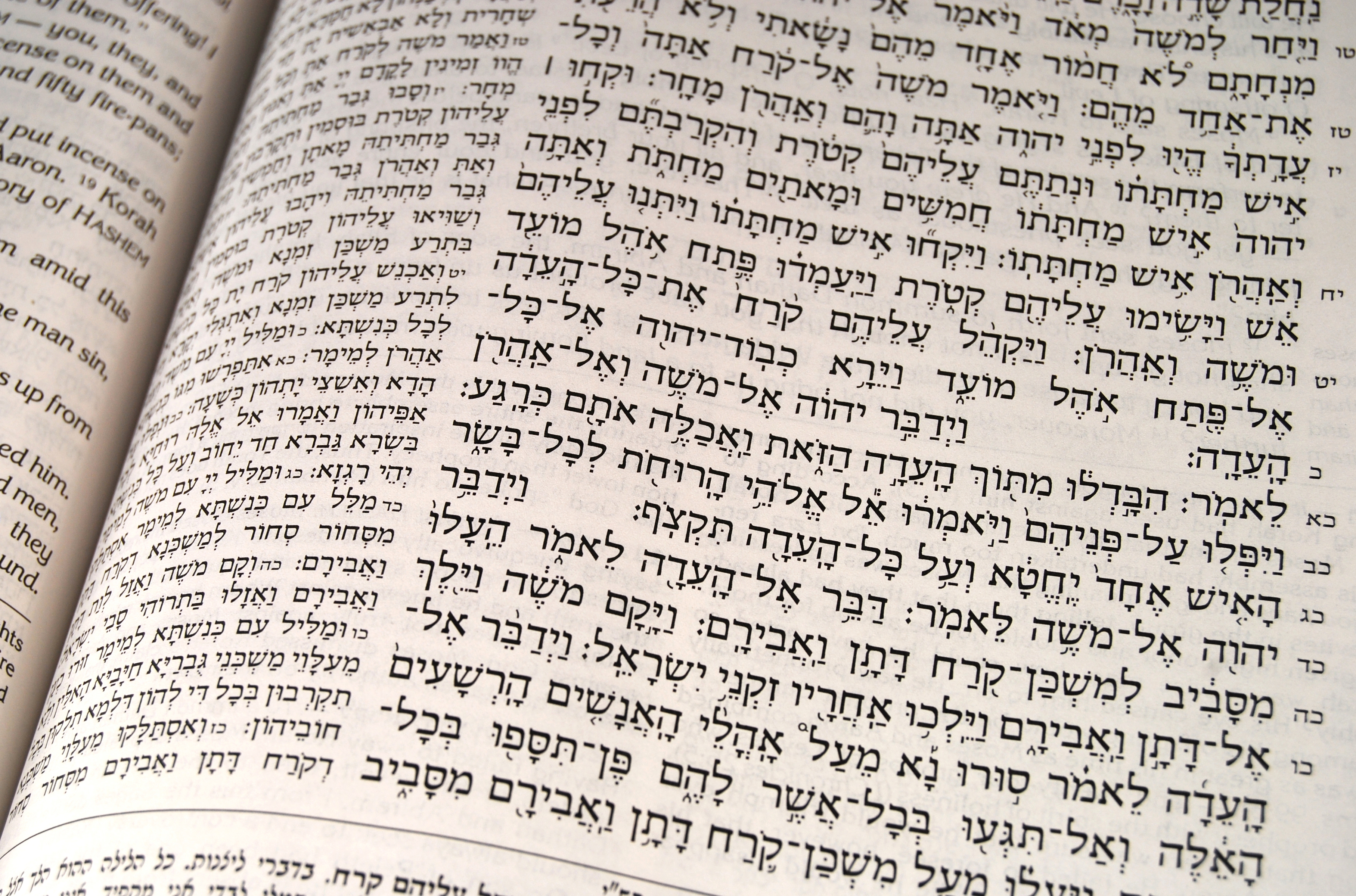
Hebrew Text 2It seems like it’s been happening to me a lot lately.

The other day on the radio, I heard a commercial for “The Biblical Money Code,” a program that claims to be able to make millions for the person who follows it:

Imagine if you had a secret code for making money … a code buried deep within biblical text.  A code that certain investment titans have quietly exploited to amass billions.  And what if this code could be used by you, today, to unlock vast amounts of wealth — safely and ethically.[1]

Now, forget the fact that what the Bible has to say about money is about as straightforward and sharp as it can be.  For instance:  “No one can serve two masters.  Either he will hate the one and love the other, or he will be devoted to the one and despise the other.  You cannot serve both God and Money” (Matthew 6:24).  Forget the fact that God nowhere promises that you can or will amass billions.  Forget the fact that the Bible doesn’t even find it particularly desirable that a person would amass billions.  All of what’s in this program has to be in the Bible.  You just have to unlock the code.

But that’s not the only biblical “code” I’ve run across recently.

The other day, I received an email from a friend claiming the prophet Muhammad was identified by name in the Old Testament.  Where?  Song of Songs 5:16:  “His mouth is sweetness itself; he is altogether lovely.  This is my lover, this my friend, O daughters of Jerusalem.”  How does this refer to Muhammad?  The Hebrew word for “altogether lovely” is machamadim, which sounds like “Muhammad.”  Now, forget the fact that, in context, this is a statement by a wife about her husband.  Forget the fact that machamadim is a Hebrew word and Muhammad is an Arabic name.  Forget the fact that there is nothing in this verse that would indicate this is a prophetic statement.  These two words sound similar, so they must be related.  You just have to unlock the code.

But that’s not the only biblical “code” I’ve run across recently.

I remember a conversation I had with some Mormon friends about the kingdoms of glory in the afterlife.  “We can enter a telestial, terrestrial, or celestial kingdom,” my friends explained.  From where do they get this?  1 Corinthians 15:40 (KJV):  “There are also celestial bodies, and bodies terrestrial: but the glory of the celestial is one, and the glory of the terrestrial is another.”  Now, forget the fact that Paul’s point here is not to talk about afterlife destinations, but to speak of the kind of body we will receive at the resurrection of the dead, as he makes abundantly clear at the conclusion of his argument:

So will it be with the resurrection of the dead. The body that is sown is perishable, it is raised imperishable; it is sown in dishonor, it is raised in glory; it is sown in weakness, it is raised in power; it is sown a natural body, it is raised a spiritual body. (1 Corinthians 15:42-44)

Forget the fact that this verse doesn’t even mention telestial bodies.  Forget the fact that no one in the Church interpreted this verse in this way before Joseph Smith.  Paul has to be talking about different afterlife destinations.  You just have to unlock the code.

With so many so-called “religious experts” peddling so many biblical codes, it is worth it to remind ourselves of the principle of perspicuity.  Perspicuity is from a Latin word meaning “clearness.”  And classically, the Church has ascribed this characteristic to Holy Writ.  The Lutheran dogmatician Francis Pieper summarizes biblical perspicuity thusly:  “The perspicuity of Scripture consists in this, that it presents, in language that can be understood by all, whatever men must know to be saved.”[2]  Pieper goes on to note that Scripture testifies to its own perspicuity in places like Psalm 19:7:  “The statutes of the LORD are trustworthy, making wise the simple.”  One can be simple intellectually and still gain wisdom from Scripture, for Scripture is clear.  Understanding the Good Book does not take a Ph.D. in theology.

Now, this is not to say that every verse of the Bible is equally easy to understand.  No less than the great preacher Chrysostom explains that some parts of the Bible can indeed be difficult to interpret:

Let us suppose … rivers … are not of the same depth.  Some have a shallow bed, others one deep enough to drown one unacquainted with it. In one part there are whirlpools, and not in another … Why then art thou bent on drowning thyself in those depths?[3]

Chrysostom compares different parts of Scripture to different rivers.  Some parts are shallow and easy to navigate.  Other parts are deeper and more difficult to wade through.  But though some parts of Scripture are richly deep, none are nefariously tricky.  In other words, the biblical authors are not trying to hide things from us with a code, but reveal things to us under the guidance of God’s Holy Spirit.

The long and short of biblical perspicuity, then, is this:  finding codes, mysteries, and secrets that cater to our sinful lusts like greed, play “sound like” games with words across languages, and rip words out of a text and shoehorn them into meaning something which, contextually, they clearly do not and cannot mean are not only not biblical, they’re evil.  God wants us to understand and follow His Word – not be confused by it and misinterpret it.

So the next time you open your Bible, don’t pull out your decoder ring, pull out your reading glasses.  They’ll work much better.  And you’ll be much more edified.


[1]The Biblical Money Code,” newsmax.com

[2] Francis Pieper, Christian Dogmatics, vol. 1 (St. Louis:  Concordia Publishing House, 1950), 320.

[3] John Chrysostom, A Select Library of the Nicene and Post-Nicene Fathers of the Christian Church, series 1, vol. 13, P. Schaff, ed. (New York: Christian Literature Company, 1889), 507.

Searching for Scapegoats

Boston Bombing SuspectsAs investigators continue to probe Dzhokhar Tsarnaev concerning his role in the Boston Marathon bombing, his motive, though not fully understood, nevertheless seems to be driven at least in part by an al Qaeda agenda.  Consider this from NBC News:

It is as slickly designed as any magazine you would find at the supermarket checkout line, or in the seat pocket in front of you on an airplane. It even has snappy cover headlines – teasing articles like “Make a Bomb in the Kitchen of Your Mom.”

And now Inspire, the recruitment magazine of al Qaeda in the Arabian Peninsula, probably has its next cover story:  It allegedly helped inspire the two brothers accused of bombing the Boston Marathon.

Dzhokhar Tsarnaev, the hospitalized suspect in the marathon attack, has told federal investigators that the brothers got information on building bombs from Inspire, law enforcement officials told NBC News.[1]

Before Dzhokhar and his brother Tamerlan were identified by the FBI as the suspects in this bombing, confusion – and, I should add, speculation – as to who could have done such a thing abounded.  There was the damaging gaffe from the New York Post which published a cover featuring two young men who, according to the Post, were sought by “the Feds” when, in fact, they were not suspects in the bombing.[2]  And then there were those who speculated – and even hoped – that the bomber would either be or not be a certain race, religion, or political persuasion.

Two articles, published before the Tsarnaev brothers were identified, are of special interest in this regard.  The first article appeared in The Guardian carrying the headline, “US Muslims ‘holding their breath’ as Boston investigators hunt for bomber.”[3]  The article opened:

US Muslims are “holding their breath” as the investigation into the Boston Marathon attacks develops, amid fears of increased racial profiling and attacks if an Islamic link is confirmed, according to advocate groups.

The second article was by David Sirota, writing for Salon, and was titled, “Let’s hope the Boston Marathon bomber is a white American.”[4]  Sirota, who I should point out is himself a white American, offers the rational for his demographic hope thusly:

If the bomber ends up being a white anti-government extremist, white privilege will likely mean the attack is portrayed as just an isolated incident – one that has no bearing on any larger policy debates. Put another way, white privilege will work to not only insulate whites from collective blame, but also to insulate the political debate from any fallout from the attack.

It will probably be much different if the bomber ends up being a Muslim and/or a foreigner from the developing world. As we know from our own history, when those kind of individuals break laws in such a high-profile way, America often cites them as both proof that entire demographic groups must be targeted, and that therefore a more systemic response is warranted. At that point, it’s easy to imagine conservatives citing Boston as a reason to block immigration reform defense spending cuts and the Afghan War withdrawal and to further expand surveillance and other encroachments on civil liberties.

Interestingly, both of these articles share this in common:  they both hoped the bomber was not a Muslim.  But Sirota’s article takes it one step farther.  He wants the bomber to be “a white anti-government extremist.”  The Guardian’s article has only a negative hope for who the bomber is not.  Sirota, on the other hand, holds out a positive hope for who the bomber is. 

I can sympathize with the sentiments of those interviewed for The Guardian’s article.  After all, I cringe whenever I hear another Christian merely say something wrongheaded, hypocritical, or bombastic.  To have someone who claims to follow Christ plant and detonate a bomb in the midst of a crowd of marathon onlookers would break my heart.  After all, such a tragedy would harm the Christian witness and put up a Satanic barrier that could very well be a powerful preventive against people coming to the truth.  I can only imagine the stress, anguish, and embarrassment that some in the Muslim community must be feeling right now.  And when these feelings are coupled with the potential of reckless retaliation against mosques and Muslim religious leaders, my guess would be that many in the Muslim community are also feeling fear.  Thus, those in the Muslim community deserve our prayers for their protection against such retaliatory attacks as well as our prayers that they continue to be afforded the basic human dignity implicit to the imago Dei.  Whether or not a person is a Christian, everyone should be afforded a basic amount of dignity and respect, for we are all creations of the Almighty.  A tragedy like this can make a certain people group feel as though they have lost even this basic modicum of dignity and respect.

I have a much harder time understanding the sentiments of Sirota’s article.  Hoping that a particular person or people group has committed a heinous crime is beyond me.  As a Christian, the prayer is never that a particular person or people group would sin, but that a particular person or people group would be guarded from sin.  The words of Jesus come to mind:  “Lead us not into temptation” (Matthew 6:13).

The fundamental problem with Sirota’s argument is this:  he is trying to identify a scapegoat that will most readily suit his own political machinations and interests.  The message of Christianity is that a scapegoat, not for politics, but for sin has already been provided – Jesus.  Thus, rather than trying to lay blame at the feet of a particular person for the sake of a political agenda, we can lay blame on the cross of Christ where it will be taken away.  For Christ not only takes the blame for human sin by His death, He conquers it by His resurrection.  And so, when sin rears its ugly head as it did in Boston, which would you rather have:  someone you can blame or someone who can save?

I know what my answer is.