Say Something

First it was Buffalo. Then, last week, Uvalde. In total, 31 people lost their lives. The pictures, stories, and stunted potential of so many precious people is heart-rending.

Again and again, we ask: Why can’t we stop this? And again and again, we discover all sorts of signs were there that deadly trouble was brewing. Law enforcement referred the Buffalo shooter for psychiatric evaluation because of his macabre musings. Days before the Uvalde shooter commenced with his massacre, he sent disturbing social media messages to random teenage girls in Germany and California. So, we ask again and again: If the signs were there, why didn’t someone intervene?

When Eve falls to the twisted temptations of a talking snake to eat some divinely forbidden fruit, not only does she partake, “she also gives some to her husband, who was with her, and he ate it” (Genesis 3:6). Adam was with Eve the whole time she was conversing with a snake, which, in and of itself should have been a signal to him that something was drastically amiss, but he didn’t say anything. The warning signs were there, but Adam never intervened. And the result was death as sin came into the world.

At the heart of the Christian message are people who saw something – and said something. As one of Jesus’ followers, Peter, explains:

We did not follow cleverly devised stories when we told you about the coming of our Lord Jesus Christ in power, but we were eyewitnesses of His majesty. He received honor and glory from God the Father when the voice came to Him from the Majestic Glory, saying, “This is My Son, whom I love; with Him I am well pleased.”We ourselves heard this voice that came from heaven when we were with Him on the sacred mountain. (2 Peter 1:16-18)

Because these first followers of Jesus said something, the world was changed – and lives were, for eternity, saved.

As debates continue to rage over the police response in Uvalde and over how to address and prevent these mass shootings more generally on the local, state, and national levels, on a personal level, if we see something, we need to say something. And we need to remind others to do the same. What we say might just be what saves a life – or many lives.

For those who are grieving because they have lost loved ones in these depraved shootings, here is a promise: the God who sees them and loves them will say something. And what He says will be life-restoring:

Wake up, sleeper, rise from the dead, and Christ will shine on you. (Ephesians 5:15)

The losses we have endured are unspeakably evil, but they do not have the last word. This is the last word: Christ is risen – and so will they.

Resurrection Trouble

Credit: cottonbro / Pexels.com

Easter is hopeful and scandalous all at the same time. It is scandalous because its message insists that what we think we know about death – that it is inescapable – has been escaped by Jesus. It is hopeful because there is something about death’s demise that strikes in us a chord of longing.

Sadly, the message of Easter – that Christ has risen in space and in time and in His body – has often been reduced to little more than a message about general hope for tomorrow and a slightly more spiritual-sounding non-descript existence after death. But it was not this way in the beginning. As N.T. Wright explains:

Death is the last weapon of the tyrant, and the point of the resurrection, despite much misunderstanding, is that death has been defeated. Resurrection is not the redescription of death; it is its overthrow and, with that, the overthrow of those whose power depends on it. Despite the sneers and slurs of some contemporary scholars, it was those who believed in the bodily resurrection who were burned at the stake and thrown to the lions. Resurrection was never a way of settling down and becoming respectable.

The resurrection caused trouble in that world – and it can still cause trouble in this world.

To the tyrant who murders to secure your power – the resurrection will destroy you.

To the disease that saps and sucks the life out of bodies – the resurrection will undo you.

To the hopelessness and helplessness and grief that can set in when a loved one dies – the resurrection will conquer you.

To the devil himself – the resurrection has already defeated you.

This is what we mean when we declare, “Christ is risen.”

And He has, indeed. Alleluia.   

Thorny Lies

Satan loves to send malicious messages. This was something the apostle Paul struggled with. When writing to the church he planted in Corinth, he admits:

I was given a thorn in my flesh, a messenger of Satan, to torment me. (2 Corinthians 12:7)

Paul struggled with a thorn. Exactly what this “thorn” was, we don’t know. Some people think it was a physical malady like a loss of sight while others conjecture that he battled some spiritual temptation. Whatever it was, Satan used this thorn as his messenger to torment Paul.

Satan does the same thing with us, too. When we struggle with and suffer from life’s thorns, Satan loves to say:

        “This thorn is because God is angry at you for a sin.”

        “This thorn means God does not care for you.”

        “This thorn proves you are unworthy of others’ love.”

        “This thorn will never end. You’ll be miserable forever.”

Have you ever struggled with thoughts that sound something like these? Satan is tormenting you with his malevolent messages.

Do not believe them. Do not believe him.

Paul certainly doesn’t. Because at the same time Satan is seeking to torment Paul with his deceptive messages, God is speaking loving words to Paul:

My grace is sufficient for you, for My power is made perfect in weakness. (2 Corinthians 12:9)

God responds to Satan’s lies of human worthlessness with the truth of His worthiness, which He gladly and freely shares with us out of His grace. When Satan tells us we are insufficient, God reminds us that His grace is wonderfully sufficient.

Satan may try to speak to us through thorns, but these thorns, instead of destroying us, are taken for us. They’ve all landed on Jesus’ head. And, in exchange, He gives us grace.

Believe that. Believe Him.

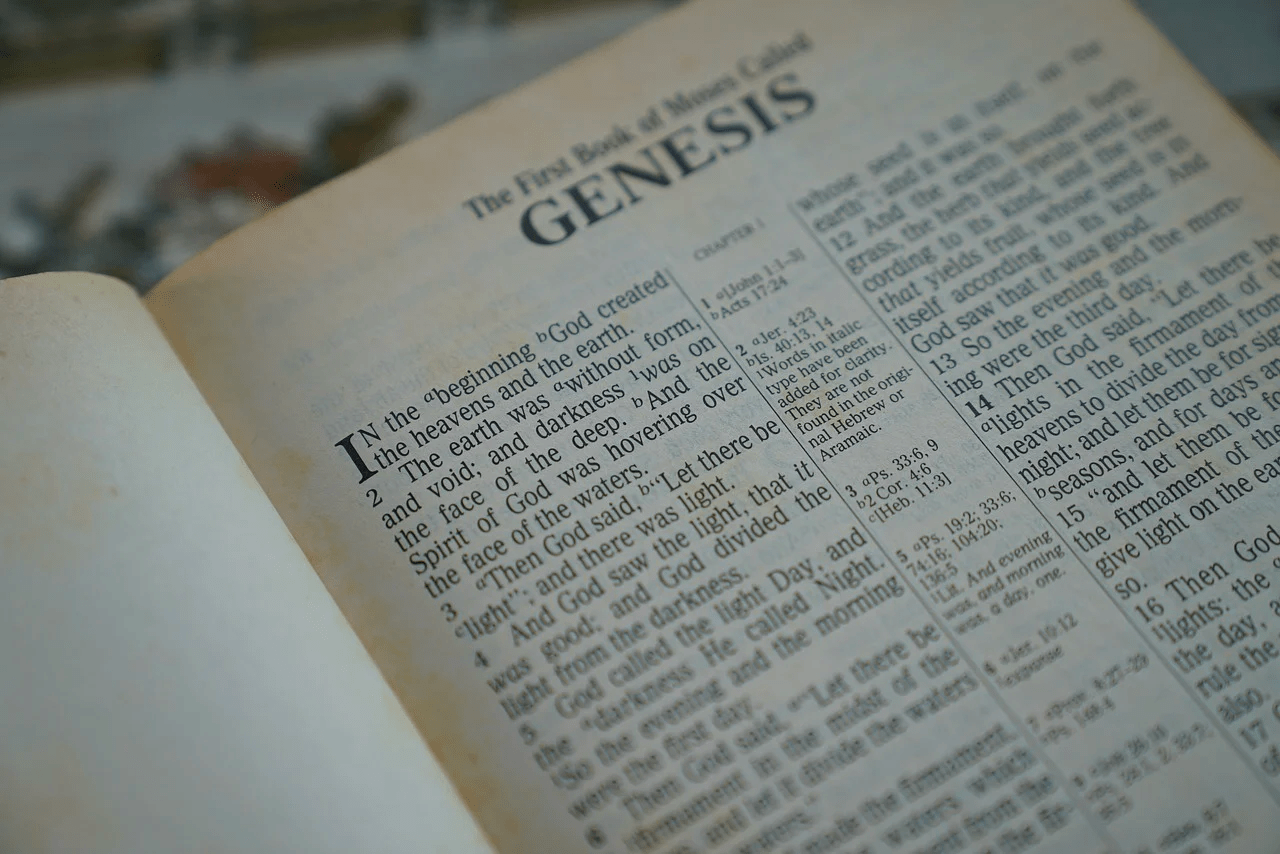
A New Genesis

Credit: Pixabay

The Old Testament opens with these famous words:

In the beginning God created the heavens and the earth. (Genesis 1:1)

In Greek, one word for “beginning” is genesis, which is why we call the first book of the Bible “Genesis.” It is a book about humanity’s beginning.

The New Testament opens with these words:

This is the genealogy of Jesus the Messiah the son of David, the son of Abraham. (Matthew 1:1)

In Greek, the word for “genealogy” is genesis. Matthew opens with a genealogy that describes Jesus from the beginning, which echoes the beginning described in Genesis 1:1 because, as John notes, Jesus “was with God in the beginning” (John 1:2). In other words, there was never a time – even in the very beginning – when Jesus was not.

But there’s more.

A little later in Genesis, we read:

This is the book of the generations of Adam. (Genesis 5:1)

What follows is a genealogy of Adam’s descendants, just like in Matthew we get a genealogy of Jesus’ ancestors. And the Greek word behind “generations” is again genesis.

But by Genesis 5, there is a problem. Adam has fallen into sin and has reaped the consequences of sin, including pain, struggle, and death. In other words, Adam’s beginning is now marching toward a tragic end. He will perish.

The story of Scripture, then, is that of a struggle and search for a new beginning that will not inevitably end in pain, struggle, and death. And in Matthew 1, the Scriptures show us that ever since the beginning of Genesis 1, God has been planning to give us a new beginning in Jesus Christ. Genesis 1 is not the only genesis we have. We have a new genesis in Jesus.

So, where do you need a fresh start? A second chance? A new beginning? What has tragically ended for you in this life? A relationship? A hope? A dream?

Christ takes your first beginning – the one we have in Adam – and nails it to a cross and exchanges it for another beginning that will not end. No ending in this life can stop what will endure eternally in the next life.

Now that’s the kind of new beginning we all need.

The end.

Not Much Lasts Forever

Credit: Meruyert Gonullu / Pexels.com

Whenever I was encountering a tough time as a child, my mother used to remind me, “Not much lasts forever.” Though it was hard for me to believe or see at the time, she was right. The problems that seemed to be such a big deal when I was in grade school, middle school, or high school are now just distant memories – and, in many cases, not even memories at all. I have forgotten about most of the things I was once upon a time so upset about.

Perhaps the most famous story in the Bible of a tough time belongs to a man named Job. His story opens with him as the richest man around, but then, through a series of Satanic-inspired calamities, he loses his wealth, his family, and his health. He wonders out loud if he will even lose his life:

A man dies and is laid low; he breathes his last and is no more. As the water of a lake dries up or a riverbed becomes parched and dry, so he lies down and does not rise. (Job 14:10-12)

As Job ponders death, he, at first, indicates that death would be a tough time that would last forever. When a person dies, after all, “he breathes his last and is no more” and “he lies down and does not rise.” Death, Job seemingly indicates, is permanent.

But Job is not quite done yet. After Job speaks of how a man, in death, “lies down and does not rise,” he continues:

…till the heavens are no more, people will not awake or be roused from their sleep. (Job 14:12)

Death, Job says, comes with a “till.” Death will last “till” the heavens are no more. But what about after the heavens are no more? The apostle Peter helps us:

The day of the Lord will come like a thief. The heavens will disappear with a roar; the elements will be destroyed by fire, and the earth and everything done in it will be laid bare. But in keeping with His promise we are looking forward to a new heaven and a new earth, where righteousness dwells. (2 Peter 3:10, 13)

After the heavens disappear, Peter promises that there will be a new heavens and a new earth – along with a new us. We will be raised from death. For, as my mother reminded me, not much lasts forever – not even death.

Job asks:

If someone dies, will they live again? (Job 14:14)

Peter answers Job’s question with a resounding, “Yes.”