If I was David, I would have been tempted to say, “The devil made me do it.”
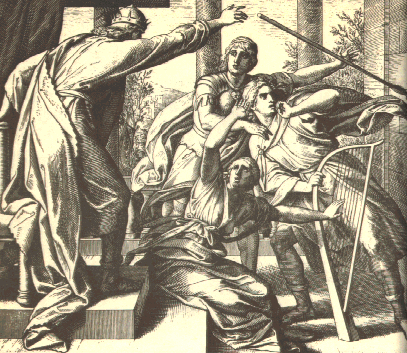
When “Satan rises up against Israel and incites David to take a census of Israel” (1 Chronicles 21:1), David can’t resist the opportunity to figure out just how big and powerful his empire really is. David, it seems, has become more prone to glorifying his nation than he is to glorifying his God. But the Lord is not pleased. So “He punishes Israel” (1 Chronicles 21:7).
David may be easily conned by folly, but, in this instance, he is also a man of quick repentance: “I have sinned greatly by doing this. Now, I beg you, take away the guilt of your servant. I have done a very foolish thing” (1 Chronicles 21:8). God answers by giving David three options for punishment. Israel can (1) endure three years of famine; (2) endure three months of attacks from surrounding enemies; or (3) suffer three days of attacks by the Lord Himself against Israel. David chooses option three, citing this reasoning: “Let me fall into the hands of the LORD, for His mercy is very great; but do not let me fall into human hands” (1 Chronicles 21:13).
God gets to work. In a flash, 70,000 people die. David’s census numbers must be amended. God then sends His angel to destroy Jerusalem, but “as the angel was doing so, the LORD saw it and relented concerning the disaster and said to the angel who was destroying the people, ‘Enough! Withdraw your hand’” (1 Chronicles 21:15). It is at this point that it becomes clear that what David has said about God is true of God: His mercy really is very great. Three days would have been more than enough time for God to destroy everything. But instead, God preserves most things.
David, however, is not convinced that God’s tour of destruction has ended. So he cries out to God, “Was it not I who ordered the fighting men to be counted? I, the shepherd, have sinned and done wrong. These are but sheep. What have they done? LORD my God, let Your hand fall on me and my family, but do not let this plague remain on Your people” (1 Chronicles 21:17). To a God who David has just called “merciful,” David offers his blood. David may say God is merciful, but he doesn’t really seem to trust in His mercy.
But God does have mercy – even for David. Indeed, God, mercifully, does not ask for David’s blood. But He does ask for an altar and a sacrifice: “Then the angel of the LORD ordered Gad to tell David to go up and build an altar to the LORD on the threshing floor of Araunah the Jebusite” (1 Chronicles 21:18). So David goes to Araunah who offers both his land and all the materials needed as a gift to David so he can make his offering. But David refuses Araunah’s gift: “No, I insist on paying the full price. I will not take for the LORD what is yours, or sacrifice a burnt offering that costs me nothing” (1 Chronicles 21:24). David deems it unacceptable to offer to God a sacrifice that costs him nothing.
But why?
Abraham didn’t seem to have any problem offering God a sacrifice that cost him nothing when, in place of his son Isaac, he offered a ram caught in the thicket – a ram that God Himself provided. And the very sacrifice to end all sacrifices – the sacrifice of God’s Son – cost humanity nothing even as it cost God everything. The best sacrifices, it seems, are the ones that come as gifts.
God acts mercifully toward David when He tells him to go the field of a man who will offer everything David needs to make a sacrifice, but David can’t quite bring himself to receive the gift. He’d rather pay. David may call God merciful, but again, he doesn’t really seem ready to rejoice in His mercy.
It is true that sacrifices can be costly for those who offer them. Indeed, sometimes, sacrifices should be costly for those who offer them. Such sacrifices can stretch us and help us grow in our faith. But sacrifices can also come as free gifts. And it’s not wise to despise a gift.
How often do we, like David, confess God to be merciful as a matter of doctrinal truth, but then refuse the very mercy that God tries to give? We’d rather pay.
God received David’s sacrifice, even though David did not receive Araunah’s gift: “The LORD answered David with fire from heaven on the altar of burnt offering” (1 Chronicles 21:26). But I can’t help but wonder what would have happened if rather than saying to Araunah, “Let me pay!” David simply said, “Thank you.” I can’t help but wonder if God would have been pleased with David’s sacrifice just the same.
The apostle Paul writes, “I urge you, brothers and sisters, in view of God’s mercy, to offer your bodies as a living sacrifice, holy and pleasing to God – this is your true and proper worship” (Romans 12:1). A holy and pleasing sacrifice does not require a payment from us. Rather, a holy and pleasing sacrifice can simply flow from the mercy of God.
So the next time God is merciful to you (which should be in no time at all), remember to receive His mercy. You don’t need to pay. You can just say, “Thank you.”