ABC Extra – The Real Thing – 1 Corinthians 6:12-20
 In 1969, the Coca Cola Company came out with one of their most memorable slogans: “Coke. It’s the real thing.” This slogan was meant to distinguish Coca Cola from all those other “phony colas” out there which were not the real thing, but only discount knock-offs. There’s only one real cola and these advertisers wanted us to know that it was Coke.
Of course, the great philosopher Plato would disagree with Coke’s slogan. Plato distinguished between two worlds: the material world which he described as a world of incidental, outward forms and the non-material world which he maintained was the world of true and universal Forms. Thus, a physical object like, let’s say, a bottle of Coca Cola, was only an incidental form and shadow of a larger, true, grander Form in a spiritual world of Forms. A physical bottle of Coca Cola, then, would quite literally not be the real thing. No, the real Coca Cola resided somewhere in an inaccessible spiritual world of true Forms.
Plato’s distinction between the true spiritual world of Forms and the illusionary physical world of forms has profoundly influenced nearly every philosophical system. It especially held sway over the philosophical systems of the first century. The Epicureans believed, for instance, that since everything in this physical world was only a shadow of the true spiritual world of Forms, everyone was free to live how they wanted, doing with their bodies as they wanted. After all, our physical, bodily forms did not really matter. It was our spiritual Forms that really counted.
Enter the Corinthian Christians. This congregation had apparently bought into Platonic and Epicurean philosophies and found it acceptable and even admirable to live hedonistic lives, apart from any ethical scruples. Indeed, they had a slogan to summarize their philosophical sensibilities: “All things are lawful for me” (1 Corinthians 6:12). The Corinthians believed that whatever they wanted, desired, or thought they needed, they could obtain without regard to moral law. Were they hungry? They could gorge themselves. Were they lusty? They could engage in promiscuity without so much as a second thought. After all, this physical world is only a place full of shadows and our physical bodies are only shells. The real spiritual Form of us resides somewhere else.
The apostle Paul, when addressing the Corinthians, has a somewhat different estimation of this physical world and our physical bodies. He writes, “The body is meant…for the Lord, and the Lord for the body” (1 Corinthians 6:13). Paul’s argument is simply this: what you do with your body counts. Your body is not just a shifting shadow of a greater spiritual reality in some non-descript world of Forms. Indeed, the body is so precious that the Lord is “for the body.” In other words, God thinks your body is a good thing! Tall, short, fat, skinny, black, white, Hispanic, male, female, old, young, or middle aged, God is for your body! He cares about your body! Indeed, he cares about it so much that he promises to raise it imperishably from the dead on the Last Day (cf. 1 Corinthians 15:42).
Paul finally describes the value of our physical bodies thusly: “Do you not know that your body is a temple of the Holy Spirit within you, whom you have from God? You are not your own, for you were bought with a price. So glorify God in your body” (1 Corinthians 6:19-20). There is an interesting textual variant at the end of verse 20. Some ancient manuscripts add another line to this verse. They add, “And in your spirit, which is God’s.”
This final line is probably a liturgical gloss. In other words, whenever a letter like Paul’s would be read out loud to an ancient Christian congregation, the congregation would know the letter so well that they would respond at certain strategic points in the reading. And so, much like when a pastor today says, “The peace of the Lord be with you all,” the congregation will respond, “And also with you,” when the pastor of one of these ancient congregations would read, “So glorify God in your body,” the congregation would respond, “And in your spirit, which is God’s.” These words seem to have become so commonplace, that they made it into some copies of the actual biblical text!
Although these words were almost certainly not in Paul’s original letter to the Corinthians, they do provide us with some interesting insight into how Christians viewed their bodies. The body, it seems, was so important to the early Christians that they came up with a responsive liturgy just to extol the value of our bodies along with our spirits: “Glorify God in your body. And in your spirit, which is God’s.” Thus, whether in our physical bodies or in our incorporeal spirits, we are to glorify God with everything in us. What you do with your body matters. It is not just a reflection of some spiritual reality, it is spiritual reality because in your body resides your spirit. So, in both your body and your spirit, live well and so glorify God with everything in you.
Want to learn more on this passage? Go to
www.ConcordiaLutheranChurch.com
and check out audio and video from Pastor Josh’s
message or Dr. Player’s ABC!

The Temptation of Christ – Matthew 4:1-11
 Yesterday at Concordia, we kicked off our Lenten season with a two and a half day fast. If you want more information on fasting, its theological significance, as well as some of the mechanics of fasting, you can download a pdf of our fasting booklet here.
My guess is, if you are participating in our fast from solid foods, even as you are reading this, your stomach is growling. Mine is. And yet, as I mentioned in my message last night, we fast so that we can feast. For as our stomachs are emptied, our souls are filled as we remember, “Man does not live on bread alone, but on every word that comes from the mouth of God” (Matthew 4:4).
As I was thinking further about the temptations Satan leveled at Jesus while he was fasting in the desert, a few things struck me. First, I found it striking that Satan didn’t stop at one temptation. He circled back to tempt Jesus a second and a third time. When it comes to luring people into sin, Satan’s motto seems to be, “If at first you don’t succeed, try, try again!” Thus, this is a temptation truth that we do well to remember: Fighting temptation is not a battle, it’s a war. If we resist temptation once, we can be pretty much guaranteed that Satan will come back for another round. But, then again, lest we throw up our hands in despair, believing it is futile to even try to resist temptation because Satan will simply continue to assault us, I also found Matthew 4:11 to be especially heartening: “Then the devil left Jesus.” Satan will eventually check out, even if he comes at you for a few rounds. Jesus’ brother James puts it well: “Resist the devil, and he will flee from you” (James 4:7). If you, like Jesus, are fighting a battle with Satan, I would simply offer you this exhortation: Resist the devil. And keep on resisting. Even if it takes forty days. For Satan will eventually check out.
The second thing I found striking about Satan’s encounter with Christ is what one scholar terms as the “descending Christology” of these temptations. In his first temptation, Satan addresses Jesus: “If you are the Son of God, tell these stones to become bread” (Matthew 4:3). Notice that Satan acknowledges Jesus could be the Son of God, but he does not acknowledge he is the Son of God. But Satan does not stop here. He dives deeper into heresy until he crassly declares in his third temptation: “All [the kingdoms of the world] I will give you if you will bow down and worship me” (Matthew 4:9). Satan begins his temptations by saying, “If you are the Son of God…” He ends his temptations by essentially saying, “If I am god…” He ends his temptations demanding Jesus worship him as a god. A subtler error turns into a huge and hoary one.
Satan uses the same tactic with us that he used with Jesus. He begins by tempting us with smaller errors but then tries to drag us into larger errors until he finally destroys our faith altogether. This is why, whether it be a temptation to tell a little white lie or a temptation to commit murder, we must resist Satan’s every temptation at every turn and on every front.
The final thing I found striking – and really, touching – about Christ’s battle with Satan is the final line of Matthew’s temptation account: “And angels came and attended Jesus” (Matthew 4:11). The Greek word for “attended” is diakaneo, a word which describes someone who waits on tables. This has led many scholars to believe that following Satan’s temptations, angels came and waited on Jesus with food. And so Jesus finally breaks his fast. Oh what a relief that must have been for our Lord. And oh what a joy it must have been to see all of heaven concerned with his hunger and temptations. And here is comfort for us too: When we feel hungry or weak or tempted, all of heaven is concerned with our concerns. And heaven attends to us. God’s angels and best of all, God’s Son, offer us strength when we are weak and perseverance when we are tired. And so, as you fast, rejoice that all of heaven watches. And rejoice that all of heaven cares. But most of all, rejoice that the God of heaven loves you.
ABC Extra – Darkness to Light – John 3:1-16
 Fitness. According to the Bible, it’s not just a diet program or an exercise regimen, it involves everything we are. For God desires us to be fit in every aspect of our lives, be that physically, emotionally, spiritually, relationally, or otherwise. Indeed, Jesus describes his mission thusly: “I have come that they may have life, and have it to the full” (John 10:10). Jesus desires not only that we have life, but that we have it to the full. And a full life can be found only in him.
Ultimately, a perfectly full life can never be had in this life, for this life will end. Thus, a full life, given by Jesus, involves a promise of a new life beyond this one – a new, eternal life beyond this one. This new, eternal life is the topic of conversation between Jesus and a Pharisee named Nicodemus in John 3. The chapter opens:
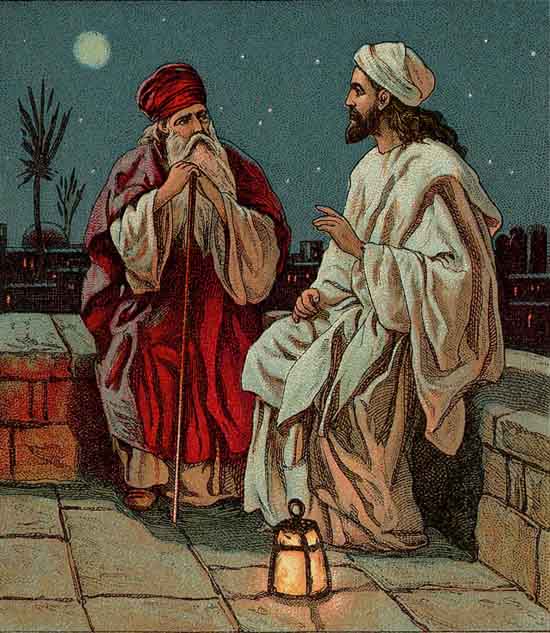
Now there was a man of the Pharisees named Nicodemus, a member of the Jewish ruling council. He came to Jesus at night and said, “Rabbi, we know you are a teacher who has come from God. For no one could perform the miraculous signs you are doing if God were not with him.” (John 3:1-2)
Especially notable in these verses is the timing of this conversation between Nicodemus and Jesus. It is “at night” (John 3:2). On the one hand, as I mentioned in Adult Bible Class, John’s gospel regularly uses the image of darkness to express not only physical darkness, but spiritual darkness. As Jesus later says in this same chapter: “This is the verdict: Light has come into the world, but men loved darkness instead of light because their deeds were evil” (John 3:19). Thus, Nicodemus’ timing in his visit to Jesus seems to express something concerning his spiritual state: he is in darkness.
But at the same time the setting of this encounter alludes to Nicodemus’ spiritual darkness, it alludes to something else: his faithfulness. According to ancient traditions, religious communities, such as the community of the Pharisees, were to study Scripture late into the night. We read in the Dead Sea Scrolls: “The general membership [of a religious community] will be diligent together for the first third of every night of the year, reading aloud from the Book, interpreting Scripture, and praying together” (1QS 6:7-8). Thus, at night, as during the day, Nicodemus was to study Scripture with his fellow Pharisees. So when Nicodemus comes to Jesus, he probably does so right after he has studied the Scriptures.
Eventually, Nicodemus comes to faith in Jesus. We read near the end of John’s gospel:
Later, Joseph of Arimathea asked Pilate for the body of Jesus. Now Joseph was a disciple of Jesus, but secretly because he feared the Jews. With Pilate’s permission, he came and took the body away. He was accompanied by Nicodemus, the man who earlier had visited Jesus at night. Nicodemus brought a mixture of myrrh and aloes, about seventy-five pounds. Taking Jesus’ body, the two of them wrapped it, with the spices, in strips of linen. This was in accordance with Jewish burial customs. At the place where Jesus was crucified, there was a garden, and in the garden a new tomb, in which no one had ever been laid. Because it was the Jewish day of Preparation and since the tomb was nearby, they laid Jesus there. (John 19:38-42)
Interestingly, by this time, Nicodemus does not seem to be nearly so shy concerning his commitment to Jesus as he was in John 3. He accompanies Joseph of Arimathea to Pontius Pilate, the very prefect of Judah. Mark records that such an act “took courage” (Mark 15:43), for Pilate could have easily condemned the two men.
Not only does Nicodemus boldly approach Pilate with Joseph, he also embalms Jesus’ body on “the Jewish day of Preparation” (John 19:42), that is, the day before the Sabbath. Jewish days were reckoned from sundown to sundown. This means that Nicodemus would have to tend to the details of Jesus’ burial before sundown – while it was still daylight.
Nicodemus’ first encounter with Jesus was under the cover of night. Nicodemus’ final encounter with Jesus was in broad daylight. Perhaps all those late night study sessions of the Scriptures helped Nicodemus after all. For hours upon hours of studying the light of God’s Word eventually led him to faith in God’s Light of the world.
Before you go to bed tonight, after it becomes dark, take a cue from Nicodemus: take a few brief moments to read and ponder the light of God’s Word, thanking God for his Light of the world.
Want to learn more on this passage? Go to
www.ConcordiaLutheranChurch.com
and check out audio and video from Pastor Tucker’s
message or Pastor Zach’s ABC!
CHRIST.ology – Part 3
 In 1971, a delicatessen opened in Austin that became instantly popular among college students for its delicious sandwiches. From its humble beginnings on South Congress Street, Schlotzsky’s has since become a national franchise with hundreds of stores scattered over thirty states. Their slogan is simple, yet to the point: “Funny name. Serious sandwich.”
As I wrap up my three-part series on Christology based on a class that I taught at Concordia’s Men’s Bible Breakfast, Schlotzsky’s slogan provides an apropos starting point for this blog: “Funny names. Serious Christology.”
In last week’s blog, I surveyed a few of the different ways in which, historically, people have gotten the two natures of Christ wrong. Arianism denied that Christ was true God. Docetism denied that Christ was true man. Nestorianism asserted that Christ not only had two natures, but was two persons. Monophysitism said that Christ had only one nature – a composite God-man nature. All of these Christologies were declared by the Church to be heretical.
So if these Christologies are wrong, then what’s right? How do we properly understand the relationship between the two natures – divine and human – in the one man, Jesus Christ? Enter the funny names.
The Church has regularly used three genera (singular, genus) to describe how the two natures in the one man Jesus Christ relate to each other. Genus is a Latin word meaning “type,” or “kind.” It is regularly used in biology as a taxonomic unit. Thus, these three genera have been used by the Church to explain the types of ways in which the two natures in Christ relate to each other. Be warned, however, for these three genera have funny names. But don’t let that throw you. For they present some serious Christology.
The Genus Idiomaticum
The Genus Idiomaticum seeks to uphold the distinction between the two natures of Christ by declaring that each nature in Christ “has its own peculiar essential or natural attributes, which it retains even in the union, yet without conversion or confusion…The difference of the natures [is not] abolished because of the union, but rather the property of each nature is preserved intact and takes part in forming the one person” (Martin Chemnitz, The Two Natures in Christ, 172). In other words, even though we cannot divide the two natures into two Christs, we can make distinctions between these two natures as they work together in the one Christ.
A biblical example of the Genus Idiomaticum comes in Romans 1:3-4: “God’s Son, who as to his human nature was a descendant of David, but through the Spirit of holiness was declared with power to be the Son of God.” Here, Paul clearly distinguishes between the human and divine natures of Christ. On the one hand, Jesus, according to his human nature is the Son of David. On the other hand, according to his divine nature, Jesus is the Son of God. The Genus Idiomaticum says that it is acceptable and even important to make these kinds of distinctions as long as one does not divide Christ’s two natures.
The Genus Majestaticum
This genus is explained well by Martin Chemnitz: “The divine nature of Christ in itself has received nothing from the hypostatic union, but…his human nature has received and possesses innumerable supernatural gifts and qualities which are contrary to its nature and which are above every name and also above, beyond, and exceeding its own essential properties, which still, however, remain unimpaired” (The Two Natures in Christ, 244). In short, Chemnitz says that the attributes of Christ’s divine nature affect and enliven the attributes of his human nature. For example, because Jesus was God, Jesus – as both God and man – could walk on water. Or because Jesus was God, Jesus – as both God and man – could heal the sick. Or because Jesus was God, Jesus – as both God and man – could rise from the dead.
Interestingly, this genus proved to be a flashpoint of contention between the Lutherans and those who were Reformed. The Lutherans properly maintained that this genus allowed Christ to be physically present with his body and blood in, with, and under the bread and wine in the Lord’s Supper. After all, because Jesus was God, Jesus – as both God and man – can be omnipresent, even in Communion. Those who were Reformed did not hold to this genus and so, at best, they asserted that only Christ’s divine nature, and not his human nature, could be present in the Sacrament. For Christ’s human nature could not be present on an altar while also being present in heaven, even as humans cannot be in two places at once. Proper Christology, then, affects many different areas in the broader discipline of theology.
The Genus Apotelesmaticum
The Genus Apotelesmaticum asserts that even though distinctions can be made in Christ’s two natures, the whole person of Christ, and not one of his natures individually, saves us. Again, Martin Chemnitz explains: “The union of Christ’s two natures took place in order that the work of redemption, propitiation, and salvation might be accomplished in, with, and through both of His natures” (The Two Natures in Christ, 218). Thus, when we speak of our salvation, we say, “Christ saved me.” We do not say, “The human nature of Christ saved me when he died on the cross,” or, “The divine nature of Christ saved me when he rose from the dead.” No! All of Christ – his birth, his ministry, his death, and his resurrection – effects our salvation.
From time to time, I will see bumper stickers on the back of vehicles with a simple two-word confession: “Jesus Saves.” Besides being a nice way in which Christians can share their faith, these bumper stickers also represent a proper understanding of the Gensus Apotelesmaticum. For they are a good reminder that it is Jesus – all of Jesus – who saves us. It is good Christology wrapped up in two words. And this is why Christology is not only incredibly intricate, it is also blessedly simple. For this confession of “Jesus saves” is a confession we can all carry in our hearts and on our tongues no matter how young or old, how theological trained or theologically novice we may be. Carry it to someone else today.
Sermon Extra – The Good Shepherd’s Voice – John 10:1-11
 This past weekend at Concordia, we kicked off a new series titled “Fit for Life” where, for the next few weeks, we are discussing how Jesus can bring health and wholeness to every area of our lives. Indeed, in my sermon this weekend, I began by talking about how the ancient Israelites had a word that they used to describe this kind of holistic health: shalom. This word, most often translated as “peace,” was used to describe a person’s overall well-being, wholeness, health, and even the promise that God would one day come and set the brokenness of this sinful world right. And then, one lonely night in Bethlehem, angels appear to a group of shepherds announcing the birth of a Savior named Jesus and singing: “Glory to God in the highest, and on earth peace to men on whom his favor rests” (Luke 2:14). In Christ, God had fulfilled his promise to bring shalom to this earth.
As God’s shalom incarnate, Jesus brings health to a broken world. He gives sight to the blind, he makes the lame walk, he cures those who are sick, he makes the deaf hear, he raises the dead, and he preaches good news (cf. Matthew 11:5). One such instance of Jesus preaching good news comes in John 10, where Jesus calls himself “the Good Shepherd” (verse 11) who comes “so that we may have life, and have it to the full” (verse 10). How does the Good Shepherd accomplish such a feat? By “laying down his life for the sheep” (verse 11).
In my sermon, I spoke of two different words that Jesus uses for “life” in verses 10 and 11 respectively. When Jesus describes our life in verse 10, he uses the word zoe, describing normal, everyday life. When Jesus talks about laying down his life in verse 11, however, he uses the word psyche, meaning “soul.” Thus, Jesus lays down his very soul at Calvary so that we can have not just normal, everyday life, but full, eternal life. Jesus’ call, then, is to build your zoe on what he did on the cross with his psyche.
One of the things that Jesus promises as our Good Shepherd is this: “His sheep follow him because they know his voice” (verse 4). I find it interesting that Jesus’ sheep do not just hear his voice, or even listen to his voice. No. Instead, they know his voice. They know its tone and tenor. Indeed, they know his voice so well that “they will never follow a stranger; in fact, they will run away from him because they do not recognize a stranger’s voice” (verse 5).
In our world, there are many voices that clamor for our attention and allegiance. The voices of politicians try to steer us to vote Republican or Democrat. The voices of financial gurus try to get us to invest with them, promising exceptional returns on our portfolios. There are even voices of differing and competing spiritualities, all trying to get us to believe their claims. “It’s all karma. You only get what you got coming to you.” “There is no God but Allah, and Mohammed is his prophet.” “All roads lead to God. Just be sincere in what you believe.” “Salvation is found in no one else but Jesus, for there is no other name under heaven given to men by which we must be saved” (Acts 4:12). Which of these voices do you believe?
The invitation of our Good Shepherd is to trust in his voice and his voice alone. For all other voices of this world – be they political or financial or spiritual – lead to an empty life and, finally, to an eternal death. But listening – and knowing – the Good Shepherd’s voice leads to a life that is full and, finally, to a life that is eternal.
This week, get to now the Good Shepherd’s voice a little better. Read his sure and certain voice in his Word. Listen for the whisper and prompting of his Spirit. Wait for the Good Shepherd to respond to your prayers. For when you know the Good Shepherd’s voice you also know shalom. And there is no better thing than shalom for a full life – and for an eternal one.
Want to learn more on this passage? Go to
www.ConcordiaLutheranChurch.com
and check out audio and video from Pastor Zach’s
message or Pastor Nordlie’s ABC!
CHRIST.ology – Part 2
 This blog is part two of a three part series I am writing on Christology, based on the Tuesday morning Men’s Bible Breakfast series I am teaching at Concordia. In part one, I spoke of Christ’s two natures as truly God and truly man. Sadly, over the centuries, these two natures have regularly been disparaged and misrepresented by heretics. So that we do not make the same mistakes as these heretics of old, it is worth surveying some of the historical mistakes made concerning Christ’s two natures.
Broadly speaking, Christological heresies have fallen into one of two categories: those which deny Christ’s two natures on the one hand, and those which confuse Christ’s two natures on the other. Let’s look at some examples of each.
Heresies which deny Christ’s two natures…
Arianism
Arianism rose to ascendancy in the third and fourth centuries. This heresy taught that though Jesus was a god, he was not the God. That is, Jesus was indeed divine, but he was not “of one substance with the Father,” as the Nicene Creed confesses. A letter that Arius wrote to Eusebius of Nicodemia, the bishop who baptized Constantine, succinctly states the Arian position: “Before Christ was begotten, he was not…The Son has a beginning, but God is without beginning.” The Arians taught that Jesus’ was God’s first creation and not eternal. John 1:1 firmly refutes such a notion: “In the beginning was the Word and the Word was with God and the Word was God.” Jesus, the Word, was in the beginning. He is uncreated and without beginning because he is in the beginning. Thus, he is not a god, he is the God.
Adoptionism
The heresy of Adoptionism surfaced at the turn of the second century. The Adoptionists taught that Jesus was not just declared God’s Son at his baptism, he was made God’s Son (cf. Luke 3:21-22). To back up this claim, the Adoptionists used Psalm 2:7: “You are my Son; today I have become your Father.” According to Acts 13:33, this Psalm is fulfilled in Jesus. The Adoptionists pointed to God “becoming” Jesus’ father as proof that he was adopted. However, their reading of this passage is woefully mistaken.
The Hebrew word for “become” in Psalm 2:7 is yalad, a word classically translated as “beget.” This word can either denote cause or relationship, depending on what Hebrew mood is used. That is, sometimes this verb can denote cause – one generation giving rise to another through procreation. Other times, however, this verb is used to denote relationship, describing the love and affection that two people have for each other. In Psalm 2:7, this verb, according to its Hebrew mood, is used to denote relationship and not cause. That is, this verb is used to speak of the Father’s loving relationship with the Son and not the Father’s causation of the Son. Thus, Psalm 2:7 is not meant to say that the Father adopted to Jesus to make him his Son, but that the Father loves his Son, even as many fathers love their sons.
Docetism
The name “Docetism” comes from the Greek word dokeo, meaning, “to seem.” The Docetists taught that though Jesus looked, or seemed, human, it was merely an illusion. He did not truly become a man and he did not truly die on a cross. The Docetists based their position on the philosophy of the Gnostics who taught that the spiritual was inherently good while the physical was inherently evil. Therefore, the Docetists taught that God, who is spiritual, would never become a man because a man is physical and the physical is evil! John refutes this heresy again and again. For instance, the evangelist writes in 2 John 7: “Many deceivers, who do not acknowledge Jesus Christ as coming in the flesh, have gone out into the world. Any such person is the deceiver and the antichrist.” John is unequivocally clear: If a person does not acknowledge that Jesus became true man, he is a deceiver.
Heresies which confuse Christ’s two natures…
Even as Arianism and Adoptionism denied Christ’s nature as God and Docetism denied Christ’s nature as a man, there were other heresies which affirmed both natures, yet confused them. To these we now turn.
Nestorianism
Nestorianism became especially prevalent in the fifth century and taught not only that there were two natures contained in the one person of Christ, but that there were actually two Christs! That is, although Christ may have looked like one person, he was actually two persons. Thus, there were some things which the human Christ did which the divine Christ did not participate in and vice versa. For instance, the Nestorians taught that only the human Christ died on the cross, for God cannot die. This is in direct contradiction to Philippians 2:6, 8 which teaches: “Christ, being in very nature God…and being found in appearance as a man, humbled himself and became obedient unto death – even death on a cross.” Paul clearly teaches that Christ, who was in his very nature God, died on the cross. Thus, God died on the cross contra Nestorianism. Christ is one person with two natures, both of which participate in everything Christ, the one man, does, including his life, miracles, ministry, death, and resurrection.
Monophysitism
In reaction to Nestorianism, there arose yet another heresy called Monophysitism. Monophysitism taught that Christ was one person with only one nature. That is, Monophysitism so desired to keep the two natures of Christ unified rather than radically separating them into two Christs as did Nestorianism that it melded Christ’s two natures into one hybrid nature. Eutyches explains Monophysite theology thusly: “Christ’s human nature was dissolved like a drop of honey in the sea.” Thus, Christ’s human nature, though still theoretically present, is not in any way distinct from his divine nature. Biblically, this is problematic because Scripture speaks of Jesus’ two natures as distinct, though not separate. For instance, in the Garden of Gethsemane, Jesus prays, “My Father, if it is possible, may this cup be taken from me. Yet not as I will, but as you will” (Matthew 26:39). Here we see both Jesus’ human and divine natures. As a human, Jesus does not want to die. As God, he surrenders himself to his Father’s will.
Pope Leo the Great wrote against Monophysitism in a declaration known as The Tome of Leo:
The proper character of both natures was maintained and came together in a single person…The birth of flesh reveals human nature; birth from a virgin is a proof of divine power. A lowly cradle manifests the infancy of the child; angels’ voices announce the greatness of the Most High. Herod evilly strives to kill one who was like a human being at the earliest stage the Magi rejoice to adore on bended knee one who is the Lord of all. And when he came to be baptized by his precursor John, the Father’s voice spoke thunder from heaven, to ensure that he did not go unnoticed because the divinity was concealed by the veil of flesh: “This is my beloved Son, in whom I am well pleased.” Accordingly, the same one whom the devil craftily tempts as a man, the angels dutifully wait on as God. Hunger, thirst, weariness, sleep are patently human. But to satisfy five thousand people with five loaves; to dispense living water to the Samaritan woman, a drink of which will stop her being thirsty ever again; to walk on the surface of the sea with feet that do not sink; to rebuke the storm and level the mounting waves; there can be no doubt these are divine.
There is hardly a finer confession, explication, and affirmation of Christ’s two natures than the one penned above. Pope Leo clearly confesses that Christ has two natures, yet he is only one person. And indeed, this confession of Christ is sorely needed – not just because it is good Christology, but because it is good soteriology, a word which refers to the doctrine of our salvation. Christ must be human so that he can identify with us in our struggles, temptations, and sin. He must be human so that he can die. But he must also be God so that he can lead us, guide us, and redeem us. He must be God so that not only does he die, but he also rises again.
Truly man. Truly God. Truly Jesus. Truly our hope and salvation. Don’t settle for anything or anyone less than him.
ABC Extra – The Cup of James and John – Mark 10:35-45
 “For even the Son of Man did not come to be served, but to serve, and to give his life as a ransom for many” (Mark 10:45). These words constitute the heart and soul of service. For service begins with Jesus and his service to us on the cross.
In worship and Adult Bible Class this past weekend, we talked about service and how Christ served us in an utterly unique way which can never repeated or recapitulated: he suffered God’s wrath at our sin in our place on the cross so that we wouldn’t have suffer God’s wrath at our sin for ourselves in hell. This is known as the doctrine of propitiation – that Christ turned back God’s wrath through his suffering and death. And only Christ can suffer in this propitiatory manner. This is why when Jesus asks James and John in Mark 10:38, “Can you drink the cup I drink or be baptized with the baptism I am baptized with?” their answer should have been, “No.” For Jesus is speaking figuratively of his impending death, even as he spoke of it explicitly just verses earlier: “The Son of Man will be betrayed to the chief priests and teachers of the law. They will condemn him to death and will hand him over to the Gentiles, who will mock him and spit on him, flog him and kill him. Three days later he will rise” (Mark 10:33-35). James and John cannot fulfill this mission of suffering, dying, and rising. Thus, they should not presume to be able to drink Jesus’ cup of the cross.
And yet, James and John respond to Jesus’ question with shocking egotism. “We can,” they boisterously announce (Mark 10:39)! “We can drink your cup of the cross!” James and John declare themselves to be saviors! But even in the face of such distasteful egotism, Jesus responds with grace and love: “You will drink the cup I drink and be baptized with the baptism I am baptized with” (Mark 10:39). To what is Jesus referring? After all, James and John certainly cannot die the propitiatory death that Jesus dies! They cannot turn back God’s wrath from humanity!
Jesus is referring to the suffering that James and John will soon have to endure for the sake of their faith in Christ. And although their deaths cannot do what Jesus’ death for humanity, their deaths can mirror how Jesus died. And indeed their deaths do just this. James, we are told in Acts 12:1-2, is arrested by Herod who puts him to death by the sword. John, history tells us, is thrown into the cauldron of boiling oil by Emperor Domitian. But when John miraculously escapes, the emperor opts to exile him to the Aegean island of Patmos. And John and James are not the only ones who suffer for the cause of Christ. Thousands of Christians in the first century suffered at and were martyred by enemies of the faith. Indeed, even a secular historian of Rome from the first century named Tacitus is called to recount some of the horrors to which these early Christians were subjected at the hand of the emperor Nero:
Nero fastened the guilt and inflicted the most exquisite tortures on a class hated for their abominations, called Christians by the populace. Christus, from whom the name had its origin, suffered the extreme penalty during the reign of Tiberius at the hands of one of our procurators, Pontius Pilatus, and a most mischievous superstition, thus checked for the moment, again broke out not only in Judea, the first source of the evil, but even in Rome, where all things hideous and shameful from every part of the world find their center and become popular. Accordingly, an arrest was first made of all who pleaded guilty; then, upon their information, an immense multitude was convicted…of hatred against mankind. Mockery of every sort was added to their deaths. Covered with the skins of beasts, they were torn by dogs and perished, or were nailed to crosses, or were doomed to the flames and burnt, to serve as a nightly illumination, when daylight had expired. Nero offered his gardens for the spectacle, and was exhibiting a show in the circus, while he mingled with the people in the dress of a charioteer or stood aloft on a car. Hence, even for criminals who deserved extreme and exemplary punishment, there arose a feeling of compassion; for it was not, as it seemed, for the public good, but to glut one man’s cruelty, that they were being destroyed. (Tacitus, Annals XV)
A couple of things are especially notable about Nero’s passage. First, Tacitus believes that the Christians were guilty of “hatred against mankind.” That is, he asserts that the Christian faith is so foreign and ridiculous that it as a grave peril to the social order. Thus, he seems to support a punishment and even the death penalty against Christians. However, Nero’s treatment of these “criminals,” as Tacitus calls the Christians, is so brutal that it turns even the Roman historian’s stomach. “There arose a feeling of compassion,” Tacitus says. And indeed there did, even as the apostle Peter tells us:
But in your hearts set apart Christ as Lord. Always be prepared to give an answer to everyone who asks you to give the reason for the hope that you have. But do this with gentleness and respect, keeping a clear conscience, so that those who speak maliciously against your good behavior in Christ may be ashamed of their slander. It is better, if it is God’s will, to suffer for doing good than for doing evil. (1 Peter 3:15-17)
Peter says that those who brutally persecute Christians are eventually ashamed of their senseless acts of violence. And thus, the public’s compassion is aroused.
Though we may never be called to suffer under the deranged delusions of an insane despot as so many of the early Christians were called to do under Nero, we are still persecuted for our faith. People still speak ill of us. They still try to discount or disparage our beliefs. Suffering for faith is alive and well. And we drink the cup of wrath: not the cup of God’s wrath against man, but the cup of man’s wrath against God and his followers. And yet, because Jesus drank the propitiatory cup of salvation, even in the midst of our suffering, we can still “rejoice and be glad, because great is our reward in heaven” (Matthew 5:12).
So this week, don’t be surprised if the world hands you a cup of suffering for the cause of Christ. But if you do suffer, remember the one who has suffered in your place. For with him, there is no suffering you can’t face.
Want to learn more on this passage? Go to
www.ConcordiaLutheranChurch.com
and check out audio and video from Pastor Tucker’s
message or Pastor Zach’s ABC!
CHRIST.ology – Part 1
 Today begins a three-part series of blogs I plan to post on Christology. These are based on a three-week Bible study I am leading at Concordia’s Men’s Bible Breakfast on Tuesday mornings.
“Christology” is a compound word. The suffix “-ology” means “the study of” and the word “Christ” means, well, “Christ.” Thus, Christology is “the study of Christ.” And indeed, there is no important topic – or, more accurately, there is no more important person – to study. Martin Luther explains:
I have perceived and noted in all histories of all of Christendom that all those who have correctly had and kept the chief article of Jesus Christ have remained safe and secure in the right Christian faith. Although they may have sinned or erred in other matters, they have nevertheless been preserved at the last. For whoever stands correctly and firmly in the belief that Jesus Christ is true God and man, that he died and has risen again for us, such a person has all other articles added to him and they firmly stand by him…On the other hand, I have also noticed that all error, heresy, idolatry, offense, misuse, and evil in the church originally came from despising or losing sight of this article of faith in Jesus Christ. (AE 34:207-208)
If we lose a proper Christology, Luther argues, we lose all of theology and quickly lapse into rank heresy and wickedness. Therefore, Christology is foundational for everything we believe, teach, and confess. This is why it’s so important.
Classically, theologians have talked about two natures in Christ – a divine nature and a human nature. And yet, even though there are two natures, there is one Christ. Over the next two weeks, I will write about how people have gotten the two natures in Christ wrong as I survey the historical heresies that have plagued Christology. I will also write about how the two natures in Christ relate to each other. But in this blog, I just want to briefly comment on two passages of Scripture which I believe are foundational to properly understanding Christology. The first passage is Matthew 16:13-16:
When Jesus came to the region of Caesarea Philippi, he asked his disciples, “Who do people say the Son of Man is?” They replied, “Some say John the Baptist; others say Elijah; and still others, Jeremiah or one of the prophets.” “But what about you?” he asked. “Who do you say I am?” Simon Peter answered, “You are the Christ, the Son of the living God.”
Two things are especially notable about this exchange between Jesus and his disciples. First, the answers of the people as to Jesus’ identity are notable, especially when considered in light of Mark 6:14-15: “King Herod heard about Jesus’ miracles, for Jesus’ name had become well known. Some were saying, ‘John the Baptist has been raised from the dead, and that is why miraculous powers are at work in him.’ Others said, ‘He is Elijah.’ And still others claimed, ‘He is a prophet, like one of the prophets of long ago.’” These answers to Jesus’ identity of John the Baptist, Elijah, and one of the prophets were apparently stock answers. Herod Antipas believes that Jesus is John the Baptist come back to life to haunt him because he had earlier beheaded him. Peter however, has a different answer, “You are the Christ, the Son of the living God.” Peter defies all the stock answers and affirms Jesus’ divinity as “the Son of the living God.” He confesses good Christology. And this leads to the second especially notable thing about this passage. When Jesus asks, “But what about you? Who do you say I am?” the “you” is plural. It’s “y’all.” In other words, even though Peter is one who answers Jesus’ question, Jesus is positing this question others as well. Indeed, this is a question that Jesus asks every disciple, including you. And this means that every disciple must answer for him or herself, including you. Thus, Christology is vital because Jesus himself asks us to confess who he is. Do you have an answer to Jesus’ question?
The second passage that is especially pertinent to Christology is 2 John 7-11:
Many deceivers, who do not acknowledge Jesus Christ as coming in the flesh, have gone out into the world. Any such person is the deceiver and the antichrist. Watch out that you do not lose what you have worked for, but that you may be rewarded fully. Anyone who runs ahead and does not continue in the teaching of Christ does not have God; whoever continues in the teaching has both the Father and the Son. If anyone comes to you and does not bring this teaching, do not take him into your house or welcome him. Anyone who welcomes him shares in his wicked work.
In Matthew 16, the Christological problem is that those outside of Christ’s church are being deceived as to Christ’s identity. In 2 John, the problem is that some inside the church are trying to deceive others as to Jesus’ identity. And interestingly, they do this not so much by denying his divinity as they do by denying his humanity: “Many deceivers, who do not acknowledge Jesus Christ as coming into the flesh, have gone out into the world” (2 John 7). This heresy seems to be rooted in a philosophy called Gnosticism, which denied that the eternal God could or would ever want to become human. Thus, there were teachers who taught that even though Christ seemed human, his humanity was merely an illusion. We’ll look at this heresy more in-depth when we study the Docetists. For now, suffice it to say that John thunders against such people: “Do not take these people into your house or welcome them” (2 John 10).
But doesn’t this seem a little harsh? After all, isn’t Jesus known as a man who “welcomes sinners and eats with them” (Luke 15:2). Yes, but those “sinners” were people outside the faith who Jesus was evangelizing so that they might believe. In John’s case, there are people inside the faith – supposedly, at least – who are, through their false teaching, seeking to drag faithful Christians away from Christ. To them, John responds the same way that Jesus responded to the religious leaders of his day who also supposed themselves to be in the faith while leading people astray: “You brood of vipers, how can you who are evil say anything good” (Matthew 12:34)?
Thus, in these two passages, we read of the heart and soul of Christology. Jesus is “the Christ, the Son of the living God” (Matthew 16:16). That is, Jesus is true God. But Jesus has also “come into the flesh” (2 John 7). That is, Jesus is also true man. True God. True Man. This is Christ. And this is Christology.
Christology. Yes, it’s a big word. But it’s also central to everything we believe. I hope that this blog has helped you understand why. So, until next Thursday, I’ll simply leave you with these questions: Who do you say Jesus is? What’s your Christology? I hope that you can confess along with Peter and the church, “I believe, teach, and confess that Jesus, true God and true man, died and rose again for my forgiveness of sins, life, and salvation.”
ABC Extra – Matthew 5:13-16
 The Roman philosopher Pliny wrote, “Nothing is more useful than salt or sunshine” (Natural History, 31.102). This past weekend in worship and Adult Bible Class, we reflected on the truth of those words as we discussed Jesus’ mission for us, using his metaphor of salt and light:
You are the salt of the earth. But if the salt loses its saltiness, how can it be made salty again? It is no longer good for anything, except to be thrown out and trampled by men. You are the light of the world. A city on a hill cannot be hidden. Neither do people light a lamp and put it under a bowl. Instead they put it on its stand, and it gives light to everyone in the house. In the same way, let your light shine before men, that they may see your good deeds and praise your Father in heaven. (Matthew 5:13-16)
Part of what makes these metaphors so powerful is that they are multifaceted and therefore rich in their applications of who we are called to be as Christ’s witnesses. Salt, for instance, had nearly limitless uses in the ancient world. From a seasoning to a preservative to a sign of friendship to an element in sacrifices to a symbol for the Word, salt was used in and for nearly anything and everything. As such, salt was considered a precious commodity. In fact, spilling salt was thought to invoke a curse. In order to break this curse, a person was to take some of the spilled salt and throw it over his shoulder. From this, we get the tradition of tossing salt over one’s shoulder for good luck.
Interestingly, in Leonardo da Vinci’s famed fresco of the Last Supper, in front of Judas is a spilled shaker of salt. Da Vinci used this well-known image of spilled sodium chloride and the superstition connected to it to poetically portray Judas’ deep and dire betrayal of his Lord and Master.
Salt’s value in the ancient world adds yet another facet to Jesus’ commission, “You are the salt of the earth.” Not only are we to spice up the world with the message of Christ, preserve the world with the true doctrine of Christ, be a friend to the friendless in the name of Christ, be willing to sacrifice for the cause of Christ, and preach the Gospel boldly according to the Word of Christ, this metaphor of salt also reminds us that we are considered precious in the sight of Christ. As God reminds us through his prophet Isaiah, “Since you are precious and honored in my sight, and because I love you, I will give men in exchange for you, and people in exchange for your life” (Isaiah 43:4). Finally, God gave not men, but a man named Jesus, in exchange for us. We are so precious in God’s sight that he gave his Son for us. Thus, when Jesus says, “You are the salt of the earth,” among other things, Jesus is reminding us of how infinitely valuable we are to him.
As for Jesus’ metaphor of light, we learned not only that are we called to be light for Christ in a dark, crooked, and depraved generation, we also learned that Christ is our light, just as he tells us: “I am the light of the world” (John 8:12). Interestingly, Jesus’ identity as the Light is intimately connected to Jesus’ identity as the Messiah. In the Old Testament, a king was called a mashiach, or messiah, a Hebrew word meaning, “anointed one.” A king would be anointed with oil as a sign of his fitness to rule and reign over Israel. Oil, of course, was used not only for anointing kings, but for a whole plethora of purposes, including that of lighting lamps. Thus, in Psalm 132:17 we find that the oil of anointing is connected to the oil which lights a lamp as the Psalmist prophecies that God will “set up a lamp for his anointed one.” The two pictures come together. The oil with which God’s Messiah is anointed becomes the very oil with which he lights a dark world. And so, when Jesus says, “I am the light of the world,” his claim is none other than a Messianic one.
Finally, these metaphors of salt and light are not only Christ’s mission for us, they are a description of Christ himself. Salt describes Christ’s love and care for us as his precious children. Light describes Christ’s identity as the world’s Messiah and Savior. In other words, we cannot be salt and light without Christ being Salt and Light first. So this week, go forth as salt and light in the name of the One who is Salt and Light.
Want to learn more on this passage? Go to
www.ConcordiaLutheranChurch.com
and check out audio and video from Pastor Tucker’s
message or Pastor Zach’s ABC!
Confession and Absolution with the Lutheran Fathers
 I came across this quote in the Lutheran Confessions and thought it might be appropriate as you prepare for worship this weekend. Two things are striking to me about this quote. First, the candor of the confessors concerning their sinfulness is a good reminder to us all concerning the importance of transparency over and against hypocrisy. Second, the questions asked by the confessors serve as a terrific guide for a private time of confession before God. As you read, read the questions slowly and ask yourself, “How have I fallen short in each of these areas?” Be honest with yourself and with God. But then, read on! For the second paragraph of this quote lays before us the sure and certain hope that we have been forgiven of our sins for the sake of Christ! Indeed, I love how the confessors quote Augustine to this end: “All the commandments of God are fulfilled when whatever is not done, is forgiven.” This is beautiful gospel, for it reminds us that we are only righteous, noble, pious, and good when God forgives us for all the ways in which we have been sinful, depraved, wicked, and bad! What a gracious God we serve and trust.
So, with that primer in mind, here is some wisdom from our Lutheran forefathers:
The Law always accuses us. For who loves or fears God sufficiently? Who with sufficient patience bears the afflictions imposed by God? Who does not frequently doubt whether human affairs are ruled by God’s counsel or by chance? Who does not frequently doubt whether he be heard by God? Who is not frequently enraged because the wicked enjoy a better lot than the pious, because the pious are oppressed by the wicked? Who does satisfaction to his own calling? Who loves his neighbor as himself? Who is not tempted by lust? Accordingly, Paul says in Romans 7:19: “The good that I would I do not; but the evil which I would not, that I do.”
Augustine says: “All the commandments of God are fulfilled when whatever is not done, is forgiven.”…Wherefore we cannot conclude that we are accounted righteous before God because of our fulfilling of the Law, but in order that the conscience may become tranquil, justification must be sought elsewhere. For we are not righteous before God as long as we flee from God’s judgment, and are angry with God. Therefore we must conclude that, being reconciled by faith, we are accounted righteous for Christ’s sake, not for the sake of the Law or our works.
Defense of the Augsburg Confession III 45-56
Want to read more from the Lutheran Confessions? Go to http://bookofconcord.org.


 Pastor Zach's Blog