A Bridegroom of Blood

Recently, I received a question about a strange story in Exodus 4. God has just called Moses to be the new leader of the children of Israel and has commissioned him to confront the Pharaoh of Egypt, who is enslaving the Israelites, and demand that he let the people go. While Moses is heading to Egypt to carry out his task:
At a lodging place on the way, the LORD met Moses and was about to kill him. But Zipporah took a flint knife, cut off her son’s foreskin and touched Moses’ feet with it. “Surely you are a bridegroom of blood to me,” she said. So the LORD let him alone. (At that time she said “bridegroom of blood,” referring to circumcision.) (Exodus 4:24-26)
This is indeed an odd story. God, at the very time Moses is traveling to Egypt to do the thing God had just told him to do, tries to murder Moses.
But why?
Moses was on his way to becoming the spiritual leader of Israel. The first spiritual leader of Israel was also the progenitor of Israel – a man named Abraham. How did God mark Abraham as the father of this nation?
This is My covenant with you and your descendants after you, the covenant you are to keep: Every male among you shall be circumcised. You are to undergo circumcision, and it will be the sign of the covenant between Me and you. For the generations to come every male among you who is eight days old must be circumcised. (Genesis 17:10-12)
Moses, as the incoming spiritual leader of Israel, had not even marked his own son with the most basic sign of God’s covenant. He has disobeyed God’s command. And God is not happy. So, God seeks to punish Moses.
In many ways, this story in Exodus 4 and another story in Numbers 20 serve as bookends to Moses’ ministry. In Numbers 20, the community of Israel is in the desert on their way to the Promised Land after their rescue from Israel, but they do not have any water. So, Moses approaches God to discuss the problem, and God offers these instructions:
“Take the staff, and you and your brother Aaron gather the assembly together. Speak to that rock before their eyes and it will pour out its water. You will bring water out of the rock for the community so they and their livestock can drink.” So Moses took the staff from the LORD’s presence, just as He commanded him. He and Aaron gathered the assembly together in front of the rock and Moses said to them, “Listen, you rebels, must we bring you water out of this rock?” Then Moses raised his arm and struck the rock twice with his staff. Water gushed out, and the community and their livestock drank. But the LORD said to Moses and Aaron, “Because you did not trust in Me enough to honor me as holy in the sight of the Israelites, you will not bring this community into the land I give them.” (Numbers 20:8-12)
In Numbers 20, Moses disobeys God by striking a rock to get water from it rather than speaking to it. And his punishment is death. In Exodus 4, Moses disobeys God by failing to circumcise his son, and his punishment should have been death. But someone intercedes. Zipporah circumcises their son and touches Moses’ feet with the blood and foreskin to remind him that the same feet that just one chapter earlier stood before God on “holy ground” (Exodus 3:5) as God appeared to Moses famously in the form of a burning bush have now wandered into sin. His feet – and his very self – need covering and cleansing. And this is what they get.
After Zipporah performs the circumcision, she calls Moses “a bridegroom of blood” (Exodus 4:25). We, too, have a bridegroom of blood. But unlike Moses, His feet have never wandered into sin. Instead, they have only staggered to a cross where He shed His blood so that we could have “a bridegroom of blood” who saves us from sin.
Israel needed a greater and better leader than Moses. And so do we. And we have One in Jesus.
God Is With Us

God has a funny way of defying the expectations people put on His presence.
When God appears to the first two humans, Adam and Eve, we find Him searching for them by “walking in the garden in the cool of the day” (Genesis 3:8). But this paradisical picture soon turns ugly when He finds out they have fallen into sin by eating fruit from His forbidden Tree of the Knowledge of Good and Evil. In punishment, God casts the couple out of the cool and lush Garden of Eden with a warning to Adam that now “by the sweat of your brow you will eat your food” (Genesis 3:19). The refreshing cool of the garden is shut off to humans and exchanged for a sweltering sweat. And it feels like God has barred humanity from His presence.
But He hasn’t.
In Genesis 18, we meet a man named Abraham who is “near the great trees of Mamre…sitting at the entrance to his tent in the heat of the day” (Genesis 18:1). Because “the cool of the day” of the Garden of Eden has gone, Abraham tries to shade himself by some trees and with his tent in “the heat of the day.” But in the middle of this sweaty scene, we read:
The LORD appeared to Abraham near the great trees of Mamre while he was sitting at the entrance to his tent in the heat of the day. (Genesis 18:1)
It turns out that God shows up not only in the cool of the day, but in the heat of the day – not only in a garden, but in a desert.
Too often, we harbor unexamined assumptions about how God’s presence has manifested itself in our lives:
“I got new job because God was with me.”
“I didn’t get the virus because God was with me.”
“I won the award because God was with me.”
“My life has turned out well because God was with me.”
All these statements may well be true. But their inverses are most certainly not:
“I didn’t get the new job because God wasn’t with me.”
“I did get the virus because God doesn’t care for me.”
“I didn’t win the award because God is against me.”
“My life has turned out tragically because God has forsaken me.”
God is with us in the garden and in the desert – in the cool of the day and in the heat of the day.
God’s presence with us even when life makes us sweat should come as no surprise to us. The word “sweat” is found twice in the Bible – once when Adam is cursed in a garden and once when Jesus is struggling in a garden:
Being in anguish, He prayed more earnestly, and His sweat was like drops of blood falling to the ground. (Luke 22:44)
Jesus knows what it’s like to sweat. And He’s promised to be with us when we sweat, too. Our circumstances – even when they are difficult and tempt us to become despondent – are not barometers of His presence. He is present with us because He has promised to be. Period.
Hagar, Sarah, Abraham, and Circumcision

We all have concocted a harebrained scheme a time or two to try to solve some problem or get ourselves out of some jam. The people of the Bible were no different.
When God appears to Abraham and Sarah and promises them that they will have a son who will be the progenitor of a great nation even though they are both well past their childbearing and childrearing years, Abraham, at first, responds with incredible faith:
Abram believed the LORD, and He credited it to him as righteousness. (Genesis 15:6)
But after years of waiting and no baby on the way to show for their patience, Abraham and Sarah decide to take matters into their own hands:
Sarai said to Abram, “The LORD has kept me from having children. Go, sleep with my slave Hagar; perhaps I can build a family through her.” Abram agreed to what Sarai said. (Genesis 16:2-3)
This is a shocking turn of events and rightly should be repulsive to us. Predictably, Abraham and Sarah’s scheme does not work out well for them:
Abraham slept with Hagar, and she conceived. When she knew she was pregnant, she began to despise her mistress. Then Sarai said to Abram, “You are responsible for the wrong I am suffering. I put my slave in your arms, and now that she knows she is pregnant, she despises me. May the LORD judge between you and me.” “Your slave is in your hands,” Abram said. “Do with her whatever you think best.” Then Sarai mistreated Hagar; so she fled from her. (Genesis 16:4-6)
Jealousy and abuse are the fruit of a pitifully and pathetically sexually disordered relationship, leaving the reader to wonder: Is there any way forward? Can any of this be repaired or restored?
In response to Abraham’s sexually disastrous choices, God announces:
You are to undergo circumcision, and it will be the sign of the covenant between Me and you. (Genesis 17:11)
I have been asked many times why God chose circumcision as the sign of the covenant He made with Abraham. It seems strange until one realizes that God takes the very spot Abraham had used to deny and disparage God’s covenant promise of a son and turns it into the very sign of His covenant. Circumcision, it turns out, is a bit of strategic sanctification. It is certainly painful, which Abraham certainly deserves in punishment for his sin. But it is also a sign to Abraham that God’s covenant promises to him still stand. In other words, Abraham’s circumcision is a surgery of grace. And grace is what Abraham needs to cover his sin.
It is no secret that sexual sin runs rampant in our world. But this is nothing new. Just ask Abraham, Sarah, and Hagar. And yet, when such sin works to betray trust, shatter promises, separate marriages, and break hearts, God is right there with His grace – working to redeem sexual sinners in their brokenness and restore those who have been sinned against sexually from their shame and pain. The sign God gave to Abraham is a testament to this – and a promise for us. God’s grace meets us when we sin sexually and when we are sinned against sexually.
If you are struggling with either sexual sin or being sinned against sexually, you can ask for help – from God and from others. Even after his sexual sin, God made Abraham the father of a great nation – Israel. And even after being sinned against by her husband, Sarah went on to become the mother of that same great nation. And even after Hagar was sinned against by both Abraham and Sarah, she and her son Ishmael, who also became a great nation, were protected and cared for by God.
God did all that with a giant mess of sexual sin. What can God do with you? It’s a question worth asking – and a hope worth holding.
Sneaky Polytheism

One of the most startling religious claims made by the ancient Israelites was that their God was the only true God. God Himself argues for His singularity when He says through the prophet Isaiah:
I am the LORD, and there is no other; apart from Me there is no God. (Isaiah 45:5)
This echoes the command God gives to the children of Israel through Moses:
You shall have no other gods besides Me. (Exodus 20:3)
In our religious milieu, unlike in the ancient world, the majority of people of faith are monotheists – that is, they believe there is only one God.
Yet, even if monotheism is common to believe, it is much harder to practice. Isaiah explains why when he speaks of the fall of Babylon:
Now then, listen, you lover of pleasure, lounging in your security and saying to yourself, “I am, and there is none besides me. I will never be a widow or suffer the loss of children.” Both of these will overtake you in a moment, on a single day: loss of children and widowhood. They will come upon you in full measure, in spite of your many sorceries and all your potent spells. You have trusted in your wickedness and have said, “No one sees me.” Your wisdom and knowledge mislead you when you say to yourself, “I am, and there is none besides me.” (Isaiah 47:8-10)
God’s judgment on Babylon feels horrifyingly harsh to us. But notice what God’s judgment is in response to. It is in response to those who say of themselves:
I am, and there is none besides me. (Isaiah 47:8, 10)
Sound familiar – like what God has just claimed for Himself two chapters earlier in Isaiah?
It turns out that the Babylonians were not just worshiping many gods, they were putting themselves in the place of God, claiming, “We are all who matter! We are all we need! There is no one else who can do what we do!”
Even if theological polytheism no longer appeals to many of us, sociological polytheism is just as prevalent in our day as it was in Isaiah’s. We are incessantly tempted to believe that our moment in history is the pinnacle of history. We understand what those who have gone before us did not and could not. We can solve the problems of the world – and, indeed, must solve the problems of the world – because our forebearers were too doddering to do so. We are quick to quip: “I am, and there is none besides me.”
This kind of arrogance is what leads Isaiah to say: “Your wisdom and knowledge mislead you” (Isaiah 47:10). Our forbearers were not as incompetent as we can sometimes think they were, and we are not as smart as we can sometimes think we are.
So, what do we need? We who declare “I am” need to humble ourselves before the true and great “I AM” (Exodus 3:14). We need to realize that having “none beside me” is not desirous, but disastrous. We, in short, need to know our place. We are under God and beside each other. That’s right where we’re supposed to be. And that’s a great place to be.
Scary Storms

Storms can be scary.
Whenever some legendary Texas severe weather rolls through San Antonio, my kids get uptight. They have trouble sleeping and stick close to mom and dad. My dog does, too. So, it’s understandable that when God shows up as a storm to the children of Israel on top of Mount Sinai, they become frightened:
When the people saw the thunder and lightning and heard the trumpet and saw the mountain in smoke, they trembled with fear. They stayed at a distance. (Exodus 20:18)
Storms can be scary.
This is why, when the disciples are caught in a storm on the Sea of Galilee, they, like the people of Israel at the base of Mount Sinai, respond with terror. But they also become frustrated with Jesus, who is with them, but is sleeping:
A furious storm came up on the lake, so that the waves swept over the boat. But Jesus was sleeping. The disciples went and woke him, saying, “Lord, save us! We’re going to drown!” (Matthew 8:24-25)
But this time, instead of Jesus manifesting divine power by showing up as a storm as God did on Mount Sinai, Jesus calms this storm:
He got up and rebuked the winds and the waves, and it was completely calm. (Matthew 8:26)
In our lives, there are times we need God to show up as a storm. We need some thunder and lightning in our lives to get our attention and to call us to repentance. But there are also times when we need God to calm a storm. We need a wind to die down and some waves to be stilled and be rescued by whatever it is that is harming us. The really difficult part is this: many times, we don’t know whether we need God as the storm or we need God to calm the storm. But God knows. And God will do what is best.
The ultimate comfort is this: storm or no storm, God is there with us, using whatever we’re experiencing for us and not against us. Storms may be scary, but they are not lonely.
The Beauty of Simplicity

In our complicated world and time, simplicity can be a blessing.
When the prophet Isaiah is preaching, the people of Israel accuse him of insulting them with his simple teaching. They scoff at him and ask:
Who is it he is trying to teach? To whom is he explaining his message? To children weaned from their milk, to those just taken from the breast? For it is: Do this, do that, a rule for this, a rule for that; a little here, a little there. (Isaiah 28:9-10)
The people of Israel accuse Isaiah of trying to teach them the ABCs and 123s of theology when they fancy themselves to be graduate-level students. They are not dopey youths; they are highly educated and enlightened adults. So, they scoff at Isaiah.
What they do not perceive is that it is not merely Isaiah who is trying to teach Israel the basics. It is God Himself. But since they will not listen to Isaiah, God will use foreign invaders to get through to His people. These invaders will conquer Israel and carry them off into exile until they learn to listen to God. Isaiah warns:
Very well then, with foreign lips and strange tongues God will speak to this people. The word of the LORD to them will become: Do this, do that, a rule for this, a rule for that; a little here, a little there. (Isaiah 28:11, 13)
As we read the rest of Isaiah, we quickly learn that the Israelites were not heeding God’s most basic commandments. They were worshiping idols, plundering the poor, and abusing the vulnerable. The Israelites did not need a graduate-level course in theology, even though that’s what they demanded. Instead, they needed to obey what they already knew to do.
As we enter into a new year, Isaiah’s message of simplicity presents us with a question: what simple things are we overlooking in our lives to which we need to attend? Have our hands become stingy or our words become prideful or our thoughts become lustful or our relationships become callous or our prayers become rote or our hearts become cold? To us, Isaiah would also say: “Do this, do that, a rule for this, a rule for that; a little here, a little there.” A little attention here and a little attention there to even the most elementary matters in our lives can go a long way.
Often, a new year is an opportunity to set lofty goals and make grandiose resolutions. If you have such a goal or resolution, I certainly don’t want to dissuade you, but I do want to invite you, along with whatever big project you plan to tackle this year, to continue to consider the smaller and simpler things in life that need your attention and affection. Attention to small things can make a big difference. So, begin with those. And remember: those small things are gifts from a big God.
Christmas Risk

The celebration of Christmas is not just a time for trees, toys, traditions, and treats; it’s also meant to be a time of reflection. If what Scripture says happened at Christmas actually happened at Christmas, it changes everything – beginning with us. I like the way Frederick Buechner describes the holiday in his book The Hungering Dark:
For the moment of Christmas…those who believe in God can never in a way be sure of Him again. Once they have seen Him in a stable, they can never be sure where He will appear or to what lengths He will go or to what ludicrous depths of self-humiliation He will descend in His wild pursuit of man. If holiness and the awful power and majesty of God were present in this least auspicious of all events, this birth of a peasant’s child, then there is no place or time so lowly and earthbound but that holiness can be present there too. And this means that we are never safe, that there is no place where we can hide from God, no place where we are safe from His power to break in two and recreate the human heart because it is just where He seems most helpless that He is most strong, and just where we least expect Him that He comes most fully.
These words remind me of the Psalmist’s:
Where can I go from Your Spirit? Where can I flee from Your presence? If I go up to the heavens, You are there; if I make my bed in the depths, You are there. (Psalm 139:7-8)
At Christmas, God shows up in a place and way that history and humanity least expected – which means none of us are safe from God showing up to and for us. This may sound almost like a threat – and for those who wish to hide from God it certainly is – but it is also a precious blessing, as Buechner explains:
For those who believe in God, it means, this birth, that God Himself is never safe from us.
Yes, we may never be safe from God, but God is also not safe from us. Indeed, He is so not safe from us that He is even willing to die by us as we turn against Him and crucify Him.
That’s amazing love – found in the ridiculous risk, the infinite uncertainty, and the utter vulnerability of a manger. And that’s worth celebrating, reflecting on, and, most importantly, believing in.
Christmas: Grace Upon Grace
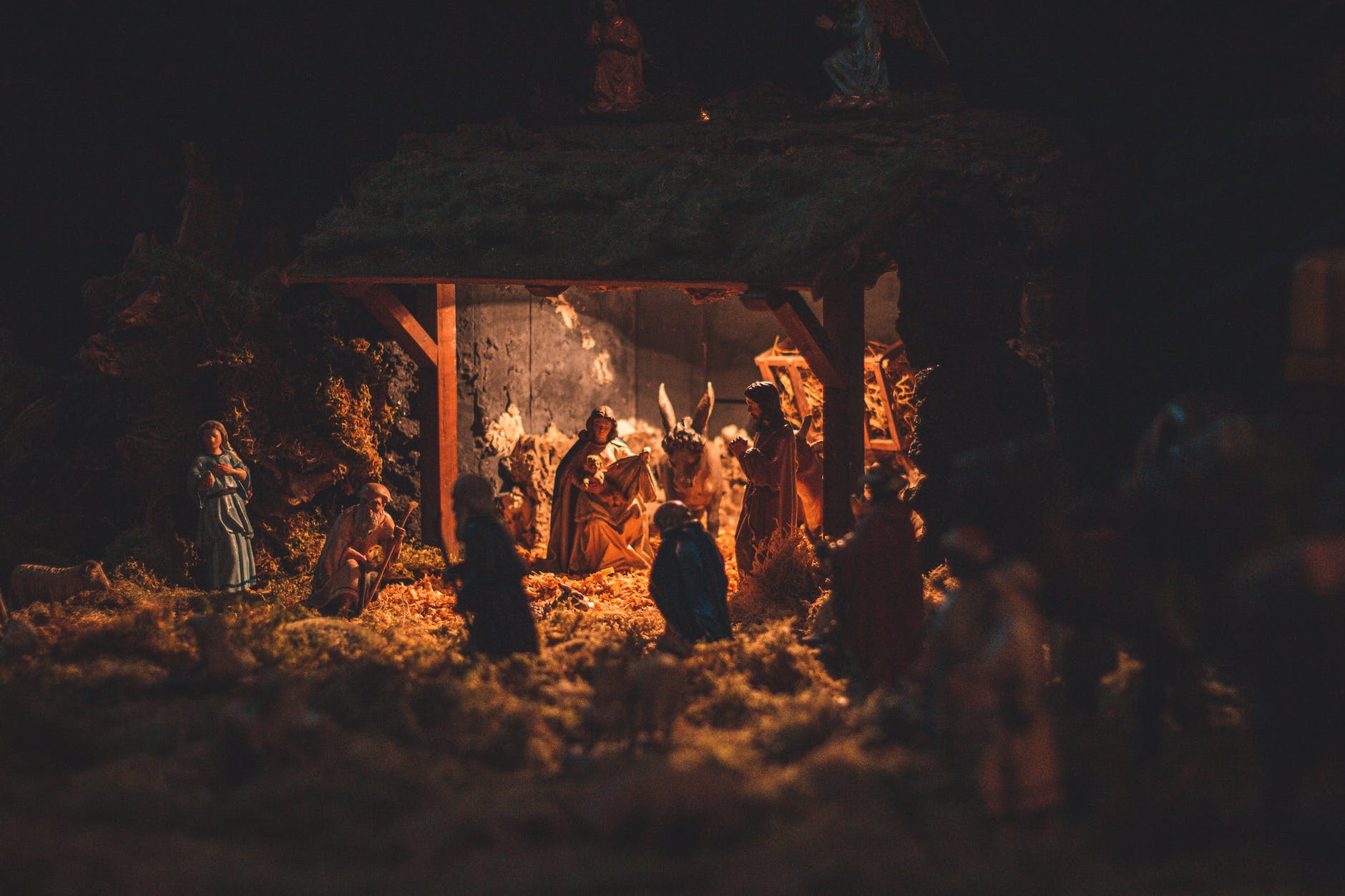
For a moment, put yourself in Joseph’s shoes. You come from an impoverished family and have endured a hardscrabble life. But now, finally, things are looking up. You are engaged to a good girl named Mary, and the two of you are on your way to a wedding. But then, she turns up pregnant. And you know the baby is not yours. What would you do?
2,000 years ago, in Israel and as a Jew, Joseph had only two options.
First, according to the law of Moses, he could have called for her life:
If a man commits adultery with another man’s wife – with the wife of his neighbor – both the adulterer and the adulteress are to be put to death. (Leviticus 20:10)
Second, as the son who Mary eventually bears notes, he could have divorced her:
I say to you: whoever divorces his wife, except for sexual immorality, and marries another, commits adultery. (Matthew 19:9)
Divorce displeases Jesus, but He permits it when sexual unfaithfulness is involved.
Death and divorce – these are Joseph’s options. Which will he choose? Matthew tells us:
He had in mind to divorce her. (Matthew 1:19)
Joseph chooses divorce over death. But there’s more to Joseph’s decision than just one option over the other. Matthew adds a very important qualifier to Joseph’s divorce decision:
He had in mind to divorce her quietly. (Matthew 1:19)
In the first century, divorces were often public spectacles, meant to shame an unfaithful spouse. But Joseph forfeits his opportunity to shame his fiancé, as Matthew makes explicit in the rest of this verse:
Because Joseph was faithful to the law, and yet did not want to expose her to public disgrace, he had in mind to divorce her quietly. (Matthew 1:19)
Joseph was walking a tightrope. As a pious Jew, devoted to following the law of Moses, he knew he couldn’t just continue on as if nothing had happened. But Joseph also knew that grimly responding to his fiancé’s perceived infidelity with all that he could do according to the law wasn’t what he should do, for shaming her would destroy her. Something else was needed.
Grace.
Joseph followed the letter of the law by planning to divorce Mary, but he also did everything he could not to retaliate against her even though he thought she had betrayed him. He responded to her apparent unfaithfulness with every bit of kindness he could muster. Joseph did the right thing according to the law and the loving thing according to grace.
Joseph’s path can be instructive for us as we face messy moral challenges in our lives. Respecting divine law is necessary and right. But we are also invited to seek opportunities to layer divine grace on top of divine law.
We can discipline our children and still remind them how much we love them.
We can reprimand an employee and still do everything we can to help them succeed.
We can adamantly disagree with someone while still treating them gently.
When Joseph layered grace on top of law, something incredible happened:
An angel of the Lord appeared to him in a dream and said, “Joseph son of David, do not be afraid to take Mary home as your wife, because what is conceived in her is from the Holy Spirit. She will give birth to a son, and you are to give Him the name Jesus, because He will save His people from their sins.” (Matthew 1:20-21)
When Joseph chose grace, an angel appeared to show him where even more grace could be found. He did not need to divorce Mary, for, contrary to appearances, she had not been unfaithful. Instead, she was being a radically faithful servant to the Lord who had miraculously gestated in her the Savior of the world (cf. Luke 1:38).
In John’s account of the Christmas story, he describes Jesus’ mission like this:
From His fullness we have all received grace upon grace. (John 1:16)
“Grace upon grace.” Grace that begets even more grace. Pile it high. Spread it wide. Do what Joseph did for Mary. And trust in what Jesus has done for us.
This is the miracle and the message of Christmas.
Celebrating Christmas Slowly

When the angel Gabriel appears to Zechariah in Luke 1 while he is performing his ritual duties at the incense altar in the Holy Place at the temple in Jerusalem to announce that he and his wife Elizabeth will have a son who will prepare the way for Jesus, it signals a remarkable turning point in the history of the nation of Israel. The Old Testament ends with a dangling prophecy:
See, I will send the prophet Elijah to you before that great and dreadful day of the LORD comes. He will turn the hearts of the parents to their children, and the hearts of the children to their parents; or else I will come and strike the land with total destruction. (Malachi 4:5-6)
This prophetic word is both retrospective and prospective. It is retrospective because it hearkens back to Israel’s greatest prophet, Elijah, who lived over 400 years before this prophecy was proffered. It is prospective because it looks forward to another and greater Elijah who will create a new family out of the remnants of a nation that has been scattered and battered by years of exile and conquest.
And then –
Gabriel shows up and announces:
Do not be afraid, Zechariah; your prayer has been heard. Your wife Elizabeth will bear you a son, and you are to call him John … And he will go on before the Lord, in the spirit and power of Elijah, to turn the hearts of the parents to their children and the disobedient to the wisdom of the righteous – to make ready a people prepared for the Lord. (Luke 1:13, 17)
This fulfillment had been a long time coming. Again, over 400 years had elapsed between the time Malachi had forecasted the coming of a new Elijah and Gabriel had announced the arrival of this new Elijah. Indeed, the last time Gabriel had shown up to anyone was over 500 years earlier to another prophet named Daniel:
While I was speaking and praying, confessing my sin and the sin of my people Israel and making my request to the Lord my God for his holy hill – while I was still in prayer, Gabriel, the man I had seen in the earlier vision, came to me in swift flight about the time of the evening sacrifice. (Daniel 9:20-21)
It is interesting to note that Gabriel appears to both men while they are making sacrifices. The angel seems to like to show up in the midst of worship.
The apostle Paul writes of Jesus’ birth:
When the set time had fully come, God sent His Son, born of a woman, born under the law, to redeem those under the law, that we might receive adoption to sonship. (Galatians 4:4-5)
It turns out that sometimes, God’s “set time” takes a long time to get here – hundreds of years, in fact. And this is one of the many things that Christmas can teach us. In a season that is known for its hustle and bustle, Christmas is best celebrated slowly and patiently – waiting for God to work in His way in His time. In a culture that prides itself on social media platforms like Instagram, cooking gadgets like Instant Pots, movie franchises that are Fast and Furious, and even Covid tests that are rapid, slowness does not find pride of place in our imaginations or priorities. And yet, it was a promise slowly but faithfully kept that changed the world – and is still changing eternities.
The name Zechariah means, “The Lord remembers.” By the time Gabriel appeared to this old priest to announce that he and his wife would have a son, it must have felt like they had been forgotten. But they had not been. God was just working slowly and patiently. May our character reflect God’s work this season – and each day.
The True Transfiguration Tabernacle

If you look closely, you’ll begin to notice that the story of Christmas isn’t found only in Jesus’ birth, but all over His life.
In Mark 9, Jesus takes His three closest disciples – Peter, James, and John – up a mountain for a “spiritual retreat” of sorts. But while they are enjoying and reflecting on the sight of Israel from the summit, Jesus is transfigured:
His clothes became dazzling white, whiter than anyone in the world could bleach them. And there appeared before them Elijah and Moses, who were talking with Jesus. (Mark 9:3-4)
This was not a sight for which the disciples were prepared. But they knew they were in the midst of a transcendent moment. Peter responds in a way that, though it might sound strange to us – would have seemed perfectly logical and appropriate to him:
Rabbi, it is good for us to be here. Let us put up three shelters – one for You, one for Moses and one for Elijah. (Mark 9:5)
Peter sees Jesus with Israel’s greatest lawgiver – Moses – and Israel’s greatest prophet – Elijah – and his response is to suggest a building project. What is Peter thinking?
The word translated as “shelters” is, in Greek, skene, which refers to a “tent.” The most famous skene in Israel’s history is introduced in Exodus 25 and 26 when God gives Moses instructions to build the tabernacle, which was the tent in which God dwelled. The tabernacle cast a long shadow over Israel’s history, especially when coupled with a mountain, because the pattern for the tabernacle came from God when He spoke to Moses from a mountain (Exodus 26:30) and this tabernacle eventually gave way to a more permanent structure in a temple, which was built on a mountain (Isaiah 2:3).
So, when Peter suggests building skenes for Jesus, Moses, and Elijah on a mountain, he senses he is part of a divine encounter just like Moses was. And when the divine shows up, tabernacles are in order.
But what Peter suggests never comes to pass. Instead:
A cloud appeared and covered them, and a voice came from the cloud: “This is My Son, whom I love. Listen to Him!” Suddenly, when they looked around, they no longer saw anyone with them except Jesus. (Mark 9:7-8)
It turns out that tabernacles were not needed for this divine encounter because there was already a tabernacle there.
And it’s this that takes us to Christmas.
In John’s version of the Christmas story, he speaks of Jesus as the divine Word, and says: “The Word became flesh and made His dwelling among us” (John 1:14). The Greek word behind the phrase “made His dwelling” is skene. When Christ was born, He was God’s tabernacle – His dwelling place – among us. Peter didn’t need to build some tabernacles on that mountain because Jesus was the tabernacle on that mountain.
The promise of this season is that God does not remain aloof from His creation or creatures. He comes to us. He sends the man, who as Matthew’s account of the Christmas story reminds us, is “Immanuel, which means ‘God with us’” (Matthew 1:23). Of the many promises this season provides, perhaps the most precious is this:
We are never alone, for God has sent a tabernacle in Jesus.


 Pastor Zach's Blog