Godly Vision, Not Personal Agenda
 It is axiomatic that vision is integral to leadership. No less than Warren Bennis, a pioneer in the field of leadership studies, defined leadership as “the capacity to translate vision into reality.”[1] If a leader does not have a vision, he will lead aimlessly. If he cannot articulate a vision, his organization will wander aimlessly. Leadership requires vision.
But that’s not all leadership requires. Leadership also requires mission. After all, mission is what gives purpose to an organization’s very existence. Vision, then, is when the leader of an organization understands his organization’s strengths, gifts, and capacities, and capitalizes on these in ways that fulfill an organization’s mission. Thus, the mission of an organization and the vision of its leader must work in synergy with each other.
When it comes to the organization – or, better yet, the body (cf. 1 Corinthians 12:27-28) – that is the Church, her mission is clear. After all, her mission was crafted and communicated by Christ Himself: “Go and make disciples of all nations, baptizing them in the name of the Father and of the Son and of the Holy Spirit, and teaching them to obey everything I have commanded you. And surely I am with you always, to the very end of the age” (Matthew 28:19-20). The mission of the Church is to make disciples by baptizing in God’s name and teaching God’s Word, all the while exuding a lively confidence that Christ is continually with us, empowering us as we carry out His mission. How precisely this mission is accomplished from congregation to congregation is a function of the vision of a congregation’s leaders – specifically, its pastor.
Sadly, in my years of ministry, I have seen far too many pastors who, rather than casting visions that capitalize on their congregations’ strengths, gifts, and capacities, push agendas based on their own likes and dislikes, preferences and antipathies. They may say they’re casting vision to congregations that have none. But what they’re really doing is asserting agendas that bully congregations at their weakest points.
To the leaders in Christ’s Church, I offer this plea: don’t confuse your agenda – no matter how noble it may seem – with Godly vision for your congregation. One, by God’s grace, can breathe life and excitement into a congregation. The other can frustrate and deflate God’s people. And Christ’s mission is far too important to settle for that. Christ’s mission deserves true vision.
[1] Kevin Kruse, “100 Best Quotes On Leadership,” Forbes Magazine (10.16.2012).
Happy Thanksgiving!

“Freedom from Want” by Norman Rockwell, 1943.
Credit: arthistory.about.com
It’s been all over Facebook. People are posting all the reasons they are thankful. My wife has joined in the Facebook thankfulness fun. As a teacher, she’s organizing her thankfulness thoughts alphabetically – using each letter of the alphabet to call to mind something for which she is thankful. I wonder what she’ll post about when she gets to “Z”?
As we head into another Thanksgiving holiday this week, I want to share with you, as I did last year, some of my favorite thoughts on thankfulness from Abraham Lincoln:
The year that is drawing towards its close, has been filled with the blessings of fruitful fields and healthful skies. To these bounties, which are so constantly enjoyed that we are prone to forget the source from which they come, others have been added, which are of so extraordinary a nature, that they cannot fail to penetrate and soften even the heart which is habitually insensible to the ever watchful providence of Almighty God. In the midst of a civil war of unequaled magnitude and severity, which has sometimes seemed to foreign States to invite and to provoke their aggression, peace has been preserved with all nations, order has been maintained, the laws have been respected and obeyed, and harmony has prevailed everywhere except in the theatre of military conflict … Needful diversions of wealth and of strength from the fields of peaceful industry to the national defense have not arrested the plough, the shuttle or the ship; the axe has enlarged the borders of our settlements, and the mines, as well of iron and coal as of the precious metals, have yielded even more abundantly than heretofore. Population has steadily increased, notwithstanding the waste that has been made in the camp, the siege and the battlefield; and the country, rejoicing in the consciousness of augmented strength and vigor, is permitted to expect continuance of years with large increase of freedom. No human counsel hath devised nor hath any mortal hand worked out these great things. They are the gracious gifts of the Most High God, who, while dealing with us in anger for our sins, hath nevertheless remembered mercy.[1]
These words are from Lincoln’s Thanksgiving Day proclamation of 1863 and, like so many of the posts I’ve seen on Facebook, offer a myriad of reasons to be thankful. But what I appreciate so much about Lincoln’s thoughts on thankfulness – and the reason I share these words again – is that his thankfulness reaches its pinnacle not as he is talking about fruitful fields and healthful skies, or the abundant yields of plough, shuttle, ship, axe, and mines, or the population increase among the states. Rather, President Lincoln’s thankfulness reaches its pinnacle when he speaks of “the Most High God, who, while dealing with us in anger for our sins, hath nevertheless remembered mercy.” In other words, Lincoln is most thankful for what God does through Jesus Christ.
This Thanksgiving, we certainly have many things for which we can be thankful. But as we give thanks for many things, may we never forget to heartily celebrate and give thanks for the most important thing: God’s Son, Jesus Christ. He is the One who gives us reason not only to be thankful for temporal blessings now, but promises us that we will be thankful in eternal dwellings later.
[1] Abraham Lincoln, “Proclamation of Thanksgiving” (10.3.1863).
Ghana Eye Clinic – Day 5
What a week it’s been! Today we wrapped up the last day at the eye clinic with a bang. We saw 465 people, sharing the gospel with every one of them, and we gave away 355 pairs of glasses. This brings us to a grand total of 1,829 people seen and 1,420 pairs of glasses given away for the week! God has blessed us during this trip mightily!
To all of you who have been praying for us throughout the course of this week: thank you. You have been a tremendous support for us, even from thousands of miles away. Tomorrow, we will head down to the Ghana coast to see a castle that was once used for holding slaves. It is sure to be a memorable and reflective experience. Sunday morning, we will worship here in Accra and then Sunday night, we will begin our journey home! We appreciate your prayers for the remainder of our time in Ghana and for our travels home.
One more time, here are some pictures from our day!
This was our trip to the clinic each morning. And I thought San Antonio roads could get bumpy!

It began as another busy morning! There were more people lined up waiting for us to begin the clinic today than there were yesterday.
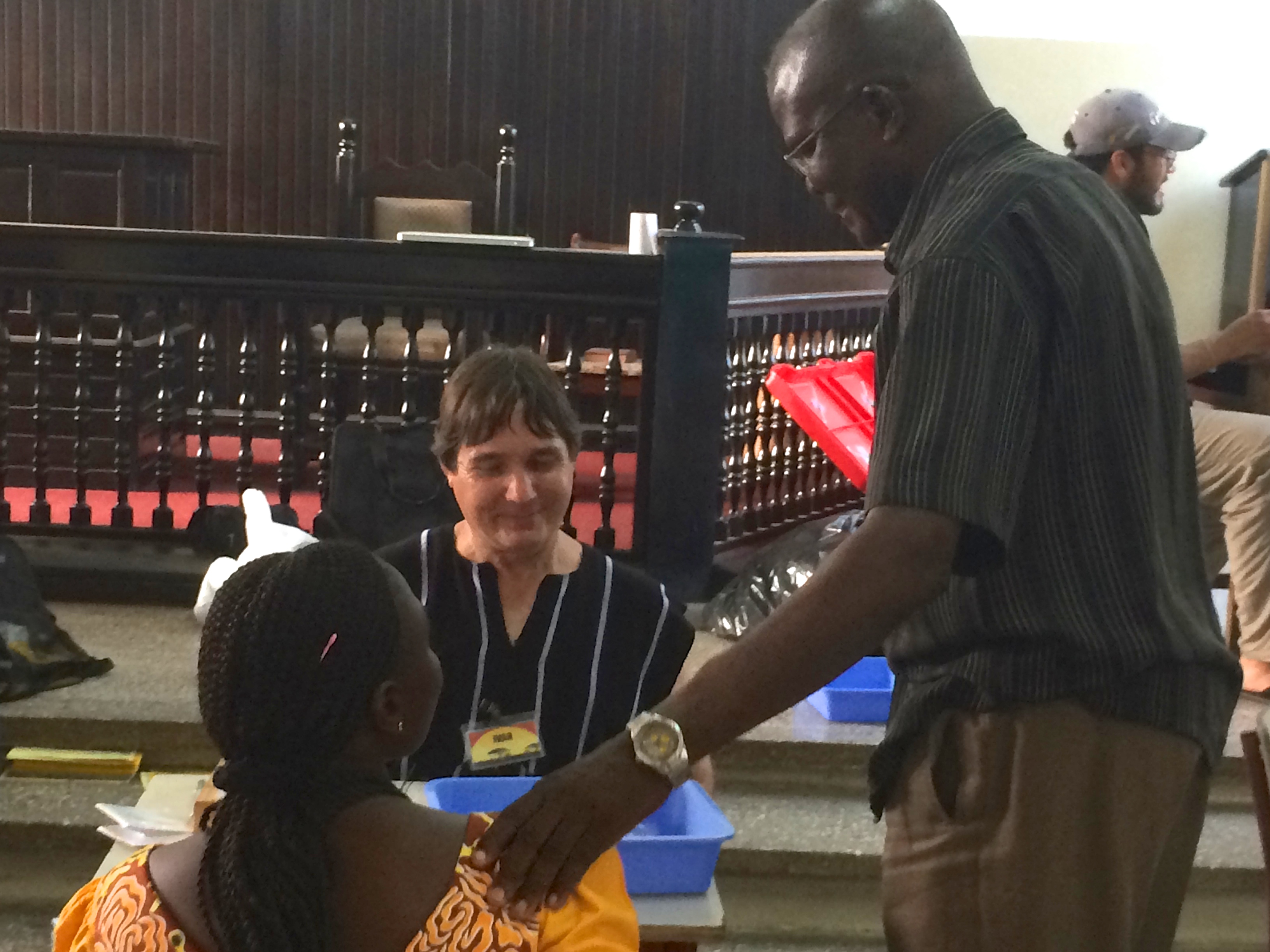
Ivan and one of the local pastors helps a woman get a new pair of glasses.

Michael is all smiles with this woman and her grandchild.

Arnold gives a man a sight test after he receives his new pair of glasses. The man was thrilled with his new crystal clear sight!
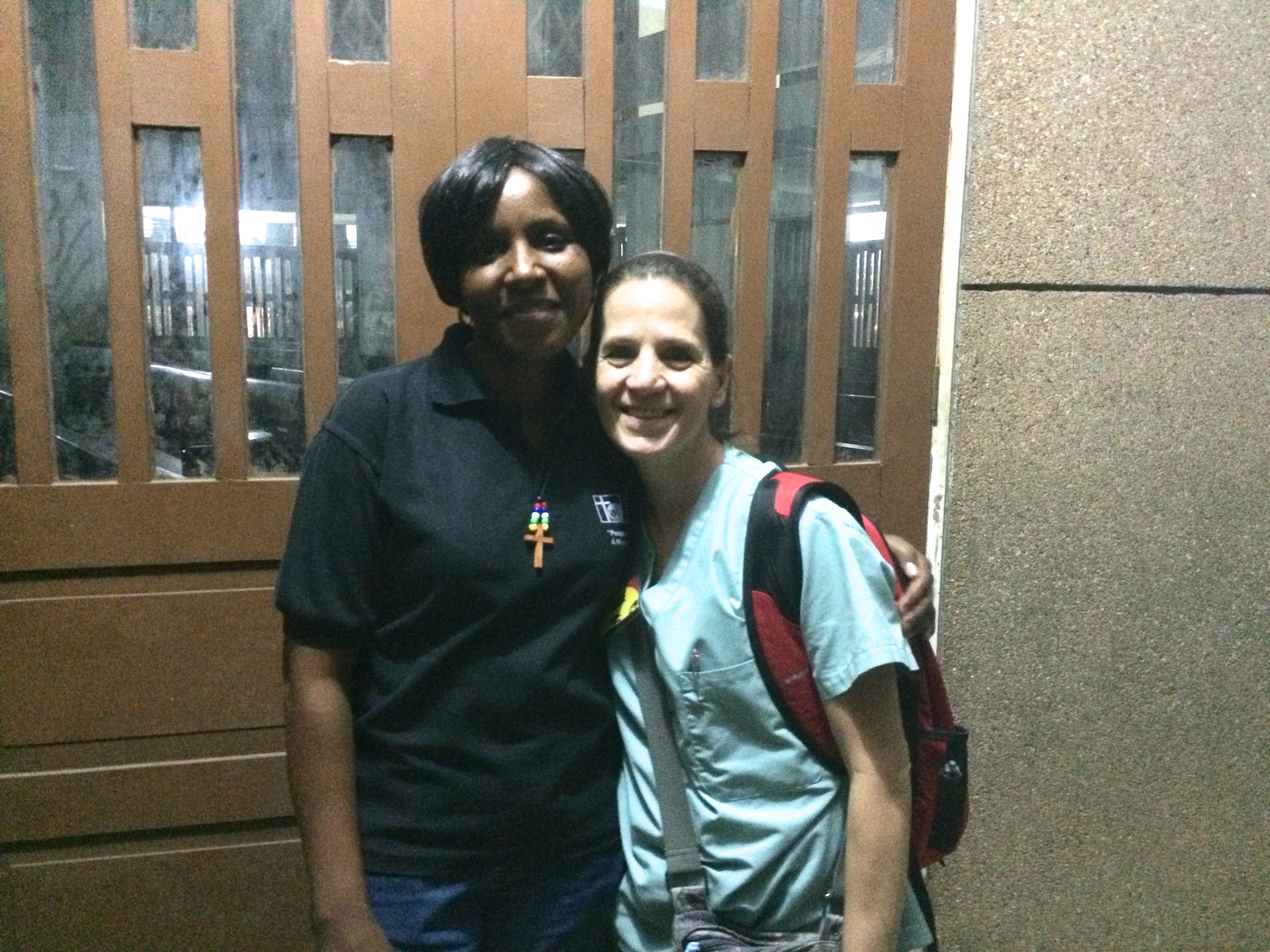
Julie poses with Joan, a local member of our team.

In addition to glasses, we also gave away crosses. Each of the colored beads reminds us of a key part of the faith. Black = sin. Red = Jesus’ blood. Blue = faith. White = holiness. Green = growth in Christ. Yellow = eternity.
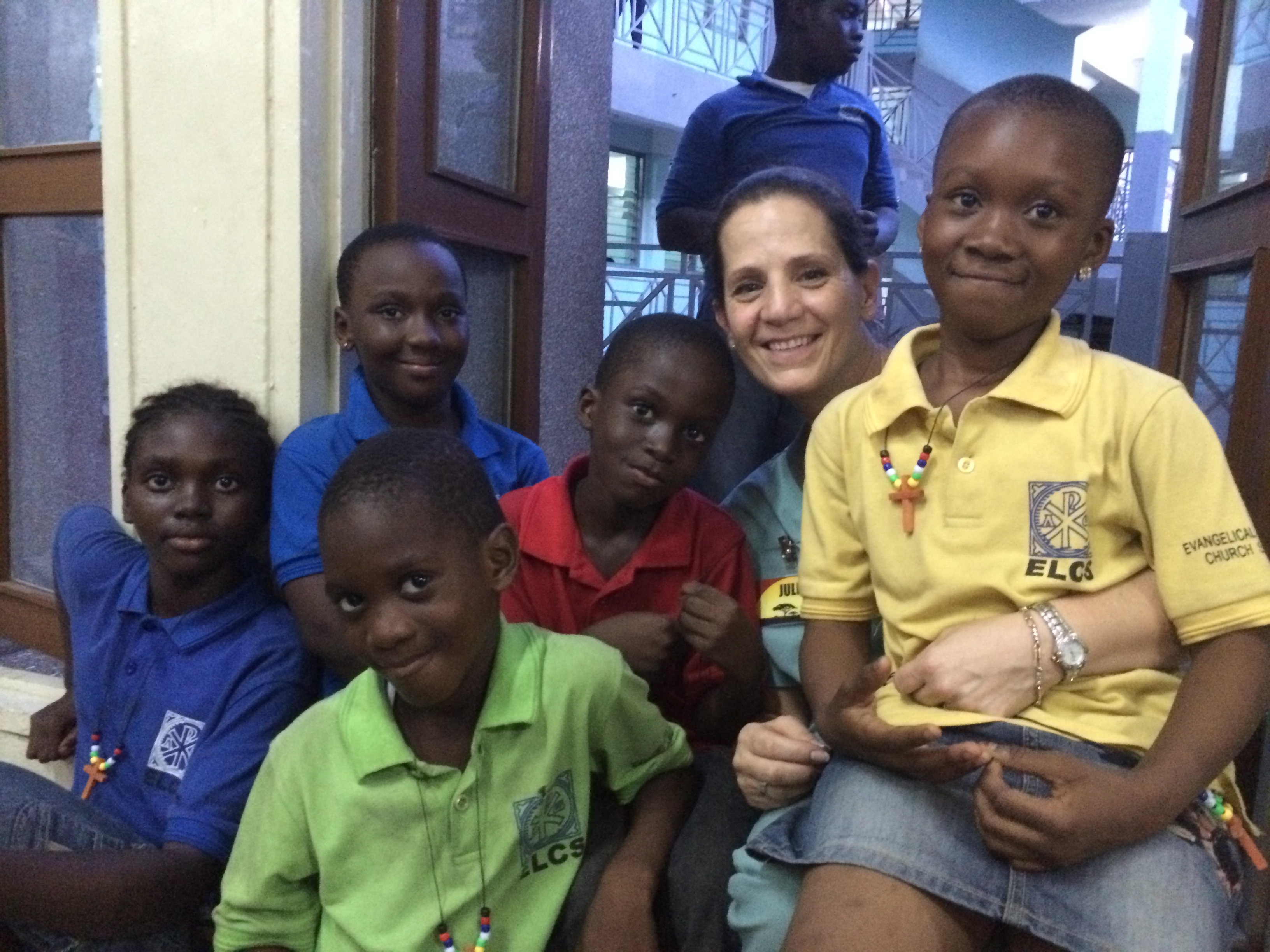
Julie poses with some of the kids from the clinic.

We went through a lot of reading glasses this week!

Each evening, we would eat supper at the Baptist House, a place that hosts missionaries and other foreign travelers. There, we met a precious girl named Tyra. We looked forward to seeing her each night!
Tyra helps us sing a Concordia classic!

This is our team from this week. Soli Deo Gloria! All to the glory of God alone!
Ghana Eye Clinic – Day 4
Wow! It was a busy day! Today, we saw 442 people, shared the gospel with them, and gave away 357 pairs of glasses. The word is getting around to many communities in Accra about our eye clinic. We expect another busy day tomorrow! Check out the pictures and stories from today.

This was the scene outside this morning as we arrived. There were 100 people waiting an hour before the clinic.

This was the scene inside as soon as the clinic opened.

One of the local pastors talks with a man about his vision problems.
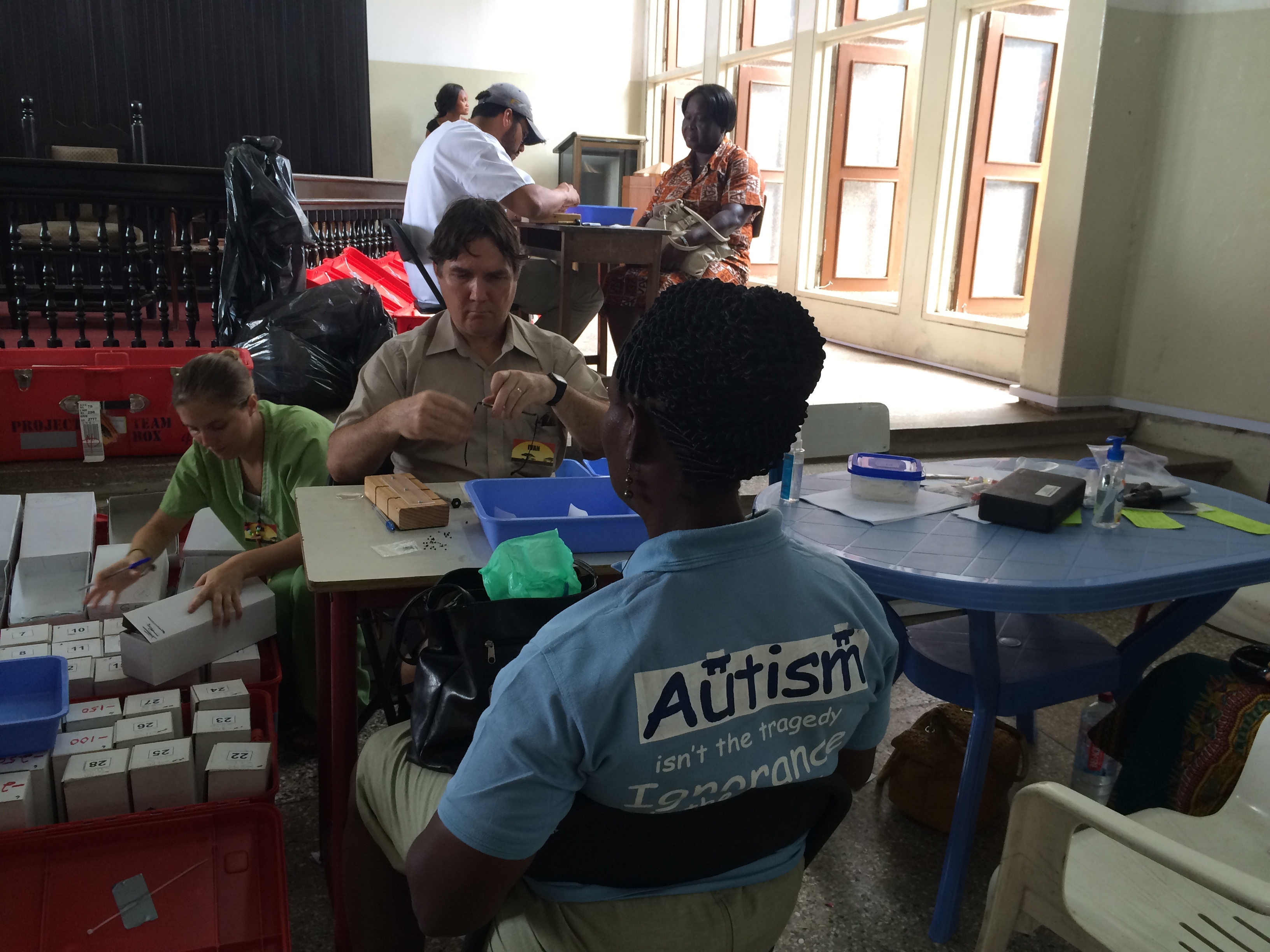
Our host, Ivan, is hard at work making a pair of glasses.
The kids at St. Paul Lutheran Church hosted a performance in their courtyard today. Line dancing isn’t just country dance halls, it’s for school kids in Accra too!

Tristina shares the gospel with a man and prays for him.

We have made lots of new friends and seen lots of precious smiles on this trip!

Michael works with a woman to discover just the right pair of lenses for her new glasses.

Even at the end of the day, the kids of St. Paul still had plenty of energy. They were literally doing cartwheels!

The school kids had plenty of energy, but we didn’t. Arnold, Pam, and Tristina still had smiles on their faces, though, even after a long day.

At the end of a long day, a little help is always a good thing!
There’s more to come tomorrow!
Ghana Eye Clinic – Day 3
Today’s numbers: We shared the gospel with 354 people and gave away 253 pairs of glasses. This was our biggest day yet!
Check out the pictures and captions below to find out more about today’s clinic.

Pam works hard sorting reading glasses for the hundreds who need them.

Arnold and Tristina have been working hard all clinic long!
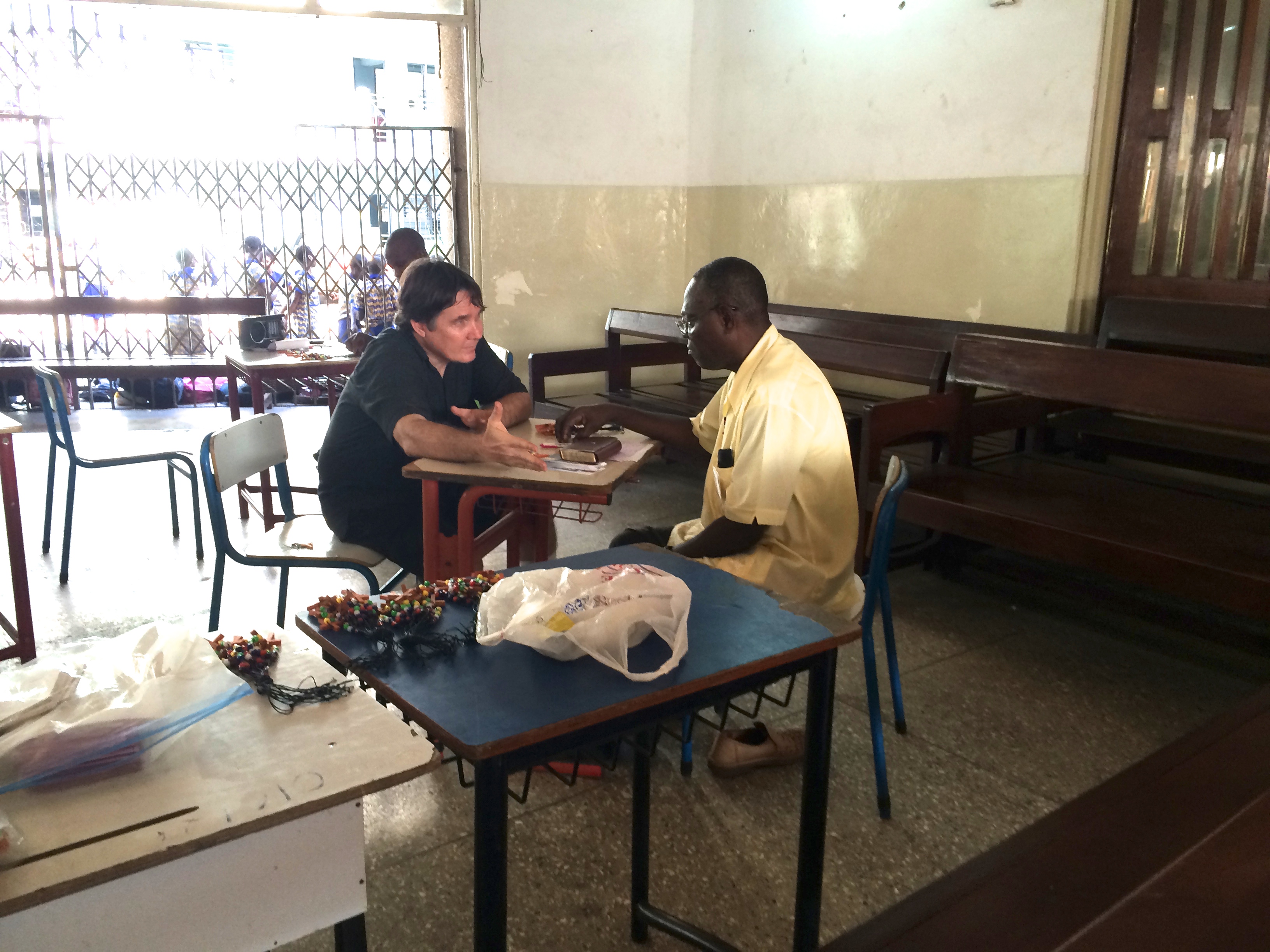
Our host, Ivan, talks to the pastor who is the president of the Lutheran seminary in Ghana and is taking some time out of his busy schedule to share the gospel with hundreds during the eye clinic.
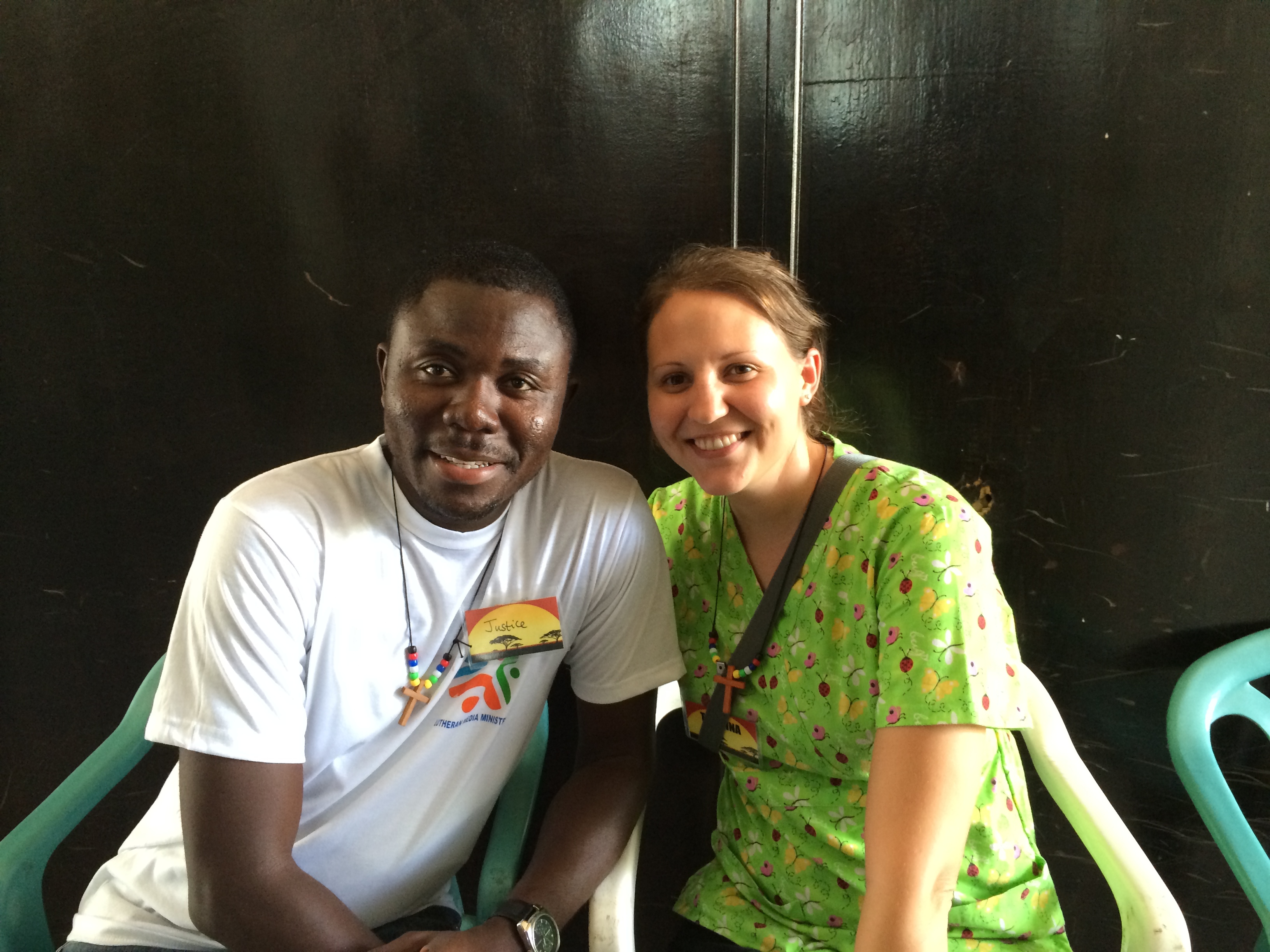
Tristina poses with one of our fabulous volunteers, Justice. Justice works hard routing people through the clinic to make sure everyone gets to the right place.
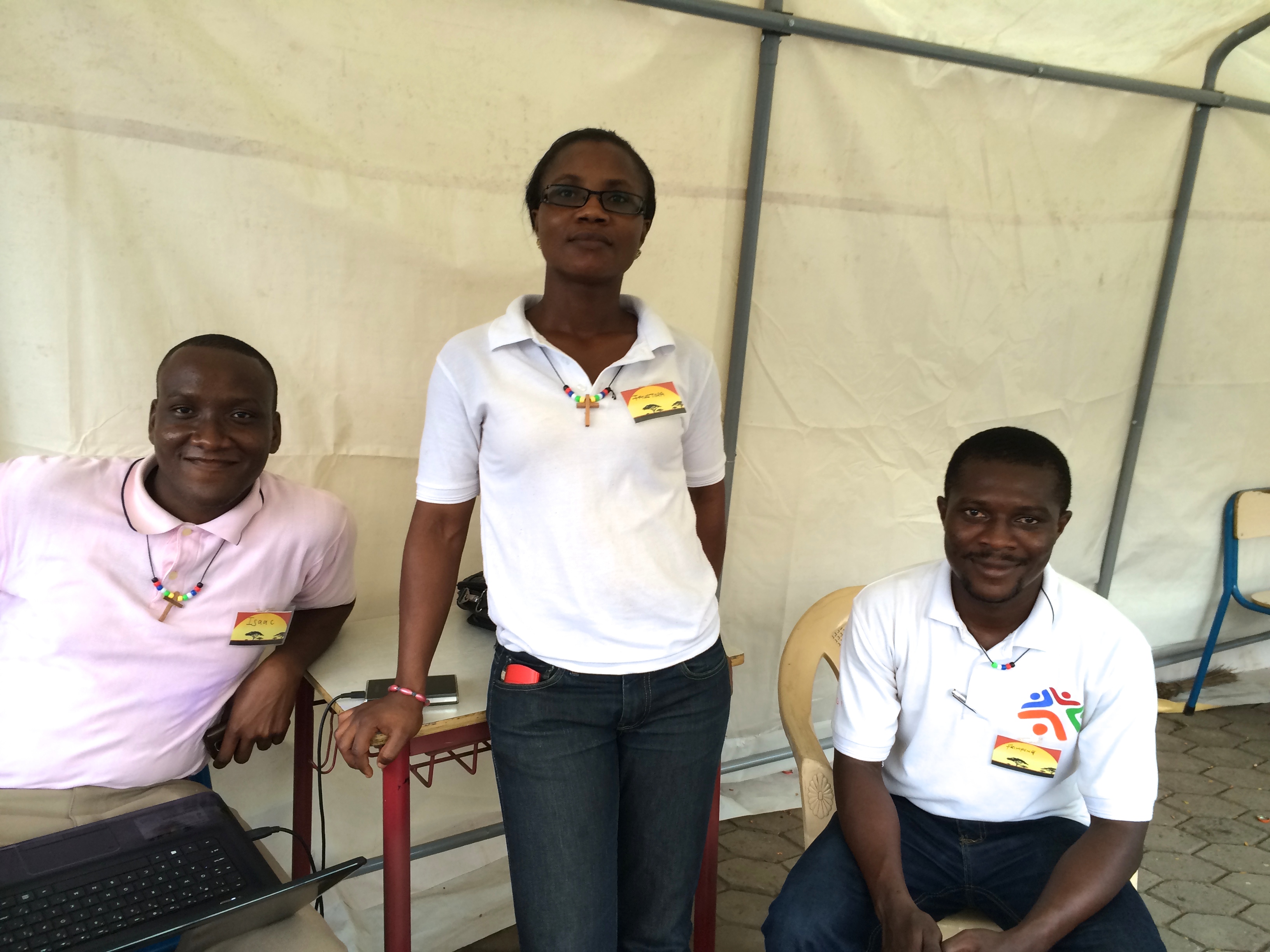
More of our fabulous volunteers! This devoted group sat outside all day in the hot Ghana sun welcoming visitors to the clinic.

Tristina and Pam are still smiling even after a long day at the clinic.

This little boy’s name is Michael and our team has decided to “adopt” him. He has a degenerative eye disease and will need ongoing medical care to preserve what little vision that he has.

Michael’s eyes.

Our host, Ivan, has a friend, Mustapha, who works to build bridges between the Muslim and Christian communities in Accra. Thankfully, the relationships between Muslims and Christians are very good in Ghana. Mustapha has invited several of his friends to the clinic.

Tristina uses the portable autorefractor to measure a boy’s eyes for new glasses.
The children of St. Paul Lutheran School in Accra are a talented bunch! Check out this video of their mad musical skills.
Ghana Eye Clinic – Day 2
We’re all settled in and things are going great! Today, we saw 256 people and shared the gospel with each one of them. We also gave away 220 pairs of glasses. Four of the people we saw were deaf. Thankfully, our team leader, Julie, is great with sign language! Our clinic closed a little early because Ghana was playing against Egypt in a big football game (that would be “soccer” to us), qualifying them for the World Cup. After our day at the clinic, we stopped by some local markets and perused some of the local wares.
Here are some pictures. I’ll post more soon.
Does this thing come with a snooze button? Good morning!

If you think San Antonio rush hour is bad, you ought to try morning traffic in Accra!
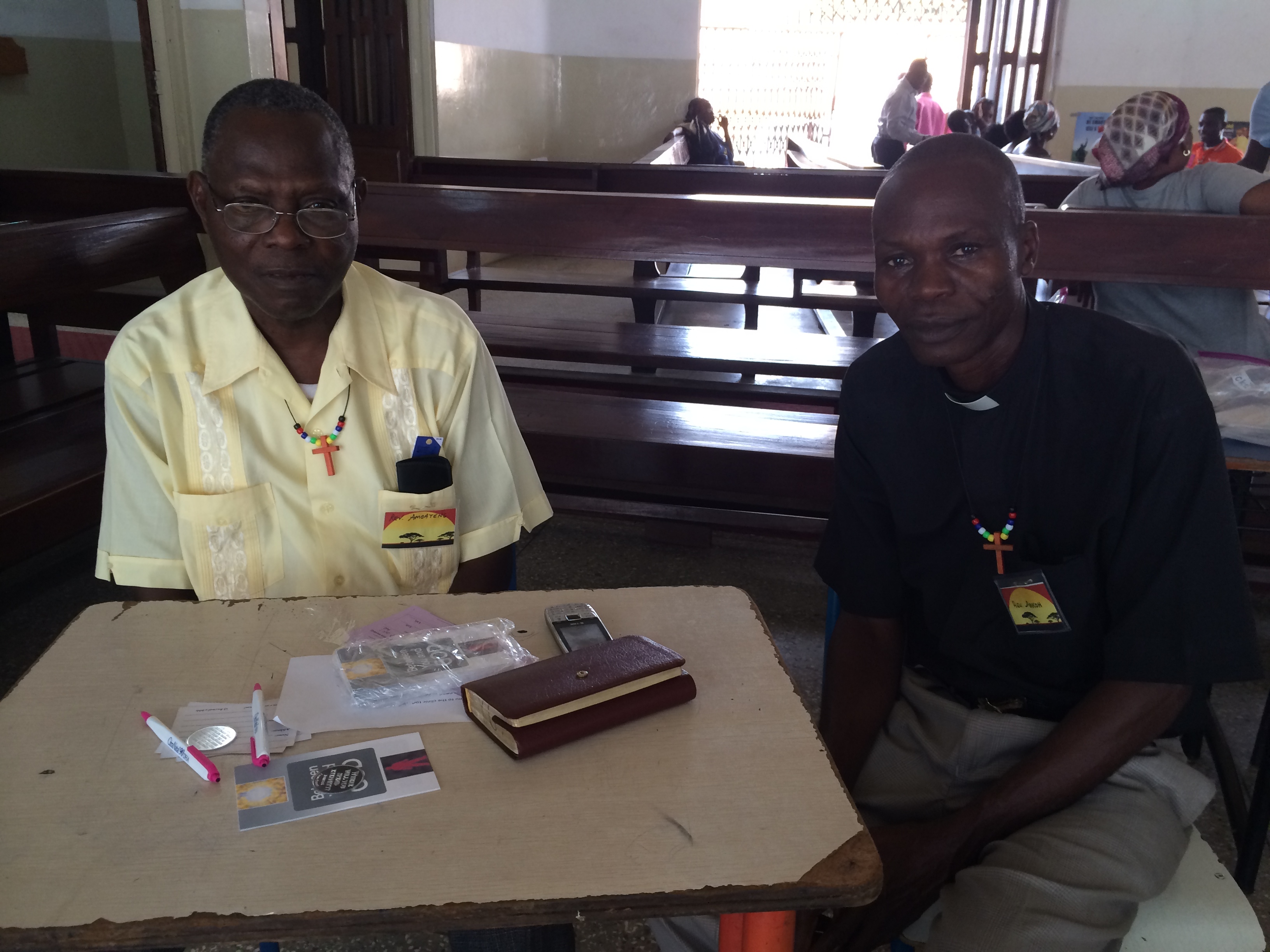
Two terrific pastors assisted in helping triage patients, figuring out what glasses they needed and sharing the gospel with them.

Michael and Arnold are hard at working, making glasses for all sorts of different prescriptions.

Julie signs to a deaf man so he can understand what glasses he needs.
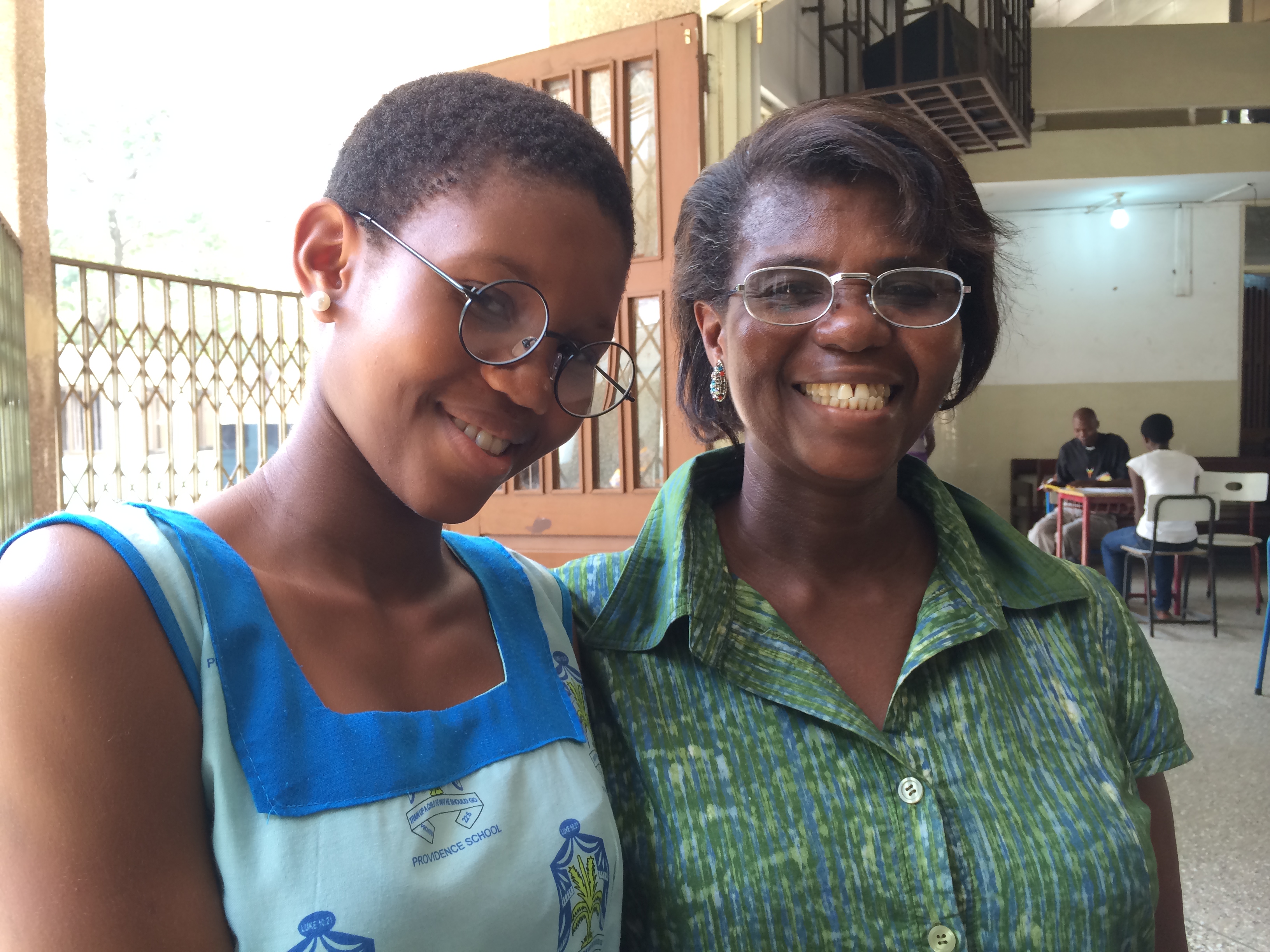
The girl on the left came in yesterday, but we couldn’t offer her treatment without her mother. Today, both mother and daughter came in and received glasses!

I’m pretty sure Julie is working on a passport for this little man so she can bring him home. She didn’t want to let him go!

Pam and our host in Ghana, Ivan, screen people for reading glasses.

There was plenty of fresh fruit at the street market.

Pam made a new friend with one of the street vendors!
Ghana Eye Clinic – Day 1
Our first day in Accra, Ghana at the eye clinic was terrific! We saw 315 people who needed vision care and gave out 217 pairs of glasses. We also had an optometrist onsite to see people who had a whole host of eye care needs. Most importantly, we shared the gospel with everyone who came through our clinic. Through the glasses, we helped people see God’s world. With the gospel, we helped people see God’s Son!
Check out these pictures from our first day.

The morning was beautiful!

Pastor Bill shares the gospel with people as they first come to the clinic.

The kids from the day school at St. Paul Lutheran in Accra sing us a song.

One of our sweet kids receives a sweet from Julie!
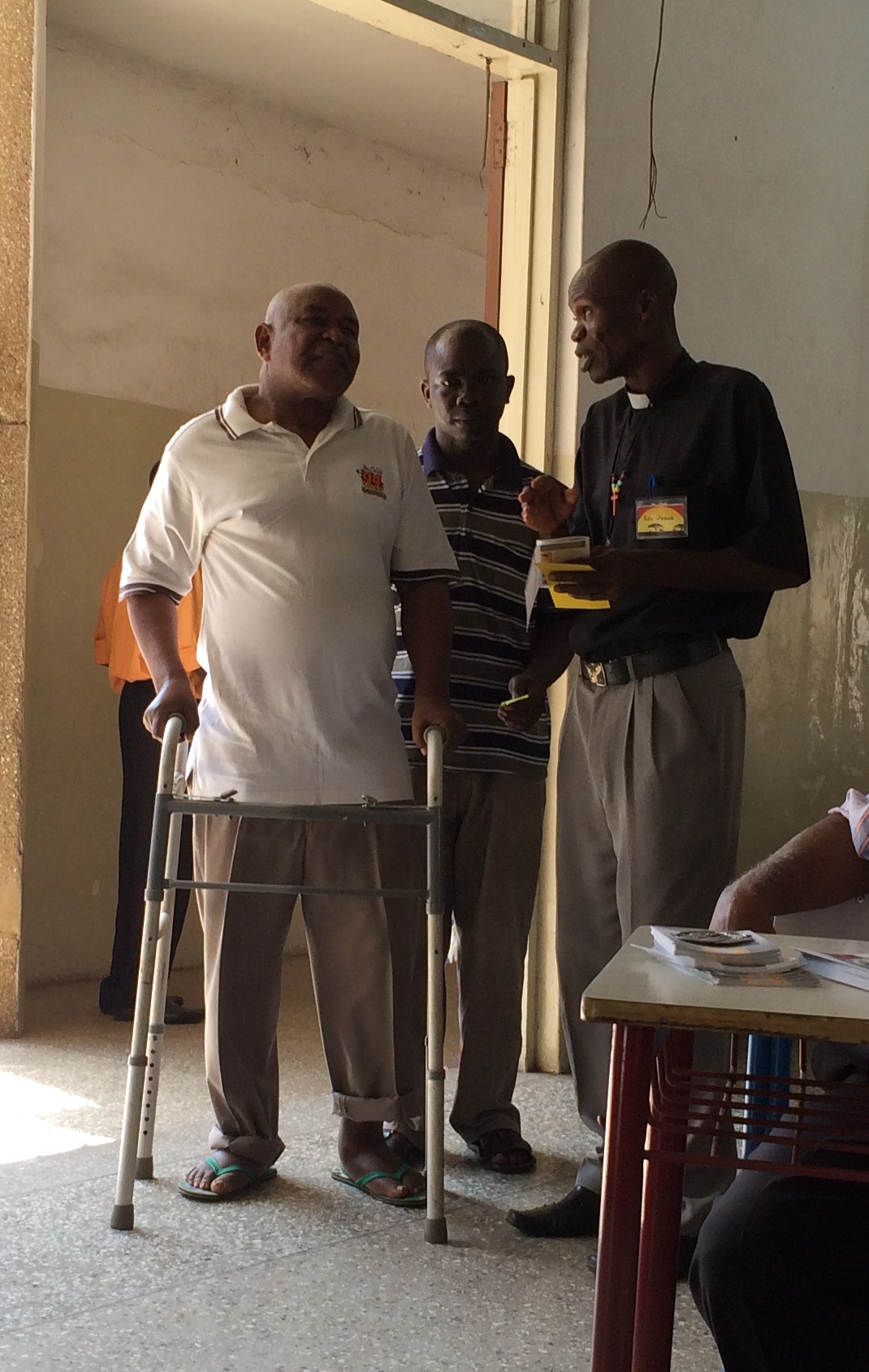
Many people came to receive glasses and hear the gospel!

Two great Concordians, Michael and Arnold, are stylin’ in the glasses we’re sharing with the folks of Accra.
I’ll be posting more pictures soon, so keep checking back. Please continue to pray for our team!
Sightseeing in Ghana
 I’m not in San Antonio anymore, that’s for sure. Instead, I am halfway across the world in Ghana, Africa with a team of my fellow Concordians and, together, we are hosting an eye clinic. There are many people in this region of Ghana in desperate need of glasses. We have the special privilege and pleasure of providing people here with the glasses they need in order to see. In the process, we also get to point people to the One in whom they can see God Himself – Jesus Christ – by sharing the gospel.
As I’ve been working as a part of this vision clinic, I’ve been pondering one of my favorite stories in Scripture:
As [Jesus] went along, He saw a man blind from birth. His disciples asked Him, “Rabbi, who sinned, this man or his parents, that he was born blind?” “Neither this man nor his parents sinned,” said Jesus, “but this happened so that the work of God might be displayed in his life.” (John 9:1-3)
In the ancient world – and especially among the ancient Jews – it was generally presumed that if you faced a trial, a trouble, or an ailment, it was because you had committed some heinous sin to deserve that trial, trouble, or ailment. Your sin and your trouble were intimately and inexorably interwoven in ancient thinking. For instance, Rabbi Ammi wrote, “There is no death without sin, and there is no suffering without iniquity.” If you were suffering, the rabbis taught, it was because you had done something wrong. In fact, some rabbis taught that not only could a person be punished for his own sin, but a child could be punished for his parents’ sin. Some rabbis believed, for example, that the untimely death of a child was the direct result of his mother’s dalliance in idolatry while he was still in the womb! Such was the close correlation between sin and tragedy.
Thus, it is really no surprise that, one day, as Jesus and His disciples are walking around and see a man born blind, the disciples ask: “Rabbi, who sinned, this man or his parents, that he was born blind” (John 9:2)? Jesus’ disciples know the teaching of their Jewish rabbis well. They know a man cannot be born blind unless there is some sin to warrant such blindness.
But what the rabbis assumed about the connection between sin and trouble isn’t what a rabbi named Jesus knows about this blind man’s plight. This is why, instead of pointing to a specific sin committed by this man which had resulted in his blindness, Jesus explains to His disciples: “Neither this man nor his parents sinned, but this happened so that the work of God might be displayed in his life” (John 9:3). This suffering is not the result of this sin or that sin. Rather, God is up to something in this suffering: He is using it to display His work.
The Greek word for “display” is phanero’o, from the word phos meaning, “light.” God, it seems, desires to bring this man darkened by blindness into the light of seeing. But God’s desire centers not only on the light of physical seeing, but on the light of spiritual seeing as well. In other words, Jesus, through His eventual healing of this man born blind, desires to bring this man not only into the light of the sun, but into the light of faith. And this is exactly what happens in the end: “Do you believe in the Son of Man?” Jesus asks. “Lord, I believe,” the man responds (John 9:35, 38). When this man confesses his faith in Christ, he is brought into the light not only physically through the recovering of his sight, but spiritually through his trust in Christ.
All this week in Ghana, our goal is to help people see in two ways – spiritually and physically. I covet your prayers that eyes would be opened – not only by the glasses we share, but by the truth of the Gospel we proclaim!
Jesus – More Than Just God
 Was Jesus really human?
These days, this question does not get asked a lot. Rather, people wonder whether or not Jesus was God. And time and time again, people come to the conclusion that Jesus is not, was not, and, indeed, could not have been God. Take, for instance, Reza Aslan, author of the bestseller Zealot: The Life and Times of Jesus of Nazareth. In an interview with NPR about his book, Reza summarizes his position on Jesus’ divinity:
If you’re asking if whether Jesus expected to be seen as God made flesh, as the living embodiment, the incarnation of God, then the answer to that is absolutely no. Such a thing did not exist in Judaism. In the 5,000-year history of Jewish thought, the notion of a God-man is completely anathema to everything Judaism stands for. The idea that Jesus could’ve conceived of Himself — or that even His followers could’ve conceived of Him — as divine, contradicts everything that has ever been said about Judaism as a religion.[1]
There’s no way, Reza says, Jesus’ followers could have considered Him to be divine. He was only a man who led a failed revolution as a failed run-of-the-mill Messiah.
In my studies for a class I’m teaching on Galatians, I came across some terrific commentary from the second-century church father Tertullian on Galatians 4:4-5. The apostle Paul writes in these verses: “But when the time had fully come, God sent His Son, born of a woman, born under law, to redeem those under law, that we might receive the full rights of sons.” Tertullian comments on Paul’s phrase “born of a woman”:
To what shifts you resort, in your attempt to rob the syllable “of” of its proper force as a preposition, and to substitute another for it in a sense not found throughout the Holy Scriptures! You say that He was born through a virgin, not of a virgin, and in a womb, not of a womb.[2]
In Tertullian’s day, there were people trying to rob Jesus not of His divinity, but of His humanity. A group of called the Docetists considered everything corporeal to be evil while holding anything non-corporeal to be good. They thus denied that the non-corporeal God of the universe would ever dare to take on corporeal human flesh. This group taught that though Jesus may have been born “through” Mary, he was not born “of” Mary. In other words, He did not take on human flesh as a genuine offspring of a genuine human mother. Rather, He merely passed through Mary as an immaterial God and received nothing concrete from her. Indeed, the Docetists taught that though Jesus may have appeared to be a physical being, He was not. In fact, the very name “Docetist” comes from the Greek word meaning, “to appear.” Jesus, then, was simply an apparition – divine, yes, but certainly not a corporeal human.
Tertullian has no time for such teaching concerning Christ. He says that Docetists “murder truth”[3] and vigorously makes the case for Christ’s humanity. Thus, the problem in the early Church was not that some denied Jesus’ divinity, but that many denied His humanity! Reza has the problem exactly backwards.
Ultimately, to deny Jesus’ humanity or His divinity is to deny Him. Paul is crystal clear concerning the person of Christ: He is God’s Son and He is born of a woman. He is both God and man. Any other or lesser confession of Christ simply will not do.
[1] “Christ In Context: ‘Zealot’ Explores The Life Of Jesus,” NPR (7.15.2013).
[2] Tertullian, On the Flesh of Christ 20.
[3] Tertullian, On the Flesh of Christ 5.
The Court of Public Opinion

Credit: rmsbunkerblog.wordpress.com
We are a nation of polls. We poll public opinion on just about everything imaginable – from how Congress is doing their jobs to how the president is doing his job to how many people support gay marriage to how many people support tougher gun control laws to how many people support the legalization of marijuana.
It’s this last bit of polling data that formed the focus of an L.A. Times article by Robin Abcarian, which chronicled the shifting tide of public opinion on our culture’s most famous controlled substance:
The Gallup organization released a poll showing that for the first time in 44 years, a wide margin of Americans – 58% to 39% – believe marijuana should be legalized.
Less than a year ago, only 48% said pot should be legal. That is an astonishing leap of 10 points in the last 11 months alone.[1]
The article explains that Colorado and Washington have led the curve by legalizing recreational marijuana use and their progressive policies, in turn, are moving the country forward: “Like gay marriage, pot is here to stay. And just like gay marriage, it seems like the rest of the country is finally starting to catch on. Or light up.”
Personally, I find it ironic and more than a little medically disingenuous that at the same time cigarettes are increasingly controlled and decried because of the health risks associated with inhaling nicotine, tar, and smoke, using marijuana, which impairs motor abilities and adversely affects cardiopulmonary health, is increasingly accepted.
Regardless of the medical and, for the matter, moral arguments against the legalization of marijuana, I nevertheless must agree with Abcarian’s conclusion: “Like gay marriage, pot is here to stay.”
Why do I concur with Abcarian’s conclusion? Because we live in a society obsessed with and ruled by public opinion. Our working presupposition is that if the majority of people approve of something, that something ought to be implemented societally. And if the majority of people approve of something, that something ought to be considered good and right. Public opinion, then, shapes far more than our federal policy; it guides our society’s morality.
But there is a problem with public opinion. Because the people who proffer it are sinful, public opinion can be sinful. One need look no farther than Pontius Pilate’s opinion poll: “What shall I do, then, with Jesus who is called the Messiah” (Matthew 27:22)? I’m not sure the public was right or righteous when they gave their opinion on Jesus’ sentence.
The apostle Paul reminds us of the stark sinfulness that can sometimes mark public opinion when he writes:
[People] have become filled with every kind of wickedness, evil, greed and depravity. They are full of envy, murder, strife, deceit and malice. They are gossips, slanderers, God-haters, insolent, arrogant and boastful; they invent ways of doing evil; they disobey their parents; they are senseless, faithless, heartless, ruthless. Although they know God’s righteous decree that those who do such things deserve death, they not only continue to do these very things but also approve of those who practice them. (Romans 1:29-32)
According to Paul, the public delights in sanctioning sin. Far from being good and moral, the public is sinful and wicked. And lest we think we are somehow immune to the depravity of the general public, Paul reminds us that we too play a role in society’s degeneracy:
You, therefore, have no excuse, you who pass judgment on someone else, for at whatever point you judge the other, you are condemning yourself, because you who pass judgment do the same things. (Romans 2:1)
It’s not just that public opinion “out there” can be wrong, it’s that our own opinions can be wrong because our opinions are stained and maimed by sin.
In a culture where public opinion shapes nearly everything, Christians have a countercultural message: what is moral and best is not always what is popular and promoted. Instead, what is moral and what is best is that which is revealed by God.
So what does this mean for the debate over legalizing marijuana? It means that a debate such as this one cannot be settled by a poll. Instead, we, as Christians, need to think about this issue in light of God’s Word. Perhaps what Paul says in 1 Corinthians 6:20 is a good place to begin: “Therefore honor God with your body.”
[1] Robin Abcarian, “Like gay marriage, medical marijuana is here to stay,” L.A. Times (10.23.2013).


 Pastor Zach's Blog