Reverse-Engineering Your Life
 The other night, I, along with three other pastors, had the pleasure of meeting with a group of seminary students for an informal discussion about life and ministry. I cherished my time with these guys. Even though we were with them for only a short time, it quickly became apparent that they are theologically curious and nuanced and have a deep passion to serve in Christ’s Church as pastors. I am excited to see what the future holds for these men.
Our discussion took on an informal Q&A feel, with seminary students asking any questions they wanted. One question particularly struck me: “What goals do you have for ministry and how do you work backwards from those goals to develop a plan to reach those goals?” This is a great question. It’s a question of reverse-engineering. You start with the end in mind and work back from that to get to that. But this question also took me aback a little bit. Because I do have goals. And I have done my share of reverse-engineering to try to reach these goals. But my goals are not particularly inspiring, captivating, or scintillating. I simply want to love Jesus, love my family, and be a faithful pastor.
I used to have other goals. More exciting goals. Once upon a time, I wanted to build and pastor the largest congregation in my church body. Once upon a time, I wanted to become a renowned and respected spokesperson for orthodox Lutheranism. After all, it seems like on the broader stage of Christian dialogue, Lutherans are all but missing in action. Once upon a time, I wanted to be an esteemed public scholar to whom people would turn for insight. Once upon a time, I wanted to be a pastor who would change the world. Now, I just want to be a person who finishes life well.
As I ultimately wound up telling the student, long before you worry about reverse engineering your goals for ministry, you need to begin by reverse engineering your goals for life and, specifically, for your family. After all, if you change the world as a pastor but forsake your family as a husband or father, you have failed miserably because prior to your vocation as a pastor is your vocation as a husband and father.
The New York Times recently published an article on the state of today’s family. Its title sums up its mood: “Stressed, Tired, Rushed: A Portrait of the Modern Family.” Clair Miller, writing for the Times, explains:
Working parents say they feel stressed, tired, rushed and short on quality time with their children, friends, partners or hobbies, according to a new Pew Research Center survey …
Fifty-six percent of all working parents say the balancing act is difficult, and those who do are more likely to say that parenting is tiring and stressful, and less likely to find it always enjoyable and rewarding. For example, half of those who said the work-family balance was not difficult said parenting was enjoyable all the time, compared with 36 percent of those who said balance was difficult.
This is sad, but it is also not surprising. As workplace demands continue to rise and the line between company time and personal time continues to blur, time to invest in family inevitably suffers.
Being a pastor carries with it many demands, which are often difficult – and, quite honestly, sometimes impossible – to juggle well. There is no doubt about it. But this is why, long before you sketch out goals for ministry, you do need to set out goals for your marriage and your family. Goals of time together as a family. Goals of date nights with your spouse. Goals of daily expressions of love and affection. Before you worry about what is outside your home, tend to who is inside your home.
Jesus once asked, “What good is it for a man to gain the whole world, yet forfeit his soul” (Mark 8:36)? It may behoove us to ask similarly: What good is it if a man changes the world, yet forfeits those closest to him? This question good not only for pastors, it’s good for everyone.
I hope you’re asking it. The people closest to you will thank you if you are.
Family Is Good, Even If It’s Not Good For You

Credit: Fran Jorgensen / Foter.com / CC BY
Boys are more sensitive than girls to disadvantage. Any disadvantage, like growing up in poverty, in a bad neighborhood or without a father, takes more of a toll on boys than on their sisters. That realization could be a starting point for educators, parents and policy makers who are trying to figure out how to help boys – particularly those from black, Latino and immigrant families.[1]
This, of course, is not to say that girls do not suffer when a family is not in tact. Sara McLanahan and Isabel Sawhill, writing for Princeton and Brookings, talk about the effects of broken families and children in general:
Marriage is on the decline. Men and women of the youngest generation are either marrying in their late twenties or not marrying at all. Childbearing has also been postponed, but not as much as marriage. The result is that a growing proportion of children are born to unmarried parents – roughly 40 percent in recent years, and over 50 percent for children born to women under 30 …
The consequences of this instability for children are not good. Research increasingly shows that family instability undermines parents’ investments in their children, affecting the children’s cognitive and social-emotional development in ways that constrain their life chances.[2]
Families are falling apart. And the results are not good.
Certainly there is a theological argument to be made for the necessity of the family. Adam, Eve, and their command from God to “be fruitful and increase in number” (Genesis 1:28) speaks to the divine origin and order of the family and points to it as a gift from God to humanity. But there is also a teleological argument to be made for the necessity of the family. For instance, an article in National Review notes, “Married parenthood was a stronger predictor of economic mobility than was a state’s racial composition or the share of its population that is college-educated.”[3] If you want your children to grow up to be economically secure tomorrow, offer them a healthy family structure today. This applies, of course, not only to future economic mobility, but to future emotional, relational, and vocational stability as well.
So if this is the case, why is there no rush to trade the cohabitation, permissive divorce laws, and broken families of today for the nuclear Leave It To Beaver-style families of yesterday? The answer is, once again, teleology. The teleological argument for the family that focuses on kids assumes that the primary goal of parents is to want what is best for their kids. And many times, even in broken families, parents do want what is best for their kids. I know many single parents, for instance, who will sacrifice in any way they can right now to try to give their children the best possible shot at stability later.
But sometimes, among some people, the teleology of personal desire and pleasure trumps the teleology of the thriving of children. “Even if a traditional family is better for my kids,” some may say, “I don’t want to be tied down by the traditional accouterments and commitments of marriage.” “Even if a traditional family is better for my kids,” others may say, “I don’t like the sexual restraints that traditional family structures demand.” Though I doubt many people would be so bold as to outright say such things (although some have), the enticement of the teleology of personal desire and pleasure is powerful, even if subconsciously.
So as we talk about why the traditional family structure is good and why it should be promoted and protected, we also need to ask the question, “Good for whom?” If we mean a traditional family structure is good for children, we could not be more correct. If we mean it is good for selfish desire and pleasure, we could not be more wrong. Having a family of your own, much like being in the family of Christ, is a lesson in dying to oneself (cf. Matthew 16:25). And though this is good transcendently, it’s not easy practically. Nor is it always desirable personally. This is why for some, the demands of a traditional family structure are simply a bridge too far. They will not sacrifice themselves for the sake of another. But for those who do, even if their traditional family structure has been broken through no fault of their own, allow me to say “thank you.” You have discovered what matters most in life: others. And because you have discovered that, who comes after you will be better because of you.
____________________________________
[1] Claire Cain Miller, “A Disadvantaged Start Hurts Boys More Than Girls,” The New York Times (10.22.2015).
[2] Sara McLanahan & Isabel Sawhill, “Marriage and Child Wellbeing Revisited: Introducing the Issue,” Marriage and Child Wellbeing Revisited 25, no. 2 (Fall 2015): 3-9.
[3] W. Bradford Wilcox, “Family Structure Matters – Science Proves It,” National Review (10.23.2015).
The Best of Times and the Worst of Times

Jean Duplessis-Bertaux | Depiction of the storming of the Tuileries Palace during the French Revolution
“It was the best of times, it was the worst of times, it was the age of wisdom, it was the age of foolishness, it was the epoch of belief, it was the epoch of incredulity, it was the season of Light, it was the season of Darkness, it was the spring of hope, it was the winter of despair…”[1]
So begins Charles Dickens’ A Tale of Two Cities. Though the story is set during the French Revolution, its opening line strikes a universal tone. Life comes mixed with good and bad, wisdom and foolishness, faith and doubt, light and darkness, hope and despair. This is true even of Jesus’ life. For example, in Mark 7, Jesus heals a blind man:
Some people brought to [Jesus] a man who was deaf and could hardly talk, and they begged Him to place His hand on the man. After He took him aside, away from the crowd, Jesus put His fingers into the man’s ears. Then He spit and touched the man’s tongue. He looked up to heaven and with a deep sigh said to him, “Ephphatha!” (which means, “Be opened!”). At this, the man’s ears were opened, his tongue was loosened and he began to speak plainly. (Mark 7:32-35)
On its surface, this story looks like one that should be marked only by joy. After all, a blind and mute man gets healed! But right before Jesus heals this man, He looks up to heaven and lets out “a deep sigh” (Mark 7:34). The Greek word for this sigh is stenazo, which denotes a groan of sorrow (e.g., Romans 8:23). Why would Jesus groan in sorrow right as He is getting ready to do something as joyful as a healing?
Like Charles Dickens, Jesus knows that even when it’s the best of times, it’s also the worst of times. He knows that even as He is getting ready to do something great, evil is not far off. Indeed, Jesus knows that He will soon face the horror of the cross. And so He lets out a groan.
The Old Testament prophets spoke of a Messiah who would come and do many miraculous things, including that of making the deaf hear and the mute speak:
Your God will come, He will come with vengeance; with divine retribution He will come to save you. Then will the eyes of the blind be opened and the ears of the deaf unstopped. Then will the lame leap like a deer, and the mute tongue shout for joy. (Isaiah 35:4-6)
Notice even in this prophecy that the best of times and worst of times are comingled. On the one hand, the Messiah will open the eyes of the blind and unstop the ears of the deaf. This is good. On the other hand, the Messiah will come with “vengeance” and “divine retribution.” This sounds bad. But it also seems strange. Isaiah says, “With divine retribution [God] will come to save you.” Just how does God intend to use His retribution for our salvation? Isn’t His retribution supposed to lead to condemnation?
Timothy Keller notes that, when Jesus came, retribution and salvation were not so much in tension with each other as they were complimentary to each other, for Jesus “didn’t come to bring divine retribution; He came to bear it.”[2] On the cross, Jesus took the retribution our sins deserve so we could receive the salvation we could never earn. This is how divine retribution can lead to our salvation.
In A Tale of Two Cities, a kind of dualism runs through its opening salvo. There is good and bad, hopefulness and despair, and the reader does not know which one will ultimately prevail – or if either will prevail. In the case of Christ, though good and bad, hopefulness and despair are real and are in tension with each other, there is no doubt which will finally carry the day. Jesus may have groaned. But He still healed. And Jesus may bear divine retribution on a bloodied cross, but He still brings salvation out of an empty tomb. In Christ, the tension of Dickens is resolved. And that’s why we can have hope.
______________________________
[1] Charles Dickens, A Tale of Two Cities (Mineola, NY: Dover Publications, 1999), 1.
[2] Timothy Keller, King’s Cross (New York: Dutton, 2011), 94
What If Planned Parenthood Is Sincere?

Credit: AFP Photo/Mandel NGAN
Last week, Cecile Richards, president of Planned Parenthood, announced in a letter to the National Institutes of Health that the organization she heads will no longer be accepting reimbursements of any kind for its disbursements of fetal tissue:
Our Federation has decided, going forward, that any Planned Parenthood health center that is involved in donating tissue after an abortion for medical research will follow the model already in place at one of our two affiliates currently facilitating donations for fetal tissue research. That affiliate accepts no reimbursement for its reasonable expenses – even though reimbursement is fully permitted … Going forward, all of our health centers will follow the same policy, even if it means they will not recover reimbursements permitted.[1]
This new policy comes on the heels of a firestorm over whether or not Planned Parenthood has been illegally selling aborted baby parts for profit. A series of undercover videos published by the Center for Medical Progress appears to show Planned Parenthood officials admitting that they do, in fact, make money off the sale of fetal tissue, even if such profit is minimal. Profit from the sale of fetal tissue is a federal offense.
Upon the release of this new policy, abortion opponents were quick to react with cynicism, asking why, if Planned Parenthood has done nothing wrong as it has been claiming throughout this controversy, the organization would need to change their current policy at all. Bre Payton, writing for The Federalist, opines, “Despite its previous claims of innocence, Planned Parenthood’s announcement today suggests that the organization knew its activities were almost certainly illegal.”[2]
Ms. Payton may be right. It may be that Planned Parenthood knew that what it was doing was illegal and was simply gaming the system. But I’m not so sure. Planned Parenthood’s statement may actually be sincere.
If I was to be accused of some wrongdoing – let’s say, financial mismanagement – not only would I adamantly maintain my innocence if I believed I had done nothing wrong, I would take extra precautionary measures to guard against further accusations. So, using the example I cited above, I may institute an annual independent audit of my income and expenses and share the results with key people in my life to make sure I am held financially accountable. But this would not be an admission I had done something wrong. Rather, it would be an attempt to be above reproach in my finances so that all could see I was committed to doing right.
I have to at least entertain the possibility that Planned Parenthood is acting in this same way by refusing to take any sort of reimbursement for their disbursement of fetal tissue. They may simply be trying to be above approach in how they handle their fetal tissue. If this is the case, however, it terrifies me. Here’s why.
If Planned Parenthood really is simply trying to be above reproach in their fetal tissue disbursements, this means that they truly believe that what they have done is not illegal and, even more disturbingly, not immoral. In other words, it could be that some – indeed, even many – at Planned Parenthood believe that what they are doing by offering abortions and dispersing baby parts is good, needed, and right. What is happening is not flowing out of sinister conniving, but out of genuine conviction.
I used to think people knew somewhere deep-down that abortion was a moral blight on our modern culture. As I have written before, if abortion isn’t self-evidentially morally repulsive, then nothing is. I still believe that most people do know this somewhere within the deep recesses of their souls. But after watching #ShoutYourAbortion trend on Twitter, I have come to recognize that some people do not. Consider these tweets:
I’ve never wanted to have children, so I had an abortion. I’m thriving, without guilt, without shame, without apologies. #ShoutYourAbortion (@favianna, 9.21.2015)
I had an abortion in 2008, and it was the easiest decision I ever made. Long before I got pregnant I had decided that… (Birdy Eugenie-Clark, 9.21.2015)
These women could be lying about their experiences with abortion. But, then again, they could be telling the truth. They really could be okay with and even happy about their abortions.
Columnist Dennis Prager distinguishes between that which “feels good” and that which “does good.” These two things, he notes, are not always the same. Take, for instance, in the realm of parenting:
It feels good to give one’s children what they want, but it rarely does good. It feels good to build children’s self-esteem – giving them trophies for no achievement, for example – but when the self-esteem is unearned, it doesn’t do good. It feels good to provide one’s adult children with money and other material benefits when they should be providing for themselves, but it doesn’t do good. And it feels good to coddle children rather than discipline them. But, same deal: It’s not good for them.[3]
What is true in parenting is true also of abortion. For some people – at least as far as they will publicly admit – abortion may feel good. It may feel good because it relieves a person of the burden of having to raise an unwanted child. It may feel good because it allows a person to have sex without having to worry about its divinely designed procreative telos. It may feel good because it feels empowering. It is the ultimate way to declare, “No one will tell me what to do with my body! Not even nature and nature’s God!” The problem is that many people have made what feels good equivalent to what is good. This is why I am willing to entertain the sincerity of Planned Parenthood’s statement about the trafficking of fetal tissue even if I am not willing to entertain its objective morality. We may have genuinely come to a point in our society where people have bought into a modified version of the old adage my mother once warned me against: “If it feels good, do it!” We now say, “If it feels good, it is good!”
As Christians, we need to continually remember and proclaim that what is good objectively cannot be determined only by what feels good internally. Good needs an external regulator. Christians believe this external regulator is Scripture and, in a secondary way, God’s ordering of creation. Even if our culture flatly rejects the first regulator, they’re still left to grapple with the second. Every pregnancy, even if it ends in abortion, is proof of that.
I hope we’re there to help people grapple with what true good looks like – and to lead them to surrender. Otherwise, this letter from Planned Parenthood will only be the first in a series of sad, but sincere, attempts to be above reproach while engaging in what is morally repulsive. And that would be heartbreaking.
____________________________________
[1] Cecile Richards, “Planned Parenthood Opt-Out,” Planned Parenthood Federation of America (10.13.2015).
[2] Bre Payton, “Planned Parenthood: We’re Going To Stop Doing That Thing We Said Was Totally Legal,” The Federalist (10.13.2015).
[3] Dennis Prager, “Feeling Good vs. Doing Good,” National Review (10.22.2015).
A Little Lesson In Leadership: “Working In” Versus “Working On”
 It’s easy to get trapped in the trenches. This is certainly true for me. With a myriad of emails to answer and phone calls to make and projects to complete, I find that if I’m not behind on at least a few things, then something is wrong! Perhaps you feel the same way.
Having too much to do and not enough time to do is nothing new. Back in 1967, Peter Drucker reminded us that people in positions of leadership always have more to do than time will allow. An effective executive, then, to borrow the title of his famous 1967 book, doesn’t just focus on getting everything done, but on “getting the right things done.”[1] He or she asks “What needs to be done?” rather than “What do I want to do?” Again, to borrow an illustration from Drucker, when Harry Truman came to the presidency, he was convinced that:
The country could and should focus again on domestic problems. He was passionately committed to reviving the New Deal. What made him an effective president was his accepting within a few weeks that international affairs, especially the containment of Stalin’s world-wide aggression, had to be given priority whether he liked it or not (and he didn’t). [2]
“What do I need to do?” is a question I am always asking myself.
I have found that what I need to do can be broadly divided into two categories. The first is what I need to “work in.” And there are many areas I “work in.” I work in the area of adult education at my church. I work in the area of pastoral care and counseling. I work in the area of blogging weekly! And make no mistake about it: I love what I work in! I love sharing God’s Word with God’s people. I love caring for people and am honored that people let me into their lives. I love blogging. I love the areas I work in.
But there is more to my job than just what I “work in.” There is also what I need to “work on.” At my congregation, we are currently working on teaching people how to have what we call “spiritual conversations” so they can share their faith with unbelievers and grow in their faith with believers. Personally, I am working on how I schedule my days so I can be more efficient in what I do.
“Working in” is necessary to get things done. “Working on,” however, is necessary so you can get things done well and, over time and with reflection, get things done better.
As a leader, what are you working in? What are you working on? Though these questions are not particularly theological in nature, they are important to ask. Sometimes, the things you need to work in become so overwhelming that you forget about what you need to work on. The problem is, the areas you need to work in will continue to pile up and you will be unable to manage everything – at least with any semblance of sanity – if you do not take the time to work on the systems and strategies that can help you get things done. So strike a balance. Don’t just work in, work on. Don’t just get things done. Figure out how to get things done well and empower others to get things done as well. Your calendar, your to-do list, and, most importantly, your weary heart will thank you.
__________________________________________
[1] Peter Drucker, The Effective Executive: The Definitive Guide to Getting the Right Things Done (New York: Harper Collins, 2002).
[2] Peter Drucker, “Drucker on Management: Six Rules for Presidents,” The Wall Street Journal (11.18.2009).
Honor, Dignity, Victimization, and Power

Credit: Franck Prevel/Getty Images
It doesn’t take much to offend people these days. Sometimes, it doesn’t take anything at all. This is what Bradley Campbell and Jason Manning argue in their paper, “Microaggression and Moral Cultures.”
Campbell and Manning cull their definition of what constitutes a microaggression from Derald Wing Sue, professor of counseling psychology at Columbia University. Microaggressions are:
The brief and commonplace daily verbal, behavioral, and environmental indignities, whether intentional or unintentional, that communicate hostile, derogatory, or negative racial, gender, and sexual orientation, and religious slights and insults to the target person or group.[1]
Two things are especially notable in Wing Sue’s definition. First, microaggressions can be either “intentional or unintentional.” What counts is not what a sender intends, but what a receiver perceives. Second, words like “indignities,” “hostile,” and “derogatory” in Wing Sue’s definition cast microaggressions in a vocabulary of victimization. Microaggressions, no matter how pint-sized they may seem, are really part of a broader caste system that relentlessly oppresses certain groups of people. The cry of those who perceive themselves as having been microaggressed, then, is really the cry of those who have been systemically victimized by this system and its cultural and socioeconomic assumptions.
Interestingly, Campbell and Manning argue that, for all the complaining that the microaggressed may do about being victimized, our newfound concern with microaggressions actually encourages a culture of victimization rather than discouraging it:
Victimization [is] a way of attracting sympathy, so rather than emphasize their strength or inner worth, the aggrieved emphasize their oppression and social marginalization … We might call this moral culture a culture of victimhood because the moral status of the victim … has risen to new heights.
In an article for the Atlantic, Conor Friedersdorf cites one example of a blossoming culture of victimization in an exchange between two students at Oberlin College. In the exchange, a white student invites a Hispanic student to a game of fútbol who takes offense at the invitation, writing on an Oberlin blog devoted to calling out microaggressions:
Who said it was ok for you to say futbol? … White students appropriating the Spanish language, dropping it in when convenient, never ok. Keep my heritage language out your mouth![2]
A big blow up and a public shaming over a single word. Welcome to the world of microaggressions.
Of course, things were not always this way. Before there was a culture of victimization, Campbell and Manning point out that there was a culture or honor. In this culture:
One must respond aggressively to insults, aggressions, and challenges or lose honor. Not to fight back is itself a kind of moral failing … Because insulting others helps establish one’s reputation for bravery, honorable people are verbally aggressive and quick to insult others.
After a culture of honor came a culture of dignity, where:
People are said to have dignity, a kind of inherent worth that cannot be alienated by others … Insults might provoke offense, but they no longer have the same importance as a way of establishing or destroying a reputation for bravery. It is commendable to have a “thick skin” that allows one to shrug off slights and even serious insults.
Though vestiges of these cultures of honor and dignity remain (compare Campbell and Manning’s definition of a culture of honor with some of the things Donald Trump has said in his presidential campaign and you’ll quickly realize that even though honor culture is on the decline, it is certainly not dead), they are quickly losing ground to a culture of victimization.
But why?
The answer seems to be “power.” Victimization, in our culture, can often be the fastest track to status and power, just as, in previous ages, honor and dignity were inroads to influence. For instance, in recent clashes over same-sex marriage, many in favor of the institution claim discrimination and victimization while many against same-sex marriage claim discrimination and victimization as well. Both groups hope that, by portraying themselves as aggrieved, oppressed, and victimized, they can engender sympathy and, ultimately, the upper hand in this debate. In other words, both sides are hoping to gain cultural capital, or power, by means of their own victimization.
Certainly, not all instances – indeed, not even most instances – of victimization represent grabs for power. One thinks of those who are sexually assaulted or emotionally abused. Such tragic examples of victimization have nothing to do with power. Rather, they represent grave injustices and deserve our prayers, our sympathy, and our action. But in cases of microaggressions and similar self-declared cries of victimization, for all their claims of powerlessness, they often turn out to be nothing more than cynical means of leveraging power.
It is here that we find that, for all of their differences, the cultural systems of honor, dignity, and victimization hold something in common: they are all means to an end of power. And this is where all of these systems run into trouble.
In His ministry, Jesus sometimes fought for honor, sometimes upheld human dignity, and sometimes embraced victimization. But His goal was not that of gaining power. When Jesus fought for honor, it was the honor of God Himself for which Jesus fought, refusing to allow the religious elites of His day to honor God with their lips while blaspheming Him in their hearts (cf. Matthew 15:8). When Jesus upheld dignity, it was the dignity of the ridiculed and marginalized He championed, like the time He rescued a woman caught in adultery from being stoned (cf. John 8:2-11). And when Jesus allowed Himself to be victimized on a cross, He did so not as a backdoor to power, but in order to ransom us from our sin (cf. Mark 10:45). Jesus, it turns out, picked up on elements from each of these cultures without endorsing the shared goal of all of these cultures. He used honor, dignity, and victimization as ways to love people rather than dominate them.
Like Jesus, His followers should feel free to fight for honor, uphold human dignity, and even see themselves, in some instances, as victimized. But none of these cultural constructs, in the economy of Christ, should be methodically used as mere means to power. Rather, they are to be used to love others.
So for whose honor will you fight? And whose dignity will you champion? And how can your victimization lead to someone else’s restoration? Rather than eschewing these cultural constructs altogether, let’s use them differently. Let’s use them for love. For when we use these things for love, even if we do not gain power culturally, we exercise power spiritually. And that’s a better kind of power anyway.
__________________________________________
[1] Bradley Campbell & Jason Manning, “Microaggression and Moral Cultures,” Comparative Psychology 13 (2014): 692-726.
[2] Conor Friedersdorf, “The Rise of Victimhood Culture,” The Atlantic (9.11.2015).
Pope Francis and What’s Most Important

Credit: AFP Photo/Paul J. Richards
The New York Times may have called him “the spiritual leader of 1.2 billion Catholics,” but it seemed nearly impossible for journalists and pundits to filter Pope Francis’ visit to the United States, which wrapped up last night in Philadelphia, through anything but a political lens. After an obligatory nod to his spiritual status, the Times went on to report about the Pope’s address to a joint session of Congress:
While he checked boxes in calling for religious liberty and defending the family, the heart of his address, and the most time, was dedicated to aspects of Catholic teaching embraced by progressives, especially the overriding need to help the poor and destitute. He was at his most passionate in embracing immigration, alluding to his own family’s history of moving from Italy to Argentina, where he was born …
He also warned of the excesses of globalization, though in far more measured tones than he has in the past, when he used fiery language and the memorable phrase “dung of the devil” to describe unbridled capitalism.[1]
“Religious liberty.” “The excesses of globalization.” “Unbridled capitalism.” Though these things certainly have theological implications, as the First Article of the Apostles’ Creed would remind us, in our society, they are cast first and foremost as political concerns. Indeed, the Times ultimately concluded:
In the end, both sides could walk away citing parts of his message. But the liberal agenda items in his speech were explicit and clear while the conservative ones were more veiled.
Apparently, the real value of Francis’ speech, according to the Times, lies in how politicians will be able to leverage it and not in the theology that was contained in it.
Filtering theology through political policy is fraught with danger. In such a system, orthodox doctrine all too often gets sacrificed to Machiavellian expediency and a Savior who died gets turned into a political operative who just happens to hate all the same people we do.
On the one hand, Francis seemed to defy such bare politicization of the papacy, as Peter Johnson points out in his article for The Federalist, “10 Stories The Media Won’t Tell You About The Pope’s USA Visit.” Mr. Johnson explains how the Pope has taken on both liberal and conservative concerns – everything from climate change and immigration to government overreach and the dangers inherent in the Affordable Care Act. Such political schizophrenia is inherent in Christian ethics, which has the pesky habit of refusing to conform to both the liberal and conservative party platforms. Christianity can, at times, annoy both the left and the right.
On the other hand, it’s not too difficult to understand why the Pope’s address to Congress has been interpreted politically rather than theologically. After all, in a speech that lasted for nearly an hour before a joint session of Congress, the Pope, while covering a whole range of geopolitical and ethical issues, failed to mention Jesus – even once! This seems odd and, honestly, downright disturbing for the leader of a body of whom the apostle Paul noted is at its best when it resolves “to know nothing … except Jesus Christ and Him crucified” (1 Corinthians 2:2).
In one sense, the domination of the geopolitical and the ethical at the expense of the Christological in the Pope’s words is understandable both in terms of the ecclesiology and the soteriology of the Roman Catholic Church.
Ecclesiologically, popes have historically laid claim not only to spiritual authority, but to temporal power as well. Such power was crystalized in 800 on Christmas Day when Pope Leo III crowned Charlemagne as the emperor of Rome. A spiritual authority, on that day, crowned a political one. These days, though the Pope’s temporal power formally extends only as far as Vatican City – and even that authority is largely titular – the papacy’s interest in and influence over temporal affairs lingers. So it comes as no surprise that Francis would seek to shape geopolitical events. In some ways, I welcome such an effort. Our geopolitics needs all the sanctified wisdom it can get. But when geopolitical concerns drown out any mention of Christ in a major address from a man who claims to be the head of Christ’s Church, I begin to get a little nervous.
Soteriologically, Roman Catholicism’s view of righteousness and its relationship to salvation lends itself to Francis’ deep concern over ethical issues. As a Lutheran Christian, I will often speak of two kinds of righteousness. The first kind of righteousness is that which is imputed to me from God in Christ by faith. In the words of the apostle Paul:
But now a righteousness from God, apart from law, has been made known, to which the Law and the Prophets testify. This righteousness from God comes through faith in Jesus Christ to all who believe. (Romans 3:21-22)
Christ’s perfect righteousness is a righteousness that leads to my salvation quite apart from anything I have done or ever will do. This righteousness is not an ethical task, but a sheer gift, not based on my actions, but based on Christ’s action for me on the cross. The second kind of righteousness involves the good deeds that I do for my neighbor. I am called to love, serve, and help my neighbor, as Jesus explains forcefully in His Parable of the Good Samaritan. When I do these things, I am acting in the way of righteousness. But such a righteousness does not save me. It simply helps others.
In the Roman Catholic system of theology, these two kinds of righteousness are collapsed into one. The righteous acts we do for our neighbor are righteous acts that are also taken into account when we receive salvation from God. The Catechism of the Catholic Church makes this clear enough:
Since the initiative belongs to God in the order of grace, no one can merit the initial grace of forgiveness and justification, at the beginning of conversion. Moved by the Holy Spirit and by charity, we can then merit for ourselves and for others the graces needed for our sanctification, for the increase of grace and charity, and for the attainment of eternal life.[2]
The Catechism baldly asserts that my righteousness cooperates with Christ’s righteousness so that I may attain eternal life. All the good things of which the Pope spoke in his speech, then, pertain to salvation because our good works on these good things aid in our salvation. It’s no wonder, then, that Francis would be especially concerned with our good works, even as the good work of Christ went missing in his words to Congress.
For all the excitement Francis’ visit and words generated, I fear that we managed to overlook what is the most important business of the Church: to proclaim Christ’s forgiveness for sinners. This, to borrow a phrase from Paul, is “of first importance” (1 Corinthians 15:3). All of the things the Pope addressed in his speech to Congress are important and should be discussed, but they are not most important.
Mollie Hemmingway puts the situation well when she writes:
It’s wonderful that some people say that Francis makes them feel the church is more welcoming to them. But if it’s just making people feel more comfortable in their politics, instead of making them feel the comfort of absolution, communion and strengthening of faith, that’s not much to get excited about.[3]
This is most certainly true. We can get excited over and become passionate about geopolitical issues. We can strongly advocate for ethical issues. I do all the time on this very blog. But our deepest commitment must be to Jesus. Our first proclamation must be of Him. For long after the concerns of this age fade way – indeed, long after this visit from this Pope is forgotten – Jesus will remain. The best thing this Pope can do, then, is invite us to turn our attention – and our hearts – to Him.
__________________________________
[1] Peter Baker & Jim Yardley, “Pope Francis, in Congress, Pleads for Unity on World’s Woes,” The New York Times (9.24.2015).
[2] Catechism of the Catholic Church (Collegeville, MN: 1994), § 2010.
[3] Mollie Hemmingway, “The Pope Francis Effect: Enthusiasm, But To What End?” The Federalist (9.25.2015).
The Problem with Pep Rallies

Credit: Mark J. Terrill, AP
It’s still thirteen and a half months away, but with the way it’s being covered – and with the ratings that CNN scored last week when it hosted the second of the Republican primary presidential debates – you’d think the presidential election of 2016 was right around the corner.
As we rush headlong into another presidential election cycle, we see all the typical trappings of what have become nothing short of political and journalistic rituals. We have a conservative action group that has launched a set of attack ads against Republican frontrunner Donald Trump. On the Democratic side, controversy has boiled over concerning the relative dearth of Democratic primary debates as compared to the number of Republican primary debates and how this favors Democratic frontrunner Hillary Clinton. As for the media, they are busy fact checking everything every candidate says. And then there are the rallies – the never ending rallies in every state and in what seems to be every American city.
Rallies, of course, are great when a politician wants to solidify his or her base of supporters. Rallies also incite and excite a candidate’s supporters to vote. Rallies, in a democratic election system like ours, are necessities.
Unfortunately, in our culture, we have taken what works well during an election cycle and have applied it, without much critical thought, to many different areas of life, including in our use of social media. Many of the posts I see on social media are meant to rally people who agree with one point of view by belittling and demeaning those who hold a differing point of view. Such posts follow a predictable pattern. First, an article, a meme, or even an out and out diatribe is posted that espouses the utter rightness of one point of view while attacking those who hold an opposing point of view as nothing less than reprobates. Second, people “pile on,” as it were, by posting comments. Third, anyone who dares to disagree with the view expressed in the initial post by posting a critical comment is harangued and attacked. Finally, nothing changes. People who agree with the sentiment expressed in the initial post still agree. And people who disagree still disagree.
We need a better way.
When posting on social media, it is time for us to start asking ourselves a question: in this post, am I trying to rally people or persuade them? The goal of persuasion is, in its strictest sense, to change someone’s mind on a particular position. In a broader sense, persuasion can also seek to engender empathy from someone who disagrees with a particular position. Even if someone does not agree with me on a particular position, I still deeply appreciate it when they at least understand why I think what I think, just as, I assume, other people appreciate it when I understand why they think what they think.
The trouble with persuading people is that it is much more difficult than rallying them. Rallying people usually only needs a stake in the ground and a line in the sand. Persuading people often needs tortured, lengthy nuanced arguments about a particular position. Rallying people can make a person feel good because, when others express agreement with a particular point, the rallier is quickly assured that he or she is not alone. Persuading people can often feel much lonelier because it does not provide a common enemy against whom you and those who agree with you can join forces, but it also does not provide the kind of toleration and capitulation that your opponents might ultimately desire. Rallying people can be done in minutes. After all, social media posts can go viral in nearly no time at all. Persuading people takes relationship building, trust, and, usually, hours, months, and even years worth of conversations. And even then, sometimes, people remain unpersuaded.
All this is to say that I can see the appeal of rallying people around a particular position. And, at times, rallies are necessary and desirable – especially in the face of a heinous evil that will not be persuaded, so it must be defeated. The problem is, as a long-range strategy, rallying doesn’t solve much. It may engender excitement and incite anger. It may get out a vote to defeat an opponent. But it doesn’t change a heart.
We, as Christians, believe there are certain things the world needs to believe. We want the world to be persuaded to believe these things. Thus, particularly as we post on issues that have to do with our faith, we need to eschew the easy way of the rally and instead choose the harder way of persuasion. After all, eternal truth is at stake. And, in many instances, so are people’s souls.
So think before you post. As Christians, we don’t want to just lambast those who might disagree with us, we want to show, with nuanced and thoughtful compassion, why people can, and should, agree with Christ. After all, Christ has persuaded us. Why would we want to do anything less than persuade others?
Common Question: What’s the Relationship Between Predestination and Evangelism?
 I first encountered the question when I was in college. “If God is the One who chooses people for salvation,” a buddy asked me, “then why do we need to worry about spreading the gospel? Isn’t God going to save people regardless of whether or not we share our faith with them?”
At the heart of my college buddy’s question was the relationship between two important doctrines: the doctrine of predestination – that God does all the work for our salvation, even down to the level of our wills, by taking the initiative to choose those who are saved – and the doctrine of evangelism – that we, as God’s people, are charged with going forth and spreading the gospel to all the world so that people may believe and be saved.
At first glance, these two doctrines do indeed seem contradictory. The apostle Paul writes of predestination:
[God] chose us in Him before the creation of the world to be holy and blameless in His sight. In love He predestined us to be adopted as His sons through Jesus Christ, in accordance with His pleasure and will – to the praise of His glorious grace, which He has freely given us in the One He loves. (Ephesians 1:4-6)
If God has already chosen people for salvation “before the creation of the world,” as Paul says, then what is the point of sharing the gospel so people will come to faith in Jesus and be saved? Isn’t everything a done deal?
When seeking to explain how these two doctrines work together, two errors have regularly been made.
The first error is that of conditional predestination. This error posits that God only chooses people for salvation on the condition that they first choose to trust in Him. This belief was famously promoted by the Five Articles of the Remonstrance, which outlines the basic tenets of Arminian theology:
God has immutably decreed, from eternity, to save those men who, by the grace of the Holy Spirit, believe in Jesus Christ, and by the same grace persevere in the obedience of faith to the end; and, on the other hand, to condemn the unbelievers and unconverted. Election and condemnation are thus conditioned by foreknowledge, and made dependent on the foreseen faith or unbelief of men.[1]
According to the Five Articles of the Remonstrance, God will not choose a person for salvation unless that person first chooses to have faith in Christ. For the Arminian, then, the burden of sharing one’s faith with others is heavy. After all, how can a person choose to have faith in Christ if he is not given a choice? And how can a person be given a choice if someone does not share with him that there is, in fact, a choice? Presenting to people the message that there is a choice to be made to have faith in Christ is the foundation of evangelism in Arminianism.
But such a theological system is not without problems. First, Scripture does not present God’s choice of us as contingent on our choice of Christ. God’s choices are unilateral. Second, by making God’s choice of us contingent on our choice of Christ, our salvation ultimately becomes dependent not on Christ Himself, but on our ability to choose Christ. It should be noted that Arminians teach that our wills, before our conversions, are helped along by divine prevenient grace, which is supposed to enable and enliven our wills so they can choose Christ, but such a teaching does not comport with Scripture. Scripture clearly teaches that our wills are anything but enabled and enlivened, especially before our conversions. Paul says of his own will: “What I do is not the good I want to do; no, the evil I do not want to do – this I keep on doing” (Romans 7:19). To make God’s choice of us contingent on our choice of Christ is a recipe for disaster. We will inevitably choose poorly because our wills are broken by and enslaved to sin.
The second error that is often made when trying to explain the relationship between predestination and evangelism is that of conditional proclamation. In this error, predestination is rightly held up as God’s unilateral decision to choose people apart from and in spite of their fallen, sinful wills. The Westminster Confession of Faith, which forms the basis for Calvinist theology, outlines this view:
Those of mankind that are predestinated unto life, God, before the foundation of the world was laid, according to His eternal and immutable purpose, and the secret counsel and good pleasure of His will, has chosen, in Christ, unto everlasting glory, out of His mere free grace and love, without any foresight of faith, or good works, or perseverance in either of them, or any other thing in the creature.[2]
This synopsis of predestination is certainly much more in line with how Paul talks about the doctrine in Ephesians 1, but even this understanding is not without its problems.
Calvinist theology runs quickly into trouble when it posits that God not only chooses people for salvation, but that He also chooses people for condemnation. Again, from the Westminster Confession:
By the decree of God, for the manifestation of His glory, some men and angels are predestinated unto everlasting life; and others foreordained to everlasting death.[3]
This is most certainly not how Paul speaks of predestination in Ephesians 1 and must be rejected. Predestination is not about God’s condemnation. It is only about His salvation. In predestination, God rescues people out of their default destination of damnation by choosing them for salvation. Predestination does not work the other way around. God does not predestine people to hell.
Second, because their doctrine of predestination both to salvation and condemnation is so strongly held, some Calvinists can become hesitant to invite someone to believe in Christ because they do not know whether the person they are inviting has been predestined from eternity for salvation or condemnation.
Perhaps the most historically notable example of such reticence comes in one of the most famous sermons of all time: Jonathan Edwards’ “Sinners in the Hands of an Angry God.” Edwards’ rhetoric is robust and his portrait of hell is horrifying, but his hope of salvation falls flat:
And let everyone that is yet out of Christ, and hanging over the pit of hell, whether they be old men and women, or middle aged, or young people, or little children, now hearken to the loud calls of God’s Word and providence … God seems now to be hastily gathering in His elect in all parts of the land; and probably the bigger part of adult persons that ever shall be saved, will be brought in now in a little time, and that it will be as it was on that great outpouring of the Spirit upon the Jews in the apostles’ days, the election will obtain, and the rest will be blinded.[4]
Notice that Edwards is careful not to extend God’s promise of salvation to the whole congregation. This is because, in Edwards’ thinking, some are predestined for salvation while others are doomed for condemnation and Edwards cannot know for certain who is who. So he simply states the facts of predestination to salvation and condemnation as he sees them.
Such a way of presenting salvation and condemnation is problematic because it strips the Christian witness of its power. No longer can people be invited to believe through the hearing of the Word (cf. Romans 10:13-15). The proclamation of the gospel is simply a window dressing for what is a fait accompli in predestination.
Thus, in some manifestations of Arminian theology, predestination is stripped of its promise because it is made contingent on a person’s decision while in some manifestations of Calvinist theology, evangelism is stripped of its power because it has no real effect on what is already a foregone conclusion from eternity. So what is the way out of this conundrum?
Because predestination takes place outside of time and because we, as God’s people, live in time, God’s eternal decrees in predestination need a way by which they can delivered evangelically into our time and space. Theologically, the vehicle by which God’s eternal decrees are delivered into our finite world is His Word. When God’s people share God’s Word, which, by the way, is the soul and substance of the evangelical task, faith is awakened in hearts and God’s decrees from before time come to pass within time and, most importantly, within lives, as they do in Acts 13:48 when, after Paul and Barnabas preach the gospel to the Gentiles, “all who were appointed,” that is, predestined, “for eternal life believed.” Without God’s people evangelically sharing God’s Word, God’s choice of people from eternity cannot be known or believed. And where there is no belief, there is no salvation. Thus, it is not just that predestination and evangelism do not conflict with each other. It is that they need each other. Predestination must travel from the timeless to the temporal in order to deliver its promise. Speaking God’s Word evangelically is the vehicle by which this promise gets delivered.
Recently, I have heard some within my own confession of faith of the Lutheran Church – Missouri Synod criticize those who characterize Christ’s evangelical mission as “emptying out the future population of hell,” or as “building a bigger heaven tomorrow by reaching people today.” They assert that such language undermines the doctrine of predestination by making our witness to the world, rather than God’s choice of His elect, responsible for people’s salvation. They prefer to speak of Christ’s mission in terms of “reaching the elect.” Though I understand their concern and share their aversion to making a person’s salvation in any way dependent on human effort, I am much more comfortable with the language of shifting populations of heaven and hell than they are. After all, such language indicates that God’s eternal decrees in predestination have entered time and space through the evangelical proclamation of the Word and have actually accomplished something! Real people are really being converted right here and now much to the real chagrin of the devil and his minions.
Those who criticize the language of shifting eternal populations would do well to remember that characterizing Christ’s mission as “reaching the elect”– even as it carries with it a clear and helpful confession of divine monergism – comes with its own set of pitfalls. For one thing, it should be noted that, exegetically, Christ promises to gather His elect not so much in time missionally, but at the end of time eschatologically (cf. Mark 13:26-27). The Parable of the Wheat and the Tares in Matthew 13:24-30 makes this clear enough. Such language can also mistakenly lead to the implication that no real conversion takes place in people in time because everything has been taken care of ahead of time in predestination. The Church is simply reminding those who are already Christ’s that they are already Christ’s. But if no real conversion takes place in people in time, then there is no real slavery to sin from which people need to be converted. And if there is no real slavery to sin from which people need to be converted, then there is no real need for a Savior to step into time to die and rise for sinners. It’s already all been taken care of ahead of time. Thus, the cross gets stripped of its power.
As it turns out, Christ’s incarnation becomes the proof in the pudding, so to speak, that what is before time in predestination doesn’t stay there. For Christ is not only the Word spoken to us evangelically, He is the Word who steps into time to die and rise for us salvifically. In a very real sense, then, the future population of hell is being emptied and the glorious population of heaven is being filled by Christ’s work as it is proclaimed by Christ’s people today. Real conversions are taking place. And what began outside of time – predestination – is coming to fruition in time and in Christ for us and for our salvation. Praise be to God for this indescribable gift.
____________________________________
[1] Five Articles of the Remonstrance (1610), First Article.
[2] Westminster of Confession of Faith (1647), III:5.
[3] Westminster Confession of Faith, III:3.
[4] Jonathan Edwards, “Sinners in the Hands of an Angry God,” Enfield, CT (7.8.1741).
A County Clerk, Gay Marriage, and What’s Right
Credit: Ty Wright/Getty Images
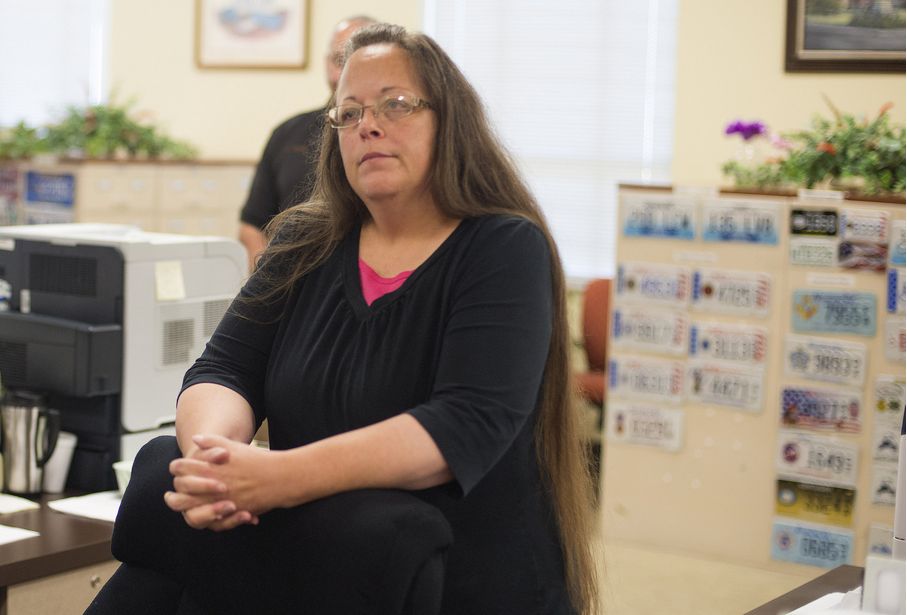
It’s not often a small town county clerk becomes a household name. But Kim Davis has managed to pull of just such a feat after going to jail last week for refusing to issue marriage licenses from her office. The Washington Post reports:
The Kentucky clerk drew headlines for refusing to issue marriage licenses to all couples, gay and straight, after the Supreme Court ruled earlier this summer that same-sex couples have the right to marry. An Apostolic Christian, Davis has said it would violate her faith to put her name on a marriage license for two people of the same sex.
She was sued by several gay couples and was ordered by [Judge] Bunning to begin issuing the licenses this week. When Davis defied the judge’s order, the couples asked for Davis to be held in contempt and fined.
But Bunning decided to jail Davis, saying fines would not be sufficient to compel compliance because Davis’s supporters could raise money on her behalf.
“The idea of natural law superseding this court’s authority would be a dangerous precedent indeed,” Bunning said.[1]
Not surprisingly, demonstrators, both in support and in protest of Mrs. Davis, gathered outside the courthouse where she was sentenced:
Ashley Hogue, a secretary from Ashland, held a sign outside the courthouse that read, “Kim Davis does not speak for my religious beliefs.”
“This is so ugly,” she said, wiping away tears. “I was unprepared for all the hate.”
Demonstrator Charles Ramey, a retired steelworker, downplayed the vitriol.
“We don’t hate these people,” he said, holding a sign that read, “Give God his rights.” “We wouldn’t tell them how to get saved if we hated them.”[2]
On the one hand, I am somewhat puzzled why Mrs. Davis, if she could not in good conscience carry out one of the duties for which state taxpayers are compensating her, did not simply resign her position. After all, for Mrs. Davis to refuse to issue marriage licenses not only to same-sex couples, but to all couples, and to make it incumbent on the clerks who work for her to follow suit hardly seems the best way to handle a personal religious objection, as Ryan T. Anderson, a senior research fellow at the Heritage Foundation, makes clear in this thoughtful article. Mrs. Davis explains her reasoning in the USA Today article: “‘If I left, resigned or chose to retire, I would have no voice for God’s word,’ calling herself a vessel that the Lord has chosen for this time and place.” Her explanation begs the question: would she really have no voice for God’s Word if she was not a county clerk? Couldn’t she be a witness for Christ in ways that involve less emotional, political, and rhetorical volatility than refusing to issue marriage licenses? And what does she do when she has to perform other duties that could – and perhaps should – violate her conscience, such as legally licensing divorces for couples who are not splitting for biblically appropriate reasons? I’m not sure I completely understand Mrs. Davis’ thinking.
On the other hand, I am also not unsympathetic to her plight. Here is a government worker who was thrown in jail because she, in her vocation, was seeking in some way to abide by what God’s Word says about sexual boundaries. A Christian theology of work says that no matter what we do, we ought to view ourselves as “working for the Lord, not for men” (Colossians 3:23). Mrs. Davis seems to be trying to put this theological truism into everyday practice. I should also note that she does not appear to have arrived at her practice of refusing to issue marriage licenses lightly. Her conversion to Christianity came on the heels of a history littered by broken marriages and broken hearts. Since her conversion, however, she has maintained a strong stance on biblically informed sexual standards.
This is one of those theologically, ethically, legally, and relationally thorny situations that seems to be increasingly common in our day and age. As Christians, how do we respond? Is Kim Davis right? Or should she resign if she cannot, in good conscience, issue marriage licenses?
In the book of Daniel, we meet a man who, like this county clerk, held a government job. Indeed, he held a very prominent government job. Under the reign of the Persian king Darius, this man Daniel “so distinguished himself among the administrators and the satraps by his exceptional qualities that the king planned to set him over the whole kingdom” (Daniel 6:3). Daniel’s upward mobility, it seems, was virtually limitless until, one day, as he went about carrying out his duties, the laws of the land changed in a way that violated his conscience:
The administrators and the satraps went as a group to the king and said: “O King Darius, live forever! The royal administrators, prefects, satraps, advisers and governors have all agreed that the king should issue an edict and enforce the decree that anyone who prays to any god or man during the next thirty days, except to you, O king, shall be thrown into the lions’ den. Now, O king, issue the decree and put it in writing so that it cannot be altered – in accordance with the laws of the Medes and Persians, which cannot be repealed.” So King Darius put the decree in writing. (Daniel 6:6-9)
As a worshiper of the God of Israel, Daniel could not, in good conscience, follow the king’s edict to pray only to the king – even though he was serving the king as a public official. So what does Daniel do?
Now when Daniel learned that the decree had been published, he went home to his upstairs room where the windows opened toward Jerusalem. Three times a day he got down on his knees and prayed, giving thanks to his God, just as he had done before. (Daniel 6:10)
I have sometimes wondered why Daniel didn’t try to negotiate some sort of compromise. Couldn’t he have stayed downstairs in a private room to pray to the true God rather than going upstairs and kneeling before an open window so everyone below would know exactly what he was doing? Couldn’t he have simply put off praying altogether in order to comply with the edict without committing idolatry against his God? After all, the edict was only in place for thirty days. In this instance, Daniel, according to his conscience, could do neither. He had to live out his faith, even if his faith was in conflict with his vocation as a public official and his status as a citizen of Persia.
You probably know the rest of the story. Daniel’s sentence was not just a jail cell, but a lions’ den. Daniel was willing to go to his death for his confession of faith. But, miraculously, “God sent His angel, and he shut the mouths of the lions” (Daniel 6:22).
It’s not difficult to draw parallels between Daniel’s story and Mrs. Davis’ story, save that we do not yet know how Mrs. Davis’ story will end. For us who are looking on, there are a couple of lessons I think we can take away from Daniel’s story. First, Daniel’s refusal to obey Darius’ edict had nothing to do with a political victory and everything to do with theological fidelity. I fear that, all too often, we can prioritize the politics of an issue like gay marriage specifically over a biblical theology of what marriage is generally. Any stand that we make must never be simply for the sake of winning a political battle, but for the sake of staying true to God’s Word. If people perceive that our theology is being leveraged merely as a means to political power, they have every right to be cynical of us and even angry at us. I’m fine if people, as I’m sure they did when Daniel was willing to be thrown to the lions, question our sanity, but we must never give people a reason to question our spiritual sincerity. Second, Daniel served and supported his governing authorities in every way he could until he couldn’t. This couldn’t have been easy for him. The Persians, after all, were pagans who shared none of Daniel’s theological commitments. But rather than fighting them, Daniel supported them in his work. He took a contrarian stand only when it was theologically necessary. I worry that, because of the deep suspicion and animosity that plagues our political system, we have become so devoted to fighting with each other on every front that we have lost our ability to take credible stands on the most important fronts. This is not to say that we can never be engaged in the political process – we do live in a democratic republic, after all – but it is to say that our governing authorities are first and foremost gifts from God to be supported by our prayers rather than political enemies to be bludgeoned by our anger.
As I think about Mrs. Davis’ predicament, I can appreciate her stand. My prayer for her, however, as she remains steadfast in her opposition to a Supreme Court ruling, is that she also proves stalwart in her commitment to love those with whom she disagrees. A strong stand may be good in the face of a morally untenable court decision. And she has decided to take one. But love – even when it’s love for the gay couple that comes walking through the door of the county clerk’s office – is absolutely necessary for Godly, gracious relationships. I hope she’s decided to give that.
______________________________
[1] James Higdon and Sandhya Somashekhar, “Kentucky clerk ordered to jail for refusing to issue gay marriage license,” The Washington Post (9.3.2015).
[2] Mike Wynn and Chris Kenning, “Ky. Clerk’s office will issue marriage licenses Friday – without the clerk,” USA Today (9.3.2015).


 Pastor Zach's Blog