You Didn’t Win Powerball…So Now What?

Credit: New York Daily News
The conversation across from me last Wednesday morning as I was sitting at Starbucks reading and sipping my coffee startled me. Next to me was a table of folks who, from the sound of their conversation, all worked in the same office. As coworkers, they were doing what coworkers should regularly be doing – they were strategizing, they were planning, they were setting goals, and they were developing financial models…for what they would do when they won the $1.5 billion Powerball jackpot.
With Powerball fever sweeping the nation last week with history’s largest ever jackpot up for grabs, these folks sounded like they needed some Tylenol to bring down their temperature. I’m not sure I’ve ever heard a more heated, even if not particularly informed, financial conversation in my life – much less a financial conversation that imagines a 1 in 292,201,338 scenario. Should we take the lump sum or should we take the annuity payments? How do we set up a trust fund since we’re splitting the pot when we win? Should we allow this or that coworker to join our pot?
Oh, if only. But as Daniel Victor of The New York Times points out:
If you printed out the name of every United States resident on individual pieces of paper, put them in a giant bowl and selected one at random, the odds of picking President Obama are not far from the odds of winning the Powerball.[1]
In other words, you are not going to win Powerball.
The way this office pool talked about Powerball, it sounded like all but a sure bet that they were going to be the big winners. But unless they happened to have just come back from Chino Hills, CA, Munford, TN, or Melbourne Beach, FL with just the right ticket in hand, they were not. Last Wednesday was not their day. And today is just another manic Monday at the office for them.
Powerball is an interesting enterprise. On the one hand, I appreciate that it helps fund education, although I can’t help but wonder if there are other, more efficient ways to fund educational programs. On the other hand, I am concerned that, from a systemic perspective, it acts as a regressive tax because it has a disproportionate appeal to lower income households who have big dreams of digging out of financial desperation. Even if it does act as a regressive tax, however, it is important to note that it is a voluntary regressive tax. No one has to buy a ticket. Indeed, the fundamental problem with Powerball is not really with Powerball at all. It’s with us. Far too many of us are quick to disregard the fundamentals of math for a quixotic wish.
“Someone has to win,” I’ve heard time and time again. “And it could be me!” Actually, someone does not have to win. This is precisely why the Powerball jackpot rose as much as it did – because someone did not have to win the jackpot and no one did win the jackpot for ten weeks straight because the odds of winning are so abysmal, they are, for all intents and purposes, at zero. Technically, they’re at .00000034223%. But it still takes a lot of zeroes in that percentage to get to any sort of a number that represents something rather than nothing.
Why in the world would we get so excited over odds like these? What are we thinking?
In one way, we’re not. We’re dreaming. And, if your dreams are anything like mine, dreams do not have to make sense or be rooted in reality. They can be sheer fantasy.
But something more is going on here. For not only are we dreaming, we’re hoping. We’re hoping lightning will strike and we will win. Or, to use the appropriate odds, we’re hoping lightning will strike 246 times and we will win one time. We’re hoping our financial troubles will be over. We’re hoping we’ll be able to quit our jobs and take life easy. We’re hoping to get rich.
The apostle Paul writes quite extensively to Timothy about the dangers associated with riches. Two of his statements are especially striking to me as the fervor over Powerball settles:
Those who want to get rich fall into temptation and a trap and into many foolish and harmful desires that plunge people into ruin and destruction. (1 Timothy 6:9)
And:
Command those who are rich in this present world not to be arrogant nor to put their hope in wealth, which is so uncertain, but to put their hope in God, who richly provides us with everything for our enjoyment. (1 Timothy 6:17)
In the first verse, Paul prohibits hoping for riches. We should not obsess over accumulating treasures on earth because such an obsession is a recipe for depression and, ultimately, for destruction. In the second verse, Paul prohibits hoping in riches. Wealth cannot do what many people think it can do. It certainly cannot solve all your problems, as past lottery winners will tell you.
The problem with the Powerball phenomenon is that its huge jackpots tempt us toward false hope – both for riches and in riches. And even if Powerball itself is nothing more than a silly game, the false hope it tempts us toward is a dangerous disease.
If you want to spend $2 on a ticket for fun, that’s one thing. But you should place about as much hope in that ticket as you do in winning your office fantasy football league where the grand prize is a Nerf football that someone spray painted gold to make it look like a trophy. If your hopes go much further than that, be careful. Your hope is not in a $2 ticket with long odds. Your hope is in Christ.
After all, He’s a sure bet.
_________________________
[1] Daniel Victor, “You Will Not Win the Powerball Jackpot,” The New York Times (1.12.2016).
The Pew View of the LCMS

Last year, the Pew Research Center released a landmark Religious Landscape Study that surveyed over 35,000 adults from across the nation about their religious beliefs. As a part of their research, Pew studied the church body of which I am a part, the Lutheran Church – Missouri Synod. Though I am well-aware of the risks associated with navel-gazing, I wanted to share a few thoughts on the section of Pew’s study that specifically pertains to my church body, because turning the mirror on oneself and seeing oneself for what one truly is – even when it is uncomfortable – can often be a helpful exercise.
Before we dig into the data, I should note that Pew’s survey of LCMS congregants has a 6-point margin of error, which, statistically, is significant. This does not mean, however, that this survey is not worth our time and attention. Even with a 6-point margin of error, the study’s findings are statistically substantial enough to be quite revealing. So on to the study.
I was surprised to see how well my demographic is represented in my church body. I had stereotypically assumed that my denomination was older than it actually turns out to be. According to Pew, 30 to 49 year olds, which is my demographic, comprise the largest segment of my church body at 32%. Generation X, which is my generation, comprises the second largest segment of my church body at 28% next to Baby Boomers, who are at 35%. Millennial representation is much lower at only 13%. Demographically, then, I am, in many ways, a typical member of an LCMS congregation. I am not, however, typical in every way – especially in my theological and moral beliefs. It is in these areas that the data becomes particularly interesting.
For example, when Pew asked LCMS people what they look to for guidance on right and wrong, while 41% answered “religion,” 45% answered “common sense.” In one way, this is not a surprise. In the face of the information onslaught of the digital age, we have become informational pluralists. We garner and glean our information and, by extension, our opinions, values, and beliefs, from a wide array of sources. The idea of a turning to a single, divinely-authored book as the first and final word on morality is simply untenable to most people. Indeed, when LCMS congregants were asked about their “frequency of participation in prayer, Scripture study or religious education groups” and about their “frequency of reading Scripture,” the largest percentage of respondents in both categories fell into the “Seldom/Never” tier. Thus, it is perfectly logical that more people would get their guidance on right and wrong from common sense than from religion and from the book on which the Christian religion is grounded, the Bible. After all, a majority of people don’t even study the Bible enough to have a nuanced understanding of what’s in it.
The Pew study also revealed that many LCMS congregants seem more unified around a politically conservative economic policy than they are around issues that pertain to traditional Christian morality. Politically, 52% of LCMS people identify as conservative over and against 33% who identify as moderate and 10% who identify as liberal. 72% prefer a smaller government with fewer services and 62% say that government aid programs do more harm than good. Morally, 46% of LCMS people believe abortion should be legal in all or most cases versus 51% who believe it should be illegal, and 56% believe homosexuality should be accepted with 45% favoring same-sex marriage. Compare this to 50% of people who identify as pro-choice nationwide and 55% who favor same-sex marriage nationwide. There is a gap between what LCMS people believe about hot button moral issues and what the general public believes, but this gap is not as wide as one might think. And, on both the issues of abortion and same-sex marriage, the LCMS is less unified than it is around conservative economic policy.
Theologically, I find it unsettling that our opinions on moral issues, which call for our Scriptural agreement, are so diverse while in areas where it’s okay and even desirable to be diverse, we are monolithic. Take, for instance, the racial makeup of the LCMS. 95% of LCMS congregants are white. This hardly seems to reflect the picture of the Church Triumphant with its people from “every nation, tribe, people and language” (Revelation 7:9). I understand that we cannot create this kind of Church by our own efforts and I also am well aware that the Church Militant, because it marches forth in a fallen world and because it does not reveal to us the universal Church, will always look different than the Church Triumphant. But let’s not use our inability to create the Church of Revelation 7:9 as an excuse to not desire it. After all, every member of the Church Triumphant starts out as a member of the Church Militant. So the Church Militant should look, at least in some way, like Church Triumphant.
When it comes to the moral and ethical issues that clearly divide not only our society, but also many in my church body, I would simply say that these are issues that demand our continued attention and discussion. And when discussing these issues, we must understand that just being a part of a church body does not guarantee, nor does it even make it likely, that a person will believe what the church body teaches. Frankly, in our current cultural configuration, the Church’s voice is just one voice – heard by most only once a week at best – among a steady stream of other voices that speak much more frequently and regularly into people’s lives. In order to gain a serious hearing among all these voices, it is important for the Church to speak charitably enough that people trust it and clearly enough that people know what the Bible teaches, even if they disagree.
Pew’s Religious Landscape Study has presented us with a challenge – and an opportunity. It has revealed some areas of moral, theological, and even demographic concern. My prayer is that we, as God’s people, rise to meet the challenge – not only for the sake of a church body, but for the sake of the world.
2015 In Review

This past week, I took some time to scroll through my blogs for 2015. It was, in some ways, an unsettling exercise. Consider these headlines:
- January: Transgender teen Leelah Alcorn takes her own life December 28, 2014. By January 2015, rallies are being held in her memory and in support of the transgender movement.
- February: The erotic movie “Fifty Shades of Grey” hits theatres, earning $570 million worldwide.
- March: The University of Oklahoma’s Sigma Alpha Epsilon chapter is shutdown after some of its members are caught on camera chanting offensive racial slurs.
- April: Rolling Stone retracts its cover article, detailing a gruesome gang rape of a woman at the University of Virginia, after it is discovered that the details of its story cannot be verified and may, in fact, be falsified.
- May: Pew Research publishes a poll chronicling the precipitous decline of people claiming to be religiously affiliated.
- June: Olympic decathlete Bruce Jenner comes out as transgender woman Caitlyn Jenner, nine worshipers are shot and killed by a racist gunman in Charleston, and the Supreme Court legalizes same-sex marriage in all 50 states.
- July: The Center for Medical Progress begins releasing undercover videos purporting to show Planned Parenthood officials offering to sell aborted fetal parts for profit.
- August: The website for Ashley Madison, which advertises itself as a service to help people have affairs, is hacked and the data of 37 million of its members is compromised.
- September: Kentucky County Clerk Kim Davis refuses to issue marriage licenses to same-sex couples and Pope Francis visits the United States.
- October: Fallout continues from the Planned Parenthood undercover videos.
- November: Students stage demonstrations on college campuses across America protesting what they perceive to be systemic campus racism and Paris is struck by a series of six coordinated terror attacks.
- December: A couple opens fire at a holiday party in San Bernardino, California killing 14 in an apparent act of terrorism.
Blogging can be a frustrating discipline because, at times, as my list above intimates, it can become flat-out depressing. It seems as though I’ve blogged on a never-ending succession of tragedies, controversies, and indignities this past year. And yet, as tough as these topics might be to tackle, I believe they are vital for us as Christians to understand and address.
A few themes have emerged as I’ve watched the headlines unfold in 2015. First, it seems as though we are obsessed with sex and oppressed by violence. Between “Fifty Shades of Grey,” the Ashley Madison scandal, and same-sex marriage, headlines relating to human sexuality and the sexual ethics have dominated. But so have headlines relating to violence. The acronym ISIS is now the stuff of household lore. Planned Parenthood’s gruesome harvesting of fetal parts sent shivers up the spines of many. Beatings and shootings with racist tinges dominate the headlines. As a child, I remember my parents criticizing many movies for having too much “sex and violence.” Was art imitating life back then or is life imitating art now?
A second theme that has emerged is a search for who we are as humans. I would be intellectually, emotionally, and relationally naïve if I did not recognize that same-sex marriage is about much more than sex. It is about the ability of people to define themselves as they see themselves. This is also the case with the transgender recrudescence. How internal desires correspond to a person’s biological ordering is key to understanding the existential angst that many people in the LGBT community experience.
Third, issues of race and religion have taken center stage this past year. From the racist chant by members of Sigma Alpha Epsilon to the shooting at the church in Charleston, racism is frustratingly alive and well. At the same time the LGBT community is trying to figure out who it is and arriving at some spiritually dangerous answers, we seem to have forgotten some of the older spiritually salutary lessons we had to learn about who we are as a nation of immigrants. And I would contend that this is true across the racial spectrum. Trumped up charges of racism in the form of the newly minted category of “microaggression” do not help, but neither do denials that racism is real and consequential. Religiously, we are learning quickly – both from Paris and San Bernardino – that bad theologies have terrible consequences. The theological drivers of groups like ISIS cannot be minimalized or rationalized. They must be confronted.
As I reflect on the stories I have covered, I have become convinced more than ever that our world is not just in need of good thinking, but theological thinking on the things that ail us. The problems we have encountered in 2015 are not just the results of some bad thinking that needs to be tuned up by an enlightened intelligentsia so we can march boldly into a utopian era. Rather, the problems we have encountered in 2015 are the results of nothing short of a deeply depraved sinfulness that needs to be confronted by the Word of God. And this is where we, as Christians, have something unique to offer our world. While the world is trying to solve its problems by political, intellectual, and social gerrymandering, we can be confronting and forgiving the sinners – even when those sinners are us – who create the problems. In my mind, that’s our greatest hope for a better world.
Human sin, sadly, will probably continue to give me plenty of reasons to write in 2016. But grace, thankfully, will give me even more reasons to rejoice. So let’s see where the year takes us.
Do Muslims and Christians Worship the Same God?

Dr. Larycia Hawkins
Last week on this blog, I discussed the danger of trading theological integrity for political expediency in the wake of Donald Trump’s proposed ban on all non-resident Muslims entering our country. As I explained, Mr. Trump’s claim that his ban is “not about religion,” though politically palatable, cannot be factually truthful. His ban, I argued, is necessarily about religion because it affects a whole group of thoroughgoingly religious people.
I also argued that it is important for us, as Christians, to have honest theological conversations with our Muslim friends. We may disagree on a great number of things, but at least we agree that theology matters. Categories like orthodoxy and heresy, truth and deity are important to us. In a culture that is far too dismissing of theology, Muslims and Christians should be enthusiastically engaging in theology.
This is what I argued for last week. And now this week, almost providentially, I have an opportunity to practice what I blog.
One of America’s premier evangelical institutions, Wheaton College, is embroiled in an imbroglio after one of its professors, Dr. Larycia Hawkins, claimed that Muslims and Christians worship the same God. Wheaton placed Dr. Hawkins on paid administrative leave, explaining in a press release:
As a Christian liberal arts institution, Wheaton College embodies a distinctive Protestant evangelical identity, represented in our Statement of Faith, which guides the leadership, faculty and students of Wheaton at the core of our institution’s identity. Upon entering into a contractual employment agreement, each of our faculty and staff members voluntarily commits to accept and model the Statement of Faith with integrity, compassion and theological clarity … Dr. Hawkins’ administrative leave resulted from theological statements that seemed inconsistent with Wheaton College’s doctrinal convictions.[1]
Dr. Hawkins’ assertion is well worth our time and attention because it is an example of precisely the kind of theological discussions I would argue Christians and Muslims ought to be having. Do Christians and Muslims worship the same God? Is Dr. Hawkins correct?
As a Christian, I would answer the question of a shared deity among Christians and Muslims in two ways: “No, but…” The answer “no” is necessary for theological honesty. The answer “but” is crucial to Christian hospitality. Let me briefly explain both answers.
“No”
It is very difficult to assert, at least in any way that demands a nuanced theology of divinity, that Muslims and Christians worship the same God. In defending her assertion on social media, Dr. Hawkins cited theologian Miroslav Volf, who, in an interview for Christianity Today, explained:
I think that Muslims and Christians who embrace the normative traditions of their faith refer to the same object, to the same Being, when they pray, when they worship, when they talk about God. The referent is the same …
God is one in both traditions. That’s very important. Two, God is merciful. Also, God is just. God’s oneness, God’s mercy, and God’s justice are significant commonalities. We have different understandings of each of these, but the overlaps are really impressive.[2]
Volf argues that Christians and Muslims worship the same God based on a list of divine attributes that happen to be the same between the two faiths. His list of divine attributes, however, strikes me as ad hoc. What about the Christian contention that God is one, yet also three persons? Muslims do not believe this (cf. Surah 4:171). What about God’s humanity? At the heart and soul of a Christian’s faith is the God-man Jesus Christ. Muslims flatly reject this (cf. Surah 10:68). What about God’s greatest attribute – that He is love (cf. 1 John 4:8)? Though one of the 99 names Muslims have for God is “the Loving One,” that God is love seems to be a bridge too far for Islamic theology.
Volf acknowledges such differences, but then moves quickly to downplay them:
There are significant differences that are the subject of strenuous debates. Some differences really are foundational to the faith, like the doctrine of the Trinity. At the same time, there’s this amazing overlap and similarity. We need to build on what is similar rather than simply bemoan what’s different.
Volf’s assertion that Muslims and Christians worship the same God in spite of significant differences in their respective conceptions of Him begs a question: where would Volf draw his line? When do differences in theology become profound enough for there to be a difference of divinities?
If somebody postulates the existence of more than one God, I would have to say we don’t worship the same God. If somebody says that God is basically one with the world, I would also have to say we don’t worship the same God.
Again, all of this seems very ad hoc to me. For Volf, the attributes of God’s oneness and His distinction from creation are vital. The attribute of God as three persons is not. Why? Simply because Volf says so?
Jesus is quite clear that, in order to be a true worshiper, a person must worship “in the Spirit and in truth” (John 4:23-24). It is quite difficult to worship “in the Spirit” while denying the Spirit’s personhood, as do Muslims, and it is impossible to worship “in truth” while denying at least parts of what Scripture says is true about God. It is important to note that the issue here is not whether a person has a complete understanding of God. Jesus affirms that a person can worship the true God while not having a complete understanding of Him when He says of the Samaritans, “You Samaritans worship what you do not know” (John 4:22). Worship does not require perfect knowledge. True worship does, however, require faith.
But the Scriptures are also very clear that if a person perverts what can be known about God from biblical revelation, he has moved from worship to idolatry. This is why the apostle Paul, when he was in Athens, was “greatly distressed to see that the city was full of idols” (Acts 17:16), but was also willing to engage the Athenians in a theological conversation around the altar the they had built “TO AN UKNOWN GOD” (Acts 17:23). The Athenians’ altar stemmed from ignorance. Their idols were built on false and dangerous ideas about divinity. The altar propelled Paul to further conversation. The idols incited his unapologetic condemnation.
Considering that Islam does not claim to be ignorant of God, but rather claims that God is widely different from whom Christians claim He is, it is difficult to see how either a Christian or a Muslim can honestly say that both faiths worship the same God. Just because two divinities share a short list of attributes does not mean they are the same God any more than a mother and a daughter who share some genes are the same person. This is why I must answer “No” to the question, “Do Christians and Muslims worship the same God?” If this is all I was to say, however, I would not be saying enough.
“But”
I firmly believe that Christians and Muslims do not worship the same God. This is not to say that I think Muslims have no knowledge of what I as a Christian would confess to be the true God or that the God of Muhammad does not reflect in certain ways the God of the Bible. In Romans 1, Paul reminds us that “since the creation of the world God’s invisible qualities – His eternal power and divine nature – have been clearly seen, being understood from what has been made” (Romans 1:20). It is no surprise, then, from a Christian standpoint, that the God of Muhammad would have attributes that are influenced and informed by the God of the Bible, for the God of the Bible is not only particularly revealed in Scripture, but generally, though not salvifically, knowable through creation.
Ultimately, even if someone believes that Christians and Muslims do indeed worship the same God, this still does not settle the question of what is true about God, how one is to approach God, and how one receives eternal life with God. The Quran, for instance, speaks of Jesus, but rejects His death for sinners (cf. Surah 4:157-158). The Bible makes Jesus’ death for sinners the very locus of His identity (cf. 1 Corinthians 2:2). Thus, when Muslims and Christians talk about Jesus, the question should not be, “Do the Bible and the Quran talk about the same Jesus?” Even if they do, this is finally of little consequence. A better question would be, “Does the Bible or the Quran authoritatively reveal the true Jesus?” After all, who Jesus is matters just as much as that He exists.
What is true of Jesus specifically is true of God generally. We need to be asking, “Does the Bible or the Quran authoritatively reveal the true God?” Who has the true and supreme revelation about God from God? As a Christian, my answer must be that the Bible has the true and supreme revelation about God from God. My guess is a Muslim would beg to differ. But this is why a willingness to have hospitable theological discussions is so important. And this is why, if a Muslim friend would like to offer his or her thoughtful and respective perspective on the God of Muhammad and the God of the Bible, I would love to hear it. Understanding may not always lead to agreement, but it does generally lead to charity. And that’s a virtue both our religions share.
_________________________
[1] “Wheaton College Statement Regarding Dr. Larycia Hawkins,” Wheaton College (12.16.2015).
[2] Mark Galli, “Do Muslims and Christians Worship the Same God?” Christianity Today (4.15.2011).
Donald Trump’s Sandbox

Credit: Huffington Post
I decided it would be best to wait for a while to write on what has become Donald Trump’s now infamous proposal that there should be “a total and complete shutdown of Muslims entering the United States until our country’s representatives can figure out what is going on” for a couple of reasons. First, the outrage, predictably, over Mr. Trump’s ban was fierce and fast and I wanted to allow some time for it to cool. Reacting to the hottest thing is not always the wisest thing. Second, I wanted to take some time to gather my thoughts on what has transpired. It is a tricky thing for a pastor to write about a politician and I never do so lightly. This is why I also feel compelled to state upfront, lest there be any confusion, that, though I do reference certain political realities, the primary purpose of this blog is not to analyze Mr. Trump’s politics or campaign. There are others who are far more adept at these types of analyses than I. I do believe, however, that Mr. Trump’s ban on Muslims has worldview and theological implications that are important for Christians to recognize and to address. Indeed, what fascinates me most about Mr. Trump’s ban is not so much what he proposed at first, but how he has continued to defend his proposal. In an interview on Live with Kelly and Michael, the presidential candidate argued, “It’s not about religion. This is about safety.”
Mr. Trump’s claim that his ban on non-resident Muslims entering the country is not about religion, though it may be in some sense politically palatable, cannot be factually truthful. He is, after all, singling out adherents of a religion – not citizens of a nation or members of a political party – in his ban. This is about religion because it affects a whole group of thoroughgoingly religious people.
There is no doubt, as we continue to deal with the fallout from the terror attacks in Paris and San Bernardino, that the threat of radical Islamist terrorism is real and that national security should be a top priority. But what often gets overshadowed in so many of our frenetic discussions concerning radical Islamist terrorism is Islam itself and the people who practice it devotedly on a daily basis. Islam, before it is anything else, is a religion with a developed theological system. It makes claims about what is true and what is false, what is orthodox and what is heretical. This is why I am sympathetic to the many Muslims who have claimed that the people who carry out terror attacks are not true Muslims. In the eyes of these Muslims, radical Islamist terrorists have said things and done things that have placed them so far outside the pale of orthodox Islamic theology that they cannot be called Muslim, at least in any theologically responsible sense. I would argue in like manner that what members of the Westboro Baptist Church have said and done has placed them so far outside of the pale of orthodox Christian theology that we cannot consider them to be Christian in any theologically responsible sense no matter what the marquis on their “church” may claim. But it is only through explicitly religious and theological analyses of these groups that we can arrive at such conclusions. Thus, a theological understanding of and, I would hasten to add, a theological repudiation of what has happened in these terrorist attacks is inescapable.
Though he probably does not realize it, Mr. Trump’s assertion that his ban on Muslims entering the country can be made without thinking through the religious implications could only be taken seriously in a secular liberal society like ours. In a recent column for The New York Times, Ross Douthat explains how secular liberalism views Islam:
Secular liberal Westerners … take a more benign view of Islam mostly because they assume that all religious ideas are arbitrary, that it doesn’t matter what Muhammad said or did because tomorrow’s Muslims can just reinterpret the Prophet’s life story and read the appropriate liberal values in …
Instead of a life-changing, obedience-demanding revelation of the Absolute, its modernized Islam would be Unitarianism with prayer rugs and Middle Eastern kitsch – one more sigil in the COEXIST bumper sticker, one more office in the multicultural student center, one more client group in the left-wing coalition.[1]
The secular liberal view of religion is one where orthodoxy always takes a back seat to pluralism and transcendent ethics must eventually bow the knee to today’s contingent truths. Theological claims must ultimately give way to political and cultural concerns. Whether knowingly or unknowingly, this is precisely what Donald Trump assumes when he claims his ban on Muslims is “not about religion.” He assumes the long-standing theological heritage of Islam can be quickly and easily ushered aside to make way for a security-driven ban on Muslims in the same way some progressives presume the theological distinctives of Islam can be breezily brushed off in favor of a Western-style spirituality that calls for no real doctrinal fidelity from its adherents. In Mr. Trump’s case, the politics of security have, excuse the pun, “trumped” any real discussion of theology. What other name can there be for this kind of prioritization but secular liberalism?
One need to look no further than to the middle part of the previous century to see what happens when secular liberalism gets what it wants. Mainstream Christian Protestantism now lies in ruins because it bartered away its classical theology for a bourgeois intellectuality acceptable to a politically-minded modernity.
Confessional Christians are in a unique position to discuss with Muslims potential solutions to the crisis posed by radical Islamist terrorists because, for all we disagree on, we at least agree that theology matters and ought to be taken seriously. It is a particular theology, after all, that, no matter how grotesquely perverted and morally repugnant it may be, drives, at least in part, the aspirations of ISIS. Such a theology needs to be confronted, deconstructed, and condemned, which, thankfully, is precisely what some Muslim theologians are doing. An appreciation for theology can also lead us to question whether or not a whole religious group should be summarily and indiscriminately dismissed with the wave of a hand and a flip explanation that a ban on this group is not about religion. If a group defines itself religiously, as do Muslims, it probably behooves us to respect, study, and take this group’s theology seriously.
Certainly, there would be challenges in any honest theological discussions between Christians and Muslims. I am no Islamic theologian, but as far as I can tell, Islamic theology does not conceive of an Augustinian distinction between a City of God and a City of Man like Christian theology does. It is this distinction, outlined for us beautifully in Romans 12 and 13, that has allowed Christians to work comfortably and conscientiously in all sorts of governmental systems, including in American democracy, because they understand that no matter what the system of government, the City of Man that is human government is ultimately, even if hiddenly, under God’s control. The Christian’s call, then, is not to try to create a Christian government, but to be the Christian Church. In Islamic theology, such a distinction between the City of God and the City of Man does not feature nearly so prominently, if, some might argue, at all. Mosque and government go hand in hand. Even so, many Muslim majority countries have figured out ways to create at least some distance between their religion and their rulers. In this way, then, Christians and Muslims have plenty to talk about, for we both struggle with how to live out our respective faiths in our societies, even if our theologies of how our religions relate to our rulers differ. Furthermore, we agree that traditional religious categories like orthodoxy, heresy, truth, revelation, prophecy, and deity are important, even if we disagree on how each of these categories, right down to the category of deity, should be filled. But at least we agree that questions about theology are more important and, ultimately, more enduring than questions of politics and power. This is more than can be said for some in the secular left.
I do not think that Mr. Trump has rigorously thought through the logical and theological inconsistencies of his statements about Muslims. I suspect he offered his ban to score political points with his base while also tweaking the milquetoast de rigueur of many of the political elites. I also have a feeling that Mr. Trump might take issue with me claiming that his ban on Muslims “is not about religion” actually shares with secular liberals an assumption about the nature and importance of theology. But even if he’s doing so naïvely, his comments betray that Mr. Trump is still playing in the secular liberals’ sandbox. And the consequences of such a foray, to use Mr. Trump’s own phrasing, are “yuge.”
_____________________________
[1] Ross Douthat, “The Islamic Dilemma,” The New York Times (12.12.2015).
Mizzou, Truth, and What Pleases Us

Credit: David Eulitt/Kansas City Star/TNS via Getty Images
Last month’s heavily publicized protests at the University of Missouri are tragic for several reasons. The racist slur that ignited them is tragic. The fumbled response of the University President is tragic. The threats from a member of Mizzou’s Department of Communication toward the media, calling for “some muscle” when an ESPN reporter was trying to cover the student protests, is tragic. But so is the response of the students. Their protests quickly spun out of control – moving from a specific instance of racism to outrage over everything from systemic racism to sexism to patriarchy. When others with differing viewpoints tried to engage Mizzou’s students on these important issues, the students blew up.
What happened at Mizzou has revealed just how incapable some college students are of having a conversation with someone with whom they disagree. Or, to put it a little less charitably, perhaps these students aren’t so much incapable as they are intransigent. It could be, I suppose, that they simply refuse to listen to viewpoints that differ from theirs. Indeed, the now famous student “safe spaces” are unapologetically touted as places of refuge where students can flee from any idea that triggers in them any sort of emotional distress. In fairness, it should be noted, as The Wall Street Journal rightly points out, that safe spaces are not just cloisters for the thin-skinned:
All of us seek “safety” from genuinely rancid views – how many of us would stay at a party where someone dominated the conversation with overtly racist bloviations? These students have merely overextended the bounds of the conclusively intolerable.[1]
It is true that there are some fools whose foolish viewpoints do not need to be answered according to their folly. The problem is not that students refuse to engage with a particularly rancid viewpoint. The problem is that some students refuse to engage with almost any viewpoint that does not mirror and mimic their own. Even a mildly disagreeable viewpoint, to some students, is an aggressively hostile and morally repugnant viewpoint.
Mizzou’s riots have brought to the forefront a hard reality. For many people, it no longer matters in any significant degree whether someone who has a viewpoint that opposes their viewpoint has a point. Categories like logic, truth, and prudence – particularly on moral and ethical issues – have been shuffled into the sunset as quaintly archaic interests. What matters most now is how someone’s viewpoint makes someone else feel. And if someone’s viewpoint makes someone else feel threatened, even if, according to the aforementioned categories, the point should be well taken, it is rejected out of hand. Philip Rieff proved to be quite prophetic when he wrote in 1966, “Religious man was born to be saved; psychological man is born to be pleased.”[2] What matters is not whether something is true. What matters is whether people are pleased by it.
It’s not just college students who have fallen prey to this therapeutic bias. In 2011, Susanna Dilliplane published an article in the Public Opinion Quarterly titled, “All the News You Want to Hear: The Impact of Partisan News Exposure on Political Participation,” where she laments how more and more Americans get their news only from outlets that share their own political views. It turns out that adults have their own “safe spaces” in the forms of cable news channels, Internet sites, and newspapers.
Even the media itself can fail to listen to viewpoints that differ from its editors. A recent article in The Economist asked, “Can porn be good for us?” Several contributors debated the question, almost all of whom accepted the premise that porn can indeed be good for us, a position which The Economist, if its own editorials are to be believed, seems to share. The debate was presented, at least implicitly, as closed. “Porn can be good for us.” But then The Economist posed the question to its readers. 80% disagreed with the newspaper. In one particularly tragic comment, a reader wrote:
Dear Madam,
Can porn be good for us? NO!! My husband has been trapped for forty years now. He stole “our” sex life used it all up for himself.[3]
The Economist thought the answer to its question was obvious. As it turned out, the editors spent too much time listening to themselves and not enough time listening to their readers. They got duped by their own sexually licentious safe space.
It’s time we begin to ask ourselves some hard questions. Have we become a people completely unwilling and unable to listen to those with whom we disagree? Have we become so impervious to arguments that threaten our worldviews that, even if they contain truth, we cannot concede that someone else who does not agree with us on many things may, in fact, have a point on at least one thing? Have we blithely rejected Patrick Henry’s famed statement – “For my part, whatever anguish of spirit it may cost, I am willing to know the whole truth; to know the worst, and to provide for it”[4] – preferring to believe lies that make us feel good instead of confronting truths that unsettle us? Have we become so proud that we can no longer consider and humbly admit that some of what we say and think may, in fact, be just plain wrong, or at least incomplete?
Whether we are students on a college campus or adults with a daily dose of news or a news outlet with a suspiciously stilted question for debate, we seem to have become much less interested in informing ourselves with rigorous analysis and much more prone to amusing ourselves with tendentious pontificating. I fear, however, that we may be doing a little more than, to borrow a book title from Neil Postman, “amusing ourselves to death.”[5]
___________________________
[1] John H. McWhorter, “Closed Minds on Campus,” The Wall Street Journal (11.27.2015).
[2] Philip Rieff, The Triumph of the Therapeutic: Uses of Faith After Freud (Chicago: The University of Chicago Press, 1987), 24-25.
[3] “Online Pornography: Can porn be good for us?” The Economist (11.17.2015-11.27.2015).
[4] Patrick Henry, “Give Me Liberty or Give Me Death!” (Richmond, VA: St. John’s Church, 3.23.1775).
[5] Neil Postman, Amusing Ourselves to Death: Public Discourse in the Age of Show Business (New York: Penguin Books, 1985).
San Bernardino and the Power of Prayer
 It all started at a holiday party. Syed Farook, who worked as an environmental specialist for the San Bernardino County health department, was celebrating the season with his coworkers when, at one point during the festivities, he left in a fit of anger. When he returned, he did so with his wife Tashfeen Malik, both of them clad in black tactical gear and heavily armed, and opened fire. By the time the hail of bullets had fallen silent, 14 were dead. 21 were injured. And the couple had left behind explosive devices, which, thankfully, they failed to be able to detonate. Officers pursued the pair and, following a shootout with at least 20 law enforcement officials, the couple was killed.
Police reports indicate that these attacks must have involved “some degree of planning” because of the military style in which they were carried out. Indeed, many experts now believe Farook was radicalized by Internet propaganda from Al Qaeda and meant this to be a terror attack.
Between what happened at Planned Parenthood in Colorado Springs two weeks ago and what happened in San Bernardino last week, it’s becoming difficult to make sense out of these mass shootings. One BBC reporter stated the insanity of all this succinctly: “Just another day in the United States of America … Another day of gunfire, panic and fear.”[1] This is most certainly – and sadly – true.
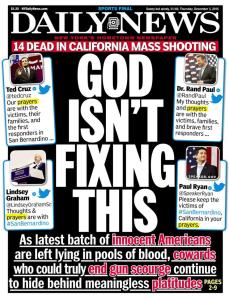
As has become the ritual in moments of tragedy and fear, politicians tweeted their “thoughts and prayers” for those of San Bernardino. The New York Daily News, however, was not all too happy with the “thoughts and prayers” of some Republican politicians, running this headline: “God Isn’t Fixing This: As latest batch of innocent Americans are left lying in pools of blood, cowards who could truly end gun scourge continue to hide behind meaningless platitudes.” Writing for the Daily News, Rich Schapiro explains the headline:
Prayers aren’t working.
White House hopefuls on the Democratic side of the aisle called for stricter gun laws in the wake of the shooting in San Bernardino that left at least 14 dead.
But after yet another mass shooting in America, GOP presidential contenders were conspicuously silent on the issue of gun control.
Instead, the Republicans were preaching about prayer.[2]
On its surface, and probably in its intention, this is a sensationalized political rant about Republicans and their stance on gun control and gun rights. But beyond the headline and behind the politics, a very troubling worldview emerges. In this regard, the Daily News headline is worth parsing.
“God Isn’t Fixing This”
How does the Daily News know this? How can the Daily News claim this? In Christian theology, sovereignty and eschatology go hand in hand. Sovereignty promises us that God has the power to wipe out evil and evildoers. Eschatology reminds us that God has a timeline, which He has not revealed to us, by which He will finally and fully defeat evil while redeeming and perfecting evildoers who put their faith in Christ. Christians, then, believe that God is fixing this, just not on the timeline that we might prefer.
Moreover, how does the Daily News account for the attacks that have been foiled? Like the one in Paris? Millions of people were praying for Paris in the wake of the highly coordinated terror attacks there. Did the prayers of the faithful work when a second terror plot never came to fruition in an attack? Or is the discovery of this terror plot simply to be chocked up to the work of law enforcement officials alone? If so, the Daily News has presented Christians with a lose-lose proposition: when terror attacks do happen, they prove that prayers do not work and God is not fixing things precisely because they have happened. When terror attacks do not happen, prayers still do not work and God is still not fixing things because a government just happened to get ahead of the attackers. Thus, the Daily News has already determined prayer does not work and God does not fix things, regardless of what does or does not happen.
If this is the case, then what does or does not happen cannot be marshaled, at least according to the rules of logic, as evidence for or against the efficacy of prayer and the activity of God because it has already been assumed that there is no correlation between prayer, divine activity, and terror attacks. What evidence does the Daily News offer, then, to back up its assertion that prayers are not working and God is not fixing this? None. We are simply to believe it because the Daily News wrote it.
“As latest batch of innocent Americans are left lying in pools of blood, cowards who could truly end gun scourge…”
If prayer does not work and God is not at work, what is the solution to these shootings? Politicians are. Politicians, the Daily News says, “could truly end gun scourge.” Really? What evidence is presented for this claim? Like with the effectiveness of prayer and the activity of God, none is. We are simply to believe it because a journalist wrote it. In point of fact, I’m fairly certain that California lawmakers have worked quite tirelessly to enact some of the strictest gun control legislation in the nation. Why didn’t it work? And if it did not work, what will?
The claim that politicians can end gun scourge is disingenuous and, quite frankly, ridiculous. Can we take steps to curb it? Of course. Can we enact legislation that addresses it? Absolutely. Can we actually end it? If we can, I would like to see that plan. And I would like to test that plan by seeing how many mass shootings and terror attacks we suffer after such a plan is enacted. The number should be, according to the Daily News headline, precisely zero. Call me a pessimist, but I have a feeling it wouldn’t be.
“…hide behind meaningless platitudes.”
On the one hand, I can understand how the phrase “thoughts and prayers” can become a meaningless platitude, especially when it is tweeted by millions. When a phrase is tossed around long enough and carelessly enough, it tends to become meaningless enough. On the other hand, if the Daily News thinks prayers themselves are meaningless platitudes, then it has made an explicitly theological claim, which, once again, it has not bothered to explain or defend. It simply assumes its view on prayer to be true and assumes its readers will uncritically agree.
As I wrote earlier, the editors of the Daily News more than likely meant this as little more than a sensationalized political rant. The very fact that they attack Republicans for tweeting out “thoughts and prayers” for those in San Bernardino without acknowledging that Democratic politicians have done the same smacks of partisan grandstanding. If they wanted to argue for tougher gun control laws, they could have done so without attacking Christian theologies of prayer and God’s activity. They could have been critical of Republican lawmakers – and even of their tweets as compared to their actions – without recklessly and baselessly announcing, “Prayers aren’t working.” But in my mind, what the Daily News probably did not intend to do with its headline, but what it nevertheless did do, matters much more than its political posturing. The Daily News essentially argues for a secular agnosticism. The Daily News asserts that God, if He does exist, will not help us. It also asserts that God, if He does exist, does not answer our prayers. Therefore, a spiritual answer to a national crisis is stupid and foolish. Only secular answers are realistic and effective. By the end of the article, it is difficult to walk away with anything other than this impression.
As a Christian, it probably comes as no surprise that I cannot accept the underlying premise of the Daily News headline. To offer only a secularly political solution to the spiritual evil of terror attacks makes no sense to me, in large part because it simply will not work. Gun control legislation is worth discussing. Politicians should be discussing it. And keeping firearms and explosive devices out of the hands of would-be terrorists and other mass murderers should be a top political and national security concern. But even our best efforts will, at least in part, fail. We can be prudent, but we cannot usher in perfection. To believe otherwise is to assume for ourselves a power that belongs only to God.
I also can’t help but wonder: even if a piece of gun control legislation could wipe out all terror attacks and gun violence, how do we help the community of San Bernardino heal in the wake of the attacks that have already taken place? Does God’s power play no role? How do we give those who have lost loved ones hope? Does God’s promise of salvation through faith in Christ mean nothing to those who grieve? Does the Daily News have a better idea than Christ for offering hope for something beyond this life? Or are the people of San Bernardino to be victimized twice – once by the bullets and bombs of terrorists and again by an acidic secular agnosticism that burns away at any worldview that espouses something beyond the days of this life?
The Atlantic, which, interestingly enough, used to be owned by the same man who now owns the Daily News, published the touching story of a text conversation between a daughter and her father that took place during the San Bernardino shooting:
“Pray for us,” a woman texted her father from inside the Inland Regional Center, while she and her colleagues hid from the gunfire. Outside the building, evacuated workers bowed their heads and held hands. They prayed.[3]
The writers at the Daily News may believe that only legislation will solve our problem with gun violence, but those who actually have a gun pointed to their heads still turn first to prayer. Maybe we should follow suit.
________________________
[1] The Editorial Board, “Another (mass shooting) day in the USA: Our view,” USA Today (12.2.2015).
[2] Rich Schapiro, “GOP presidential candidates offer prayers — not solutions on gun control — after San Bernardino massacre,” New York Daily News (12.3.2015).
[3] Emma Green, “Prayer Shaming After a Mass Shooting in San Bernardino,” The Atlantic (12.2.2015).
Some Thoughts on Thankfulness
Jennie Augusta Brownscombe,
The First Thanksgiving at Plymouth, 1914
Thanksgiving holds a special place in my heart. In many ways, it is an overwhelming holiday for me because I quickly realize, if I take even just a moment to reflect, that I have so many things for which to be thankful. I am thankful for my wife. I am thankful for my daughter. I am thankful for the son I have on the way. I am thankful for my home. I am thankful for my extended family. I am thankful for what is always my favorite meal of the year on Thanksgiving Day. I am thankful for Christ and Him crucified. I am thankful for blessings too numerous to count.
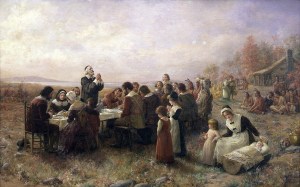
Thanksgiving is a uniquely American holiday. From the first Thanksgiving celebration with the Puritans and Native Americans at Plymouth in 1621 to the likes of presidents such as George Washington and Abraham Lincoln, who both wrote moving proclamations calling Americans to days of national Thanksgiving, to Franklin Roosevelt, who formalized Thanksgiving Day as the fourth Thursday in November, Americans have always found plenty of reasons to be thankful.
But Thanksgiving, at its heart, is much more than a national holiday. It is a theological necessity. We are commanded by Scripture to “give thanks” (1 Thessalonians 5:18). Indeed, it must be very difficult to celebrate Thanksgiving apart from faith. For, without faith, who does one give thanks to? Certainly, one can be thankful to others for what they have done. But the gifts of nature and beauty and joy and the cosmos come from no man. And without a theological framework, they come from nowhere. And so there is no one to whom an unbeliever can say “thank you” for these things. As it turns out, thanksgiving, at least for the things greater than humans can give, is an inescapably theological exercise.
One of the things I deeply desire for my family is that we would share together a sense of thankful wonderment. We, as a family, are blessed beyond measure. My wife and I have jobs that are fulfilling, even when they are challenging. We are part of a church that we love. We can provide for our family in ways that many cannot. And our life together is marked by a general peace and contentment. God has given us much. But, as Jesus says, “Unto whomsoever much is given, of him shall be much required” (Luke 12:48). We have a responsibility to recognize just how much we have been given, to steward it well, and to, above all, be thankful for it and be thankful to the One who gives it.
I have often mused that the difference between being blessed and being spoiled is thankfulness. A person is blessed when he has been given much and he knows it. So he thanks God for it. A person is spoiled when he has been given much and he fails to see it. So he grumbles for more. To borrow a distinction from G.K. Chesterton: there is a world difference between taking things for granted and receiving things with gratitude.[1] Spoiled people take things for granted. Blessed people receive God’s gifts with gratitude.
This is not to say that there are no reasons to lament. But there is a difference between lamenting and grumbling. Grumbling looks at God’s blessings and says, “That’s not enough.” Lament looks at the sinfulness and brokenness of our world and says, honestly and candidly, “There’s something wrong.” This is why the same Psalter that sings, “Give thanks to the LORD, for He is good; His love endures forever” (Psalm 107:1), also cries, “My God, my God, why have You forsaken me? Why are You so far from saving me, so far from the words of my groaning” (Psalm 22:1)? Christopher Wright explains it well when he writes, “Lament is not only allowed in the Bible; it is modeled in abundance. God seems to want to give us as many words with which to fill out our complaint forms as to write our thank-you notes.”[2] So to those who are facing a tragedy, a trial, or a temptation this holiday season, know that your lament is just as holy as your thanksgiving. For both lament and thanksgiving turn to God in faith rather than turning in on oneself in greed, as does grumbling. Lament and thanksgiving can comingle.
As I slowly eat my way through what are now my Thanksgiving leftovers, my prayer is that I see more and more of the things for which I have to be thankful. I am thankful for much, but I also miss much. Dear God, may I see what I have missed. To borrow some more wisdom from G.K. Chesterton: “Children are grateful when Santa Claus puts in their stockings gifts of toys or sweets. Could I not be grateful to [have] in my stockings the gift of two miraculous legs?”[3] Legs to go in my socks. There’s something for which I have not yet said “thank you.” I wonder what else I’m missing.
__________________
[1] See G.K. Chesterton, Irish Impressions (New York: John Lane Company, 1920), 24.
[2] Christopher J.H. Wright, The God I Don’t Understand: Reflections on Tough Questions of Faith (Grand Rapids: Zondervan, 2008), 51.
[3] G.K. Chesterton, Orthodoxy (New York: John Lane Company, 1919), 98.
Happy Thanksgiving!
 In what has become a bit of Thanksgiving tradition on this blog, I want to share with you a portion of Abraham Lincoln’s Proclamation of Thanksgiving from 1863. I will have some additional thoughts on thankfulness in my regular post on Monday. Stay tuned! For now, here’s President Lincoln:
The year that is drawing towards its close, has been filled with the blessings of fruitful fields and healthful skies. To these bounties, which are so constantly enjoyed that we are prone to forget the source from which they come, others have been added, which are of so extraordinary a nature, that they cannot fail to penetrate and soften even the heart which is habitually insensible to the ever watchful providence of Almighty God. In the midst of a civil war of unequaled magnitude and severity, which has sometimes seemed to foreign States to invite and to provoke their aggression, peace has been preserved with all nations, order has been maintained, the laws have been respected and obeyed, and harmony has prevailed everywhere except in the theatre of military conflict … Needful diversions of wealth and of strength from the fields of peaceful industry to the national defense have not arrested the plough, the shuttle or the ship; the axe has enlarged the borders of our settlements, and the mines, as well of iron and coal as of the precious metals, have yielded even more abundantly than heretofore. Population has steadily increased, notwithstanding the waste that has been made in the camp, the siege and the battlefield; and the country, rejoicing in the consciousness of augmented strength and vigor, is permitted to expect continuance of years with large increase of freedom. No human counsel hath devised nor hath any mortal hand worked out these great things. They are the gracious gifts of the Most High God, who, while dealing with us in anger for our sins, hath nevertheless remembered mercy.[1]
This Thanksgiving, we have many things for which to be thankful. But as we give thanks for these many things, may we never forget to heartily celebrate and give thanks for, to use the words of Lincoln, “the Most High God, who, while dealing with us in anger for our sins, hath nevertheless remembered mercy.” God’s mercy is the reason that we have not only temporal blessings, but eternal forgiveness, life, and salvation. And for these, we should be thankful.
Happy Thanksgiving.
_______________________
[1] Abraham Lincoln, “Proclamation of Thanksgiving” (10.3.1863).


 Pastor Zach's Blog
The Death of the Hegelian Dialectic
Don’t misunderstand me. In seminary, I was taught to be suspicious of the Hegelian dialectic as it is popularly explained. The idea that a thesis and antithesis should somehow always be reconciled and, ultimately, compromised to form a synthesis spelled death for Christian orthodoxy, my professors warned me. And I agree. I cannot endure a Hegelian dialectic that synthesizes away the truth claims of Christianity. Nor can I tolerate a Hegelian dialectic that undermines the very nature of God, as Hegel himself was prone to do, believing that God was a thesis who had need of an antithesis to form a new synthesis. Hegel saw God not as a concrete Being, but as an ever-evolving process, always on the road of becoming. I should also register my utter revulsion for how the dialectic was used by men such as Karl Marx in the promotion of Communist tyranny. Furthermore, I would also disagree with the Hegelian dialectic’s contention that its outcomes should ultimately be devoid of any real resolution as a synthesis immediately becomes the next thesis in need of antithesis – a never-ending tension to an anxious nowhere. But, with its dangers duly noted, I also believe that Hegel’s dialectic has some usefulness for the moral conversations of our day. The ability to clearly lay out a moral thesis is important. And listening to another’s antithesis – working to understand both its reasoning and its merits, even while noting its deficiencies – is generous. And working toward a synthesis that actually lasts rather than just becoming the next thesis – provided such a synthesis serves to clarify rather than to compromise important moral principles – is noble and needed. In this specific and admittedly somewhat idiosyncratic understanding of Hegel’s dialectic, while still keeping my eyes wide open to its problems and pitfalls, I find it useful. But Hegel’s dialectic seems all but dead in 2016.
Writing for The New York Times, Thomas Friedman puts his finger squarely on the moral mood of our age in his article, “The Age of Protest.” Mr. Friedman, quoting Dov Seidman who is the author of the book How, explains:
“People everywhere seem to be morally aroused,” said Seidman. “The philosopher David Hume argued that ‘the moral imagination diminishes with distance.’ It would follow that the opposite is also true: As distance decreases, the moral imagination increases. Now that we have no distance – it’s like we’re all in a crowded theater, making everything personal – we are experiencing the aspirations, hopes, frustrations, plights of others in direct and visceral ways.”[1]
Moral arousal has become ubiquitous, says Seidman. Everyone everywhere seems to be commenting on some morally significant issue.
Now, on the one hand, as Seidman notes elsewhere in his comments, moral arousal can be a good thing. When we see evil in the world, we need to be willing to confront it. Indeed, this is what the Christus Victor theory of atonement, for all its problems, explains well – that God in Christ has confronted and conquered sin, death, and the devil. On the other hand, there is a shadowy underbelly to our constant state of moral arousal, which Seidman goes on to pinpoint as moral outrage:
When moral arousal manifests as moral outrage … “it can result in a vicious cycle of moral outrage being met with equal outrage, as opposed to a virtuous cycle of dialogue and the hard work of forging real understanding and enduring agreements.”
Furthermore, “when moral outrage skips over moral conversation, then the outcome is likely going to be acquiescence, not inspired solutions.”
This strikes me as profoundly true. Rather than looking at one moral thesis, another antithesis, and then, when appropriate, forming a helpful synthesis that engages a more morally comprehensive reality, the goal has become to bludgeon into submission anyone who disagrees with or has a concern about a given moral thesis.
In his interview with Seidman, Friedman notes:
There is surely a connection between the explosion of political correctness on college campuses – including Yale students demanding the resignation of an administrator whose wife defended free speech norms that might make some students uncomfortable – and the ovations Donald Trump is getting for being crudely politically incorrect.
Both in the case of the Yale protesters as well as in the case of Donald Trump’s presidential campaign, the anger and bluster of moral outrage has nearly drowned out the sobriety and thoughtfulness of moral conversation. In an article for Commentary, John Podhoretz notes that the rise of both Donald Trump among Republicans and Bernie Sanders among Democrats has much to do with the raw anger in both parties: “Trump said in the last debate that he was content to be a ‘vessel for anger.’ Sanders yells a lot in debate, thus signaling anger.”[2] These days, moral outrage appears to be non-partisan. But it doesn’t mean it is particularly helpful.
Sober and thoughtful moral conversation on complicated issues requires, as Seidman notes in The New York Times, “perspective, fuller context, and the ability to make meaningful distinctions.” The problem is that many of the people who howl the loudest with moral outrage do not seem to be too interested in the hard work it takes to have moral conversation. Instead, they want only tendentious and raucous stump speeches that buttress their angry biases.
So what is the way out of this culture of moral outrage? I hesitate to wax prophetic – because predicting the future is a dangerous and, if you get it wrong, an embarrassing business – but I have at least a hunch that the answer may simply be “time.” Our bout with fury may simply need to burn white hot until it burns out and we are left confronting the truth about which James, the brother of Jesus, wrote so long ago: “Human anger does not produce the righteousness that God desires” (James 1:20). In other words, nothing is really solved by our constant outrage.
Eventually, we’re going to have calm down and thoughtfully figure out what is right instead of thoughtlessly diving headlong into the kind of angry tirades that feel right right now. Because of this, I am confident in the return of a cautious version of the Hegelian dialectic. And I am also confident that we can become a little wiser if we, once again, learn to use it a little oftener in our moral conversations – not to compromise on principle, but to clarify what is true and good instead of just being angry at what is wrong and bad.
___________________________
[1] Thomas L. Friedman, “The Age of Protest,” The New York Times (1.13.2016).
[2] John Podhoretz, “Trump and Sanders: ‘Apocalypse Now,’” Commentary (1.21.2016).
January 25, 2016 at 5:15 am Leave a comment