Pain, Suffering, and Morality
 I’ve been doing a fair amount of thinking lately on suffering and its effect on faith. In one way, I can’t help but believe and even assert that there is every reason to question God in the face of great suffering. Elie Wiesel’s gut-wrenching account of his time in a Nazi concentration camp comes to mind not only as a natural response to pain and suffering, but as a needed one:
Never shall I forget that night, the first night in camp, that turned my life into one long night seven times sealed. Never shall I forget that smoke. Never shall I forget the small faces of the children whose bodies I saw transformed into smoke under a silent sky. Never shall I forget these flames that consumed my faith forever.[1]
Elie’s description of his first night in a concentration camp should arouse in us nothing other than horror, grief, and sympathy. Although I don’t know precisely how I would react to such an experience, I would be naïve to think that Elie’s reaction could never be my reaction. The scene is just too jarring. The brutality is just too disgusting. The deaths are just too agonizing. I too could question God.
And yet…
Some did not respond to the concentration camps the way Elie Wiesel did. One survivor of the camps, Alex Seidenfeld, in an interview with the Associated Press, said simply, “We stayed alive. We survived. How could this have happened without the almighty?”[2]
Elie looked at all those who died and asked, “How can God be?” Alex looked at all those who survived and asked, “How can God not be?” Elie looked at all those who died and angrily shouted, “God didn’t stop this!” Alex looked at all those who survived and declared, “But God did save some of us from this!”
The question of where God is in the face of suffering is really a question of God’s role in the midst of suffering. Is God’s role to stop us from suffering or to save us through suffering? In one sense, it is both. But the first role, at least according to Scripture, doesn’t find its full expression until later, at the end of days.
Ultimately, I would argue that, even if God does not stop all suffering, it is difficult to surmise from the existence of suffering that God does not exist. C.S. Lewis famously explains why:
My argument against God was that the universe seemed so cruel and unjust. But how had I gotten this idea of just and unjust? A man does not call a line crooked unless he has some idea of a straight line. What was I comparing this universe with when I called it unjust? … Of course I could have given up my idea of justice by saying it was nothing but a private idea of my own. But if I did that, then my argument against God collapsed too – for the argument depended on saying that the world was really unjust, not simply that it did not happen to please my private fancies. Thus in the very act of trying to prove that God did not exist – in other words, that the whole of reality was senseless – I found I was forced to assume that one part of reality – namely my idea of justice – was full of sense.[3]
C.S. Lewis puts his finger on the reality that the problem we have with suffering is that we believe and perceive that it is, in some sense, wrong. It is unjust. But if we reject God, we lose the privilege of saying that anything is wrong or unjust because, without God and His ordering of the universe, standards of organized morality disappear into the ether of a universe that coalesced around the free-for-all of chance. This world and all that is in it, to borrow a phrase from the famous atheist philosopher Bertrand Russell, is nothing more than “the outcome of accidental collocations of atoms.”[4] In this view, suffering exists in the same way that a ball that lands on black 22 on a roulette wheel exists. It just happens to happen sometimes. There is nothing more to be said about it, at least not morally.
Arguing against a moral God in light of what is perceived to be immoral suffering, then, is an argument that collapses on itself. You can’t argue against God using a framework that has its basis in God. Either suffering just is, or it is somehow just wrong. To question how there can be a good God who allows bad things assumes that, even if implicitly, there is a God and that, in some regard, He is not playing by His own rules, or at least by what we perceive to be His rules. If this is the case, it may be fair to ask Him, “Why?” But, as a Christian, I would propose that it might be even better to ask Him for help. From what I hear, even if God doesn’t always stop suffering, He is quite adept at blessing people in suffering.
_____________________
[1] Elie Wiesel, Night (New York: Hill and Wang, 2006), 33.
[2] Aron Heller, “Observant survivors keep the faith after Holocaust,” The World Post (1.26.2016).
[3] C.S. Lewis, Mere Christianity (New York: Harper Collins Publishers, 1980), 38
[4] Bertrand Russell, “A Free Man’s Worship,” The Collected Papers of Bertrand Russell, vol. 12 (London: Routledge, 1985).
Faith and Morality
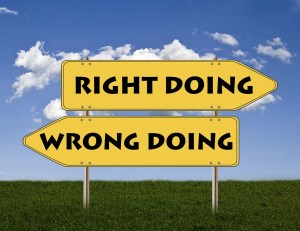 On this blog, I have written at length on moral issues. I believe, quite firmly, that morality has a helpful role to play in the public square and, therefore, moral questions should be discussed and debated and moral standards should be regarded as useful and necessary for and in society. For all my support public morality, however, there is a part of public morality that I find terrifying. Here’s what I mean.
There can be little doubt that the experiment of societal moral relativism has failed. Throwing off the shackles of a transcendent and traditional morality for a culturally conditioned and convenient one that ultimately assumes that there is only amorality never got us Thomas Hobbes’ Epicurean dream. It just left us Adolf Hitler’s Third Reich nightmare. Leviathan, it turns out, wasn’t nearly as competent to do its job as Hobbes thought.
Moral relativism, then, can be quite deadly. It does no society any good because, by definition, it is utterly individualistic. And individuals, left to their own devices, seem to come up with awfully immoral relative moralities. A traditional and transcendent morality is needed to order society in such a way that we do not (A) wind up killing each other, and (B) actually do some things that are helpful for each other. For these reasons, as well as for many others, public morality is needed.
But at the same time a traditional and transcendent public morality is needed, it is also terrifying.
Once a month, I teach a Bible study at a local business. This year, I am working through the book of James when, a while back, I came to these famous words:
What good is it, my brothers, if a man claims to have faith but has no deeds? Can such faith save him? Suppose a brother or sister is without clothes and daily food. If one of you says to him, “Go, I wish you well; keep warm and well fed,” but does nothing about his physical needs, what good is it? In the same way, faith by itself, if it is not accompanied by action, is dead. (James 2:14-17)
As a Lutheran, James’ trumpeting of moral works as important to faith can sometimes arouse in me an almost allergic reaction! As an avid reader of all things Pauline, I know that works do not help faith. Indeed, I know that works can actually be in opposition to faith:
[We] know that a person is not justified by the works of the law, but by faith in Jesus Christ. So we, too, have put our faith in Christ Jesus that we may be justified by faith in Christ and not by the works of the law, because by the works of the law no one will be justified. (Galatians 2:16)
“Faith” and “works,” Paul says, do not mix when it comes to salvation.
Of course, James’ point is not that works somehow help faith when it comes to salvation, but that faith results in works that flow from salvation. A saving faith, James argues, is inevitably an active faith. Indeed, James would go so far to argue that a saving faith that is not an active faith is not even faith. To quote his brother’s words: “By their fruit you will recognize them” (Matthew 7:16). A faith that does not result in moral works does not exist. Such a faith is a myth that belongs on the shelf with unicorns, leprechauns, and that time your mom told you that if you swallow your gum, it will stay in your stomach for seven years.
This is why, at the same time I believe public morality is needed, I am also terrified by it. A faith without moral works is impossible. James says so. Christians should not be frightened, therefore, to declare moral works as “necessary” to faith. What is frightening, however, is that the inverse does not hold true. Moral works may be necessary to faith, but faith is not necessary for moral works. One can be very moral and still be very damned. And herein lies the good and the bad of public morality. Public morality helps others. It may even help you. But it doesn’t help you before God. Only faith can help you before the Almighty.
Even as I continue to argue for the merits of public morality if for no other reason than that I’m not a big fan of the Third Reich, I will continue to serve proudly as a pastor to point people toward faith in Jesus Christ. I like morality that comes from faith a lot better than morality that is divorced from faith. The second morality may be nice for society, but the first receives a “well done” in eternity.
Wrong and Wrong-er

Credit: Huffington Post
Recently, I read a blog by a well known pastor who expressed concern over the lack of civility in this year’s presidential election cycle. In his blog, he singled out one candidate who caused him particular concern. Although I do not think it is always inappropriate to discuss a particular candidate in a blog (I myself have done so), I do believe that a pastor should enter into such discussions with more than a fair share of fear and finesse. Political figures are notoriously hard to critique in a way that leads people to listen to and engage with the critique because these figures tend to engender reflexive emotions long before they inspire extended thought. Such was the case with this pastor’s blog. There were many commenters who were appreciative of this pastor’s words. Others were deeply offended and even furious that a pastor would critique, even if gently, a presidential candidate. Some argued that it is never appropriate for a pastor to critique political candidates. Others, like this commenter, argued against this pastor’s critique like this:
Cute hit piece on [my candidate]. Now lets talk about letting [another candidate] in the White House … who wouldnt know the truth if [this other candidate] saw it.
This is a fascinating argument because it basically runs like this: “My candidate may not be all that great, but this other candidate is worse! Therefore, I will support my candidate and will attack anyone who tries to point out a concern with my candidate, even if the concern is legitimate.” In other words, this commenter is trying to excuse bad behavior from her candidate by pointing out what is – at least in her mind – worse behavior from another candidate.
It’s not just angry social media commenters who makes these kinds of arguments. Professional pundits do as well. Consider this from John O’Sullivan of National Review:
[One candidate] tells falsehoods loosely and spontaneously in a sort of stream-of-consciousness lying to boost his prospects, win over doubters, crush opponents, and save his face. Details can be found all over the Internet. Most of them strike me as trivial. But none of the [leading candidates] have been exactly models of truth-telling in this campaign. So the relevant question then becomes “Compared with whom?” Let’s compare [this candidate’s] boastful and evasive untruths with the very different lies of [another candidate] on various immigration bills he has tried to sell.[1]
Mr. O’Sullivan explicitly and unashamedly justifies one candidate’s lies by pointing to another candidate’s lies. Since when did lying become okay at all? How does the fact that presidential candidates lie make anything better? Did Mr. O’Sullivan ever stop to think that it might be best – rather than excusing a preferred political candidate for his bad behavior by pointing to some other bad behavior – to argue and ask for better behavior?
These kinds of arguments, it should be pointed out, are not only the stuff of election year politics. They are also the arguments of nearly everyone who desperately wants to excuse some bad behavior. “Yes, I may have stolen that dress, but it’s not like I’m Bernie Madoff!” “Yes, I may have had an emotional affair, but that’s completely different from a physical affair!” “Yes, I may be a drunkard, but at least I’m not a self-righteous religious person!”
Whenever I hear these kinds of arguments, I’m led to ask: so what? What do these kinds of arguments accomplish? What do they prove? Does pointing out someone else’s wrong somehow make you right? My mother used to tell me, “Two wrongs don’t make a right.” Do two wrongs of perceived unequal wrongness somehow make one wrong right?
The answer to the above question, of course, is, “No.” One cannot right a wrong by comparing it to another wrong-er wrong. All such a comparison does is inevitably lower all moral standards because it points only to that which is below it rather than aspiring to that which is above it. And when a comparison only looks down, where else is there to go but down? Thus, this comparison inevitably drags those who make it down into deeper immorality rather than spurring them on to a more carefully considered higher ethic.
It is impossible to make a wrong right by comparing it to something else that is wrong. This is why, when He wanted to make us right with Him, God didn’t just send someone who wasn’t quite as bad as we were, He sent someone who was truly good because He was fully perfect. Our Savior raised the bar of morality all the way to perfection and then gave us His perfection by being raised on a tree for our salvation. From His perfect morality comes not only a way of salvation apart from our merits, but a way for daily living that is to declare His merits.
So whether we are a candidate for President of the United States or an everyday citizen working a job and raising a family, let’s look to Christ’s standard of morality rather than wallowing around in the mud of someone else’s immorality. Let’s aspire to that. Let’s hold each other to that – not because we can ever attain that by our own merits, but because we should actually want that. To settle for anything less is just plain wrong.
________________________
[1] John O’Sullivan, “The Rise of the Undocumented Republicans,” National Review (2.26.2016).
Justice Antonin Scalia: 1936-2016
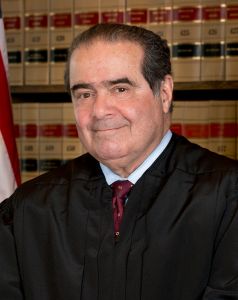 He was a man who combined a first-class intellect with a caustic whit. The world lost not only a legal titan, but a brilliant mind when Justice Antonin Scalia passed away. Sadly, some cheered his death in a macabre display of twisted politically-driven hatred. Others – even those who disagreed with him politically and legally – were far more charitable.
Justice Scalia was fiercely devoted to Constitutional originalism. He defined his originalism this way:
The Constitution that I interpret and apply is not living but dead, or as I prefer to call it, enduring. It means today not what current society, much less the court, thinks it ought to mean, but what it meant when it was adopted.[1]
His originalism came out in many ways, especially in his dissents. His famous 2001 dissent in PGA Tour, Inc. v. Casey Martin, for instance, is the stuff of legend. Mr. Martin was a golfer who wanted to participate in the PGA Tour, but could not because had a degenerative leg disorder that prevented him from walking any considerable distance. PGA rules required golfers to walk all 18 holes. He sued the PGA under The Americans with Disabilities Act. The high court ruled in his favor, noting, contrary to the PGA’s assertion, that using a golf cart does not “fundamentally alter the nature of the competition,” but its majority opinion did not find favor with Justice Scalia who believed the Court should not get involved in defining what does and does not constitute actual golf. In a sarcastic dissent, he wrote:
It has been rendered the solemn duty of the Supreme Court of the United States, laid upon it by Congress in pursuance of the Federal Government’s power “[t]o regulate Commerce with foreign Nations, and among the several States,” U. S. Const., Art. I, §8, cl. 3, to decide What Is Golf. I am sure that the Framers of the Constitution, aware of the 1457 edict of King James II of Scotland prohibiting golf because it interfered with the practice of archery, fully expected that sooner or later the paths of golf and government, the law and the links, would once again cross, and that the judges of this august Court would some day have to wrestle with that age-old jurisprudential question, for which their years of study in the law have so well prepared them: Is someone riding around a golf course from shot to shot really a golfer? The answer, we learn, is yes. The Court ultimately concludes, and it will henceforth be the Law of the Land, that walking is not a “fundamental” aspect of golf.[2]
No other Justice could turn the legal into the comedic the way Justice Scalia did.
At the same time Justice Scalia was a legal scholar, he was also a devoted Catholic. In a speech at a Living the Catholic Faith Conference, he rumbled:
God assumed from the beginning that the wise of the world would view Christians as fools…and he has not been disappointed.…If I have brought any message today, it is this: Have the courage to have your wisdom regarded as stupidity. Be fools for Christ. And have the courage to suffer the contempt of the sophisticated world.[3]
Justice Scalia’s call to endure scoffing from others for the sake of faith in and a witness to the gospel is quintessentially Christian. It is also, I would add, experientially true. After all, Justice Scalia himself had to endure countless questions – not all of which were inappropriate, but many of which were the product of a secular skepticism – about his faith and the ways in which he exercised it.
Of course, Justice Scalia did and does have his supporters – including some of those who most vehemently disagreed with him during his life. In a remembrance penned by Ruth Bader Ginsburg, one of the Supreme Court’s most liberal justices, she wrote of Justice Scalia:
He was a jurist of captivating brilliance and wit, with a rare talent to make even the most sober judge laugh. The press referred to his “energetic fervor,” “astringent intellect,” “peppery prose,” “acumen,” and “affability,” all apt descriptions. He was eminently quotable, his pungent opinions so clearly stated that his words never slipped from the reader’s grasp … It was my great good fortune to have known him as working colleague and treasured friend.[4]
For all of their political and legal differences, these two justices were best friends. And it is here that we find one of Justice Scalia’s most important legacies. Justice Scalia was strongly opinionated. He did not mince words concerning his legal or theological views. There was no question as to where he stood. But at the same time he was intellectually rigorous as a justice and theologically rigorous as a Catholic, he was also relationally generous. He befriended and loved even some of those with whom he vehemently disagreed.
From prostitutes to adulterers to tax collectors to religious elites, there was once another man who behaved similarly. He too could be known for His “peppery prose.” “You snakes! You brood of vipers!” He once thundered, “How will you escape being condemned to hell” (Matthew 23:33)? But the same people He thundered against in His words, He also died for on a cross. He was most certainly intellectually and theologically rigorous. Indeed, he was more: He was intellectually and theologically perfect. But He was – and is – also relationally generous. And somehow, the two went and worked together for us and for our salvation.
Justice Scalia leaves behind an impressive professional legacy. And he will continue to be criticized – sometimes thoughtfully and sometimes angrily – for many things. But beyond his professional legacy is his personal example of how intellectual and theological rigor can go hand in hand with relational generosity. They went hand in hand in him. And in this, Justice Scalia reflected how they go hand in hand in Christ.
At Justice Scalia’s funeral this past Saturday, his son, the Reverend Paul Scalia, began his homily:
We are gathered here because of one man, a man known personally to many of us, known only by reputation to many more; a man loved by many, scorned by others; a man known for great controversy and for great compassion … That man, of course, is Jesus of Nazareth.[5]
In his son’s mind, Justice Scalia’s greatest legacy is found not in what his father accomplished, but in how his father reflected Christ – even if imperfectly. This is why, for Reverend Scalia, Justice Scalia’s funeral was not about Justice Scalia. It was about Jesus.
May we be about Jesus too.
________________________
[1] NPR Staff, “Originalism: A Primer On Scalia’s Constitutional Philosophy,” npr.org (2.17.2016).
[2] PGA Tour, Inc. v. Casey Martin, 532 U.S. 661 (2001) (Scalia, J., dissenting)
[3] Ken McIntyre, “The Wit and Wisdom of Scalia: Nine Zingers,” Newsweek (2.14.2016).
[4] Marina Fang, “Ruth Bader Ginsburg Remembers Antonin Scalia, Her Dear Friend And Sparring Partner,” Huffington Post (2.14.2016).
[5] Julie Zauzmer, “A moving homily for Justice Scalia by his son, Rev. Paul Scalia,” The Washington Post (2.20.2016).
The Fight to Defeat Zika

Credit: AP Photo/Felipe Dana
When I searched for it, the first article that came up was from CNN and was titled, “What are the chances I’ll get it?” The “it” is the Zika virus. And right now, the virus constitutes a menacing epidemic.
On the one hand, societies have seen and battled viruses far more serious than Zika. As CNN explains:
Only about one in five people infected with Zika virus will actually become ill, according to the [Centers for Disease Control]. “The most common symptoms of Zika are fever are rash, joint pain or conjunctivitis (red eyes). Other symptoms include muscle pain and headache,” the CDC says. For most people, the illness is mild with symptoms lasting from several days to a week. People don’t usually get sick enough to require a hospital visit, and the virus very rarely results in death.[1]
This is not good, but it is also not particularly devastating. One needs only to remember the Ebola outbreak of 2014 to realize that Zika’s threat pales in comparison. Indeed, the CDC also notes that once a person has contracted the virus, he is likely to be inoculated from future infections.
So why all the concern?
The concern lies primarily in Zika’s adverse effects during pregnancy. The virus has been linked to birth defects that include microcephaly and Guillain-Barré. Furthermore, the disease, it turns out, can be contracted not only from mosquitos, but also from sexual contact. On February 2, Dallas County Health and Human Services confirmed via the CDC that a woman contracted the Zika virus after having unprotected sex with a man who had just returned from a country where Zika is prevalent.
How the Zika virus will run its course and how far it will spread across not only other countries, but across this country, is still to be determined. But this much is already certain: our nation is facing a serious public health threat. As Christians, there are a few things we should keep in mind.
First, we should pray for those who have contracted the virus and we should pray that the spread of the virus would be quickly stymied. Even if the virus does not affect many of the infected adversely, any kind of sickness is never a part of God’s plan for His creation (cf. Matthew 4:23). It is always, therefore, appropriate to pray against disease. Because the virus is spread primarily by mosquitos, we should also pray that the governments of the nations who are being most affected by this virus would quickly develop effective methods of controlling these varmints.
Second, we should continue to declare that every life is precious – even those lives in the womb. Because Zika is widely associated with serious birth defects, many in Latin American countries, where Zika is most prevalent, are beginning to argue for looser abortion restrictions because of the large number of women who are pregnant and who are getting pregnant while being infected with the virus. The Washington Post reports:
Across Latin America, calls to loosen some of the most restrictive abortion laws in the world in the face of the Zika virus outbreak are gaining momentum but encountering strong and entrenched opposition.
In El Salvador, where abortions are banned under any circumstance, the health minister has argued for a revision of the law because of the dangers the virus poses to fetal development.
In Colombia, an organized movement to lift restrictions on abortion has gained allies in the government but has run into determined opposition from religious authorities. The same is happening in Brazil – and some doctors say that as a consequence, illegal, back-alley abortions are on the rise.
Nearly everywhere in Latin America, including in those countries hit hardest by Zika, women who wish to terminate their pregnancies have few legal options. But as U.N. health officials have projected as many as 4 million infections in the Americas this year, activists are pressing lawmakers to act as swiftly as possible to ease rigid restrictions …
“If I were a woman, had just got pregnant and discovered that I had been infected by the Zika virus, I would not hesitate an instant to abort the gestation,” columnist Hélio Schwartsman wrote in the daily newspaper Folha de Sao Paulo. Each mother should be able to follow her own instincts, he said.[2]
To use an epidemic to argue for American-style abortion legalization in countries that have traditionally looked at the practice with moral suspicion defies decency and smacks of the worst kind of political opportunism. The effects that Zika can have on the unborn are devastating. But a moral solution to this concern involves sexual self-control until this epidemic passes. It does not and cannot involve the taking of innocent human life. Indeed, Zika should remind us that sexual intimacy carries with it great power and responsibility. This is true both for the couple enjoying sexual intimacy and for the progeny who can result from such intimacy.
Passing the Zika virus through sexual contact is a real possibility. Thus, even for people who are married, sexual restraint may be in order. Sexual restraint is also necessary in order to avoid dangerous pregnancies. In a hyper-sexualized world, such self-control can appear to be impossible, regressive, and oppressive. But at a time like this, what an act of love it would be for a person to deny himself the pleasures of sex in order to protect both the health of his spouse and the life of one who could come after him. We must ask ourselves: are we willing to love even when it involves self-denial? Or have we become so selfish and base that to deny our desires is out of the question?
Finally, we should refuse to give into fear. Every epidemic raises questions. How will this epidemic be halted? How many lives might it take? How many birth defects might it result in? How widespread may it become? At this point, we do not have answers to these questions. But a lack of answers does not need to lead to an abundance of fear. This is not to say we should not be cautious. But there is a difference between caution and fear. Caution responds to a situation wisely. Fear panics about a situation needlessly.
As Zika continues to spread, I lean on the words of the Psalmist: “Praise the LORD, my soul, and forget not all His benefits – who forgives all your sins and heals all your diseases” (Psalm 103:2-3). The benefits of God are greater than the denouements of disease. Zika will not have the last word.
_____________________
[1] Ben Tinker, “Zika virus: What are the chances I’ll get it? (And other Q&As),” cnn.com (2.9.2016).
[2] Dom Phillips, Nick Miroff and Julia Symmes Cobb, “Zika prompts urgent debate about abortion in Latin America,” The Washington Post (2.8.2016).
More than “He” and “She”

What’s in a pronoun? This is the question Jessica Bennett of The New York Times asked in her article on the rapidly expanding list of gender pronouns from which a person can choose these days:
He, she, hers, his, male, female – there’s not much in between. And so has emerged a new vocabulary, of sorts: an attempt to solve the challenge of talking about someone who identifies as neither male nor female (and, inevitably, the linguistic confusion that comes along with it).
These days, on college campuses, stating a gender pronoun has become practically as routine as listing a major. “So it’s like: ‘Hi, I’m Evie. My pronouns are she/her/hers. My major is X,’” said Evie Zavidow, a junior at Barnard.
“Ze” is a pronoun of choice for the student newspaper at Wesleyan, while “E” is one of the categories offered to new students registering at Harvard.
At American University, there is ”ey,” one of a number of pronoun options published in a guide for students (along with information about how to ask which one to use).
There’s also “hir,” “xe” and “hen,” which has been adopted by Sweden (a joining of the masculine han and the feminine hon); “ve,” and “ne,” and “per,” for person, “thon,” (a blend of “that” and “one”); and the honorific “Mx.” (pronounced “mix”) — an alternative to Ms. and Mr. that was recently added to the Oxford English Dictionary. (The “x” in Mx. is meant to represent an unknown, similar to the use of x in algebraic equations.)[1]
Wow. I love language, but honestly, the array of gender pronouns now available is dizzying and a little intimidating to me. Indeed, one of the points that Ms. (or should it be Mx.?) Bennett makes in her article is:
Facebook now offers 50 different gender identity options for new users, including gender fluid (with a gender identity that is shifting), bigender (a person who identifies as having two distinct genders) and agender (a person without an identifying gender).
Without a degree in gender studies, how is one supposed to keep all these pronouns straight?
Even if they’re hard to keep straight, referring to someone by their preferred pronoun – no matter how many pronouns there may be from which to choose – is important, according to Ms. Bennett, who cites Caitlin Dewey of The Washington Post: “Misgendering ‘isn’t just a style error … It’s a stubborn, longtime hurdle to transgender acceptance and equality, a fundamental refusal to afford those people even basic grammatical dignity.’” In other words, misgendering someone is deeply insulting and morally reprehensible because it denies who a person is, or, to put it more pessimistically, would like to be.
This debate over gender pronouns fascinates me. It fascinates me first of all because of where it most often takes place. Ms. Bennett, albeit anecdotally, cites two places: college campuses and the secularly liberal and affluent Sweden. These are places of power and privilege. This is not to say that these debates take place only in places of power and privilege, but places of power and privilege are certainly pacesetters in these debates.
Today’s debates over gender pronouns in the halls of power and privilege may be connected to an influential – even if somewhat problematic and not wholly accurate – theory of psychological fulfillment that was first put forth by psychology professor Abraham Maslow in the previous century. In his 1943 paper, titled “A Theory of Human Motivation,” Professor Maslow famously identified what he termed a “hierarchy of needs.” At the bottom of Maslow’s hierarchy were physiological needs such as air, water, and food. These were followed by safety needs, which include things like national peace, job security, and a safe home environment free from abuse and neglect. Next came needs pertaining to love and belonging like the needs for friends and family. Then came the need for esteem, that is, respect.[2] Finally, at the top of Maslow’s hierarchy, came the need for self-actualization. In his paper, Maslow describes the need for self-actualization thusly:
We may still often (if not always) expect that a new discontent and restlessness will soon develop, unless the individual is doing what he is fitted for. A musician must make music, an artist must paint, a poet must write, if he is to be ultimately happy. What a man can be, he must be.[3]
Professor Maslow sagely puts his finger on the fact that before a person intently pursues self-actualization, he first must have his physiological, safety, love, and esteem needs met. Maslow’s sequence of needs seems to inform, at least in part, why the debate over gender pronouns is hottest in places of power in privilege. After all, these are the places, generally speaking, that have the highest potential to be the highest up Maslow’s hierarchy. The desire to self-actualize one’s gender and the pile of pronouns that comes with such a quest is much less pronounced when you’re wondering where your next meal is going to come from.
For the Christian, of course, the problems with self-actualization run deep. Maslow, understandably, seems unaware of the ways in which his notion of self-actualization could or would be used 73 years later. “What a man can be,” to use Maslow’s own words, is much greater than Maslow himself could have imagined, for, in the estimation of gender scholars, a man can be a woman, or a whole host of other things on the gender continuum. Maslow seems to think of self-actualization in terms of vocation rather than in terms of a psychological identity that bends a physical reality.
Ultimately, the very notion of self-actualization, even as Maslow understood it, is problematic. Christians believe that the road to fulfillment leads not through self-actualization, but self-denial: “Whoever wants to be My disciple must deny themselves and take up their cross and follow Me” (Matthew 16:24). Maslow himself seemed to intuit this when, in later years, he replaced the self-actualization at the pinnacle of his hierarchy with self-transcendence, arguing that, ultimately, human identity is found not so much in who one can be, but in how one can serve.
Christians know that self-actualization is nearly as old as history itself. It was a serpent, after all, who first touted the glory of self-actualization when he said to Adam and Eve, “You will be like God” (Genesis 3:5). But what the serpent said was self-actualization was in reality self-destruction.
Something tells me that all these pronouns, denying and sometimes even downright despising how God has made us “male and female” (Genesis 1:27), isn’t far off from this old, old version of self-actualization. The line between self-actualization and self-destruction, it turns out, is razor thin. Let us pray we have not crossed it.
______________________
[1] Jessica Bennett, “She? Ze? They? What’s In a Gender Pronoun?” The New York Times (1.30.2016).
[2] I find it troubling that Maslow places the need for esteem just under the need on the pinnacle of his hierarchy. I see the need for esteem as much more foundational, for as creatures who are crafted in God’s image (cf. Genesis 1:27), we are afforded an esteem by our Creator that is foundational because it is rooted in the very order of creation.
[3] Abraham Maslow, “A Theory of Human Motivation,” Psychological Review 50, no. 4 (1943): 382.
Planned Parenthood, Legality, and Morality
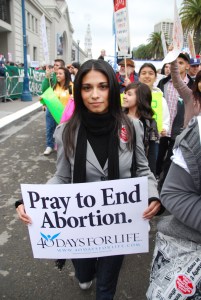 Last July, the Center for Medical Progress began releasing a series of undercover videos cataloguing conversations between its operatives, posing as potential buyers of aborted fetal parts for a human biologics company, and high level Planned Parenthood representatives, who appeared to be willing to sell fetal parts for profit, even if that profit was minimal. Selling fetal parts for profit is a federal offense. Getting reimbursed for the cost of procuring and transferring fetal parts, however, is not. Thus, there has been a protracted debate over whether or not Planned Parenthood has broken the law.
Last week, a grand jury in Houston took its shot at answering this debate. Though the grand jury did not find sufficient evidence to indict Planned Parenthood, it did indict David Daleiden, one of the producers of the undercover videos. Danielle Paquette, writing for The Washington Post, explains the reasoning behind the indictment:
David Daleiden, the director of the Center for Medical Progress, faces a felony charge of tampering with a governmental record and a misdemeanor count related to buying human tissue.[1]
In order to gain access to a Planned Parenthood facility in Houston, Mr. Daleiden and his companion, Sandra Merritt, presented fake California driver’s licenses. According to The Washington Post article, using fake IDs with “intent to cause harm” is a felony for which Mr. Daleiden could face anywhere from two to twenty years in prison if he is convicted. The misdemeanor charge has to do with Mr. Daleiden’s overtures to purchase fetal parts. According to Texas law, it is illegal, irrespective of whether or not Mr. Daleiden’s offers were genuine, to offer to pay for fetal parts.
This is a strange outcome to a sensational story. How many cases are there where a grand jury is asked to decide whether or not it should indict one party and it winds up indicting another party?
The New York Times editorial board came out in favor of the indictment of Mr. Daleiden, writing:
One after the other, investigations of Planned Parenthood prompted by hidden-camera videos released last summer have found no evidence of wrongdoing. On Monday, a grand jury in Harris County, Tex., went a step further. Though it was convened to investigate Planned Parenthood, it indicted two members of the group that made the videos instead.
The Harris County prosecutor, Devon Anderson, a Republican who was asked by the lieutenant governor, a strident opponent of Planned Parenthood, to open the criminal investigation, said on Monday that the grand jurors had cleared Planned Parenthood of any misconduct.
Yet despite all the evidence, Texas’ Republican governor, Greg Abbott, said on Monday that the state attorney general’s office and the State Health and Human Services Commission would continue investigating Planned Parenthood. This is a purely political campaign of intimidation and persecution meant to destroy an organization whose mission to serve women’s health care needs the governor abhors.
Fortunately, in the Harris County case, the jurors considered the facts.[2]
What is most fascinating about The New York Times’ editorial is not its opinion about this case, but how it reports the facts of this case: “One after the other, investigations of Planned Parenthood prompted by hidden-camera videos released last summer have found no evidence of wrongdoing.” It seems as though, for The New York Times editorial board, that which is legal is coterminous with that which is moral. Because Planned Parenthood was not found guilty of doing anything illegal, they must also not have been guilty of any, to use The New York Times’ own terminology, “wrongdoing.”
As a Christian, I have to disagree. The first and final source and arbiter of moral activity – what is right-doing and what is wrongdoing – is not rooted in a humanly contrived legality, but in a graciously given theopneusty.
At the church where I serve, we are preaching and teaching through the book of Judges and I was reminded once again of how the Bible views and treats unborn life when I came to the story of Samson. Samson, most famous for his strength, was also consecrated to the Lord as a Nazirite from before birth. Being a Nazirite involved a vow to reject, among other things, any food or drink made from grapes. When the Lord comes to Samson’s mother and announces that she will bear a deliverer for Israel, He says to her, “Now see to it that you drink no wine or other fermented drink and that you do not eat anything unclean, because you will conceive and give birth to a son” (Judges 13:4-5). Notice that the Lord is concerned not only with Samson keeping his vow, but with his mother keeping his vow in his stead even before he is born. The Lord regards the actions of Samson’s mother as his actions, knowing that her actions can affect the child in her womb not only medically – after all, refraining from “fermented drink” is sage advice for any expecting woman – but also spiritually. Samson’s vow, then, binds him not only from the day of his birth, but from the day of his conception. Why? Because even in the womb, he is alive. And his life is important to God and ought to be kept sacred for God. The taking of any life by abortion, therefore, though it may be legal, is certainly not moral.
As Albert Mohler, president of the Southern Baptist Theological Seminary, rightly points out in his commentary on this story, what The New York Times has posited in its editorial amounts to a kind of legal positivism – a theory of law that, while being acutely concerned with societal legality, has no use for transcendent morality. The editorial board applauds Planned Parenthood simply because its disbursement of fetal parts has been found to be purportedly legal. The board never takes the time, however, to go beyond the legal questions and consider the intrinsic merits and morality of abortion law itself, for these considerations involve all the questions legal positivism does not care or dare to ask. But I would argue that some of the greatest triumphs of justice over the previous century have come not because people were content with the law as it was, but because they strove for a moral standard beyond the law that, at the time, was not, but should be. Watershed victories like women’s suffrage and the Civil Rights Act happened not because editorial boards assumed that the legality of an issue was its warp and woof, but because they knew that legality must work in tandem with a higher morality.
This is not to say that there are no questions to be asked of the Center for Medical Progress. Its action of obtaining fake IDs and having misleading conversations with Planned Parenthood officials raise not only legal concerns, but moral ones too. There is the moral question of deceit. Is it ever moral to lie for the sake of a just cause? Uncovering the true and disturbing nature of what happens at Planned Parenthood clinics is certainly just, but should a person present a fake ID in order to gain access to what happens at these clinics? Rahab told a lie to her compatriots to protect the lives of a group of Israelite spies who had come to case her city, and she is hailed as a hero of the faith in the Bible (cf. Hebrews 11:31)! Can we not do the same?
My personal view is that though there may be an occasional extraordinary circumstance – such as trying to protect a life – where telling a lie is the lesser of two evils, this does not make lying moral, it only makes it understandable and, perhaps, reluctantly preferable. Furthermore, I would hope that we would generally try to avoid willingly placing ourselves in situations where we would feel compelled to lie.
There is also the moral problem of the Center for Medical Progress’ violation of the law in its use of fake IDs. Considering we are called to “be subject to the governing authorities” (Romans 13:1), it is important to ask if it is appropriate to violate the moral law of truthfully representing one’s identity in order to bring to light the immoral practice of aborting babies and harvesting their organs for disbursement.
I would note that even as the actions of the Center for Medical Progress raise some moral questions about truthfulness and legality, Planned Parenthood’s actions raise these same moral quandaries. By all appearances, Planned Parenthood’s desire to be less than forthcoming about its fetal tissue disbursement practices, perhaps even to the point of deceit, and the question of whether or not Planned Parenthood violated any laws in its handling of fetal organs are issues worth pursuing further. Planned Parenthood was, at the very least, living near the edge of the law, which oftentimes leads to, at minimum, isolated instances of going outside of the law.
There are many moral questions that surround this story, but this much is morally certain: Scripturally, putting an end to abortion and the gruesome harvesting of fetal organs for disbursement is one of the great ethical imperatives of our time. In a story that raises many moral question marks, this should be a moral period. This is something for which Christians must call.
___________________
[1] Danielle Paquette,“The charges against anti-Planned Parenthood filmmaker, explained,” The Washington Post (1.26.2016).
[2] The Editorial Board, “Vindication for Planned Parenthood,” The New York Times (1.26.2016).
You Didn’t Win Powerball…So Now What?

Credit: New York Daily News
The conversation across from me last Wednesday morning as I was sitting at Starbucks reading and sipping my coffee startled me. Next to me was a table of folks who, from the sound of their conversation, all worked in the same office. As coworkers, they were doing what coworkers should regularly be doing – they were strategizing, they were planning, they were setting goals, and they were developing financial models…for what they would do when they won the $1.5 billion Powerball jackpot.
With Powerball fever sweeping the nation last week with history’s largest ever jackpot up for grabs, these folks sounded like they needed some Tylenol to bring down their temperature. I’m not sure I’ve ever heard a more heated, even if not particularly informed, financial conversation in my life – much less a financial conversation that imagines a 1 in 292,201,338 scenario. Should we take the lump sum or should we take the annuity payments? How do we set up a trust fund since we’re splitting the pot when we win? Should we allow this or that coworker to join our pot?
Oh, if only. But as Daniel Victor of The New York Times points out:
If you printed out the name of every United States resident on individual pieces of paper, put them in a giant bowl and selected one at random, the odds of picking President Obama are not far from the odds of winning the Powerball.[1]
In other words, you are not going to win Powerball.
The way this office pool talked about Powerball, it sounded like all but a sure bet that they were going to be the big winners. But unless they happened to have just come back from Chino Hills, CA, Munford, TN, or Melbourne Beach, FL with just the right ticket in hand, they were not. Last Wednesday was not their day. And today is just another manic Monday at the office for them.
Powerball is an interesting enterprise. On the one hand, I appreciate that it helps fund education, although I can’t help but wonder if there are other, more efficient ways to fund educational programs. On the other hand, I am concerned that, from a systemic perspective, it acts as a regressive tax because it has a disproportionate appeal to lower income households who have big dreams of digging out of financial desperation. Even if it does act as a regressive tax, however, it is important to note that it is a voluntary regressive tax. No one has to buy a ticket. Indeed, the fundamental problem with Powerball is not really with Powerball at all. It’s with us. Far too many of us are quick to disregard the fundamentals of math for a quixotic wish.
“Someone has to win,” I’ve heard time and time again. “And it could be me!” Actually, someone does not have to win. This is precisely why the Powerball jackpot rose as much as it did – because someone did not have to win the jackpot and no one did win the jackpot for ten weeks straight because the odds of winning are so abysmal, they are, for all intents and purposes, at zero. Technically, they’re at .00000034223%. But it still takes a lot of zeroes in that percentage to get to any sort of a number that represents something rather than nothing.
Why in the world would we get so excited over odds like these? What are we thinking?
In one way, we’re not. We’re dreaming. And, if your dreams are anything like mine, dreams do not have to make sense or be rooted in reality. They can be sheer fantasy.
But something more is going on here. For not only are we dreaming, we’re hoping. We’re hoping lightning will strike and we will win. Or, to use the appropriate odds, we’re hoping lightning will strike 246 times and we will win one time. We’re hoping our financial troubles will be over. We’re hoping we’ll be able to quit our jobs and take life easy. We’re hoping to get rich.
The apostle Paul writes quite extensively to Timothy about the dangers associated with riches. Two of his statements are especially striking to me as the fervor over Powerball settles:
Those who want to get rich fall into temptation and a trap and into many foolish and harmful desires that plunge people into ruin and destruction. (1 Timothy 6:9)
And:
Command those who are rich in this present world not to be arrogant nor to put their hope in wealth, which is so uncertain, but to put their hope in God, who richly provides us with everything for our enjoyment. (1 Timothy 6:17)
In the first verse, Paul prohibits hoping for riches. We should not obsess over accumulating treasures on earth because such an obsession is a recipe for depression and, ultimately, for destruction. In the second verse, Paul prohibits hoping in riches. Wealth cannot do what many people think it can do. It certainly cannot solve all your problems, as past lottery winners will tell you.
The problem with the Powerball phenomenon is that its huge jackpots tempt us toward false hope – both for riches and in riches. And even if Powerball itself is nothing more than a silly game, the false hope it tempts us toward is a dangerous disease.
If you want to spend $2 on a ticket for fun, that’s one thing. But you should place about as much hope in that ticket as you do in winning your office fantasy football league where the grand prize is a Nerf football that someone spray painted gold to make it look like a trophy. If your hopes go much further than that, be careful. Your hope is not in a $2 ticket with long odds. Your hope is in Christ.
After all, He’s a sure bet.
_________________________
[1] Daniel Victor, “You Will Not Win the Powerball Jackpot,” The New York Times (1.12.2016).
The Pew View of the LCMS

Last year, the Pew Research Center released a landmark Religious Landscape Study that surveyed over 35,000 adults from across the nation about their religious beliefs. As a part of their research, Pew studied the church body of which I am a part, the Lutheran Church – Missouri Synod. Though I am well-aware of the risks associated with navel-gazing, I wanted to share a few thoughts on the section of Pew’s study that specifically pertains to my church body, because turning the mirror on oneself and seeing oneself for what one truly is – even when it is uncomfortable – can often be a helpful exercise.
Before we dig into the data, I should note that Pew’s survey of LCMS congregants has a 6-point margin of error, which, statistically, is significant. This does not mean, however, that this survey is not worth our time and attention. Even with a 6-point margin of error, the study’s findings are statistically substantial enough to be quite revealing. So on to the study.
I was surprised to see how well my demographic is represented in my church body. I had stereotypically assumed that my denomination was older than it actually turns out to be. According to Pew, 30 to 49 year olds, which is my demographic, comprise the largest segment of my church body at 32%. Generation X, which is my generation, comprises the second largest segment of my church body at 28% next to Baby Boomers, who are at 35%. Millennial representation is much lower at only 13%. Demographically, then, I am, in many ways, a typical member of an LCMS congregation. I am not, however, typical in every way – especially in my theological and moral beliefs. It is in these areas that the data becomes particularly interesting.
For example, when Pew asked LCMS people what they look to for guidance on right and wrong, while 41% answered “religion,” 45% answered “common sense.” In one way, this is not a surprise. In the face of the information onslaught of the digital age, we have become informational pluralists. We garner and glean our information and, by extension, our opinions, values, and beliefs, from a wide array of sources. The idea of a turning to a single, divinely-authored book as the first and final word on morality is simply untenable to most people. Indeed, when LCMS congregants were asked about their “frequency of participation in prayer, Scripture study or religious education groups” and about their “frequency of reading Scripture,” the largest percentage of respondents in both categories fell into the “Seldom/Never” tier. Thus, it is perfectly logical that more people would get their guidance on right and wrong from common sense than from religion and from the book on which the Christian religion is grounded, the Bible. After all, a majority of people don’t even study the Bible enough to have a nuanced understanding of what’s in it.
The Pew study also revealed that many LCMS congregants seem more unified around a politically conservative economic policy than they are around issues that pertain to traditional Christian morality. Politically, 52% of LCMS people identify as conservative over and against 33% who identify as moderate and 10% who identify as liberal. 72% prefer a smaller government with fewer services and 62% say that government aid programs do more harm than good. Morally, 46% of LCMS people believe abortion should be legal in all or most cases versus 51% who believe it should be illegal, and 56% believe homosexuality should be accepted with 45% favoring same-sex marriage. Compare this to 50% of people who identify as pro-choice nationwide and 55% who favor same-sex marriage nationwide. There is a gap between what LCMS people believe about hot button moral issues and what the general public believes, but this gap is not as wide as one might think. And, on both the issues of abortion and same-sex marriage, the LCMS is less unified than it is around conservative economic policy.
Theologically, I find it unsettling that our opinions on moral issues, which call for our Scriptural agreement, are so diverse while in areas where it’s okay and even desirable to be diverse, we are monolithic. Take, for instance, the racial makeup of the LCMS. 95% of LCMS congregants are white. This hardly seems to reflect the picture of the Church Triumphant with its people from “every nation, tribe, people and language” (Revelation 7:9). I understand that we cannot create this kind of Church by our own efforts and I also am well aware that the Church Militant, because it marches forth in a fallen world and because it does not reveal to us the universal Church, will always look different than the Church Triumphant. But let’s not use our inability to create the Church of Revelation 7:9 as an excuse to not desire it. After all, every member of the Church Triumphant starts out as a member of the Church Militant. So the Church Militant should look, at least in some way, like Church Triumphant.
When it comes to the moral and ethical issues that clearly divide not only our society, but also many in my church body, I would simply say that these are issues that demand our continued attention and discussion. And when discussing these issues, we must understand that just being a part of a church body does not guarantee, nor does it even make it likely, that a person will believe what the church body teaches. Frankly, in our current cultural configuration, the Church’s voice is just one voice – heard by most only once a week at best – among a steady stream of other voices that speak much more frequently and regularly into people’s lives. In order to gain a serious hearing among all these voices, it is important for the Church to speak charitably enough that people trust it and clearly enough that people know what the Bible teaches, even if they disagree.
Pew’s Religious Landscape Study has presented us with a challenge – and an opportunity. It has revealed some areas of moral, theological, and even demographic concern. My prayer is that we, as God’s people, rise to meet the challenge – not only for the sake of a church body, but for the sake of the world.


 Pastor Zach's Blog
The Death of the Hegelian Dialectic
Don’t misunderstand me. In seminary, I was taught to be suspicious of the Hegelian dialectic as it is popularly explained. The idea that a thesis and antithesis should somehow always be reconciled and, ultimately, compromised to form a synthesis spelled death for Christian orthodoxy, my professors warned me. And I agree. I cannot endure a Hegelian dialectic that synthesizes away the truth claims of Christianity. Nor can I tolerate a Hegelian dialectic that undermines the very nature of God, as Hegel himself was prone to do, believing that God was a thesis who had need of an antithesis to form a new synthesis. Hegel saw God not as a concrete Being, but as an ever-evolving process, always on the road of becoming. I should also register my utter revulsion for how the dialectic was used by men such as Karl Marx in the promotion of Communist tyranny. Furthermore, I would also disagree with the Hegelian dialectic’s contention that its outcomes should ultimately be devoid of any real resolution as a synthesis immediately becomes the next thesis in need of antithesis – a never-ending tension to an anxious nowhere. But, with its dangers duly noted, I also believe that Hegel’s dialectic has some usefulness for the moral conversations of our day. The ability to clearly lay out a moral thesis is important. And listening to another’s antithesis – working to understand both its reasoning and its merits, even while noting its deficiencies – is generous. And working toward a synthesis that actually lasts rather than just becoming the next thesis – provided such a synthesis serves to clarify rather than to compromise important moral principles – is noble and needed. In this specific and admittedly somewhat idiosyncratic understanding of Hegel’s dialectic, while still keeping my eyes wide open to its problems and pitfalls, I find it useful. But Hegel’s dialectic seems all but dead in 2016.
Writing for The New York Times, Thomas Friedman puts his finger squarely on the moral mood of our age in his article, “The Age of Protest.” Mr. Friedman, quoting Dov Seidman who is the author of the book How, explains:
“People everywhere seem to be morally aroused,” said Seidman. “The philosopher David Hume argued that ‘the moral imagination diminishes with distance.’ It would follow that the opposite is also true: As distance decreases, the moral imagination increases. Now that we have no distance – it’s like we’re all in a crowded theater, making everything personal – we are experiencing the aspirations, hopes, frustrations, plights of others in direct and visceral ways.”[1]
Moral arousal has become ubiquitous, says Seidman. Everyone everywhere seems to be commenting on some morally significant issue.
Now, on the one hand, as Seidman notes elsewhere in his comments, moral arousal can be a good thing. When we see evil in the world, we need to be willing to confront it. Indeed, this is what the Christus Victor theory of atonement, for all its problems, explains well – that God in Christ has confronted and conquered sin, death, and the devil. On the other hand, there is a shadowy underbelly to our constant state of moral arousal, which Seidman goes on to pinpoint as moral outrage:
When moral arousal manifests as moral outrage … “it can result in a vicious cycle of moral outrage being met with equal outrage, as opposed to a virtuous cycle of dialogue and the hard work of forging real understanding and enduring agreements.”
Furthermore, “when moral outrage skips over moral conversation, then the outcome is likely going to be acquiescence, not inspired solutions.”
This strikes me as profoundly true. Rather than looking at one moral thesis, another antithesis, and then, when appropriate, forming a helpful synthesis that engages a more morally comprehensive reality, the goal has become to bludgeon into submission anyone who disagrees with or has a concern about a given moral thesis.
In his interview with Seidman, Friedman notes:
There is surely a connection between the explosion of political correctness on college campuses – including Yale students demanding the resignation of an administrator whose wife defended free speech norms that might make some students uncomfortable – and the ovations Donald Trump is getting for being crudely politically incorrect.
Both in the case of the Yale protesters as well as in the case of Donald Trump’s presidential campaign, the anger and bluster of moral outrage has nearly drowned out the sobriety and thoughtfulness of moral conversation. In an article for Commentary, John Podhoretz notes that the rise of both Donald Trump among Republicans and Bernie Sanders among Democrats has much to do with the raw anger in both parties: “Trump said in the last debate that he was content to be a ‘vessel for anger.’ Sanders yells a lot in debate, thus signaling anger.”[2] These days, moral outrage appears to be non-partisan. But it doesn’t mean it is particularly helpful.
Sober and thoughtful moral conversation on complicated issues requires, as Seidman notes in The New York Times, “perspective, fuller context, and the ability to make meaningful distinctions.” The problem is that many of the people who howl the loudest with moral outrage do not seem to be too interested in the hard work it takes to have moral conversation. Instead, they want only tendentious and raucous stump speeches that buttress their angry biases.
So what is the way out of this culture of moral outrage? I hesitate to wax prophetic – because predicting the future is a dangerous and, if you get it wrong, an embarrassing business – but I have at least a hunch that the answer may simply be “time.” Our bout with fury may simply need to burn white hot until it burns out and we are left confronting the truth about which James, the brother of Jesus, wrote so long ago: “Human anger does not produce the righteousness that God desires” (James 1:20). In other words, nothing is really solved by our constant outrage.
Eventually, we’re going to have calm down and thoughtfully figure out what is right instead of thoughtlessly diving headlong into the kind of angry tirades that feel right right now. Because of this, I am confident in the return of a cautious version of the Hegelian dialectic. And I am also confident that we can become a little wiser if we, once again, learn to use it a little oftener in our moral conversations – not to compromise on principle, but to clarify what is true and good instead of just being angry at what is wrong and bad.
___________________________
[1] Thomas L. Friedman, “The Age of Protest,” The New York Times (1.13.2016).
[2] John Podhoretz, “Trump and Sanders: ‘Apocalypse Now,’” Commentary (1.21.2016).
January 25, 2016 at 5:15 am Leave a comment