Everybody Wants To Be Famous

Credit: Wikipedia
Simon Cowell has finally received his star on the Hollywood Walk of Fame – an honor that was long overdue, at least if you ask Mr. Cowell. He began his remarks at a ceremony honoring him by quipping, “Before we start, I would just like to ask you: why did this take so long?” He quickly added, “I’m kidding.”
Mr. Cowell rose to fame in the early 2000s when he joined Paula Abdul and Randy Jackson as a judge on the hit show “American Idol,” which he created. His acerbic personality, which often revealed itself in biting criticisms of the show’s singing contestants, garnered him both affection and hatred from the millions who watched him. But whether you loved him or hated him, you knew him. He was – and still is – famous. Hence, his newly concreted star in Hollywood history.
At the conclusion of his remarks, Mr. Cowell noted how much he enjoyed being famous: “If anyone says fame is a bad thing, I don’t know what you’re talking about. It’s the best thing in the world.” I appreciate that Mr. Cowell admits what many of us only secretly think: fame is awesome!
People covet fame because it generally rests at the intersection of money and power. With fame, there often comes a fat paycheck as people are willing to pay top dollar for a star’s appearances and work. With fame, there also normally comes throngs of people who hang on a star’s every word and an entourage of handlers who attend to a star’s every wish. It’s no wonder Simon Cowell thinks fame is awesome.
But, of course, this is not a complete portrait of fame. Scripture is clear that with great fame comes great responsibility – and no shortage of great danger.
One of the most famous figures in the Bible is King David. David gained his fame by his monumental military accomplishments. 2 Samuel 8 outlines David’s victories in battle and includes this note: “David became famous” (2 Samuel 8:13). But David’s fame went to his head. He not only set out to conquer Israel’s enemies, just three chapters later, in 2 Samuel 11, he set out to cover up his own sin. After having an affair with a woman who was not his wife, he had this woman’s husband Uriah, a famous warrior in his own right, killed when it was discovered that she was pregnant by David and that her husband would be able to quickly discern that the baby was not his. A man who had made a name for himself in battle killed another man who had made a name for himself in battle all in an attempt to ensure that his fame would not become infamy.
Nearly 400 years after David, the prophet Habakkuk wrote:
LORD, I have heard of Your fame; I stand in awe of Your deeds, LORD. Repeat them in our day, in our time make them known; in wrath remember mercy. (Habakkuk 3:2)
Habakkuk knew what fame chasers often forget – the most important fame we can desire is not our own. It is the Lord’s.
The Lord freely grants fame to people out of His grace. The Lord gave Israel “fame and honor high above all the nations” (Deuteronomy 26:19). He made Joshua’s “fame spread throughout the land” (Joshua 6:27). Fame, in and of itself, is not bad. But man’s fame, as the old saying goes, lasts only briefly – 15 minutes or so, if you believe Andy Warhol. God’s fame, however, endures. Which is good. Because God is famous for His compassion, grace, and salvation. And everyone should know about that. Because everyone needs plenty of that.
A Senator, A Pope, And A Shooter

Credits: Gage Skidmore, Catholic Church, Getty Images
This past weekend was a busy one in the news, to say the least. Friday, it was announced that Senator John McCain would discontinue treatment for his brain cancer. 24 hours later, he passed away. Around this same time Saturday, news broke that Pope Francis may have known of accusations against one of his closest confidants, former Washington D.C. archbishop Cardinal Theodore McCarrick, who resigned this summer after it was discovered that he may have sexually abused a minor some 50 years ago. Then, yesterday afternoon, a gunman opened fire in a Jacksonville, Florida bar during a Madden 19 video game tournament, killing three and wounding eleven.
After a weekend like this one, it is easy to be left reeling and restive. When cancer takes the life of an American hero, when a spiritual leader is accused of covering for sexual abuse, and when another – yes, another – mass shooting unfolds on another soft target, it can be extremely difficult to take everything in, much less to make sense of much or any of it.
So, how do we process any of this?
During relatively peaceful times, which seem fewer and farther between these days, we can be lured into a false sense of security. We can be tricked into forgetting that, in the words of God to Cain, “sin is crouching at the door” (Genesis 4:7) and it can rear its head at any moment. However, during tumultuous times, which seem to have become all too common, we can become drawn into alarmism and catastrophism. We can have a false sense that, in the words of Chicken Little, “the sky is falling.” Both senses are false. Generally, things are never quite as bad or quite as good as we think they are.
The message of Christ can provide us with a reality check after a weekend like this one. Jesus has no problem warning the world of the full damage and devastation that human sinfulness can wreak. Jesus warns that, in this age, there will be an “increase of wickedness, and the love of most will grow cold” (Matthew 24:12). But Jesus also is clear that He has come to overcome sin. In the words of Jesus’ dear friend John, Jesus is “the light shines in the darkness, and the darkness has not overcome it” (John 1:5). Sin will not ultimately get its way.
Christians can respond to the tragedies of our world with both a sober realism and an indefatigable hope. The death of a man as well regarded and as widely celebrated as John McCain can serve as a reminder of the brokenness of our political system and the often illogical rancor that eats away at any generative discourse. The promise of the man Jesus Christ is that He has come to bring peace between divided peoples and parties. The alleged secrecy of a man like Pope Francis in the face of a terrible crime like the one allegedly committed by Theodore McCarrick reminds us that sin runs for cover so it can continue its damaging and damning work. The promise of the man Jesus Christ is that He has come not only to reveal sin, but to heal those ravaged by it. The murderous intentions of a man like Jacksonville’s mass shooter is a reminder that death comes for everyone – sometimes at the times we least expect it. The promise of the man Jesus Christ is that by His death, He has conquered death.
Every tragedy yearns for a Savior. Christianity promises that every tragedy has a Savior. And after a weekend like this one, that’s what we need to know most – and believe deeply.
The Dioceses of Pennsylvania

In what is the biggest sex scandal to rock the Roman Catholic Church yet, a report from a Pennsylvania grand jury, released last Tuesday, found that over 300 priests from across six dioceses in that state abused sexually abused more than 1,000 victims over a period of 70 years.
As The New York Times explains, the report:
…catalogs horrific instances of abuse: a priest who raped a young girl in the hospital after she had her tonsils out; a victim tied up and whipped with leather straps by a priest; and another priest who was allowed to stay in ministry after impregnating a young girl and arranging for her to have an abortion.
Even more tragically, the report also notes that there are likely many more victims who were and are too afraid to come forward.
How was this able to continue for so long among so many? According to the grand jury, church officials seemed to have a method of intentionally and even maliciously obfuscating what was happening. For instance, the grand jury reports that when a sexual assault came to light, church records would never clearly identify a horrific crime like rape. Instead church officials would employ euphemisms such as “inappropriate contact” or “boundary issues” to describe the crime. Many priests who sexually assaulted children, instead of being defrocked, would simply be moved to another parish where their sins were not known.
This is gut wrenching stuff. But it is more than that. It is downright wicked. It is godless. It is satanic. But it is also, terrifyingly, human.
What humans are capable of is truly shocking. History is littered with numberless testaments to the bottomlessness of human depravity. The prophet Jeremiah aptly describes the horrifying proclivities of the human heart when he says, “The heart is deceitful above all things, and desperately wicked: who can know it” (Jeremiah 17:9)? Jeremiah is not being hyperbolic here. The human heart and all it entails – emotions, desires, and drives – really is deceitful above everything else. There is nothing so dangerous as the human heart.
Jeremiah’s question of the heart – “Who can know it?”, or, as another translation puts it, “Who can understand it?” – takes on fresh meaning in light of this scandal. It seems nearly impossible to fully understand how any heart can commit this kind of sin for so long against so many. But even if we could understand the darkness in the hearts behind these crimes, it would, ultimately, do us no good. Understanding cannot undo a crime, restore a violated little body, or comfort a crushed soul. What we need is not understanding, but change. We don’t need to analyze the human heart; we need to guard our own hearts. In the words of Solomon, “Above all else, guard your heart, for everything you do flows from it” (Proverbs 4:23).
Yes, indeed. What we do flows from what’s in our hearts. That is why our hearts must always be Christ’s home.
Another Revelation Rocks Willow Creek
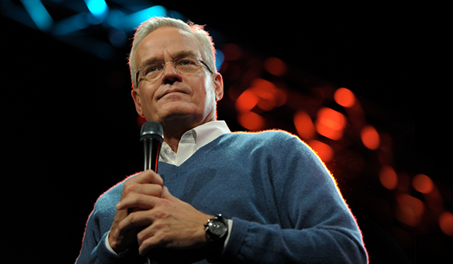
This year was one unlike any other for the Willow Creek Association’s Global Leadership Summit, which was held last week. The annual event, which began in 1995 at Willow Creek Community Church in South Barrington, Illinois, has drawn some of the biggest names in the world as its speakers – from U2’s Bono to President Bill Clinton to Prime Minister Tony Blair. The Summit is broadcast all over the world, including at over 600 locations in the U.S. alone. But when the Chicago Tribune published an expose last March accusing the Summit’s founder and former Senior Pastor at Willow Creek, Bill Hybels, of making sexually inappropriate advances toward multiple women over a period of decades, the event found itself facing an unprecedented crisis. Over 100 congregations withdrew as satellite host sites. Speakers who were scheduled to teach at the Summit, including Denzel Washington, cancelled their appearances.
This past week, the Summit and Willow Creek suffered yet another blow as the New York Times published its own bombshell report chronicling a new story of another woman accusing Mr. Hybels of making sexually illicit advances toward her. The revelations were so shocking that the church’s lead teaching pastor, Steve Carter, resigned his position the next day, citing his grave concern about the:
…church’s official response, and its ongoing approach to these painful issues. After many frank conversations with our elders, it became clear that there is a fundamental difference in judgment between what I believe is necessary for Willow Creek to move in a positive direction, and what they think is best.
This past Wednesday, the congregation’s other lead pastor, Heather Larson, along with the elder board, resigned their positions after apologizing for not more sensitively and thoroughly addressing and investigating the accusations leveled against Mr. Hybels. A church that was once the gold standard for leadership, witness, teaching, and worship has been laid low in a matter of months.
As I have written before, Willow Creek has had a formative influence on me in my ministry. I am thankful for all the congregation has given the worldwide Church. Unfortunately, it is now offering the Church a lesson it certainly never planned or wanted to – a first-hand warning of what happens when hypocrisy and secrecy overtakes integrity and transparency. The results speak for themselves.
Several years ago, Bill Hybels wrote a book titled, Who You Are When No One’s Looking. In it, he extolled the value of character, which he defined as “what we do when no one is looking.” Character is being the same person in private as you present yourself to be in public. He was right in what he wrote. It appears he was very wrong in how he lived. And now, not only are he and his legacy left in tatters, the church and Summit he founded, the staff he led, and the family who thought they knew him are paying an inestimably steep price. Lapses in integrity never affect only the perpetrator.
Because we are all sinful, none of us live with full integrity. We are all, to one extent or another, hypocrites. The best way to deal with inevitable lapses in integrity is to tell the truth about them fully and immediately. Sin is killed by confession. Unfortunately, our reflex is not to confess our sin, but to cover it up. When Adam and Eve committed history’s first sin by eating fruit from a tree of which God had commanded they should not, Genesis 3:8 says, “They hid from the LORD.” Adam and Eve thought it would be better to keep the secret of their sin than to tell the truth about their sin. They were wrong – a fact to which all of history is still testifying as we endure the effects of their first sin and cover-up.
Secrets, especially when they cover shameful realities, can be awfully easy to keep. And the truth, when it is embarrassing and damaging, can be awfully hard to tell. But secrets come with a steep price, as Willow Creek is painfully learning. The truth, however, even when it is tough to tell, comes with a blessed return of freedom. Which, in the long run, do you think is better?
The Biggest Humanitarian Crisis In The World

Credit: USAID
Katherine Zimmerman, a Middle East expert, has called it the biggest humanitarian crisis in the world. In 2014, war broke out in the poverty-stricken nation of Yemen when Iranian-backed rebels stormed and occupied Yemen’s capital city of Sanaa. Since then, a Saudi-led coalition, along with the Yemeni government, has been trying to take back the city. Over 10,000 people have died, half of which have been civilians, as a direct result of the fighting. Indirect casualties are even higher. Save the Children reports that 130 children are dying every day in Yemen. Ms. Zimmerman fears that conditions in the country will continue to deteriorate, explaining, “As the conflict goes on, the people are suffering, and it’s to the point now where we’re looking at a cholera epidemic, and massive risk of famine.”
Sadly, this crisis, half a world away, has been regularly eclipsed by a steady stream of riveting domestic intrigue. But the cries of these victims of war deserve our listening ears and concerned hearts.
One of the most common prayers in the Bible, especially in the Psalms, is that the Lord would hear the cries of the oppressed:
- “Hear my cry for help, my King and my God, for to You I pray.” (Psalm 5:2)
- “Hear my cry for mercy as I call to You for help, as I lift up my hands toward Your Most Holy Place.” (Psalm 28:2)
- “Hear my cry, O God; listen to my prayer.” (Psalm 61:1)
The glorious promise is that the Lord does hear the cries of the oppressed:
- “The LORD has heard my cry for mercy; the LORD accepts my prayer.” (Psalm 6:9)
- “Praise be to the LORD, for He has heard my cry for mercy.” (Psalm 28:6)
- “I love the LORD, for He heard my voice; He heard my cry for mercy.” (Psalm 116:1)
If the Lord hears the cries of the downtrodden, we should too. So please join me in lending your prayers to the cries of the Yemenis, asking God to bring this crisis to an end. Pray also that famine and disease would not overtake this land.
In a world where our news cycles regularly revolve around the powerful, it can be all too easy to forget about those on the margins of our societies. The gospel, however, reminds us that we worship a God who marginalized Himself by being born into a poor village called Bethlehem and growing up as a poor carpenter from Nazareth only to become a poor rabbi who was executed by His enemies on a cross. Jesus lived His life as a marginalized man. This man on the margins, however, has promised to use His very marginalization on the cross to draw all people to Himself (cf. John 12:32). This man on the margins has turned out to be nothing less than the very center of history.
Jesus’ method of marginalization should most certainly inform our mission of reaching and loving the world for Him and in Him. So, let’s keep our peripheral vision peeled to see those others miss and love those our world overlooks. For this is what Jesus has done with us.
Digitizing Life After Death

Credit: Martin420
There seems to be something hardwired into humans that wants to cheat death. Writing for NBC News, Kevin Van Aelst, in his article “Disrupting death: Technologists explore ways to digitize life,” chronicles a new bevy of scientific experiments designed to con the grim reaper.
In one experiment, researchers work at mapping brain connections in an attempt to digitize the mind so that, even after a body dies, a “human being can live in on virtual form.” In another experiment:
Artificial intelligence specialists are developing digital avatars that replicate users’ personalities and can continue to communicate with loved ones after their owners have passed away … The program, Augmented Eternity, will then be able to communicate memories of your life and answer questions on certain topics, such as your political views, depending on what information is stored in your data.
Even before these technologies have been thoroughly tested and refined, their limits are glaring. Having someone live on as a digitized mind makes bioethicist John Harris wonder, because “we are so much flesh and blood creatures,” what it would be like to “continue to exist in a disembodied state.” Another woman, who created an avatar of a friend she lost, describes the avatar as a “sort of digital tomb to come to and mourn” and freely admits that her friend is no longer alive – at least in any sort of meaningful way. In other words, for all of science and technology’s attempts to cheat death, its reality and finality still loom large.
Christ does what science and technology cannot. All of our experiments, from digitizing minds to fashioning avatars, only succeed in mimicking life after death. Christ actually gives life after death. As He says to Martha: “I am the resurrection and the life. The one who believes in Me will live, even though they die” (John 11:25). The Christian hope is much more than a digital grave that a person can pay a visit to in order to hear a phantom voice. It is a real life that we are promised.
The scientific and technological advances that address life and death are both problematic in that they blur distinctions between the two and promising in that they give us insight into the two. But whatever their problems and promises may be, this much is clear: they will always only be partial. Only Christ can give real life – a life that is “to the full” (John 10:10).
The Mandalay Bay Moves to Protect Itself

Credit: Håkan Dahlström
This past week, MGM Resorts International filed a lawsuit against the victims of last October’s Las Vegas shooting, when a gunman opened fire from his suite in the Mandalay Bay, an MGM property, into a group of concert goers below. The lawsuit does not seek any money from the victims, but argues that MGM cannot be held responsible for any deaths, injuries, or damages that occurred during the shooting. Legal experts believe that MGM is attempting to shield itself against protracted battles in state courts, which could be sympathetic to the victims, and instead push any cases up to the federal court system, which MGM believes to be more attuned to their interests.
This is the kind of story that invokes a reflexive revulsion in many. There is a hotel that is suing shooting victims?
The Psalmist writes:
No one can redeem the life of another or give to God a ransom for them – the ransom for a life is costly, no payment is ever enough – so that they should live on forever and not see decay. (Psalm 49:7-9)
In a culture where lawsuits are plentiful, the Psalmist reminds us that, in a tragedy like the Las Vegas shooting, even the most lavish remuneration of cash does not lead to a restoration of life. This is not to say that negligent parties should not be held accountable and that monetary penalties should not be imposed; it is only to say that any action we take after death will always be incomplete. This is because, ultimately, life is not a commodity, but a gift, and the only way to truly address the loss of one gift is with another, even greater, gift. But what gift can be greater than that of a life?
Jesus offers a greater gift. For He takes a life that is lost and replaces with a new life that is eternal. He takes death itself – even when death rears its head in the most tragic ways imaginable, as in the case of the Mandalay Bay shooting – and turns it into an opportunity for an upgrade to a resurrected life with Christ for all who trust in Christ. Christ does more than just pay for death. He conquers it. And Christ offers what no payment can – a promise that we can “live on forever and not see decay.”
I pray that MGM does the right thing and treats the victims of this terrible shooting, along with their families, with the respect and support they need and deserve, even if doing so costs the hotel chain some money. I am thankful, however, that while MGM may rightly honor the lives lost, Jesus can actually restore them.
Hope From the Cave

Credit: Jayakarthi Natarajan
In a saga that began June 23, twelve boys from a Thai soccer team found themselves trapped in Thailand’s Tham Luang cave system for over two weeks. What began as an assistant coach taking his team on a rite of passage through a cave wound up teetering on the brink of disaster after the sky outside opened up while the boys were in the cave and the rains flooded their exit route from the cave. It took a team of 1,000 local army and navy troops along with teams from the U.S., the U.K., China, and Australia, as well as a crack team of Thai Navy SEALs, to find and rescue the boys. Even with all these people on site, the rescue still spanned multiple days. But now, the boys are out safely and a nation – along with many across the world – is celebrating.
In an age where so many tragedies end tragically, tragedies that are hijacked into victories buoy our spirits because they bring into sharp clarity the reality and the persistence of hope. Today’s state, no matter how dire it may seem, does not have to be tomorrow’s fate. This is why the message of Christ continues to find resonance in people’s lives and take up residence in people’s hearts. For Christ came to bring hope – a hope that the sin and calamity of this world could and would be undone and defeated by Him. And though we still await the final consummation of this hope upon His return, we get glimpses of this hope every time a vaccine for a dreaded disease appears promising, a crippled airliner lands safely, and a group of boys escape from a waterlogged cave.
Come to think of it, these boys aren’t the first ones to make a miraculous escape from a cave that seemed impermeable. Jesus pulled that off 2,000 years ago on a morning we now call Easter.
Is it any wonder He is our source of hope?
Keeping It Quiet

Last week, The Wall Street Journal published a disturbing article on the kind of access that many app developers are able to gain to Gmail accounts, which now number over one billion. Writing for the Journal, Douglas MacMillan opens his nearly 2,300-word article:
Google said a year ago it would stop its computers from scanning the inboxes of Gmail users for information to personalize advertisements, saying it wanted users to “remain confident that Google will keep privacy and security paramount.”
But the internet giant continues to let hundreds of outside software developers scan the inboxes of millions of Gmail users who signed up for email-based services offering shopping price comparisons, automated travel-itinerary planners or other tools. Google does little to police those developers, who train their computers – and, in some cases, employees – to read their users’ emails, a Wall Street Journal examination has found.
One of those companies is Return Path Inc., which collects data for marketers by scanning the inboxes of more than two million people who have signed up for one of the free apps in Return Path’s partner network using a Gmail, Microsoft Corp. or Yahoo email address. Computers normally do the scanning, analyzing about 100 million emails a day. At one point about two years ago, Return Path employees read about 8,000 unredacted emails to help train the company’s software, people familiar with the episode say …
Letting employees read user emails has become “common practice” for companies that collect this type of data, says Thede Loder, the former chief technology officer at eDataSource Inc., a rival to Return Path. He says engineers at eDataSource occasionally reviewed emails when building and improving software algorithms.
“Some people might consider that to be a dirty secret,” says Mr. Loder. “It’s kind of reality.”
This report serves as yet another reminder that the data and conversations one sends and stores on email might be personal, but they are probably not private. Understanding you is too critical to too many companies who want to market to you. So these companies, when you download one of their apps, ask you to check a box at the bottom of some long end-user agreement that almost no one reads that gives them permission to sneak-a-peak into your inbox.
This story can serve as a great reminder of the importance – and, really, the sanctity – of keeping a confidence. Some information, no matter what a legal end-user agreement may allow, is not best morally bought, sold, and shared. As Proverbs 11:13 pithily puts it: “A gossip goes around revealing a secret, but a trustworthy person keeps a confidence.”
Confidences in our culture are far too easily betrayed. From a person’s presumably private information being shared and sold by large tech companies under a cloud of legalese to the steady drip of politically laced leaks meant to damage people in public positions to the titillating headlines about this or that celebrity splashed across the front pages of our tabloids to the more modest office gossip that happens around water coolers across America, not only are we bad at keeping confidences, we often delight in breaking confidences if we think doing so will gain us friends and get us power. Unlike Christ, who sacrificed Himself for the sake of others, we, with giddily gossipy tongues, sacrifice others for the sake of ourselves.
Certainly, confidences can never be turned into excuses for cover-ups of sin. Morally illicit behavior, when it comes to one’s attention, needs to be confronted frankly, even if also compassionately, by someone in a position of authority to do so, which means that sometimes, something that comes to your attention needs to be shared with someone who is equipped to address it. But it can still be shared in strict confidence for a specific purpose – not to get the word out, but to privately and poignantly call someone to repentance.
At its heart, keeping a confidence is simply a vow to treat people’s tender spots tenderly. We all have points of pain and shame in our lives. To be able to share those with a person we can trust is often necessary for healing. In a culture that delights in the damaging and devastating weaponry of gossip, may we practice the restorative and healing power of keeping a confidence. As my mother used to say: “Sometimes, you’ve just got to zip your lips.”
This is most certainly true.
Justice Anthony Kennedy Will Retire

In what was one of the biggest stories of this past week, after 30 years on the bench of the Supreme Court, Justice Anthony Kennedy announced his retirement last Wednesday, effective July 31. Justice Kennedy’s tenure as a Supreme Court justice was fraught with anticipation and tension when various landmark cases were being decided, with many referring to Kennedy as the court’s “swing vote.” He voted with the more conservative branch of the court on issues such as gun control and campaign financing while siding with the more progressive branch on issues like same-sex marriage, abortion, and the death penalty.
Not surprisingly, the announcement of Justice Kennedy’s retirement has set off a flurry of political activity, with conservatives delighted that President Trump appears poised to deliver another proponent of originalist jurisprudence to the nation’s highest court while those on the liberal flank of the political divide worry about what such a justice could mean not only for the current progressive agenda, but for some of the most consequential Supreme Court decisions of the past half-century.
The fiery debate that is unfolding is a timely reminder for Christians that good judgment really does matter. Over the past few decades, it has become fashionable to decry nearly any sort of judgment as self-righteous judgmentalism, and to respond to those who call for keen legal, moral, ethical, or theological discernment with a cry for tolerance and relativism – living and letting others live. This is why an artist like Chris Brown can sing a song like “Don’t Judge Me,” where he asks his girlfriend to forgive his indiscretions. This is why Justice Kennedy himself could write, in a 1992 majority opinion on Planned Parenthood v. Casey in support of abortion:
At the heart of liberty is the right to define one’s own concept of existence, of meaning, of the universe, and of the mystery of human life. Beliefs about these matters could not define the attributes of personhood were they formed under compulsion of the State.
This is a judgment that refuses to make a judgment on something as basic and fundamental as what constitutes life. In this way, it is relativistic in the extreme. Of course, by not making a judgment on what constitutes life, Justice Kennedy makes a de facto judgment: either there is no human life in the womb, or there is no human life in the womb worth protecting. Either one is a judgment that carries with it massive life-and-death implications.
A moment like Justice Kennedy’s retirement reveals that an unmoored relativism and an absolutist tolerance ultimately cannot stand. Society needs and wants good judgment. After all, judgment, both legal and personal, decides how money is spent, how people are treated, what relationships are desirable and permissible, and, as Planned Parenthood v. Casey demonstrates, even which lives endure. The Supreme Court is called upon to render judgments on disputed issues according to the U.S. Constitution. As Christians, we are called, first and foremost, to judge our own lives according to the law of the Lord and then, second, to lovingly and compassionately call others to appreciate the beauty, the value, and the wisdom of this divine law.
Our society is in desperate need of good judgment. Sadly, we live in a time rife with poor judgment where standards, especially in the realm of politics, shift for the sake of expediency and, as the fight over a new nominee for the Supreme Court will surely reveal, power. But, as Jesus warns, “In the same way you judge others, you will be judged, and with the measure you use, it will be measured to you” (Matthew 7:2). We will not be able to elide consistent standards of judgment forever in order to suit our own fleeting fancies. Our standards and principles may slide and glide around today’s political ice rink, but God’s standards will outlast our shifts and will, ultimately, judge our shifts. Perhaps we would do well to consider His standards when making our judgments.


 Pastor Zach's Blog