When A Missionary’s Zeal Turns Deadly

The wisdom, or lack thereof, of John Allen Chau’s deadly decision to try to witness to an isolated tribe of indigenous people on North Sentinel Island, off the coast of India, is a topic of hot debate. Initial reports portrayed Mr. Chau as a reckless explorer and mountain climber, seeking adventure in far-flung, exotic locations. It quickly became apparent, however, that he was also a devoted missionary committed to preaching Christ to the Sentinelese people. Although his initial overture to the tribe appeared clumsy – in his journal, he wrote about how he “hollered” to the tribespeople, “My name is John. I love you, and Jesus loves you” – he was also heavily vaccinated and linguistically and medically trained before embarking on his journey. It turns out that Mr. Chau was not just some hotheaded adventurer. He was a calculated planner, even if his planning finally proved to be woefully incomplete.
Among evangelically minded Christians, there is little debate over whether we should share our faith. The call of Jesus Himself is to spread and share His message to and with the world. There is much debate, however, over how we should share our faith. Clawing your way onto a remote and, according to Indian law, off-limits island and confronting tribespeople who are known to be hostile toward, probably because they feel threatened by, outsiders hardly seems like an effective missionary method.
During this time of year, Christians celebrate the incarnation – that the God of the universe took on flesh in the person of Jesus in space and time in the little town of Bethlehem. In His incarnation, Jesus carried out God’s mission by preaching God’s message and doing God’s work of dying for us and for our salvation. Jesus’ incarnation, then, was part and parcel of Jesus’ mission.
In our outreach efforts, Jesus’ life can serve as our model. Mission and incarnation should work together in our lives, too. Our evangelization of any people should always be coupled with a careful contextualization. This is what Mr. Chau appears to have overlooked. He wanted to reach the people of this remote island, but did not have workable plan to enter into their culture and customs, as Jesus did when He became man.
The reality is that, because of the islanders’ hostility toward outsiders and the Indian laws that shield them from modern society, reaching these people will take more than one person’s plan. Coordinated diplomatic efforts will probably be required so laws are not broken and, of course, a careful posture toward the Sentinelese people themselves is absolutely necessary. Building trust with them will take much time and, frankly, in this case, probably nothing less than a miracle of God. But that’s okay. God is, after all, quite good at the miraculous.
I appreciate Mr. Chau’s passion to reach the unreached. And I am saddened by his death. I pray for his family and friends who are, I am sure, grieving. Mr. Chau’s devotion to Christ’s mission is a laudable devotion for any Christian to have. But learning from his dangerous and ultimately deadly strategy is also necessary.
The death of Mr. Chau should call every mission-minded Christian to take some time to learn and reflect so that we can better witness and love. Jesus wants nothing less for the sake of the many souls who are still far from Him.
Happy Thanksgiving

Credit: Max Pixel
Thanksgiving is my favorite holiday. So much of my day-to-day life centers around what I must do. There are tasks to complete and errands to run and bills to pay and conversations to have and decisions to make and Bible studies and sermons to write and preach. These things to do are often, even if not always, joyous, but Thanksgiving reminds me that I must never get so caught up in what I have to do that I forget about what has already been done. God has done great things for me. He has given me a family I adore, a church I love, and a forgiveness I need. And for these things, I am called to be thankful.
Thanksgiving keeps me humble. When I am tempted to boast in all I have accomplished, Thanksgiving reminds me of all I’ve been given. Even my life itself is a gift of God’s grace. This is why I must continually and humbly rely on Him.
Each year, I make it my tradition to read a Thanksgiving Proclamation from one of our nation’s founders. This year, I came across George Washington’s Thanksgiving Proclamation of 1789. In it, he thanks God:
…for His kind care and protection of the people of this country previous to their becoming a nation; for the signal and manifold mercies and the favorable interpositions of His providence in the course and conclusion of the late war; for the great degree of tranquility, union, and plenty which we have since enjoyed; for the peaceable and rational manner in which we have been enabled to establish constitutions of government for our safety and happiness, and particularly the national one now lately instituted; for the civil and religious liberty with which we are blessed, and the means we have of acquiring and diffusing useful knowledge; and, in general, for all the great and various favors which He has been pleased to confer upon us.
President Washington rattles of a list of the many blessings for which, he believes, a newly minted nation should be thankful. And he’s right. These are things for which our nation should still be thankful. But what I love most about his proclamation comes in what he says next:
May we then unite in most humbly offering our prayers and supplications to the great Lord and Ruler of Nations, and beseech Him to pardon our national and other transgressions.
President Washington was under no delusion that our nation’s blessings were somehow the product of our nation’s – or her individuals’ – intrinsic merit. This is why he offers not only a prayer of thanksgiving, but a prayer of confession. For he knew that God had blessed this new nation in the same way He has always blessed every nation: by grace.
When God chose Israel to be His people and gave to her a Promised Land, He made sure she knew her blessings came by His grace:
It is not because of your righteousness that the LORD your God is giving you this good land to possess, for you are a stiff-necked people. Remember this and never forget how you aroused the anger of the LORD your God in the wilderness. From the day you left Egypt until you arrived here, you have been rebellious against the LORD. (Deuteronomy 9:6-7)
God did not bless Israel because of her righteousness, but in spite of her unrighteousness. God works this way with every nation and every person.
Ultimately, then, to be thankful is to be repentant, knowing that we have what we have not because we’ve earned it or deserved it, but because God has willed it. Thus, each Thanksgiving, I am called to make little of myself and my accomplishments, which are few, and much of God and His blessings, which are bountiful.
As this long weekend draws to a close, my prayer is that the holiday of Thanksgiving becomes a habit of thanksgiving. After all, I have plenty to be thankful for.
You do, too.
Tragedy in California

Credit: U.S. Department of Agriculture
They are the worst wildfires in the history of the state of California.
Nearly 250,000 acres have burned. 79 people have been killed. Sadly, that number will likely climb as first responders continue their search through the rubble these fires have left behind. The town of Paradise, in the Sierra Nevada foothills, has been especially hard hit, with nearly the whole town being destroyed.
California has had a rough go of it lately. Just two weeks ago, the state endured another tragedy as a gunman opened fire at a country bar filled with college students in Thousand Oaks, killing twelve. The shooter was a Marine Corps veteran who appears to have had all sorts of mental health issues and was, at one time, on the cusp of being committed.
The sheer number of tragedies that roll in through each news cycle can begin to feel overwhelming. For each town that is charred and person that is shot, we ask, “How can we stop this from happening?” Answers to this perennial and pressing question seem to elude us. When tragedies do strike, we are thankful for firefighters who risk their lives on the frontlines of massive and unpredictable blazes and officers who run into hails of bullets rather than away from them. Proactively, we are instructed to keep dry brush away from homes in fire zones and guns out of the hands of mentally disturbed people. But despite our best efforts, the tragedies keep coming. Tragedies, even if they can be somewhat mitigated and managed by us, cannot be successfully stayed by us.
On the surface, the California fires and the California shooting seem to be two different types of tragedies. One is a natural disaster. The other is man-caused carnage. Below the surface, however, these two tragedies share a common core: sin. The fires remind us that the sin that came into the world with Adam and Eve has disordered and distorted the world in profound and frightening ways. The mass shooting reminds us that sin is not just in the world. It is in us. It’s not just that we cannot eradicate the sin that distorts creation; it’s that we cannot even kill the sin in ourselves.
The message of Christianity reminds us that, even as societies scramble to address sin, we need a victory over sin that we cannot gain for ourselves. Sin needs not only our noble actions and timely reactions, but a perfect transaction that exchanges our sad sin for a better righteousness. This is the transaction Christ makes for us on the cross.
Tragedies are sure to continue. And we should be thankful for those fighting on the front lines of those tragedies. But we can also be hopeful that tragedy’s time is short, for sin’s defeat is certain.
The Only Sacrifice You Need

“David Plays the Harp for Saul” by Rembrandt, circa 1650
The downfall of Saul began with a sacrifice.
We usually think of sacrifices as being noble – like when parents sacrifice for their children or when soldiers sacrifice for their country. And these sacrifices certainly are noble. But King Saul’s sacrifice was different. King Saul’s sacrifice was not noble, but self-serving.
In 1 Samuel 15, the prophet Samuel instructs Saul, “Go, attack the Amalekites and totally destroy all that belongs to them” (1 Samuel 15:3). Saul does attack the Amalekites. He does defeat the Amalekites. But he does not destroy all that belongs to them:
Saul and the army spared…the best of the sheep and cattle, the fat calves and lambs – everything that was good. These they were unwilling to destroy completely, but everything that was despised and weak they totally destroyed. (1 Samuel 15:9)
Saul disobeys Samuel’s – and, by extension, God’s – instruction. When Samuel confronts Saul in his disobedience, Saul first tries to deny that he disobeyed at all. He says to Samuel, “I have carried out the LORD’s instructions” (1 Samuel 15:13). When Samuel catches him in his lie, Saul claims, “The soldiers spared the best of the sheep and cattle to sacrifice to the LORD your God, but we totally destroyed the rest” (1 Samuel 15:15). Samuel, though, is having none of it. He asks:
Does the LORD delight in burnt offerings and sacrifices as much as in obeying the LORD? To obey is better than sacrifice, and to heed is better than the fat of rams … Because you have rejected the word of the LORD, He has rejected you as king. (1 Samuel 15:22-23)
Saul thought he could use a sacrifice to weasel out of his disobedience. He was sorely mistaken.
What was true of Saul’s sacrifice, the Bible says, is true of all sacrifices. God cannot be somehow bribed to overlook sin by a sacrifice. The preacher of Hebrews says of the Old Testament sacrificial system: “Day after day every priest stands and performs his religious duties; again and again he offers the same sacrifices, which can never take away sins” (Hebrews 10:11). Sacrifices do not fix sins. That is, except for one sacrifice: Christ’s. For by Christ’s “one sacrifice He has made perfect forever those who are being made holy” (Hebrews 10:14).
Whereas kings and priests would offer broken sacrifices in their sin, Jesus offered a perfect sacrifice for our sin. The one man who needed no sacrifice for Himself because He was sinless was the one man who made a sacrifice for all in their sinfulness. And His sacrifice changed everything.
The next time you are caught in a sin, then, do not try to hide your sin, like Saul. Instead, confess your sin freely. And do not try slyly redeem yourself by making a sacrifice, like Saul. Instead, rejoice that you have been forgiven by a sacrifice already made. Jesus is all the sacrifice you need.
Midterms 2018

Credit: Lorie Shaull/Flickr
I read somewhere that there’s an election tomorrow.
Actually, unless you haven’t turned on any TV, scrolled through any social media feed, or driven anywhere and seen any billboards or yard signs for the past few months, it’s difficult not to know that there’s an election tomorrow.
For a midterm election, the rhetoric has been unusually hot. The stakes feel unusually high. And, if early voting reports are any indication from across my home state of Texas, people are turning out in record numbers because they are unusually engaged.
Sadly, though much of the voter turnout is surely driven by a sense of civic privilege and responsibility, at least some of it is driven by fear and anger. The thought of having the “other party” or the “other candidate” in power – whichever or whoever the “other party” or the “other candidate” is for you – terrifies and enrages some folks. Civic privilege and responsibility take a backseat to despising and disparaging one’s political enemies.
George Washington, in his farewell address of 1796, warned:
The alternate domination of one faction over another, sharpened by the spirit of revenge, natural to party dissension, which in different ages and countries has perpetrated the most horrid enormities, is itself a frightful despotism.
Sound familiar?
Do we live in a political climate marked by “the alternate domination of one faction over another”? Do we ever engage with and exhibit a “spirt of revenge”? George Washington calls this kind of political fist fighting “a frightful despotism.” Why? Because rather than honestly and thoughtfully debating the ideas and principles necessary to maintain any robust republic, we begin to bludgeon and berate other people we see only as evil enemies. We trade our humanity and humility for indignation and domination.
Early each Saturday, I go for a 5 am stroll, cup of coffee in hand, around my neighborhood. This hour of the morning may seem crazy, especially since it is the weekend, but it can’t be that crazy – or, at least, that’s what I tell myself – because I’m not the only one out walking. Each Saturday, my neighbors a couple doors down are also out, walking their dog. We wish each other a good morning and, occasionally, we catch up on neighborhood news.
I noticed the other day that in my neighbors’ yard is a sign for the Senate candidate from Texas for whom I did not vote. I have some deeply held principled differences with this candidate and I gladly voted for his opponent. And yet somehow, despite our differing candidate preferences, my neighbors and I still manage to like each other and care for each other and talk to each other. Why? Because the same principles that lead me to vote in certain ways also remind me that it is “self-evident that all men are created equal” and are therefore worthy of my respect and care even if I disagree with their political positions.
I’m not averse to good political humor and satire. Sometimes, it’s the only way to stay sane in what can often feel like a political circus. I am also all for folks arguing forcibly and persuasively for positions, principles, and even particular politicians as they see fit. And I think it is honorable to go out and vote. And tomorrow, we’ll have the opportunity to do just that. But remember, through every joke that is made, debate that is had, and vote that is cast, we are still called to love our neighbors.
A Package Bomber and a Synagogue Shooter

Credit: Associated Press
It’s been a tragic week in our nation. And that’s putting it mildly. Beginning last Monday, a series of packages containing explosive devices began to turn up at homes, at business, and in post offices. These packages were addressed to Democratic politicians, including the Obamas and the Clintons, as well as to financier George Soros, actor Robert De Niro, and CNN. Though none of the packages detonated, they were sent by a man who was, to put it mildly, devotedly partisan in his views. He drove a van covered with bumper stickers showing Democratic politicians in crosshairs. He also posted violent and threatening rhetoric on social media.
Then, on Saturday, a gunman armed with an AR-15 and three rifles showed up at the Tree of Life Synagogue in Pittsburgh. He shouted, “All Jews must die,” and opened fire. By the time his shots fell silent, eleven were dead and a number of others were injured. As investigators looked into this shooter’s past, he too was found to have posted violent and threatening rhetoric on social media. He was also a member of an egregiously anti-Semitic online community.
It’s no secret that we’re a nation on edge. A lot of people hate a lot of other people. This hate, in turn, when coupled with a mental health crisis that seems to be creeping across our society, erupts in violence – just as it did in the case of these two men.
At this moment, when hatred is hot, Christians must be on the frontlines advocating for love. Our culture is fighting the wrong demons. Our culture sees demons in politicians and positions it doesn’t like. It sees demons in religions and races it doesn’t like. But Scripture is clear. We are called to fight:
…not against flesh and blood, but against the rulers, against the authorities, against the powers of this dark world and against the spiritual forces of evil in the heavenly realms. (Ephesians 6:12)
If we’re fighting other people, we’re doing it wrong. Our struggle is against the demons the Bible identifies as truly demonic – not against the demons created for us on social media.
In his new book, Them: Why We Hate Each Other – And How To Heal, Senator Ben Sasse offers a convicting analysis of our cultural milieu:
It seems clear that in America today, we’re facing problems that feel too big for us, so we’re lashing out at each other, often over less important matters. Many of us are using politics as a way to distract ourselves from the nagging sense that something bigger is wrong. Not many of us would honestly argue that if our “side” just had more political power, we’d be able to fix what ails us. Fortunately, we can avoid addressing the big problems as long as someone else – some nearer target – is standing in the way of our securing the political power even to try. It’s easier to shriek at people on the other side of the street. It’s comforting to be able to pin the problems on the freaks in the pink hats or the weirdos carrying the pro-life signs.
At least our contempt unites us with other Americans who think like we do.
At least we are not like them.
Senator Sasse speaks specifically to our political climate, but his words can be applied to our broader cultural problems as well. There is an attitude prevalent among many that does not want to solve problems. Instead, it only wants to grab power. There is an attitude prevalent among many that does not seek understanding. Instead, it only traffics in character assassination. And the results, even if they are, thankfully, generally not violent, are certainly not good. People begin to trade transcendent commitments for tribal grievances. They stop looking at others as people who are precious by virtue of being created in God’s image and instead see them as enemies needing to be eradicated. They make demons out of mortals.
The Psalmist describes God’s patience with the Israelites of old like this:
He was merciful; He forgave their iniquities and did not destroy them. Time after time He restrained His anger and did not stir up His full wrath. He remembered that they were but flesh, a passing breeze that does not return. (Psalm 78:38-39)
God was patient with and merciful to the Israelites because He remembered who the Israelites were – mere, fragile mortals. Their lives were so short and fragile that they were like passing breezes. God is patient with and merciful to us because He remembers who we are – mere, fragile mortals. Our lives are so short and fragile that we are like passing breezes. Perhaps we should see each other like God sees us. Perhaps we should restrain our anger and wrath like God does for us. I hope this past week has taught us at least that much.
Life’s too short to hate.
A Journalist Is Murdered

Credit: POMED
When Jamal Khashoggi walked into the Saudi consulate in Istanbul on October 2, he was planning to pick up some documents for his upcoming marriage. Instead, he walked into an ambush that took his life. The purported details of the ambush are grim – from dismemberment to acid being used to dispose of his remains.
Mr. Khashoggi wrote articles for The Washington Post that were critical of Saudi Crown Prince Mohammed bin Salman’s autocratic tendencies. Suspicions are running high that behind Mr. Khashoggi’s murder is a furious Crown Prince. In a phone call with President Trump, however, the royal vehemently denied any knowledge of or participation in the crime.
On the one hand, as an article by Kevin D. Williamson cautions us, there is still plenty we do not yet know about Mr. Khashoggi’s death. This is why investigators are hot on this case. Leveling ironclad accusations and jumping to confident conclusions now may damage our credibility later. Patience, to modify an old Latin proverb, often winds up being the mother of accuracy.
On the other hand, even as new facts continue to tumble in, there does seem to be a preponderance of circumstantial evidence that points to the Crown Prince’s involvement. Thus, provisional, measured, and appropriately humble suspicions that call for further investigation are appropriate.
As it stands right now, this story could have all the makings of a modern-day crime of Cain. Like Cain cultivated bitterness against Abel for bringing to light his faulty sacrifice, a ruler may have nursed jealously against a journalist for uncovering his ruthless rule. Instead of rethinking his ways, he may have exacted his vengeance. If this is, in fact, the case, this we can know: the truth of this crime, one way or another, will come to light. God discovers Cain’s crime against his brother when Abel’s blood cries out to Him from the ground (Genesis 4:10). The victims of sin, it turns out, do not stay silent – even in death. Sin always seems to get discovered and uncovered.
Thankfully, as Christians, we know that sin is not only inexorably revealed, it will also be eventually routed. Abel’s blood spoke the truth of Cain’s crime. But, as the preacher of Hebrews reminds us, there is a “blood that speaks a better word than the blood of Abel” (Hebrews 12:24). For this blood doesn’t just speak of foul play; it secures a holy redemption. The blood does not just cry for justice; it confers justification. This blood does not just point to death; it defeats death. And this blood does not just spill because of man’s sin; it flows from the side of a perfect Savior.
Mr. Khashoggi was ruthlessly murdered in an ambush. Jesus was ruthlessly murdered on a cross. But Jesus was also raised. And He is returning to raise those who have died in Him to live with Him. And there will be nothing any royal regime, no matter how repressive and resentful, will be able to do about it.
Hurricane Michael

It’s been a busy hurricane season. This time, it was Hurricane Michael that slammed into the Florida Panhandle with Gulf-churned sustained winds of 155 miles per hour – the strongest storm ever to hit the region and the third most intense storm to make landfall in the United States. The storm moved fast – some 13 miles per hour – but that kind of wind does not have to be around long to do serious damage. So far, the death count stands at 16. Tens of thousands are still without power. Mexico Beach, where the storm made landfall, is devastated. And now begins the long, slow process of cleaning up and rebuilding.
Last week, I was delighted when a cold front moved through San Antonio – not only because it brought us clear blue skies and lower temperatures, but because I recently had new grass installed in my yard and the rain meant my sprinklers could take a break and my water bill could take a dive. Rain is good – except when there’s too much. Then we call rain a flood. Sun is also good – except when there’s too much. Then we call sun a drought.
A hurricane is the poster child for “too much.” With a hurricane comes not a cooling breeze, but a battering gale. With a hurricane comes not a needed shower to quench a parched land, but a torrential downpour to deluge an already saturated ground. With a hurricane comes not a peaceful wave on a picturesque beach, but, in the case of Hurricane Michael, an eight-foot storm surge that floods neighborhoods and guts homes.
The book of Jonah famously tells the story of a reluctant prophet who does not want to carry out his God-assigned preaching mission to a town called Nineveh, which is, in Jonah’s day, the capital of the Assyrian Empire. Jonah cannot stand the city of Nineveh because it represents, in Jonah’s view, all that is wicked and vile – violence, decadence, and religious irreverence. So, Jonah seeks to scuttle his preaching obligation by hopping a ship heading in the opposite direction of this miscreant metropolis. But God is having none of it. A storm comes upon the ship in which Jonah is stowing away. The sailors, who quickly realize that this storm is bigger than they can handle, each cry out “to his own god” (Jonah 1:5). But the sailors’ gods sit silent. It isn’t until Jonah calls upon his God, and surrenders his stubborn will to his God by allowing Him to transport him to Nineveh via a titanic tuna, that the sea is finally calmed.
Storms like Michael and like Jonah’s are reminders of just how little power we have over the wind and the waves. In an article for The Atlantic, Sam Kemp recounts a time when a Nobel Prize winning chemist, Irving Langmuir, led a 1947 experiment to slow a hurricane:
On October 13, 1947, a mild hurricane named King sliced through Miami and began drifting northeast, out into the Atlantic Ocean. Because King seemed to be dying anyway, Cirrus officials decided to seed it the next day. A B-17 puttered out to meet it and scattered 180 pounds of dry-ice pellets into the eyewall. Everyone sat back and waited for the eye to widen and for King to collapse. Instead, the storm grew stronger, fiercer. To everyone’s horror, it then pivoted – taking an impossible 135-degree turn – and began racing into Savannah, Georgia, causing $3 million in damage ($32 million today) and killing one person.
Though, at the time, people blamed Langmuir for making the storm worse, in reality, he didn’t make the storm do anything at all. The storm was simply beyond even a Nobel laureate’s control.
The Psalmist reminds us that it is the Lord alone who can still “the storm to a whisper” and hush “the waves of the sea” (Psalm 107:29). Yes, storms may be out of our control. But they are not out of God’s. And although we may not understand why God does not always still storms before they collide with coastlines, we do know that God Himself willingly goes through them. Jesus, after all, claims to be another Jonah: “For as Jonah was three days and three nights in the belly of a huge fish, so the Son of Man will be three days and three nights in the heart of the earth” (Matthew 12:40). Jonah’s stormy salvation finds its counterpart in Jesus’ tempestuous tomb. Jesus went through the storm of sin – and conquered it. And if He can go through a storm that fierce, I’m sure He hasn’t left – and He won’t leave – anyone alone in the aftermath of Michael.
Today, then, Jesus lovingly stands with the people of Florida. He knows how they feel. Perhaps we should stand with them too.
Who Is God’s Enemy?
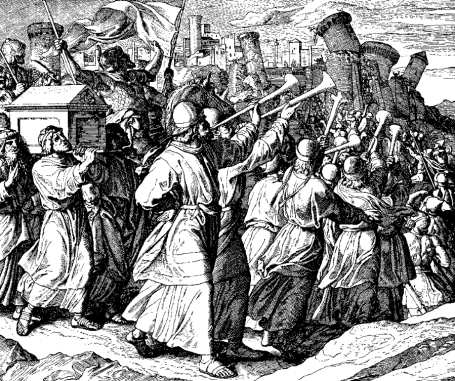
There is a fascinating exchange between Joshua and an unnamed man right before he fights the battle at Jericho. As Joshua is nearing the city and mustering his troops, he looks up and sees a man with a sword drawn in his hand. He asks him, “Are you for us or for our enemies?” The man replies, “Neither, but as a commander of the army of the LORD I have now come” (Joshua 5:13-14).
This exchange, though somewhat cryptic, is extremely revelatory. In this exchange, this man reveals who He is. He is part neither of Israel’s army nor of the army of Israel’s enemy. Instead, He commands the forces of God Almighty. In other words, He is not just a man. He is divine. This is why this commander echoes the words that God speaks to Joshua’s predecessor, Moses, from a burning bush. “Take of your sandals,” this commander says to Joshua, “for the place where you are standing is holy” (Joshua 5:15). This commander speaks the same words God once spoke to Moses because He Himself is God, who is now speaking to Joshua.
But the revelation that is given to Joshua in this man does not end here. For this man reveals not only who God is, but who God cares about. Before one of the biggest battles in Israel’s history, this commander comes to Joshua and tells him that He is not somehow blindly for Israel and against Jericho. But neither is he for Jericho and against Israel. Instead, He is for God who, ultimately, is for all. It is indeed true that God does rain down His wrath on Jericho’s sin in this story. But this does not mean that He does not love Jericho’s people. God is much more interested in saving people than in siding against them.
In our current milieu, I think it can be all too easy to forget that God cares about not only us, but those who we call “enemies.” But if we took the time to actually ask Him, “Are you for us or for our enemies?” God’s answer might just surprise us. It might just be, “Neither.” God is much more interested in loving the world than He is in making enemies.
The next time you are tempted to hate your enemy, remember this commander’s interaction with Joshua. And remember the admonition of Jesus: “Love your enemies and pray for those who persecute you” (Matthew 5:44). And, most importantly, remember the action of Jesus: “While we were God’s enemies, we were reconciled to Him through the death of His Son” (Romans 5:10). Paul says that God’s enemy, before the cross, was you. So, ask yourself, “How did God treat me when I was His enemy?”
Go and do likewise with your enemy.
Jekyll, Hyde, and Mr. Cosby

Credit: Flickr, weisspaarz.com
Last Tuesday, Bill Cosby was sentenced to three to ten years in state prison for drugging and sexually assaulting Andrea Constand. Though it was Mrs. Constand’s charges that ultimately landed Mr. Cosby in prison, she is just one of 60 women accusing the famous actor and comedian of sexual assault.
In an age where the ugliness of sexual immorality is bubbling to the top all around us, Mr. Cosby’s case is another reminder of what happens when power, lies, and lust all coalesce. People get used. Tracks get covered. Spirits get shorn.
One of the things that makes Mr. Cosby’s case so difficult to process is the massive disconnect between the doting dad America knew as Dr. Huxtable on the Cosby Show in the 80s and the sickening nature of his alleged and, until recently, secretive crimes with multiple women. “Hypocrisy” feels like too weak a word to describe his actions.
Dallas Willard once wrote, “We are a whole being, and our true character pervades everything we do.” In other words, people may try, as did Mr. Cosby, to be one person in public while being someone completely different in private. Eventually, however, everyone gets revealed for who they really are. Dr. Jekyll inevitably gets mown down by Mr. Hyde. Or, as Jesus puts it:
“There is nothing hidden that will not be disclosed, and nothing concealed that will not be known or brought out into the open.” (Luke 8:17)
The secret sins of Mr. Cosby eventually caught up to the perfect persona of Dr. Huxtable. And now a legacy of laughter is clouded and a whole string of abused women are shattered.
The Bible testifies that human sexuality has been disordered for a very long time. King David used the power of his throne to commit adultery and murder his lover’s husband. A group of religious leaders tried to stone a woman caught in adultery, all the while speciously ignoring the sins of her male counterpart. From marital unrighteousness to incorrigible self-righteousness, there is plenty of sexual sin to go around.
God calls us to something different and better than sexual licentiousness and laziness. God calls us to a sexual commitment that is ultimately selfless instead of selfish. The apostle Paul writes of marital intimacy:
The husband should fulfill his marital duty to his wife, and likewise the wife to her husband. The wife does not have authority over her own body but yields it to her husband. In the same way, the husband does not have authority over his own body but yields it to his wife. (1 Corinthians 7:3-4)
In a cultural milieu that can egg people on to chase what they want sexually, Scripture invites husbands and wives to serve each other tenderly. Intimacy is not meant to be taken, but given. It is not meant to be violative, but restorative.
Let’s take what intimacy is meant to be, and let’s make a promise: this is what intimacy will be for me. And this is how I will use intimacy for thee. Your spouse will thank you. And others who are struggling in sexual brokenness just might take note of you.


 Pastor Zach's Blog