The Dioceses of Pennsylvania
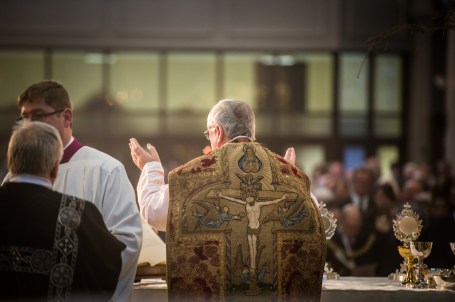
In what is the biggest sex scandal to rock the Roman Catholic Church yet, a report from a Pennsylvania grand jury, released last Tuesday, found that over 300 priests from across six dioceses in that state abused sexually abused more than 1,000 victims over a period of 70 years.
As The New York Times explains, the report:
…catalogs horrific instances of abuse: a priest who raped a young girl in the hospital after she had her tonsils out; a victim tied up and whipped with leather straps by a priest; and another priest who was allowed to stay in ministry after impregnating a young girl and arranging for her to have an abortion.
Even more tragically, the report also notes that there are likely many more victims who were and are too afraid to come forward.
How was this able to continue for so long among so many? According to the grand jury, church officials seemed to have a method of intentionally and even maliciously obfuscating what was happening. For instance, the grand jury reports that when a sexual assault came to light, church records would never clearly identify a horrific crime like rape. Instead church officials would employ euphemisms such as “inappropriate contact” or “boundary issues” to describe the crime. Many priests who sexually assaulted children, instead of being defrocked, would simply be moved to another parish where their sins were not known.
This is gut wrenching stuff. But it is more than that. It is downright wicked. It is godless. It is satanic. But it is also, terrifyingly, human.
What humans are capable of is truly shocking. History is littered with numberless testaments to the bottomlessness of human depravity. The prophet Jeremiah aptly describes the horrifying proclivities of the human heart when he says, “The heart is deceitful above all things, and desperately wicked: who can know it” (Jeremiah 17:9)? Jeremiah is not being hyperbolic here. The human heart and all it entails – emotions, desires, and drives – really is deceitful above everything else. There is nothing so dangerous as the human heart.
Jeremiah’s question of the heart – “Who can know it?”, or, as another translation puts it, “Who can understand it?” – takes on fresh meaning in light of this scandal. It seems nearly impossible to fully understand how any heart can commit this kind of sin for so long against so many. But even if we could understand the darkness in the hearts behind these crimes, it would, ultimately, do us no good. Understanding cannot undo a crime, restore a violated little body, or comfort a crushed soul. What we need is not understanding, but change. We don’t need to analyze the human heart; we need to guard our own hearts. In the words of Solomon, “Above all else, guard your heart, for everything you do flows from it” (Proverbs 4:23).
Yes, indeed. What we do flows from what’s in our hearts. That is why our hearts must always be Christ’s home.
Another Revelation Rocks Willow Creek

This year was one unlike any other for the Willow Creek Association’s Global Leadership Summit, which was held last week. The annual event, which began in 1995 at Willow Creek Community Church in South Barrington, Illinois, has drawn some of the biggest names in the world as its speakers – from U2’s Bono to President Bill Clinton to Prime Minister Tony Blair. The Summit is broadcast all over the world, including at over 600 locations in the U.S. alone. But when the Chicago Tribune published an expose last March accusing the Summit’s founder and former Senior Pastor at Willow Creek, Bill Hybels, of making sexually inappropriate advances toward multiple women over a period of decades, the event found itself facing an unprecedented crisis. Over 100 congregations withdrew as satellite host sites. Speakers who were scheduled to teach at the Summit, including Denzel Washington, cancelled their appearances.
This past week, the Summit and Willow Creek suffered yet another blow as the New York Times published its own bombshell report chronicling a new story of another woman accusing Mr. Hybels of making sexually illicit advances toward her. The revelations were so shocking that the church’s lead teaching pastor, Steve Carter, resigned his position the next day, citing his grave concern about the:
…church’s official response, and its ongoing approach to these painful issues. After many frank conversations with our elders, it became clear that there is a fundamental difference in judgment between what I believe is necessary for Willow Creek to move in a positive direction, and what they think is best.
This past Wednesday, the congregation’s other lead pastor, Heather Larson, along with the elder board, resigned their positions after apologizing for not more sensitively and thoroughly addressing and investigating the accusations leveled against Mr. Hybels. A church that was once the gold standard for leadership, witness, teaching, and worship has been laid low in a matter of months.
As I have written before, Willow Creek has had a formative influence on me in my ministry. I am thankful for all the congregation has given the worldwide Church. Unfortunately, it is now offering the Church a lesson it certainly never planned or wanted to – a first-hand warning of what happens when hypocrisy and secrecy overtakes integrity and transparency. The results speak for themselves.
Several years ago, Bill Hybels wrote a book titled, Who You Are When No One’s Looking. In it, he extolled the value of character, which he defined as “what we do when no one is looking.” Character is being the same person in private as you present yourself to be in public. He was right in what he wrote. It appears he was very wrong in how he lived. And now, not only are he and his legacy left in tatters, the church and Summit he founded, the staff he led, and the family who thought they knew him are paying an inestimably steep price. Lapses in integrity never affect only the perpetrator.
Because we are all sinful, none of us live with full integrity. We are all, to one extent or another, hypocrites. The best way to deal with inevitable lapses in integrity is to tell the truth about them fully and immediately. Sin is killed by confession. Unfortunately, our reflex is not to confess our sin, but to cover it up. When Adam and Eve committed history’s first sin by eating fruit from a tree of which God had commanded they should not, Genesis 3:8 says, “They hid from the LORD.” Adam and Eve thought it would be better to keep the secret of their sin than to tell the truth about their sin. They were wrong – a fact to which all of history is still testifying as we endure the effects of their first sin and cover-up.
Secrets, especially when they cover shameful realities, can be awfully easy to keep. And the truth, when it is embarrassing and damaging, can be awfully hard to tell. But secrets come with a steep price, as Willow Creek is painfully learning. The truth, however, even when it is tough to tell, comes with a blessed return of freedom. Which, in the long run, do you think is better?
The Biggest Humanitarian Crisis In The World

Credit: USAID
Katherine Zimmerman, a Middle East expert, has called it the biggest humanitarian crisis in the world. In 2014, war broke out in the poverty-stricken nation of Yemen when Iranian-backed rebels stormed and occupied Yemen’s capital city of Sanaa. Since then, a Saudi-led coalition, along with the Yemeni government, has been trying to take back the city. Over 10,000 people have died, half of which have been civilians, as a direct result of the fighting. Indirect casualties are even higher. Save the Children reports that 130 children are dying every day in Yemen. Ms. Zimmerman fears that conditions in the country will continue to deteriorate, explaining, “As the conflict goes on, the people are suffering, and it’s to the point now where we’re looking at a cholera epidemic, and massive risk of famine.”
Sadly, this crisis, half a world away, has been regularly eclipsed by a steady stream of riveting domestic intrigue. But the cries of these victims of war deserve our listening ears and concerned hearts.
One of the most common prayers in the Bible, especially in the Psalms, is that the Lord would hear the cries of the oppressed:
- “Hear my cry for help, my King and my God, for to You I pray.” (Psalm 5:2)
- “Hear my cry for mercy as I call to You for help, as I lift up my hands toward Your Most Holy Place.” (Psalm 28:2)
- “Hear my cry, O God; listen to my prayer.” (Psalm 61:1)
The glorious promise is that the Lord does hear the cries of the oppressed:
- “The LORD has heard my cry for mercy; the LORD accepts my prayer.” (Psalm 6:9)
- “Praise be to the LORD, for He has heard my cry for mercy.” (Psalm 28:6)
- “I love the LORD, for He heard my voice; He heard my cry for mercy.” (Psalm 116:1)
If the Lord hears the cries of the downtrodden, we should too. So please join me in lending your prayers to the cries of the Yemenis, asking God to bring this crisis to an end. Pray also that famine and disease would not overtake this land.
In a world where our news cycles regularly revolve around the powerful, it can be all too easy to forget about those on the margins of our societies. The gospel, however, reminds us that we worship a God who marginalized Himself by being born into a poor village called Bethlehem and growing up as a poor carpenter from Nazareth only to become a poor rabbi who was executed by His enemies on a cross. Jesus lived His life as a marginalized man. This man on the margins, however, has promised to use His very marginalization on the cross to draw all people to Himself (cf. John 12:32). This man on the margins has turned out to be nothing less than the very center of history.
Jesus’ method of marginalization should most certainly inform our mission of reaching and loving the world for Him and in Him. So, let’s keep our peripheral vision peeled to see those others miss and love those our world overlooks. For this is what Jesus has done with us.
Digitizing Life After Death

Credit: Martin420
There seems to be something hardwired into humans that wants to cheat death. Writing for NBC News, Kevin Van Aelst, in his article “Disrupting death: Technologists explore ways to digitize life,” chronicles a new bevy of scientific experiments designed to con the grim reaper.
In one experiment, researchers work at mapping brain connections in an attempt to digitize the mind so that, even after a body dies, a “human being can live in on virtual form.” In another experiment:
Artificial intelligence specialists are developing digital avatars that replicate users’ personalities and can continue to communicate with loved ones after their owners have passed away … The program, Augmented Eternity, will then be able to communicate memories of your life and answer questions on certain topics, such as your political views, depending on what information is stored in your data.
Even before these technologies have been thoroughly tested and refined, their limits are glaring. Having someone live on as a digitized mind makes bioethicist John Harris wonder, because “we are so much flesh and blood creatures,” what it would be like to “continue to exist in a disembodied state.” Another woman, who created an avatar of a friend she lost, describes the avatar as a “sort of digital tomb to come to and mourn” and freely admits that her friend is no longer alive – at least in any sort of meaningful way. In other words, for all of science and technology’s attempts to cheat death, its reality and finality still loom large.
Christ does what science and technology cannot. All of our experiments, from digitizing minds to fashioning avatars, only succeed in mimicking life after death. Christ actually gives life after death. As He says to Martha: “I am the resurrection and the life. The one who believes in Me will live, even though they die” (John 11:25). The Christian hope is much more than a digital grave that a person can pay a visit to in order to hear a phantom voice. It is a real life that we are promised.
The scientific and technological advances that address life and death are both problematic in that they blur distinctions between the two and promising in that they give us insight into the two. But whatever their problems and promises may be, this much is clear: they will always only be partial. Only Christ can give real life – a life that is “to the full” (John 10:10).
The Mandalay Bay Moves to Protect Itself

Credit: Håkan Dahlström
This past week, MGM Resorts International filed a lawsuit against the victims of last October’s Las Vegas shooting, when a gunman opened fire from his suite in the Mandalay Bay, an MGM property, into a group of concert goers below. The lawsuit does not seek any money from the victims, but argues that MGM cannot be held responsible for any deaths, injuries, or damages that occurred during the shooting. Legal experts believe that MGM is attempting to shield itself against protracted battles in state courts, which could be sympathetic to the victims, and instead push any cases up to the federal court system, which MGM believes to be more attuned to their interests.
This is the kind of story that invokes a reflexive revulsion in many. There is a hotel that is suing shooting victims?
The Psalmist writes:
No one can redeem the life of another or give to God a ransom for them – the ransom for a life is costly, no payment is ever enough – so that they should live on forever and not see decay. (Psalm 49:7-9)
In a culture where lawsuits are plentiful, the Psalmist reminds us that, in a tragedy like the Las Vegas shooting, even the most lavish remuneration of cash does not lead to a restoration of life. This is not to say that negligent parties should not be held accountable and that monetary penalties should not be imposed; it is only to say that any action we take after death will always be incomplete. This is because, ultimately, life is not a commodity, but a gift, and the only way to truly address the loss of one gift is with another, even greater, gift. But what gift can be greater than that of a life?
Jesus offers a greater gift. For He takes a life that is lost and replaces with a new life that is eternal. He takes death itself – even when death rears its head in the most tragic ways imaginable, as in the case of the Mandalay Bay shooting – and turns it into an opportunity for an upgrade to a resurrected life with Christ for all who trust in Christ. Christ does more than just pay for death. He conquers it. And Christ offers what no payment can – a promise that we can “live on forever and not see decay.”
I pray that MGM does the right thing and treats the victims of this terrible shooting, along with their families, with the respect and support they need and deserve, even if doing so costs the hotel chain some money. I am thankful, however, that while MGM may rightly honor the lives lost, Jesus can actually restore them.
Hope From the Cave

Credit: Jayakarthi Natarajan
In a saga that began June 23, twelve boys from a Thai soccer team found themselves trapped in Thailand’s Tham Luang cave system for over two weeks. What began as an assistant coach taking his team on a rite of passage through a cave wound up teetering on the brink of disaster after the sky outside opened up while the boys were in the cave and the rains flooded their exit route from the cave. It took a team of 1,000 local army and navy troops along with teams from the U.S., the U.K., China, and Australia, as well as a crack team of Thai Navy SEALs, to find and rescue the boys. Even with all these people on site, the rescue still spanned multiple days. But now, the boys are out safely and a nation – along with many across the world – is celebrating.
In an age where so many tragedies end tragically, tragedies that are hijacked into victories buoy our spirits because they bring into sharp clarity the reality and the persistence of hope. Today’s state, no matter how dire it may seem, does not have to be tomorrow’s fate. This is why the message of Christ continues to find resonance in people’s lives and take up residence in people’s hearts. For Christ came to bring hope – a hope that the sin and calamity of this world could and would be undone and defeated by Him. And though we still await the final consummation of this hope upon His return, we get glimpses of this hope every time a vaccine for a dreaded disease appears promising, a crippled airliner lands safely, and a group of boys escape from a waterlogged cave.
Come to think of it, these boys aren’t the first ones to make a miraculous escape from a cave that seemed impermeable. Jesus pulled that off 2,000 years ago on a morning we now call Easter.
Is it any wonder He is our source of hope?
Keeping It Quiet

Last week, The Wall Street Journal published a disturbing article on the kind of access that many app developers are able to gain to Gmail accounts, which now number over one billion. Writing for the Journal, Douglas MacMillan opens his nearly 2,300-word article:
Google said a year ago it would stop its computers from scanning the inboxes of Gmail users for information to personalize advertisements, saying it wanted users to “remain confident that Google will keep privacy and security paramount.”
But the internet giant continues to let hundreds of outside software developers scan the inboxes of millions of Gmail users who signed up for email-based services offering shopping price comparisons, automated travel-itinerary planners or other tools. Google does little to police those developers, who train their computers – and, in some cases, employees – to read their users’ emails, a Wall Street Journal examination has found.
One of those companies is Return Path Inc., which collects data for marketers by scanning the inboxes of more than two million people who have signed up for one of the free apps in Return Path’s partner network using a Gmail, Microsoft Corp. or Yahoo email address. Computers normally do the scanning, analyzing about 100 million emails a day. At one point about two years ago, Return Path employees read about 8,000 unredacted emails to help train the company’s software, people familiar with the episode say …
Letting employees read user emails has become “common practice” for companies that collect this type of data, says Thede Loder, the former chief technology officer at eDataSource Inc., a rival to Return Path. He says engineers at eDataSource occasionally reviewed emails when building and improving software algorithms.
“Some people might consider that to be a dirty secret,” says Mr. Loder. “It’s kind of reality.”
This report serves as yet another reminder that the data and conversations one sends and stores on email might be personal, but they are probably not private. Understanding you is too critical to too many companies who want to market to you. So these companies, when you download one of their apps, ask you to check a box at the bottom of some long end-user agreement that almost no one reads that gives them permission to sneak-a-peak into your inbox.
This story can serve as a great reminder of the importance – and, really, the sanctity – of keeping a confidence. Some information, no matter what a legal end-user agreement may allow, is not best morally bought, sold, and shared. As Proverbs 11:13 pithily puts it: “A gossip goes around revealing a secret, but a trustworthy person keeps a confidence.”
Confidences in our culture are far too easily betrayed. From a person’s presumably private information being shared and sold by large tech companies under a cloud of legalese to the steady drip of politically laced leaks meant to damage people in public positions to the titillating headlines about this or that celebrity splashed across the front pages of our tabloids to the more modest office gossip that happens around water coolers across America, not only are we bad at keeping confidences, we often delight in breaking confidences if we think doing so will gain us friends and get us power. Unlike Christ, who sacrificed Himself for the sake of others, we, with giddily gossipy tongues, sacrifice others for the sake of ourselves.
Certainly, confidences can never be turned into excuses for cover-ups of sin. Morally illicit behavior, when it comes to one’s attention, needs to be confronted frankly, even if also compassionately, by someone in a position of authority to do so, which means that sometimes, something that comes to your attention needs to be shared with someone who is equipped to address it. But it can still be shared in strict confidence for a specific purpose – not to get the word out, but to privately and poignantly call someone to repentance.
At its heart, keeping a confidence is simply a vow to treat people’s tender spots tenderly. We all have points of pain and shame in our lives. To be able to share those with a person we can trust is often necessary for healing. In a culture that delights in the damaging and devastating weaponry of gossip, may we practice the restorative and healing power of keeping a confidence. As my mother used to say: “Sometimes, you’ve just got to zip your lips.”
This is most certainly true.
Justice Anthony Kennedy Will Retire

In what was one of the biggest stories of this past week, after 30 years on the bench of the Supreme Court, Justice Anthony Kennedy announced his retirement last Wednesday, effective July 31. Justice Kennedy’s tenure as a Supreme Court justice was fraught with anticipation and tension when various landmark cases were being decided, with many referring to Kennedy as the court’s “swing vote.” He voted with the more conservative branch of the court on issues such as gun control and campaign financing while siding with the more progressive branch on issues like same-sex marriage, abortion, and the death penalty.
Not surprisingly, the announcement of Justice Kennedy’s retirement has set off a flurry of political activity, with conservatives delighted that President Trump appears poised to deliver another proponent of originalist jurisprudence to the nation’s highest court while those on the liberal flank of the political divide worry about what such a justice could mean not only for the current progressive agenda, but for some of the most consequential Supreme Court decisions of the past half-century.
The fiery debate that is unfolding is a timely reminder for Christians that good judgment really does matter. Over the past few decades, it has become fashionable to decry nearly any sort of judgment as self-righteous judgmentalism, and to respond to those who call for keen legal, moral, ethical, or theological discernment with a cry for tolerance and relativism – living and letting others live. This is why an artist like Chris Brown can sing a song like “Don’t Judge Me,” where he asks his girlfriend to forgive his indiscretions. This is why Justice Kennedy himself could write, in a 1992 majority opinion on Planned Parenthood v. Casey in support of abortion:
At the heart of liberty is the right to define one’s own concept of existence, of meaning, of the universe, and of the mystery of human life. Beliefs about these matters could not define the attributes of personhood were they formed under compulsion of the State.
This is a judgment that refuses to make a judgment on something as basic and fundamental as what constitutes life. In this way, it is relativistic in the extreme. Of course, by not making a judgment on what constitutes life, Justice Kennedy makes a de facto judgment: either there is no human life in the womb, or there is no human life in the womb worth protecting. Either one is a judgment that carries with it massive life-and-death implications.
A moment like Justice Kennedy’s retirement reveals that an unmoored relativism and an absolutist tolerance ultimately cannot stand. Society needs and wants good judgment. After all, judgment, both legal and personal, decides how money is spent, how people are treated, what relationships are desirable and permissible, and, as Planned Parenthood v. Casey demonstrates, even which lives endure. The Supreme Court is called upon to render judgments on disputed issues according to the U.S. Constitution. As Christians, we are called, first and foremost, to judge our own lives according to the law of the Lord and then, second, to lovingly and compassionately call others to appreciate the beauty, the value, and the wisdom of this divine law.
Our society is in desperate need of good judgment. Sadly, we live in a time rife with poor judgment where standards, especially in the realm of politics, shift for the sake of expediency and, as the fight over a new nominee for the Supreme Court will surely reveal, power. But, as Jesus warns, “In the same way you judge others, you will be judged, and with the measure you use, it will be measured to you” (Matthew 7:2). We will not be able to elide consistent standards of judgment forever in order to suit our own fleeting fancies. Our standards and principles may slide and glide around today’s political ice rink, but God’s standards will outlast our shifts and will, ultimately, judge our shifts. Perhaps we would do well to consider His standards when making our judgments.
Children, Immigration, and Federal Law

Credit: Jordi Bernabeu Farrús
This past week, the heated debate over immigration boiled over. Last April, Attorney General Jeff Sessions announced a zero-tolerance stance toward illegal immigration, which he described as a “goal to prosecute every case that is brought to us.” When a family crossed the border unlawfully, the parents would be criminally prosecuted while the children would be sent to shelters in accordance with the 1997 Flores Settlement, which stipulated that children in such situations be placed “in the least restrictive setting appropriate to the minor’s age and special needs.”
In the past, the federal government prioritized the prosecution and deportation of what it deemed to be dangerous migrants while releasing what it perceived to be more benign families of migrants. Family separations still happened, but with the attorney general’s new zero-tolerance stance, these separations spiked, and controversy erupted.
Sadly, but also unsurprisingly, this controversy was quickly exploited for political gain. Some of those who oppose the current presidential administration compared the zero-tolerance practice to what happened in Nazi concentration camps. Some others who support the zero-tolerance practice have responded flippantly and grotesquely to heartbreaking stories of children being separated from their parents.
The attorney general defended his zero-tolerance practice, in part, by referencing a Bible passage from Romans 13. Mr. Sessions said at a press conference:
I would cite you to the apostle Paul and his clear and wise command in Romans 13, to obey the laws of the government because God has ordained them for the purpose of order. Orderly and lawful processes are good in themselves and protect the weak and lawful.
Whatever one may think of the current state of U.S. border enforcement, this is some theologizing that needs a bit of clarifying.
Romans 13 is part of a broader section that describes how Christians ought to live as both citizens of the kingdom of God and the kingdom of man. As citizens of the kingdom of God, living in a fallen world where we will often be wronged, we ought to:
…not repay anyone evil for evil … Do not take revenge, my dear friends, but leave room for God’s wrath, for it is written: “It is mine to avenge; I will repay,” says the Lord. On the contrary: “If your enemy is hungry, feed him; if he is thirsty, give him something to drink. In doing this, you will heap burning coals on his head.” Do not be overcome by evil, but overcome evil with good. (Romans 12:17, 19-21)
As Christians, we ought to respond to the great evil in this world with that which is righteous and, specifically, with that which is merciful. Instead of repaying wickedness with wrath, we ought to repay wickedness with tenderness.
But how, then, are evildoers to be punished? Mercy, after all, may be righteous, but wickedness must still be stopped! And often, stopping wickedness includes rendering judgment. This is where we can be grateful that we are also part of the kingdom of man, where God has ordained that the government:
…is God’s servant for your good. But if you do wrong, be afraid, for rulers do not bear the sword for no reason. They are God’s servants, agents of wrath to bring punishment on the wrongdoer. (Romans 13:4)
Before Christ returns on the Last Day with His final and perfect judgment that will wipe out evil once and for all, God has ordained that governmental authorities render preliminary judgments that suppress evil. For this we can and should be thankful. And because of this, we should respect our governmental authorities, as Paul directs:
Let everyone be subject to the governing authorities, for there is no authority except that which God has established. The authorities that exist have been established by God. (Romans 13:1)
In this much, the attorney general was right. We are to obey the laws of our nation, many of which, including our immigration laws, are in place for the sake of good order. What must not be lost in any analysis of Romans 13, however, is that this chapter emphasizes not only the importance of people duly subjecting themselves to the authority of the government, but the importance of the government seeking what is good and right in its formulation and implementation of legislation. Laws are not good simply because they are crafted and drafted by a government. Laws are good insofar as they comport with and do not defy the higher law of the Lord.
Governmental authorities must recognize and remember that they are not lords over people, but, in our system of government, servants of the people and, biblically and ultimately, servants of God. The gift of power from God to certain authorities must never become an excuse for the misuse and abuse of power by these same authorities. The government’s power must always be arbitrated and tempered by the government’s status as God’s servant.
As God’s servant, then, the government must seek not only to exercise power, but to exercise power well. How can our government exercise its power well to protect its citizens against nefarious actors like drug lords who breach our borders? How can our government exercise its power well to respect the dignity and humanity of children who wind up, through no fault of their own, on the wrong side of the law?
Contrary to much of the quixotic political grandstanding that has surrounded our immigration debates, these are complex questions. But they are also necessary questions that deserve our thoughtful answers.
Many in our government are struggling to craft some piece of legislation that will allow the flood of immigrant families who are lumbering their way across our borders to stay together. On Wednesday, President Trump signed an executive order that supports the idea that migrant parents should be able to remain with their children while they are detained. These politicians need our prayers, deserve our sober thoughtfulness, and, when required, should take seriously our appropriate and measured calls to accountability and change. This debate may be hot at the moment, but it would be even better if it became enlightening and productive for the long haul.
Let us pray that it will.
The Supreme Court Takes the Cake
Credit: Ted Eytan
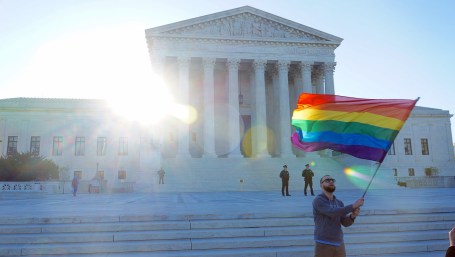
Two weeks ago, the Supreme Court rendered a verdict on a case that pitted a cake shop owner against a same-sex couple. Jack Phillips, the owner of Masterpiece Cakeshop in Lakewood, Colorado declined to bake a cake for Charlie Craig and David Mullins when, in 2012, they married in Massachusetts and asked Mr. Phillips to craft a cake to celebrate their union. Mr. Phillips cited his Christian commitments concerning marriage as the reason he could not, in good conscience, provide a custom cake for this particular celebration. The case went to the Colorado Civil Rights Commission, which ruled in favor of Mr. Craig and Mr. Mullins. The verdict was subsequently appealed and finally found its way to the Supreme Court.
The Supreme Court found in favor of Mr. Phillips, but also took great pains to offer an extremely narrow ruling. Writing for the majority, Justice Anthony Kennedy reasoned:
The case presents difficult questions as to the proper reconciliation of at least two principles. The first is the authority of a State and its governmental entities to protect the rights and dignity of gay persons who are, or wish to be, married but who face discrimination when they seek goods or services. The second is the right of all persons to exercise fundamental freedoms under the First Amendment …
Whatever the confluence of speech and free exercise principles might be in some cases, the Colorado Civil Rights Commission’s consideration of this case was inconsistent with the State’s obligation of religious neutrality … When the Colorado Civil Rights Commission considered this case, it did not do so with the religious neutrality that the Constitution requires.
Justice Kennedy cited an example of the State’s lack of “religious neutrality” by quoting one of the persons on the Colorado Civil Rights Commission who first heard this case:
Freedom of religion and religion has been used to justify all kinds of discrimination throughout history, whether it be slavery, whether it be the holocaust, whether it be – I mean, we – we can list hundreds of situations where freedom of religion has been used to justify discrimination. And to me it is one of the most despicable pieces of rhetoric that people can use to – to use their religion to hurt others.
Justice Kennedy responded to this characterization of Mr. Phillips’ faith with a stinging decrial:
To describe a man’s faith as “one of the most despicable pieces of rhetoric that people can use” is to disparage his religion in at least two distinct ways: by describing it as despicable, and also by characterizing it as merely rhetorical –something insubstantial and even insincere. The commissioner even went so far as to compare Phillips’ invocation of his sincerely held religious beliefs to defenses of slavery and the Holocaust. This sentiment is inappropriate for a Commission charged with the solemn responsibility of fair and neutral enforcement of Colorado’s antidiscrimination law – a law that protects discrimination on the basis of religion as well as sexual orientation.
This case is yet another example of the tension between Christians’ desires to live and operate, both at home and in the workplace, in ways that respect historic Christian norms concerning human sexuality and same-sex couples’ desires to freely practice their views concerning human sexuality, which includes the ability to ask a business to create a product that accords with their views and serves their needs. This ruling does not resolve this tension. Instead, it leaves the tension squarely intact while siding with Mr. Phillips in this instance seemingly simply because the Colorado Civil Rights Commission denigrated Mr. Phillips’ faith in an egregious and offensive way.
Christians will most certainly continue to be faced with these kinds of cases, questions, and tensions. How we respond is critical – both for the sake of our faithfulness and for the sake of our witness. Here, then, are two things to keep in mind when these cases, questions, and tensions arise.
First, we must remember to respect everyone simply because they are someone. Regardless of how a Christian may feel about same-sex intimate relationships theologically and personally, respecting others with whom a Christian may disagree is not only generally kind, but explicitly commanded in Scripture: “Show proper respect to everyone” (1 Peter 2:17). A Christian’s basic respect for others and gregarious treatment of others should not be fundamentally contingent upon others’ belief systems or moral commitments. Instead, it should be first based on their foundational statuses as creatures crafted in God’s image. As the philosopher Charles Taylor puts it in his book, Sources of the Self:
The original Christian notion of agape is of a love that God has for humans which is connected with their goodness as creatures … There is a divine affirmation of the creature, which is captured in the repeated phrase in Genesis 1 about each stage of creation, “and God saw that it was good.”
The simple fact that God has made someone should be enough to command a certain amount of respect, for everyone is “fearfully and wonderfully made” (Psalm 139:14).
Second, we must remember to be empathetic to those with whom we disagree. I have had many conversations with Christians who are scared that those in LGBTQ communities are out to trample their rights and destroy their faith. This leads them to sometimes marginalize and demonize these communities. I also know many in LGBTQ communities who worry that some Christians are out to destroy their communities and condemn them to hell. They do not see Christianity’s objection to same-sex practices as part of a broad ethical stance on human sexuality generally, but as an attack on the very core of their identity specifically.
What would happen if we entered into each other’s fears? Might it change our fears? Might it move us beyond myopic court battles over whether it is legally necessary to bake cakes for each other? I have no doubt that some Christians are out to get LGBTQ people and that some in LGBTQ communities are out to get Christians. For the rest of us, however, a little empathy can go a long way. Christians can advocate for a certain set of sexual ethics while still comforting those who feel threatened or marginalized. Those in LGBTQ communities can continue to advocate for fair and respectful treatment for themselves without attacking the sincerity of Christians who have questions and concerns about the helpfulness and morality of the sexual revolution.
Christians must continue to tell the truth and live according to the truth in a world that is full of confusion. The truth is that human sexuality is not indefinitely malleable. It is a gift from God that is to be celebrated guardedly and gladly in the context of a commitment in marriage between a man and a woman. But at the same time Christians must care about this truth, we also must care for people. This means sharing God’s truth, modeling God’s truth in our actions and decisions, listening to others’ fears and, yes, even objections to this truth, and loving them – not because they always do the right thing, but because love is the right thing to do.


 Pastor Zach's Blog