Posts filed under ‘Current Trends’
The National Anthem and the NFL
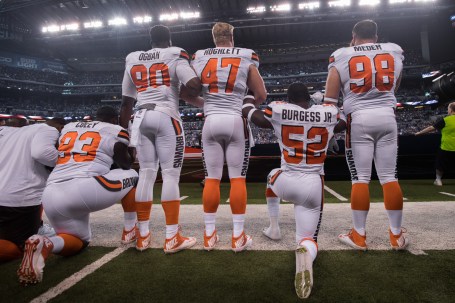
Credit: Time
I’m not sure I ever thought I’d see the day where more people would be talking about the National Anthem at the beginning of an NFL game than the score at the end of an NFL game. But here we are.
What began as a one-man protest by Colin Kaepernick, the former San Francisco 49ers quarterback, against, according to his own words, “a country that oppresses black people and people of color” has been spun up into an all-out culture war with as many rabbit trails as Scylla has heads. One head continues to protest racial inequality. Another head complains that a United States president would insert himself into an NFL personnel predicament to call for the firing of football players who kneel. Still another head seethes over the thought that anyone would dare to disrespect a flag that is so closely tied to the men and women who have laid down their lives in service to our country. The only thing these heads seem to share in common is that they’re all beet red with anger.
This can’t be good for us. I agree with Ross Douthat who described this controversy as one in which “mutual misunderstanding reigns and a thousand grievances are stirred up without a single issue being clarified or potentially resolved.” This is most certainly true. This is a controversy that is ready-made to stoke the flames of a fight without providing a path to peace. This is a controversy that encourages us to fester in a self-righteous indignation without having to listen to any side besides our own. This is a controversy that excuses us from any duty to empathize so that we can hate a villain we refuse to humanize.
Bret Stephens, in a recent lecture, said that far too many of our positions on the public debates of our day “have become the moated castles from which we safeguard our feelings from hurt and our opinions from challenge. It is our ‘safe space.’ But it is a safe space of a uniquely pernicious kind – a safe space from thought, rather than a safe space for thought.” So, we boo at those who dare to kneel and shame those who want to stand.
One of the things I appreciate about our National Anthem is that it can serve as a reminder of all the things we have to appreciate about our country – our freedom, our entrepreneurial spirit, and our commitment to be “the home of the brave” not only by confronting threats abroad, but also by honestly addressing where we have fallen short at home. But now, as with so many other things, the National Anthem has become a flashpoint for division instead of a call to brotherhood. We’ve taken our national motto’s pluribus and divorced it from its unum. Now all we’re left with is e pluribus odium.
As Christians, we must never forget that even when our country is fracturing, Christ’s Church will not. The unity that He gives is an example that, especially right now, our nation needs. And the unity that He promises is a hope that, especially right now, we can share. Fractures can still be healed and many can still be one because of the One who died for many.
Predictions Come and Predictions Go

Ludwig Ferdinand Schnorr von Carolsfeld, Apocalypse, 1831
Well, things are still here.
There was some doubt as to whether or not they would be, at least in the mind of one man named David Meade. Mr. Meade is a self-styled “Christian numerologist” who believed this past Saturday would bring a super-sign that would mark the beginning of the end of the world. He based his prediction on the number 33:
“Jesus lived for 33 years. The name Elohim, which is the name of God to the Jews, was mentioned 33 times [in the Bible],” Meade told The Washington Post. “It’s a very biblically significant, numerologically significant number. I’m talking astronomy. I’m talking the Bible…and merging the two.”
And September 23 is 33 days since the August 21 total solar eclipse, which Meade believes is an omen.
Mr. Meade also pointed to a mythical planet named Nibiru, which he said would pass by the earth, causing all sorts of calamities.
The difficulties with Mr. Meade’s odd eschatologizing are legion. For starters, by one count, the Hebrew word for “God,” Elohim, doesn’t appear in the Bible 33 times, but in the Old Testament 2,570 times! Mr. Meade’s count isn’t even close. And the planet Nibiru, which was supposed to be central to his apocalyptic super sign, according to NASA scientists, doesn’t even exist.
Of course, whenever anyone – even if they are someone as obscure as Mr. Meade – makes this kind of sensationalistic prediction, reporters rush to interview Christian leaders to ask for their take on the prediction. In this instance, thankfully, the leaders who they interviewed responded, to paraphrase, “Give me a break.”
Unfortunately, implausible apocalyptic predictions have become something of a matter of course for some who love to traffic in the dramatic. In 2011, it was Harold Camping who predicted that the rapture would occur on May 21. But predictions like these go back much further than that. One of the earliest ballyhooed apocalyptic predictions dates all the way back to the end of the fourth century, when the church father Martin of Tours announced that the Antichrist had already been born and that the world would end by 400. 1,617 years later, we’re still waiting.
One problem with predictions like these is that they have the effect of discrediting the Christian message because those who trumpet them attach them to the Christian message. And when these predictions inevitably fail, other parts of Christianity begin to look suspect.
Another problem with predictions like these is how they tend to portray the end times. These predictions tend to focus so much on the destruction of earth that they forget about the return of Christ. Mr. Meade, in his prediction, highlighted things like “volcanic eruptions, tsunamis, and earthquakes,” but he seemed to overlook the thrilling trumpet call, the breathtaking new Jerusalem, and the joyous resurrection to everlasting life.
The return of Christ, for those who trust in Him, is not meant to terrifying, but encouraging. In one way, then, we should feel a twinge of disappointment that Mr. Meade wasn’t right. For when Christ returns, all the depravity, devastation, despair, and death will be set right, which, for all the charms of this world, makes what comes next something I am looking forward to and praying for.
So, although I would never be so bold as to try to chronologize the end times, I do pray that Jesus will come. Mr. Meade’s prediction doesn’t have to be right for that prayer to be good.
Maranatha!
The International Hurricane
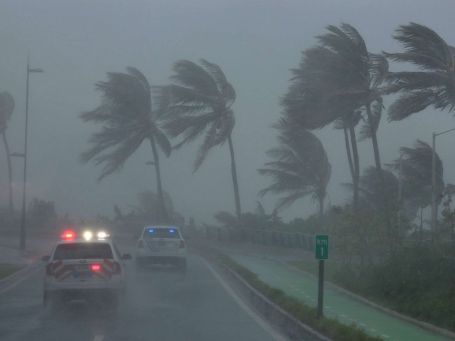
Credit: Alvin Baez / Reuters
As Hurricane Irma tore across the Atlantic, it had its sights set on ___________.
How you fill in this blank depends on where your focus lies. For most of us in the states, we saw Irma targeting Florida. Floridians themselves might have gotten a little more specific. Hurricane Irma had its sights set on: Key West, Marco Island, Naples, Fort Myers, and, even though it is on the other side of the state, Miami.
But, of course, Irma affected – and devastated – more than just our nation’s southeastern-most state. Cuba, the Bahamas, Turks and Caicos, the Virgin Islands, and Antigua and Barbuda, among others, were all hit.
In a piece for NBC Nightly News a week ago Sunday, Joe Fryer tugged at the heartstrings by showing a parade of pictures of those overwhelmed by Irma’s wrath while delivering a monologue:
These are the faces of Hurricane Irma – victims who found themselves in the long path of a heartless storm, forever connected by what they’ve endured. Looking at the damage, it’s impossible to tell which territories are American or British, French or Dutch. The hurricane did not discriminate.
Mr. Fryer reminded us that the story of this hurricane cut across peoples and nations, islands and mainlands, nations and territories, rich and poor. Irma indeed did not discriminate. Irma was sweeping in its devastation.
Sweeping problems need sweeping solutions. Mr. Fryer ended his piece on Irma by musing: “The human spirit – every bit as powerful as the storm.” This is certainly a sweet sentiment. And, in one way, I suppose I agree. The human spirit that has been on display across the regions now affected by two major hurricanes – Harvey and Irma – has been indefatigable. People are determined to recover from these storms. But as much as the human spirit may help us recover from storms like these, it does not help us restrain storms like these. We cannot turn a category 4 hurricane into a sunny day. We cannot steer the “cone of uncertainty” we’ve heard so much about over these past few weeks in whatever direction we might like. The human spirit may be strong, but it is not omnipotent.
But we know Someone who is.
We know a God of whom the Psalmist writes, “He stilled the storm to a whisper; the waves of the sea were hushed” (Psalm 107:29). And we know a Man of whom the disciples ask, “Who is this? Even the wind and the waves obey Him” (Mark 4:41)! We know Someone who has power that the human spirit does not. We know Someone who has sweeping solutions to the sweeping problems of this world.
In Acts 15, the Christian Church is meeting in Jerusalem to debate and discuss whether or not Gentiles should have to follow certain old rules of Israel. Specifically, there are some Jews who are teaching, “Unless you are circumcised, according to the custom taught by Moses, you cannot be saved” (Acts 15:1). Peter, himself a Jew, speaks into this debate and asserts that God does not “discriminate between us and them, for He purified their hearts by faith” (Acts 15:9). Peter says that whether a person is Jew or Gentile, they are purified from sin in the same way – by faith in Jesus Christ. God does not give different paths to purification to different people because God does not discriminate. He purifies all the same. He has a sweeping solution to the sweeping problem of sin in this world – faith in His Son, Jesus Christ.
The God who is sweeping in His solution to the problem of sin is also sweeping in His love for the people who struggle through the effects of sin. Just like Hurricane Irma did not discriminate in its destructive power, God does not discriminate in His love and care. He sees every lost life in Cuba, every now-homeless person in the Bahamas, every hungry soul in Turks and Caicos, every exhausted worker in the Virgin Islands, every forgotten resident in Antigua and Barbuda, and every hurting family Florida, and He says, “I care about that and I have come into that through Jesus.”
A hurricane that hurts the world needs a God who loves the world and a God who can still the storms of the world. And we have a God who does and a God who will.
“For God so loved the world that He gave His one and only Son, that whoever believes in Him shall not perish but have eternal life.” (John 3:16)
“In front of the throne there was what looked like a sea of glass, clear as crystal.” (Revelation 14:6)
Debating DACA

Credit: NBC News
When President Trump sent his Attorney General, Jeff Sessions, before the cameras to announce the reversal of the Deferred Actions for Childhood Arrivals policy – an executive order signed by President Obama that allows certain undocumented immigrants who were brought to the U.S. as minors to receive a renewable two-year deferral of deportation – he had to suspect that his announcement would spark controversy both on the right and on the left. In his statement, the Attorney General explained:
As the Attorney General, it is my duty to ensure that the laws of the United States are enforced and that the constitutional order is upheld…
To have a lawful system of immigration that serves the national interest, we cannot admit everyone who would like to come here. That is an open border policy and the American people have rightly rejected it.
Therefore, the nation must set and enforce a limit on how many immigrants we admit each year and that means all cannot be accepted.
This does not mean they are bad people or that our nation disrespects or demeans them in any way. It means we are properly enforcing our laws as Congress has passed them.
It is with these principles and duties in mind, and in light of imminent litigation, that we reviewed the Obama Administration’s DACA policy…
The Department of Justice has advised the President and the Department of Homeland Security that DHS should begin an orderly, lawful wind down, including the cancellation of the memo that authorized this program.
Acting Secretary Duke has chosen, appropriately, to initiate a wind down process. This will enable DHS to conduct an orderly change and fulfill the desire of this administration to create a time period for Congress to act – should it so choose.
Key to understanding the Attorney General’s remarks is his acknowledgement that Congress can act to pass a bill that addresses the issue of immigrants brought to this country illegally as minors in the time that DACA is winding down. President Trump, in a Tweet, explicitly encouraged Congress to pass some sort of legislation that addresses this group of immigrants:
Congress now has 6 months to legalize DACA (something the Obama Administration was unable to do). If they can’t, I will revisit this issue!
– Donald J. Trump (@realDonaldTrump) September 6, 2017
Though the issues involved here are many, I believe there are three specific concerns we must take into account in order to address the questions and controversies that surround DACA faithfully and sensitively.
The first concern is that of constitutionality. Many are arguing that the action President Obama took when he signed his executive order on DACA was indeed constitutional. Others are arguing just the opposite. Just the fact that there are so many questions surrounding the legality of this executive order should at least encourage us to consider what other, less constitutionally questionable, options are available. Operating squarely within the law brings a stability and sustainability to governmental actions that flirting with policies and positions on the legal periphery does not. The Attorney General put it well in his statement when he said:
No greater good can be done for the overall health and well-being of our Republic, than preserving and strengthening the impartial rule of law. Societies where the rule of law is treasured are societies that tend to flourish and succeed.
Societies where the rule of law is subject to political whims and personal biases tend to become societies afflicted by corruption, poverty, and human suffering.
The law, when it is written morally and enforced equitably, can indeed be a force for great good and a guard against dark evil. Thus, constitutional questions ought to be carefully weighed when considering the future of DACA.
A second concern in this discussion should be that of safety. Since its inception, about 1,500 people who were once eligible for DACA have had their DACA status revoked because they committed some sort of crime. Since President Trump took office, arrests and deportations of DACA eligible immigrants have increased, pointing to a more rigorous prosecution against those who commit crimes. In the interest of “providing for the common defense,” those who appear poised to do citizens harm should be carefully monitored and those who have done citizens harm should be appropriately punished. A well-ordered society where wrongdoers are held accountable “promotes the general welfare” by allowing people to live in reasonable safety and societal prosperity. The safety of people has been – and should continue to be – a focus not only of this government, but of any government.
A final concern in this discussion should be that of morality. We must never forget that the legality of something doesn’t necessarily ensure the morality of something. Abortion, for instance, may be legal, but it is certainly not moral. This is why, for decades now, biblically minded Christians have been speaking out against it. We must grapple with the question of morality when dealing with issues of unlawful immigration. What is the right thing to do with this or that group of undocumented immigrants? Are we called to help others, even if they are here illegally? In Jesus’ Parable of the Good Samaritan, a priest and a Levite missed an opportunity to be a neighbor to a man who had been badly beaten and was laying on the side of the road because of some legal concerns over helping such a man. Mosaic law stipulated that touching a dead body rendered a person ceremonially unclean. The beaten man, although he was not in actuality dead, looked dead. Checking on him, then, if he did turn out to be dead, would have legally defiled them. So, they passed by as far away from him as they could “on the other side” so as not to risk defilement. A Samaritan, however, when he saw this man, opted to take a risk and help him. Jesus commends the Samaritan for having done the right thing. A spirit of helpfulness and neighborliness can and should be paramount in how we address this issue.
Most of the angry polemical positions people take on this issue come when one of these concerns – be that the concern of constitutionality, safety, or morality – is exalted to the exclusion of the others. Some are concerned only with legal questions and never bother to ask, “How can I be a neighbor to everyone, even to those who are here illegally?” Some love to paint themselves as morally superior neighbors, but are loathe to do the hard work of studying, supporting, and, when appropriate, critiquing immigration law for the sake of the long-term stability and equitability of our nation’s immigration policy. Still others are so concerned with safety that they see threats where, sometimes, there are none and take a by-any-means-necessary approach to security, even when the security measures they support harm innocent people.
Taking into account all of these concerns, though difficult, may just offer us a path forward that will be legal, reasonably safe, and neighborly all at the same time. Let’s see if we can’t find such a path – and then walk it.
Hurricane Harvey and Human Selflessness

The news in the wake of Hurricane Harvey just seems to get worse. 18 counties in Texas have been declared federal disaster areas. Meteorologists are calling the flooding in Houston a 500-year event, though they admit that, by the time all is said and done, the effects of this storm may be closer to a 1,000-year event, or perhaps even bigger. In Beaumont, a toddler was found was shivering in the water, clinging to her drowned mother. Scenes and stories like this are simply heartbreaking.
Of course, for every heartbreaking story, there are hundreds of heartwarming stories. The picture below shows Cathy Pham, holding her sleeping baby, being carried to safety by a member of the Houston SWAT Team.

Credit: Louis DeLuca / Dallas News
Then there was Spiderman who took some time to visit some of the children who were sheltering at the George R. Brown Convention Center.

Credit: Hollywood Reporter
Images like these have made many people wonder out loud: Why can’t we always act this compassionately toward each other? Why can’t we put the differences that normally divide us aside and come together like the Coastal Bend, Houston, and the Golden Triangle have?
On the one hand, it’s important to remember that the selflessness we see demonstrated in tragedies like these is not quite as universal as it can first appear. Disasters bring out the best in many. But they also bring out the worst in some. From looters looking to pillage the possessions of displaced homeowners and damaged businesses to storm chasers who run from disaster zone to disaster zone trying to turn a quick profit off of beleaguered survivors by overcharging for a service and performing it poorly, or, sometimes, even not at all, there are still plenty of slick characters who will gladly trade the virtue of altruism for a windfall from opportunism.
In an article for Slate that has been widely criticized, Katy Waldman offers a somewhat cynical take on the staying power of human goodness, writing:
Humans may possess inherent goodness, but that goodness needs to be activated. Some signal has to disperse the cloud of moral Novocain around us. Some person, or fire, or flood, has got to say: now.
Ms. Waldman has serious doubts whether the goodness we see now in Texas can last beyond the storm. The selflessness we’ve seen, she says, has only been activated by the terrible trials people have had to endure. Once the trials pass, selflessness will ebb. Sadly, she might be right. But she doesn’t have to be.
One of the most compelling stories in the Bible is that of Job. Job was a man who had it all, and then lost it all – his house, his cattle, his children, and even his health. Job’s story recounts his struggle to come to terms with God’s faithfulness and providence in the midst of his suffering. Throughout his terrible ordeal, Job maintains that he has done nothing to deserve the calamities that have befallen him, even boldly demanding to speak with God to protest his circumstances: “I desire to speak to the Almighty and to argue my case with God” (Job 13:3). Throughout Jobs’ protestations, however, God remains silent – until He doesn’t.
At the end of the book, God speaks:
Then the LORD spoke to Job out of the storm. He said: “Who is this that obscures My plans with words without knowledge? Brace yourself like a man; I will question you, and you shall answer Me. Where were you when I laid the earth’s foundation? Tell Me, if you understand. Who marked off its dimensions? Surely you know! Who stretched a measuring line across it? On what were its footings set, or who laid its cornerstone – while the morning stars sang together and all the angels shouted for joy?” (Job 38:1-7)
God’s basic point to Job is that even when life feels unfair and God seems either absent or incompetent, He is neither. God really does know what He’s doing. He really does have a plan. And He really is quite competent at running the universe, for He put the universe together in the first place.
What is especially important for our purposes, however, is not only what God says to Job, but where God says it: “Then the LORD spoke to Job out of the storm” (Job 38:1). Job’s stringent sufferings have constituted a personal storm of epic proportions. But God has been there with him in the storm the whole time. Out of the storm, God speaks.
What was true of Job’s storm is true of Hurricane Harvey. With so much human suffering on display in the headlines and on our television screens, it can be tempting to think God is either absent or incompetent. But He is neither. God is in the storm. This is why, for all the suffering we see, we see even more selflessness. God is in the storm, leading people to help each other through the storm.
This is also why Ms. Waldman’s contention that when a storm subsides, selflessness wanes doesn’t have to ring true. Human selflessness in the midst of extraordinary suffering is not a result of suffering, but a gift from God. Suffering may be a vehicle through which God reveals human selflessness, but suffering itself is not the source of human selflessness. God in the storm – and not the storm itself – is the true source of our selflessness. And though God is in the storm, He is also beyond the storm. He will be there when the floods of Harvey have dried and the recovery and reconstruction projects have reached completion. Which means that the kind of selflessness that has been so beautifully on display in this storm can last long beyond this storm.
Hurricane Harvey has put on display the divine gift of human selflessness. And we have liked what we’ve seen. So let’s make sure this precious gift doesn’t go back into hiding once Harvey fades from our headlines. After all, if places like Houston can be wonderful because of people even when things are terrible because of weather, imagine what things could look like on a sunny day.
I’d love to see.
God’s Presence in the Storm

I took the above picture two years ago when I was out for one of my early morning walks, cup of coffee in hand, along the beach of Port Aransas. Each summer, my family and I vacation in this charming Gulf town. The pictures I have seen of Port Aransas after Hurricane Harvey, along with its surrounding communities of Rockport, Aransas Pass, Port O’ Connor, Refugio, and, of course, Corpus Christi, are devastating. Homes have been flattened. Businesses have been destroyed. And now, our nation’s fourth most populous city is feeling Harvey’s wrath. Houston has been deluged by than 20 inches of rainfall. Forecasters predict that, by the time this is all said and done, some spots in Houston may receive in excess of 50 inches of rain.
None of this is easy to watch. I have called Texas home for 21 years and have many friends who live in the affected communities. To see places I know that are home to people I love be destroyed by nature’s worst is heartbreaking.
As Christians, we are never called to be idle in the face of devastation and distress. Here are a few things to consider – and to do – as this tragedy continues to unfold.
Pray
One of the many wonderful things about prayer is that it operates both as a support from God and an encouragement to others. When we cry out to God in prayer, He does hear and He does care. But prayer is important not only because of the connection it affords us with God, but because of the reassurance it can give to others. Not only praying for people, but letting people know that you’re praying for them is important in a situation like this. Pick up the phone. Send a text message. Pray for those in the Coastal Bend and Houston and then tell them you are. A note from you about your prayers for them could be just the boon their souls need in this troubled time.
Give
A couple of days ago, a friend of mine went through a disaster relief class being held by the Red Cross. He said so many people are volunteering to help victims of Harvey that the Red Cross is overwhelmed. What a great problem to have! Of course, just because lots of people are volunteering doesn’t mean there’s not lots of work still to be done and lots of resources still to be provided. You may want to consider giving to a reputable organization like the Red Cross, the Salvation Army, or the Disaster Relief Fund of the Texas District of the Lutheran Church – Missouri Synod.
Trust
In Adult Bible Class this morning at the church where I work, we were studying the story of Joseph. When Joseph is sold into slavery to the Egyptians, there is this interesting line: “The LORD was with Joseph” (Genesis 39:2). If Joseph looked only at his circumstances, it would have seemed not that the Lord was with him, but instead that the Lord had forsaken him. But we must never confuse the sweetness of our circumstances with the reality of God’s presence. The cross of Christ reveals that God’s presence is not ultimately indicated by the comforts in our lives, but by the compassion of His Son, who endured the worst of human suffering to see us through all of human suffering. Christ is there with the people of the Coastal Bend. And He is there with the people of Houston. The same Savior who was with His disciples in a storm on the Sea of Galilee and who was with the children of Israel as they passed through the waters of the Red Sea is with the Texans who are being pummeled by this storm and trying to get through some very deep waters of some very big flooding. Harvey may be catastrophic, but this storm is no match for our Savior. He will see us through.
“When you pass through the waters, I will be with you; and when you pass through the rivers, they will not sweep over you.” (Isaiah 43:2)
Killing Racism: When Self-Preservation Meets Self-Sacrifice

Credit: Getty Images
President Trump, in the least controversial of his three statements on this tragedy, declared:
Racism is evil. And those who cause violence in its name are criminals and thugs, including the KKK, neo Nazis, white supremacists, and other hate groups that are repugnant to everything we hold dear as Americans. We are a nation founded on the truth that all of us are created equal. We are equal in the eyes of our Creator. We are equal under the law. And we are equal under our Constitution. Those who spread violence in the name of bigotry strike at the very core of America.
As Christians, we can agree that “racism is evil.” But it is evil not just because, as the president noted, it is an affront to the dignity that is inherently ours by virtue of the fact that we are created by Almighty God; it is evil also because it is fundamentally antithetical to the Christian gospel. One of the hallmarks of the gospel of Christ is its power to reconcile us not only to God in spite of our sin, but with each other in spite of our differences. The apostle Paul explains:
Remember that formerly you who are Gentiles…were separate from Christ, excluded from citizenship in Israel and foreigners to the covenants of the promise, without hope and without God in the world. But now in Christ Jesus you who once were far away have been brought near by the blood of Christ. For He Himself is our peace, who has made the two groups one and has destroyed the barrier, the dividing wall of hostility … Consequently, you are no longer foreigners and strangers, but fellow citizens with God’s people and also members of His household. (Ephesians 2:11-14, 19)
Paul here identifies two groups of people – Jews and Gentiles – and says that, in Christ, the things that once separated them have now been destroyed. The faith they share trumps any racial and cultural differences they might have.
This theme of different groups being brought together in Christ is not unique to Paul. This is the centerpiece of the day of Pentecost where “Parthians, Medes and Elamites; residents of Mesopotamia, Judea and Cappadocia, Pontus and Asia, Phrygia and Pamphylia, Egypt and the parts of Libya near Cyrene; visitors from Rome (both Jews and converts to Judaism); Cretans and Arabs” (Acts 2:9-11) all hear the gospel declared to them in their own languages. This is also the centerpiece of eternity itself, as people “from every nation, tribe, people and language” (Revelation 7:9) come together in worship of the Lamb of God. It turns out that it is awfully hard to have a Christian view of and hope for heaven while espousing racism, for, in eternity, all people of all races will be glorified as precious and redeemed in God’s sight. Heaven has no room for racial divisions.
With all this being said, we must now ask ourselves: how do we fight the racism that continues to plague our society? Perhaps the best way to fight it is to strike at its root. And although there is no singular root, I agree with Ben Shapiro when he argues that identity politics is one of the primary causes of many of our modern-day manifestations of racism. Although identity politics is classically associated with the political left, Shapiro notes that groups like “Unite the Right” engage in “a reactionary, racist, identity-politics…dedicated to the proposition that white people are innate victims of the social-justice class and therefore must regain political power through race-group solidarity.” In other words, it is the drive for self-preservation that fuels much of the racism we see today.
In order to confront our modern-day manifestations of racism, we must take our tendency toward self-preservation and exchange it for something else – something better – like the beauty of self-sacrifice. Thankfully, the call to self-sacrifice is one that Christianity is perfectly poised to make, for we follow a Savior who sacrificed Himself for our salvation and who reminds His disciples that “whoever wants to save their life will lose it” (Mark 8:35). Jesus calls us to lives of self-sacrifice.
What does self-sacrifice look like practically? The Declaration of Independence famously claims that “all men are created equal.” But in order to truly adopt this claim as our own, we must clarify what is meant by “all men.” In many people’s experience, “all men” includes two groups: “us men,” meaning those who are like us and share our background and beliefs, and “those men,” meaning those are unlike us and conflict with our background and beliefs. Human nature tends to prioritize “us men” over “those men.” In other words, even if we believe, in principle, that “all men are created equal,” we tend to concern ourselves with those who are like us – “us men” – before we stop to consider the needs of those who are unlike us – “those men.” Christianity calls us to flip this order and first consider “those men” before we attend to the concerns of “us men.” The apostle Paul makes this point when he writes, “In humility value others above yourselves, not looking to your own interests but each of you to the interests of the others” (Philippians 2:3-4). This, it should be noted, is precisely how Christ lived. For Him, every man belonged to the category of “those men,” for He alone stood as the God-man. No one was like Him. And yet, rather than preserving Himself, He sacrificed Himself for us. Christ is the very essence of self-sacrifice.
Last week, I came across an article written several years ago by Bradley Birzer, a professor of history who holds the Russell Amos Kirk Chair in American Studies at Hillsdale College. In his article, Professor Birzer tells the story of a priest named Maximilian Kolbe. The story is so poignant and compelling that it is worth quoting at length:
St. Maximilian Kolbe, a Roman Catholic priest, had been taken prisoner by the Nazis, as had been vast number of his fellow men, Poles, Jews, Catholics, and Lutherans. The Nazis seemed to avoid discrimination when it came to state sanctioned murder.
On the last day of July 1941, a prisoner had attempted to escape the terror camp. As punishment, the commandant called out ten random names – the names of those to be executed in retribution for the one man trying to escape. One of the names called had belonged (or, rather, had been forced upon) a husband and father. As the man pleaded his case, Father Kolbe came forward and offered his life for the one pleading. The commandant, probably rather shocked, agreed, and Kolbe, with nine others, stripped naked, entered the three-foot high concrete bunker. Deprived of food, water, light, and toilets, the men survived – unbelievably – for two weeks. Madness and cannibalism never overcame them, as the Nazis had hoped. Instead, through Kolbe’s witness as priest and preacher and as an incarnate soul made in the image of Christ, grace pervaded the room. When the commandant had the room searched two weeks later, only to find the men and Father Kolbe alive, he furiously ordered them all to be injected with carbolic acid.
The man who removed Kolbe’s body offered a wondrous testimony under oath. Kolbe, he said, had been in a state of definite ecstasy, his eyes focused on something far beyond the bunker, his arm outstretched, ready to accept the death of the chemicals to be injected in him.
Father Kolbe lived a life of self-sacrifice, even when a life of self-sacrifice meant offering himself unto death. As he awaited his fate, he preached the gospel, which burnished in his bunker-mates love for each other instead of competition against each other over the meager resources of the Nazis’ concentration camp. And because of Father Kolbe’s willingness to sacrifice himself, Poles, Jews, Catholics, and Lutherans were able to stand together.
Do you want to confront racism? Just live like that. It is difficult to be racist when you put others before yourself, because instead of being suspicious of others, you learn to love others. And love and racism simply cannot coexist. In fact, love, when it is embodied in self-sacrifice, not only confronts racism, it kills it. And it’s much better to kill an evil like racism than to kill a person like in Charlottesville.
Kim Jong Un, Power, Politics, and Christ

Credit: Damir Sagolj / Reuters
Last week, when The Washington Post reported that North Korea had successfully miniaturized nuclear warheads that can fit inside the long-range missiles it has been so publicly and ostentatiously testing, the world snapped to attention. The U.N. Security Council had already voted unanimously the previous weekend to impose new economic sanctions on Pyongyang in response of North Korea’s launch of two intercontinental missiles. National Security Advisor H.R. McMaster said in an interview with Hugh Hewitt that continued provocation from North Korea’s leader, Kim Jong Un, is “intolerable, from the president’s perspective” and warned that the president is leaving “all options…and that includes the military option” on the table. President Trump himself declared that any further threats from the Kim regime would be met with “fire and fury.” Kim Jong Un responded to the president’s warning by threatening an attack against the U.S. territory of Guam. Tensions have crested dangerously.
As the world grapples with a dangerous and potentially deadly conflict, how do we, as Christians, process this battle of words between the United States and North Korea that could quickly degenerate into a battle of bombs? Here are a few thoughts.
Pray for a peaceful solution.
Jim Geraghty of National Review outlined three ways the U.S. can potentially respond to North Korea’s latest threats:
A) Learn to live with a nuclear-armed North Korea that can strike the United States with intercontinental ballistic missiles; B) a conventional war sooner to eliminate the threat, that will involve massive casualties on the Korean peninsula and possibly elsewhere; or C) a nuclear exchange with North Korea sometime in the future.
While U.S. officials weigh what Geraghty admittedly calls “three bad options,” Christians should be praying for an option beyond these options: peace. I have never been ashamed or afraid to pray what appear to be quixotic prayers. When someone is terminally ill, I still pray for healing – along with praying for comfort if an earthly healing doesn’t come. If a marriage seems inexorably headed toward divorce, I still pray for reconciliation – along with praying for each person’s best possible future if reconciliation does not come. In the case of this latest conflict between the United States and North Korea, I have no problem praying that God would bring peace – that weapons would be laid down and that threats would turn into productive talks – along with praying that our national leaders would be able to respond with other-worldly wisdom to Kim Jong Un if he continues in his menacing ways.
If God can bring peace between Himself and us through His Son, Jesus Christ, peace between nations cannot be dismissed as unrealistic or impossible. With God, even the impossible can be possible. So, let us pray for peace.
Don’t let the scope of the threat fool you.
Part of what makes this threat appear so ominous is its scope. The very word “nuclear” brings to mind visions of mushroom clouds, radiation fallout, and mass casualties. But the scope of destruction does not have be extensive to be egregious in God’s sight. Every murder that is committed, every lone wolf terrorist attack that is carried out, and every life that is lost angers God, for all of these things pervert the goodness of God’s creation by destroying the lives of God’s creatures. The destruction of life offends God deeply, even when it does not make headlines in the form of a nuclear missile. God is not just concerned with international crises. He is concerned with every single life – including yours.
Remember, Christ has triumphed over every rogue authority.
One of the fascinating features of North Korean culture is how it has deified the Kim regime. A North Korean defector, Yeonmi Park, admitted in a 2014 interview that she believed Kim Jong Un’s father, Kim Jong-il, was a god who could read her thoughts. Of course, such deification of earthly leaders is nothing new. The first century Roman emperors fashioned a whole cultus around themselves. In Jesus’ day, Tiberius Caesar had coins minted with the inscription, “Tiberius Caesar, son of divine Augustus,” with the obverse side declaring Tiberius to be “the high priest.”[1] The early Christians rejected such deification of political leaders because they knew that Caesar was not Lord. Christ was. This is why the apostle Paul can write that Christ has “disarmed the powers and authorities [and has] made a public spectacle of them, triumphing over them by the cross” (Colossians 2:15). There is only one God – and He is not in North Korea, the White House, or any other human seat of power. He is enthroned “in heaven, and His kingdom rules over all” (Psalm 103:19). Christ is the authority over every earthly authority.
Caution is certainly needed as we head into an uncertain future with North Korea. Fear, however, is not. Kim Jong Un may have nuclear weapons, but we have the sword of the Spirit. And the Spirit’s sword will continue to wield its power long after human weapons have been beaten into plowshares. For that, we can be thankful. And because of that, we can be hopeful.
_________________________________
[1] See Ben Witherington III, The Gospel of Mark: A Socio-Rhetorical Commentary (Grand Rapids: Wm. B. Eerdmans Publishing Company, 2001), 325.
Human Smuggling Comes to San Antonio

Credit: CNN
I first heard about the tractor trailer packed with people in a Wal-Mart parking lot on my city’s south side when a friend sent me a link to a news story as I was preparing for worship a week ago. As the story unfolded over this past week, the details that have emerged have been grisly. Up to 200 illegal immigrants may have been crammed into the back of the truck without food, water, or refrigeration as temperatures in south Texas topped 100 degrees. Ten people died. Thirty others had to be hospitalized. Some suffered serious brain damage. The driver of the truck, James Bradley, told investigators he did not know there were immigrants inside the back of the truck he was driving. The evidence, however, points to a conclusion that he did. He has been charged with knowingly transporting illegal immigrants.
Human smuggling is a crime. What has happened here breaks immigration law and ought to be – and, in fact, is being – treated as a crime. But, of course, there is more to this story than just the legal concerns it raises, for what has happened here is also a terrible assault on human dignity. People are not commodities to be smuggled, bought, or sold, even if they can be enticed by promises of a better life. Indeed, one of the people in the back of the truck to San Antonio was from Aguascalientes and paid $5,500 to escape Mexico. He was willing to pay a steep fee for a long shot at a new life. And those who transported him were all too willing to take as much money as they could from him, while at the same time recklessly endangering his life.
In the New Testament, Paul writes a letter to a slaveholder named Philemon whose slave, Onesimus, had run away to find asylum with the apostle. Paul pleads with Philemon to receive Onesimus back “no longer as a slave, but better than a slave, as a dear brother.” Paul then adds, “He is very dear to me but even dearer to you, but as a fellow man and as a brother in the Lord” (Philemon 16). Paul, by how he assumes Philemon regards Onesimus, seeks to persuade Philemon that Onesimus is not a commodity to be recouped, but a human created by God to be loved and respected.
Philosophically, the Declaration of Independence echoes this view that human beings are to be treated with dignity when its drafters write that “all men are created equal,” and, as a necessary entailment of this, are “endowed by their Creator with certain unalienable rights, that among these are life, liberty, and the pursuit of happiness.” The framers of the Declaration insist that no person can be commoditized and stripped of their dignity because every person is created by God and is therefore worthy of respect.
Senator Ben Sasse of Nebraska notes that, although this claim about human dignity is popularly enshrined in an American document, this is a value that should be embraced across humanity. Senator Sasse explains:
The American idea is that God gives us rights … I think that the distinction we do well to clarify is that the American founding is a truth claim of all 7 billion people on the earth. We believe everyone is created with dignity.
In a tractor trailer that traveled to a Wal-Mart parking lot on the south side of San Antonio, this value was disregarded. And for that, there must be an accounting. Human life is just too precious to demand anything less.
When Not Practicing What You Preach About Sex Is a Good Thing

It’s no secret that we live in a sexually infatuated society. In an article for The Federalist, Shane Morris cites research showing that 92 percent of the 174 songs that made it into the Billboard Top 10 during 2009 included references to sex. What’s more, in another study, researchers found that from the 1960s to the 2000s, songs with sexual subject matter sung by male artists went from 7 percent in the decade known for its “make love, not war” attitude to a whopping 40 percent in the 2000s. In another compelling factoid, Morris mentions that out of Billboard’s top 50 love songs of all time, only six are from the year 2000 or later. Why? Because artists just don’t sing about love like they used to. Instead, they boast about sex.
And yet…
For all our boasting about sex, it turns out that actual sexual intimacy between real human beings is down. In a study published in the Archives of Sexual Behavior, researchers found that “American adults had sex about nine fewer times per year in the early 2010s compared to the late 1990s” due primarily to “an increasing number of individuals without a steady or marital partner.” Even those who are married reported “a decline in sexual frequency among those partners.” Interestingly enough, these same researchers found that, out of all the recent generations, it was the generation born in the 1930s that enjoyed intimacy most often.
As Christians, we know that part of our culture’s quandary over what we say and what we actually do about sex comes because sex has become largely decoupled from its biblical context – that of marriage. Our culture’s vaulted sexual revolution has not led to more or better sex. It’s just led to the enshrinement of sex as an idol. And anything that is idolized inevitably becomes counted on for too much, which, in turn, makes it deliver less than it could if it was kept in its proper place in the first place. Thus, it is no surprise that our near-worship of sex has not led to an increase in sex.
There are some hopeful signs that we, as a society, know, even if only intuitively, that we have taken a wrong turn when it comes to sex. In a post for National Review, Max Bloom notes that for all of the avant-garde attitudes Millennials might have about sex, in their actual intimate lives, they are trending toward the traditional:
Millennials are more than twice as likely to have had no sexual partners in their early 20s than those born in the 1960s. In general, Millennials have about as many sexual partners as Baby Boomers and considerably less than Generation X-ers – those born in the ’60s, ’70s, and ’80s.
It turns out that, when it comes to sexual partners and practices, what is old is new again. There is still plenty of room for monogamy and abstinence. Bloom notes that Millennials are trending traditional in other ways, too: “They are less likely to drink, smoke marijuana, or use cocaine than previous generations.” But for all their traditional habits, one non-traditional trend continues: Millennials continue to increasingly drift from traditional religious practices such as worship and prayer.
So, what does all this tell us? First, it tells us that even as our culture drifts from any understanding of or appreciation for Christian orthodoxy, natural law, à la Romans 2:14-15, seems to still hold some sway over our concrete propriety. Second, our trending sexual traditionalism also tells us that our God really does have, even for a society that can be as misguided as ours can be, what the Calvinists call “common grace.” Regardless of whether or not our culture believes in traditional sexual mores, the very fact that so many of us live by a more traditional code of ethics that protects us from the pain, fear, and heartbreak that sexual egalitarianism inevitably brings is a testament to God’s broad, gracious protection of society. To those who have walked down the road of sexual anarchy and have had their hearts and bodies broken in the process, Christians must be prepared to offer love, understanding, guidance, and grace.
Hopefully, the materializing rupture between what we as a culture believe and what we as a culture do when it comes to sex will lead us to try to reconcile our curious pockets of orthopraxy with a much-needed orthodoxy. Our culture will be better for it. And who knows? We might just be able to stop boasting about sex in songs because we’ll actually be enjoying more love in life.


 Pastor Zach's Blog