In my message this weekend, I talked about how Israel’s worship of the golden calf in Exodus 32 became a watershed and guilt-inducing moment for literally centuries in ancient Israel.
For instance, ancient Jews paid an annual half-shekel tax for the upkeep of the temple in Jerusalem. Jesus references this tax when He instructs Peter: “Go to the lake and throw out your line. Take the first fish you catch; open its mouth and you will find a four-drachma coin. Take it and give it to them for my tax and yours” (Matthew 17:27). The coin Peter finds is equal to a shekel––enough to pay the tax for both Jesus and Peter.
But this tax was not merely about maintenance. It was also tied, in later Jewish interpretation, to malfeasance. A Jewish collection of sermons known as Midrash Tanchuma connects the half-shekel tax to Israel’s sin with the golden calf: “Because they had violated the Ten Commandments,” and specifically the First Commandment when they made the calf, “each one had to give ten gerah, which totals half a shekel” (Midrash Tanchuma, Ki Tisa 10:1). The tax became, in this tradition, a way of reckoning with guilt for a sin committed centuries earlier.
As news broke about the Central Texas floods and the loss of 27 girls at Camp Mystic, this was the picture that got me. A first responder – clearly tough as nails – with his head in his hand sobbing at what – at who – he has just found.
When I first saw it, I started sobbing, too.
I am no mind-reader, but I can tell you with almost 100 percent certainty what he was thinking as the tears flowed: “If only I could have saved her.” In fact, even more than that: “I would have willingly given my life for hers.”
There is something in the human instinct and drive to save others, especially children, that profoundly reflects the God in whose image we are made. It’s why mothers leap to the ground to cushion their toddlers from a fall. It’s why firefighters rush into burning buildings. Tears for Fears told us, “Everybody wants to rule the world.” Maybe so. But there’s something even deeper in us that wants to save the world.
I can’t imagine a more exhilarating feeling than saving a life. The mixture of joy and relief that rushes through the soul can’t be described – only experienced.
But the inverse is also true. I can’t imagine anything more soul-crushing than losing a life you desperately wanted to save. Hence the haunting thoughts:
“If only I could have saved her.”
“I would have willingly given my life for hers.”
I know these thoughts because they are universal. We’ve all thought them in one form or another when loss visits us. And they’re ancient. This is why the Psalmist complains: “No man can ransom another, or give to God the price of his life” (Psalm 49:7). But oh, how we wish we could.
The gospel has something to say to that first responder – and to us – when we cry: “I would have willingly given my life for hers.” It says, “Thank you. And I know you would have. But Someone already has. She’s taken care of.”
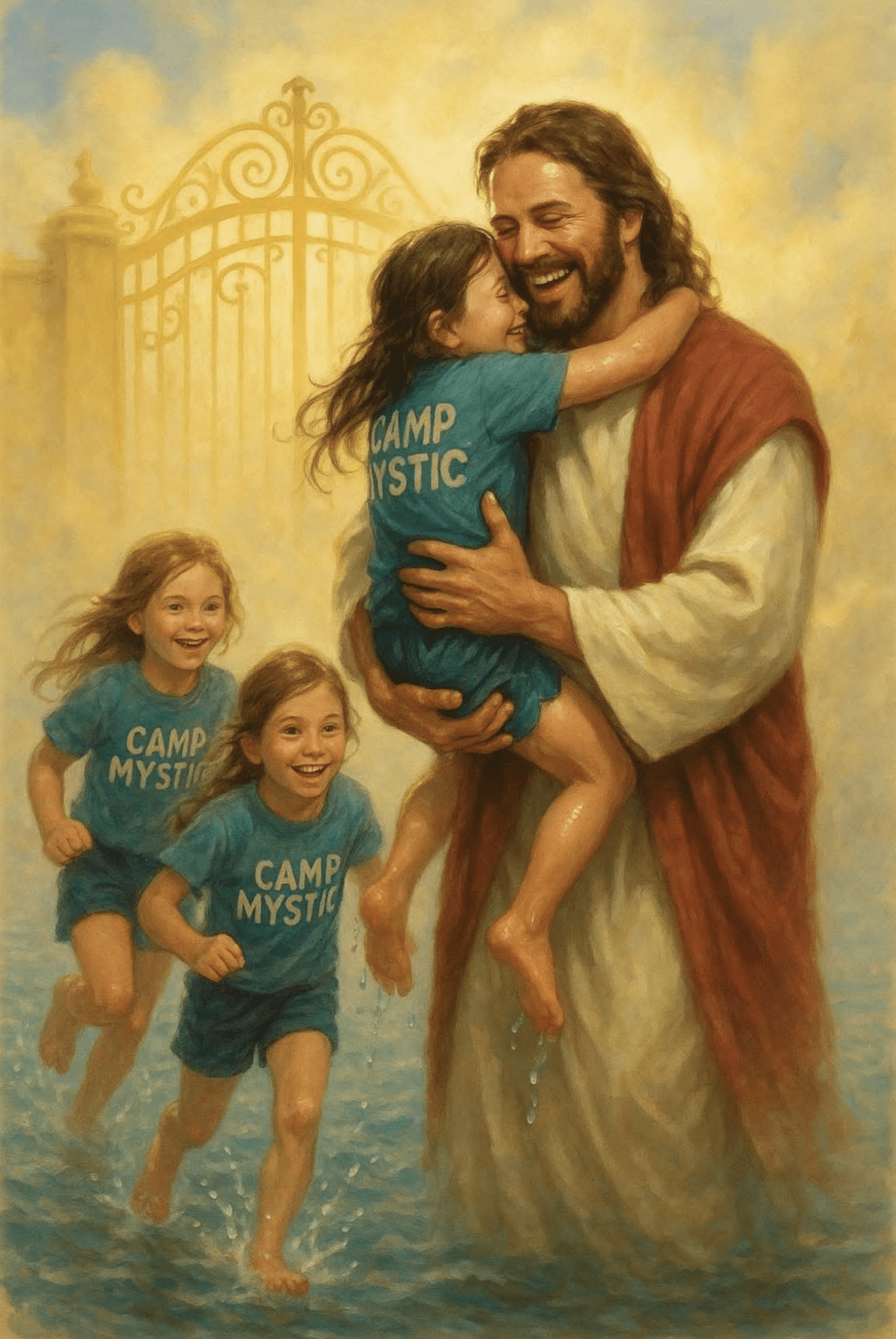
This is why this is the other picture that brought me to tears.
This picture reminds me that the girls who lost their lives at Camp Mystic still have their lives – because long before floodwaters surged down the Guadalupe River on a Friday in the twenty-first century, one Man gave His life on a cross in exchange for theirs on a Friday in the first century.
That doesn’t stop our tears. But it promises us that our tears are not final.
When Jesus tells the story of two men who go up to the temple in Jerusalem to pray, He relays two prayers that couldn’t be more different. One man, a Pharisee, prays:
God, I thank you that I am not like other people – robbers, evildoers, adulterers – or even like this tax collector. I fast twice a week and give a tenth of all I get. (Luke 18:11-12)
The tax collector, to whom the Pharisee refers in his prayer, is the other person who prays at the temple that day. His prayer consists simply of:
In his prayer, the Pharisee compares himself to other people and judges himself better than them. The tax collector compares himself to God and finds himself infinitely lacking, so he asks for mercy from Him. The Pharisee believes he is like God and unlike other sinners. The tax collector confesses he is utterly unlike God and worse than other sinners.
After describing these two prayers, Jesus declares:
I tell you that this man, rather than the other, went home justified before God. (Luke 18:14)
Jesus says that the tax collector, and not the Pharisee, leaves the justified before God. Why? Because the tax collector looked to the righteousness of God to justify him. The Pharisee only looked at the sinfulness of others and justified himself compared to them. The Pharisee tried to justify himself before God by using others. The tax collector realized if you want to be justified before God, you need to be justified by God.
It is far too easy to try to justify ourselves like the Pharisee tried to justify himself by using others. But true justification comes not by using others, but by trusting Jesus. May we find our justification in the right place – which is in the Righteous One.
It was Francis Bacon who ostensibly was the first to say, “Knowledge is power.” Whoever actually said it first, it’s been repeated many times – and it’s been believed for much longer than it’s been said.
When Satan shows up in the Garden of Eden, he tempts Adam and Eve with nothing less than knowledge. He tries to get them to eat fruit from a tree that God has forbidden, because it will open their eyes to the knowledge of not only good, but also evil. But Satan says this knowledge will also give them power:
God knows that when you eat from it your eyes will be opened, and you will be like God, knowing good and evil. (Genesis 3:5)
Satan implies that if Adam and Eve can gain the knowledge of God, that will give them power over God. And they fall for it. But instead of gaining power, their new knowledge instead results in death.
One of the wisest men who ever lived, King Solomon, sternly warns against gossip:
The words of a gossip are like choice morsels; they go down to the inmost parts. (Proverbs 18:8 and 26:22)
We are still enticed by gossip, however. Why? Because we believe that knowledge about someone may afford us power over someone. From blackmail to shaming to even manipulating someone with knowledge we know about them that they don’t know we know about them, we still believe knowledge is power. But, like Adam and Eve, such knowledge often leads to nothing but death – death in our relationships, death in our trust of another person, and the death of our ability to talk to someone rather than about someone.
Satan gossiped about God to Adam and Eve and look where it led them. There are some things that are simply none of our business. We don’t need to know. In a culture that loves to know, sometimes, ignorance isn’t just bliss; it’s holy. So, let’s reject gossip about others. For by rejecting gossip about others, we can know God better. And He’s someone we do need to know.
Credit: The Creation of Adam by Michelangelo (1511) / Wikimedia
When God creates the plants, fish, and land animals in Genesis 1, He speaks to the land and water He has already created to bring these creatures forth:
Let the land produce vegetation: seed-bearing plants and trees on the land that bear fruit with seed in it, according to their various kinds. (Genesis 1:11)
Let the water teem with living creatures. (Genesis 1:20)
Let the land produce living creatures according to their kinds: the livestock, the creatures that move along the ground, and the wild animals, each according to its kind. (Genesis 1:24)
God calls to the land to produce plants and animals and to the water to produce fish. Why? Because the land is where plants and animals belong and the water is where fish belong.
And yet, when God creates human beings, things change. Rather than speaking to the land, where we will live, God speaks to Himself:
Let us make mankind in Our image, in Our likeness, so that they may rule over the fish in the sea and the birds in the sky, over the livestock and all the wild animals, and over all the creatures that move along the ground. (Genesis 1:26)
If the land is where humans will live and belong, why doesn’t God call to the land to bring them – to bring us – forth? It’s because ultimately and in a very unique way, we don’t belong to the land, but to God. We are created in His image:
God created mankind in His own image, in the image of God he created them; male and female he created them. (Genesis 1:27)
Yes, we will live on the land. And yes, the first man Adam is even created from the ground. But he belongs – and we belong – to God.
This is why Adam’s fall into sin in Genesis 3 is such a tragedy. He goes from belonging to God to wanting to be like God, which shatters his relationship with God. But God does not give up. Through the prophet Jeremiah, He envisions a time when:
“This is the covenant I will make with the people of Israel…” declares the Lord. “I will put My law in their minds and write it on their hearts. I will be their God, and they will be My people. No longer will they teach their neighbor, or say to one another, ‘Know the Lord,’ because they will all know Me, from the least of them to the greatest,” declares the Lord. “For I will forgive their wickedness and will remember their sins no more.” (Jeremiah 31:33-34)
God will make sure we belong to Him. We will be His people. He will be our God.
God loves you so much that, when He created you, He had a conversation with Himself about you. You belong to Him. And nothing can change that.