Posts tagged ‘Theology’
Syria’s Setting the Stage for…the End of the World?

Credit: The New York Times
I had to chuckle. While I was doing research for this blog, an email hit my inbox with an ominous subject line: “History’s final chapter will be written in Jerusalem.” It was a promotion for the latest Christian apocalyptic thriller, matrixing today’s headlines with cherry picked Scripture verses which come together to portend disaster. This email was especially funny to me because I was researching precisely these kinds of doomsday declarations for this post.
These days, of course, doomsday’s ground zero is Syria. And for those who have a penchant for taking ancient prophecies and sensationalizing them in light of current crises, Isaiah 17:1 has taken center stage: “See, Damascus will no longer be a city but will become a heap of ruins.” Joel Rosenberg, author of a new book, Damascus Countdown, is leading the charge of Syrian doom and gloom, writing on his blog, “No, we don’t know that these prophecies will come to pass soon, or even in our lifetime. But yes, it is possible that Isaiah 17 … could come to pass in our lifetime.”[1] Predictably, news outlets are picking up on his new take on this old passage. Everyone from the Huffington Post to USA Today to Fox News to Mother Jones to The Blaze has run stories on Isaiah’s prophecy and its relationship to the current Syrian imbroglio.
For the record, let me say that I highly doubt the prophecy of Isaiah 17 will come to pass in our lifetimes. How can I say this? Because it already has come to pass…over 2,700 years ago. Isaiah originally proffered this prophecy during the Syro-Ephraimite alliance of 735-732 BC. This is why the fates of the Syrians and Ephraimites are linked in verse 3: “The fortified city will disappear from Ephraim, and royal power from Damascus.” Ephraim – that is, northern Israel – made a treaty with Syria in a last ditch effort to defend herself against an immanent attack from Assyria, one of the most menacing superpowers of the eighth century BC. This is why we read in Isaiah 7:2: “Syria is in league with Ephraim.” The alliance did not work. In 732 BC, the Assyrians, led by Shalmaneser, sacked the Syrians, destroying the alliance between Ephraim and Syria. Ten years later, the Assyrians came for Ephraim, and northern Israel was no more. Yet, even after this devastating defeat, God made a promise that His people would endure: “Some gleanings will remain, as when an olive tree is beaten, leaving two or three olives on the topmost branches, four or five on the fruitful boughs” (Isaiah 17:6). Isaiah uses an agricultural metaphor to describe how God’s people, though defeated by the Assyrians, will never be destroyed. There will always be a remnant faithful to Him.
To turn this ancient prophecy, fulfilled some twenty-seven centuries ago, into a modern day harbinger of hopelessness is to do violence to it. Indeed, I am frustrated that many journalists reporting on this story and the debate between those who think this prophecy has already been fulfilled and those who think it is yet to be fulfilled are casting this debate as one between theologians who look at this text literalistically and others who do not. Take, for instance, this line from Time magazine: “Nearly all Biblical scholars … argue that such a literalist interpretation of the text is highly problematic.”[2] The debate over this text is not between those who read this text in a literalistic manner as a prophecy of things to come and those who read it as already being fulfilled in ancient times. Being “literal” or “non-literal” has nothing to do with this debate. Rather, this is a debate over how to handle this biblical text responsibly, carefully looking at its context and seeking to understand this text in the manner Isaiah himself would have understood it. Thus, a responsible reading of this text would note that this oracle against Syria is just one of a series of oracles against places like Philistia, Moab, and Cush, all of which no longer exist. In context, then, it is clear that Isaiah is speaking not of modern day Syrian warfare, but of an attack against the Syria of his day along with attacks against other nations of his day, leading to their demise.
Ultimately, what is happening in Syria is the fulfillment of biblical prophecy, but not of the one in Isaiah 17. Instead, words from Jesus come to mind: “You will hear of wars and rumors of wars, but see to it that you are not alarmed. Such things must happen, but the end is still to come.” (Matthew 24:6). Jesus tells us there will be war. And not just war, but wars. The current conflict in Syria is just one such example. Jesus also tells us that these wars do not mean the end of the world has arrived. Conflicts are indicative that the end is indeed coming, but they are not determinative that the end has come. Finally, and perhaps most importantly, Jesus reminds us that we should not be alarmed at these troubled times. Indeed, instead of fear, we should feel compassion toward those whose lives have been turned upside down by this terrible conflict. The fear mongering that passes for theology in many best selling books is in direct contradiction to Jesus’ admonishment to be not afraid. After all, what do we have to fear? Jesus has the end of the world – and everything leading up to it – taken care of.
We can trust in Him.
[1] Joel C. Rosenberg, “Pastors: here are 24 pages of study notes on Isaiah 17, Jeremiah 49 & the future of Damascus. Please feel free to share with others,” flashtrafficblog.wordpress.com (9.11.2013).
[2] Elizabeth Dias, “Some Evangelicals See Biblical Prophecy In Syrian Crises,” Time (8.29.2013).
The Value of Patience
Credit: baycitizen.org
I am not a patient person. I wish I was, but I’m not sure I really have the patience to learn patience.
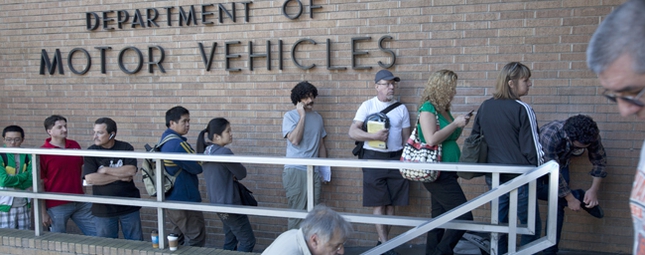
The other day I had to go to the DMV to get a registration sticker for my truck. I had renewed my registration online some two months earlier, but my registration sticker never came. When I called inquiring about my vehicle registration, they informed me that the sticker must have gotten lost in the mail and that it was my responsibility to drive to a DMV office and purchase a replacement sticker.
So that’s what I did.
When I arrived, I found two lines. One line took care of vehicle registration renewals and the other line took care of everything else. I was hoping I could wait in the registration renewal line, but because I was not renewing my registration and instead getting a replacement sticker, I had to wait in the other line. Did I mention that the other line was longer and moving much slower?
After over an hour waiting in line, I finally got my sticker. It took less than a minute. Needless to say, I walked out with less than a smile on my face.
I am not a patient person. God, however, is patient. The Bible regularly celebrates God’s patience: “The LORD is compassionate and gracious, slow to anger, abounding in love” (Psalm 103:8). Rather than getting upset easily and quickly, God’s patient love prevails.
For all of God’s patience, it is important to note that even His patience does not last forever. When Israel rebels against God for centuries in wickedness, God warns: “You have rejected me … You keep on backsliding. So I will reach out and destroy you; I am tired of holding back” (Jeremiah 15:6). God will only tolerate unrepentant sin for so long. Such sin will eventually lead to divine judgment. Thus, although we are called to trust God’s patience, we should not try God’s patience.
I got frustrated because I had to wait an hour to get my vehicle registration sticker at the DMV. God has been waiting thousands of years so more and more people might repent and trust in Him. And if God is can wait that long for us, maybe I can wait a little longer for others.
Weary from Work

Credit: http://www.celalteber.com
It’s that time of year again. You know, the time of year when school begins, extracurricular activities increase, social events get scheduled, and work projects pile up. This time of year is difficult and wearisome for many – from parents right down to their kids. When the calendar fills up, it can be easy to throw your hands up in resignation. How does one navigate the wiles of overwhelming obligations?
It must be understood that becoming weary from a sometimes heavy workload is simply part of living in a sinful, fallen, broken world. This is why, after the first man Adam eats of the fruit of the tree of which God has warned, “You shall not eat” (cf. Genesis 2:16-17), God says to Adam:
Cursed is the ground because of you; through painful toil you will eat of it all the days of your life. It will produce thorns and thistles for you, and you will eat the plants of the field. By the sweat of your brow you will eat your food until you return to the ground, since from it you were taken; for dust you are and to dust you will return. (Genesis 3:17-19)
When sin enters the world, Adam’s work gets hard. He must earn his wages by the sweat of his brown and be nicked and pricked by thorns and thistles. And he cannot escape this. He must simply deal with this.
So where, then, is the hope for those weary from work? The hope is in Jesus. There’s a reason Jesus contrasts His work with our work in the world by saying:
Come to Me, all you who are weary and burdened, and I will give you rest. Take my yoke upon you and learn from Me, for I am gentle and humble in heart, and you will find rest for your souls. For My yoke is easy and My burden is light. (Matthew 11:28-30)
Jesus says this because He knows whereas the brokenness of this world’s work can drain us, the glory of His work can fill us. Jesus’ work on our behalf on the cross and our labor under His name for the sake of His Kingdom can bring contentment and joy like no other work can.
Finally, we can take comfort in the promise that the wearisome work of this world will not go on forever. The prophet Isaiah speaks of a time when “instead of the thornbush will grow the pine tree, and instead of briers the myrtle will grow” (Isaiah 55:13). Rather than the thorns and thistles of Genesis 3, Isaiah reminds us that in eternity we will enjoy lush pines and myrtles. In other words, the pain of this world’s work will be wiped away in favor of work that bring joy, peace, and fulfillment. Work lasts forever. Wearying work, however, does not.
So if you feel overwrought by your work right now, take heart that you will one day feel overjoyed by serving God in glory.
In Defense of Child Rearing
Credit: Time Magazine
I’ve been a dad for five months now. I know that makes me nowhere close to an expert on parenting, but it is amazing how steep the learning curve is when you’re a daddy. I’ve learned how to change a diaper, how to burp a baby, how to swaddle a baby, how to fasten a car seat, and which brands of formula stain badly after your daughter spits up on you. But beyond these nuts and bolts lessons, I have learned something else: having a child makes your life exponentially more complicated. There are schedules you have to arrange, bedtimes you have to keep, and a whole host of new chores you have to do. It’s not simple being a dad.
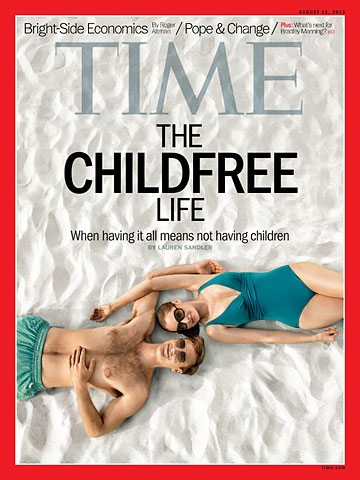
It was this realization that with raising children comes complications that led Lauren Sandler to write an apologetic for childlessness in Time Magazine titled, “Having It All Without Having Children.” In her article, she notes how people are opting out of parenthood with ever increasing frequency:
The birthrate in the U.S. is the lowest in recorded American history, which includes the fertility crash of the Great Depression. From 2007 to 2011, the most recent year for which there’s data, the fertility rate declined 9%. A 2010 Pew Research report showed that childlessness has risen across all racial and ethnic groups, adding up to about 1 in 5 American women who end their childbearing years maternity-free, compared with 1 in 10 in the 1970s.[1]
Kids, for many people it turns out, are cumbersome – too cumbersome. There is, of course, the financial burden of raising children:
The rise of attachment parenting, with its immersive demands, and the sheer economic cost of raising a child – for a child born in 2011, an average of $234,900 until age 18, according to the USDA, and $390,000 if your household earns over $100,000 – has made motherhood a formidable prospect for some women.
There is also the burden raising a child puts on one’s career: “The opportunity costs for an American woman who gets off the career track could average as high as $1 million in lost salary, lost promotions and so on.” But perhaps the most interesting burden that childhood brings, according to one researcher, is an intellectual burden:
At the London School of Economics, Satoshi Kanazawa has begun to present scholarship asserting that the more intelligent women are, the less likely they are to become mothers … Kanazawa analyzed the U.K.’s National Child Development Study, which followed a set of people for 50 years, and found that high intelligence correlated with early – and lifelong – adoption of childlessness. He found that among girls in the study, an increase of 15 IQ points decreased the odds of their becoming a mother by 25%. When he added controls for economics and education, the results were the same: childhood intelligence predicted childlessness.
As titillating at these statistics might be, they generate more heat than light. Indeed, they are only props marshaled to justify the real reason people do not want to have kids. The real reason can be found in the words of documentary filmmaker Laura Scott, whom Lauren Sandler quotes at the beginning of her article: “My main motive not to have kids was that I loved my life the way it was.” Scott makes no secret of the reason she opted out of parenthood: her life is her life. Kids make her life not about her. And that, she decided, is something she cannot endure.
One has to wonder when it became commendable to be so unashamedly selfish. The beauty and blessing of giving your life to the nurture and care of another is apparently lost on far too many people.
In the face of such cultural confusion concerning child rearing, it is useful to briefly review what the Bible says about children:
- Children matter to God which means they should matter to us too. Jesus’ words and actions express vividly His concern and care for kids. When people are bringing their children to Jesus to have Him bless them and the disciples try to keep the kids away, Jesus chides the Twelve, saying, “Let the little children come to Me, and do not hinder them, for the kingdom of God belongs to such as these” (Mark 10:14). Jesus enjoys spending time with children and blessing them. We should too.
- Bearing and raising children, though it is not commanded specifically for every individual, is generally commendable. God’s commission at creation has an inescapably universal ring to it: “Be fruitful and increase in number; fill the earth and subdue it” (Genesis 1:28). Though we have plenty of biblical examples of people who did not have children due to one circumstance or another, a disdain for and avoidance of childbearing runs contrary to the biblical estimation of kids.
- Children, even when they feel like a burden, are in reality a divine blessing! The words of the Psalmist sum it up: “Children are a heritage from the Lord, offspring a reward from Him” (Psalm 127:3).
So what does all this mean? It means simply this: kids are precious and well worth celebrating. Past cultural adages such as “Children should be seen and not heard” as well as a present cultural avoidance and diminishment of child rearing are sad testimonies to human sinfulness and selfishness. Conversely, engaging children can be not only fun, it can also be sanctifying. And everyone needs opportunities to be sanctified.
[1] Lauren Sandler, “Having It All Without Having Children,” Time (8.12.2013).
Millennial Morality: Thoughts On A Generation’s Thoughts On Christianity

Credit: urbanfaith.com
Last weekend, popular blogger Rachel Held Evans, writing for CNN, offered an account of why she thinks those in the millennial generation are leaving the Church. Her comments are worth quoting at length:
Armed with the latest surveys, along with personal testimonies from friends and readers, I explain how young adults perceive evangelical Christianity to be too political, too exclusive, old-fashioned, unconcerned with social justice and hostile to lesbian, gay, bisexual and transgender people.
I point to research that shows young evangelicals often feel they have to choose between their intellectual integrity and their faith, between science and Christianity, between compassion and holiness.
I talk about how the evangelical obsession with sex can make Christian living seem like little more than sticking to a list of rules, and how millennials long for faith communities in which they are safe asking tough questions and wrestling with doubt.[1]
Rachel Held Evans certainly has her finger on the pulse of contemporary culture. Research does indeed show that millennials describe Christianity as “too political, too exclusive, old-fashioned, unconcerned with social justice and hostile to lesbian, gay, bisexual and transgender people.” In other words, many millennials view traditional Christian teachings as repressive and regressive. What Rachel fails to ask, however, is, “Does this popularly held perception of Christianity match its reality?”
There’s a whole army of research out there about how people feel about Christianity. But what about the research that reveals what is actually being preached and taught from Christian pulpits? How many sermons on politics are actually preached week in and week out? How about sermons on sex? How about sermons that are openly hostile to lesbian, gay, bisexual, and transgender people? Here, the research becomes much more scant. And, I suspect, the sermons themselves might just be much more scant as well.
Now, I know it’s not hard to skew popular perceptions of what the Christian Church is all about. After all, it’s usually not the sermon on John 3 and God loving the world that makes the rounds on YouTube; it’s the sermon on Leviticus 20 with the sweaty pastor yelling about the abominations of sodomy that gets 500,000 views.
Still, I can’t help but wonder if the objections that many millennials have to some of the teachings of Christianity aren’t so much objections as they are excuses. In other words, the reason many millennials object to particular Christian tenets is not because they are “too political, too exclusive, old-fashioned, unconcerned with social justice and hostile to lesbian, gay, bisexual and transgender people”; it is because they simply don’t like parts of what Christianity teaches. So they accuse Christians of absolutism so they can live in libertinism. Nathan Hitchen explains it like this: “When people don’t want to believe something, they ask themselves, ‘Must I believe this?’ and then search for contrary evidence until they find a single reason to doubt the claim and dismiss it.”[2] In other words, they find that YouTube video with the sweaty, yelling pastor and say, “No way.”
From a theological perspective, C.S. Lewis offers keen insight into the objectionable character of Christian morality:
Christ did not come to preach any brand new morality … Really great moral teachers never do introduce new moralities: it is quacks and cranks who do that. As Dr. Johnson said, “People need to be reminded more often than they need to be instructed.” The real job of every moral teacher is to keep on bringing us back, time after time, to the old simple principles which we are all so anxious not to see; like bringing a horse back to the fence it has refused to jump or bringing a child back to the bit in its lesson that it wants to shirk.[3]
C.S. Lewis minces no words about how tough the task of teaching Christian morality really is. It’s tough because the “old simple principles” of morality are ones “which we are all so anxious not to see.” Yet, Jesus, as a teacher of morality, among other things, preached these “old simple principles.” Of course, such preaching didn’t make Him popular or unobjectionable. It got Him killed.
So perhaps popularity is not in the cards for Christianity. This should not come as a surprise. It wasn’t in the cards for Jesus. And yet, as Rachel Held Evans finally notes in her CNN article, “Like every generation before ours and every generation after, deep down, we long for Jesus.” Maybe that’s because, deep down, even if our depravity rebels against it, something keeps telling us Jesus is right. And if Jesus is right, that means He can make us right with God.
That’s our message as Christians. And I, for one, intend to keep sharing it.
[1] Rachel Held Evans, “Why millennials are leaving the church,” cnn.com (7.27.2013).
[2] Nathan Hitchen, “Marriage Counter-Messaging: An Action Plan” (The John Jay Institute: 2013), 4.
[3] C.S. Lewis, Mere Christianity (New York: Macmillan Publishing Company, 1952), 64.
Where Human Justice Cannot Tread: The Case of Trayvon Martin & George Zimmerman

Credit: The Associated Press
We will never know for sure what happened.
Well, we will never know for sure all that happened. There are a few things we do know. We do know that on the night of February 26, 2012 in Sanford, Florida, an altercation took place between Trayvon Martin and George Zimmerman. We do know that this altercation left Trayvon Martin dead of a single gunshot wound, fired at intermediate range. We do know that George Zimmerman was the shooter. And we do know that on Saturday, July 13, Zimmerman was found “not guilty” of both the charges of second-degree murder and of manslaughter.
As the trial of George Zimmerman unfolded before a nation of breathless spectators, it became clear to many pundits and reporters – regardless of how these pundits and reporters hoped this case would turn out – that the prosecution was in trouble. Consider this from ABC News:
Prosecutors started strong with a powerful, concise opening statement from Assistant State Attorney John Guy, in contrast to the silly knock-knock joke and seemingly disorganized and meandering defense argument …
But then something happened that many would have thought improbable as this case received wall to wall coverage leading up to Zimmerman’s arrest.
What the state hoped would be proof that Zimmerman initiated the altercation and that he, not Martin, was on top as they grappled on the ground, did not appear to proceed as planned …
With each witness there were either facts that we now know are not true (like hearing three shots, when there was only one) or indications that their memories have somehow become clearer since the incident itself.[1]
The prosecution’s witnesses, in their testimonies of what happened that night, gave conflicting and confusing accounts. Coupled with the fact that the burden to prove that Zimmerman shot Martin in something other than self-defense rested on the prosecution, the prospects for a conviction were grim for the state. Again, ABC News summarized the prosecution’s problem well:
Prosecutors still have to prove beyond a reasonable doubt that Zimmerman did not “reasonably believe” he was “in imminent danger of death or great bodily harm” during their altercation. That is a heavy burden to bear.
It turns out, as the verdict this past Saturday revealed, that it was a burden too heavy to bear.
Along with the wide range of human emotions that a trial such as this one elicits, this trial has also exposed the limits of human justice. The jury found George Zimmerman “not guilty.” This does not necessarily mean that Zimmerman committed no crime. It simply means that, in the opinions of the jurors, there was not enough evidence to demonstrate beyond a reasonable doubt that he was guilty of a crime. The jurors’ verdict does not pretend or presume to rule on George Zimmerman’s guilt or innocence as a matter of fact. It simply says that Zimmerman will not be incarcerated as a matter of the law.
The justice of our God is much more comprehensive and, as strange as it sounds, just than the justice of our courts. For our God is concerned with infinite transcendent justice rather than with limited legal justice. Indeed, our God is passionate about justice. God shouts in Amos 5:24: “But let justice roll on like a river, righteousness like a never-failing stream!” Where human justice falls short, God’s justice does not.
Ultimately, regardless of the verdict, the justice rendered in that Florida courtroom can only be provisionary and incomplete. Even if George Zimmerman had been found guilty, his incarceration would not have undone the painful problem of death, which is finally what this case – and every murder case – is all about. But the painful problem of death cannot be solved in any courtroom; it can only be solved on a cross. Only Jesus can bring justice to death by conquering it with His life – a life that will finally and fully be revealed on the Last Day.
So while a Florida court has ruled, we are still waiting for Jesus to rule – or, to put it more clearly, to reign – when He returns on the Last Day. And, blessedly, the justice He will bring on that day will be far better than the justice we have in these days. For His justice does much more than merely rule on tragedies; His justice fixes them.
[1] Dan Abrams, “George Zimmerman’s Prosecution Woes: Analysis,” ABC News (7.1.2013).
Tornadoes and Satan
 Crises have a strange way of calling people to faith. In a day and age where many are bemoaning that our nation is becoming increasingly secular, the devastating EF 5 tornado that struck Moore, Oklahoma on May 20 gave rise to an abundance of prayers and cries to God. Ed Stetzer paints the scene well in his article for USA Today, which is worth quoting at length:
Times of grief reaffirm our identity as a religious nation. Shortly after the horrific news of the tornado devastation in Oklahoma, “#PrayforOklahoma” quickly rose to the top of Twitter’s trending list as millions shared their prayers for the people who lost loved ones and had their homes destroyed.
In times of prosperity, far removed from tragedies, many people in our culture reject expressions of faith. In the moments of hopelessness, however, the desire to reach out to a higher power is an instinctive reflex.
Some may say, “But that’s Oklahoma – it’s the Bible Belt.” Yet, after the Sandy Hook tragedy, I was struck by the comment made by Connecticut Gov. Dan Malloy referencing our collective religious heritage:
“In the coming days, we will rely upon that which we have been taught and that which we inherently believe: that there is faith for a reason, and that faith is God’s gift to all of us.”
Many are embarrassed by this national identity – until it is time to grieve. Then, politicians, celebrities and reporters can unashamedly say they are praying for those affected. News networks will show church bells ringing in memory of those lost. Nightly news shows feel the need to broadcast excerpts from sermons delivered by pastors in the area. Journalists interview religious leaders about how God can help us through.
And yes, that is where the discussion often begins. We consider why this would happen. Some people representing faith groups may speak quickly (and unwisely), assuming they can connect the dots between something in our culture and the most recent tragedy.
Others simply ask the question, “How could God allow this to happen?”[1]
Tragedies of the sort that struck Moore, no matter how supposedly “secularized” our nation has become, call forth faith. And, as Stetzer duly notes, they also call forth questions. Most often, tragedies like the one in Moore call forth the question that Stetzer poses: “How could God allow this to happen?” But in the wake of the tragedy at Moore, I received another question that, though less common, is certainly worthy of a moment of our reflection: “Can Satan cause a tornado?” When a tragedy strikes, most people wonder about God’s power to prevent tragedies and His ultimate purpose in allowing them. But it is also worth asking what kind of prerogative Satan has to wreak havoc in our world.
Satan does seem to have some power to cause trouble in our world. One needs to look no farther than the story of Job. In nearly an instant, Job’s life goes from riches to rags. A quick sequence of four calamities, instigated by Satan himself, robs Job of nearly everything he has. The fourth of these calamities is especially instructive for our purposes: “Yet another messenger came and said, ‘Your sons and daughters were feasting and drinking wine at the oldest brother’s house, when suddenly a mighty wind swept in from the desert and struck the four corners of the house. It collapsed on them and they are dead, and I am the only one who has escaped to tell you’” (Job 1:18-19)! Notice that it is a windstorm that Satan sends to destroy Job’s family. Satan, it seems, does seem to have limited power to incite natural disasters.
It is important to note that, as the story of Job clearly delineates, Satan incites calamities on a person not because a person is somehow particularly sinful or deserving of such calamities, for Job was “was blameless and upright; he feared God and shunned evil” (Job 1:1). No, Satan incites calamities out of depraved delight – he enjoys watching people suffer.
Certainly we cannot know, nor should we speculate on, the transcendental cause of Moore’s devastating tornado. The most we can say is that natural disasters are part of living in a sinful, fallen world and Satan takes cynical delight in the effects of sin on our world.
But there is hope. For even if Satan can incite calamities, his ability to do so is severely – and blessedly – limited. Jesus describes Satan as a “strong man” whose fate is sealed: “How can anyone enter a strong man’s house and carry off his possessions unless he first ties up the strong man” (Matthew 12:29)? Satan may be a strong man. But Jesus is the stronger man. And He came to tie up Satan by defeating his favorite calamity – death – on the cross.
Ultimately, then, no matter what the spiritual causes of the natural disasters that plague our world may be, in this we can take consolation: no matter how much strength sin and Satan may have for ill, Jesus is stronger. He’s so strong, in fact, that “even the wind and the waves obey Him” (Matthew 8:27). He has things under control. And He holds Moore’s victims in His heart and hands. May we hold them in our prayers.
[1] Ed Stetzer, “We still cry out to God when tragedy strikes: Column,” USA Today (5.22.2013).
Jason Collins’ Big Announcement
 There have been plenty of splashy and flashy headlines sprawled across newspapers, news stations, and news websites concerning NBA free agent Jason Collins over these past several days, but I prefer the simplicity of CNN: “NBA’s Jason Collins comes out as gay.”[1] The reactions to Jason Collins’ revelation, as expected, have been wide and diverse. The Huffington Post reports that President Obama called Collins to tell him “he was impressed by his courage.”[2] Sports analyst Chris Broussard sparked a firestorm when, speaking on ESPN’s “Outside the Lines,” he said, “I’m a Christian. I don’t agree with homosexuality…I think it’s a sin, as I think all sex outside of marriage between a man and a woman is.”[3] Finally, the Human Rights Campaign likened the effects Collins’ “coming out” to that of Jackie Robinson being the first African American to play baseball in the modern era. HRC President Chad Griffin released this statement:
Jason Collins’ commitment to living openly is a monumental step forward toward greater equality and he immediately becomes a role model for youth all across this country. His actions today tell LGBT young people that what will define our success in life is our character and dedication, not our sexual orientation. At a moment when millions are reflecting on the life and legacy of Jackie Robinson, Jason Collins is a hero for our own times.[4]
So what is a Christian to make of all this? Chris Broussard summarizes the orthodox Christian position quite well when he says, “I think [homosexuality is] a sin, as I think all sex outside of marriage between a man and a woman is.” The second part of Broussard’s statement is key. As we watch the story of Jason Collins’ “coming out,” we must see it as only a piece of a bigger puzzle. For decades, sexual immorality has been rampant in professional sports. One can’t help but think of the offer AshleyMadison.com put on the table shortly after Tim Tebow joined the New York Jets. Noel Biderman, the founder of Ashley Madison, offered one million dollars to anyone who could produce evidence that the backup quarterback was not, in fact, a virgin. Biderman said, “Sports and sex (and of course, infidelity) go hand in hand…If Mr. Tebow is indeed abstaining from adult relationships, I would encourage him to find a nice lady or two and enjoy his youth and fame as much as possible.”[5] His assertion that “sports and sex (and of course, infidelity) go hand in hand” is, sadly, true. Story after story could be enumerated of professional athletes behaving badly – engaging in everything from infidelity to rape to premarital sex which has become so culturally accepted, it is no longer disconcerting enough to raise even an eyebrow much less make a headline. Thus, Chris Broussard’s embrace of an openly homosexual lifestyle is only one instance in a long parade of what the Bible would deem sexual immorality.
In a culture that has such radically different sexual mores from that of the Christian ethos, there are a couple of things Christians should keep in mind. First, we should remember that, no matter how winsomely and well Christian sexual standards are explained or packaged, there will be many who will reject and ridicule them. This has to do with the foolishness of the Scripture and of the gospel itself to those who do not trust Jesus. As the apostle Paul says, “For the message of the cross is foolishness to those who are perishing, but to us who are being saved it is the power of God” (1 Corinthians 1:18). The Scriptural reservation for sex between a husband and wife is simply unintelligible to many in our society.
Second, even if the world considers God’s wisdom foolish, this does not mean that we should not share God’s wisdom with our world. Christians can and must speak to the issues of our day. After all, if we truly believe that God’s way is the best way, and if we truly love our neighbors as Jesus commands, how can we not share God’s desire for them out love for them?
Finally, as we share God’s Word – and especially as we share God’s Word concerning human sexuality – we must do so with an attitude of humility rather than with a spirit of arrogance. Jesus makes it clear that all struggle with sexual brokenness: “You have heard that it was said, ‘Do not commit adultery.’ But I tell you that anyone who looks at a woman lustfully has already committed adultery with her in his heart” (Matthew 5:27-28). Jesus’ standard for sexual purity is one that none of us have kept. When we speak to others about sexual purity, therefore, we must do so as fellow strugglers rather than as self-righteous sermonizers.
In a culture that celebrates and sanctions sexual sin, we are called to hold out a message of hopeful purity. By God’s grace, may we hold out that message with the clarity, conviction, and compassion that it deserves.
[1] Joe Sterling and Steve Almasy, “NBA’s Jason Collins comes out as gay,” CNN (4.30.2013).
[2] Sam Stein and Amanda Terkel, “Obama Calls Jason Collins, ‘Impressed By His Courage’ In Coming Out,” The Huffington Post (4.29.2013).
[3] Scott Collins, “ESPN’s Chris Broussard sparks uproar with Jason Collins remarks,” LA Times (4.29.2013.)
[4] HRC Staff, “Jason Collins Changes the Face of Sports Forever By Coming Out,” Human Rights Campaign (4.29.2013).
[5] Danny Cox, “Jets quarterback Tim Tebow’s virginity worth a reported $1 million dollars,” Examiner.com (4.24.2012).
Searching for Scapegoats
 As investigators continue to probe Dzhokhar Tsarnaev concerning his role in the Boston Marathon bombing, his motive, though not fully understood, nevertheless seems to be driven at least in part by an al Qaeda agenda. Consider this from NBC News:
It is as slickly designed as any magazine you would find at the supermarket checkout line, or in the seat pocket in front of you on an airplane. It even has snappy cover headlines – teasing articles like “Make a Bomb in the Kitchen of Your Mom.”
And now Inspire, the recruitment magazine of al Qaeda in the Arabian Peninsula, probably has its next cover story: It allegedly helped inspire the two brothers accused of bombing the Boston Marathon.
Dzhokhar Tsarnaev, the hospitalized suspect in the marathon attack, has told federal investigators that the brothers got information on building bombs from Inspire, law enforcement officials told NBC News.[1]
Before Dzhokhar and his brother Tamerlan were identified by the FBI as the suspects in this bombing, confusion – and, I should add, speculation – as to who could have done such a thing abounded. There was the damaging gaffe from the New York Post which published a cover featuring two young men who, according to the Post, were sought by “the Feds” when, in fact, they were not suspects in the bombing.[2] And then there were those who speculated – and even hoped – that the bomber would either be or not be a certain race, religion, or political persuasion.
Two articles, published before the Tsarnaev brothers were identified, are of special interest in this regard. The first article appeared in The Guardian carrying the headline, “US Muslims ‘holding their breath’ as Boston investigators hunt for bomber.”[3] The article opened:
US Muslims are “holding their breath” as the investigation into the Boston Marathon attacks develops, amid fears of increased racial profiling and attacks if an Islamic link is confirmed, according to advocate groups.
The second article was by David Sirota, writing for Salon, and was titled, “Let’s hope the Boston Marathon bomber is a white American.”[4] Sirota, who I should point out is himself a white American, offers the rational for his demographic hope thusly:
If the bomber ends up being a white anti-government extremist, white privilege will likely mean the attack is portrayed as just an isolated incident – one that has no bearing on any larger policy debates. Put another way, white privilege will work to not only insulate whites from collective blame, but also to insulate the political debate from any fallout from the attack.
It will probably be much different if the bomber ends up being a Muslim and/or a foreigner from the developing world. As we know from our own history, when those kind of individuals break laws in such a high-profile way, America often cites them as both proof that entire demographic groups must be targeted, and that therefore a more systemic response is warranted. At that point, it’s easy to imagine conservatives citing Boston as a reason to block immigration reform defense spending cuts and the Afghan War withdrawal and to further expand surveillance and other encroachments on civil liberties.
Interestingly, both of these articles share this in common: they both hoped the bomber was not a Muslim. But Sirota’s article takes it one step farther. He wants the bomber to be “a white anti-government extremist.” The Guardian’s article has only a negative hope for who the bomber is not. Sirota, on the other hand, holds out a positive hope for who the bomber is.
I can sympathize with the sentiments of those interviewed for The Guardian’s article. After all, I cringe whenever I hear another Christian merely say something wrongheaded, hypocritical, or bombastic. To have someone who claims to follow Christ plant and detonate a bomb in the midst of a crowd of marathon onlookers would break my heart. After all, such a tragedy would harm the Christian witness and put up a Satanic barrier that could very well be a powerful preventive against people coming to the truth. I can only imagine the stress, anguish, and embarrassment that some in the Muslim community must be feeling right now. And when these feelings are coupled with the potential of reckless retaliation against mosques and Muslim religious leaders, my guess would be that many in the Muslim community are also feeling fear. Thus, those in the Muslim community deserve our prayers for their protection against such retaliatory attacks as well as our prayers that they continue to be afforded the basic human dignity implicit to the imago Dei. Whether or not a person is a Christian, everyone should be afforded a basic amount of dignity and respect, for we are all creations of the Almighty. A tragedy like this can make a certain people group feel as though they have lost even this basic modicum of dignity and respect.
I have a much harder time understanding the sentiments of Sirota’s article. Hoping that a particular person or people group has committed a heinous crime is beyond me. As a Christian, the prayer is never that a particular person or people group would sin, but that a particular person or people group would be guarded from sin. The words of Jesus come to mind: “Lead us not into temptation” (Matthew 6:13).
The fundamental problem with Sirota’s argument is this: he is trying to identify a scapegoat that will most readily suit his own political machinations and interests. The message of Christianity is that a scapegoat, not for politics, but for sin has already been provided – Jesus. Thus, rather than trying to lay blame at the feet of a particular person for the sake of a political agenda, we can lay blame on the cross of Christ where it will be taken away. For Christ not only takes the blame for human sin by His death, He conquers it by His resurrection. And so, when sin rears its ugly head as it did in Boston, which would you rather have: someone you can blame or someone who can save?
I know what my answer is.
[1] Erin McClam, “Slick al Qaeda online magazine aims to train a generation of killers,” NBC News (3.23.2013).
[2] See “NY Post claims these are the two men police are looking for in Boston bombings – but one is a local teen who’s in shock,” The Blaze (4.18.2013)
[3] Karen McVeigh, “US Muslims ‘holding their breath’ as Boston investigators hunt for bomber,” The Guardian (4.17.2013).
[4] David Sirota, “Let’s hope the Boston Marathon bomber is a white American,” Salon (4.16.2013)
A Week of Tragedies
 What a week it’s been. Monday the headline was carnage at the Boston Marathon as a pair of terrorists planted and detonated two bombs, though they planted more, at the race’s finish line. Three lost their lives. More than 170 were injured. I awoke Wednesday morning to the news that the tiny town of West, Texas, north of Waco, erupted in a fireball in an explosion in a fertilizer plant. Dozens lost their lives because of this tragic accident.
On the heels of so much tragedy and loss of life, two questions inevitably arise, both consisting of just one word: “How?” and “Why?”
“How did these two terrorists manage to plant numerous bombs at the finish line of a major race in seemingly plain sight with so many law enforcement officials standing by for any sign of trouble?” “How did a small blaze at a fertilizer plant get so out of control in a literal split second?” Investigators specialize in answering these “How?” questions. Already, expansive and detailed investigations have been launched to try to figure out how these tragedies happened.
The “Why?” questions are a little tougher to answer. “Why would someone premeditatedly work to cause so much pain and anguish in the bodies, hearts, and lives of so many?” “Why would God allow any of this to happen?”
Though we have partial answers to our perennial “Why?” questions, our answers are inevitably incomplete because of our finite perspective. But there are some things we can know and say in tragic times like these nonetheless.
First, we must say that tragedies like these are spawned because of sin. The attacks in Boston are an example of the darkest corners of human depravity on display. Two individuals took it upon themselves to actively break God’s law and our nation’s laws in order to coldly calculate a catastrophe. The fertilizer plant explosion in West is an example of creation’s sinful brokenness. Because we live in a world that has gone wrong (cf. Genesis 3:17-19, Luke 13:1-5), wrong things happen.
Second, we can also say that tragedies like these testify to God’s patience, albeit in a strange and backwards way. After all, God is under no particular compulsion to allow this sinful world to continue on. But He does. Why? Because He loves the people He has made and wants to give them as much time as possible to repent of their sinful state and turn toward Him. As the apostle Peter reminds us, “Bear in mind that our Lord’s patience means salvation” (2 Peter 3:15).
In the days ahead, steps will no doubt be taken to try to assure that the tragedies of this week will not be repeated. This is good! We ought to learn from tragedies like these for the sake of everyone’s safety and wellbeing. But no matter how many steps we might take to try to guard against similar situations in the future, no human being can root out the underlying cause of all such situations: sin. Though we might be able to prevent a particular tragedy from happening again, we cannot take out tragedy’s foundation of sin. Only Jesus can do this. Only Jesus can conquer the wickedness of this world and restore His creation and His people back to the way He originally dreamed and designed them: perfect.


 Pastor Zach's Blog