Posts tagged ‘Spirituality’
Ghana Eye Clinic – Day 3
Today’s numbers: We shared the gospel with 354 people and gave away 253 pairs of glasses. This was our biggest day yet!
Check out the pictures and captions below to find out more about today’s clinic.

Pam works hard sorting reading glasses for the hundreds who need them.

Arnold and Tristina have been working hard all clinic long!

Our host, Ivan, talks to the pastor who is the president of the Lutheran seminary in Ghana and is taking some time out of his busy schedule to share the gospel with hundreds during the eye clinic.

Tristina poses with one of our fabulous volunteers, Justice. Justice works hard routing people through the clinic to make sure everyone gets to the right place.

More of our fabulous volunteers! This devoted group sat outside all day in the hot Ghana sun welcoming visitors to the clinic.

Tristina and Pam are still smiling even after a long day at the clinic.

This little boy’s name is Michael and our team has decided to “adopt” him. He has a degenerative eye disease and will need ongoing medical care to preserve what little vision that he has.

Michael’s eyes.

Our host, Ivan, has a friend, Mustapha, who works to build bridges between the Muslim and Christian communities in Accra. Thankfully, the relationships between Muslims and Christians are very good in Ghana. Mustapha has invited several of his friends to the clinic.

Tristina uses the portable autorefractor to measure a boy’s eyes for new glasses.
The children of St. Paul Lutheran School in Accra are a talented bunch! Check out this video of their mad musical skills.
Ghana Eye Clinic – Day 2
We’re all settled in and things are going great! Today, we saw 256 people and shared the gospel with each one of them. We also gave away 220 pairs of glasses. Four of the people we saw were deaf. Thankfully, our team leader, Julie, is great with sign language! Our clinic closed a little early because Ghana was playing against Egypt in a big football game (that would be “soccer” to us), qualifying them for the World Cup. After our day at the clinic, we stopped by some local markets and perused some of the local wares.
Here are some pictures. I’ll post more soon.
Does this thing come with a snooze button? Good morning!

If you think San Antonio rush hour is bad, you ought to try morning traffic in Accra!
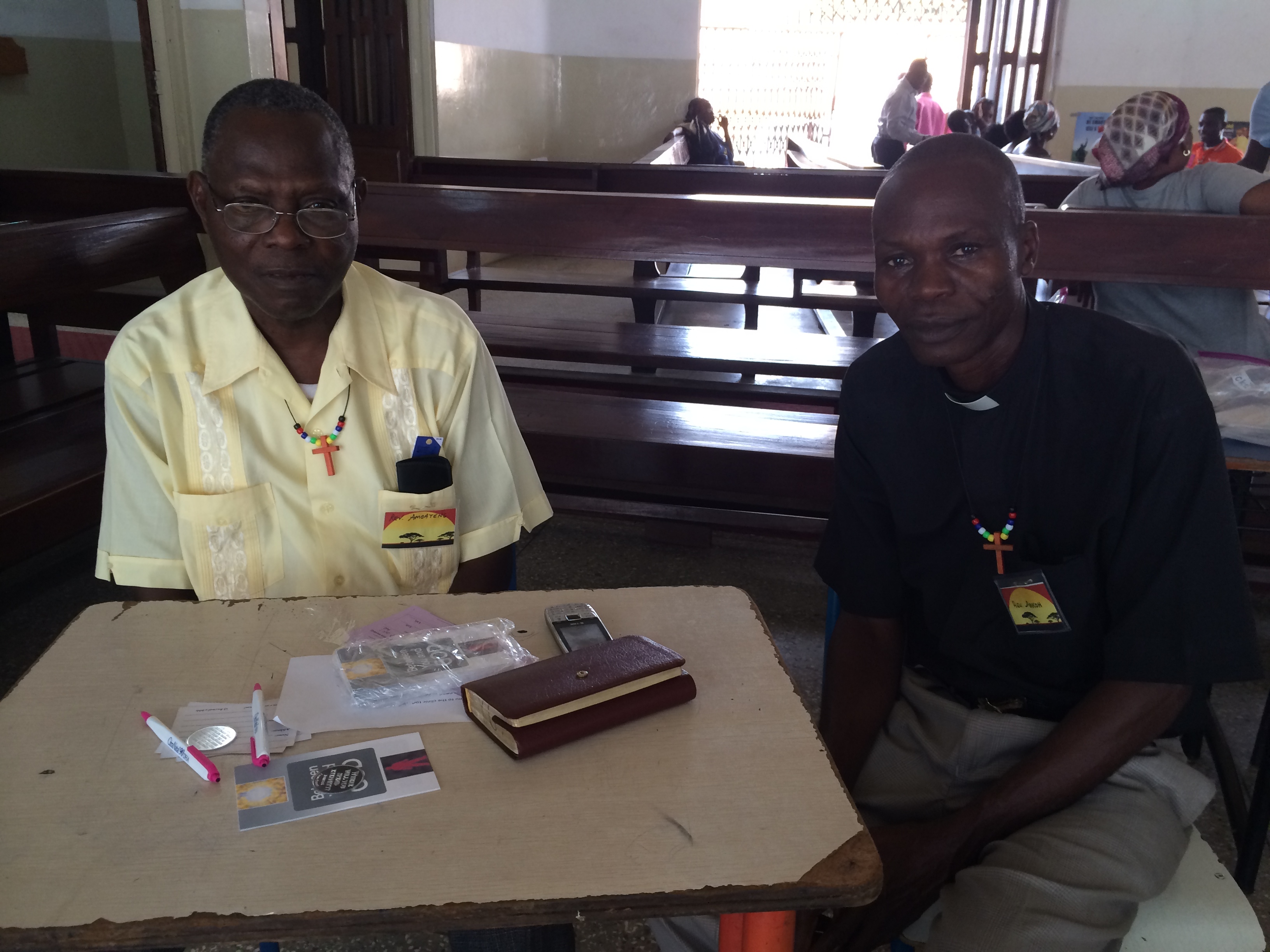
Two terrific pastors assisted in helping triage patients, figuring out what glasses they needed and sharing the gospel with them.

Michael and Arnold are hard at working, making glasses for all sorts of different prescriptions.

Julie signs to a deaf man so he can understand what glasses he needs.

The girl on the left came in yesterday, but we couldn’t offer her treatment without her mother. Today, both mother and daughter came in and received glasses!

I’m pretty sure Julie is working on a passport for this little man so she can bring him home. She didn’t want to let him go!

Pam and our host in Ghana, Ivan, screen people for reading glasses.

There was plenty of fresh fruit at the street market.

Pam made a new friend with one of the street vendors!
Ghana Eye Clinic – Day 1
Our first day in Accra, Ghana at the eye clinic was terrific! We saw 315 people who needed vision care and gave out 217 pairs of glasses. We also had an optometrist onsite to see people who had a whole host of eye care needs. Most importantly, we shared the gospel with everyone who came through our clinic. Through the glasses, we helped people see God’s world. With the gospel, we helped people see God’s Son!
Check out these pictures from our first day.

The morning was beautiful!

Pastor Bill shares the gospel with people as they first come to the clinic.

The kids from the day school at St. Paul Lutheran in Accra sing us a song.

One of our sweet kids receives a sweet from Julie!

Many people came to receive glasses and hear the gospel!

Two great Concordians, Michael and Arnold, are stylin’ in the glasses we’re sharing with the folks of Accra.
I’ll be posting more pictures soon, so keep checking back. Please continue to pray for our team!
Sightseeing in Ghana
 I’m not in San Antonio anymore, that’s for sure. Instead, I am halfway across the world in Ghana, Africa with a team of my fellow Concordians and, together, we are hosting an eye clinic. There are many people in this region of Ghana in desperate need of glasses. We have the special privilege and pleasure of providing people here with the glasses they need in order to see. In the process, we also get to point people to the One in whom they can see God Himself – Jesus Christ – by sharing the gospel.
As I’ve been working as a part of this vision clinic, I’ve been pondering one of my favorite stories in Scripture:
As [Jesus] went along, He saw a man blind from birth. His disciples asked Him, “Rabbi, who sinned, this man or his parents, that he was born blind?” “Neither this man nor his parents sinned,” said Jesus, “but this happened so that the work of God might be displayed in his life.” (John 9:1-3)
In the ancient world – and especially among the ancient Jews – it was generally presumed that if you faced a trial, a trouble, or an ailment, it was because you had committed some heinous sin to deserve that trial, trouble, or ailment. Your sin and your trouble were intimately and inexorably interwoven in ancient thinking. For instance, Rabbi Ammi wrote, “There is no death without sin, and there is no suffering without iniquity.” If you were suffering, the rabbis taught, it was because you had done something wrong. In fact, some rabbis taught that not only could a person be punished for his own sin, but a child could be punished for his parents’ sin. Some rabbis believed, for example, that the untimely death of a child was the direct result of his mother’s dalliance in idolatry while he was still in the womb! Such was the close correlation between sin and tragedy.
Thus, it is really no surprise that, one day, as Jesus and His disciples are walking around and see a man born blind, the disciples ask: “Rabbi, who sinned, this man or his parents, that he was born blind” (John 9:2)? Jesus’ disciples know the teaching of their Jewish rabbis well. They know a man cannot be born blind unless there is some sin to warrant such blindness.
But what the rabbis assumed about the connection between sin and trouble isn’t what a rabbi named Jesus knows about this blind man’s plight. This is why, instead of pointing to a specific sin committed by this man which had resulted in his blindness, Jesus explains to His disciples: “Neither this man nor his parents sinned, but this happened so that the work of God might be displayed in his life” (John 9:3). This suffering is not the result of this sin or that sin. Rather, God is up to something in this suffering: He is using it to display His work.
The Greek word for “display” is phanero’o, from the word phos meaning, “light.” God, it seems, desires to bring this man darkened by blindness into the light of seeing. But God’s desire centers not only on the light of physical seeing, but on the light of spiritual seeing as well. In other words, Jesus, through His eventual healing of this man born blind, desires to bring this man not only into the light of the sun, but into the light of faith. And this is exactly what happens in the end: “Do you believe in the Son of Man?” Jesus asks. “Lord, I believe,” the man responds (John 9:35, 38). When this man confesses his faith in Christ, he is brought into the light not only physically through the recovering of his sight, but spiritually through his trust in Christ.
All this week in Ghana, our goal is to help people see in two ways – spiritually and physically. I covet your prayers that eyes would be opened – not only by the glasses we share, but by the truth of the Gospel we proclaim!
Jesus – More Than Just God
 Was Jesus really human?
These days, this question does not get asked a lot. Rather, people wonder whether or not Jesus was God. And time and time again, people come to the conclusion that Jesus is not, was not, and, indeed, could not have been God. Take, for instance, Reza Aslan, author of the bestseller Zealot: The Life and Times of Jesus of Nazareth. In an interview with NPR about his book, Reza summarizes his position on Jesus’ divinity:
If you’re asking if whether Jesus expected to be seen as God made flesh, as the living embodiment, the incarnation of God, then the answer to that is absolutely no. Such a thing did not exist in Judaism. In the 5,000-year history of Jewish thought, the notion of a God-man is completely anathema to everything Judaism stands for. The idea that Jesus could’ve conceived of Himself — or that even His followers could’ve conceived of Him — as divine, contradicts everything that has ever been said about Judaism as a religion.[1]
There’s no way, Reza says, Jesus’ followers could have considered Him to be divine. He was only a man who led a failed revolution as a failed run-of-the-mill Messiah.
In my studies for a class I’m teaching on Galatians, I came across some terrific commentary from the second-century church father Tertullian on Galatians 4:4-5. The apostle Paul writes in these verses: “But when the time had fully come, God sent His Son, born of a woman, born under law, to redeem those under law, that we might receive the full rights of sons.” Tertullian comments on Paul’s phrase “born of a woman”:
To what shifts you resort, in your attempt to rob the syllable “of” of its proper force as a preposition, and to substitute another for it in a sense not found throughout the Holy Scriptures! You say that He was born through a virgin, not of a virgin, and in a womb, not of a womb.[2]
In Tertullian’s day, there were people trying to rob Jesus not of His divinity, but of His humanity. A group of called the Docetists considered everything corporeal to be evil while holding anything non-corporeal to be good. They thus denied that the non-corporeal God of the universe would ever dare to take on corporeal human flesh. This group taught that though Jesus may have been born “through” Mary, he was not born “of” Mary. In other words, He did not take on human flesh as a genuine offspring of a genuine human mother. Rather, He merely passed through Mary as an immaterial God and received nothing concrete from her. Indeed, the Docetists taught that though Jesus may have appeared to be a physical being, He was not. In fact, the very name “Docetist” comes from the Greek word meaning, “to appear.” Jesus, then, was simply an apparition – divine, yes, but certainly not a corporeal human.
Tertullian has no time for such teaching concerning Christ. He says that Docetists “murder truth”[3] and vigorously makes the case for Christ’s humanity. Thus, the problem in the early Church was not that some denied Jesus’ divinity, but that many denied His humanity! Reza has the problem exactly backwards.
Ultimately, to deny Jesus’ humanity or His divinity is to deny Him. Paul is crystal clear concerning the person of Christ: He is God’s Son and He is born of a woman. He is both God and man. Any other or lesser confession of Christ simply will not do.
[1] “Christ In Context: ‘Zealot’ Explores The Life Of Jesus,” NPR (7.15.2013).
[2] Tertullian, On the Flesh of Christ 20.
[3] Tertullian, On the Flesh of Christ 5.
The Court of Public Opinion

Credit: rmsbunkerblog.wordpress.com
We are a nation of polls. We poll public opinion on just about everything imaginable – from how Congress is doing their jobs to how the president is doing his job to how many people support gay marriage to how many people support tougher gun control laws to how many people support the legalization of marijuana.
It’s this last bit of polling data that formed the focus of an L.A. Times article by Robin Abcarian, which chronicled the shifting tide of public opinion on our culture’s most famous controlled substance:
The Gallup organization released a poll showing that for the first time in 44 years, a wide margin of Americans – 58% to 39% – believe marijuana should be legalized.
Less than a year ago, only 48% said pot should be legal. That is an astonishing leap of 10 points in the last 11 months alone.[1]
The article explains that Colorado and Washington have led the curve by legalizing recreational marijuana use and their progressive policies, in turn, are moving the country forward: “Like gay marriage, pot is here to stay. And just like gay marriage, it seems like the rest of the country is finally starting to catch on. Or light up.”
Personally, I find it ironic and more than a little medically disingenuous that at the same time cigarettes are increasingly controlled and decried because of the health risks associated with inhaling nicotine, tar, and smoke, using marijuana, which impairs motor abilities and adversely affects cardiopulmonary health, is increasingly accepted.
Regardless of the medical and, for the matter, moral arguments against the legalization of marijuana, I nevertheless must agree with Abcarian’s conclusion: “Like gay marriage, pot is here to stay.”
Why do I concur with Abcarian’s conclusion? Because we live in a society obsessed with and ruled by public opinion. Our working presupposition is that if the majority of people approve of something, that something ought to be implemented societally. And if the majority of people approve of something, that something ought to be considered good and right. Public opinion, then, shapes far more than our federal policy; it guides our society’s morality.
But there is a problem with public opinion. Because the people who proffer it are sinful, public opinion can be sinful. One need look no farther than Pontius Pilate’s opinion poll: “What shall I do, then, with Jesus who is called the Messiah” (Matthew 27:22)? I’m not sure the public was right or righteous when they gave their opinion on Jesus’ sentence.
The apostle Paul reminds us of the stark sinfulness that can sometimes mark public opinion when he writes:
[People] have become filled with every kind of wickedness, evil, greed and depravity. They are full of envy, murder, strife, deceit and malice. They are gossips, slanderers, God-haters, insolent, arrogant and boastful; they invent ways of doing evil; they disobey their parents; they are senseless, faithless, heartless, ruthless. Although they know God’s righteous decree that those who do such things deserve death, they not only continue to do these very things but also approve of those who practice them. (Romans 1:29-32)
According to Paul, the public delights in sanctioning sin. Far from being good and moral, the public is sinful and wicked. And lest we think we are somehow immune to the depravity of the general public, Paul reminds us that we too play a role in society’s degeneracy:
You, therefore, have no excuse, you who pass judgment on someone else, for at whatever point you judge the other, you are condemning yourself, because you who pass judgment do the same things. (Romans 2:1)
It’s not just that public opinion “out there” can be wrong, it’s that our own opinions can be wrong because our opinions are stained and maimed by sin.
In a culture where public opinion shapes nearly everything, Christians have a countercultural message: what is moral and best is not always what is popular and promoted. Instead, what is moral and what is best is that which is revealed by God.
So what does this mean for the debate over legalizing marijuana? It means that a debate such as this one cannot be settled by a poll. Instead, we, as Christians, need to think about this issue in light of God’s Word. Perhaps what Paul says in 1 Corinthians 6:20 is a good place to begin: “Therefore honor God with your body.”
[1] Robin Abcarian, “Like gay marriage, medical marijuana is here to stay,” L.A. Times (10.23.2013).
Is Christianity Dumb?
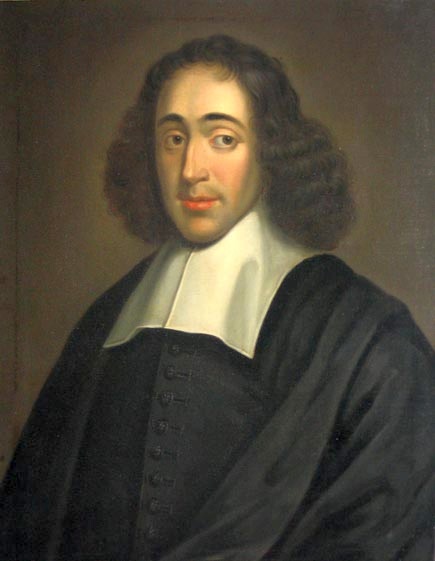
Benedict Spinoza
Credit: Wikipedia
It’s really the Enlightenment’s fault. Ever since René Descartes decided the best catalyst for rational inquiry was skepticism, the skepticism supposedly necessary to reason and the faith integral to religion have been regularly presented as at odds with each other, or, at the very least, best quarantined from each other. Consider this from Descartes devotee and Old Testament critic, Benedict Spinoza:
Those who do not know how to distinguish philosophy from theology dispute as to whether Scripture should be subject to reason or whether, on the contrary, reason should be the servant of Scripture: that is to say, whether the sense of Scripture should be accommodated to reason or whether reason should be subordinated to Scripture … It is obvious that both are absolutely wrong. For whichever position we adopt, we would have to distort either reason or Scripture since we have demonstrated that the Bible does not teach philosophical matters but only piety, and everything in Scripture is adapted to the understanding and preconceptions of the common people.[1]
Spinoza passionately contends that reason and religion must be kept in two separate spheres. If they are not, he warns, Scripture will distort reason and reason will distort Scripture. But key to understanding Spinoza’s argument for the separation of Scripture and reason is why these two entities distort each other. “Scripture,” Spinoza explains, “is adapted to the understanding and preconceptions of the common people.” Spinoza assumes that the biblical characters of antiquity did not have the intellectual faculties necessary to imbibe the great rational truths of the Enlightenment. Spinoza elsewhere explains:
God adapted His revelations to the understanding and opinions of the prophets [and other biblical authors as well], and that the prophets could be ignorant of matters of purely philosophical reason that are not concerned with charity and how to live; and indeed they really were ignorant in this respect and held contradictory views. Hence knowledge about natural and spiritual matters is by no means to be sought from them.[2]
Isn’t that nice. God would have revealed matters of rational, philosophical reason to the biblical writers, but because they were not smart enough to understand them, God had to stick with giving them moral platitudes about “charity and how to live.” Thankfully, Spinoza does understand the truths of rational philosophy and can explain them to us full-throatedly.
Unfortunately, Spinoza’s parings of reason with intelligence and religion with ignorance are still assumed in and normative to the thinking of our day. Consider this from the Huffington Post:
Are religious people less intelligent than atheists?
That’s the provocative conclusion of a new review of 63 studies of intelligence and religion that span the past century. The meta-analysis showed that in 53 of the studies, conducted between 1928 to 2012, there was an inverse relation between religiosity – having religious beliefs, or performing religious rituals – and intelligence. That is, on average, non-believers scored higher than religious people on intelligence tests.
What might explain the effect?
Scientists behind studies included in the review most often suggested that “religious beliefs are irrational, not anchored in science, not testable and, therefore, unappealing to intelligent people who ‘know better.’”[3]
Now, the rules of rational and, for that matter, statistical inquiry remind us that correlation does not equal causation. So, to surmise that religious beliefs decrease IQ from a study that happens to show some people with religious beliefs have lower IQ’s than those without religious beliefs is suspect at best. Indeed, Jordan Silberman, a co-author of the study, admitted as much to the Huffington Post:
I’m sure there are intelligent religious people and unintelligent atheists out there … The findings pertain to the average intelligence of religious and non-religious people, but they don’t necessarily apply to any single person. Knowing that a person is religious would not lead me to bet any money on whether or not the person is intelligent.
Silberman concedes that there are many anomalies that counter his correlation between religious belief and lower IQ’s, which speaks forcefully against any kind of causation. Thus, this study gives us no real insight into to whether or not religion and rationality are truly at odds with each other.
So why do I bring all of this up? Because, regardless of whether or not it is true, firmly ingrained into our society’s zeitgeist is the narrative that religion and reason are irreconcilable. I, however, believe this to be false. Christians can make full use of their rational faculties without having to sell their faith to the strictures of a seventeenth century movement and its incorrigible assumptions concerning the incompatibility of reason and religion. Regardless of any assumptions bequeathed to us by the Enlightenment, we know that we have far more than just reason or just religion, “we have the mind of Christ” (1 Corinthians 2:16). And His mind bridges both reason and religion. After all, His command created both reason and religion.
[1] Benedict Spinoza, Theological-Political Treatise, Michael Silverthorne & Jonathan Israel, trans. (Cambridge: Cambridge University Press, 2007), 186.
[2] Spinoza, Theological-Political Treatise, 40.
[3] Macrina Cooper-White, “Religious People Branded As Less Intelligent Than Atheists In Provocative New Study,” The Huffington Post (8.14.2013).
Waiting To Be Adopted

15-year-old Davion Only with his caseworker
Credit: Tampa Bay Times
It’s heartwarming and heartbreaking all at the same time. 15-year-old Davion Only attended St. Mark Missionary Baptist Church in St. Petersburg, Florida on a recent Sunday with a request: “Somebody, anybody, please adopt me.” Lane DeGregory of the Tampa Bay Times sets the scene of this boy’s dark past:
Davion Navar Henry Only loves all of his names. He has memorized the meaning of each one: beloved, brown, ruler of the home, the one and only.
But he has never had a home or felt beloved. His name is the last thing his parents gave him.
He was born while his mom was in jail. He can’t count all of the places he has lived.
In June, Davion sat at a library computer, unfolded his birth certificate and, for the first time, searched for his mother’s name. Up came her mug shot: 6-foot-1, 270 pounds – tall, big and dark, like him. Petty theft, cocaine.
Next he saw the obituary: La-Dwina Ilene “Big Dust” McCloud, 55, of Clearwater, died June 5, 2013. Just a few weeks before.[1]
It’s hard to imagine how this young man’s childhood could have been more heart-rending.
By Davion’s own admission, he has had rage problems in the past. His caseworker once took him to a picnic hosted by an organization devoted to helping foster kids find permanent homes, but he lashed out – throwing chairs and pushing people away. But the death of his mother changed him:
When he learned his birth mother was dead, everything changed. He had to let go of the hope that she would come get him. Abandon his anger. Now he didn’t have anyone else to blame.
“He decided he wanted to control his behavior and show everyone who he could be,” [his caseworker] said.
So someone would want him.
The only thing more heartbreaking than the story of Davion’s past is that state of Davion’s present, encapsulated in this one line: “So someone would want him.”
There’s a reason the Bible often uses adoption as a descriptor for the Gospel. Paul writes, “But when the fullness of time had come, God sent forth His Son, born of woman, born under the law, to redeem those who were under the law, so that we might receive adoption as sons” (Galatians 4:4-6). Elsewhere in his writings, Paul makes it clear that God’s adoption of us as His children is in no way based on our desirability. Quite the contrary. Paul minces no words explaining just how undesirable we are: “None is righteous, no, not one; no one understands; no one seeks for God. All have turned aside; together they have become worthless; no one does good, not even one” (Romans 3:10-12). Our adoption as God’s children is not based on our desirability, but on His grace.
The Gospel, then, is this: We do not have to wait for someone to want us. For we know that someone does want us – so much, in fact, that He’s willing to die for us.
Lane DeGregory’s article ends with this postscript: “At publication time, two couples had asked about Davion, but no one had come forward to adopt him.” Praise be to God that when we are slow to adopt, our Lord is not. He signed the papers for us 2,000 years ago.
[1] Lane DeGregory, “An orphan goes to church and asks someone, anyone to adopt him,” The Tampa Bay Times (10.15.2013).
You Don’t Want To Be Number One

“Moses with the Tablets of the Law” by Rembrandt, 1659
Credit: Wikipedia
Idolatry is rampant in our society. And this is no surprise. After all, people have loved to worship, serve, and trust in gods of their own making for millennia now. From money to sex to power to education to an obsession with whatever rights we think we’re supposed to have, we have no shortage of gods on hand and in our hearts. And idolatry begins when we are young.
I remember a chapel service I conducted for a childcare center at the church I used to serve. I was talking to the kids about the First Commandment, which I paraphrased like this: “God is number one.” It was with this paraphrase that I heard a little two year old voice pipe up from the back of the room: “No!” the voice protested, “I’m number one!” I was taken aback. So I tried to clarify: “You are special and important,” I said, “But God is number one. He’s number one over everything.” The voice, however, wasn’t buying it. “No! I’m number one!” it fired back.
By the end of my chapel message, it was almost comical. Whenever I said, “God is number one,” this little voice would respond, “No! I’m number one!” It seems the idolatrous desire to take God’s place is ingrained in us from the earliest of years.
Martin Luther comments on the First Commandment:
Now this is the work of the First Commandment, which enjoins, “Thou shalt have no other gods.” This means, “Since I alone am God, thou shalt place all thy confidence, trust, and faith in Me alone and in no one else.”[1]
I love how Luther describes the spirit of the First Commandment not in terms of obedience, but in terms of faith. In the First Commandment, Luther explains, God invites us to trust in Him rather than in the idols we make for ourselves. Why? Because the idols we make for ourselves take from us, hurt us, and condemn us. The true God, however, gives to us, blesses us, and saves us. Idols pain us. The true God comforts us.
The pain of idolatry becomes especially acute when the idols we make for ourselves happen to be ourselves. When we are our own gods, we are inevitably left disparaging and hating ourselves, for we fail ourselves and find that we are not the kinds of gods we need ourselves to be.
The First Commandment, then, is not just a dictate, but a promise – a promise that we do not have to worry about running everything as number one gods. The real God already has that number one spot – and all the responsibility and peril that comes with it – covered. So don’t just obey the First Commandment, have faith in the One who issues it. For it is only by faith that this commandment is kept.
[1] Martin Luther, Luther’s Works, vol. 44, J. J. Pelikan, H. C. Oswald & H. T. Lehmann, eds. (Philadelphia: Fortress Press, 1966), 30.
I Don’t Want To Grow Up
 It used to be just a fanciful myth. Now, it’s a psychological reality. When the Spanish conquistador Juan Ponce de León came to believe some waters at Bimini, the westernmost islands of the Bahamas, could reverse aging and restore youthfulness, he set out on an expedition to find what we have come to know as the Fountain of Youth.
These days, we don’t need a fountain to enjoy perpetual youth, just a psychological pronouncement. An article published in BBC News chronicles the shift in the way psychologists are viewing youthful adolescence. Sarah Helps, a clinical psychologist, explains:
We used to think that the brain was fully developed by very early teenagerhood and we now realise that the brain doesn’t stop developing until mid-20s or even early 30s. There’s a lot more information and evidence to suggest that actually brain development in various forms goes on throughout the life span.[1]
It is with this research in mind that child psychologists have now identified three stages of adolescence: early adolescence from 12-14 years, middle adolescence from 15-17 years, and late adolescence after 18 years. Notice there is no upper limit on late adolescence. Adolescence, it seems, can now extend into an indeterminable future. We can be forever young. Bob Dylan would be ecstatic.
This is quite a shift from the beginning of the twentieth century when, according to columnist Diana West, “Children in their teen years aspired to adulthood; significantly, they didn’t aspire to adolescence.”[2] It used to be children wanted to leave adolescence as quickly as they could so they could enjoy the promising perks of adulthood. Now, more and more grown-ups are eschewing adulthood, with all of its responsibilities, for the nostalgic perks of childhood.
I am not going to argue against scientific evidence that suggests the human brain continues to develop into the late 20s and 30s. This is, I am certain, true. But this does not mean that, even while brains are developing, these “late adolescents” are somehow incapable of living – or should not be living – as reasonably developed adults. Indeed, in any area of life, challenge is necessary for development. If one wants to develop physical strength, he must endure challenging workouts. If one wants to increase intellectual acumen, she must challenge herself with reading, researching, and thinking. If one wants to develop in maturity, he must challenge himself to live as an independent, responsible adult rather than as a dependent, carefree child.
Perhaps it is Gary Cross, Distinguished Professor of Modern History at Penn State University, who states the problem with the increasingly delayed transition into adulthood most succinctly when he writes of young men who refuse to leave the thrills of adolescence: “The culture of the boy-men today is less a life stage than a lifestyle, less a transition from childhood to adulthood than a choice to live like a teen ‘forever.’”[3] Brain development may indeed be a product of psychological biology. Maturity and immaturity, however, are consequences of moral volition.
Choose wisely.
[1] Lucy Wallis, “Is 25 the new cut-off point for adulthood?” BBC News Magazine (9.23.2013).
[2] Diana West, The Death of the Grown-Up: How America’s Arrested Development Is Bringing Down Western Civilization (New York: St. Martin’s Press, 2007), 1.
[3] Gary Cross, Men to Boys: The Making of Modern Immaturity (New York: Columbia University Press, 2008), 5.


 Pastor Zach's Blog