Posts tagged ‘Religion’
Oh, Those Good Ole Days
 Recently, the New York Times featured a sanguine article on the value of nostalgia. In a culture that tends to obsess over the “next big thing,” it turns out that “old small things” are worth remembering and celebrating. Journalist John Tierney explains:
Nostalgia has been shown to counteract loneliness, boredom and anxiety. It makes people more generous to strangers and more tolerant of outsiders. Couples feel closer and look happier when they’re sharing nostalgic memories. On cold days, or in cold rooms, people use nostalgia to literally feel warmer.[1]
Of course, nostalgia has not always been so appreciated:
Nostalgia was originally described as a “neurological disease of essentially demonic cause” by Johannes Hoffer, the Swiss doctor who coined the term in 1688. Military physicians speculated that its prevalence among Swiss mercenaries abroad was due to earlier damage to the soldiers’ ear drums and brain cells by the unremitting clanging of cowbells in the Alps.
Even now, many psychologists mistake a case of nostalgia – often brought on by a major life transition when people understandably pine for parts of their past – for depression.
Nostalgia, though often underappreciated in our world, held primacy of place in the lives of the ancient Israelites. In fact, one of the most common commands of the Old Testament is to be nostalgic – to remember:
- Remember that you were slaves in Egypt and that the LORD your God brought you out of there with a mighty hand and an outstretched arm. (Deuteronomy 5:15)
- Remember how the LORD your God led you all the way in the wilderness these forty years, to humble and test you in order to know what was in your heart, whether or not you would keep his commands. (Deuteronomy 8:2)
- Remember the wonders [the LORD] has done, His miracles, and the judgments He pronounced. (Psalm 105:5)
Over and over again, the LORD asks His people to remember what He has done for them. Why?
For the ancient Israelites, remembering was more than taking a nostalgic trip from the present to the past; remembering actually made the past into the present. Indeed, whenever the Jews celebrated the Passover, they recited the Haggadah, a Hebrew word meaning “telling.” The Haggadah recounted the mighty acts of the Lord the night He brought them out of their harsh slavery in Egypt. A key line in the Haggadah read:
In every generation, a person is obligated to regard himself as if he had left Egypt. It was not only our ancestors whom the Holy One, blessed be He, redeemed from Egypt; rather, He redeemed us, as it is stated: “He brought us out from there, so that He might bring us to the land He promised our fathers, and give it to us.”[2]
The Jews believed that when they remembered what God had done, they not only recalled God’s acts in the past, they became the beneficiaries of those acts in the present. One cannot help but think of the Haggadah that Jesus gave His disciples, also on a Passover night, when He said, “Do this in remembrance of Me” (Luke 22:19). When we partake of the Lord’s Supper, we do not just remember what Jesus did in the past, we receive the benefits of His very body and blood in the present.
For the Christian, nostalgia is a good thing because remembering is a good thing. But nostalgia is more than nostalgia when it reflects on what God has done in Christ. For what Christ has done in the past still blesses us – and saves us – in the present.
[1] John Tierney, “What Is Nostalgia Good For? Quite a Bit, Research Shows,” New York Times (7.8.2013).
[2] “Text of the Haggadah,” Eliyahu Touger, trans.
Where Human Justice Cannot Tread: The Case of Trayvon Martin & George Zimmerman

Credit: The Associated Press
We will never know for sure what happened.
Well, we will never know for sure all that happened. There are a few things we do know. We do know that on the night of February 26, 2012 in Sanford, Florida, an altercation took place between Trayvon Martin and George Zimmerman. We do know that this altercation left Trayvon Martin dead of a single gunshot wound, fired at intermediate range. We do know that George Zimmerman was the shooter. And we do know that on Saturday, July 13, Zimmerman was found “not guilty” of both the charges of second-degree murder and of manslaughter.
As the trial of George Zimmerman unfolded before a nation of breathless spectators, it became clear to many pundits and reporters – regardless of how these pundits and reporters hoped this case would turn out – that the prosecution was in trouble. Consider this from ABC News:
Prosecutors started strong with a powerful, concise opening statement from Assistant State Attorney John Guy, in contrast to the silly knock-knock joke and seemingly disorganized and meandering defense argument …
But then something happened that many would have thought improbable as this case received wall to wall coverage leading up to Zimmerman’s arrest.
What the state hoped would be proof that Zimmerman initiated the altercation and that he, not Martin, was on top as they grappled on the ground, did not appear to proceed as planned …
With each witness there were either facts that we now know are not true (like hearing three shots, when there was only one) or indications that their memories have somehow become clearer since the incident itself.[1]
The prosecution’s witnesses, in their testimonies of what happened that night, gave conflicting and confusing accounts. Coupled with the fact that the burden to prove that Zimmerman shot Martin in something other than self-defense rested on the prosecution, the prospects for a conviction were grim for the state. Again, ABC News summarized the prosecution’s problem well:
Prosecutors still have to prove beyond a reasonable doubt that Zimmerman did not “reasonably believe” he was “in imminent danger of death or great bodily harm” during their altercation. That is a heavy burden to bear.
It turns out, as the verdict this past Saturday revealed, that it was a burden too heavy to bear.
Along with the wide range of human emotions that a trial such as this one elicits, this trial has also exposed the limits of human justice. The jury found George Zimmerman “not guilty.” This does not necessarily mean that Zimmerman committed no crime. It simply means that, in the opinions of the jurors, there was not enough evidence to demonstrate beyond a reasonable doubt that he was guilty of a crime. The jurors’ verdict does not pretend or presume to rule on George Zimmerman’s guilt or innocence as a matter of fact. It simply says that Zimmerman will not be incarcerated as a matter of the law.
The justice of our God is much more comprehensive and, as strange as it sounds, just than the justice of our courts. For our God is concerned with infinite transcendent justice rather than with limited legal justice. Indeed, our God is passionate about justice. God shouts in Amos 5:24: “But let justice roll on like a river, righteousness like a never-failing stream!” Where human justice falls short, God’s justice does not.
Ultimately, regardless of the verdict, the justice rendered in that Florida courtroom can only be provisionary and incomplete. Even if George Zimmerman had been found guilty, his incarceration would not have undone the painful problem of death, which is finally what this case – and every murder case – is all about. But the painful problem of death cannot be solved in any courtroom; it can only be solved on a cross. Only Jesus can bring justice to death by conquering it with His life – a life that will finally and fully be revealed on the Last Day.
So while a Florida court has ruled, we are still waiting for Jesus to rule – or, to put it more clearly, to reign – when He returns on the Last Day. And, blessedly, the justice He will bring on that day will be far better than the justice we have in these days. For His justice does much more than merely rule on tragedies; His justice fixes them.
[1] Dan Abrams, “George Zimmerman’s Prosecution Woes: Analysis,” ABC News (7.1.2013).
Righteous
 This weekend in worship and ABC, we learned about the doctrine of justification which teaches that our righteousness before God is not a product of ourselves and our works; rather, it is a free gift from God, given to us by the work of Christ on the cross. As the apostle Paul writes, “[We] are justified freely by [God’s] grace through the redemption that came by Christ Jesus” (Romans 3:24).
Throughout the history of the Church, some have tried to undercut this doctrine of God’s work with human works. The Pelagians, for instance, taught that by obeying God’s commands, people could gain favor in God’s sight. The Synergists taught that justification was not a gift of God’s righteousness exclusively, but a comingling of God’s righteousness with human righteousness. In the face of such unbiblical teachings, Martin Luther offers this important reflection on justification as God’s work and not as ours:
The world wants to win heaven from our Lord God by right, although He is causing the message to be proclaimed aloud throughout the world that He wants to give it to us for nothing. He says: “I want to be your God; out of grace and for nothing I want to save you … I will not let you win heaven from Me. Therefore make no other gods, do not invent things that you do for yourself … Do not begin with your good works; allow Me to have mercy on you.” It certainly is a shame that people must accuse us being unwilling to accept heaven for nothing, nay, of actually wanting to earn it and of proposing to give to God, to Him who desires to offer everything to us in plenty. Such fools are we: we want to give what we ought to take.[1]
We bring nothing to our righteous standing before God – no good work, no pious thought, no warm heart. Instead, God supplies any and all righteousness we need through His Son. This is the doctrine of justification. This is the promise of the gospel. And this is the cornerstone of our faith.
May we never seek to add our works to God’s work. After all, it is God’s work – and His work alone – that saves us.
[1] Martin Luther, What Luther Says, Ewald M. Plass, comp. (St. Louis: Concordia Publishing House, 1959), §2207.
The Downfall of DOMA
 The headline was welcomed with both cheers and tears: “Supreme Court strikes down Defense of Marriage Act.”[1] For some, this ruling was a welcomed vindication – and indication that the argument for same-sex marriage had not only won the day in the Supreme Court, but in the court of public opinion. Others were saddened and even embittered. Former Arkansas Governor and presidential candidate Mike Huckabee tweeted: “My thoughts on the SCOTUS ruling that determined that same sex marriage is okay: ‘Jesus wept.’”[2]
So how is a Christian to respond to this ruling? There are two things I believe that are paramount to any Christian’s response.
The first is humility. Responding with bravado – either for or against this ruling – is not helpful. Whether it be the raucous celebrations of many of this ruling’s supporters or the vitriolic denouncements of many of this ruling’s detractors, anything less than a humble and gentle spirit leads to combat rather than conversation. And as I have written elsewhere, simply trying to win against each other rather than listening to each other means that no matter who supposedly “wins,” everybody loses.[3]
The second thing needed is honesty. Christians need not compromise moral conviction when it comes to human sexuality. We simply must hold to our convictions humbly rather than haughtily. The biblical moral vision for human sexuality is clear: sexual intimacy is to be reserved for a husband and wife in the lifelong covenant of marriage (cf. Genesis 2:24-25). Deviations from this – be they fornication, adultery, or homosexuality – are prohibited by Holy Writ. It’s okay to say this. It’s okay to stand up for this. It’s okay to make a moral pronouncement on marriage.
Indeed, as I have thought through the court’s ruling on DOMA, I find Justice Kennedy’s majority opinion to have far reaching moral implications:
The avowed purpose and practical effect of the law here in question are to impose a disadvantage, a separate status, and so a stigma upon all who enter into same-sex marriages made lawful by the unquestioned authority of the States.
The history of DOMA’s enactment and its own text demonstrate that interference with the equal dignity of same-sex marriages, a dignity conferred by the States in the exercise of their sovereign power, was more than an incidental effect of the federal statute. It was its essence. The House Report announced its conclusion that “it is both appropriate and necessary for Congress to do what it can to defend the institution of traditional heterosexual marriage. … H. R. 3396 is appropriately entitled the ‘Defense of Marriage Act.’ The effort to redefine ‘marriage’ to extend to homosexual couples is a truly radical proposal that would fundamentally alter the institution of marriage.”… The House concluded that DOMA expresses “both moral disapproval of homosexuality, and a moral conviction that heterosexuality better comports with traditional (especially Judeo-Christian) morality.” … The stated purpose of the law was to promote an “interest in protecting the traditional moral teachings reflected in heterosexual-only marriage laws.”[4]
In Justice Kennedy’s opinion, DOMA was drafted and passed into law with the express purpose of interfering “with the dignity of same-sex marriages.” How does he know this? Because DOMA demonstrates “both moral disapproval of homosexuality, and a moral conviction that heterosexuality better comports with traditional (especially Judeo-Christian) morality.” In other words, Justice Kennedy claims that the Judeo-Christian morality in which DOMA is grounded diminishes the dignity of same-sex marriages. Such a diminishment cannot be tolerated. It is, in a word, illegal. This is why DOMA must be overturned.
The duty of the Supreme Court justices is to render legal decisions. But every legal decision carries with it an indissoluble moral component. In this instance, this legal decision’s moral component is in the declaration that a law based on the Judeo-Christian sexual moral standard is discriminatory and illegal. Such a pronouncement replaces the Judeo-Christian sexual moral standard with a sexual moral standard of its own – one that is open to same-sex marriage while still, interestingly enough, discriminating against other forms of marriage (e.g., polygamy). Thus, what Justice Kennedy and the Supreme Court majority have done is issued not only a legal opinion, but a moral valuation.
Laws are irreducibly moral. Laws against murder or perjury or theft inevitably promote some vision of what morality is and means. Thus, even the justices of the Supreme Court cannot render a strictly amoral legal verdict on whether or not to federally recognize same-sex marriages. What they declare on this issue will always, in some way, involve judgments of and on morality. The question we must ask ourselves is, “Is the morality of the Supreme Court majority the right morality?”
Justice Kennedy has given his answer. What’s yours?
[1] Pete Williams & Erin McClam, “Supreme Court strikes down Defense of Marriage Act, paves way for gay marriage to resume in California,” NBCNews.com (6.26.2013).
[2] Mike Huckabee, twitter.com/govmikehuckabee (6.26.2013).
[3] Zach McIntosh, “The State Of Our Public Debate: Same-Sex Marriage As A Test Case,” zachmcintosh.com (4.8.2013).
[4] United States v. Windsor, 570 U. S. 1 (2013).
Dodging Dating Disasters
 Recently, I was talking to a friend who is in the throws of the dating scene. Over the course of our conversation, it began to strike me just how complicated, frustrating, and frightening dating really can be. Her past few dates had not gone so well. And she was beginning to lose hope. “All the good ones are taken,” she said with a definite edge of resignation. “I’m just going to have to take what I can get.”
The more I pondered her statement, the more concerned I became. Her willingness to just “take what she can get” seemed to be nothing but a setup for a let down. After all, if her past few dates had ended poorly because she just settled for what she could get, how much worse would things go if she married someone just because he was all she thought she could get at the time?
Over the years, I have shared with people a taxonomy that helps them consider who to date and who not to date. The interesting thing about this taxonomy is that it is one we all use or have used, but we often use it only subconsciously. Pulling this taxonomy from our subconscious to our conscious, however, can help us identify our patterns of thinking and, hopefully, save us from dating disaster. So it is with this in mind that, if you are dating or would like to date, I would encourage you take a moment and create a three-column list.
Column 1: What I want.
In this column, simply write honestly what you would like in a companion. And don’t sugarcoat it. If you’re a lady who wants the guy who looks like a cross between The Rock and Vin Diesel, write that down. If you’re a guy who wants the girl with the perfect hourglass shape, write that down. Hopefully, you also have some more modest and meaningful desires for a companion as well – someone who has a good sense of humor, a deep intuition, or a knack for solving big problems.
Column 2: What I need.
In this column go the non-negotiables. The non-negotiables include items such as faithfulness, forgiveness, commitment, and, of course, a hearty trust in the Lord. Think long and hard about this column and try not to confuse what you actually need with what you think you need. For instance, you may think you need someone who meets some predetermined standard of outward beauty so that you will be intensely physically attracted to them. But though physical attraction is important, outward beauty inevitably changes and fades. Thus, striking outward beauty is not really needed – even if you think it is – because it cannot be kept.
Column 3: What I’ll settle for.
In this column go the compromises you are willing to make. And as I did in the first column of what you want, I would encourage honesty. Sadly, many people are willing to make compromises morally to try to make a dating relationship work, engaging in intimate acts that are rightly reserved for marriage. But, of course, not every compromise is immoral or embarrassing. Some compromises are neutral. For instance, if you want a person with a good sense of humor, but wind up dating someone who couldn’t deliver the punch line to a joke to save their life, that’s a compromise, but can your significant other’s lack of humor can also become endearing in its own right.
Now, think about each of your three columns and consider these questions:
- How does column three affect column one? Are there any things you want in a mate that you could live without? If so, this is good! This means that you know your wants are just that – wants – and not necessities.
- How does column one affect column three? Are there any wants on which you should be willing to at least consider a compromise, but you’re not, thereby treating a want from column one like a need from column two? If so, you are in a danger zone. For when you refuse to even think about compromising on a want, you are putting your desires ahead of another person. And this is selfishness, which leads only to relationship breakdown.
- How does column three affect column two? Are there any things you know you need on which you are willing to compromise? If so, you are in a danger zone. Compromising on things like integrity, faithfulness, or faith is a recipe for a relationship disaster and great emotional and spiritual harm.
- How does column one affect column two? Are there any things that you want in a relationship that are opposed to what you need? For instance, if you want someone with good looks, does this tempt you to become shallowly infatuated over how a person looks on the outside rather than being committed to who they are on the inside? If so, you are again in a danger zone. The righteous needs in column two should always trump the desired wants in column one.
As you can see, what matters most is column two. Columns one and three are both negotiable. This is why when I counsel those who are dating, I encourage them to give on columns one and three, but not on column two. For column two holds the keys to long-lasting relationships.
So if you’re dating, or getting ready to enter the dating scene, think on these things. Taking just a few moments to fill out these columns now can save you a lot of pain and heartache in the future because these columns can help you keep your priorities straight. And keeping your priorities straight can help keep your heart in tact.
The Bible Is All About ___________
 The Bible is all about __________.
How you fill in this blank makes a big difference in how you approach not only the Bible, but your life as a believer in Christ.
I have no doubt that most Christians would fill in the blank with “Christ.” After all, a respectably orthodox theology demands no other answer. “The Scriptures…testify about Me,” Jesus declares (John 5:39). But what we say about the Bible and what we want to know from the Bible are often two very different things.
I once had a lady who felt the need to give me some preaching advice following one of my sermons. “The problem with you,” she began, “is that you always end your sermons the same way: by talking about Jesus. I already know what Jesus did,” she continued. “I want to hear about what I need to do to live a better and successful life!” She expressed publicly the way a lot of people feel secretly. To learn about Jesus is fine and good, but what we really want is to learn about ourselves – how we can be successful.
Tullian Tchividjian, pastor of Coral Ridge Presbyterian Church, calls such a desire “reading the Bible narcissistically.” He explains:
We often read the Bible as if it were fundamentally about us: our improvement, our life, our triumph, our victory, our faith, our holiness, our godliness. We treat it like a book of timeless principles that will give us our best life now if we simply apply those principles. We treat it, in other words, like it’s a heaven-sent self-help manual…Even our devout Bible reading can become fuel for our own narcissistic self-improvement plans, the place we go for the help we need to “conquer today’s challenges and take control of our lives.”[1]
But this is not the purpose of the Good Book. The Bible is not about us being better. It’s about Jesus being perfect.
“But what about me?” someone may protest. “I have concerns I need answered! And they’re not just concerns about how I can go to heaven after I die, they’re concerns about how to deal with things while I’m still alive!”
This is where we can modify how we fill in the blank a little bit. Because the Bible is indeed all about Jesus. But Jesus came for us. Jesus lived for us. Jesus died for us. And Jesus rose for us. The Bible is all about Jesus who just happens to be for us.
Tchividjian continues:
The Bible is one long story of God meeting our rebellion with His rescue; our sin with His salvation; our failure with His favor; our guilt with His grace; our badness with His goodness.
The problem with the way so many people approach the Bible is that they skip over Jesus to get to themselves. The Bible is indeed about us, but it’s about us in light of Jesus. And it is when we read the Bible in light of Jesus that we discover that we are more deeply sinful than we ever thought, unable to improve our lives under our own power and will, and Jesus is more magnificently gracious than we ever imagined, able to save us from our sin and our selves. You see, Jesus is not only the key to reading the Bible correctly, He is the key to reading ourselves correctly – as sinners in need of a Savior. It is when we see Him as the center of the Scriptures that we find we need Him as the Savior of our lives.
[1] Tullian Tchividjian, “Reading The Bible Narcissistically,” The Gospel Coalition (6.10.2013).
The Law of Retaliation
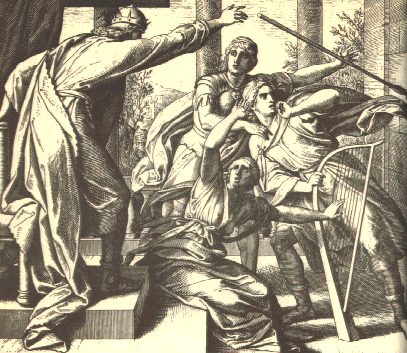
“Saul Tries to Kill David” by Julius Schnorr von Karolsfeld, 1850’s, Wikimedia Commons
This past weekend in worship and ABC, we discussed the importance of friendship. Every person needs a friend for encouragement, for challenge, and for consolation. In the words of Proverbs 17:17: “A friend loves at all times, and a brother is born for adversity.” For good times and for bad, everyone needs a friend.
Perhaps the most famous example of friendship in the Bible is that of David and Jonathan. These two guys far more than just bar buddies. 1 Samuel 18:1 describes their relationship like this: “The soul of Jonathan was knit to the soul of David.”
Though David and Jonathan’s friendship was strong, it was also fraught with peril. Jonathan’s dad, Saul, the king of Israel, hated David and wanted to kill him. But Jonathan was so deeply devoted to his friend that he went to bat for him, telling his father:
“Let not the king sin against his servant David, because he has not sinned against you, and because his deeds have brought good to you. For he took his life in his hand and he struck down the Philistine, and the LORD worked a great salvation for all Israel. You saw it, and rejoiced. Why then will you sin against innocent blood by killing David without cause?” (1 Samuel 19:4-5)
In my sermon, I talked about how Jonathan, in order to defend his friend, appeals to the lex talionis, a Latin phrase referring to the “law of retaliation.” This law is classically expressed in Leviticus 24:19-20: “If anyone injures his neighbor, as he has done it shall be done to him, fracture for fracture, eye for eye, tooth for tooth; whatever injury he has given a person shall be given to him.” This law, of course, is not meant to promote violence, but to contain it. The lex talionis stipulates that “the punishment must fit the crime.” If someone takes your eye, you can’t take his arm. The example I used in my sermon is, “If someone steals $100 from you, you can’t sue him for $1 million because of emotional pain and suffering.”
The way Jonathan uses the lex talionis in 1 Samuel 19 is especially fascinating. For rather than appealing to the lex talionis responsively to punish a crime, he appeals to it preemptively to prevent a crime. Jonathan’s essential argument to his father is this: “You can’t kill David! The law of retaliation says you can only hurt someone if he first hurts you! And David hasn’t hurt you!”
I have gained a deep appreciation for Jonathan’s argument to his father because Jonathan essentially turns the lex talionis into a catch 22. You can hurt someone, but only if he hurts you first. Someone else can hurt you, but only if you hurt him first. This means no one can hurt anyone because no one can make the first move to hurt someone because, by sheer chronological necessity, there would be no prior just cause for such an injury, thus breaking the lex talionis! Far more than regulating violence, the lex talionis prevents it.
This use of the lex talionis is nicely in line with Jesus’ commentary on the rule: “You have heard that it was said, ‘An eye for an eye and a tooth for a tooth.’ But I say to you, Do not resist the one who is evil. But if anyone slaps you on the right cheek, turn to him the other also” (Matthew 5:38-39). Jesus essentially says, “Even if you are unjustly wounded, never give anyone a reason to use the lex talionis on you. Self-control, even in the midst of terrible adversity, is paramount. If you don’t hurt someone else, then that other person has no ground on which to stand if he hurts you.”
What tensions and quarrels do you have with others? The best way to end them is to refuse to give the person with whom you are in conflict any reason to retaliate. Your cool and collected response to someone who is angry may just be what diffuses a fight, ends a conflict, and restores a friendship.
Remembering the Lost
 Today, we remember those who sacrificed their lives in service to their country. Memorial Day is always a day full of mixed emotions. On the one hand, we celebrate the bravery, valor, and commitment of these soldiers who were willing to suffer all – even death – to serve our nation. On the other hand, as with any loss of life, we mourn. And we should. After all, in the words of the apostle Paul, death is not only an enemy, but the enemy (cf. 1 Corinthians 15:26). We want death to be defeated. We do not want it to defeat us. But even as we mourn the loss of those we love, we can take heart in the promise of the Gospel that death’s defeat of us is only partial and temporary. It is partial because death destroys only our bodies and not our souls. And it is only temporary because when Jesus returns, He will raise our bodies to live with Him forever.
On this Memorial Day, as we remember our fallen, I would point you to some words from one of our nation’s founding fathers, John Hancock:
I hereby call upon ministers and people of every denomination, to…devoutly and sincerely offer to almighty God, the gratitude of our hearts, for all His goodness towards us; more especially in that He has been pleased to continue to us so a great a measure of health, to cause the earth plentifully to yield her increase so that we are supplied with the necessaries and the comforts of life, to prosper our merchandise and fishery, and, above all, not only to continue to us the enjoyment of our civil rights and liberties, but the great and most important blessing, the gospel of Jesus Christ. And together with our cordial acknowledgments, I do earnestly recommend, that we may join the penitent confession of our sins, and implore the further continuance of the divine protection, and blessings of heaven upon this people; especially that He would be graciously pleased to direct, and prosper the administration of the federal government, and of this, and the other states in the Union, to afford Him further smiles on our agriculture and fisheries, commerce and manufactures, to prosper our university and all seminaries of learning, to bless the virtuously struggling for the rights of men…and to afford his almighty aid to all people, who are established in the world; that all may bow to the scepter of our Lord Jesus Christ, and the whole earth be filled with His glory.[1]
A few things are notable about Hancock’s words here. First, as Hancock would guide us, it is important that we always remember to give thanks. We are called by our Lord, even when times are trying and tenuous, to give thanks to Him for His blessings to us, His presence with us, and, most importantly, His gospel for us. No amount of sin or tragedy can circumvent the good and sturdy promises of almighty God – even the tragedy of losing a loved one in battle. For this, we can be thankful.
Second, Hancock encourages all of us to acknowledge our sinfulness. After all, the sinfulness and brokenness of this world is the reason there are wars. History is littered with tyrants who, rife with evil intent, needed to be defeated in battle so they could not carry out – or, in most instances, continue to carry out – their wicked agendas. When we confess our sins, we do so with the knowledge that the whole earth is broken by sin and needs healing. We also acknowledge that even if we can curb and contain evil thanks to the valiant efforts of our brave troops, we cannot finally defeat it. This can only be done by Christ.
Third, Hancock desires that we pray for the safety and protection of our troops. On a day when we remember lives that have been lost, it is most certainly appropriate to pray that no more will be lost.
Finally, Hancock points us toward the Christian’s hope that, on the Last Day, “all may bow to the scepter of our Lord Jesus Christ, and the whole earth be filled with His glory.” One day, wars will cease. One day, tyrants will be no more. One day, nations will not take up arms against nations. Because one day, all will bow to Jesus and the whole earth will be filled with His glory.
As we remember those who have died waiting and longing for this day, may we ourselves pray that it would come soon so that we may be reunited with those we have lost and celebrate the final defeat of evil in the presence of our Savior.
[1] John Hancock, “Proclamation – Thanksgiving Day – 1791, Massachusetts.”
Our Leadership Lacuna
 The headlines speak for themselves. “Exclusive: Benghazi Talking Points Underwent 12 Revisions, Scrubbed of Terror Reference.”[1] “IRS Admits To Targeting Conservative Groups Over Tax Status.”[2] “Gov’t Obtains Wide AP Phone Records In Probe.”[3] It has not been a good week for our nation’s leaders. And there has been much shock and dismay expressed from people of all political persuasions and stripes. And yet, no matter how large these scandals may loom, there remains a subtle subtext that underscores these immense ignominies. To quote the words of the great George Strait in summary of this subtext: “I’ve come to expect it from you.” This, sadly, is the kind of behavior that we expect from our leaders. It may be scandalous, but it isn’t all that surprising.
So how does the general public respond to these salacious, but unsurprising, scandals? Consider this from TIME’s Zeke Miller and Michael Crowley in response to the AP phone records story:
Conservatives are not often fierce defenders of the media. But Monday’s news that the Justice Department obtained phone records for several Associated Press reporters as part of a national security leak probe raised a furor on the right, causing numerous Republicans to harshly criticize the Obama administration. While some may have genuine concerns about First Amendment protections, the right’s response also spotlighted an emerging Republican critique of Barack Obama as a Big Brother-style tyrant in charge of a power-abusing surveillance state…
Conservatives are now in the odd position of implicitly defending the media’s rights against the imperative of national security secrecy, a cause that didn’t interest them much when the FBI sought media phone records during the Bush years.[4]
Miller and Crowley’s argument runs like this: Republicans defended their own when President Bush went after media phone records, so Democrats may do the same with President Obama. After all, every president and politician bends the rules and compromises on ethics. We simply have to accept this and then back the horse of our own political persuasion while also working to discredit the opposition. After all, that’s the formula for winning elections. One need look no farther than the recent victory of Mark Sanford, just sworn in as South Carolina’s newest Republican congressman, even though a few years earlier he engaged in an illicit affair with an Argentinian woman, insisting that she was his “soul mate,” all while serving as South Carolina’s governor.
Hopefully, a Christian can see right through this kind of shameful political jockeying. As my mother used to tell me, “Two wrongs don’t make a right.” You can’t justify your group’s bad behavior by pointing to the bad behavior of another group.
So then, how should the Christian react and respond when corruption and scandal among our rock our nation’s leaders? First, no matter what our political persuasion, we can honestly, but also compassionately, call these types of scandals what they are: sinful. Second, rather than buying into the talking points, spin rooms, and damage control strategies, we can honestly, but also compassionately, call for repentance from our leaders. The best way to deal with sin is not to minimize or excuse it, but to confess it! Finally, even if our leaders in Washington are not the kind of leaders our nation and world needs, we can be the kind of leaders our nation and world needs. We can lead in our sphere of influence with integrity and character and with repentance when we falter and fail. We can seek to lead the way King David sought to lead Israel: “And David shepherded them with integrity of heart; with skillful hands he led them” (Psalm 78:72).
Even though we cannot control how our leaders lead us, we can control the way we lead others – and ourselves. With God’s help, may we diligently guard the quality and character of our leadership. Our world needs all the faithful leaders it can get.
[1] Jonathan Karl, “Exclusive: Benghazi Talking Points Underwent 12 Revisions, Scrubbed of Terror Reference,” ABC News (5.10.2013).
[2] Zeke J Miller & Alex Altman, “IRS Admits To Targeting Conservative Groups Over Tax Status,” TIME Magazine (5.10.2013).
[3] Mark Sherman, “Gov’t Obtains Wide AP Phone Records In Probe,” The Associated Press (5.13.2013).
[4] Zeke Miller & Michael Crowley, “The New GOP Case Against Obama: He’s Cheney!” TIME Magazine (5.14.2013).
Adam Is For Real
 In 1906, theologian and philanthropist Albert Schweitzer published The Quest of the Historical Jesus, surveying theologians’ attempts to understand who Jesus was historically apart from what Schweitzer thought to be the layers of mythologizing that had been overlaid on Him by the Bible. Schweitzer finally concluded that Jesus saw Himself as One whose suffering and death would bring in the Parousia, or the final appearance of God. In Schweitzer’s own words: “He must suffer for others…that the Kingdom might come.”[1] But Jesus proved mistaken in His imminent expectations of God’s Kingdom and Christianity has been grappling with Jesus’ failed apocalyptic expectations ever since:
The whole history of “Christianity” down to the present day, that is to say, the real inner history of it, is based on the delay of the Parousia, the non-occurrence of the Parousia, the abandonment of eschatology, the progress and completion of the “de-eschatologising” of religion which has been connected therewith.[2]
Interestingly, Schweitzer later abandoned his quest for the historical Jesus, considering it futile. After all, reconstructing who Jesus was apart from and skeptical toward the record of Jesus in the Bible is a tall order!
Over one hundred years after Schweitzer’s quest, Christianity Today published an article titled “The Search for the Historical Adam.”[3] Much like the quest for the historical Jesus a century earlier, this quest seeks to reconstruct who Adam was quite apart from the biblical record of him. But this quest questions not only what Adam did and did not do – for example, “Did he really eat some forbidden fruit?” – this quest questions whether Adam even existed. The argument against Adam’s existence, which is where the shining stars of this quest have broadly landed, runs thusly: because evolution is true, a historical Adam cannot be. Instead, the human race emerged out of the chaos of natural selection, albeit this natural selection was guided by the detached hand of theism, rather than according to the simple and succinct word of the personal Creator.
It is important to note that cries to dispense with a historical Adam are not few and far between, nor are they outside the mainstream of Evangelical Christianity. Consider this argument against the existence of a historical Adam:
What is a “given” for Paul is the saving event of Jesus’ death and resurrection. The other things he says, especially about sin, the Law, and eschatology, are reinterpretations that grow from the fundamental reality of the Christ event. Recognizing this relieves the pressure that sometimes builds up around a historical Adam…We can now recognize that Adam is not the foundation on which the system of Christian faith and life is built, such that removing him means that the whole edifice comes crashing down. Instead, the Adam of the past is one spire in a large edifice whose foundation is Christ. The gospel need not be compromised if we find ourselves having to part ways with Paul’s assumption that there is a historical Adam, because we share Paul’s fundamental conviction that the crucified Messiah is the resurrected Lord over all.[4]
From where does such an argument against the historicity of Adam arise? From J.R. Daniel Kirk, and associate professor at Fuller Theological Seminary, a one-time bastion of classic evangelical orthodoxy. Denying the historical existence of Adam has gone mainstream.
Contrary to the sentiments of many, I would argue that it is theologically and logically necessary for the historical Adam to have existed. It is theologically necessary because no mythical character can account for real sin. And the apostle Paul identifies Adam as the original sinner: “Sin entered the world through one man, and death through sin, and in this way death came to all men, because all sinned” (Romans 5:12). It is logically necessary because it is incoherent to make an argument for Christ’s death and resurrection, boldly contradicting the consensus of the scientific community that dead people do not come back to life, on the one hand while arguing against the historicity of Adam because of the general consensus of the scientific community concerning evolution by natural selection on the other hand.
What Professor Kirk engages in is nothing less than a full on gospel reductionism. That is, Professor Kirk is willing to cede the integrity and veracity of the biblical record on whether or not Adam really existed as long as he can hold on to the gospel that Christ died and rose again. But once one lets go of what the Bible says in general, he will not be able to hold on to what the Bible says about the gospel in specific for long! The church body of which I am a part, the Lutheran Church – Missouri Synod, has explained it this way:
The Gospel is not normative for theology in the sense that beginning with it as a fundamental premise, other items of the Christian system of doctrine are developed as provisional, historically conditioned responses to a given situation which will need to be revised for another situation.[5]
This is precisely what Professor Kirk does in his article. He assumes that we can reinterpret the historicity of Adam for our situation because Paul’s insistence on a historical Adam was only a “provisional, historically conditioned response to a given situation.” But this false view of Adam can only lead to a false view of the gospel. In the words of G.E. Ladd, who was addressing those who were undermining the historicity of the Gospels’ accounts of Jesus’ life:
Jesus was a historical person. His words were historical events. His deeds involved other people; but they were far larger than the boundaries of personal existence. His deeds included interpersonal fellowship, healings of bodies as well as minds. His mission created a new fellowship of men; and this fellowship after the resurrection because the Christian church which has become one of the most influential institutions in Western culture. All of this happened in history; and it is only because certain events first happened in history that other results were experienced in their existential dimension. Existential import results only from historical event.[6]
What is true of Jesus is true of Adam. The existential reality of sin can only be meaningfully explained by an existentially historical Adam. Evangelically orthodox Christians must settle for nothing less.
[1] Albert Schweitzer, The Quest of the Historical Jesus (Mineola, Dover Publications, Inc., 2005), 387.
[2] The Quest of the Historical Jesus, 358.
[3] Richard N. Ostling, “The Search for the Historical Adam,” Christianity Today (6.3.2011).
[4] J.R. Daniel Kirk, “Does Paul’s Christ Require a Historical Adam?” Fuller Theology News & Notes (Spring 2013).
[5] The Commission on Theology and Church Relations of the Lutheran Church – Missouri Synod, “Gospel and Scripture” (November 1972), 9.
[6] G.E. Ladd, The Pattern of New Testament Truth (Grand Rapids: Eerdmans, 1968), 64.


 Pastor Zach's Blog