Posts tagged ‘Religion’
Syria’s Setting the Stage for…the End of the World?

Credit: The New York Times
I had to chuckle. While I was doing research for this blog, an email hit my inbox with an ominous subject line: “History’s final chapter will be written in Jerusalem.” It was a promotion for the latest Christian apocalyptic thriller, matrixing today’s headlines with cherry picked Scripture verses which come together to portend disaster. This email was especially funny to me because I was researching precisely these kinds of doomsday declarations for this post.
These days, of course, doomsday’s ground zero is Syria. And for those who have a penchant for taking ancient prophecies and sensationalizing them in light of current crises, Isaiah 17:1 has taken center stage: “See, Damascus will no longer be a city but will become a heap of ruins.” Joel Rosenberg, author of a new book, Damascus Countdown, is leading the charge of Syrian doom and gloom, writing on his blog, “No, we don’t know that these prophecies will come to pass soon, or even in our lifetime. But yes, it is possible that Isaiah 17 … could come to pass in our lifetime.”[1] Predictably, news outlets are picking up on his new take on this old passage. Everyone from the Huffington Post to USA Today to Fox News to Mother Jones to The Blaze has run stories on Isaiah’s prophecy and its relationship to the current Syrian imbroglio.
For the record, let me say that I highly doubt the prophecy of Isaiah 17 will come to pass in our lifetimes. How can I say this? Because it already has come to pass…over 2,700 years ago. Isaiah originally proffered this prophecy during the Syro-Ephraimite alliance of 735-732 BC. This is why the fates of the Syrians and Ephraimites are linked in verse 3: “The fortified city will disappear from Ephraim, and royal power from Damascus.” Ephraim – that is, northern Israel – made a treaty with Syria in a last ditch effort to defend herself against an immanent attack from Assyria, one of the most menacing superpowers of the eighth century BC. This is why we read in Isaiah 7:2: “Syria is in league with Ephraim.” The alliance did not work. In 732 BC, the Assyrians, led by Shalmaneser, sacked the Syrians, destroying the alliance between Ephraim and Syria. Ten years later, the Assyrians came for Ephraim, and northern Israel was no more. Yet, even after this devastating defeat, God made a promise that His people would endure: “Some gleanings will remain, as when an olive tree is beaten, leaving two or three olives on the topmost branches, four or five on the fruitful boughs” (Isaiah 17:6). Isaiah uses an agricultural metaphor to describe how God’s people, though defeated by the Assyrians, will never be destroyed. There will always be a remnant faithful to Him.
To turn this ancient prophecy, fulfilled some twenty-seven centuries ago, into a modern day harbinger of hopelessness is to do violence to it. Indeed, I am frustrated that many journalists reporting on this story and the debate between those who think this prophecy has already been fulfilled and those who think it is yet to be fulfilled are casting this debate as one between theologians who look at this text literalistically and others who do not. Take, for instance, this line from Time magazine: “Nearly all Biblical scholars … argue that such a literalist interpretation of the text is highly problematic.”[2] The debate over this text is not between those who read this text in a literalistic manner as a prophecy of things to come and those who read it as already being fulfilled in ancient times. Being “literal” or “non-literal” has nothing to do with this debate. Rather, this is a debate over how to handle this biblical text responsibly, carefully looking at its context and seeking to understand this text in the manner Isaiah himself would have understood it. Thus, a responsible reading of this text would note that this oracle against Syria is just one of a series of oracles against places like Philistia, Moab, and Cush, all of which no longer exist. In context, then, it is clear that Isaiah is speaking not of modern day Syrian warfare, but of an attack against the Syria of his day along with attacks against other nations of his day, leading to their demise.
Ultimately, what is happening in Syria is the fulfillment of biblical prophecy, but not of the one in Isaiah 17. Instead, words from Jesus come to mind: “You will hear of wars and rumors of wars, but see to it that you are not alarmed. Such things must happen, but the end is still to come.” (Matthew 24:6). Jesus tells us there will be war. And not just war, but wars. The current conflict in Syria is just one such example. Jesus also tells us that these wars do not mean the end of the world has arrived. Conflicts are indicative that the end is indeed coming, but they are not determinative that the end has come. Finally, and perhaps most importantly, Jesus reminds us that we should not be alarmed at these troubled times. Indeed, instead of fear, we should feel compassion toward those whose lives have been turned upside down by this terrible conflict. The fear mongering that passes for theology in many best selling books is in direct contradiction to Jesus’ admonishment to be not afraid. After all, what do we have to fear? Jesus has the end of the world – and everything leading up to it – taken care of.
We can trust in Him.
[1] Joel C. Rosenberg, “Pastors: here are 24 pages of study notes on Isaiah 17, Jeremiah 49 & the future of Damascus. Please feel free to share with others,” flashtrafficblog.wordpress.com (9.11.2013).
[2] Elizabeth Dias, “Some Evangelicals See Biblical Prophecy In Syrian Crises,” Time (8.29.2013).
The Value of Patience

Credit: baycitizen.org
I am not a patient person. I wish I was, but I’m not sure I really have the patience to learn patience.
The other day I had to go to the DMV to get a registration sticker for my truck. I had renewed my registration online some two months earlier, but my registration sticker never came. When I called inquiring about my vehicle registration, they informed me that the sticker must have gotten lost in the mail and that it was my responsibility to drive to a DMV office and purchase a replacement sticker.
So that’s what I did.
When I arrived, I found two lines. One line took care of vehicle registration renewals and the other line took care of everything else. I was hoping I could wait in the registration renewal line, but because I was not renewing my registration and instead getting a replacement sticker, I had to wait in the other line. Did I mention that the other line was longer and moving much slower?
After over an hour waiting in line, I finally got my sticker. It took less than a minute. Needless to say, I walked out with less than a smile on my face.
I am not a patient person. God, however, is patient. The Bible regularly celebrates God’s patience: “The LORD is compassionate and gracious, slow to anger, abounding in love” (Psalm 103:8). Rather than getting upset easily and quickly, God’s patient love prevails.
For all of God’s patience, it is important to note that even His patience does not last forever. When Israel rebels against God for centuries in wickedness, God warns: “You have rejected me … You keep on backsliding. So I will reach out and destroy you; I am tired of holding back” (Jeremiah 15:6). God will only tolerate unrepentant sin for so long. Such sin will eventually lead to divine judgment. Thus, although we are called to trust God’s patience, we should not try God’s patience.
I got frustrated because I had to wait an hour to get my vehicle registration sticker at the DMV. God has been waiting thousands of years so more and more people might repent and trust in Him. And if God is can wait that long for us, maybe I can wait a little longer for others.
The Endurance of Ethics

Judge G. Todd Baugh
Credit: cnn.com
I’m not quite sure if she really believes what she wrote, or if she is just trying to make a name for herself.
When a Montana high school teacher was found guilty of raping one of his 14-year-old students who, two years later, committed suicide, the judge in the case shocked the victim’s family and all those following the trial when he handed down a sentence of a paltry thirty days in prison. The outrage was quick and hot. “I don’t believe in justice anymore,” the victim’s mother said in a statement. “She wasn’t even old enough to get a driver’s license.” A protest organizer against the judge’s verdict noted, “Judges should be protecting our most vulnerable children … not enabling rapists by placing blame on victims.”[1] It seemed the public disdain for what had transpired – both in the relationship between the teacher and his student and in the sentence that was passed down – was universal.
Except that it wasn’t.
Leave it to Betsy Karasik of the Washington Post to outline – and incite outrage with – an alternative view:
As protesters decry the leniency of Rambold’s sentence – he will spend 30 days in prison after pleading guilty to raping 14-year-old Cherice Morales, who committed suicide at age 16 – I find myself troubled for the opposite reason. I don’t believe that all sexual conduct between underage students and teachers should necessarily be classified as rape, and I believe that absent extenuating circumstances, consensual sexual activity between teachers and students should not be criminalized … There is a vast and extremely nuanced continuum of sexual interactions involving teachers and students, ranging from flirtation to mutual lust to harassment to predatory behavior. Painting all of these behaviors with the same brush sends a damaging message to students and sets the stage for hypocrisy and distortion of the truth.[2]
As I noted at the beginning of this post, I’m not quite sure if Karasik really believes what she wrote, or if she is just trying to make a name for herself. If it’s the latter, she has certainly succeeded. Her words have caused a big stir, as a perusal of the Washington Post’s comments section will readily reveal. Words like “disgusting,” “sick,” and “ridiculous” pepper the comments section of her article.
So why all the outrage over a woman who argues for the legality of teacher-student sexual relations? The answer is traditional ethics. And, more specifically, traditional sexual ethics. In a culture that sanctions all sorts of sexual shenanigans, our ethical compass on statutory rape stands strong. And this is good – not only for the victims of these crimes, but for society at large. Though I do not always agree with the way in which some express outrage at immorality, it is nevertheless important to note how our society’s occasional bursts of ethical outrage indicate that, despite our culture’s best attempts at relativizing and minimizing all sorts of ethical standards, traditional ethical standards just won’t die. They are here to stay.
The nihilist philosopher Friedrich Nietzsche famously sought to replace traditional ethical standards with one ethical standard – that of power. “What is good?” Nietzsche asked, “All that heightens the feeling of power in man, the will to power, power itself. What is bad? All that is born of weakness. What is happiness? The feeling that power is growing, that resistance is overcome.”[3] For Nietzsche, traditional notions of good and evil, right and wrong, needed to be discarded in favor of whatever gained a person the most power. This is why Nietzsche so vehemently railed against Christianity. He regarded Christianity as the font and foundation of a fundamentally broken ethic that favored servility over supremacy. Nietzsche wrote of Christianity:
I regard Christianity as the most fatal and seductive lie that has ever yet existed – as the greatest and most impious lie: I can discern the last sprouts and branches of its ideal beneath every form of disguise, I decline to enter into any compromise or false position in reference to it – I urge people to declare open war with it.[4]
According to Nietzsche, Christianity’s ethics had to be destroyed so an ethic of power might prevail. But here’s the funny thing about Nietzsche’s quest to destroy Christian ethics: in his quest to destroy Christian ethics, he appeals to a Christian ethic – that of truthfulness. He calls Christianity a “fatal and seductive lie.” Using Nietzsche’s own ethical standard, I am compelled to ask, “So what? If this fatal and seductive lie has led to the ascendency of Christian power, and power is the ultimate good, what’s the problem?”
Yes, traditional ethics – even in a Nietzschean nihilist worldview – stubbornly rear their heads. Yes, traditional ethics – even in our sexually saturated civilization – continue to inform our moral outrages. Traditional ethics just won’t die.
But why won’t they die, despite our most valiant efforts to vanquish them?
Maybe, just maybe, it’s because traditional ethics are true. And maybe, just maybe, truth has a pull on the human heart that can be clouded by lies of relativism and nihilism, but never eclipsed. And for that, I thank God.
“The light shines in the darkness, and the darkness has not overcome it” (John 1:5).
[1] Christine Mai-Duc, “Judge in rape case criticized for light sentence, remarks about victim,” Los Angeles Times (8.28.2013).
[2] Betsy Karasik, “The unintended consequences of laws addressing sex between teachers and students,” Washington Post (8.30.2013).
[3] Friedrich Nietzsche, The Antichrist, H.L. Mencken, trans. (New York: Alfred A. Knopf, 1920), 42-43.
[4] Friedrich Nietzsche, The Will To Power, 2 vols., Anthony M. Ludovici, trans. (Digireads.com Publishing, 2010), 82.
Weary from Work

Credit: http://www.celalteber.com
It’s that time of year again. You know, the time of year when school begins, extracurricular activities increase, social events get scheduled, and work projects pile up. This time of year is difficult and wearisome for many – from parents right down to their kids. When the calendar fills up, it can be easy to throw your hands up in resignation. How does one navigate the wiles of overwhelming obligations?
It must be understood that becoming weary from a sometimes heavy workload is simply part of living in a sinful, fallen, broken world. This is why, after the first man Adam eats of the fruit of the tree of which God has warned, “You shall not eat” (cf. Genesis 2:16-17), God says to Adam:
Cursed is the ground because of you; through painful toil you will eat of it all the days of your life. It will produce thorns and thistles for you, and you will eat the plants of the field. By the sweat of your brow you will eat your food until you return to the ground, since from it you were taken; for dust you are and to dust you will return. (Genesis 3:17-19)
When sin enters the world, Adam’s work gets hard. He must earn his wages by the sweat of his brown and be nicked and pricked by thorns and thistles. And he cannot escape this. He must simply deal with this.
So where, then, is the hope for those weary from work? The hope is in Jesus. There’s a reason Jesus contrasts His work with our work in the world by saying:
Come to Me, all you who are weary and burdened, and I will give you rest. Take my yoke upon you and learn from Me, for I am gentle and humble in heart, and you will find rest for your souls. For My yoke is easy and My burden is light. (Matthew 11:28-30)
Jesus says this because He knows whereas the brokenness of this world’s work can drain us, the glory of His work can fill us. Jesus’ work on our behalf on the cross and our labor under His name for the sake of His Kingdom can bring contentment and joy like no other work can.
Finally, we can take comfort in the promise that the wearisome work of this world will not go on forever. The prophet Isaiah speaks of a time when “instead of the thornbush will grow the pine tree, and instead of briers the myrtle will grow” (Isaiah 55:13). Rather than the thorns and thistles of Genesis 3, Isaiah reminds us that in eternity we will enjoy lush pines and myrtles. In other words, the pain of this world’s work will be wiped away in favor of work that bring joy, peace, and fulfillment. Work lasts forever. Wearying work, however, does not.
So if you feel overwrought by your work right now, take heart that you will one day feel overjoyed by serving God in glory.
In Defense of Child Rearing
Credit: Time Magazine
I’ve been a dad for five months now. I know that makes me nowhere close to an expert on parenting, but it is amazing how steep the learning curve is when you’re a daddy. I’ve learned how to change a diaper, how to burp a baby, how to swaddle a baby, how to fasten a car seat, and which brands of formula stain badly after your daughter spits up on you. But beyond these nuts and bolts lessons, I have learned something else: having a child makes your life exponentially more complicated. There are schedules you have to arrange, bedtimes you have to keep, and a whole host of new chores you have to do. It’s not simple being a dad.
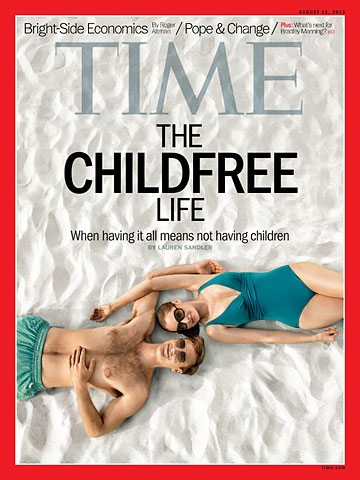
It was this realization that with raising children comes complications that led Lauren Sandler to write an apologetic for childlessness in Time Magazine titled, “Having It All Without Having Children.” In her article, she notes how people are opting out of parenthood with ever increasing frequency:
The birthrate in the U.S. is the lowest in recorded American history, which includes the fertility crash of the Great Depression. From 2007 to 2011, the most recent year for which there’s data, the fertility rate declined 9%. A 2010 Pew Research report showed that childlessness has risen across all racial and ethnic groups, adding up to about 1 in 5 American women who end their childbearing years maternity-free, compared with 1 in 10 in the 1970s.[1]
Kids, for many people it turns out, are cumbersome – too cumbersome. There is, of course, the financial burden of raising children:
The rise of attachment parenting, with its immersive demands, and the sheer economic cost of raising a child – for a child born in 2011, an average of $234,900 until age 18, according to the USDA, and $390,000 if your household earns over $100,000 – has made motherhood a formidable prospect for some women.
There is also the burden raising a child puts on one’s career: “The opportunity costs for an American woman who gets off the career track could average as high as $1 million in lost salary, lost promotions and so on.” But perhaps the most interesting burden that childhood brings, according to one researcher, is an intellectual burden:
At the London School of Economics, Satoshi Kanazawa has begun to present scholarship asserting that the more intelligent women are, the less likely they are to become mothers … Kanazawa analyzed the U.K.’s National Child Development Study, which followed a set of people for 50 years, and found that high intelligence correlated with early – and lifelong – adoption of childlessness. He found that among girls in the study, an increase of 15 IQ points decreased the odds of their becoming a mother by 25%. When he added controls for economics and education, the results were the same: childhood intelligence predicted childlessness.
As titillating at these statistics might be, they generate more heat than light. Indeed, they are only props marshaled to justify the real reason people do not want to have kids. The real reason can be found in the words of documentary filmmaker Laura Scott, whom Lauren Sandler quotes at the beginning of her article: “My main motive not to have kids was that I loved my life the way it was.” Scott makes no secret of the reason she opted out of parenthood: her life is her life. Kids make her life not about her. And that, she decided, is something she cannot endure.
One has to wonder when it became commendable to be so unashamedly selfish. The beauty and blessing of giving your life to the nurture and care of another is apparently lost on far too many people.
In the face of such cultural confusion concerning child rearing, it is useful to briefly review what the Bible says about children:
- Children matter to God which means they should matter to us too. Jesus’ words and actions express vividly His concern and care for kids. When people are bringing their children to Jesus to have Him bless them and the disciples try to keep the kids away, Jesus chides the Twelve, saying, “Let the little children come to Me, and do not hinder them, for the kingdom of God belongs to such as these” (Mark 10:14). Jesus enjoys spending time with children and blessing them. We should too.
- Bearing and raising children, though it is not commanded specifically for every individual, is generally commendable. God’s commission at creation has an inescapably universal ring to it: “Be fruitful and increase in number; fill the earth and subdue it” (Genesis 1:28). Though we have plenty of biblical examples of people who did not have children due to one circumstance or another, a disdain for and avoidance of childbearing runs contrary to the biblical estimation of kids.
- Children, even when they feel like a burden, are in reality a divine blessing! The words of the Psalmist sum it up: “Children are a heritage from the Lord, offspring a reward from Him” (Psalm 127:3).
So what does all this mean? It means simply this: kids are precious and well worth celebrating. Past cultural adages such as “Children should be seen and not heard” as well as a present cultural avoidance and diminishment of child rearing are sad testimonies to human sinfulness and selfishness. Conversely, engaging children can be not only fun, it can also be sanctifying. And everyone needs opportunities to be sanctified.
[1] Lauren Sandler, “Having It All Without Having Children,” Time (8.12.2013).
Casting Stones

Credit: Ciro Miguel via Flickr
From the department of the inane but entertaining, the real estate site Movoto.com recently published its list of America’s most sinful cities. Surprisingly, the city famed for its profligate sinfulness, Las Vegas, didn’t make the list. An article in The Street explains how the list was compiled:
The study analyzed 95 of the nation’s 100 most-populous communities…to see how often locals commit the Catholic Church’s seven major sins: Envy, Gluttony, Greed, Lust, Pride, Sloth and Wrath…
[They then matched] each behavior on the church’s 1,400-year-old list of sins with a modern-day measure of immorality.
For instance, [they] gauged Wrath by looking at the FBI’s annual report on each U.S. city’s violent-crime rate – the number of murders, robberies, aggravated assaults, rapes and non-negligent manslaughter cases reported each year per 1,000 residents.[1]
Here’s what the study found.
Coming in at number five is Milwaukee. According to CDC obesity rates, Milwaukee falls prey to the sin of gluttony. Spot number four belongs to Pittsburgh, which struggles with pride. In this city, there is one cosmetic surgeon for every 3,170 residents. Minneapolis garnered spot number three. Over 30% of Minneapolis’s residents are inactive, making this city super slothful. Place number two belongs to Orlando, which, like Minneapolis, struggles with sloth. And spot number one belongs to – drumroll, please – St. Louis! Movoto found “the Gateway to the West places number two for Wrath and Envy, with 20 violent crimes and 65 property incidents per year for every 1,000 St. Louis residents.” If it’s banal carnality you want, St. Louis is the place to go.
Of course, it’s hard to take a study like this too seriously. But I have to admit, I breathed a sigh of relief when my town of San Antonio didn’t make the list. Then again, I used to live in St. Louis. I went to seminary there. So I guess that means, according to this article, I once lived in a den of iniquities.
What makes a study like this one so comical for Christians is that we know that sin defies such simplistic statistical quantification and comparison. This is the apostle Paul’s point when he writes, “There is no difference, for all have sinned and fall short of the glory of God” (Romans 3:22-23). There is no difference, Paul says, between one sin and another in God’s eyes. Every sin leads to death. Every sin leads to damnation. Before God and apart from Christ, sin is sin. Period.
This is why, when an angry mob of religious leaders seek to have a woman caught in adultery stoned for her sin, Jesus disarms this mob’s self-righteous pretenses by saying, “If any one of you is without sin, let him be the first to throw a stone at her” (John 8:7). Underlying this statement is an assumption that we have no right to use our own self-styled righteousness as a benchmark against which we can measure and condemn other people’s sinfulness. The only benchmark that may be used to distinguish righteousness from sinfulness is God’s. Everything else is just casting stones.
So, although I won’t cast stones at my old seminary town, I will eat concrete if I ever return for a visit. And if that previous line doesn’t make any sense to you, just click here.
[1] Jerry Kronenberg, “5 Most Sinful Cities in America,” The Street (7.17.13).
More Than A Little
 I suffer from calorie creep. It’s amazing. If I wake up in the morning and commit to making wise food choices, staying away from sweets, and considering the calories of what I put in my mouth before those calories get there, I can usually keep the number of my calories down and the quality of my calories up. But if I don’t…
It only takes a little. “I’ll just have a little bit of ice cream for dessert,” I think to myself after lunch. But it’s amazing how much ice cream I can cram into even a little bowl. And by the time supper rolls around, a second bowl of ice cream begins to sound awfully enticing. The more junk food I eat, the more junk food I want. A little always turns into a lot.
“It’s just a little white lie.” “We were just kicking back a little.” “A little bit of fun never hurt anyone!” It’s amazing how many times I have heard these statements or statements like these as excuses for sin. How are they excuses? They’re excuses because they sanction sin by arguing that what they’re supporting is only “a little” sin. But a little always turns into a lot.
Solomon makes this precise point when he talks about the sin of laziness: “A little sleep, a little slumber, a little folding of the hands to rest – and poverty will come on you like a thief and scarcity like an armed man” (Proverbs 24:33-34). Solomon says that sin adds up faster than you think. And this means that sin can wreak havoc in your life quicker than you think.
When the apostle Paul is writing to the Galatians, he warns them against tolerating even a little sin with a metaphor: “A little yeast works through the whole batch of dough” (Galatians 5:9). Paul says that just like it only takes a little yeast to make bread rise, it only takes a little sin to make wickedness rise.
The other day, I came across some thoughts from the Archbishop Chaput, the current Archbishop of Canterbury, worth citing here:
We live in a culture where our marketers and entertainment media compulsively mislead us about the sustainability of youth; the indignity of old age; the avoidance of suffering; the denial of death; the nature of real beauty; the impermanence of every human love; the oppressiveness of children and family; the silliness of virtue; and the cynicism of religious faith. It’s a culture of fantasy, selfishness, sexual confusion and illness that we’ve brought upon ourselves …
As the historian Gertrude Himmelfarb observed more than a decade ago, “What was once stigmatized as deviant behavior is now tolerated and even sanctioned; what was once regarded as abnormal has been normalized.” But even more importantly, she added, “As deviancy is normalized, so what was once normal becomes deviant. The kind of family that has been regarded for centuries as natural and moral – the ‘bourgeois’ family as it is invidiously called – is now seen as pathological” and exclusionary, concealing the worst forms of psychic and physical oppression.
My point is this: Evil talks about tolerance only when it’s weak. When it gains the upper hand, its vanity always requires the destruction of the good and the innocent, because the example of good and innocent lives is an ongoing witness against it. So it always has been. So it always will be.[1]
His last paragraph is key. A little bit of evil will ask you to tolerate it so it can get itself in the door of your life. But once it gains access to your heart’s hallways, it will grow – gradually, perhaps, but inexorably. And what it asked for itself in the name of tolerance it will not give to goodness. For it has come to destroy goodness. It has come to destroy you. And that is why Jesus has come to destroy it.
Stand firm, then. For even a little sin is a little too much.
[1] Archbishop Charles J. Chaput, “A Thread for Weaving Joy,” Voices Online Edition, vol. XXVII, no. 1 (Lent – Eastertide 2012).
Millennial Morality: Thoughts On A Generation’s Thoughts On Christianity

Credit: urbanfaith.com
Last weekend, popular blogger Rachel Held Evans, writing for CNN, offered an account of why she thinks those in the millennial generation are leaving the Church. Her comments are worth quoting at length:
Armed with the latest surveys, along with personal testimonies from friends and readers, I explain how young adults perceive evangelical Christianity to be too political, too exclusive, old-fashioned, unconcerned with social justice and hostile to lesbian, gay, bisexual and transgender people.
I point to research that shows young evangelicals often feel they have to choose between their intellectual integrity and their faith, between science and Christianity, between compassion and holiness.
I talk about how the evangelical obsession with sex can make Christian living seem like little more than sticking to a list of rules, and how millennials long for faith communities in which they are safe asking tough questions and wrestling with doubt.[1]
Rachel Held Evans certainly has her finger on the pulse of contemporary culture. Research does indeed show that millennials describe Christianity as “too political, too exclusive, old-fashioned, unconcerned with social justice and hostile to lesbian, gay, bisexual and transgender people.” In other words, many millennials view traditional Christian teachings as repressive and regressive. What Rachel fails to ask, however, is, “Does this popularly held perception of Christianity match its reality?”
There’s a whole army of research out there about how people feel about Christianity. But what about the research that reveals what is actually being preached and taught from Christian pulpits? How many sermons on politics are actually preached week in and week out? How about sermons on sex? How about sermons that are openly hostile to lesbian, gay, bisexual, and transgender people? Here, the research becomes much more scant. And, I suspect, the sermons themselves might just be much more scant as well.
Now, I know it’s not hard to skew popular perceptions of what the Christian Church is all about. After all, it’s usually not the sermon on John 3 and God loving the world that makes the rounds on YouTube; it’s the sermon on Leviticus 20 with the sweaty pastor yelling about the abominations of sodomy that gets 500,000 views.
Still, I can’t help but wonder if the objections that many millennials have to some of the teachings of Christianity aren’t so much objections as they are excuses. In other words, the reason many millennials object to particular Christian tenets is not because they are “too political, too exclusive, old-fashioned, unconcerned with social justice and hostile to lesbian, gay, bisexual and transgender people”; it is because they simply don’t like parts of what Christianity teaches. So they accuse Christians of absolutism so they can live in libertinism. Nathan Hitchen explains it like this: “When people don’t want to believe something, they ask themselves, ‘Must I believe this?’ and then search for contrary evidence until they find a single reason to doubt the claim and dismiss it.”[2] In other words, they find that YouTube video with the sweaty, yelling pastor and say, “No way.”
From a theological perspective, C.S. Lewis offers keen insight into the objectionable character of Christian morality:
Christ did not come to preach any brand new morality … Really great moral teachers never do introduce new moralities: it is quacks and cranks who do that. As Dr. Johnson said, “People need to be reminded more often than they need to be instructed.” The real job of every moral teacher is to keep on bringing us back, time after time, to the old simple principles which we are all so anxious not to see; like bringing a horse back to the fence it has refused to jump or bringing a child back to the bit in its lesson that it wants to shirk.[3]
C.S. Lewis minces no words about how tough the task of teaching Christian morality really is. It’s tough because the “old simple principles” of morality are ones “which we are all so anxious not to see.” Yet, Jesus, as a teacher of morality, among other things, preached these “old simple principles.” Of course, such preaching didn’t make Him popular or unobjectionable. It got Him killed.
So perhaps popularity is not in the cards for Christianity. This should not come as a surprise. It wasn’t in the cards for Jesus. And yet, as Rachel Held Evans finally notes in her CNN article, “Like every generation before ours and every generation after, deep down, we long for Jesus.” Maybe that’s because, deep down, even if our depravity rebels against it, something keeps telling us Jesus is right. And if Jesus is right, that means He can make us right with God.
That’s our message as Christians. And I, for one, intend to keep sharing it.
[1] Rachel Held Evans, “Why millennials are leaving the church,” cnn.com (7.27.2013).
[2] Nathan Hitchen, “Marriage Counter-Messaging: An Action Plan” (The John Jay Institute: 2013), 4.
[3] C.S. Lewis, Mere Christianity (New York: Macmillan Publishing Company, 1952), 64.
San Antonio’s Anti-Discrimination Ordinance
 Recently, there has been a lot of debate and discussion concerning a proposed amendment to San Antonio’s anti-discrimination ordinance on which the City Council will soon vote. You can read about the debate here. Because this ordinance has certain theological implications, Concordia’s senior pastor, Bill Tucker, has prepared a letter outlining some of the facets and possible effects of this ordinance. I would encourage you to take a moment to read his letter below.
Dear Concordia Family,
The apostle Paul writes, “I urge, then, first of all, that requests, prayers, intercession and thanksgiving be made for everyone – for kings and all those in authority” (1 Timothy 2:1-2a). This is a time for us as a congregation to be in prayer for those in authority – specifically, for those in authority on our San Antonio City Council.
San Antonio’s Anti-Discrimination Ordinance
Our City Council is currently considering amending its anti-discrimination ordinance to include a prohibition against discrimination on the basis of, among other things, “sexual orientation” and “gender identity.” The ordinance defines discrimination as demonstrating “a bias, by word or deed, against any person, group of persons, or organization on the basis of race, color, religion, national origin, sex, sexual orientation, gender identity, veteran status, age or disability.” Many Jews, Muslims, and Christians have long considered homosexual activity, same-sex marriage, and transgender lifestyles to be “sinful.” Such a designation may now be considered discriminatory according to the definition of bias given in this ordinance. Thus, an ordinance meant to prohibit discrimination may set up a de facto form of discrimination against some people of faith because it may preclude people with certain religious beliefs from serving the City.
How Will This Ordinance Affect You?
- Bias: Pastors or other people of faith who discuss whether or not certain behaviors are “sinful” may be considered to be engaging in discrimination according to the definition of “bias” given in this ordinance. Such accusations of discrimination may affect both our ability to speak God’s truth in love and our freedoms of speech, religion, and association.
- Public Accommodations: If you are a business owner who has rental property, restaurants, hotels, or theatres, you may be compelled by this ordinance to violate your conscience and not operate the business according to your religious convictions.
- Appointments and Contracts with the City: A person may not be appointed to a position with the City if he or she is perceived to have a bias against those of a homosexual or transgender orientation and can be removed from office even if previously appointed. A person may also be precluded from contracting with the City if that person is perceived to have a bias against any group named in the ordinance.
Actions to Consider
- Pray for our City Council and consider what your response might be.
- Several local faith-based organizations have expressed concerns about the amended ordinance. You can read their concerns at sahumanrightscoalition.com.
- If you would like to learn more about the Bible’s teaching on homosexuality and same-sex marriage, read “A Pastoral Statement on President Obama’s Endorsement of Same-Sex Marriage.”
- If you would like to contact your Council member or Mayor, go to sanantonio.gov for a list of districts, Council members, and contact information.
Finally, I encourage you to remember how Paul concludes his statement to Timothy on praying for those in authority: “I urge, then, first of all, that requests, prayers, intercession and thanksgiving be made for everyone – for kings and all those in authority, that we may live peaceful and quiet lives in all godliness and holiness” (1 Timothy 2:1-2). Paul’s call to prayer is meant not only to affect our City officials; it is meant to affect us. It is meant to move us toward peace in times of tribulation and form in us a humble godliness, shaped by love, as a holy witness to a world filled with sin. It is meant, in a phrase, to lead us to “shine like stars.” May we, at Concordia, be people who do exactly this.
God bless you,

Bill Tucker
Senior Pastor
Concordia Lutheran Church
Love That Lasts Past One Night
 Over the past few weeks, the New York Times has published a couple of articles of special interest to Christians. The first is by Kate Taylor and chronicles the seedy underbelly of the college hook up culture. The picture she paints is dark and disturbing:
At 11 on a weeknight earlier this year, her work finished, a slim, pretty junior at the University of Pennsylvania did what she often does when she has a little free time. She texted her regular hookup — the guy she is sleeping with but not dating. What was he up to? He texted back: Come over. So she did. They watched a little TV, had sex and went to sleep.
Nationwide, nearly 3 in 10 seniors say they have never hooked up in college.[1]
Take a moment to ponder the significance of this statistic. It’s not that three in ten college seniors have hooked up, it’s that three in ten college senior have not hooked up. This means by the time a college graduate walks across the stage to receive a diploma, there’s a 70% chance he or she has engaged in casual, illicit sexual activity. This is nothing less than ghastly.
Now, contrast this with a New York Times article by Ross Douthat on college campuses as one of the last non-virtual bastions at which to meet a lifelong mate. He begins his column by citing a 2012 study:
From about 1960 to 1990 … neighborhood and church had a roughly steady influence over how heterosexual couples met, with about 10% of heterosexual couples meeting as neighbors and about 7% meeting in or through houses of worship. After 2000, neighborhood and church went in to steep decline along with most of the other traditional ways of meeting romantic partners.[2]
It seems the dating strongholds that have traditionally set people on the path to marriage are in steep decline. This trend does not hold true, however, for college campuses: “College has also dipped since 2000 as a place to meet, but only modestly,” Douthat notes. What, then, is the upshot of these statistics? Douthat concludes:
It seems fair to assume that there are still a lot of people who would prefer to meet their future spouse the old fashioned way — through initial flesh-and-blood encounters embedded in a larger pre-existing social network. If that’s your preference, the university campus is one of the few flesh-and-blood arenas that seems to be holding its own as a place to form lasting attachments. So for those Americans who do attend college, the case for taking advantage of its denser-than-average social landscape might actually get stronger as the non-virtual alternatives decline.
So there you have it. On the one hand, college campuses can be hotbeds of squalid sexual hookups – places where people make out at night and walk out the next morning. On the other hand, college campuses remain ideal environments for meeting, dating, and, eventually, marrying.
The apostle Paul issues a sobering warning about the effects of sexual immorality, saying that God gives over people “in the sinful desires of their hearts to sexual impurity for the degrading of their bodies with one another” (Romans 3:24). When reading such a warning, I can’t help but think of an especially telling story from Kate Taylor’s article:
For many Penn students, their initiation into the sexual culture takes place at fraternity parties during New Student Orientation, a five-day period before classes start in the fall, which, along with Spring Fling in April, is known as the biggest partying time of the year.
“You go in, and they take you down to a dark basement,” Haley, a blond, pink-cheeked senior, recalled of her first frat parties in freshman year. “There’s girls dancing in the middle, and there’s guys lurking on the sides and then coming and basically pressing … up against you and trying to dance.”
Dancing like that felt good but dirty, and like a number of girls, Haley said she had to be drunk in order to enjoy it. Women said universally that hookups could not exist without alcohol, because they were for the most part too uncomfortable to pair off with men they did not know well without being drunk.
The first line of the last paragraph haunts me: “Dancing like that felt good but dirty.” Another word for “dirty,” of course, is “degrading,” the very thing which Paul says is the result of sexual immorality.
So often we read Paul’s words in Romans 1 as a condemnation of those whose sexual ethics differ from those of Christianity. But Paul’s words are much more than a condemnation. They are a sad statement of reality. And even the New York Times knows it. Sexual immorality is dirty. Sexual immorality is degrading. Perhaps C.S. Lewis puts it best when he writes specifically of females trapped in sexually promiscuous lifestyles: “I have no sympathy with moralists who frown at the increasing crudity of female provocativeness. These signs of desperate competition fill me with pity.”[3] Like Lewis, may we pity those who are so desperate, they willingly degrade themselves sexually. Such degradation is truly heartbreaking.
The choice is clear. At college, a student can either degrade him or herself in sexual recklessness, or take advantage of a university’s social landscape to form friendships and, by God’s grace, a lifelong marriage relationship.
My prayer is that more and more people would choose chastity – not only because it gives glory to God, but because it really is better for His creations. It really is better for you. You don’t need to degrade yourself. For you have One who was degraded for you on a cross.
[1] Kate Taylor, “Sex on Campus: She Can Play That Game, Too,” New York Times (7.12.2013).
[2] Ross Douthat, “The Dating World of Tomorrow,” New York Times (7.19.2013).
[3] C.S. Lewis, C.S. Lewis: Readings for Meditation and Reflection, Walter Hooper, ed. (New York: Harper Collins, 1992), 88


 Pastor Zach's Blog