Posts tagged ‘Religion’
Chafed Over Chick-fil-A
 The firestorm is burning white hot. And it didn’t take much to spark it either. All it took was a passing statement from Chick-fil-A COO Dan Cathy in an interview with the Baptist Press:
We are very much supportive of the family – the biblical definition of the family unit. We are a family-owned business, a family-led business, and we are married to our first wives. We give God thanks for that.[1]
Cathy’s qualification of “family” as “the biblical definition of the family unit” upset and offended many of those who support same-sex marriage, which, by all traditional Christian accounts, falls outside the pale of “the biblical definition of the family unit.”[2] But Cathy wasn’t backing down. In an appearance on “The Ken Coleman Show,” Cathy solidified his stance:
I think we are inviting God’s judgment on our nation when we shake our fist at Him and say, “We know better than You as to what constitutes a marriage,” and I pray God’s mercy on our generation that has such a prideful, arrogant attitude to think that we have the audacity to try to redefine what marriage is about.[3]
The reactions to these two statements have predictably ranged from the genuinely offended to the bombastically outrageous. Equality Illinois, an LGBT advocacy group, plans a “kiss-in,” akin to the “sit-ins” of the 1960’s civil rights movement, in front of selected Chick-fil-A’s to protest Cathy’s statements. The group has also launched a “Flick the Hate” campaign, saying, “Rather than spend money at hateful businesses like Chick-fil-A, support businesses that support LGBT rights.”[4] Rosanne Barr tweeted, “Anyone who eats *Expletive* Fil-A deserves to get the cancer that is sure to come from eating antibiotic filled tortured chickens 4Christ.”[5] She later apologized for her incendiary statement. Then there was Juliet Jeske, a comedian, who posed the perennial hermeneutical quandary: “I don’t quite understand how Christians who cite these six scant verses in the Bible that condemn homosexuality conveniently ignore some of the more extreme laws. How is one verse the ‘WORD OF GOD’ and another discarded as being out-of-date?”[6] She cites a slew of peculiar-sounding passages from Leviticus and opines on why Christians no longer follow the Good Book’s restrictions concerning menstruating women and clothing made of more than one fabric while insisting on following the Bible’s moral verdict on homosexuality. If she is interested in the answer to her conundrum, I would suggest she read Tim Keller’s insightful article, “Making Sense of Scripture’s ‘Inconsistency.’” Considering how many times this question concerning the so-called “inconsistent” application of the Bible has been raised, however, and how many times it has been answered – quite well, I would add – I have begun to wonder if this article, and others like it, is not more of a cheap shot at Christian biblical interpretation rather than a genuine question about Christian biblical interpretation.
What disturbs me most about the Chick-fil-A controversy is not Cathy’s statements, for the immorality of all sex outside the confines of a marriage between one man and one woman is a longstanding Christian tenant. Nor do the objections of many in the LGBT community to Cathy’s statement disturb me, for such objections are to be expected. What disturbs me most about this controversy is the eventual response of Chick-fil-A as a corporation to the stir. The company issued a statement that read in part, “Going forward, our intent is to leave the policy debate over same-sex marriage to the government and political arena.”[7] Though people may debate whether or not it is prudent for COO’s of large corporations to express their theological convictions to news outlets that often make a habit out of subjecting theological convictions to the acerbic accusations of public opinion, I would submit that Chick-fil-A made precisely the wrong move when it so willingly relinquished this debate to the arena of government and politics.
At its heart, the debate over homosexuality and gay marriage is not a political debate, but a moral one. To relegate this debate to the realm of politics and wrangling legislators is to cheapen it and, ultimately, to give it less consideration and credence than it deserves. Moral debate should not be settled by majority vote, but by robust and respectful conversation grounded in something steadier and more transcultural than November’s ballot box – something like Holy Scripture for Christians, or, in broader society, natural, moral law.[8] Morality by democracy can lead only to disaster, for it encourages people to breezily act according to what is right in their own eyes (cf. Judges 17:6).
The mayor of Chicago, Rahm Emanuel, had it at least partially right when he said, “Chick-fil-A values are not Chicago values.”[9] Though, as a Christian, I heartily disagree with Rahm Emanuel’s values as they pertain to same-sex marriage, on this much we find common ground: this is about values and morals, not politics and opinion polls. Let’s not turn it into anything less.
[1] K. Allan Blume, “‘Guilty as charged,’ Cathy says of Chick-fil-A’s stand on biblical & family values,” Baptist Press (7.16.12).
[2] Read Concordia’s stance on same-sex marriage in “A Pastoral Statement on President Obama’s Endorsement of Same-Sex Marriage.”
[3] As cited in “Dan Cathy, Chick-Fil-A President, On Anti-Gay Stance: ‘Guilty As Charged,’” The Huffington Post (7.17.12).
[5] Cited in Paul Bond, “Roseanne Barr Responds to Critics After Controversial Chick-fil-A Tweet,” The Hollywood Reporter (7.26.12).
[6] Juliet Jeske, “Chick-Fil-A, Do You Really Want to Run Your Company on Biblical Values?” The Huffington Post (7.26.12).
[7] Cited in Shan Li, “Chick-fil-A steps out of public debate on gay marriage,” The Los Angeles Times (7.19.12).
[8] An examination of same-sex marriage in light of natural, moral law can be found in “A Pastoral Statement on President Obama’s Endorsement of Same-Sex Marriage.”
[9] Cited in Bill Barrow, “Chick-fil-A sandwiches become a political symbol,” The Associated Press (7.27.12).
Hope in the Midst of a Colorado Tragedy

The Century 16 Theatre at which James Holmes opened fire during the movie, “Batman: The Dark Knight Rises.”
When 24 year-old neuroscience Ph.D. candidate dropout James Holmes burst into an Aurora, Colorado theatre at a midnight premier of “Batman: The Dark Knight Rises” in full tactical gear with a semi-automatic rifle, a shotgun, and a pistol, packing as many as 6,000 rounds, the carnage was nearly instant. Twelve are dead. Over fifty are wounded.
Almost immediately, investigators sprung into action, trying to answer the same question they always try to answer after an act of senseless violence like this: “Why?” So far, Holmes hasn’t left us much to go on.
One of the things that strikes me about this mass shooting is how utterly elusive Holmes’ motive seems to be. He has no Facebook page to scour for clues. He has no Twitter account to review. He didn’t host a blog. He wasn’t connected to anyone on LinkedIn. In an era of ubiquitous social media, investigators have not been able to turn to any of these standard-fare communal clearinghouses for insight into this man’s mind. His police record has left investigators just as mystified. One traffic violation in 2011. That’s it. No arrests. No prior investigations. Nothing that would lead officers to believe this man could or would explode in a rampage of mass murder.
The L.A. Times has been hard at work trying to understand Holmes’ motive, interviewing several people who knew him, albeit not very well. Here is how they describe him:
- “A generally pleasant guy…James was certainly not someone I would have ever imagined shooting somebody.” – James Goodwin, high school classmate
- “He was very quiet…He was a nice guy when you did occasionally talk to him. But he was definitely more introverted.” – Tori Burton, fellow with the National Institutes of Health
- “A super-nice kid…kinda quiet…really smart…He didn’t seem like a troublemaker at all. He just seemed like he wanted to get in and out, and go to college.” – Dan Kim, UC San Diego student[1]
The portrait of Holmes, even if not particularly profound, is incredibly consistent. He was nice. He was smart. He was studious. He was introverted. And he did what? He massacred how many?
Jesus says to the religious leaders of His day, “On the outside you appear to people as righteous but on the inside you are full of hypocrisy and wickedness” (Matthew 23:28). Jesus knew the goodness a person presents on the outside often conflicts with the darkness he harbors on the inside. And as it was with the religious leaders, so it is with James Holmes. On the outside, Holmes looked like a bright, promising Ph.D. student. But on the inside, as we are now learning, he was full of dark aspiration.
The Bible has a word for this conflict between a person’s externally righteous appearance and his internally depraved heart: hypocrisy. This is why Jesus begins His diatribe against the religious leaders by saying, “Woe to you, teachers of the law and Pharisees, you hypocrites” (Matthew 23:13)! In the ancient world, a “hypocrite” was an actor – someone who put on a mask to perform in a play. Though the actor presented himself as one person on stage, he was, in reality, another person in his day-to-day life.
What is so sad about James Holmes is that, as he burst into that theatre filled with moviegoers, he was not necessarily being hypocritical, at least in a theological sense. Instead, he was – as the doctrine of human depravity makes all too horrifyingly clear – just being himself. He was carrying out in a shower of gunfire the sin that, exacerbated by what seems to be an apparent mental illness, had been smoldering in his heart for a long time. And lest we pontificate on Holmes’ wickedness from a position of self-righteous arrogance, we must remember that the same depraved root of sinfulness that lives in Holmes’ heart lives in every human heart – even in our hearts. As the prophet Jeremiah soberly says, “The heart is deceitful above all things and beyond cure. Who can understand it” (Jeremiah 17:9)?
In a situation as devastating as this one, Christians are in a unique position both to minister to the hurting on the one hand and to speak honestly about the depth of human wickedness on the other. To the hurting – especially to those who have lost loved ones – we can offer a shoulder to cry on and a message of hope: “Christ conquers death!” To those who ask “Why?” we can respond with one, simple word: “sin.” Sin led to this act. Sin leads to all wicked acts. Sin leads to our wicked acts. But, like with death, Christ conquers sin.
As this story continues to unfold, we are sure to learn more about the gunman – his background, his possible motive, and, perhaps, his personal demons. But no matter how much we may learn about his past, we cannot change the past. Loved ones will still be lost. Survivors will still bear physical and emotional scars from that dreadful night. And the hearts of so many will still be broken. The past will stand as it is right now: tragic. Only Christ can take this terrible moment from our past and redeem it in the future – when He calls those who trust in Him to rise from death to eternal life, unscarred and unmarred even by a gunman’s bullets. And so in our distress, we hope and trust in Him. What else can we do?
[1] “Complex portrait emerges of suspected Colorado gunman James Holmes,” Los Angeles Times (7.20.12).
Christianity in a Culture of Narcissism: From Epicurus to Gilbert
 “I know that God wouldn’t want me to be unhappy!” I have heard these words time and time again over the course of my ministry, usually from people who wanted to make decisions that, according to the Bible, were sinful. Yet, these people could not fathom a God who would ever want them to choose a difficult or painful path – a path that would make them unhappy – even if it formed in them obedient righteousness.
The search for human happiness was perhaps most famously forged by the fourth century BC Greek philosopher Epicurus. Epicurus asserted that a truly happy life was characterized primarily by two features: a sense of peace and the absence of pain. If a person had these two things, he would be happy. How did Epicurus accomplish such a peace-filled and pain-free life? First, he sought self-sufficiency and second, he lived with a large group of friends. Epicurus, it seems, was the original college student – venturing out from his parents’ place with lots of his buddies by his side. And though Epicurus himself was actually quite restrained in his morality and actions, his philosophy eventually gave rise to hedonism, a way of life which recklessly trades that which is peace-filled and pain-free for parties and pleasure.
For our purposes, it is important to understand how Epicurus related his search for happiness to his faith in God. For the relationship Epicurus establishes between happiness and God serves as an almost precise blueprint for those today who cannot fathom a God whose ultimate goal would be anything other than their personal happiness. Epicurus says of a person’s belief in God:
Attach to your theology nothing which is inconsistent with incorruptibility or with happiness; and think that a deity is invested with everything which is able to preserve this happiness.[1]
For Epicurus, God does not define what it means to be happy. Instead, happiness defines what it means to have God. If you are not happy, then, the problem is not with you, it’s with God! God is merely a means to the end of your personal happiness. He is not your sovereign ruler and creator, but your divine therapist whose fundamental function is to make you feel better. He is a “happy pill” of sorts – a pick-me-up to help you avoid the painful realities of life. Thus, if happiness eludes you, the solution is as simple as shifting your theological sensibilities: “Attach to your theology nothing which is inconsistent with…happiness.”
Epicurus’ philosophy has been replayed over and over again throughout the ages. It has been most recently and famously espoused by Elizabeth Gilbert in her bestselling book Eat, Pray, Love: One Woman’s Search for Everything Across Italy, India, and Indonesia. Gilbert, by her own admission, was a woman who had it all. She was married to a devoted husband and lived in a giant house in the New York suburbs. The plan was, shortly after she turned thirty, the couple would have children – they would start a family. As her story opens, she is thirty-one. But on a cold November night, locked in her bathroom, she discovers what she has always intuitively known: she does not want to have kids. She doesn’t even want to be married. Gilbert explains it like this:
My husband and I – who had been together for eight years, married for six – had built our entire life around the common expectation that, after passing the doddering old age of thirty, I would want to settle down and have children. By then, we mutually anticipated, I would have grown weary of traveling and would be happy to live in a big, busy household full of children and homemade quilts, with a garden in the backyard and a cozy stew bubbling on the stovetop…But I didn’t – as I was appalled to be finding out – want any of these things. Instead, as my twenties had come to a close, that deadline of THIRTY had loomed over me like a death sentence, and I discovered that I did not want to be pregnant.[2]
So how does Gilbert solve her crisis of marriage and motherhood? Existentially, of course! She divorces her husband and takes off globetrotting – to Italy, India, and Indonesia. And it is during her international adventures that she comes to a conclusion about God that, even though it is altogether unsurprising in its substance, is jarring in its frankness:
I think you have every right to cherry-pick when it comes to moving your spirit and finding peace in God. I think you are free to search for any metaphor whatsoever which will take you across the worldly divide whenever you need to be transported or comforted…You take whatever works from wherever you can find it, and you keep moving toward the light.[3]
“Attach to your theology nothing which is inconsistent with…happiness.” Gilbert falls lock step into a crassly Epicurean vision of God. She is right at home with a “do-it-yourself” theology. If one version of God doesn’t work for her – if He doesn’t bring her the happiness, joy, peace, and fulfillment she desires as she defines these things – she is perfectly comfortable redefining her theology as much as necessary to suit her longings. God exists solely to make her feel good about herself. God exists to make Elizabeth Gilbert happy.
No matter how attractive Elizabeth Gilbert’s custom made system of doing theology may first appear, it is fundamentally dishonest. It was the atheist stalwart Friedrich Nietzsche who knew that theological cherry picking was a futile and academically vacuous pursuit: “Christianity is a system, a consistently thought out and complete view of things. If one breaks out of it a fundamental idea…one thereby breaks the whole thing to pieces.”[4] You can take it all or leave it all when it comes to theology, Nietzsche says, but you can’t take only certain parts. Nietzsche left it all. At least he was intellectually – and spiritually, for that matter – consistent.
There is a bitter irony for the person who believes in a therapeutic God who would never want him to be unhappy. In a limited and carefully qualified sense, he’s right! God does not desire the unmitigated misery of His people. Jesus opens His famed Sermon on Mount with a series of blessings, widely known as the Beatitudes. He declares:
Blessed are the poor in spirit, for theirs is the kingdom of heaven. Blessed are those who mourn, for they will be comforted…Blessed are those who are persecuted because of righteousness, for theirs is the kingdom of heaven. (Matthew 5:3-4, 10)
The word “blessed” is rendered in many translations as “happy.” Though I prefer the translation “blessed,” “happy” is not altogether inappropriate, as long as the substance of Jesus’ happiness is properly understood. But in order to properly understand Jesus’ happiness, we must first notice the paradoxical nature of Jesus’ statements. Those who are poor in spirit…can be happy! Those who mourn…can be happy! Even those who are persecuted…can be happy! People in seemingly very unhappy situations can nevertheless be happy! But how? True happiness, Jesus teaches, has nothing to do with a person’s external circumstances, or even with his desires, dreams, and feelings, but with his eschatological and eternal hope. Those who brandish about the statement “God wouldn’t want me to be unhappy” as a license to do what they want, regardless of whether or not what they want is sinful, don’t really care about God’s happiness for them because they really don’t care about how God’s happiness comes to them – for sometimes, God’s happiness comes only through personal suffering and prodigious sacrifice.
How are you happy? Are you happy only if you get your own way? Or, are you happy when Christ works His way through you? The first happiness is nothing but narcissism. The second happiness is comfortingly indelible, even in a broken and sinful world that relentlessly seeks to bring us sorrow. This is why I find my happiness – no, my joy – in Christ. As the prophet exhorts, “Find your joy in the LORD” (Isaiah 58:14).
[1] Diogenes Laertius, 10.123
[2] Elizabeth Gilbert, Eat, Pray, Love: One Woman’s Search for Everything Across Italy, India, and Indonesia (New York: Viking, 2006), Chapter 2.
[3] Gilbert, Chapter 70.
[4] Friedrich Nietzsche in R.J. Hollingdale, Nietzsche: The Man and His Philosophy (Cambridge: Cambridge University Press, 2001), 99.
Christianity in a Culture of Narcissism: From Darwin to Dawkins
 Growing up, one of my favorite books was P.D. Eastman’s Are You My Mother? If you have kids, or if you grew up with my generation, or even the generation before, you no doubt remember this jewel of a children’s story. It features a baby bird who hatches while his mother is out worm-hunting. When he discovers he is alone in the nest, he ventures out looking for his mother. But he does not know who she is or what she looks like. So he goes to a kitten and asks her if she is his mother. The cat remains silent. So he goes to a hen. No dice. She’s the wrong kind of bird. He journeys on to find a dog. But the dog insists she is not the bird’s mother. Desperate, the little bird presses on to even inanimate objects, asking if they are his mother – a car, a tugboat, a plane, and finally an enormous power shovel. “Are you my mother?” the bird asks the shovel. The shovel, much to the little bird’s fright, snorts smoke out of its exhaust stack and picks up the bird and lifts him high, high into the sky. But then, in a twist of fate, the shovel drops him right back into his nest just in time for his real mother to return. And when the bird sees her, he sings with delight, “I know who you are. You are not a kitten. You are not a hen. You are not a dog. You are not a cow. You are not a boat, or a plane, or a Snort!” – the little bird’s name for the power shovel – “You are a bird, and you are my mother.”[1]
Perhaps the reason this story has resonated with the hearts of so many children for so many years is because it touches on a need all of us have – to belong. The little bird wanted to know to whom he belonged. And so do we. As kids, we want to feel as though we belong to our parents. As we grow, we want to belong to a group of our peers. As we get yet older, we often will give ourselves to one another in marriage and thus belong to a spouse.
This desire to belong is not surprising. After all, the Bible says we are created in “the image of God” (Genesis 1:27) and, as such, are ultimately designed to belong to Him. As the apostle Paul reminds us, “You do not belong to yourself, for God bought you with a high price” (1 Corinthians 6:19-20 NLT). We all want to belong. And, by faith in Christ, we can belong, above everything and everyone else, to God.
Though we all feel a need to belong, a narcissism disguised and gilded in the sterile white lab coats of those who believe that science as a discipline demands a naturalistic worldview in toto is seeking to slowly undermine and supplant this natural desire. This narcissism is promoted by people who, with a paradoxical twist of religious fervency, ground themselves in a system of Darwinian evolution hitched to a strident atheism which espouses not a human desire to belong, but a human fight for survival.
It is well known that the mechanism by which Darwinian evolution works is Natural Selection, or, to use the phrase originally coined by the British philosopher Herbert Spencer, “the survival of the fittest.” Charles Darwin explains the principle:
Owing to this struggle for life, any variation, however slight and from whatever cause proceeding, if it be in any degree profitable to an individual of any species, in its infinitely complex relations to other organic beings and to external nature, will tend to the preservation of that individual, and will generally be inherited by its offspring. The offspring, also, will thus have a better chance of surviving, for, of the many individuals of any species which are periodically born, but a small number can survive. I have called this principle, by which each slight variation, if useful, is preserved, by the term of Natural Selection.[2]
Evolution, Darwin claims, lurches forward because those with less desirable traits die off while those with more desirable traits survive, passing on their superior attributes to subsequent generations. These subsequent generations, in turn, grow stronger and more environmentally adept. In short, they “evolve.” Survival, then, becomes a mark of success in a Darwinian system where propagation of oneself is the name of the game. Can there be a goal more blatantly narcissistic than this?
The difficulty with Darwin’s theory, of course, is that, even while it has succeeded at elevating biological narcissism to a cause célèbre, it has nevertheless failed to explain why humans sometimes act so un-narcissistically – even downright charitably! Indeed, Darwin decried this human tendency toward charity and warned of its ill effects:
We civilized men…do our utmost to check the process of elimination; we build asylums for the imbecile, the maimed, and the sick; we institute poor-laws; and our medical men exert their utmost skill to save the life of every one to the last moment. There is reason to believe that vaccination has preserved thousands, who from a weak constitution would formerly have succumbed to small-pox. Thus the weak members of civilized societies propagate their kind. No one who has attended to the breeding of domestic animals will doubt that this must be highly injurious to the race of man. It is surprising how soon a want of care, or care wrongly directed, leads to the degeneration of a domestic race; but excepting in the case of man himself, hardly any one is so ignorant as to allow his worst animals to breed.[3]
“If only,” Darwin opines, “we would not labor so compassionately to ‘check the process of elimination.’ If only we weren’t so charitable to each other!” According to Darwin, a narcissistic fight for one’s own survival and propagation that results in other, less fit creatures dying off and dying out is in line nature’s ultimate goal and good.
But this still does not solve the problem of human charity. If we are indeed the products of an inexorable evolutionary march propelled by Natural Selection, what causes us to trade the narcissism innate to this system for an unnatural, and even counterproductive, altruism?
Committed atheist and evolutionary biologist Richard Dawkins sought to address this difficulty in his 1976 classic, The Selfish Gene. Dawkins explains that, even when people act in seemingly altruistic ways, their genes are still driving them to act in a manner which ultimately protects their survival and insures their propagation. So if a mother runs into a burning car to save her children, for instance, she is doing so not out of authentic altruism, but so that her genes can live on in her children, even if she dies. Likewise, if someone helps someone else to whom is he not genetically related, Dawkins claims he is doing so out of “reciprocal altruism,”[4] a term Dawkins borrows from the sociobiologist Robert Trivers, which is essentially the genetic equivalent of the old saw, “You scratch my back, I’ll scratch yours.” In other words, when a person does something “nice” for someone else, that person expects some sort of genomic favor in return. Yet, not all cases of altruism can be accounted for so coldly. For instance, when a fireman risks his own life, storming a burning building to save another, how can one account for this biologically? He is usually not related to the person trapped inside. Thus, he cannot be said to be working out of an evolutionary mandate to propagate his progeny. And his chance of receiving a favor in return, though possible, is certainly not probable enough to drive the risk he takes. Even Dawkins must admit that there is such a thing as “pure, disinterested altruism” that “has no place in nature.” Indeed, it has “never existed before in the whole history of the world.”[5] Evolutionary biology simply cannot account for all the mysteries of human philanthropy.
If nothing else, the evolutionary attack on human charity in favor of a calculated, genomic narcissism shows that, no matter how prevalent narcissism may be in our world, it is not altogether systemic. There are still times and places in which people look outside of themselves. Belonging to each other through love and kindness still count. And lest one cynically protests that belonging is merely an underhanded means to propagation and survival, we must remember that sometimes, belonging means risking one’s livelihood and even life. Belonging to an army means risking one’s existence for the sake of a cause. Belonging to a philanthropic organization means risking one’s health and wellbeing for the sake of fighting the AIDS pandemic in Africa. And belonging to Christ means losing one’s life for the sake of the gospel. That’s not narcissistic. That’s selfless. And that’s still good…no matter what Natural Selection may claim.
[1] P.D. Eastman, Are You My Mother? (Random House Books, 1960), 62.
[2] Charles Darwin, On the Origin of Species (London: Cassell & Company, Ltd., 1909), 64.
[3] Charles Darwin, The Descent of Man (forgottenbooks.org, 1874), 116-117.
[4] Richard Dawkins, The Selfish Gene (Oxford: Oxford University Press, 1976), 202.
[5] Dawkins, 201.
Christianity in a Culture of Narcissism: From Descartes to Kant
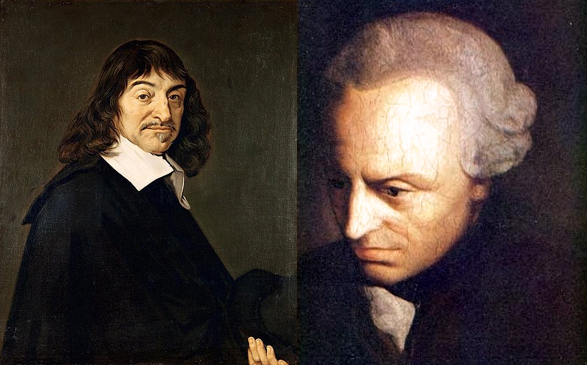
René Descartes and Immanuel Kant
It began in the Garden. When Adam and Eve ate of the forbidden fruit, they became history’s first narcissists. Narcissism is defined as “a consuming self-absorption or self-love; a type of egotism. Narcissists constantly assess their appearance and desires.”[1] Adam and Eve assessed their desires and decided that their desires trumped God’s command. Theologically, then, narcissism is as old as history itself. Philosophically, however, narcissism’s origin – or at least its willing sanction – is slightly more modern.
Narcissism finds its philosophical roots in the seventeenth century French philosopher René Descartes. In 1637, he published his seminal work, Discourse on Method, in which he undertook to find something concrete on which to rest his life – a point of certainty in an illusory and shifting universe. How would he discover such a point of certainty? By doubting everything he possibly could. He writes, “I ought to reject as absolutely false all opinions in regard to which I could suppose the least ground for doubt, in order to ascertain whether after that there remained aught in my belief that which was wholly indubitable.”[2] Descartes trumpets methodological doubt as his mechanism to discover certainty. For doubt and certainty are inimical to each other. This means that if Descartes can find something which he cannot doubt, then this thing must, by antonymic reasoning, be certain.
So what does Descartes doubt? Pretty much everything. He doubts human intelligence and insight. After all, Descartes says, there are a great “number of conflicting opinions touching a single matter that may be upheld by learned men.”[3] Thus, how is one to know who holds the correct opinion? We are left only with uncertainty. And where there is doubt, we must throw it out. Societal norms and traditions must also be doubted. For different societies have different and conflicting opinions and customs: “A person brought up in France or Germany exhibits [a very different character] from that which, with the same mind originally, this individual would have possessed had he always lived among the Chinese or the savages.”[4] Not even one’s own senses can be totally trusted, for “our senses sometimes deceive us.”[5]
So are we left with anything which cannot be doubted? Descartes says there is one indubitable thing:
Whilst I thus wished to think that all was false, it was absolutely necessary that I, who thus thought, should be somewhat; and I observed that this truth, I think, therefore I am, was so certain and of such evidence that no ground of doubt, however extravagant, could be alleged by the skeptics capable of shaking it.[6]
Here we have perhaps the most famous words spoken by any philosopher in any age: “I think, therefore I am.” This is what Descartes can know for certain: He exists. How does he know this? He thinks. Consciousness, in Descartes’ scheme, becomes the cause of one’s existence, for the very certainty of a person’s very existence is based on nothing else than that person’s very thinking! Everything a person can know, experience, or be certain of is found in nothing other than the person who is knowing, experiencing, and being certain. A person, then, is a completely self-contained and self-absorbed entity. And this, by definition, is narcissism.
It is important to note that, no matter how egocentric Descartes’ dictum may be, the philosopher styled himself as a committed Catholic and finally, at the end of Discourse on Method, seeks to make an argument for the existence of God. But consider how he fashions his argument: “I was led to inquire whence I had learned to think of something more perfect than myself; and I clearly recognized that I must hold this notion from some nature which in reality was more perfect.”[7] Descartes argues that because he can think of a being more perfect than himself, there must indeed be such a being! In other words, Descartes thinks of God, so there is God. He thinks, therefore God is.
Though Descartes ultimately exercises a certain amount of restraint in Discourse on Method, trying to steer clear of the unabated egoism that his philosophical system inevitably brings, Descartes’ “I” was quickly marshaled by other less scrupulous philosophers to plunge into a pool of silly solipsism and self-regarding subjectivism. The next century saw the rise of Immanuel Kant who championed the distinction between the noumenon and the phenomenon. The noumenon is what Kant referred to in German as the ding an sich, “the thing in itself.” That is, the noumenon is that which is outside of us. The phenomenon, conversely, is our personal experience, roughly analogous to the Cartesian “I.” Kant argued that a person has no access to the noumenon apart from the phenomenon. In other words, it is impossible for us to get outside of our phenomenal selves to directly observe the noumenal world. Kant asserts, “We cannot know these objects as things in themselves” (ding an sich). Thus, we are stuck in our hopelessly subjective phenomenal perspectives. Lest one believe that subjectivity is all there is, however, Kant quickly qualifies: “Though we cannot know these objects as things in themselves, we must yet be in a position at least to think them as things in themselves; otherwise we should be landed in the absurd conclusion that there can be appearance without anything that appears.”[8] Notice how closely Kant’s apology for the existence of the noumenon mirrors Descartes’ apology for the existence of God: “I can think it, so it must exist!”
With such a rosy view of the human intellect, it is no wonder that subsequent generations have quickly left behind Kant’s noumenon – since it was ultimately inaccessible anyway – in favor of the egoistic phenomenon. That is, what is “out there” noumenally no longer matters to many people. Some have even gone so far as to deny the existence of the noumenon altogether. It is only what is “in us” phenomenally that counts. This, in turn, has led to obsessive and unyielding introspection – a tell tale sign of narcissism.
Christianity, of course, tells a different story. We should not bow to what is “in us” as the ultimate grounds for our existence. Indeed, what is “in us” is suspect at best and, more realistically, downright evil. The prophet Jeremiah warns, “The heart is deceitful above all things and beyond cure. Who can understand it” (Jeremiah 17:9)? Our ability to understand even our own selves (not to mention the rest of the world) by ourselves is fatally flawed. Understanding must start from outside of us; not from inside of us. This is why, according to Scripture, wisdom and insight are finally gifts from an external God and not functions of an internal human intellect (e.g., 1 Kings 4:29).
Perhaps Descartes’ dictum would be better reversed: “I am, therefore I think.” Or, even better, “I am created, therefore I think.” In this dictum, creation – the mechanism by which we exist – precedes deliberation. We can only think because we have been endowed with an intellect by a loving Creator. He is the center and superlative of our being, for He is the source of our existence. Our narcissistic “I” must yield to His perfect glory.
[1] “Narcissism,” The American Heritage Dictionary, dictionary.com.
[2] Rene Descartes, Discourse on the Method of Rightly Conducting the Reason, and Seeking Truth in the Sciences (Forgotten Books, 2008), 28.
[3] Discourse on Method, 7.
[4] Discourse on Method, 14.
[5] Discourse on Method, 28.
[6] Discourse on Method, 28-29.
[7] Discourse on Method, 30.
[8] Vincent G. Potter, Readings in Epistemology: From Aquinas, Bacon, Galileo, Descartes, Locke, Berkeley, Hume, Kant (Fordham University Press, 1993), 198-199.
Christianity in a Culture of Narcissism

“Narcissus” by Caravaggio, 1596
“I wanna talk about me, wanna talk about I, wanna talk about number one, oh my me my.”
– Toby Keith, country singer[1]
“I think I’m fascinating.”
– Snooki, Jersey Shore star[2]
“What do you really want out of life? A bigger, better job? A hotter sex life? The lean, mean body you had in college? All of the above? Men’s Health can help you get there.”
– Men’s Health promotion[3]
As the Roman poet Ovid tells it, Narcissus was quite the heartbreaker. Narcissus was a handsome young hunter, furiously courted by every young lady who met him. But Narcissus rejected every advance of every young lady because Narcissus only had eyes for…himself. The story goes that one day, after an especially rigorous morning of hunting, Narcissus decided to rest for a moment on a verdant pasture next to a quiet pond. When he went to the pond to get a drink of water, what did he see, but himself! So enamored was Narcissus by his own appearance, that he eventually died there by that pool, for he was unable to pry himself away from his striking reflection.[4]
Narcissus, of course, serves as the namesake and the caution for the personality disorder we know as narcissism. I recently read that the American Psychiatric Association is considering removing narcissism from its highly influential Diagnostic and Statistical Manual of Mental Disorders (DSM). Why? Because more and more psychologists consider it to be “a manifestation of normal personality.”[5] Narcissism is now normal. Or so psychologists say.
One doesn’t need to look very far to see just how “normal” narcissism has become. From country singers who want to talk about themselves to faux reality TV stars who find themselves to be inexhaustibly interesting to magazines which unabatedly sell narcissism to self-absorbed, even if fitness-conscious, consumers, instances of narcissism are everywhere. Yet, I would argue that simply because narcissism is prevalent doesn’t necessarily mean it is normal. “Normal” refers to something which “conforms to a standard or common type.”[6] But what “standard or common type” norms that which is normal? In psychology, it is the standard of self. Whatever behavior, trait, or characteristic is most common among the majority of people is considered normal. Majority norms psychology. Hence, the reason narcissism is being considered for removal from the DSM. Theologically, however, things work differently. Normal is not defined by human prevalence but by divine revelation. And theologically, narcissism is most definitely abnormal – and worse, sinful. As the apostle Paul warns, “But mark this: There will be terrible times in the last days. People will be lovers of themselves” (2 Timothy 3:1-2). According to Paul, to be obsessed with self is a sinful sign of the terrible times. It’s time, then, to leave narcissism behind for something else – something better.
Over the next few weeks in my blog, I’ll be probing the foundations of narcissism in our society and asking, “How did we get here? How did narcissism become ‘normal’?” To this end, I’ll be exploring the historical underpinnings of narcissism philosophically, scientifically, and therapeutically. All of these disciplines, of course, will be discussed in light of the Bible’s verdict on narcissism theologically.
Ovid says of Narcissus’ narcissism, “Its empty being on thy self relies; Step thou aside, and the frail charmer dies.”[7] Here is a somber warning that we would do well to take to heart. Ovid cautions that narcissism finally leads to death. For in its emphasis on the self, narcissism leaves you only by yourself. And left by yourself, you will only die. For you are only mortal. This is why Jesus invites us to leave behind the deathly hallows of narcissism to find lasting life in Him: “If anyone would come after Me, he must deny himself and take up his cross and follow Me” (Mark 8:34). Jesus is clear: He and narcissism do not mix. Following Him is about losing yourself, not indulging yourself. For when you lose yourself, you happily wind up getting lost in Jesus Himself – His love, His grace, His mercy, His compassion, His identity, and His everlasting life. And He is better than you. In a culture of narcissism, this is what we, as Christians, are called to proclaim.
[1] Toby Keith, “I Wanna Talk About Me” (2001).
[2] Hillary Busis, “Barbara Walters Learns What ‘Smoosh’ Means During Interview With Jersey Shore Cast,” Mediaite (12.10.10).
[3] Email promotion from Men’s Health Magazine (5.31.11).
[4] Ovid, Metamorphoses, Book 3.
[5] NPR Staff, “It’s All About Me: But Is Narcissism A Disorder?” National Public Radio (12.11.10).
[7] Ovid, Metamorphoses, Book 3.
Why Didn’t God Do A Better Job?

Thomas Aquinas
“If…then why?” I have been asked many a question about God which involved these three words. “If God knew that Adam and Eve were going to eat the forbidden fruit, then why did God put the tree there in the first place?” “If God knew some people were going to reject Him, then why did He even create them?” “If God is so good and loving, then why do so many bad things happen?”
Truth be told, there are no easy or complete answers to these questions. Indeed, all of these questions have behind them the problem of “theodicy,” a term borrowed from Greek meaning, “the justice of God.” Theodicy describes the struggle to reconcile the perfect justice of God’s character with the sinful injustice in the world He created.
I have blogged about the problem of theodicy before. And yet, it is impossible to address this troubling issue exhaustively, for no human understands it completely. So, there is always more to say. Thus, I thought it might be helpful to interact with this problem once again from yet another angle. This time, Thomas Aquinas, the great thirteenth century theologian of the Roman Catholic Church, gives us some keen insight into theodicy.
Aquinas, in his seminal work Summa Theologica, makes a distinction between God’s absolute power and God’s ordained power. God’s absolute power refers to the nearly infinite number of possibilities which God could conceivably bring to pass while His ordained power describes what God actually does. Aquinas writes of God’s absolute power:
Now God cannot be said to be omnipotent through being able to do all things that are possible to created nature; for the divine power extends farther than that. If, however, we were to say that God is omnipotent because He can do all things that are possible to His power, there would be a vicious circle in explaining the nature of His power. For this would be saying nothing else but that God is omnipotent, because He can do all that He is able to do. It remains therefore, that God is called omnipotent because He can do all things that are possible absolutely; which is the second way of saying a thing is possible. For a thing is said to be possible or impossible absolutely, according to the relation in which the very terms stand to one another, possible if the predicate is not incompatible with the subject…and absolutely impossible when the predicate is altogether incompatible with the subject.[1]
Interestingly, even within the realm of God’s absolute power, Aquinas allows that there are certain things which are “absolutely impossible.” That is, there are certain things not even God is able to do – not because they fall outside of the purview of His power, but because to demand them is utterly nonsensical. For instance, the old cliché question “Can God make a rock so big He can’t move it?” is impossible to answer not because it exposes some hidden limit to God’s power, but because it doesn’t make any sense. To answer this question with either a “yes” or a “no” is to compromise God’s omnipotence in some way. In this sense, then, this question is not “possible” of God. It is not possible at all.
Aquinas then goes on to speak of God’s ordained power:
We must say that God can do other things by His absolute power than those He has foreknown and pre-ordained He would do. But it could not happen that He should do anything which He had not foreknown, and had not pre-ordained that He would do, because His actual doing is subject to His foreknowledge and pre-ordination, though His power, which is His nature, is not so. For God does things because He wills so to do; yet the power to do them does not come from His will, but from His nature.[2]
This is heady stuff, but it is nevertheless important. Aquinas explains that though there are many things God could do according to the omnipotence of His nature, there are many things God does not desire to do according to the foreknowledge of His will. If God were to do these “other” things, these would be in contradiction to His perfect foreknowledge, thus compromising the integrity of one attribute of God – His foreknowledge – for another – His omnipotence. And if God’s foreknowledge is compromised, ultimately, so is His omnipotence. For then God is not powerful enough to figure out even what He Himself is doing!
Thus, the only way we can understand the power of God is in what God actually does, not in what we wish He would do. This means, much to our chagrin, our many “If…then why” questions and accusations of God are futile. For we cannot deal with God theoretically and abstractly in His absolute power, we can only deal with Him realistically and concretely in His ordained power.
We are not the first generation to speculate concerning the possibilities of God’s absolute power over and against the realities of His ordained power. The fifteenth century Roman Catholic Desiderius Erasmus found many of the speculative questions the armchair theologians of his day were asking to be deplorable:
- Can God undo the past, such as making a harlot into a virgin?
- Could God have become a beetle or a cucumber, instead of a human?[3]
And you thought we had tough questions of God! Although the questions we ask concerning God’s absolute power may strike us as slightly less silly, they are nevertheless of the same ilk as the questions of Erasmus’ day. For they are conjectures based on nothing more than the supercilious speculations of our fertile imaginations.
So what does all this mean? On the one hand, it means that questions concerning why God created human beings if He knew they were going to sin and make a mess out of His world are not only unanswerable, they’re foolish. Alternate scenarios of the way God could have done things can be multiplied ad infinatum. The problem with these scenarios is that just when someone imagines one scenario that is better than the one we currently have, someone else imagines yet another scenario better than the already imagined one. Thus, even if we had another scenario, we would likely be imagining still other scenarios and asking God why we did not have those! To speculate about other scenarios that ask God “Why didn’t You do things this way?” is only to lead us down a careening path of theoretical improvement that ultimately leads and ends nowhere. On the other hand, we can also rest assured that, according to God’s ordained power, it’s not as if God doesn’t know what He’s doing. After all, everything is here and is the way it is according to God’s foreknowledge. In other words, He knew things were going to turn out this way all along. The question is: Do we trust that God knows what He’s doing in His ordained power, or do we belligerently complain to God, explaining how we could have done a better job than He?
Finally, speculation about the way things could be or the way we think things should be leads only to frustration. We have what is; not what is not. But we also hope for what will be. Though there is sin and despair in this world right now, it will not be this way forever. God has promised to us perfection at the Parousia. And His foreknowledge is immutable. This assures us that this perfection will come to pass. Thus, when we are content with what is while also looking forward to what is to come, we find true fulfillment.
So, frustration over what isn’t or fulfillment from trusting in a God who has created what is and will ultimately bring righteousness to reign – which would you rather have?
Facebook Follies
 “Does Facebook Wreck Marriages?” So asked the provocative title of Quentin Fottrell’s blog for the Wall Street Journal.[1] Of course, we know that Facebook in and of itself is not responsible for the breakdown of wedded bliss; rather, it is the way people use Facebook that damages marriages. Still, the statistics cited in Fottrell’s article are staggering:
- More than a third of divorce filings last year contained the word “Facebook.”
- Over 80% of U.S. divorce attorneys say they’ve seen a rise in the number of cases using social networking.
- Of the fifteen cases Gary Traystman, a divorce attorney in New London, Connecticut, handles per year where computer history, texts, and emails are admitted as evidence, 60% involve Facebook exclusively.
Why does Facebook play such a key role in so many connubial collapses? Fottrell brings in an expert for keen insights:
“Affairs happen with a lightning speed on Facebook,” says K. Jason Krafsky, who authored the book Facebook and Your Marriage with his wife Kelli. In the real world, he says, office romances and out-of-town trysts can take months or even years to develop. “On Facebook,” he says, “they happen in just a few clicks.” The social network is different from most social networks or dating sites in that it both re-connects old flames and allows people to “friend” someone they may only met once in passing. “It puts temptation in the path of people who would never in a million years risk having an affair,” he says.
Krafsky’s last line is key: “It puts temptation in the path of people.”
Jesus knew how readily people can fall to temptation when it is placed even peripherally in their path. This is why He warns His disciples, “Watch and pray so that you will not fall into temptation. The spirit is willing, but the body is weak” (Mark 14:38). Jesus’ caution against temptation and His diagnosis of the flesh’s relative spiritual strength, or rather, its lack thereof, ought to be taken seriously.
When a marriage is in disarray, Facebook can provide an all too easily accessible foray into the arena of temptation. Its appeal lies at two opposing poles. On the one side, Facebook provides a public forum for a scorned spouse to spout off about how he or she has been wronged and receive eager and many times blind support from friends who are, at best, only partially informed about the situation. On the other side, though Facebook is public, it deceptively feels private. After all, it’s only “friends” who can see what you are posting – that is, until a divorce attorney subpoenas records from your Facebook account and presents them in court as incriminating evidence.
Both the public and private faculties of Facebook make its appeal to those in rocky relationships almost irresistible. But when Facebook is used to arbitrate an unsettled union, it inevitably leads to ruin. For it allows couples to steep themselves in the sometimes rotten advice from friends or the sometimes illicit advances of lovers while avoiding conversation with the person they need to be talking with the most – the other spouse.
So, how can a couple use Facebook to connect with friends – old and new alike – while steering clear of its more seedy enticements? A few practical, common sense safeguards can go a long way to protecting your integrity – and your marriage.
- First, make sure your spouse has access to your Facebook account. There is no reason why your spouse should not know what you’re posting online. If you’re trying to surprise him or her using a little help from your Facebook friends, find another way. Sustained trust trumps an occasional need for the secrecy of a surprise.
- Second, if your marriage is troubled, personal details are not Facebook appropriate. You don’t need uneven advice from partial pals, you need professional guidance from a licensed therapist. Facebook is a great place to post thought-provoking quotes, interesting articles, and even pictures of your Memorial Day backyard barbeque or your newborn bouncing baby boy. It is not an appropriate place, however, to air your, or someone else’s, dirty laundry. Falstaff, though he was a shameful coward in Shakespeare’s Henry the Fourth, proved to be wise beyond his actions when he said, “The better part of valor is discretion, in the which better part I have sav’d my life.”[2] Discretion on Facebook may just save your marriage.
- Third, be discerning. Believe it or not, regardless of a person’s Facebook classification as your “friend,” not everyone you communicate with on social networking sites has your best interest at heart. And not everyone who proffers advice via the internet knows what he or she talking about, or, as the case may be, “posting” about. This means that you should not set yourself up to get bad advice from your Facebook friends by posting sordid details of your life gone awry, nor should you insert yourself via public posts into someone else’s messy Facebook spectacle. If you’re truly concerned about someone, a face-to-face conversation, or, if that is impossible, a private conversation by some other means, works much better than a public posting.
Finally, a sober estimation of your own sinful desires and weaknesses may be the best safeguard against the wily relational entrapments that internet social networking can bring. No matter how strong you may think your marriage is, all it takes is one click or keystroke to lead it down the road to ruin. And so we pray, “Lead us not into temptation” (Matthew 6:13).
[1] Quentin Fottrell, “Does Facebook Wreck Marriages?” The Wall Street Journal (5.21.12).
[2] William Shakespeare, Henry the Fourth (Part 1, Act 5, Scene 4).
Concordia’s New Series: tHE aBNORMAL lIFE
 We’re gearing up for our summer series at Concordia. It’s one you’re not going to want to miss! Even though you only have to wait one week to find out what it’s all about, we thought you might like a sneak peek. The series is based on the feedback we received from our beloved Concordia.
We asked: What is you biggest struggle in…
- Your relationship with God?
- Your relationships with others?
- Your finances?
- Your health?
- Your work?
In each of these important areas, we saw some common struggles emerge. The series outlined below reflects these common struggles and themes. We believe it will be helpful to you and we hope you’ll join us beginning June 10! We worship Saturdays at 6 pm and Sundays at 8, 9:30, and 11 am.
tHE aBNORMAL lIFE: Changing on Purpose
The word “abnormal” comes from the Latin word abnormis. Normis describes a “rule” or a “norm,” and ab is a preposition meaning “away from.” To be “abnormal,” then, means “to stray from the norm.” Scripture tells us that we have all strayed from the norm of God’s Word. This is why we all have abnormal lives! Yet, by His grace, God can bring us back to His norms.
Series Memory Verse: “We all, like sheep, have gone astray, each of us has turned to his own way; and the LORD has laid on Him the iniquity of us all” (Isaiah 53:6).
6/10 – Trusting God Totally
Based on Hosea 1:2-10.
God is in the business of asking people to do seemingly strange things. In the book of Hosea, God asks the prophet to take a prostitute as a wife. The prophet and the prostitute – what a combination! But through this odd coupling, God teaches Israel about being faithful to Him. Will we be faithful to God, even during difficult times?
What you’re saying about trusting God totally…
- “I have trouble going to God with everything, especially big decisions.”
- “It’s hard letting God take the driver’s seat.”
- “I want to let God be ruler over my life.”
- “I want to keep God first above all things.”
- “Trusting God always and following His will is hard!”
6/17 – Leadership God’s Way
Based on Psalm 1:1-6.
Many people struggle finding time for God in Bible study and prayer. For husbands and fathers, being rooted and grounded in these things is especially important, since they are called to lead their families spiritually. On Father’s Day, we reflect on the promise that a man who is grounded in God’s Word will have the strength to lead his family faithfully and well.
What you’re saying about being rooted in God’s Word and prayer…
- “I need to spend more time with God in prayer.”
- “I’m not able to attend a weeknight Bible study because of work.”
- “I want to be able to read the Bible every day.”
- “Keeping in touch with God through prayer is tough.”
- “I have trouble finding ways with my busy schedule to read the Bible.”
6/24 – Living with Loneliness
Based on Mark 14:27-31.
According to a study conducted by the AARP, 44 million people struggle with loneliness. This same study found 35% are chronically lonely, a 15% jump from ten years ago. Loneliness is epidemic. Jesus can sympathize with our loneliness. In His hour of deepest need – as He was on His way to the cross – His dear disciples left Him all alone. In spite of Jesus’ own loneliness, however, He makes us a promise to never leave us or forsake us.
What you’re saying about loneliness…
- “I feel like I live in a hole.”
- “I do not know many people.”
- “I need friends.”
- “I’m not sure I know how to attract a mate.”
- “I can’t find time to spend on relationships.”
- “I feel like some people don’t have time for me.”
7/1 – Learning to Forgive
Based on Jonah 4:2-11.
When someone wounds you deeply, it is difficult to forgive. Yet, forgiveness is what we are called to by God, for God Himself is forgiving. The prophet Jonah despised this attribute of God. He said, “I knew that You are a gracious and compassionate God, slow to anger and abounding in love, a God who relents from sending calamity” (Jonah 4:2). If we do not forgive, we are bound by those who hurt us. When we forgive, however, we are freed!
What you’re saying about forgiveness…
- “I have trouble trusting since I have been used and abused in the past.”
- “My relationship with my dad needs a lot of work.”
7/8 – Giving Grace, Telling Truth
Based on John 8:2-11.
As Christians, we are called to speak the truth in love (cf. Ephesians 4:15). However, holding love and truth together can be difficult. Sometimes, we are tempted to tell someone the truth self-righteously, lambasting him or her to make a point. Other times, we are tempted to avoid a tough conversation, preferring to offer only loving encouragement even when someone needs to be confronted in sin. When Jesus meets a woman caught in adultery in John 8, He holds both love, or grace, and truth together in perfect tension. He does not condemn this woman, but He also does not sanction her sin.
What you’re saying about giving grace and telling truth…
- “It’s hard loving difficult people.”
- “I need to try to see people using God’s eyes.”
- “I am trying not to communicate with a condescending attitude.”
- “I want to be more honest.”
- “I don’t know what to say to people who misuse God’s grace a license for sin.”
7/15 – The One Debt You Want
Based on Romans 13:8-10.
Many people struggle with out-of-control debt. God’s call is that we steward the resources He has given us faithfully and avoid debt as much as possible. Yet, there is one debt God wants us to have: the debt to love each other. On Pastor Tucker’s Twenty-Fifth Ordination Anniversary, President Emeritus of the Lutheran Church – Missouri Synod, Jerry Kieschnick, shares how the continuing debt to love each other is part of the pastoral ministry and every Christian’s ministry.
What you’re saying about debt…
- “I am in debt and financially insecure.”
- “I overspend on items and go over budget.”
- “I want to get out of debt.”
- “I want to learn how to pay off debt.”
- “How do I avoid debt?”
- “How do I pay off debt?”
7/22 – A Healthy Look At Me, Part 1
Based on Genesis 1:26-28, 31.
Many people struggle with feelings of worthlessness and unworthiness. However, when we remember that we are made in God’s image, we can rest assured that it is in Him that we have our worth and identity. It is from this that we can develop a healthy self-image.
What you’re saying about your self-image…
- “I don’t eat enough to nourish myself.”
- “I want to be able to look in the mirror and tell myself I am worthy.”
- “I want to look more Christ-like.”
- “I never think I have done enough.”
- “I have a hard time putting me first before my children and family.”
7/29 – A Healthy Look At Me, Part 2
Based on 1 Timothy 4:1-8.
The Hebrew word for “health” is shalom, which describes not only our physical health, but our mental, spiritual, and emotional health as well. God wants us to be healthy in all aspects of our lives. The foundation for holistic health, however, is our health in Christ. In this message, we discuss how all these areas of health intersect with each other.
What you’re saying about your health…
- “I need to exercise and change my eating habits.”
- “I eat too much junk food.”
- “I struggle with fear and worry.”
- “I struggle with depression.”
- “I need to lose weight.”
- “I’m trying to keep my diabetes under control.”
- “I’m having trouble facing my mortality.”
- “I’m challenged to make exercise a priority.”
8/5 – How to Pray
Based on Matthew 6:5-13.
Many people want to pray, they just don’t know how! Thankfully, Jesus gives us a great way to pray in His prayer – the Lord’s Prayer. But this prayer is not just a prayer to be recited, it’s a prayer to be followed. Praying for everything from God’s glory to forgiveness for sins to our daily needs are all appropriate topics for prayer. In this message, we learn how this one prayer can be a pattern for all of our praying.
What you’re saying about prayer…
- “I need to spend more time with God in prayer.”
- “How can I create time each day to spend with God in prayer?”
- “How can I hear God’s directions and answers in prayer?”
- “How do I keep in close touch with God through prayer?”
- “I need to develop a devoted prayer time.”
- “How do I pray?”
8/12 – Help! My Job Is Unfulfilling!
Based on Genesis 39:1-4, 11-15.
A recent feature in Psychology Today asked, “Is Your Job Killing You?” It’s no secret that some people do not like their jobs and feel like they are slowly having the life sucked out of them. How do you survive when work gets hard? You survive by remembering that, ultimately, even in a trying job, you can still serve God. This is what Joseph had to remember when he worked for Potiphar. His job was so bad that it landed him in jail. But God ultimately came through for Joseph and He will come through for you too.
What you’re saying about your job…
- “Accepting my lot in life is hard.”
- “It’s hard to stay focused and work as if I worked for God.”
- “My job is not stable.”
- “I love my job, but I can’t help but feel there’s more I should be doing.”
- “I’m not sure what I’m called to do.”
- “How do I find joy in housework?”
- “I’m presently unhappy at work and am ready for a change.”
- “My job is unfulfilling.”
8/19 – Budgeting and Tithing
Based on Proverbs 3:5-10.
Key to any theology of Christian stewardship is budgeting is giving. Solomon reminds us, “Honor the Lord with your wealth, with the firstfruits of all your crops; then your barns will be filled to overflowing, and your vats will brim over with new wine” (Proverbs 3:9-10). When we trust God to give back to Him what He has given us, our faith in Him to provide for all of our needs grows by leaps and bounds.
What you’re saying about budgeting and tithing…
- “I want to continue to pay my bills and help God’s Church and my family.”
- “I need God’s help for me to support His Church.”
- “I’m having trouble tithing and budgeting every month.”
- “I need to learn to budget more wisely and save.”
- “How do I build my faith so I can tithe?”
- “How can I know where God wants my finances to go?”
- “I need to stick to a budget.”
- “What do I do when my spouse doesn’t want to tithe?”
8/26 – Taking Work Home
Based on Exodus 20:8-12.
Many people take work home with them, either physically or emotionally. Some people are always on call or working on projects and are never able to stop. Other people carry the emotional weight of their work on their shoulders and are never able to relax. In this message, we look at the importance of balancing work and rest and note how in the Ten Commandments, a mandate to rest goes hand in hand with a mandate concerning relationships in the family.
What you’re saying about balancing work and life…
- “How do I stay healthy with so many things going on?”
- “How do I keep my physical health and mental capacity at peak performance?”
- “I never feel like I have enough done.”
- “I’ve been doing the same thing for so long, I feel stuck.”
- “I can’t find a good balance between work and home.”
- “How do I maintain the discipline I need to get everything done?”
9/2 – Retirement That Works
Based on Exodus 7:1-7.
Retirement involves more than playing golf and lounging around! When Moses led the children of Israel out of slavery in Egypt, he was eighty and his brother Aaron was eighty-four. Just because you retire doesn’t mean that God can’t use you to do amazing work! What work is God calling you to do for Him?
What you’re saying about retirement…
- “I need to retire!”
- “How do I use my retirement years to be faithful to the Lord?”
- “I’m retired and my volunteerism is limited. How can this change?”
- “I need to figure out what to do after years focused on raising children.”


 Pastor Zach's Blog
It’s All Relative
Nearly everybody cheats, but usually only a little…That’s because most of us think we are pretty wonderful. We can cheat a little and still keep that “good person” identity. Most people won’t cheat so much that it makes it harder to feel good about themselves.
The basis for Brooks’ thesis is a new book by Dan Ariely, a professor of psychology at Duke University, titled The (Honest) Truth About Dishonesty. Through a series of surprisingly creative studies, Ariely finds that people are disturbingly comfortable bending moral standards to suit their own purposes…as long as they don’t bend them too much. For instance, for the purposes of his book, Ariely asked a blind and a sighted colleague to take several taxi rides. The drivers happily cheated the sighted client by taking longer routes in order to rack up higher fares. They did not, however, cheat the blind client nearly as often because of the stinging psychological guilt associated with cheating a blind person.
Brooks summarizes Ariely’s findings:
For the past several centuries, most Westerners would have identified themselves fundamentally as Depraved Sinners. In this construct, sin is something you fight like a recurring cancer – part of a daily battle against evil.
But these days, people are more likely to believe in their essential goodness. People who live by the Good Person Construct try to balance their virtuous self-image with their selfish desires. They try to manage the moral plusses and minuses and keep their overall record in positive territory. In this construct, moral life is more like dieting: I give myself permission to have a few cookies because I had salads for lunch and dinner. I give myself permission to cheat a little because, when I look at my overall life, I see that I’m still a good person.
The Good Person isn’t shooting for perfection any more than most dieters are following their diet 100 percent. It’s enough to be workably suboptimal, a tolerant, harmless sinner and a generally good guy.
Brooks and Ariely assert that when it comes to our modern moral reckonings, most people assume close is good enough. But are Brooks and Ariely right in their analysis?
One of the bad habits I have is reading what commenters post at the bottom of online articles. These comments range from the insightful to the mundane to the paranoid to the bellicose. Nevertheless, the reason I read these commenters – as maddening as they can sometimes be – is because they give me a sense of our society’s zeitgeist. It is with this in mind that I had to chuckle at the top comment, as chosen by The New York Times, on David Brooks’ piece:
Most people in the world today are just trying to survive. A billion people don’t have access to clean water. In America, we see people who destroyed the economy not prosecuted. We see soldiers fight in far off lands, many coming home damaged for life. We see corporations allowed to buy elections. Millions of dollars are thrown away on tawdry campaign commercials that only enrich the coffers of media companies.
There is so much angst in the world today, and Mr. Brooks thinks we should worry about stealing office supplies, or eating an extra cookie.
Thank you for proving Mr. Brooks’ point, kind commenter. Notice how this commenter gauges morality. There are big moral issues – things like dirty drinking water, crimes left unprosecuted, physically and emotionally wounded soldiers, and corporate corruption – and there are small moral issues – things like stealing office supplies or eating an extra cookie. Who has time to sweat the small stuff when there are bigger fish to fry?
But notice the subversive self-aggrandizement that undergirds this commenter’s response. For all of the immoral injustices this commenter identifies are “out there.” Immorality resides in greedy politicians and corrupt corporations, not in people who casually comment on New York Times pieces. This commenter intimates his own morality by decrying others’ immorality. He implies his own relative goodness by opining about the macro-moral problems of our world while jettisoning the micro-moral failings of his life. He seems to believe, to use Brooks’ language, in his own “essential goodness.”
All this is not to say our macro-moral problems are somehow unimportant. They are vitally important. But our micro-moral problems matter too. Why? Because there is no macro-immorality problem in our world that did not begin as a micro-immorality problem in a life. Big injustices begin one person and one decision at a time. Just ask Adam and Eve.
David Brooks concludes his column with a sage warning: “We’re mostly unqualified to judge our own moral performances, so attach yourself to some exterior or social standards.” Brooks is almost right. An exterior standard is indeed necessary to gauge human morality in any sort of meaningful way. But I would argue that this exterior standard should not be a social one. For social standards, though they might be relatively external to us, are not absolutely external to us, because they are based on the collective consensus of human societies – you and me. Thus, even morality guided by social standards ultimately collapses into an internal moral narcissism. Only God is absolutely external. Therefore, in the Christian view, only God can serve as humanity’s enduring moral compass. Only God can judge our moral performances for what they truly are. Is it any wonder the preacher of Hebrews declares of the Lord, “‘It is mine to avenge; I will repay,’ and again, ‘The Lord will judge His people’” (Hebrews 10:30)?
Our modern moral mores decry judging other people’s morality. Christianity decries this too (cf. Matthew 7:1-2). But Christianity takes it a step further. For Christianity not only prohibits judging other people’s morality, it also prohibits judging our own morality. Christianity teaches that we are so morally depraved, we can do nothing less than judge ourselves with a foolhardy rose-colored ethical optimism. In other words, we dupe ourselves into believing we are better than we really are. This is why it is God’s job to adjudicate morality – all morality…our morality. And we are called to listen, follow, and believe God’s verdict on morality – all morality…our morality.
[1] David Brooks, “The Moral Diet,” The New York Times (6.7.2012).
June 18, 2012 at 5:15 am Leave a comment