Posts tagged ‘Morality’
When Cultures Clash
 Three weeks ago on this blog, I shared a quote from The Gospel Coalition’s Trevin Wax that I think brilliantly summarizes a radical shift in our culture:
A generation ago, a person’s religious observance was a public matter, a defining characteristic of one’s identity, while a person’s sexual activity was something private. Today, this situation is reversed. A person’s sexual behavior is now considered a defining characteristic of identity, a public matter to be affirmed (even subsidized) by others, while religious observance is private and personal, relegated to places of worship and not able to infringe upon or impact the public square.
The culture clash today is less about the role of religion in business or politics, and more about which vision of humanity best leads to flourishing and should therefore be enshrined in or favored by law.[1]
Sex has become a – if not the – defining characteristic for many in our society. I recently read an article about a professor who, in a women’s studies course, asked the class to write down the moment they realized they were gay, straight, bisexual, or queer.[2] For many, one’s sexual awakening has become their road to Emmaus. It is nothing less than their conversion experience. I grew up Baptist, and the question I was often asked was, “When did you ask Jesus into your heart?” Now the question is, “When did you have your sexual awakening?” Sexuality is what gives many their meaning, purpose, and identity.
As I wrote three weeks ago, as a Christian, I cannot define myself in the way so many in our society have chosen to define themselves. I must define myself by Christ and His Gospel. I am, however, well aware that when I define myself in this way, I offend a whole host of societal sensibilities, especially as they pertain to sexuality.
As I’ve been pondering this clash of values, I’ve come to realize that Jesus faced much the same situation. First century society was rife with sexual standards that were radically different from His. Take for instance, the emperor of Rome during Jesus’ day, Tiberius Caesar, who, according to the Roman historian Suetonius, enjoyed watching group sex.[3] This type of sexual licentiousness is, thankfully, offensive to many in our day, but, sadly, nevertheless acceptable and practiced among some. So how did Jesus respond to sexual ethics that contradicted His own?
First, Jesus was ethically rigorous. Jesus didn’t compromise His sexual standards in an effort win allies or appear tolerant. I think of Jesus’ clash with the religious leaders over divorce. In a world where many religious teachers taught that it was acceptable for a man “to divorce his wife for any and every reason,” Jesus responds, “I tell you that anyone who divorces his wife, except for marital unfaithfulness, and marries another woman commits adultery” (Matthew 19:3, 9). This sexual standard was so rigorous that Jesus’ own disciples exclaimed, “If this is the situation between a husband and wife, it is better not to marry” (Matthew 19:10).
It was William Ralph Inge, Dean of St. Paul’s Cathedral in London, who famously quipped: “Whoever marries the spirit of this age will find himself a widower in the next.”[4] Jesus was not interested in conforming to the sexual spirit of His age. We should not be interested in conforming either.
But there is another side to Jesus’ engagement with the sexual spirit of His society. For at the same time that Jesus was ethically rigorous, He was also relationally generous. In other words, even if people were in lifestyles He could not condone, He did not shun them. He loved them. I think of the woman at the well in John 4. Or the woman caught in adultery in John 8. Or the woman who anoints Jesus with perfume in Luke 7. Jesus cared deeply for these people. We should too – even if they do not share our ethical commitments.
A faithful Christian response to the sexual standards of our society, then, demands that we answer two questions. First, where do we stand? Have we compromised biblical sexual standards to kowtow to the spirit of our age? If so, no less than the living Lord commands that we hold the line. But second, who are our friends? Do we generously befriend those who do not think or live like we do? If our friends are only those who share our ethical commitments, we have traded Jesus’ love for quarantined law. And that helps no one.
As Christians, we need both ethical standards and relational grace. I hope you have both. You should. Jesus has given you both. After all, how do you think He befriended you?
_____________________________
[1] Trevin Wax, “The Supreme Court Agrees With Hobby Lobby, But Your Neighbor Probably Doesn’t,” The Gospel Coalition (6.30.2014).
[2] W. Blue, “When Did You Know You Were Gay?” Psychology Today (7.15.2014).
[3] Suetonius, Life of Tiberius 43.
[4] Tony Lane, Exploring Christian Doctrine: A Guide to What Christians Believe (Downers Grove, IL: InterVarsity Press, 2014), 48.
Practicing Patience
 The other day, I drove down to the Social Security office to apply to get a Social Security card for my daughter, Hope. Because she is adopted, she did not get one issued to her at the hospital. While I was on my way to visit my local friendly government agency, the skies opened up, thunder clapped, and rain poured down, slowing traffic to a crawl.
Now, usually, I hate being stuck in traffic. I’m always looking for a way to weave in and out of traffic and find that elusive lane that is going 40 miles per hour faster than all the other lanes. But not so on this day. It was raining so hard that, quite frankly, I was glad traffic was moving at a snail’s pace. I’d rather slosh down the road slowly and arrive safely at my destination than try to gun it and wind up in a wreck.
As I sat there contentedly in a sea of brake lights, my thoughts were drawn to the virtue of patience. After all, for once in my life, I actually felt patient. Here is what I realized in my moments spent reflecting: the virtue of patience leads to other virtues. It is what I call a “funnel virtue.” That is, if you practice patience, it will funnel you in to other important virtues.
For instance, take the virtue of responsibility. At the end of the day, my wife directs Hope to clean up her toys. But directing a one-year-old to clean up toys is never an easy – or a quick – task. Hope will drop a toy in her toy basket only to immediately pull it out again. But Melody knows it’s important to teach Hope responsibility. But to teach the virtue responsibility, Melody first needs to exercise the virtue of patience (which she does marvelously, by the way). Patience funnels into responsibility.
Or how about the virtue of joy? The disease of road rage is well documented. Drivers lose their minds because they feel the person in front of them is going too slow. But what would happen if they were patient? Perhaps they would rediscover the joy of a Sunday drive – motoring down the road more to take in the sights rater than to reach a destination. Patience could funnel into joy.
Then, of course, there is the virtue of love. There is perhaps no better expression of love than patience. This is why the very first virtue that Paul uses to describe love in 1 Corinthians 13:4 is, “Love is patient.” To be patient with someone teaches you to love someone because it forces you to put someone else’s pace and schedule above of and in front of your own.
Finally, patience also can serve as a funnel to fuller faith. Right now, we are in the process of buying a new home. I cannot tell you how many times I have prayed to God for an answer about something pertaining to this process…right now! God is answering my requests in some pretty miraculous ways, just not according to my schedule. And I am having to remember and re-learn that God really does have this all under control and I can trust Him to work things out. But here’s the key: the longer I have to wait on Him, the more I learn to trust Him. Patience funnels into faith.
As it turns out, when I got to the Social Security office, I was not able to get a card for Hope. The documentation requirements that I read in the Social Security brochure did not match the documentation requirements they had at the Social Security office. I left empty handed with an errand list of other government agencies I had to visit to get the required documents. I had wasted my time. And I found I was not nearly as patient on the way back from the Social Security office as I was on the way to the Social Security office.
Perhaps my patience funnel still has room to expand.
“Don’t Ask, Don’t Tell” Lives!
 Apparently, “Don’t ask, don’t tell” didn’t die in our Armed Forces, it just moved to our marriages. Recently, Redbook published a part-confessional, part-apologetic exposé titled, “How Affairs Make My Marriage Stronger.” The author, who, not surprisingly, chose to remain anonymous, opens salaciously:
It’s a Wednesday night, and my boyfriend and I are drinking wine and making out in the back booth of a dimly lit bar. It feels like nothing else in the world exists…until my phone vibrates.
“It’s my husband. The kids are in bed,” I say, then put my phone in my purse and pull my boyfriend toward me. I spend half a second staring at the diamond on my engagement ring before hiding my hand from my sight line. It’s not a secret that I’m married, but it’s also not something I want to think about right now.
Am I a horrible person? Without context, I know I sound horrible. But in my marriage, having affairs works. My husband and I don’t talk about it. But I’m certain our don’t-ask-don’t-tell rule is what has allowed our marriage to last as long as it has.
Notice that I didn’t say we’re in an open marriage – we’re not. An open marriage is transparent, with agreed-upon rules and an understanding of what both parties will and will not do with others. My marriage is opaque.[1]
What a sham of a marriage – full of affairs and cover-ups. It should be a soap opera. Instead, it’s real life.
What I find most striking about this apologetic for adultery is how kitschy it is – even according to the author’s own admission. In a telling line, she concedes, “The more I think about it, the less okay I am with our lifestyle, so I’ve become pretty good at shutting down that part of my brain.” If there ever was a line that affirmed the inescapably reality of natural, moral law, this is it! No matter what she may claim about she and her husband’s affairs, she can’t escape the feeling that something isn’t right. As the apostle Paul explains: “The requirements of the law are written on [people’s] hearts, their consciences also bearing witness, and their thoughts now accusing, now even defending them” (Romans 2:15).
As much moral ire as this article raises in me, it raises even more sympathetic pain. It’s hard to listen to this woman divulge her deeply held fears without having my heart broken:
Truth be told, I do worry that Dave might fall in love with someone else. That’s why when I see his secret smiles or notice him spending tons of time texting, I step it up on my end, asking him to be home on a certain night and initiating sex. I remind him how much I love him and how much our marriage means to me.
What’s the title of this article again? “How Affairs Make My Marriage Stronger”? What a lie. So let’s try some truth:
I take you to be my wedded beloved, to have and to hold from this day forward, for better, for worse, for richer, for poorer, in sickness and in health, to love and to cherish, till death us do part, according to God’s holy will; and I pledge to you my faithfulness.
You took the vow. You made the promise. So keep it. You’ll be better for it. Your heart will be filled with it. And you’ll please God by it.
_______________________
[1] Anonymous, as told to Anna Davies, “How Affairs Make My Marriage Stronger,” Redbook (5.18.2014).
You’re not smart enough or good enough, even if people like you
 It was Stuart Smalley, played by Al Franken on Saturday Night Live, who said, “I’m good enough, I’m smart enough, and, doggone it, people like me!” As it turns out, many took Smalley’s credo to heart. And the results have been sadly predictable.
Case in point: the American Bible Society, in conjunction with the Barna Group, recently published its “State of the Bible” report for 2014. The report opens with plenty of punch:
Now there are just as many Americans skeptical of the Bible as there are engaged with the Bible. According to the fourth annual State of the Bible survey, 19 percent said that they were skeptical of the Bible. This number is up from 10 percent in 2011.
This trend is even more pronounced among the Millennial generation (who range in age from 18-29). According to the State of the Bible report, Millennials are
– Less likely to view the Bible as sacred literature (64 percent in comparison to 79 percent of adults),
– Less likely to believe the Bible contains everything a person needs to know to lead a meaningful life (35 percent in comparison to 50 percent of adults), and
– More likely to never read the Bible (39 percent compared in comparison to 26 percent of adults).[1]
It turns out that America’s latest generation is more suspicious of the Bible than any that has come before it.
Now, on the one hand, such suspicion requires solid biblical apologists – people who can argue for Scripture’s veracity, historicity, consistency, and even morality to a society that is increasingly questioning Scripture on all these fronts. Indeed, one factoid that came out of this report is that while 50 percent of all adults believe the Bible has too little influence on society, only 30 percent of Millennials believe this. This is, in part, because many Millennials no longer accept the basic premise that the Bible teaches right from wrong. Instead, many Millennials now believe the Bible promotes wrong rather than right – for instance, on topics like sexual ethics. Thus, they see the Bible as having a negative, rather than a positive, influence on society – one they would be happy to see continue to wane.
But there is more to this report than just what Millennials believe about the Bible. The statistic I found most telling from this report is this one: 19 percent of Millennials believe no literature is sacred compared to 13 percent of all adults who believe no literature is sacred. In other words, it’s not just that Millennials have a problem with the Bible in particular, it’s that they struggle with any literature that claims to be sacred in general.
It is here that we arrive at the core of this new generation’s struggle. For to claim a particular piece of literature is sacred is, at the same time, to say something about its authority. After all, something with a sacred, or divine, origin is, by definition, “above” me and can therefore make certain claims on me and demands from me. But this is something this current generation simply cannot endure. For to believe a book like the Bible has divine authority is to concede that if I disagree with the Bible, the Bible gets the right of way. But when I’ve been told, “I’m good enough, I’m smart enough, and, doggone it, people like me,” I cannot stand to have my goodness or moral intelligence questioned by some backward work from ancient antiquity. My modern, enlightened sensibilities cannot be wrong. I must be right. The only sacred literature left, then, is the moral script I’ve written for myself and carry around in myself – hence, the reason so many Millennials see not only the Bible as unsacred, but any religion’s holy book as unsacred.
So with all of this in mind, perhaps it’s worth it to do a little reflection on our assumption concerning the sapience and sacredness of our moral sensibilities. We have been told we are smart enough. But are we, really? Have we never made a wrong call, a tragic error, or a bumbling fumble? We have been told we are good enough. But are we, really? Have we never broken our own moral boundaries or changed them over time because of a shifting perspective, or, more cynically, because of coldly calculated expedience? A little bit of honest introspection is enough to remind us that what Stuart Smalley taught us is profoundly untrue. Indeed, it is downright silly. And it is supposed to be. That’s why it aired on Saturday Night Live.
So let’s stop looking to ourselves for truth and morality and start looking to something higher. Let’s take an honest look at the Bible. Who knows? We may find it’s smarter and better than even we are. And, doggone it, we might even learn to like that.
____________________________
[1] “State of the Bible 2014,” American Bible Society.
Beyond the Pale: What UK Hospitals Are Doing With Aborted Babies
 Moral standards are moving targets. Ask three people for their thoughts on a contentious moral or ethical issue and you’ll get four opinions. But there are some things so unequivocally horrifying – so undeniably mortifying – that they command universal and reflexive shock, outrage, and revulsion. Enter an exposé by London’s Telegraph newspaper on what’s heating some UK hospitals:
The bodies of thousands of aborted and miscarried babies were incinerated as clinical waste, with some even used to heat hospitals, an investigation has found.
Ten NHS trusts have admitted burning fetal remains alongside other rubbish while two others used the bodies in ‘waste-to-energy’ plants which generate power for heat.
Last night the Department of Health issued an instant ban on the practice which health minister Dr. Dan Poulter branded ‘totally unacceptable.’
At least 15,500 fetal remains were incinerated by 27 NHS trusts over the last two years alone …
One of the country’s leading hospitals, Addenbrooke’s in Cambridge, incinerated 797 babies below 13 weeks gestation at their own ‘waste to energy’ plant. The mothers were told the remains had been ‘cremated.’[1]
No matter how many times I read this article, it still makes me sick to my stomach. And I’m not the only one who finds this story nauseating, as the comments posted under the story indicate. One reader comments, “I think I am going to be sick.” Another writes, “The horror of it … what has our country become folks? This is just too much.” And still another existentially inquires, “Dear God, what have we become?”
Though much could be written about this story – and, I would add, I hope much is written about this because this is a story that needs to be thoroughly vetted – I want to offer two initial observations about this terrible, tragic report.
First, it must be admitted that here is an unabashed display of human depravity at it most dreadful depths. Just the thought of treating fetal remains so carelessly and callously should turn even the most hardened of stomachs. In Western society, we pride ourselves on making moral progress. We trumpet our advances on the frontier of human rights. A story like this one should give us a gut check. Moral progress is never far from moral regress. Indeed, even secular theorists are beginning to realize that humanity is not on an ever-improving, ever-increasing moral arc. Alan Dershowitz, one of the great secular thinkers of our time, admits as much in an interview with Albert Mohler when he says:
I think the 20th century is perhaps the most complicated, convoluted century in the history of the world perhaps because I lived in it, but it had the worst evil. Hitler’s evil and Stalin’s evil are unmatched in the magnitude in the world … On the other hand, it was the century in which we really ended discrimination based on race and based on gender. We made tremendous scientific progress … So I think the 20th century has really proved that progress doesn’t operate in a linear way … We don’t evolve morally, we don’t get better morally as time passes.[2]
Morally, we must be continually careful and endlessly vigilant. We will never become so good that we are no longer bad. To quote the caution of the apostle Paul: “If you think you are standing firm, be careful that you don’t fall” (1 Corinthians 10:12)!
The second observation I would offer on this story is that we are sadly deluded as a society if we decry the burning of fetuses on the one hand while supporting abortion on the other. There is a reason incinerating fetuses to heat hospitals has raised so many moral hackles. And it’s not because these fetuses are nothing more than “tissue.” Indeed, I find it quite telling that The Telegraph refers to these fetuses as “remains.” A quick perusal of a dictionary will find that the noun “remains” refers to “dead bodies,” or “corpses.” In other words, dead people. This is not just aborted tissue. These are aborted people. Aborted babies. But now these babies have passed. And to treat the dead in such an undignified manner as these UK hospitals have is unconscionable. The difference between the passing of these babies, however, and the passing of others who die in hospitals is that these babies have died intentionally at the hands of abortion doctors.
Yes, I am well aware of arguments for abortion that center on a woman’s right to do with her body as she pleases. But if she can do with her body as she wishes, I’m not sure why a hospital can’t do with its procedural remains as it wants. If it can throw away fluid drained from someone’s lungs in a biohazard bag, why can’t it burn a baby? Yes, I am aware that some may accuse me of making a fallacious “slippery slope” argument and they would counter-argue that you don’t need to ban abortion to decry the burning of fetal remains. But this counter-argument intimates that abortion is somehow a lesser evil than burning aborted corpses – an assumption I do not share. Indeed, I think abortion is a great and deep evil – but not just because I believe it deliberately ends the life of a child, but because I hate what abortions do to the women who suffer through them. Case in point: a recent study in The British Journal of Psychiatry shows that women who undergo abortions have an 81 percent higher risk of subsequent mental health problems.[3] Nevertheless, proponents of abortion could claim that one can support abortion without sliding all the way down the slope into the moral morass of these UK hospitals. But I would point out that we already have, in fact, slid all the way down this slope. The charred now non-remains of 15,500 babies testify to it. So perhaps it’s time to repent and, by the grace of God, start scaling the slope – and not just halfway up the slope, but all the way off the slope. Human depravity warns us that if we don’t, we’ll slide right back down again.
______________________
[1] Sarah Knapton, “Aborted babies incinerated to heat UK hospitals,” The Telegraph (3.24.2014).
[2] Albert Mohler, “Moral Reasoning in a Secular Age: A Conversation with Professor Alan Dershowitz,” albertmohler.com.
[3] Priscilla K. Coleman, “Abortion and mental health: quantitative synthesis and analysis of research published 1995–2009,” The British Journal of Psychology 199 (2011), 182.
S.B. 1062
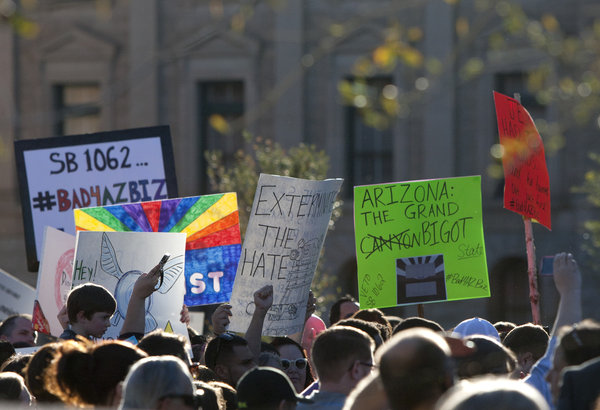
Credit: LA Times
A funny thing happened on my way back from a recent trip I took to Arizona. The state became embroiled in a heated political battle over Senate Bill 1062.[1] Okay, it may not have been funny. But these kinds of battles are common.
According to some, S.B. 1062 championed religious liberty, allowing business owners with religious convictions to deny service to a party if the business owner felt that serving that party would substantially burden or contradict his religious convictions. According to others, S.B. 1062 violated the civil rights of homosexuals by formally and legally legitimatizing discrimination against them.
Last Wednesday, Governor Jan Brewer vetoed the bill, explaining, “I have not heard of one example in Arizona where business owners’ religious liberty has been violated … The bill is broadly worded and could result in unintended and negative consequences.”[2] Of course, the political pressure on Governor Brewer was hot:
Companies such as Apple Inc. and American Airlines, and politicians including GOP Sen. John McCain and former Republican presidential nominee Mitt Romney were among those who urged Brewer to veto the legislation. The Arizona Super Bowl Host Committee, which is overseeing preparations for the 2015 game, came out with a statement against the legislation. The Hispanic National Bar Association on Wednesday said it canceled its 2015 convention in Phoenix over the measure.[3]
In observing the volley between supporters and detractors of this bill, two things strike me.
First, homosexuality – and, specifically, gay rights – is not only a hot topic in our society, it is the hot topic in our society. Interestingly, nowhere does S.B. 1062 mention homosexuality. It simply speaks of “the free exercise of religion.” Yet, USA Today reported on Governor Brewer’s veto of the bill with this headline: “Arizona governor vetoes anti-gay bill.”[4] These days, how a piece of legislation will affect the gay community is the litmus test as to whether or not a bill can or should pass, even if that bill does not specifically mention the gay community. Gay rights, then, are front and center. They are the battleground du jour of our society.
Second, there are a lot of homosexuals who deeply despise Christians with orthodox beliefs concerning the sinfulness of homosexual activity and will go to great – and even duplicitous – lengths to paint Christians as homophobic bigots. Stories abound of people who have concocted heinous hate crimes against themselves. Take, for instance, the lesbian couple that spray-painted their own garage with the message “Kill the gay.”[5] Or how about the Tennessee man who falsely claimed that three men beat him and robbed his store in an anti-gay attack?[6] Then, of course, there was the famed incident of the waitress who falsely claimed she was stiffed on a tip because she was a lesbian.[7] Personally, I don’t want to think of anyone in the homosexual community as my enemy. Life is too short to keep an enemies’ list. But I am not so naïve as to believe that there aren’t some in the homosexual community who think of me as their enemy.
So what am I to do?
Jesus’ admonition to pray for those who are on the outs with you (cf. Matthew 5:44) seems to be especially apropos for a time such as this. To this end, I would invite you to join me in praying for three things as the culture war over sexual rights continues to rage.
First, pray for forgiveness. Though it is painful to admit, it was not too long ago that it was exponentially more likely for a message like “Kill the gay” to be spray painted not by someone self-imposing a hate crime, but by someone committing one. And sometimes, that someone was even a self-professed Christian. This, of course, directly defies a myriad of biblical commandments concerning our conduct as Christians. Our call to tell the truth about sin must never be a license to commit sin – especially the sin of hate. We need forgiveness for our missteps – which are plenty – in this debate.
Second, pray for understanding. I want to be understood. I want people to understand and believe that I am not a homophobic hate monger who wants to oppress, humiliate, and exile those who do not share my same faith and ethical commitments. But if I want this for myself, it is only fair that I afford the same courtesy to others. Martin Luther summarized the Eighth Commandment by saying that, when dealing with our neighbors, we should “put the best construction on everything.”[8] I can think of no better way to respond to those who put the worst construction on Christians’ intentions than by putting the best construction on theirs. Generous understanding offers our greatest hope for peace in the midst of a hotly contested and, sadly, dirtily fought culture war.
Third, pray that true love would prevail. The “true” is just as important as the “love” here, for our society has settled for a counterfeit love that reduces love to nothing more than tolerance. Just the other day, I heard a caller to a radio talk show explain how one of the primary virtues of Christianity is tolerance. Really? A quick search of the word “tolerate” in the Bible brings up verses like these:
- Whoever slanders their neighbor in secret, I will put to silence; whoever has haughty eyes and a proud heart, I will not tolerate. (Psalm 101:5)
- Your eyes are too pure to look on evil; You cannot tolerate wrongdoing. Why then do You tolerate the treacherous? (Habakkuk 1:13)
- It is actually reported that there is sexual immorality among you, and of a kind that even pagans do not tolerate: A man is sleeping with his father’s wife. (1 Corinthians 5:1)
Tolerance does not seem to be the high brow Scriptural virtue that some would like to peddle it as. This is not to say that we shouldn’t live with, work alongside with, and care for people who do not share our same moral commitments. In this way, we should indeed be tolerant. But tolerance does not necessarily entail endorsement.
Ultimately, as Christians, we ought to aspire to a much higher value than that of tolerance. We ought to aspire to love. “Love,” the apostle Paul reminds us, “does not delight in evil but rejoices with the truth” (1 Corinthians 1:6). To love someone well, we must tell him the truth, even when the truth is unpopular. This is our calling with all sin – sexual and otherwise.
So these are my prayers. Now, it’s your turn. Will you join me in praying the same?
[2] Aaron Blake, “Arizona governor vetoes bill on denying services to gays,” The Washington Post (2.26.2014).
[3] Bob Christie, “Arizona Religious Bill That Angered Gays Vetoed,” ABC News (2.27.2014).
[4] Dan Nowicki, Yvonne Wingett Sanchez and Alia Beard Rau, “Arizona governor vetoes anti-gay bill,” USA Today (2.26.2014).
[5] Alyssa Newcomb, “Lesbian Couple Charged With Staging Hate Crime,” ABC News (2.19.2012).
[6] Chuck Ross, “Report: Man falsified police report in alleged anti-gay attack,” The Daily Caller (12.26.2013).
[7] Cavan Sieczkowski, “New Jersey Waitress In Anti-Gay Receipt Saga Reportedly Let Go From Job,” The Huffington Post (12.9.2013).
Michael Sam Makes It Public

Credit: cnn.com
“Does the NFL have any gay players?” my wife asked me last Sunday. She was watching a Hallmark Valentine movie where one of the characters, an NFL quarterback, came out as homosexual. “No, sweetie,” I responded. “The NFL does not have any openly gay players. There have been some players who have come out after they left the NFL, but to date, no players currently in the NFL are openly homosexual.”
It didn’t take long for that to change.
The next morning, while I was working out and watching ESPN, there was Michael Sam, former Missouri Defensive End and candidate in the NFL draft, coming out on national TV as a gay football player. “I am an openly, proud gay man,” Sam told ESPN’s “Outside the Lines.” Granted, Sam is not an NFL player…yet. But his prospects are good.
I am surprised – pleasantly so – by how muted the negative response to Sam’s announcement has been. Some journalists have hinted that responses could turn negative, but to date there is no swell of detractors decrying Sam as a dangerous degenerate. By the same token, those who are writing and speaking about him are hailing him as a hero. Brendon Ayanbadejo, a former linebacker who is currently a free agent, was effusive about Sam’s announcement, comparing him to Jackie Robinson and Rosa Parks. To cap off his feelings concerning Sam, he said, “To borrow from Neil Amstrong, this is one small step for gay men and one giant leap for the LGBTQ community.”[1] Juliet Macur of the New York Times wrote a manifesto demanding that an NFL team draft Sam. She begins by writing, “It’s time,” and ends by declaring, “Sam must be drafted. It’s time to move forward. The teams and the league are on the clock.”[2] For Macur, Sam’s status as a future NFL star is not a matter of his talent, but of a moral imperative that says the NFL must have an openly gay player.
For orthodox Christians, all of this can be hard to sort out. On the one hand, there is something to be celebrated here. It is refreshing to see so many display a measured sensitivity to and deep compassion for those with same-sex attractions and those in same-sex relationships. The gay slurs, gay jokes, and gay bashing of yesteryear have drastically dissipated and, for my part, I say, “Good riddance.” Such speech is diametrically opposed to the biblical command to love, which Paul says is the fulfillment and summation of all biblical commandments (cf. Romans 13:8-9). On the other hand, Christians cannot pretend that our society’s sexual free-for-all, which demands not only the toleration of, but the celebration of sexual practices that are far from biblical standards for human sexuality, is nothing more than an issue of civil rights. Whether it’s Michael Sam touting his homosexuality or Richie Incognito and Jonathan Martin exchanging texts about how many women they have slept with and the use of prostitutes,[3] the spacious sexual ethic of our society is simply not something Christians can endorse. Partly because it’s immoral and Scripturally forbidden, yes. But also because it hurts, belittles, and objectifies people, which, in and of itself, is tragic, no matter what your ethical worldview.
Ultimately, the loose sexual standards of our society are nothing new. The path of sexual salaciousness is well worn – not only in twenty-first century America, but in all the societies that have come before her. But we can choose a different path. We can choose the path of sexual commitment in marriage while walking “humbly with our God” (Micah 6:8). I pray that we do. For when we do, we not only live out God’s sexual standard in our commitments, we show God’s lavish love by our humility.
[1] Mike Foss, “Ex-NFL player: Draft prospect who came out is like Jackie Robinson and Rosa Parks,” USA Today (2.10.2014).
[2] Juliet Macur, “It’s Time for the N.F.L. to Welcome a Gay Player,” New York Times (2.9.2014).
[3] Adam H. Beasley, “Texts shed light on relationship between Miami Dolphins’ Jonathan Martin, Richie Incognito,” Miami Herald (2.5.2014).
Let Freedom Ring…Temperately
 It was Jean-Jacques Rousseau who wrote, “Man was born free, and everywhere he is in chains.”[1] Of course, Rousseau’s conception of freedom was one where man was free from all restraints, most especially moral and social restraints. Rousseau argued that man’s ideal state is one where he is not reliant on morals or on others. Reliance on morals and others rather than self-reliance, Rousseau opined, threatens man’s very survival and existence.
Rousseau wrote his words concerning man’s freedom in 1762. We’ve been trying to decide whether or not he was right ever since.
Case in point: Beyoncé’s performance at the Grammy’s. Anand Giridharadas of the New York Times, in an article on her Grammy appearance, characterized Beyoncé like this: “God-fearing girl from Texas, scantily clad and sexualized vixen, mononymous superstar and feminist icon, the wife who took Jay-Z’s last name, Carter.”[2] What an interesting combination of characteristics. She’s a sexualized vixen and a God-fearing girl. And both were on display in her Grammy performance. On the one hand, Beyoncé sang a truly blush-worthy and downright raunchy song in an outfit that defied common decency. On the other hand, she performed with her husband, Jay-Z, as together they extolled the pleasures of sex within marriage. Extolling the pleasures of sex within marriage is solidly Christian. Grinding in front of 28.5 million viewers is crass voyeurism. Marital intimacy is solidly moral and, I would point out, biblically commanded (cf. 1 Corinthians 7:5). Dropping your bedroom onto a national stage is a Rousseauian dream.
The apostle Paul writes, “It is for freedom that Christ has set us free. Stand firm, then, and do not let yourselves be burdened again by a yoke of slavery” (Galatians 5:1). Rousseau’s freedom was a freedom to sin. Paul’s freedom was a freedom from sin: “You, my brothers, were called to be free. But do not use your freedom to indulge the sinful nature; rather, serve one another in love” (Galatians 5:13). Rousseau abhorred the notion that man would rely on others. Paul called Christians to be people on which others could happily rely.
Thomas Jefferson once noted, “It would be a miracle were [people] to stop precisely at temperate liberty.”[3] Jefferson feared that, left to their own devices, people would all too easily and quickly lapse into “unbounded licentiousness,” running headlong for the unbridled freedom of Rousseau rather than toward the virtuous liberty of Paul. And this is, sadly, what has happened.
But not completely.
There are still some who understand that true freedom is not so much about the moral bounds you can break, but about the responsibility you can take. There are still some who understand that freedom is not so much about the selfish hedonism in which you can engage, but about the loving service you can offer. That’s true freedom. That’s real freedom. And, by God’s grace, we can still carry forth in that freedom. We must carry forth in that freedom.
Anything else is just “a yoke of slavery.”
[1] Jean-Jacques Rousseau, The Social Contract, Christopher Betts, trans. (Oxford: Oxford University Press, 1994), 45
[2] Anand Giridharadas, “Beyoncé and Jay-Z’s Sultry Dance Makes a Case for Marriage,” New York Times (2.3.2014).
[3] Esther Franklin, Thomas Jefferson: Inquiry History for Daring Delvers (Esther Franklin, 2012).
Pluralistic Ignorance, a.k.a., “Everybody’s Doing It”
 “Everybody’s doing it.” Before this line was used by teenagers in attempts to strong-arm their parents into allowing them to engage in all manner and kind of youthful foolishness, it was the title of a 1938 movie about an alcoholic who creates picture puzzles for a national contest only to get kidnapped before he can deliver the final batch of puzzles. From the reviews I’ve read, the movie wasn’t very good or very believable.[1]
“Everybody’s doing it.” Long after the movie, I remember using this line on my parents – with slight modifications, of course. If I wanted to go to a party, I’d tell my parents, “But everyone will be there!” Or if I wanted my parents to buy me something, I’d tell them, “But everyone else has one!”
“Everybody’s doing it.” This is more than just a teenager’s favorite line. It’s also a dangerous state of mind.
A few years ago, two researchers from Binghamton University in New York, Chris Reiber and Justin Garcia, published a paper titled, “Hooking Up: Gender Differences, Evolution, and Pluralistic Ignorance.”[2] In this paper, they explored the differences between the real and perceived comfort levels with different types of sexual activity among young adults. They discovered what psychologists refer to as “pluralistic ignorance.” They explain:
Pluralistic ignorance (PI) has been demonstrated to play a role in hook-up behavior. PI is characterized by individuals behaving in accordance with (generally false) beliefs attributed to the group, regardless of their own beliefs … Young adults routinely believe that others are more comfortable with various sexual behaviors than they, themselves, are. This leads them to behave as if they were more comfortable than they actually are, and engage in behaviors with which they are not actually comfortable.
After a myriad of charts and graphs illustrating this thesis, the researchers conclude, “Individuals of both genders attributed to others of the same gender higher comfort levels [with different kinds of sexual activity] than they themselves had.” In other words, those surveyed thought that “everyone was doing it,” but, as it turns out, they’re not. And if you think they are, you’re ignorant about what’s going on in the bedrooms of the plurality of people in our world.
Tragically, this perception of the nature and type of sexual activity among one’s peers often leads to the violation of one’s own ethical sensibilities. Thus, far too many people wind up breaching moral boundaries for the farcical, mistaken impression that “everyone is doing it.”
In his epistle to the Romans, the apostle Paul speaks of how “the requirements of [God’s] law are written on [people’s] hearts, their consciences also bearing witness, and their thoughts sometimes accusing them and at other times even defending them” (Romans 2:4). The apostle here contends that all people, whether or not they are Christian, have a conscience – a foundational moral compass that helps them distinguish right from wrong. My contention is that we ought to spend more time listening to our consciences and less time worrying and wondering about what “everybody else” is doing. As the research shows, we don’t really know what everybody else is doing and when we try to guess, we guess wrong.
So, to those who are thinking of breaching an ethical boundary so you can roll with a cultural tide, you need to know: the cultural tide will only roll you. Others are not doing what they say they’re doing and you don’t really know what they’re doing anyway. So listen to your conscience, not to them. Or, better yet, listen to God’s Word. You’ll wind up much less morally anguished and much more joyfully fulfilled.
[2] Chris Reiber & Justin R. Garcia “Hooking Up: Gender Differences, Evolution, and Pluralistic Ignorance,” Evolutionary Psychology 8, no. 3 (2010): 390-404.
The Court of Public Opinion

Credit: rmsbunkerblog.wordpress.com
We are a nation of polls. We poll public opinion on just about everything imaginable – from how Congress is doing their jobs to how the president is doing his job to how many people support gay marriage to how many people support tougher gun control laws to how many people support the legalization of marijuana.
It’s this last bit of polling data that formed the focus of an L.A. Times article by Robin Abcarian, which chronicled the shifting tide of public opinion on our culture’s most famous controlled substance:
The Gallup organization released a poll showing that for the first time in 44 years, a wide margin of Americans – 58% to 39% – believe marijuana should be legalized.
Less than a year ago, only 48% said pot should be legal. That is an astonishing leap of 10 points in the last 11 months alone.[1]
The article explains that Colorado and Washington have led the curve by legalizing recreational marijuana use and their progressive policies, in turn, are moving the country forward: “Like gay marriage, pot is here to stay. And just like gay marriage, it seems like the rest of the country is finally starting to catch on. Or light up.”
Personally, I find it ironic and more than a little medically disingenuous that at the same time cigarettes are increasingly controlled and decried because of the health risks associated with inhaling nicotine, tar, and smoke, using marijuana, which impairs motor abilities and adversely affects cardiopulmonary health, is increasingly accepted.
Regardless of the medical and, for the matter, moral arguments against the legalization of marijuana, I nevertheless must agree with Abcarian’s conclusion: “Like gay marriage, pot is here to stay.”
Why do I concur with Abcarian’s conclusion? Because we live in a society obsessed with and ruled by public opinion. Our working presupposition is that if the majority of people approve of something, that something ought to be implemented societally. And if the majority of people approve of something, that something ought to be considered good and right. Public opinion, then, shapes far more than our federal policy; it guides our society’s morality.
But there is a problem with public opinion. Because the people who proffer it are sinful, public opinion can be sinful. One need look no farther than Pontius Pilate’s opinion poll: “What shall I do, then, with Jesus who is called the Messiah” (Matthew 27:22)? I’m not sure the public was right or righteous when they gave their opinion on Jesus’ sentence.
The apostle Paul reminds us of the stark sinfulness that can sometimes mark public opinion when he writes:
[People] have become filled with every kind of wickedness, evil, greed and depravity. They are full of envy, murder, strife, deceit and malice. They are gossips, slanderers, God-haters, insolent, arrogant and boastful; they invent ways of doing evil; they disobey their parents; they are senseless, faithless, heartless, ruthless. Although they know God’s righteous decree that those who do such things deserve death, they not only continue to do these very things but also approve of those who practice them. (Romans 1:29-32)
According to Paul, the public delights in sanctioning sin. Far from being good and moral, the public is sinful and wicked. And lest we think we are somehow immune to the depravity of the general public, Paul reminds us that we too play a role in society’s degeneracy:
You, therefore, have no excuse, you who pass judgment on someone else, for at whatever point you judge the other, you are condemning yourself, because you who pass judgment do the same things. (Romans 2:1)
It’s not just that public opinion “out there” can be wrong, it’s that our own opinions can be wrong because our opinions are stained and maimed by sin.
In a culture where public opinion shapes nearly everything, Christians have a countercultural message: what is moral and best is not always what is popular and promoted. Instead, what is moral and what is best is that which is revealed by God.
So what does this mean for the debate over legalizing marijuana? It means that a debate such as this one cannot be settled by a poll. Instead, we, as Christians, need to think about this issue in light of God’s Word. Perhaps what Paul says in 1 Corinthians 6:20 is a good place to begin: “Therefore honor God with your body.”
[1] Robin Abcarian, “Like gay marriage, medical marijuana is here to stay,” L.A. Times (10.23.2013).


 Pastor Zach's Blog