Posts tagged ‘Meaning’
Meaning in Life

David Foster Wallace’s final unfinished novel, The Pale King, describes a handful of IRS employees looking for meaning in life. One employee, Lane Dean Jr., seems to be particularly overwhelmed by the apparent tedious and utter meaninglessness of his job:
The rule was, the more you looked at the clock the slower the time went. None of the wigglers wore a watch, except he saw that some kept them in their pockets for breaks. Clocks on Tingles were not allowed, nor coffee or pop. Try as he might, he could not this last week help envisioning the inward lives of the older men to either side of him, doing this day after day. Getting up on a Monday and chewing their toast and putting their hats and coats on knowing what they were going out the door to come back to for eight hours. This was boredom beyond any boredom he’d ever felt.
Lane Dean Jr. tries to browbeat his boredom into beauty by imagining a beach, full of sunshine and warmth, but after just an hour of work:
The beach was a winter beach, cold and gray and the dead kelp like the hair of the drowned, and it stayed that way despite all attempts.
Lane Dean Jr. could not seem, try as he might, to conjure meaning in what felt to him to be a meaninglessness job.
Lane Dean Jr.’s struggle for meaning was a reflection of Wallace’s own intensely personal and desperate struggle. For all of his success as an innovative and creative novelist, who is still widely read and well regarded to this day, he too was on a search for meaning in life. But try as he did, he was simply not resourceful enough to create meaning ex nihilo in his admittedly brilliant novels. And his struggle cost him dearly as, tragically, he took his own life.
Wallace’s sad struggle with meaning in life is nothing new. It was King Solomon who once cried:
Meaningless! Meaningless! Utterly meaningless! Everything is meaningless. (Ecclesiastes 1:2)
Solomon, like so many others before and after him, struggled to see meaning in life. Indeed, the Hebrew word for “meaningless” here is hebel, which refers to a “vapor” or “mist.” Solomon knew that so much of the stuff in life that we tout as meaningful – our jobs, our successes, our paychecks, our social networks, and even our morality – always and eventually evaporate before our eyes. They do not and cannot be lastingly meaningful in and of themselves.
So, what is the solution to our futile and desperate attempts to create meaning in life? It is to trade our obsession to create meaning in life for a humble and sincere desire to seek the meaning of life. For life to have lasting meaning, meaning must come from somewhere beyond life and from something larger than life. Humans cannot create true meaning ex nihilo. Instead of being created, true meaning must be revealed. This is why Solomon, after declaring all human attempts to create meaning futile, concludes:
Of making many books there is no end, and much study wearies the body. Now all has been heard; here is the conclusion of the matter: Fear God and keep His commandments, for this is the duty of all mankind. (Ecclesiastes 12:12-13)
People may write volumes upon volumes of books, as did David Foster Wallace, seeking to make life meaningful, but only God and His Word can provide true and lasting meaning. It is in His Word that the true and lasting meaning of life is revealed – to obey God’s commands and to be loved by Him even when we do not.
Is this the foundation of your meaning?
Searching for Meaning in a Condo Collapse
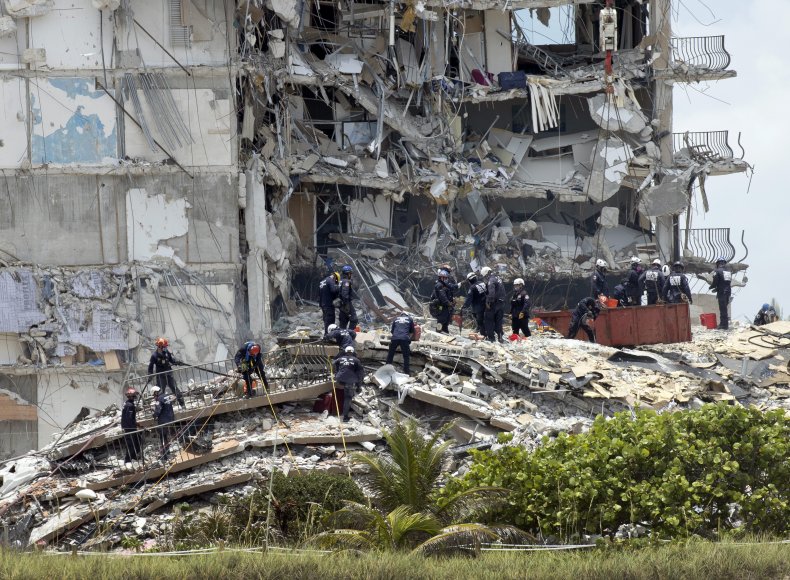
I first heard of the news about the collapse of Champlain Towers South, a condo complex on the beach in Surfside, Florida, early Thursday morning while staying in a condo complex on the beach in Port Aransas. The reports sounded ominous. The pictures that have emerged are dolorous. The number of people still missing is tortuous. And the reason for the building’s collapse remains mysterious.
When a tragedy like this strikes, it is natural for people to ask: Why? We have an intractable need to find meaning, even in the midst of what appears to be a desultory disaster. In our minds, a disaster is never just a disaster. There is always a reason behind it. There is always something we can learn from it.
This desire to find meaning in disaster is nothing new. The specific meanings we derive from disasters may change, but our search for some kind of meaning – any kind of meaning – remains. This search for meaning is what Jesus addresses when He references a tower collapse in His day and the meaning people had assigned to it:
Those eighteen who died when the tower in Siloam fell on them – do you think they were more guilty than all the others living in Jerusalem? I tell you, no! But unless you repent, you too will all perish. (Luke 13:4-5)
In Jesus’ day, there was an assumption that if a disaster befalls you, this indicates an especially grievous sinfulness had engulfed you. Jesus says that deriving this kind of a meaning from this kind of a disaster is wrongheaded. But just because this meaning cannot be derived from this disaster does not mean no meaning can be derived from any disaster.
So, what meaning can we rightly find in disaster?
Near the end of his life, Solomon, one of the greatest kings of ancient Israel, reflects on all he has done, experienced, and accomplished and compiles his thoughts in the book of Ecclesiastes. After much reflection, he arrives at this conclusion:
“Meaningless! Meaningless!” says the Teacher. “Utterly meaningless! Everything is meaningless.” (Ecclesiastes 1:2)
Though these words are quite famous, they also represent one of my least favorite translations in the Hebrew Bible. In Hebrew, the word translated as “meaningless” is hebel, which does not denote a lack of meaning, but instead describes transience. Hebel is a “vapor” or a “mist.” Solomon’s point, then, is this: just when we think we’ve taken a hold of something, it slips through our fingers. Solomon continues by offering a litany of things that slip through our fingers: wisdom, pleasure, hard work, and riches. And it is here with hebel that we find not meaninglessness, but some much-needed meaning in disaster. Disasters remind us that this life and everything in it is like a vapor or a mist. It slips through our fingers – sometimes when we least expect it, like when a tower shockingly crumbles. This life can be shorter than we care to admit.
So, what are we to do in light of life’s transience? On the one hand, Solomon says, this kind of transience should lead us to live joyfully in this day because we do not know whether another day awaits us:
I know that there is nothing better for people than to be happy and to do good while they live. That each of them may eat and drink, and find satisfaction in all their toil – this is the gift of God. (Ecclesiastes 3:12-13)
On the other hand, life’s transience should also lead us to search for something that is not transient – something that lasts. This is why Solomon says in the next verse:
I know that everything God does will endure forever. (Ecclesiastes 3:14)
This life may not last. But what God does will. This means that when God sent His Son to bring life, He brought a life that lasts – a life that is eternal. Tragedy may remind us that this life doesn’t last. But God gives us hope for a life that does – a life that extends far beyond this one. And that’s not just meaning we can take from a tragedy like the Champlain Towers collapse; that’s hope we can have no matter what tragedy we may face.
The Search for Meaning

In his 1946 classic, Man’s Search for Meaning, Victor Frankl candidly and insightfully reflects on his time as a concentration camp prisoner in Auschwitz and how he struggled to find bright spots of meaning what felt like a deeply dark vacant evil. In one particularly moving passage, Frankl describes how he found meaning by thinking about his wife as he was forced into hard and humiliating work:
We stumbled on in the darkness, over big stones and through large puddles, along the one road leading from the camp. The accompanying guards kept shouting at us and driving us with the butts of their rifles. Anyone with very sore feet supported himself on his neighbor’s arm. Hardly a word was spoken; the icy wind did not encourage talk. Hiding his mouth behind his upturned collar, the man marching next to me whispered suddenly: “If our wives could see us now! I do hope they are better off in their camps and don’t know what is happening to us.”
That brought thoughts of my own wife to mind. And as we stumbled on for miles, slipping on icy spots, supporting each other time and again, dragging one another up and onward, nothing was said, but we both knew: each of us was thinking of his wife. Occasionally I looked at the sky, where the stars were fading and the pink light of the morning was beginning to spread behind a dark bank of clouds. But my mind clung to my wife’s image, imagining it with an uncanny acuteness. I heard her answering me, saw her smile, her frank and encouraging look. Real or not, her look was then more luminous than the sun which was beginning to rise.[1]
As Frankl thought about the woman he loves, he found meaning for life in that love. He writes, “Love is the ultimate and the highest goal to which man can aspire.”
The human desire for meaning, it seems, is a desire that is nearly impossible to extinguish, even when it is confronted with the horrors of a concentration camp. Whether consciously or subconsciously, everyone lives for something. Some people live for riches. Others live for fame. Still others live for pleasure. Some wiser and more mature souls find meaning in, if you will excuse the somewhat circular logic, more meaningful things. For example, I was talking to a single mom some time ago who lives for her kids. She works long hours and she has gone back to school so she can better provide for her two daughters. She finds her meaning in motherhood.
What is particularly fascinating to me about this mother’s search for meaning is that she is, by her own admission, not a Christian. “Religion,” she admits, “is just not my thing.”
I have known this mom for quite a while and, on the one hand, I am proud of how far she’s come. There was a time, not too long ago, when she reveled in a shallow hedonism – drinking, carousing, and doing drugs. All that has ended. She has fled those demons. On the other hand, however, I can’t help but notice that, as admirable as her investment into motherhood is, she has only kicked her search for ultimate meaning down the curb a bit. Here’s what I mean.
If my friend finds her meaning for life in being a mother, what happens if her kids rebel against her and ultimately reject her? Will she lose her source of meaning because they have pulled away from her? Or, what happens if she falls back into her old habits of substance abuse and fast living? Will she lose her source of meaning because she will not have been the mother she could have been? Or, less dramatically, what happens when her kids grow up and move away? When she no longer has little children to nurture, what will provide her with meaning and purpose?
It is in light of questions like these that Christianity’s answer to man’s search for meaning becomes critical. For Christianity asserts that man can only find ultimate meaning in God and in the hope of an eternity with Him. To use the formulation in the opening salvo of the Westminster Catechism: “Man’s chief end is to glorify God, and to enjoy Him forever.” This is where man finds his ultimate meaning.
The problem with finding ultimate meaning in anything other than God is that no other source of meaning lasts. Every other source of meaning only kicks the search for meaning down the curb, for every other source of meaning eventually fades and expires, which compels another search for another source of meaning. Only God ends such searches permanently.
It is not until my friend finds her ultimate meaning in Christ that her search for meaning will find its final answer. There are greater sources of meaning and lesser sources of meaning to be sure. But there is only one eternal source of meaning. I pray that she, along with others like her, discovers this eternal source. For when she does, she will find that this eternal source leads to eternal life.
____________________________________
[1] Victor Frankl, Man’s Search for Meaning (Boston: Beacon Press, 2006), 36-37.


 Pastor Zach's Blog