Posts tagged ‘Life’
A Tragic Spate of Suicides
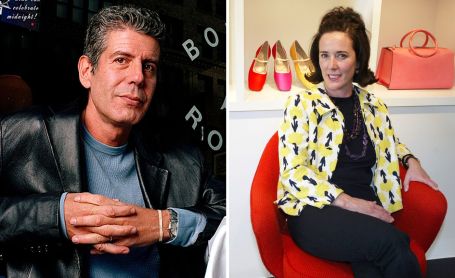
Credit: New York Daily News
One week. Two tragic deaths.
First, it was iconic fashion designer Kate Spade, who was found dead in her apartment Tuesday night after she had hung herself. Then last Friday, it was celebrity chef Anthony Bourdain who, while working on an upcoming episode of his CNN show “Parts Unknown,” also hung himself at the hotel where he was staying in Kaysersberg, France.
We are facing nothing short of a suicide epidemic in our country. The Centers for Disease Control and Prevention report that suicide rates are up almost 30 percent nationwide since 1999. During this time period, only one state saw a decrease in suicides: Nevada. And Nevada’s rate decreased by only 1 percent. In North Dakota, the suicide rate jumped more than 57 percent during this time period. In 2016, nearly 45,000 people took their own lives across the United States, making suicide more than twice as common as homicide and the tenth leading cause of death overall.
We have a problem.
Mental illness certainly plays a role in many of these terrible deaths. But more than half of the suicides in 27 states involved people who had no known mental health concerns.
Of course, no explanation, no matter how clinical or comprehensive it may be, can ever even begin to blunt the pain of a life lost on those left behind. Mental health diagnoses of diseases like clinical depression often only leave people wondering why physicians weren’t able to help. Suicide notes often raise more question than they answer. It seems no explanation can really answer the furious and frustrated one-word interrogation of “why?”. This is because this is an interrogation birthed by pain and bathed in pain. You see, there is a creeping realization that comes with death – a realization that a person who was once with us has now gone away from us and we will no longer be able to see them, talk to them, or hold them. As many a grieving person has muttered after the suicide of a loved one: they were taken from us too soon.
The horror of suicide needs some sort of hope. But hope is hard to find in something as final and gruesome as death. This is why we need the gospel, for the gospel reminds us that there is a death that undoes death. While suicide takes people we love from us, the gospel declares that Jesus, out of love, gave His life for us. As the apostle Paul puts it in Romans 5:8: “God demonstrates His own love for us in this: while we were still sinners, Christ died for us.”
Suicides may feel final, but the cross of Christ reminds us that they do not have to be. The cross’s effects held on for three days before the cross was double-crossed by an empty tomb. The effects of a dark moment of despair that leads to a tragic end by one’s own hand may hold on for a little longer, but their days too are numbered. A resurrection is on its way.
And so, to anyone who is suffering, perhaps in silence, let me say simply this: you do not have to escape despair through your own death, because despair has already been defeated by Jesus’ death.
He’s your reason to live.
If you’re struggling with thoughts of suicide, you are loved and there is help. Talk to a counselor or a pastor at your church. If you need immediate help, please call the National Suicide Prevention Lifeline at 1-800-273-8255. Do it now. The life God has given you is far too valuable to lose.
Down Syndrome, Life, and Death

When Eve gives birth to her first son, Cain, she declares, “With the help of the LORD I have brought forth a man” (Genesis 4:1). With these words, Eve acknowledges a fundamental reality about conception, birth, and life in general: without God, the creation and sustentation of life is impossible. Each life is a miracle of God and a gift from God.
Sadly, this reality has become lost on far too many. Life is no longer hailed as something God gives, but is instead touted as something we can create and, even more disturbingly, control. The latest example of this kind of thinking comes in an op-ed piece in The Washington Post by Ruth Marcus, the paper’s deputy editorial page editor, titled, “I would’ve aborted a fetus with Down syndrome. Women need that right.” Ms. Marcus explains:
I have had two children; I was old enough, when I became pregnant, that it made sense to do the testing for Down syndrome. Back then, it was amniocentesis, performed after 15 weeks; now, chorionic villus sampling can provide a conclusive determination as early as nine weeks. I can say without hesitation that, tragic as it would have felt and ghastly as a second-trimester abortion would have been, I would have terminated those pregnancies had the testing come back positive. I would have grieved the loss and moved on.
According to her opinion piece, Ms. Marcus’ concern over whether or not a woman should be able to abort a child with Down Syndrome comes, at least in part, because of HB205, a bill introduced by Utah State Representative Karianne Lisonbee, which would ban doctors in that state from performing abortions for the sole reason of a Down Syndrome diagnosis. Ms. Marcus passionately defends her position, going even so far as to conclude:
Technological advances in prenatal testing pose difficult moral choices about what, if any, genetic anomaly or defect justifies an abortion. Nearsightedness? Being short? There are creepy, eugenic aspects of the new technology that call for vigorous public debate. But in the end, the Constitution mandates – and a proper understanding of the rights of the individual against those of the state underscores – that these excruciating choices be left to individual women, not to government officials who believe they know best.
Ms. Marcus admits that choosing whether to keep or abort a baby based on certain physical traits or genetic anomalies has “creepy, eugenic aspects.” But such moral maladies are not nearly unnerving enough for her to even consider the possibility that some sort guardrail may be good for the human will when it comes to abortion. The ability to choose an abortion, in her view, is supreme and must remain unassailable.
Ms. Marcus flatly denies what Eve once declared: “With the help of the LORD I have brought forth a man.” She has exculpated herself from the moral responsibilities intrinsic in the front phrase of Eve’s sentence and has left herself with only, “I have brought forth a man.” She has made herself the source and sustainer of any life that comes from her womb. And as the source and sustainer of such life, she believes that she should have the ability to decide whether the life inside of her is indeed worthy of life, or is instead better served by death.
Part of what makes Eve’s statement so intriguing is that it seems to be pious and prideful at the same time. On the one hand, Eve acknowledges that God is the giver of life. Indeed, Martin Luther notes that Eve may have believed her son “would be the man who would crush the head of the serpent”[1] – that is, she may have believed her son would be the Messiah God had promised in Genesis 3:15 after the fall into sin. On the other hand, what she names her son is telling. She names him “Cain,” which is a play on the Hebrew word for the phrase, “I have brought forth.” Eve names her son in a way the emphasizes her action instead of God’s gift.
Countless years and 60 million American abortions later, this emphasis has not changed. Maybe it should. As the fall into sin reminds us, human sovereignty is never far away from human depravity, which is why our demand to be able to choose death never works as well as God’s sovereignty over life.
_____________________________________
[1] Martin Luther, Luther’s Works, vol. 1, Jaroslav Pelikan, ed. (St. Louis: Concordia Publishing House, 1958), 242.
Advocating for Life

Over these past few weeks, lots of big news has been breaking regarding the abortion industry. Perhaps most notably, it was announced a week ago that Cecile Richards, who is the president of Planned Parenthood, has decided to step down from her position. Mrs. Richards’ time at the helm of Planned Parenthood has been marked by scandal, as a series of exposés were published accusing her organization of trafficking fetal parts, and by a total of some 3.5 million abortions.
Also in the news, new research has been published in the controversial Journal of American Physicians and Surgeons, which claims to shed light on the emotional pain that many women experience after going through an abortion. If the study’s findings are even close to accurate, they are shocking:
13% reported having visited a psychiatrist, psychologist, or counselor prior to the first pregnancy resulting in an abortion, compared to 67.5% who sought such professional services after their first abortion. Only 6.6% of respondents reported using prescription drugs for psychological health prior to the first pregnancy that ended in abortion, compared with 51% who reported prescription drug use after the first abortion.
Abortion, this study asserts, has deep, lasting, and adverse effects on women’s emotional health.
Digging deeper into the study, some of the individual responses given by women to researchers concerning how their abortions affected them are nothing short of heartbreaking. When asked, “What are the most significant positives, if any, that have come from your decision to abort?” one woman responded:
None, there are no positives. My life is no better, it is much worse. I carry the pain of a child lost forever. Although I know I am forgiven and have worked through the guilt and shame, the heart-wrenching pain is still there. I would rather have been a single mother of two and have my baby here to love and dote on than the pain of empty arms.
Another woman explained:
My child is dead and by my own choice. I spent years of anger, shame, and grief. It damaged my relationship with my husband, my children, and my God. For 30 years I did not speak of it to anyone but my husband. My grief overwhelmed him and left him powerless and ashamed. For years I cried every Sunday in church, experienced dark depressions, thoughts of suicide, and flashes of anger.
Clearly, the abortions these women endured were devastating to their emotional health.
Along with this research, there is also a proposed bill that addresses the care of babies who are born alive in failed abortion attempts. Representative Marsha Blackburn has introduced the “Born-Alive Abortion Survivors Protection Act,” which requires doctors, if a baby is born alive during an attempted abortion, to provide the same level of care for that child that would be offered to any child born at the same gestational age and to immediately admit that child to a hospital for further care. The House of Representatives has already passed the bill. It now awaits consideration in the Senate.
In all this news, opponents of abortion, among which I count myself, have much on which to reflect. A successful and, I should add, gigantic March for Life in Washington D.C. a few weeks ago demonstrates that the advocates for babies in the womb are both many and organized. Through academic investigation, state and federal legislation, mass demonstration, and, of course, one-on-one conversation, the cause of life marches forward. It marches forward for the babies who have yet to be born, and it marches forward for the women who have been emotionally scarred by their decisions to terminate their pregnancies. Babies in the womb deserve our protection and advocacy. Women who are hurting because of a decision to abort deserve our sympathy and support. The devastation abortion leaves – both in the lives of mothers and the deaths of children – must be revealed for what it is.
As a Christian, I am a firm believer that life is stubborn. It wants to triumph, even over death. This the promise of Easter. And this is what leads to hope for a world without abortion.
The Dogs of North Korea

Credit: Korean Central News Agency
The more we learn about North Korea, the more sickening the regime there looks. Recently, U.N. Ambassador Nikki Haley held a meeting on human rights in North Korea, which featured Ji Hyeon-A, a woman who escaped from North Korea to South Korea in 2007. Fox News reported on her remarks:
“Pregnant women were forced into harsh labor all day,” she said. “At night, we heard pregnant mothers screaming and babies died without ever being able to see their mothers.”
North Korea does not allow for mixed-race babies, she said. At one detention center, she described how inmates starved to death. Their dead bodies, she said, were given to the guard dogs for food.
This is horrifying. But it is also tragically common in this isolated nation. So, how are we to respond?
First, we should pray for the protection of the citizens of North Korea. Living under the nation’s current dictator, Kim Jong-un, or its prior dictator, Kim Jong-il, as did Ji Hyeon-A, has to be terrifying emotionally, psychologically, spiritually, and physically. Just this past week it was reported that North Korea’s top military official, Hwang Pyong-so, second only to Kim Jong-il himself, is suspected dead after falling out of favor with the supreme leader. In North Korea, there is no reasonable assurance of life. Thus, prayers for the thousands whose lives are in danger every day are in order. In Psalm 22, the Psalmist prays:
But You, LORD, do not be far from me. You are my strength; come quickly to help me. Deliver me from the sword, my precious life from the power of the dogs. (Psalm 22:19-20)
The Psalmist’s prayer echoes an all-too-literal North Korean fear. For those who face the grisly specter of being fed to dogs, we must pray. For those who are oppressed or threatened in any way in North Korea, we must pray.
But we must go further. Our prayers must include not only petitions for protection, but cries for justice. The evil of the North Korean regime must be stopped.
When John has a vision of heaven in Revelation, he sees both those saved by God’s grace and those condemned by God’s judgment. He explains the scene thusly:
Blessed are those who wash their robes, that they may have the right to the tree of life and may go through the gates into the city. Outside are the dogs, those who practice magic arts, the sexually immoral, the murderers, the idolaters and everyone who loves and practices falsehood. (Revelation 22:14-15)
John offers a laundry list of those who will be “outside” salvation on the Last Day. But what is most interesting about this list is who heads it: “the dogs.” Considering dogs are such a ubiquitous part of American families that they have garnered the moniker of “man’s best friend,” the idea that dogs would be excluded from God’s kingdom may puzzle us. But in the ancient world, dogs were considered to be not pets, but dangerous, disease-ridden scavengers. They were reviled. In his vision, then, John sees dogs as symbols of all that is evil.
Those who feed people who have died to literal dogs can only be called dogs themselves, in the biblical sense. Yet, we have the assurance that, one day, these dogs will find themselves on the “outside,” just like John foresees – whether this means they lose power in this age, or in the age to come.
In Psalm 22, shortly before the Psalmist prays that God would deliver him from the dogs, he declares:
Dogs surround me, a pack of villains encircles me; they pierce my hands and my feet. (Psalm 22:16)
This psalm, it turns out, is not only a prayer for deliverance, but a prophecy of things to come – a prophecy of One who, just like in the psalm, would be surrounded by His enemies and pierced for them (Psalm 22:16; Luke 24:39), a prophecy of One who, just like in the psalm, would die humiliated as His enemies divided His clothes and cast lots for them (Psalm 22:18; Matthew 27:35), and a prophecy of one who, just like in the psalm, would cry out in despair, “My God, My God, why have You forsaken Me” (Psalm 22:1; Matthew 27:46)?
Jesus, just like the North Koreans, knew the horror of being surrounded by dogs while in the throes of death. Jesus, just like the North Koreans, experienced the most diabolical evils humans could perpetrate. But Jesus, while suffering death at the hands of evil, was not overcome by it. The dogs that surrounded Him were defeated when His tomb turned up empty. And the dogs that surround many in North Korea will be defeated when our tombs turn up empty too.
The dogs may maul. But Jesus’ resurrection is the promise of their defeat, and it is offered to all.
Charlie Gard and the Tenacity of Hope

Credit: Independent
There is a hardly a more compelling example of the ravages of disease warring against the hope for life than that of Charlie Gard. Charlie is almost a year old now, born last August in the U.K. Shortly after his birth, it was discovered that he had a rare genetic condition known as mitochondrial DNA depletion syndrome, which affects vital internal organs such as, as in Charlie’s case, the kidneys and brain. At present, Charlie is being kept alive by a ventilator, but the hospital at which Charlie is staying asked a judge back in March to rule that life support should be discontinued, which the judge ruled in support of in April. Charlie’s parents appealed the ruling, but did not get it overturned. Both President Trump and Pope Francis have signaled their support for Charlie, with the pope even offering Charlie a spot at the Vatican pediatric hospital for continuing treatment. Charlie’s parents have asked to have their son transferred to the U.S. for an experimental treatment, which has had some limited success, but the U.K. hospital has refused to do so, citing legal hurdles.
The issues in this dispute are legion. Should a judge have the ability to trump parents’ wishes with regard to their own child, provided that the parents are seeking the genuine welfare and, in this case, the continued life, of their son? Are Charlie’s parents seeking the correct course of action, considering their son is not able to live, at least at this point, apart from extraordinary and continuous medical intervention? And what are the hopes for some sort of improvement or change in Charlie’s condition if he is moved elsewhere to receive treatment?
It is the last of these questions that is most captivating to me because it is the question that sits in the background of the first two questions. The U.K. believes there is no real hope for Charlie’s recovery. Charlie’s parents believe there is enough hope for, at minimum, some sort of improvement that they want to continue his life support and investigate an experimental treatment. This battle royal, then, boils down to hope.
Over the course of my ministry, I have known more than one person who was terminally ill and, when presented with an option for an experimental treatment, declined and instead chose to go into hospice because they did not see any real hope for healing, even with the treatment. This does not mean, however, that these people did not have any hope. Their hope was simply located in a different place – not in a treatment, but in a Lord who can call even the dead to life. Whether it is a temporary stay on death by means of a medical treatment, or an eternal resurrection on the Last Day by means of a trumpet call and a returning Christ, hope for life, it seems, will not be squelched.
Theologically, the irrepressibility of hope for life makes sense because, in the beginning, death was not part of God’s plan. Contrary to Yoda, death is not a natural part of life – and we know it, even if only intuitively. Death, Scripture says, is an enemy to be defeated. And though Charlie’s parents cannot conquer death like Christ, they do seem voraciously intent on confronting death through the very best that medicine has to offer their son.
It does unsettle me that a judge would arrogate to himself the prerogative of telling two parents whether or not their son can receive a potentially life-saving treatment. I will confess that, according to the information at hand, the hospital is probably correct in its estimation of Charlie’s recovery prospects. But hope has a funny way of looking beyond the information at hand to divine intervention. And that is a hope that is worth holding on to. Indeed, as Christians, we know that is the hope Jesus died to give and rose to secure. I hope the hospital and the British legal system can respect that hope.
Physician-Assisted Suicide and Who We Really Are

Physician-assisted suicide has gained limited acceptance in many regions of the country because it has been peddled, in part, as an option for those suffering from the excruciating pain of certain types of terminal illnesses. Supervised suicide was sold as a way to alleviate physical misery. A new study published in The New England Journal of Medicine, however, suggests that the actual reasons people choose assisted suicide are quite different from that of physical suffering. One of the researchers in the study, Madeline Li, explains that many people consider assisted suicide because of:
…what I call existential distress. [For some people,] their quality of life is not what they want. They are mostly educated and affluent – people who are used to being successful and in control of their lives, and it’s how they want their death to be.
In one instance cited in this study, a marathon runner found herself confined to her bed because of cancer. She wanted to take her own life because “that was not how she saw her identity,” Li explained. In another case, a university professor wanted to die because, according to Li, “he had a brain tumor, and he didn’t want to get to the point of losing control of his own mind, [where he] couldn’t think clearly and couldn’t be present.”
This study reveals that physician-assisted suicide can turn out to be not so much a palliative response to physical pain, but an angry response to the loss of how we see ourselves. A marathon runner wants to end her life when she can longer run marathons. A university professor sees no reason to live if he is no longer able to think at the level he once was. It turns out that when people lose what gives them their identities, they often lose the very will to live.
If nothing else, this study should serve as a warning concerning the dangers of finding your meaning, purpose, and identity in something you are or in something you do, for these types of identities can all too easily be shattered by the wily ravages of this world and this life. This is why, as Christians, we are called to find who we are in Christ.
When a rich man comes to Jesus in Mark 10 and asks Him, “What must I do to inherit eternal life?” Jesus responds by citing a sampling of the Ten Commandments: “You shall not murder, you shall not commit adultery, you shall not steal, you shall not give false testimony, you shall not defraud, honor your father and mother.” When the man boasts to Jesus, “All these I have kept as a little boy,” Jesus responds, “One thing you lack. Go, sell everything you have and give to the poor, and you will have treasure in heaven. Then come, follow Me.” The rich man, the story says, “went away sad, because he had great wealth.” It turns out that this man found his meaning, purpose, and identity in his wealth. And when Jesus asked him to give up the source of his earthly identity, he could not – even to follow Jesus eternally. May we never make the same devastating mistake.
Physician-assisted suicide carries with it a whole host of ethical problems, including the temptation to place profits over people. Just last week, The Washington Times reported on a doctor who claimed that some Nevada insurance companies refused to cover certain life-saving treatments he requested for his patients because they were too expensive. Instead, these companies offered to help his patients end their lives. If this story is true, such a practice is nothing short of appalling. But sadly, far too many people do not need a creepy suggestion from a greedy insurance company to consider taking their own lives. They only need to be so turned in on who they are in this life that they forget about who they are in Christ.
Suicide may be some people’s answer to a loss of identity. But suicide cannot give someone a new identity. It cannot give someone hope. Only Jesus can do that. So let us find ourselves in Him.
“I consider that our present sufferings are not worth comparing with the glory that will be revealed in us.” (Romans 8:18)
The Search for Meaning

In his 1946 classic, Man’s Search for Meaning, Victor Frankl candidly and insightfully reflects on his time as a concentration camp prisoner in Auschwitz and how he struggled to find bright spots of meaning what felt like a deeply dark vacant evil. In one particularly moving passage, Frankl describes how he found meaning by thinking about his wife as he was forced into hard and humiliating work:
We stumbled on in the darkness, over big stones and through large puddles, along the one road leading from the camp. The accompanying guards kept shouting at us and driving us with the butts of their rifles. Anyone with very sore feet supported himself on his neighbor’s arm. Hardly a word was spoken; the icy wind did not encourage talk. Hiding his mouth behind his upturned collar, the man marching next to me whispered suddenly: “If our wives could see us now! I do hope they are better off in their camps and don’t know what is happening to us.”
That brought thoughts of my own wife to mind. And as we stumbled on for miles, slipping on icy spots, supporting each other time and again, dragging one another up and onward, nothing was said, but we both knew: each of us was thinking of his wife. Occasionally I looked at the sky, where the stars were fading and the pink light of the morning was beginning to spread behind a dark bank of clouds. But my mind clung to my wife’s image, imagining it with an uncanny acuteness. I heard her answering me, saw her smile, her frank and encouraging look. Real or not, her look was then more luminous than the sun which was beginning to rise.[1]
As Frankl thought about the woman he loves, he found meaning for life in that love. He writes, “Love is the ultimate and the highest goal to which man can aspire.”
The human desire for meaning, it seems, is a desire that is nearly impossible to extinguish, even when it is confronted with the horrors of a concentration camp. Whether consciously or subconsciously, everyone lives for something. Some people live for riches. Others live for fame. Still others live for pleasure. Some wiser and more mature souls find meaning in, if you will excuse the somewhat circular logic, more meaningful things. For example, I was talking to a single mom some time ago who lives for her kids. She works long hours and she has gone back to school so she can better provide for her two daughters. She finds her meaning in motherhood.
What is particularly fascinating to me about this mother’s search for meaning is that she is, by her own admission, not a Christian. “Religion,” she admits, “is just not my thing.”
I have known this mom for quite a while and, on the one hand, I am proud of how far she’s come. There was a time, not too long ago, when she reveled in a shallow hedonism – drinking, carousing, and doing drugs. All that has ended. She has fled those demons. On the other hand, however, I can’t help but notice that, as admirable as her investment into motherhood is, she has only kicked her search for ultimate meaning down the curb a bit. Here’s what I mean.
If my friend finds her meaning for life in being a mother, what happens if her kids rebel against her and ultimately reject her? Will she lose her source of meaning because they have pulled away from her? Or, what happens if she falls back into her old habits of substance abuse and fast living? Will she lose her source of meaning because she will not have been the mother she could have been? Or, less dramatically, what happens when her kids grow up and move away? When she no longer has little children to nurture, what will provide her with meaning and purpose?
It is in light of questions like these that Christianity’s answer to man’s search for meaning becomes critical. For Christianity asserts that man can only find ultimate meaning in God and in the hope of an eternity with Him. To use the formulation in the opening salvo of the Westminster Catechism: “Man’s chief end is to glorify God, and to enjoy Him forever.” This is where man finds his ultimate meaning.
The problem with finding ultimate meaning in anything other than God is that no other source of meaning lasts. Every other source of meaning only kicks the search for meaning down the curb, for every other source of meaning eventually fades and expires, which compels another search for another source of meaning. Only God ends such searches permanently.
It is not until my friend finds her ultimate meaning in Christ that her search for meaning will find its final answer. There are greater sources of meaning and lesser sources of meaning to be sure. But there is only one eternal source of meaning. I pray that she, along with others like her, discovers this eternal source. For when she does, she will find that this eternal source leads to eternal life.
____________________________________
[1] Victor Frankl, Man’s Search for Meaning (Boston: Beacon Press, 2006), 36-37.
Death Is Dying

Even as we celebrated Easter yesterday, it was difficult not to be burdened by the death we see around us every day. This past Sunday, 44 worshipers lost their lives at St. George Church in Tanta and St. Mark’s Cathedral in Alexandria, both in Egypt, when ISIS suicide bombers detonated themselves in the middle of these churches’ Palm Sunday worship services. Closer to home, in San Bernardino, a man signed himself into an elementary school at the front desk and then proceeded to walk into the classroom where his estranged wife was teaching and fatally shoot her while also wounding two students, one of whom later died from the injuries he sustained. After his shooting spree, he took his own life. Then, of course, earlier this month, there were the sarin gas attacks by the Assad regime against his own people in northwestern Syria. Death is all around us.
And this is why I am so glad we get to celebrate Easter.
The story of Easter is a story of many things. It is a story of joy, as the people close to Jesus realize the man who they thought was dead has risen. It is a story of fear, as the women who come to the tomb that first Easter morning encounter angelic beings who startle and scare them with their fantastic message. But it is also a story of subversion. It is a story of subverting all those who prefer death to life.
N.T. Wright explains the subversive nature of Easter well:
Who…was it who didn’t want the dead to be raised? Not simply the intellectually timid or the rationalists. It was, and is, those in power, the social and intellectual tyrants and bullies; the Caesars who would be threatened by a Lord of the world who had defeated the tyrant’s last weapon, death itself; the Herods who would be horrified at the postmortem validation of the true King of the Jews.[1]
In a world where terrorist attacks, school shootings, and chemical bombings instill fear into all who see and hear about them, the resurrection of Jesus reminds us that, in the words of the prophet, “no weapon forged against [us] will prevail” (Isaiah 54:17), even if these weapons kill us, for “the one who raised the Lord Jesus from the dead will also raise us” (2 Corinthians 4:14). A tyrant may kill us. But God will raise us. This is Easter’s promise. And this is why it is so good to celebrate Easter at a time like this. For Easter reminds us that even if this world full of death, we need not fear. Christ has risen. And because He has risen, we will rise.
Take that, death.
___________________________________
[1] N.T. Wright, Surprised by Hope (New York: HarperOne, 2008), 75.
Abortion as Big Business

Whenever the curtains are pulled back on Planned Parenthood clinics, the results never seem to turn out well. Through an interview with two former Planned Parenthood employees, it was discovered a clinic in Storm Lake, Iowa had abortion quotas. Sue Thayer, a former manager at Planned Parenthood, revealed:
Every center had a goal for how many abortions were done. And centers that didn’t do abortions like mine that were family planning clinics had a goal for the number of abortion referrals. And it was on this big grid, and if we hit our goal, our line was green. If we were 5 percent under, it was yellow. If we were 10 percent under, it was red. That’s when we needed to have a corrective action plan – why we didn’t hit the goal, what we’re going to do differently next time.
Planned Parenthood, for all the assertions it makes about helping people with family planning, seems to be primarily interested in selling one service – abortions. Mrs. Thayer went on to disclose some of the techniques her clinic would use to sell abortions:
I trained my staff the way that I was trained, which was to really encourage women to choose abortion, to have it at Planned Parenthood, because that counts as, you know, towards our goal. We would try to get the appointment scheduled for the abortion before they left our clinic. We would say things like, “Your pregnancy test, your visit today is X number of dollars. How much are you going to be able to pay towards that?” If they’d say, “I’m not able to pay today,” then we would say something like, “Well, if you can’t pay ten dollars today, how are you going to take care of a baby? Have you priced diapers? Do you know how much it costs to buy a car seat? … So really, don’t you think your smartest choice is termination?”
Honestly, this kind of sales pitch and posturing is difficult for me to process. Planned Parenthood workers freely admitted in their conversations that a life in a womb is – or, at the very least, will be – a baby who will need to be cared for and fed and protected, and yet, because of the expenses involved in raising a child, there is a cold calculation at work that says it is better to abort a child than to financially invest in one. I’m honestly not sure how else I’m supposed to interpret a calculation like this than this: for Planned Parenthood, financial burden trumps human life.
But it goes beyond that. For Planned Parenthood, financial gain also trumps human life. For those clinics that reached their abortion quotas, Mrs. Thayer explained:
We would have things like pizza parties. Occasionally, they would say, “You can two hours of paid time off.” If your center consistently hit goal and you were green all the time, you know, like, three months in a row, you might be center manager of the month and go to Des Moines and have lunch, you know, with the upper management, or something … It sounds kind of crazy, but pizza is a motivator.
Planned Parenthood is so devoted to selling abortions that they offer pizza parties as an incentive to their clinics to sell a lot of them. It turns out that they also hand out awards to clinics that increase the number of abortions they perform year over year.
The moral questions such practices raise are inescapable. Are the lives of babies who are born into lower financial means more disposable than the lives of babies who are born into more affluent families? Should the future of a life be subject to a financial litmus test – if a life can be afforded, it should be nurtured, and if it cannot, it should be ended? Should expectant mothers, who often have nagging doubts and deep moral misgivings about whether or not they should have an abortion, be pressured into a procedure to add to a company’s bottom line?
Peter Singer, the Ira W. DeCamp Professor of Bioethics chair at Princeton, has been widely decried, and rightly so, for his crassly utilitarian view of human life. He has claimed, for instance, “that a human’s life is not necessarily more sacred than a dog’s, and that it might be more compassionate to carry out medical experiments on hopelessly disabled, unconscious orphans than on perfectly healthy rats.” For Singer, the worth of a life can be coolly calculated by a set of criteria. If a life meets the criteria, it should be nurtured and protected. If it does not, it can be ended, even if it is a human life. It is difficult to see how Planned Parenthood’s financial criteria to determine a human life’s value differs all that much from Professor Singer’s method.
It must be said that a Christian cannot endorse or endure such a view of human life. Human life is not valuable because it meets certain criteria. It is valuable, according to Scripture, because of its origin and its unique reflection of its Creator. Neil Gorsuch, President Trump’s nominee for Supreme Court Justice, echoes this sentiment using a Constitutional lens when he writes:
The Fourteenth Amendment to the U.S. Constitution guarantees equal protection of the laws to all persons; this guarantee is replicated in Article 14 of the European Convention and in the constitutions and declarations of rights of many other countries. This profound social and political commitment to human equality is grounded on, and an expression of, the belief that all persons innately have dignity and are worthy of respect without regard to their perceived value based on some instrumental scale of usefulness or merit. We treat people as worthy of equal respect because of their status as human beings and without regard to their looks, gender, race, creed, or any other incidental trait – because, in the words of the Declaration of Independence, we hold it as ‘self-evident’ that ‘all men (and women) are created equal’ and enjoy ‘certain unalienable Rights,’ and ‘that among these are Life.’
What is “self-evident” to the framers of the Declaration of Independence is apparently not so self-evident to Planned Parenthood. May we never allow the inherent value of human life to be anything less than self-evident to us.
Standing for Life

I grew up in the first state in our union to legalize physician-assisted suicide. When Oregon passed the Death with Dignity Act in 1997, which allowed a terminally ill patient to administer lethal drugs to him or her self under the direction of a doctor, it stirred a lot of controversy. Though other states and regions have since followed suit, even nearly twenty years later, laws like the Death with Dignity Act still stir a lot of controversy and concern.
Our nation’s capital is now joining the fray of this debate with the D.C. Council readying themselves to vote tomorrow on legislation that would allow doctors to prescribe lethal drugs to terminally ill people. Fenit Nirappil of The Washington Post explains:
A majority of D.C. Council members say they plan to vote for the bill when it comes before them Tuesday.
But chances for enactment are unclear. The council will have to vote on the bill twice more by the end of the year. Mayor Muriel E. Bowser (D) has not indicated whether she will sign the legislation, although her health director has testified against it, saying it violates the Hippocratic oath. It is not certain that proponents have enough votes for an override. And Congress could also strike down the legislation.[1]
Many in the African-American community of Washington D.C. strongly oppose the legislation. The charge against the legislation is being led by Rev. Eugene Rivers III, who is leading a group called No DC Suicide. Rev. Rivers calls the legislation “back end eugenics,” and believes it is aimed at eliminating poor blacks. Leona Redmond, a community activist, echoes Rev. Rivers’ sentiment, saying, “It’s really aimed at old black people. It really is.” Proponents of the law have made countless assurances that there is no racial component to the legislation. Donna Smith, herself an African-American and the organizer for Compassion and Choices, argues, “This just isn’t a ‘white’ issue. This issue is for everyone who’s facing unbearable suffering at the end of life.”
Certainly, any move by any group to end people’s lives based on their race is repulsive. Indeed, if this legislation is enacted and, even if unintentionally, disproportionately affects a particular race, serious questions will need to be asked and stern objections will need to be raised. The problem for the Christian, however, extends beyond the boundaries of race to the dignity of humanity itself.
In the third article of the Nicene Creed, Christians confess, “I believe in the Holy Spirit, the Lord and giver of life.” Fundamental to what we confess as Christians is that God is the giver of life. When the apostle Peter is preaching a sermon on Pentecost day, he says to those assembled, “You killed the author of life, but God raised Him from the dead” (Acts 3:15). Because God is the author of life, Christians believe that life is a sacred gift from God to us and ought to be stewarded carefully and lovingly by us. This is why orthodox Christianity has consistently stood against the taking of life whether that be through abortion at life’s beginning or through physician-assisted suicide as life may be nearing its end. Both of these practices treat life not as a gift to be stewarded, but as burden to be manipulated and, ultimately, destroyed.
It is true that life can sometimes become burdensome. But when a young lady becomes terrified at the specter of an unexpected pregnancy, or when a person is suffering through the throes of a terminal illness, we must remind ourselves that life itself is not the culprit in these types of tragic situations. A world broken by sin is the culprit. So attacking life itself doesn’t relieve the burden. Instead, attacking life actually succumbs to the burden because it capitulates to what sin wants, which is always ultimately death. To fight against sin, therefore, is to fight for life.
As Christians fight for life, it is very important that they fight for all of life and not just certain moments in life. All too often, Christians have been concerned with fighting for those at the beginning of life as they stand against abortion, or fighting for those who may be nearing the end of life as they stand against physician-assisted suicide. But there is so much more to life than just its beginning and its end. Christians should be fighting against human trafficking, which treats lives as commodities to be traded rather than as souls to be cherished. Christians should be fighting against racism, which trades the beauty of a shared humanity for the dreadfulness of discriminatory distinctions. Christians should be concerned with genocide in places like Aleppo, as Syria’s army continues to launch indiscriminate military strikes against its own citizens with horrifying results. To celebrate life means to celebrate all of life – from the moment of conception to the moment of death and everything in between.
So let’s stand for and celebrate life. After all, after this life comes everlasting life through faith in Christ. Life will win out in the end. So we might as well surrender to and celebrate life now.
______________________________
[1] Fenit Nirappil, “Right-to-die law faces skepticism in nation’s capital: ‘It’s really aimed at old black people,’” The Washington Post (10.17.2016).


 Pastor Zach's Blog