Posts tagged ‘Jesus’
Where Human Justice Cannot Tread: The Case of Trayvon Martin & George Zimmerman

Credit: The Associated Press
We will never know for sure what happened.
Well, we will never know for sure all that happened. There are a few things we do know. We do know that on the night of February 26, 2012 in Sanford, Florida, an altercation took place between Trayvon Martin and George Zimmerman. We do know that this altercation left Trayvon Martin dead of a single gunshot wound, fired at intermediate range. We do know that George Zimmerman was the shooter. And we do know that on Saturday, July 13, Zimmerman was found “not guilty” of both the charges of second-degree murder and of manslaughter.
As the trial of George Zimmerman unfolded before a nation of breathless spectators, it became clear to many pundits and reporters – regardless of how these pundits and reporters hoped this case would turn out – that the prosecution was in trouble. Consider this from ABC News:
Prosecutors started strong with a powerful, concise opening statement from Assistant State Attorney John Guy, in contrast to the silly knock-knock joke and seemingly disorganized and meandering defense argument …
But then something happened that many would have thought improbable as this case received wall to wall coverage leading up to Zimmerman’s arrest.
What the state hoped would be proof that Zimmerman initiated the altercation and that he, not Martin, was on top as they grappled on the ground, did not appear to proceed as planned …
With each witness there were either facts that we now know are not true (like hearing three shots, when there was only one) or indications that their memories have somehow become clearer since the incident itself.[1]
The prosecution’s witnesses, in their testimonies of what happened that night, gave conflicting and confusing accounts. Coupled with the fact that the burden to prove that Zimmerman shot Martin in something other than self-defense rested on the prosecution, the prospects for a conviction were grim for the state. Again, ABC News summarized the prosecution’s problem well:
Prosecutors still have to prove beyond a reasonable doubt that Zimmerman did not “reasonably believe” he was “in imminent danger of death or great bodily harm” during their altercation. That is a heavy burden to bear.
It turns out, as the verdict this past Saturday revealed, that it was a burden too heavy to bear.
Along with the wide range of human emotions that a trial such as this one elicits, this trial has also exposed the limits of human justice. The jury found George Zimmerman “not guilty.” This does not necessarily mean that Zimmerman committed no crime. It simply means that, in the opinions of the jurors, there was not enough evidence to demonstrate beyond a reasonable doubt that he was guilty of a crime. The jurors’ verdict does not pretend or presume to rule on George Zimmerman’s guilt or innocence as a matter of fact. It simply says that Zimmerman will not be incarcerated as a matter of the law.
The justice of our God is much more comprehensive and, as strange as it sounds, just than the justice of our courts. For our God is concerned with infinite transcendent justice rather than with limited legal justice. Indeed, our God is passionate about justice. God shouts in Amos 5:24: “But let justice roll on like a river, righteousness like a never-failing stream!” Where human justice falls short, God’s justice does not.
Ultimately, regardless of the verdict, the justice rendered in that Florida courtroom can only be provisionary and incomplete. Even if George Zimmerman had been found guilty, his incarceration would not have undone the painful problem of death, which is finally what this case – and every murder case – is all about. But the painful problem of death cannot be solved in any courtroom; it can only be solved on a cross. Only Jesus can bring justice to death by conquering it with His life – a life that will finally and fully be revealed on the Last Day.
So while a Florida court has ruled, we are still waiting for Jesus to rule – or, to put it more clearly, to reign – when He returns on the Last Day. And, blessedly, the justice He will bring on that day will be far better than the justice we have in these days. For His justice does much more than merely rule on tragedies; His justice fixes them.
[1] Dan Abrams, “George Zimmerman’s Prosecution Woes: Analysis,” ABC News (7.1.2013).
Righteous
 This weekend in worship and ABC, we learned about the doctrine of justification which teaches that our righteousness before God is not a product of ourselves and our works; rather, it is a free gift from God, given to us by the work of Christ on the cross. As the apostle Paul writes, “[We] are justified freely by [God’s] grace through the redemption that came by Christ Jesus” (Romans 3:24).
Throughout the history of the Church, some have tried to undercut this doctrine of God’s work with human works. The Pelagians, for instance, taught that by obeying God’s commands, people could gain favor in God’s sight. The Synergists taught that justification was not a gift of God’s righteousness exclusively, but a comingling of God’s righteousness with human righteousness. In the face of such unbiblical teachings, Martin Luther offers this important reflection on justification as God’s work and not as ours:
The world wants to win heaven from our Lord God by right, although He is causing the message to be proclaimed aloud throughout the world that He wants to give it to us for nothing. He says: “I want to be your God; out of grace and for nothing I want to save you … I will not let you win heaven from Me. Therefore make no other gods, do not invent things that you do for yourself … Do not begin with your good works; allow Me to have mercy on you.” It certainly is a shame that people must accuse us being unwilling to accept heaven for nothing, nay, of actually wanting to earn it and of proposing to give to God, to Him who desires to offer everything to us in plenty. Such fools are we: we want to give what we ought to take.[1]
We bring nothing to our righteous standing before God – no good work, no pious thought, no warm heart. Instead, God supplies any and all righteousness we need through His Son. This is the doctrine of justification. This is the promise of the gospel. And this is the cornerstone of our faith.
May we never seek to add our works to God’s work. After all, it is God’s work – and His work alone – that saves us.
[1] Martin Luther, What Luther Says, Ewald M. Plass, comp. (St. Louis: Concordia Publishing House, 1959), §2207.
The Law of Retaliation
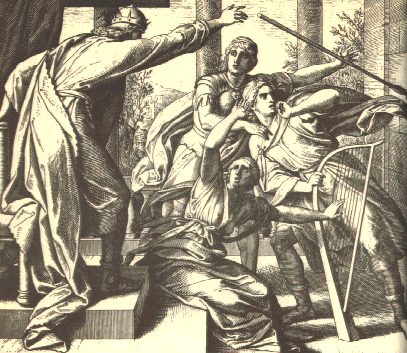
“Saul Tries to Kill David” by Julius Schnorr von Karolsfeld, 1850’s, Wikimedia Commons
This past weekend in worship and ABC, we discussed the importance of friendship. Every person needs a friend for encouragement, for challenge, and for consolation. In the words of Proverbs 17:17: “A friend loves at all times, and a brother is born for adversity.” For good times and for bad, everyone needs a friend.
Perhaps the most famous example of friendship in the Bible is that of David and Jonathan. These two guys far more than just bar buddies. 1 Samuel 18:1 describes their relationship like this: “The soul of Jonathan was knit to the soul of David.”
Though David and Jonathan’s friendship was strong, it was also fraught with peril. Jonathan’s dad, Saul, the king of Israel, hated David and wanted to kill him. But Jonathan was so deeply devoted to his friend that he went to bat for him, telling his father:
“Let not the king sin against his servant David, because he has not sinned against you, and because his deeds have brought good to you. For he took his life in his hand and he struck down the Philistine, and the LORD worked a great salvation for all Israel. You saw it, and rejoiced. Why then will you sin against innocent blood by killing David without cause?” (1 Samuel 19:4-5)
In my sermon, I talked about how Jonathan, in order to defend his friend, appeals to the lex talionis, a Latin phrase referring to the “law of retaliation.” This law is classically expressed in Leviticus 24:19-20: “If anyone injures his neighbor, as he has done it shall be done to him, fracture for fracture, eye for eye, tooth for tooth; whatever injury he has given a person shall be given to him.” This law, of course, is not meant to promote violence, but to contain it. The lex talionis stipulates that “the punishment must fit the crime.” If someone takes your eye, you can’t take his arm. The example I used in my sermon is, “If someone steals $100 from you, you can’t sue him for $1 million because of emotional pain and suffering.”
The way Jonathan uses the lex talionis in 1 Samuel 19 is especially fascinating. For rather than appealing to the lex talionis responsively to punish a crime, he appeals to it preemptively to prevent a crime. Jonathan’s essential argument to his father is this: “You can’t kill David! The law of retaliation says you can only hurt someone if he first hurts you! And David hasn’t hurt you!”
I have gained a deep appreciation for Jonathan’s argument to his father because Jonathan essentially turns the lex talionis into a catch 22. You can hurt someone, but only if he hurts you first. Someone else can hurt you, but only if you hurt him first. This means no one can hurt anyone because no one can make the first move to hurt someone because, by sheer chronological necessity, there would be no prior just cause for such an injury, thus breaking the lex talionis! Far more than regulating violence, the lex talionis prevents it.
This use of the lex talionis is nicely in line with Jesus’ commentary on the rule: “You have heard that it was said, ‘An eye for an eye and a tooth for a tooth.’ But I say to you, Do not resist the one who is evil. But if anyone slaps you on the right cheek, turn to him the other also” (Matthew 5:38-39). Jesus essentially says, “Even if you are unjustly wounded, never give anyone a reason to use the lex talionis on you. Self-control, even in the midst of terrible adversity, is paramount. If you don’t hurt someone else, then that other person has no ground on which to stand if he hurts you.”
What tensions and quarrels do you have with others? The best way to end them is to refuse to give the person with whom you are in conflict any reason to retaliate. Your cool and collected response to someone who is angry may just be what diffuses a fight, ends a conflict, and restores a friendship.
Has The Bible Been Corrupted?
 This past weekend in worship and ABC, we discussed some of the biggest objections and obstacles that people present to trusting in Jesus. One of the objections and obstacles I covered in ABC had to do with the reliability of Scripture. Bart Ehrman, a skeptical scholar at the University of North Carolina at Chapel Hill, explains why so many people call into question the Bible’s reliability:
Not only do we not have the originals [of the biblical manuscripts], we don’t have the first copies of the originals. We don’t even have the copies of the copies of the originals, or the copies of the copies of the copies of the originals. What we have are copies made later – much later. In most instances, they are copies made centuries later. And these copies all differ from one another, in many thousands of places…These copies differ from one another in so many places that we don’t even know how many differences there are. Possibly it is easiest to put it in comparative terms: there are more differences in our manuscripts than there are words in the New Testament.[1]
Many people wonder if that which is recorded in the Bible is historically accurate. Recently, popular news commentator Bill O’ Reilly called into question the historicity of the biblical stories of Adam and Eve and of Jonah, saying, “I was taught, in my Catholic school, that a lot of the stories in the Bible are allegorical.”[2] Bart Ehrman takes it a step farther. He not only questions if what is recorded in the Bible is historically accurate, he questions if what is recorded in the Bible was even supposed to be there at all! He notes the many ancient copies we have of the Bible differ from each other, thereby undermining their veracity, at least in Ehrman’s eyes. After all, if no two ancient manuscripts completely agree with each other, how can we know which manuscripts record what was actually written by Matthew, Mark, Luke, John, Paul, Peter, et al?
In their book Reinventing Jesus,[3] three biblical scholars make some helpful distinctions concerning the types of variants, or differences, that we find in ancient biblical manuscripts. In order to understand what is truly going on with the differences we have between ancient copies of the Bible, it is worth it to review their categories.
Spelling Differences
The majority of the variants we have in the New Testament are either alternate spellings or misspellings of a given word. For instance, the name John is in some manuscripts spelled Ioannes, while in other manuscripts, it is spelled Iaones. One “n” or two? It doesn’t really matter. Regardless of how this name is spelled, we know to whom the manuscript is referring.
Differences That Do Not Affect Translation
There are some differences between ancient copies of the Bible that have no affect on how we read something in English. For example, Greek allows for definite articles before proper names, but does not demand them. Thus, instead of referring to “Mary,” a biblical Greek text may refer to “the Mary.” Or, instead of referring to Jesus, a Greek text may read “the Jesus.” Because Greek allows for but does not demand these definite articles, some ancient Greek texts contain the definite articles in front of names while others do not. This, however, does not affect the translation or meaning of a given biblical text. Rather, the decision to retain or forgo a definite article is merely a matter of style.
Meaningful Variants That Are Not Viable
There are some differences between ancient biblical copies that do indeed affect the meaning of a text, but one of the variant readings is simply not viable. For instance, ancient versions of 1 Thessalonians 2:9 refer to “the gospel of God” while a late medieval manuscript of this same verse refers to “the gospel of Christ.” Though the gospel is indeed Christ’s gospel, because only one late medieval manuscript has this reading while almost all other ancient manuscripts refer to “the gospel of God,” the reading that refers to the gospel of Christ simply isn’t viable. Too many other texts militate against this reading.
Meaningful and Viable Variants
Finally, there are some variants between ancient biblical copies that both affect the meaning of a text and are viable. Romans 5:1 has variants that read, “We have peace” as well as “Let us have peace.” Scholars are split on which one is original. But even if scholars are split on which one is original, both statements are theologically correct. After all, we are both promised peace through Christ and commanded to be people of peace by Christ.
It is important to note that the variants which are both meaningful and viable make up only about one percent of all textual variants. Moreover, even with the many, but small, differences in our many ancient biblical manuscripts, not one of these differences – even the meaningful and viable ones – compromises a biblical doctrine. Throughout all of these manuscripts, doctrines like the Trinity, the divinity of Christ, and salvation by grace through faith are taught. Indeed, Ehrman is finally forced to admit that the vast majority of variants in ancient biblical manuscripts are insignificant when he writes, “Most of these differences are completely immaterial and insignificant.”[4]
So what does all this mean? It means the text of the Bible we have is the text of the Bible as it has always been. Thanks to the faithful and diligent efforts of many scribes and scholars over many centuries, the words of the apostles and prophets have been faithfully handed down from one generation to the next. What we read now in the Bible is what the Christian Church has always believed, taught, and confessed. Christ has preserved His Word from corruption by His grace. Thanks be to God!
[1] Bart Ehrman, Misquoting Jesus (New York: Harper Collins, 2005), 10.
[2] Melissa Barnhart, “Robert Jeffress Argues With Bill O’Reilly Over If Jonah, Adam and Eve Stories Are Real,” Christian Post (3.8.13).
[3] J. Ed Komoskewski, M. James Sawyer & Daniel B. Wallace, Reinventing Jesus: How Contemporary Skeptics Miss the Really Jesus and Mislead Popular Culture (Grand Rapids: Kregel Publications, 2006), 53-63.
[4] Bart Ehrman, Misquoting Jesus, 10.
Sharing the Gospel…Even When It’s Hard
 How far would you go to share the gospel? Paul’s words in 1 Corinthians 9 constitute a rallying cry to “pull out all the stops,” as it were, to get the gospel to those who need to hear it:
Though I am free and belong to no man, I make myself a slave to everyone, to win as many as possible. To the Jews I became like a Jew, to win the Jews. To those under the law I became like one under the law (though I myself am not under the law), so as to win those under the law. To those not having the law I became like one not having the law (though I am not free from God’s law but am under Christ’s law), so as to win those not having the law. To the weak I became weak, to win the weak. I have become all things to all men so that by all possible means I might save some. I do all this for the sake of the gospel, that I may share in its blessings. (1 Corinthians 9:19-23)
Paul’s call to “become all things to all men…for the sake of the gospel” has been a topic of many a conversation about what is involved in showing and sharing God’s love to a world that is hostile to the exclusive claims of Christ. Though many things could be said about proclaiming the gospel in a world like this, there is one thing in particular that I would focus on in this post: Proclaiming the gospel to a world adverse to its message often involves pain.
Proclaiming the gospel involves much more than just being familiar enough with the culture around you to speak the gospel in a way that is intelligible to that culture, it involves enduring persecution from that culture when it takes umbrage with the gospel’s message. This was certainly the case with Paul. Paul writes, “To the Jews I became like a Jew, to win the Jews” (verse 20). To become like a Jew was no easy task for Paul, especially since his Jewish comrades considered his message of a crucified Messiah blasphemous. And the punishment for speaking blasphemy was nothing less than a beating. This is why Paul writes in 2 Corinthians 11:24: “Five times I received from the Jews the forty lashes minus one.” Interestingly, a compendium of Jewish rabbinical teaching called the Mishnah considers lashes to be only a secondary punishment for blasphemy. The primary punishment was that of being cut off from the Jewish people. The rabbis wrote, “All those who are liable to extirpation who have been flogged are exempt form their liability to extirpation” (Mishnah Makkot 3:15). The primary punishment for blasphemy, then, was that of being excommunicated from the Jewish community, but if a person could not stand the thought of excommunication, he could instead choose to be lashed. Paul chose the lashes over the shunning. But why? It certainly wasn’t because he took any particular pride in being a Jew by birth. Paul says of his Jewish pedigree: “I consider everything a loss compared to the surpassing greatness of knowing Christ Jesus my Lord, for whose sake I have lost all things. I consider them rubbish, that I may gain Christ” (Philippians 1:8). Paul chose the lashes because he could not stand the thought of being excommunicated by his Jewish comrades. After all, such excommunication would spell the end of his efforts “to win the Jews” (verse 20). Paul was so desperate to share the gospel with his Jewish community, he was willing to be beaten within inches of his death to do so.
The apostle Peter writes, “To this you were called, because Christ suffered for you, leaving you an example, that you should follow in His steps” (1 Peter 2:21). Sometimes, becoming “all things to all men…for the sake of the gospel” means suffering for the sake of the gospel. By the Spirit’s enabling, may we be prepared to face adversity and pain to share and spread God’s message and power of salvation!
ABC Extra – Some Much Needed Rest
 This past weekend in worship and ABC, we talked about the importance of working smarter rather than harder. The poster child for the opposite – working harder rather than smarter – was Moses, who, after he explained to his father-in-law Jethro how he was serving as the sole arbiter and judge for all of Israel’s disputes, was told by his father-in-law, “What you are doing is not good. You and these people who come to you will only wear yourselves out. The work is too heavy for you; you cannot handle it alone” (Exodus 18:17-18). Blessedly, Moses humbly swallowed his pride and, in Exodus 18:24, we read, “Moses listened to his father-in-law and did everything he said.”
Moses may have had the good sense to listen to his father-in-law and delegate some of his duties to other trustworthy Israelites, but, even with some much needed help, Moses’ responsibilities did not suddenly became light and easy. Jethro admits as much when, after encouraging Moses to share his workload with others, he says, “If you do this and God so commands, you will be able to stand the strain” (Exodus 18:23). Moses’ responsibilities, though fewer, will continue to be straining and stressful. There will still be plenty for Moses to do.
Perhaps you can relate to Moses. After all, you, like Moses, have probably been told of the importance of working smarter and not harder. Yet, no matter how many time management principles you implement and no matter how many tasks you delegate, you, like Moses, may still find yourself awash in a sea of obligations and unexpected troubles that can become overwhelming at times. What do you do when the principles of working smarter rather than harder fail you? Jesus shows the way.
Mark 6 proves to be one of the most tragic in the Gospel. Jesus’ dear friend and cousin, John the Baptist, is beheaded at the behest of Herod Antipas’ stepdaughter. Jesus is understandably distraught. But Jesus’ jam-packed calendar of ministry marches on. In the episode immediately succeeding John the Baptist’s untimely death, Mark notes, “So many people were coming and going that Jesus and His disciples did not even have a chance to eat” (Mark 6:31). Jesus may be mourning, but the crowds still want to see Him.
It is with the memory of Jesus’ cousin weighing in on Him and the throngs of curiosity seekers pressing down around Him that Jesus issues an invitation to His disciples, “Come with Me by yourselves to a quiet place and get some rest” (Mark 6:31).
Jesus’ invitation is fascinating. Though Jesus Himself is certainly tired and emotionally spent, Jesus’ primary concern is not with Himself, but with His disciples. The verbs of His invitation – “come” and “get some rest” – are second person plural verbs. That is, Jesus is saying to His followers, “You come with Me by yourselves to a quiet place and you get some rest.” Jesus, knowing that His disciples are exhausted even as He is exhausted, nevertheless has compassion on His disciples and invites them to get some rest by spending time with Him.
Jesus, it seems, is a man of boundless compassion. He has compassion on His disciples when He invites them to rest with Him. When Jesus’ plans for a peaceful getaway are foiled because large crowds follow Him to His destination, Mark notes, “He had compassion on them, because they were like sheep without a shepherd. So He began teaching them many things” (Mark 6:34). Jesus has compassion on the crowds when He cancels His vacation plans to preach them a sermon. Following His sermon, when He finds out the crowds He has been teaching are hungry, He has compassion on the multitudes by holding history’s first potluck. When everyone else forgets to bring a side dish, Jesus takes the meager offering of a little boy – five loaves and two fish – and multiplies it to feed five thousand.
As He does on the disciples when they are tired and as He does on the crowds when they are spiritually lost and physically hungry, Jesus has compassion on you too. When your life is straining and stressful, Jesus understands. After all, He has gone through straining and stressful times too – losing loved ones and being exhausted by the rigors of day-to-day ministry. But Jesus doesn’t just empathize, He can also help. For the same invitation He offers to His disciples, He extends to you: “Come with Me by yourselves to a quiet place and get some rest” (Mark 6:31). Or, as He puts it another time: “Come to Me, all you who are weary and burdened, and I will give you rest” (Matthew 11:28).
No time management principle – no matter how good it may be – can remove all stress and strain from life. For life is full of the unexpected. But no stress or strain – no matter how heavy – can destroy the peace and rest that Jesus gives. For the peace and rest that Jesus gives is not based on life’s circumstances, but on His promise. And His promise is stronger than life’s stresses.
So go away with Jesus and get some rest. You need it.
When Darkness Closes In: Processing a Tragedy
 The tragedy at Sandy Hook Elementary School in Newtown, Connecticut has touched – and shattered – many lives. Last weekend in worship and ABC, the pastors of Concordia offered some thoughts on this tragedy in light of God’s Word and promises. You can check out Pastor Tucker’s message and my Adult Bible Class below.
We pray that God would comfort and keep all those devastated by this terrible travesty. And may the families find their solace and hope in God’s promise of the resurrection of the dead to eternal life!
The Problem with Poverty
 “The poor you will always have with you,” Jesus said (Matthew 26:11). This is most certainly true. Our best-laid plans to abolish poverty have fallen woefully short. New York Times journalist Nicholas D. Kristof shines a spotlight on just how short our plans have fallen in his recent column titled, “Profiting From a Child’s Illiteracy.”[1] His opening paragraphs are bone chilling:
This is what poverty sometimes looks like in America: parents here in Appalachian hill country pulling their children out of literacy classes. Moms and dads fear that if kids learn to read, they are less likely to qualify for a monthly check for having an intellectual disability.
Many people in hillside mobile homes here are poor and desperate, and a $698 monthly check per child from the Supplemental Security Income program goes a long way – and those checks continue until the child turns 18.
A plan that seeks to alleviate poverty in the form of Supplemental Security Income in some instances actually perpetuates it. After all, there is no immediate economic payoff for having a son or daughter learn how to read, only a potential loss. And though a myriad of statistics could be marshaled concerning how, over the long haul, children who enjoy solid educations early in life enjoy economic and social stability later in life, these parents can’t afford to concern themselves with “the long haul.” They’re just concerned about their next meal. And so these parents are pressed into a self-perpetuating poverty.
“The poor you will always have with you,” Jesus said. This means two things. First, it means that the sinfulness that leads to poverty will always be with us and in us, at least on this side of the Eschaton. There will always be some people who are lazy and refuse to work, placing themselves in poverty’s grip and on the government’s dole. There will always be some people who are victims of economic injustice – just ask those who were bamboozled by Bernie Madoff. There will always be some people who, because of some fortuitous tragic circumstance – a devastating illness, a lost job, a natural disaster – find themselves with bills they can’t pay and a family they can’t support. Satan will continue to find delight in impoverishing people.
And yet, Jesus’ words are not only a commentary on human sinfulness, they are also a call to Christian action. For with His words, Jesus opens for us plenty of opportunities to show mercy. After all, there are hungry people for us to feed. There are naked people for us to clothe. There are hopeless people for us to encourage. There are plenty of people to which we can offer a cup of water in Jesus’ name (cf. Mark 9:41). In fact, I love how Mark records Jesus’ statement: “The poor you will always have with you, and you can help them any time you want” (Mark 14:27).
Jesus says, “You can help.” So let’s get to it! How and who can you help this holiday season? Maybe you can serve at a soup kitchen. Maybe you can visit someone who is lonely. That’s your mission. That’s your calling. And, as Jesus says, you can carry out that mission “any time you want” – even beyond the holidays.
I hope you will.
[1] Nicholas D. Kristof, “Profiting From a Child’s Illiteracy,” New York Times (12.7.12).
When Darkness Closes In: Processing a Tragedy
 Please take a moment and read this brief important note from Pastor Bill Tucker and then make plans to join us for worship tomorrow at Concordia at 8, 9:30, or 11 am.
Beloved Concordia Family,
The events of Friday in Connecticut have shocked and appalled all of us. Our hearts are broken for the children and families lost…and for those whose lives will never be the same. I cannot imagine a person anywhere in the world who hears of this terrible tragedy that does not feel grief over what has happened.
In the wake of these events and the terrible grief we are all feeling, Pastor Zach and I have decided to divert from the planned messages for ABC and Worship tomorrow. Instead, we will talk about what has happened and address three questions:
1. Why?
2. What about the precious children who lost their lives?
3. What can we do now?
Please plan to join us. In these times of deep darkness, we must cling to our faith and turn to our God. Please invite your loved ones and friends to join us, as well.
You are loved!
Pastor Bill
The Exodus Belongs To Jesus

“The Israelites Leaving Egypt” by David Roberts (1830)
One of the things for which I am deeply grateful is the hard work of New Testament textual scholars who search out and study ancient copies of biblical manuscripts, comparing and contrasting their little differences, in order to try to discern what the oldest, best, and, hopefully, original reading of a biblical text may have been. The standard for wading through the myriad of texts out there for pastors and scholars alike is the Nestle-Aland Novum Testamentum Graece. Your English Bible, if it is of recent translation, is more than likely based on this Greek text.
When I was in seminary, Nestle-Aland’s Greek New Testament was on its twenty-seventh edition. Recently, the twenty-eighth addition hit the presses. And though there are many notable changes and improvements, one change rises above the rest. It is in Jude 5. The NIV translates the verse this way: “I want to remind you that the Lord delivered His people out of Egypt, but later destroyed those who did not believe.” Here, Jude hearkens back to God’s rescue of His people out of Egypt as well as their unfortunate subsequent destruction because of their rebellion. He references the exodus to warn his readers against those “who change the grace of our God into a license for immorality and deny Jesus Christ our only Sovereign and Lord” (Jude 4).
Interestingly, there has been a fair amount of dispute over the text of Jude 5. The NIV translates it according to the preferred reading of Nestle-Aland’s twenty-seventh edition. But the twenty-eighth edition makes an important change: “I want to remind you that Jesus delivered His people out of Egypt.” Rather than having “the Lord,” a title for God generically, deliver His people out of Egypt as the NIV translates it, the twenty-eighth edition of Nestle-Aland says this verse should read that it was Jesus specifically who led the people out of Egypt. Bruce Metzger, a world renowned textual scholar, notes that “critical principles seem to require the adoption of ‘Jesus,’ which admittedly is the best attested reading among Greek and versional witnesses.”[1]
The change from “the Lord” to “Jesus” is of inestimable significance, for it gives us an important window into the way first century Christians understood God’s work in Christ. Christ was no one new when He was born in Bethlehem; rather, He was older than creation itself. Indeed, He was active in creation itself (cf. John 1:1-3). And He has been active throughout the course of redemptive history, long before His incarnation.
Thus, wherever there is rescue, wherever there is salvation, wherever there is freedom, wherever there is hope – be that in the Old Testament or in the New Testament – there is Christ. Christ is present and active throughout all of Scripture. Christ led the charge out of slavery in Egypt for the Israelites and He leads the charge out of slavery in sin for us. Jude 5 says so.
[1] Bruce Metzger, A Textual Commentary on the New Testament, 3rd ed. (New York: United Bible Societies, 1971), 726.


 Pastor Zach's Blog