Posts tagged ‘Jesus’
It’s Not Tricky … It’s Really Not
 It seems like it’s been happening to me a lot lately.
The other day on the radio, I heard a commercial for “The Biblical Money Code,” a program that claims to be able to make millions for the person who follows it:
Imagine if you had a secret code for making money … a code buried deep within biblical text. A code that certain investment titans have quietly exploited to amass billions. And what if this code could be used by you, today, to unlock vast amounts of wealth — safely and ethically.[1]
Now, forget the fact that what the Bible has to say about money is about as straightforward and sharp as it can be. For instance: “No one can serve two masters. Either he will hate the one and love the other, or he will be devoted to the one and despise the other. You cannot serve both God and Money” (Matthew 6:24). Forget the fact that God nowhere promises that you can or will amass billions. Forget the fact that the Bible doesn’t even find it particularly desirable that a person would amass billions. All of what’s in this program has to be in the Bible. You just have to unlock the code.
But that’s not the only biblical “code” I’ve run across recently.
The other day, I received an email from a friend claiming the prophet Muhammad was identified by name in the Old Testament. Where? Song of Songs 5:16: “His mouth is sweetness itself; he is altogether lovely. This is my lover, this my friend, O daughters of Jerusalem.” How does this refer to Muhammad? The Hebrew word for “altogether lovely” is machamadim, which sounds like “Muhammad.” Now, forget the fact that, in context, this is a statement by a wife about her husband. Forget the fact that machamadim is a Hebrew word and Muhammad is an Arabic name. Forget the fact that there is nothing in this verse that would indicate this is a prophetic statement. These two words sound similar, so they must be related. You just have to unlock the code.
But that’s not the only biblical “code” I’ve run across recently.
I remember a conversation I had with some Mormon friends about the kingdoms of glory in the afterlife. “We can enter a telestial, terrestrial, or celestial kingdom,” my friends explained. From where do they get this? 1 Corinthians 15:40 (KJV): “There are also celestial bodies, and bodies terrestrial: but the glory of the celestial is one, and the glory of the terrestrial is another.” Now, forget the fact that Paul’s point here is not to talk about afterlife destinations, but to speak of the kind of body we will receive at the resurrection of the dead, as he makes abundantly clear at the conclusion of his argument:
So will it be with the resurrection of the dead. The body that is sown is perishable, it is raised imperishable; it is sown in dishonor, it is raised in glory; it is sown in weakness, it is raised in power; it is sown a natural body, it is raised a spiritual body. (1 Corinthians 15:42-44)
Forget the fact that this verse doesn’t even mention telestial bodies. Forget the fact that no one in the Church interpreted this verse in this way before Joseph Smith. Paul has to be talking about different afterlife destinations. You just have to unlock the code.
With so many so-called “religious experts” peddling so many biblical codes, it is worth it to remind ourselves of the principle of perspicuity. Perspicuity is from a Latin word meaning “clearness.” And classically, the Church has ascribed this characteristic to Holy Writ. The Lutheran dogmatician Francis Pieper summarizes biblical perspicuity thusly: “The perspicuity of Scripture consists in this, that it presents, in language that can be understood by all, whatever men must know to be saved.”[2] Pieper goes on to note that Scripture testifies to its own perspicuity in places like Psalm 19:7: “The statutes of the LORD are trustworthy, making wise the simple.” One can be simple intellectually and still gain wisdom from Scripture, for Scripture is clear. Understanding the Good Book does not take a Ph.D. in theology.
Now, this is not to say that every verse of the Bible is equally easy to understand. No less than the great preacher Chrysostom explains that some parts of the Bible can indeed be difficult to interpret:
Let us suppose … rivers … are not of the same depth. Some have a shallow bed, others one deep enough to drown one unacquainted with it. In one part there are whirlpools, and not in another … Why then art thou bent on drowning thyself in those depths?[3]
Chrysostom compares different parts of Scripture to different rivers. Some parts are shallow and easy to navigate. Other parts are deeper and more difficult to wade through. But though some parts of Scripture are richly deep, none are nefariously tricky. In other words, the biblical authors are not trying to hide things from us with a code, but reveal things to us under the guidance of God’s Holy Spirit.
The long and short of biblical perspicuity, then, is this: finding codes, mysteries, and secrets that cater to our sinful lusts like greed, play “sound like” games with words across languages, and rip words out of a text and shoehorn them into meaning something which, contextually, they clearly do not and cannot mean are not only not biblical, they’re evil. God wants us to understand and follow His Word – not be confused by it and misinterpret it.
So the next time you open your Bible, don’t pull out your decoder ring, pull out your reading glasses. They’ll work much better. And you’ll be much more edified.
[1] “The Biblical Money Code,” newsmax.com
[2] Francis Pieper, Christian Dogmatics, vol. 1 (St. Louis: Concordia Publishing House, 1950), 320.
[3] John Chrysostom, A Select Library of the Nicene and Post-Nicene Fathers of the Christian Church, series 1, vol. 13, P. Schaff, ed. (New York: Christian Literature Company, 1889), 507.
Pluralistic Ignorance, a.k.a., “Everybody’s Doing It”
 “Everybody’s doing it.” Before this line was used by teenagers in attempts to strong-arm their parents into allowing them to engage in all manner and kind of youthful foolishness, it was the title of a 1938 movie about an alcoholic who creates picture puzzles for a national contest only to get kidnapped before he can deliver the final batch of puzzles. From the reviews I’ve read, the movie wasn’t very good or very believable.[1]
“Everybody’s doing it.” Long after the movie, I remember using this line on my parents – with slight modifications, of course. If I wanted to go to a party, I’d tell my parents, “But everyone will be there!” Or if I wanted my parents to buy me something, I’d tell them, “But everyone else has one!”
“Everybody’s doing it.” This is more than just a teenager’s favorite line. It’s also a dangerous state of mind.
A few years ago, two researchers from Binghamton University in New York, Chris Reiber and Justin Garcia, published a paper titled, “Hooking Up: Gender Differences, Evolution, and Pluralistic Ignorance.”[2] In this paper, they explored the differences between the real and perceived comfort levels with different types of sexual activity among young adults. They discovered what psychologists refer to as “pluralistic ignorance.” They explain:
Pluralistic ignorance (PI) has been demonstrated to play a role in hook-up behavior. PI is characterized by individuals behaving in accordance with (generally false) beliefs attributed to the group, regardless of their own beliefs … Young adults routinely believe that others are more comfortable with various sexual behaviors than they, themselves, are. This leads them to behave as if they were more comfortable than they actually are, and engage in behaviors with which they are not actually comfortable.
After a myriad of charts and graphs illustrating this thesis, the researchers conclude, “Individuals of both genders attributed to others of the same gender higher comfort levels [with different kinds of sexual activity] than they themselves had.” In other words, those surveyed thought that “everyone was doing it,” but, as it turns out, they’re not. And if you think they are, you’re ignorant about what’s going on in the bedrooms of the plurality of people in our world.
Tragically, this perception of the nature and type of sexual activity among one’s peers often leads to the violation of one’s own ethical sensibilities. Thus, far too many people wind up breaching moral boundaries for the farcical, mistaken impression that “everyone is doing it.”
In his epistle to the Romans, the apostle Paul speaks of how “the requirements of [God’s] law are written on [people’s] hearts, their consciences also bearing witness, and their thoughts sometimes accusing them and at other times even defending them” (Romans 2:4). The apostle here contends that all people, whether or not they are Christian, have a conscience – a foundational moral compass that helps them distinguish right from wrong. My contention is that we ought to spend more time listening to our consciences and less time worrying and wondering about what “everybody else” is doing. As the research shows, we don’t really know what everybody else is doing and when we try to guess, we guess wrong.
So, to those who are thinking of breaching an ethical boundary so you can roll with a cultural tide, you need to know: the cultural tide will only roll you. Others are not doing what they say they’re doing and you don’t really know what they’re doing anyway. So listen to your conscience, not to them. Or, better yet, listen to God’s Word. You’ll wind up much less morally anguished and much more joyfully fulfilled.
[2] Chris Reiber & Justin R. Garcia “Hooking Up: Gender Differences, Evolution, and Pluralistic Ignorance,” Evolutionary Psychology 8, no. 3 (2010): 390-404.
Truly God, Truly Man
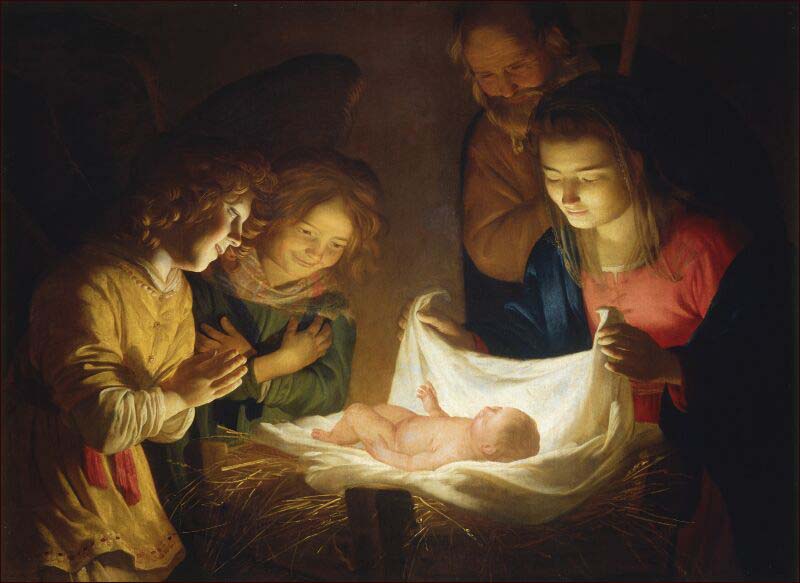
“The Adoration of the Shepherds” by Gerard van Honthorst, 1622.
During the Christmas season, it is important to focus not only on the birth of Christ, but on the person of Christ. That is, it is important for us to remember not only that Jesus was born, but who Jesus was born as. For it is not the simple fact of Jesus’ birth that gives the Christmas story significance. After all, people are born all the time. But Jesus’ identity as it is revealed in the Christmas story makes Jesus’ birth significant even 2,000 years later.
In Matthew’s Gospel, we get a clue concerning Jesus’ identity beginning with Mathew’s opening line: “A record of the genealogy of Jesus Christ the son of David, the son of Abraham” (Matthew 1:1). From here, Matthew goes on to give an extensive genealogy of Jesus’ family tree, going all the way back to Abraham. The genealogy in Luke’s Gospel goes back even farther – all the way to Adam (cf. Luke 3:23-38). These two genealogies, it should be noted, are quite different from each other, making Jesus’ family tree look quite disparate. Indeed, over the years, scholars have debated the differences between the Matthew and Luke’s genealogies of Jesus. Most often, scholars have conjectured that Matthew presents the royal genealogy of Jesus through Joseph, his stepfather, while Luke presents the biological genealogy of Jesus through Mary, His mother. What is often left out of such discussions and debates, however, is that there is actually a third Christmas genealogy that all too regularly goes unnoticed.
Where is this third genealogy? Beginning in Matthew 1:18: “This is how the birth of Jesus Christ came about: His mother Mary was pledged to be married to Joseph, but before they came together, she was found to be with child through the Holy Spirit.” The Greek word for “birth” is genesis, from which we get our English word “genealogy” In fact, this is the same word Matthew uses in 1:1 when he introduces his “genealogy [in Greek, genesis] of Jesus Christ the son of David, the son of Abraham.” Thus, in just one chapter, Matthew presents two genealogies.
So how are to understand these two genealogies? In Matthew’s first genealogy, we read of Jesus’ human origin. He is the son of David and the son of Abraham. In Matthew’s second genealogy, we read about Jesus’ divine origin. He is of the Holy Spirit. Thus, Jesus is truly man, the son of Abraham and David; but He is also truly God, conceived by the Holy Spirit and born of the virgin Mary.
Ultimately, Jesus’ status as truly man and truly God is what gives the Christmas story its significance. For as a man, Jesus can identify with us men – our weakness, struggles, and trials. But as God, Jesus can save us from our sin.
Truly man. Truly God. All of this wrapped in a manger. What an incredible story! And what a terrific reason to say, “Merry Christmas.”
Ghana Eye Clinic – Day 5
What a week it’s been! Today we wrapped up the last day at the eye clinic with a bang. We saw 465 people, sharing the gospel with every one of them, and we gave away 355 pairs of glasses. This brings us to a grand total of 1,829 people seen and 1,420 pairs of glasses given away for the week! God has blessed us during this trip mightily!
To all of you who have been praying for us throughout the course of this week: thank you. You have been a tremendous support for us, even from thousands of miles away. Tomorrow, we will head down to the Ghana coast to see a castle that was once used for holding slaves. It is sure to be a memorable and reflective experience. Sunday morning, we will worship here in Accra and then Sunday night, we will begin our journey home! We appreciate your prayers for the remainder of our time in Ghana and for our travels home.
One more time, here are some pictures from our day!
This was our trip to the clinic each morning. And I thought San Antonio roads could get bumpy!

It began as another busy morning! There were more people lined up waiting for us to begin the clinic today than there were yesterday.
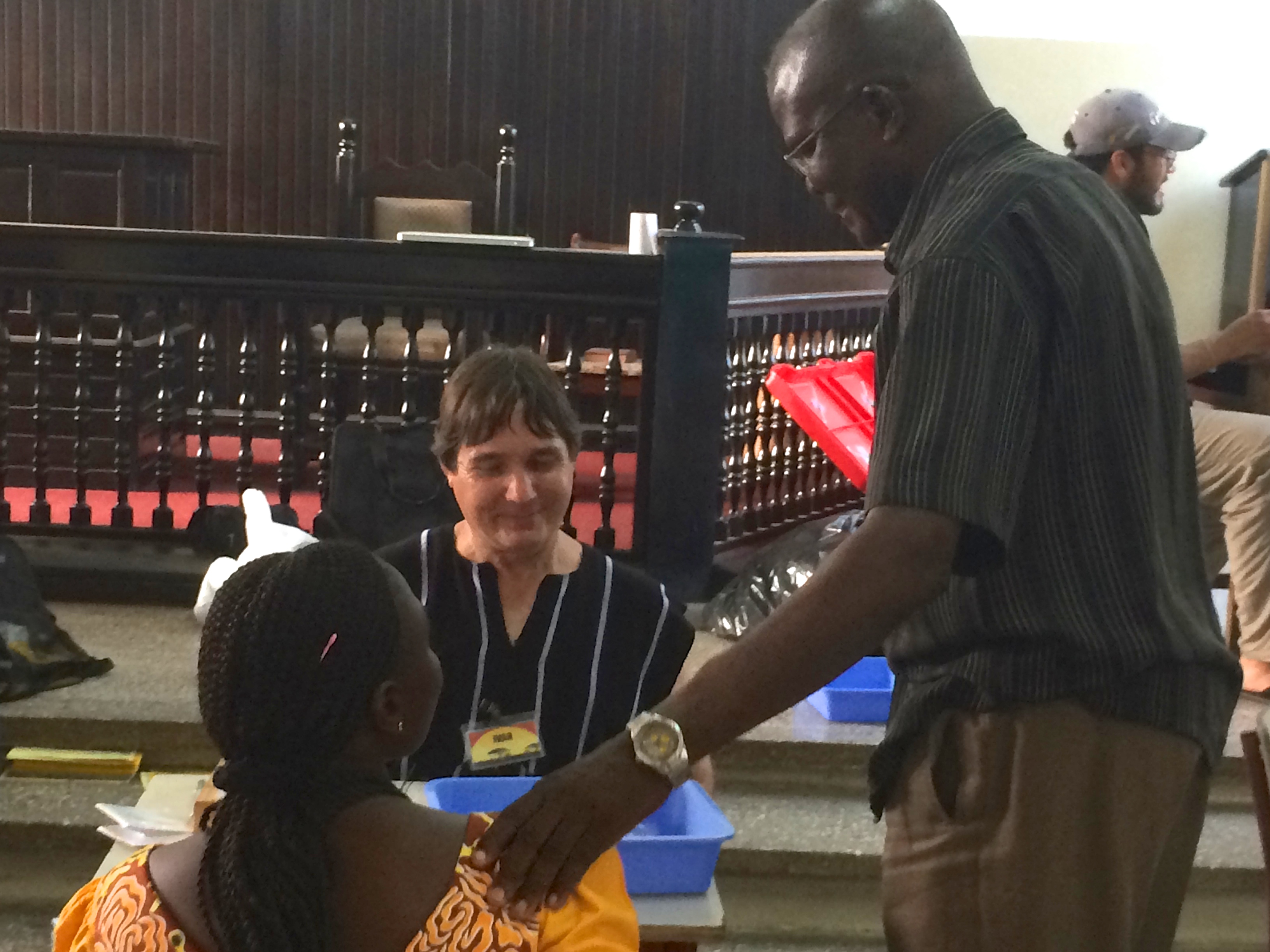
Ivan and one of the local pastors helps a woman get a new pair of glasses.

Michael is all smiles with this woman and her grandchild.

Arnold gives a man a sight test after he receives his new pair of glasses. The man was thrilled with his new crystal clear sight!

Julie poses with Joan, a local member of our team.

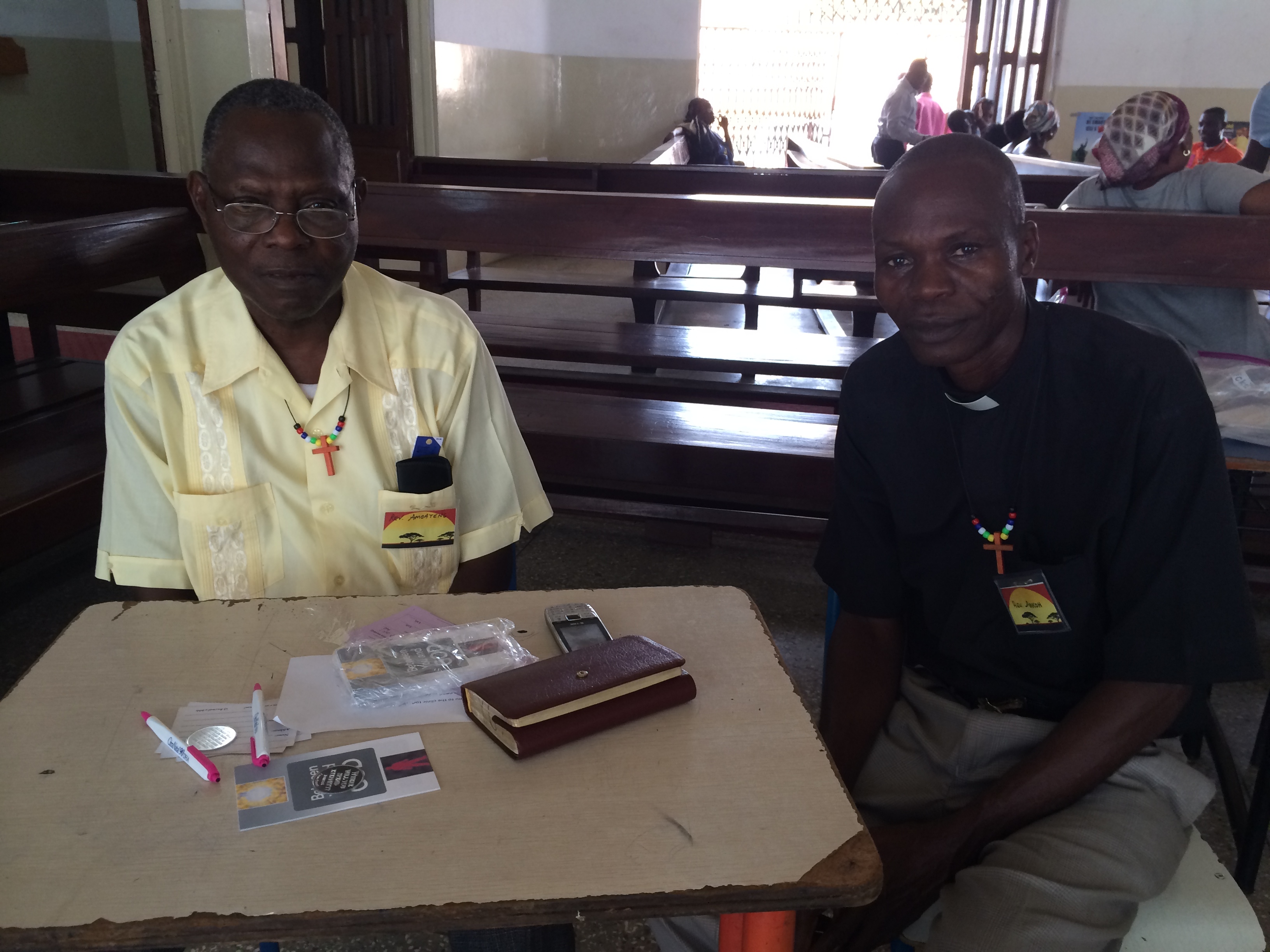
In addition to glasses, we also gave away crosses. Each of the colored beads reminds us of a key part of the faith. Black = sin. Red = Jesus’ blood. Blue = faith. White = holiness. Green = growth in Christ. Yellow = eternity.

Julie poses with some of the kids from the clinic.

We went through a lot of reading glasses this week!

Each evening, we would eat supper at the Baptist House, a place that hosts missionaries and other foreign travelers. There, we met a precious girl named Tyra. We looked forward to seeing her each night!
Tyra helps us sing a Concordia classic!

This is our team from this week. Soli Deo Gloria! All to the glory of God alone!
Ghana Eye Clinic – Day 4
Wow! It was a busy day! Today, we saw 442 people, shared the gospel with them, and gave away 357 pairs of glasses. The word is getting around to many communities in Accra about our eye clinic. We expect another busy day tomorrow! Check out the pictures and stories from today.

This was the scene outside this morning as we arrived. There were 100 people waiting an hour before the clinic.

This was the scene inside as soon as the clinic opened.

One of the local pastors talks with a man about his vision problems.

Our host, Ivan, is hard at work making a pair of glasses.
The kids at St. Paul Lutheran Church hosted a performance in their courtyard today. Line dancing isn’t just country dance halls, it’s for school kids in Accra too!

Tristina shares the gospel with a man and prays for him.

We have made lots of new friends and seen lots of precious smiles on this trip!

Michael works with a woman to discover just the right pair of lenses for her new glasses.

Even at the end of the day, the kids of St. Paul still had plenty of energy. They were literally doing cartwheels!

The school kids had plenty of energy, but we didn’t. Arnold, Pam, and Tristina still had smiles on their faces, though, even after a long day.

At the end of a long day, a little help is always a good thing!
There’s more to come tomorrow!
Ghana Eye Clinic – Day 3
Today’s numbers: We shared the gospel with 354 people and gave away 253 pairs of glasses. This was our biggest day yet!
Check out the pictures and captions below to find out more about today’s clinic.

Pam works hard sorting reading glasses for the hundreds who need them.

Arnold and Tristina have been working hard all clinic long!
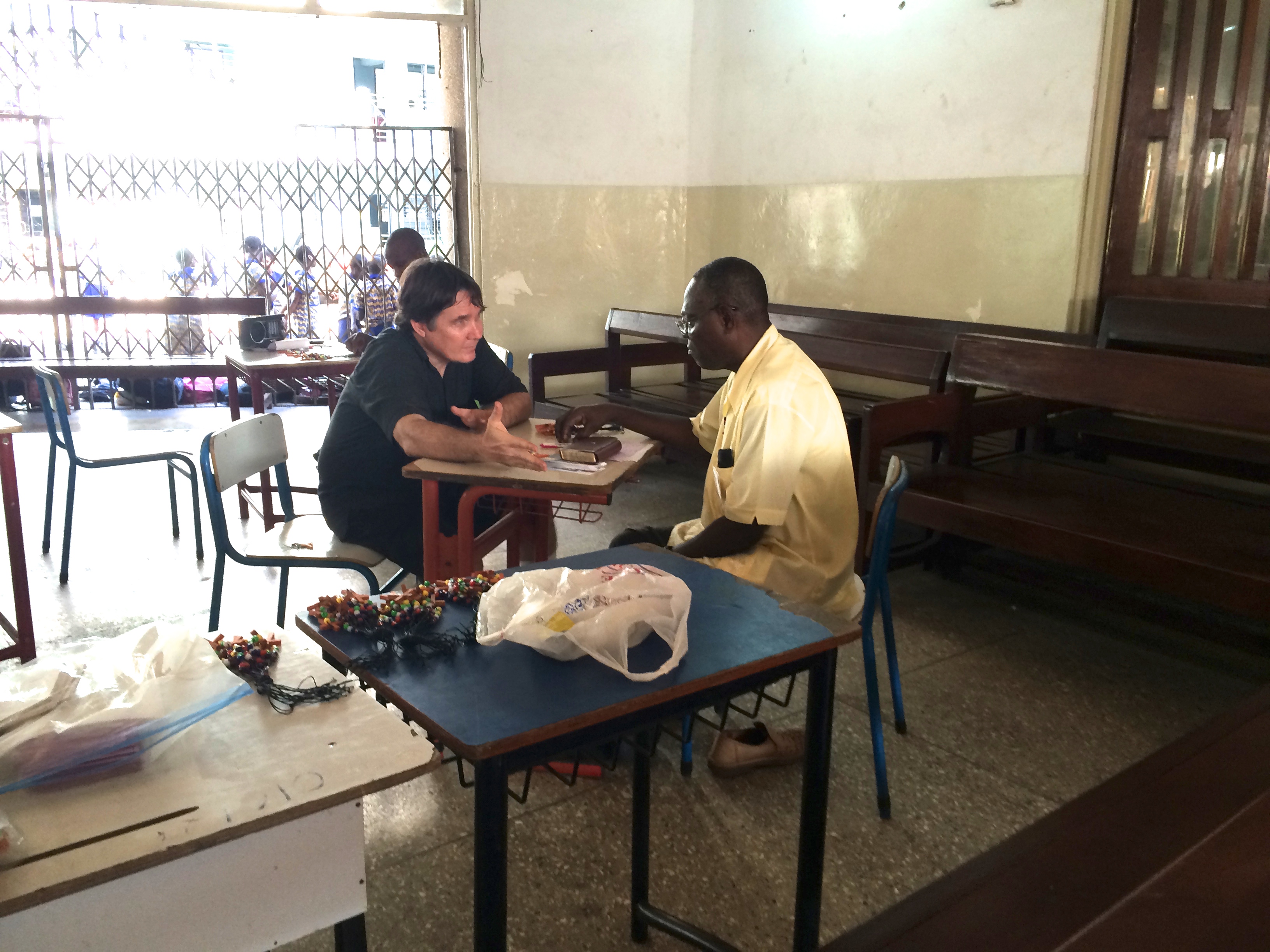
Our host, Ivan, talks to the pastor who is the president of the Lutheran seminary in Ghana and is taking some time out of his busy schedule to share the gospel with hundreds during the eye clinic.

Tristina poses with one of our fabulous volunteers, Justice. Justice works hard routing people through the clinic to make sure everyone gets to the right place.

More of our fabulous volunteers! This devoted group sat outside all day in the hot Ghana sun welcoming visitors to the clinic.

Tristina and Pam are still smiling even after a long day at the clinic.

This little boy’s name is Michael and our team has decided to “adopt” him. He has a degenerative eye disease and will need ongoing medical care to preserve what little vision that he has.

Michael’s eyes.

Our host, Ivan, has a friend, Mustapha, who works to build bridges between the Muslim and Christian communities in Accra. Thankfully, the relationships between Muslims and Christians are very good in Ghana. Mustapha has invited several of his friends to the clinic.

Tristina uses the portable autorefractor to measure a boy’s eyes for new glasses.
The children of St. Paul Lutheran School in Accra are a talented bunch! Check out this video of their mad musical skills.
Ghana Eye Clinic – Day 2
We’re all settled in and things are going great! Today, we saw 256 people and shared the gospel with each one of them. We also gave away 220 pairs of glasses. Four of the people we saw were deaf. Thankfully, our team leader, Julie, is great with sign language! Our clinic closed a little early because Ghana was playing against Egypt in a big football game (that would be “soccer” to us), qualifying them for the World Cup. After our day at the clinic, we stopped by some local markets and perused some of the local wares.
Here are some pictures. I’ll post more soon.
Does this thing come with a snooze button? Good morning!

If you think San Antonio rush hour is bad, you ought to try morning traffic in Accra!
Two terrific pastors assisted in helping triage patients, figuring out what glasses they needed and sharing the gospel with them.

Michael and Arnold are hard at working, making glasses for all sorts of different prescriptions.

Julie signs to a deaf man so he can understand what glasses he needs.

The girl on the left came in yesterday, but we couldn’t offer her treatment without her mother. Today, both mother and daughter came in and received glasses!

I’m pretty sure Julie is working on a passport for this little man so she can bring him home. She didn’t want to let him go!

Pam and our host in Ghana, Ivan, screen people for reading glasses.

There was plenty of fresh fruit at the street market.

Pam made a new friend with one of the street vendors!
Ghana Eye Clinic – Day 1
Our first day in Accra, Ghana at the eye clinic was terrific! We saw 315 people who needed vision care and gave out 217 pairs of glasses. We also had an optometrist onsite to see people who had a whole host of eye care needs. Most importantly, we shared the gospel with everyone who came through our clinic. Through the glasses, we helped people see God’s world. With the gospel, we helped people see God’s Son!
Check out these pictures from our first day.

The morning was beautiful!

Pastor Bill shares the gospel with people as they first come to the clinic.

The kids from the day school at St. Paul Lutheran in Accra sing us a song.

One of our sweet kids receives a sweet from Julie!

Many people came to receive glasses and hear the gospel!

Two great Concordians, Michael and Arnold, are stylin’ in the glasses we’re sharing with the folks of Accra.
I’ll be posting more pictures soon, so keep checking back. Please continue to pray for our team!
Sightseeing in Ghana
 I’m not in San Antonio anymore, that’s for sure. Instead, I am halfway across the world in Ghana, Africa with a team of my fellow Concordians and, together, we are hosting an eye clinic. There are many people in this region of Ghana in desperate need of glasses. We have the special privilege and pleasure of providing people here with the glasses they need in order to see. In the process, we also get to point people to the One in whom they can see God Himself – Jesus Christ – by sharing the gospel.
As I’ve been working as a part of this vision clinic, I’ve been pondering one of my favorite stories in Scripture:
As [Jesus] went along, He saw a man blind from birth. His disciples asked Him, “Rabbi, who sinned, this man or his parents, that he was born blind?” “Neither this man nor his parents sinned,” said Jesus, “but this happened so that the work of God might be displayed in his life.” (John 9:1-3)
In the ancient world – and especially among the ancient Jews – it was generally presumed that if you faced a trial, a trouble, or an ailment, it was because you had committed some heinous sin to deserve that trial, trouble, or ailment. Your sin and your trouble were intimately and inexorably interwoven in ancient thinking. For instance, Rabbi Ammi wrote, “There is no death without sin, and there is no suffering without iniquity.” If you were suffering, the rabbis taught, it was because you had done something wrong. In fact, some rabbis taught that not only could a person be punished for his own sin, but a child could be punished for his parents’ sin. Some rabbis believed, for example, that the untimely death of a child was the direct result of his mother’s dalliance in idolatry while he was still in the womb! Such was the close correlation between sin and tragedy.
Thus, it is really no surprise that, one day, as Jesus and His disciples are walking around and see a man born blind, the disciples ask: “Rabbi, who sinned, this man or his parents, that he was born blind” (John 9:2)? Jesus’ disciples know the teaching of their Jewish rabbis well. They know a man cannot be born blind unless there is some sin to warrant such blindness.
But what the rabbis assumed about the connection between sin and trouble isn’t what a rabbi named Jesus knows about this blind man’s plight. This is why, instead of pointing to a specific sin committed by this man which had resulted in his blindness, Jesus explains to His disciples: “Neither this man nor his parents sinned, but this happened so that the work of God might be displayed in his life” (John 9:3). This suffering is not the result of this sin or that sin. Rather, God is up to something in this suffering: He is using it to display His work.
The Greek word for “display” is phanero’o, from the word phos meaning, “light.” God, it seems, desires to bring this man darkened by blindness into the light of seeing. But God’s desire centers not only on the light of physical seeing, but on the light of spiritual seeing as well. In other words, Jesus, through His eventual healing of this man born blind, desires to bring this man not only into the light of the sun, but into the light of faith. And this is exactly what happens in the end: “Do you believe in the Son of Man?” Jesus asks. “Lord, I believe,” the man responds (John 9:35, 38). When this man confesses his faith in Christ, he is brought into the light not only physically through the recovering of his sight, but spiritually through his trust in Christ.
All this week in Ghana, our goal is to help people see in two ways – spiritually and physically. I covet your prayers that eyes would be opened – not only by the glasses we share, but by the truth of the Gospel we proclaim!
Jesus – More Than Just God
 Was Jesus really human?
These days, this question does not get asked a lot. Rather, people wonder whether or not Jesus was God. And time and time again, people come to the conclusion that Jesus is not, was not, and, indeed, could not have been God. Take, for instance, Reza Aslan, author of the bestseller Zealot: The Life and Times of Jesus of Nazareth. In an interview with NPR about his book, Reza summarizes his position on Jesus’ divinity:
If you’re asking if whether Jesus expected to be seen as God made flesh, as the living embodiment, the incarnation of God, then the answer to that is absolutely no. Such a thing did not exist in Judaism. In the 5,000-year history of Jewish thought, the notion of a God-man is completely anathema to everything Judaism stands for. The idea that Jesus could’ve conceived of Himself — or that even His followers could’ve conceived of Him — as divine, contradicts everything that has ever been said about Judaism as a religion.[1]
There’s no way, Reza says, Jesus’ followers could have considered Him to be divine. He was only a man who led a failed revolution as a failed run-of-the-mill Messiah.
In my studies for a class I’m teaching on Galatians, I came across some terrific commentary from the second-century church father Tertullian on Galatians 4:4-5. The apostle Paul writes in these verses: “But when the time had fully come, God sent His Son, born of a woman, born under law, to redeem those under law, that we might receive the full rights of sons.” Tertullian comments on Paul’s phrase “born of a woman”:
To what shifts you resort, in your attempt to rob the syllable “of” of its proper force as a preposition, and to substitute another for it in a sense not found throughout the Holy Scriptures! You say that He was born through a virgin, not of a virgin, and in a womb, not of a womb.[2]
In Tertullian’s day, there were people trying to rob Jesus not of His divinity, but of His humanity. A group of called the Docetists considered everything corporeal to be evil while holding anything non-corporeal to be good. They thus denied that the non-corporeal God of the universe would ever dare to take on corporeal human flesh. This group taught that though Jesus may have been born “through” Mary, he was not born “of” Mary. In other words, He did not take on human flesh as a genuine offspring of a genuine human mother. Rather, He merely passed through Mary as an immaterial God and received nothing concrete from her. Indeed, the Docetists taught that though Jesus may have appeared to be a physical being, He was not. In fact, the very name “Docetist” comes from the Greek word meaning, “to appear.” Jesus, then, was simply an apparition – divine, yes, but certainly not a corporeal human.
Tertullian has no time for such teaching concerning Christ. He says that Docetists “murder truth”[3] and vigorously makes the case for Christ’s humanity. Thus, the problem in the early Church was not that some denied Jesus’ divinity, but that many denied His humanity! Reza has the problem exactly backwards.
Ultimately, to deny Jesus’ humanity or His divinity is to deny Him. Paul is crystal clear concerning the person of Christ: He is God’s Son and He is born of a woman. He is both God and man. Any other or lesser confession of Christ simply will not do.
[1] “Christ In Context: ‘Zealot’ Explores The Life Of Jesus,” NPR (7.15.2013).
[2] Tertullian, On the Flesh of Christ 20.
[3] Tertullian, On the Flesh of Christ 5.


 Pastor Zach's Blog