Posts tagged ‘Jesus’
Decidophobia

Credit: thebeaconmag.com
I have a confession to make: I suffer from decidophobia.
Now, before you accuse me of making up words, this term is not my own. Walter Kaufmann, who served as a philosophy professor for over 30 years at Princeton, coined it. He explains decidophobia like this:
In the fateful decisions that mold our future, freedom becomes tangible; and they are objects of extreme dread. Every such decision involves norms, standards, goals. Treating these as given lessens this dread. The comparison and choice of goals and standards arouses the most intense decidophobia.[1]
Here’s what Kaufmann is saying: decisions form futures. Those who suffer from decidophobia worry that their decisions will tank their futures.
Now, to a certain extent, this is true. Foolish decisions can lead to bad futures. If one wracks up a lot of debt now, it leads to a lot of bills in the future. If one is having an affair now, it can lead to a heart-wrenching divorce in the future.
But there are other decisions – decisions that don’t always carry with them the ethical clarity that getting into a bottomless pit of debt or having an affair do. Decisions like, “What job should I take?” “What vehicle should I buy?” “What house should I live in?” I am trying to make a decision on the last of these three quandaries. And I have come down with a bad case of decidophobia.
As I have looked at neighborhoods and floor plans and features and storage space, I’ve become worried and concerned. Will I make the right decision? But here’s what I’ve come to realize: decisions like these, though not always easy, are not devastatingly determinative of my future. If a house does not have all the features I might like, it will still provide me with a roof over my head at the end of the day. If a job you take does not meet all your dreams and expectations, you will still have a paycheck at the end of your pay period. If a car you buy isn’t the one you’ve dreamed of since you were a teenager, it will still get you from point A to point B by the end of your trip.
I have long suspected that God gives us some decisions to make not to teach us about decisions themselves, but to teach us about the anxiety that so many of us feel when we are in the throws of a decision-making process. I read somewhere that we should “not worry about tomorrow, for tomorrow will worry about itself” (Matthew 6:34). Many of the decisions we make carry with them no biblical mandate. Any decision we make will be fine. Being free from worry, however, does carry with it a biblical mandate. That’s why it’s time to stop incessantly fretting. Decidophobia is sinful.
So what’s causing you decidophobia? Before you get your stomach tied in knots, remind yourself of Christ’s words in Matthew 6:34. These decisions are not worth your worry. You are in God’s care.
___________________________
[1] Walter Kaufmann, Without Guilt and Justice: From Decidophobia to Autonomy (New York: Peter H. Wyden, Inc., 1973), 3.
#Blessed

Credit: socialmediaexaminer.com
I don’t know how many times I’ve received the prayer request. But it’s definitely more times than I can remember. “Pray that God will bless my…” and then fill in the blank. “Finances.” “Job Search.” “Move.” “Golf Game.” “Baby Shower.” And the list could go on and on.
Now, on the one hand, I have no particular problem with these kinds of prayer requests per se. Indeed, when people come to me with these kinds of prayers, I gladly oblige. But on the other hand, even though we pray to be blessed, I’m not so sure we always understand what it truly entails to be blessed, at least not biblically.
The other day, I came across an article by Jessica Bennett of The New York Times chronicling all the blessings she has stumbled across on social media. She opens:
Here are a few of the ways that God has touched my social network over the past few months:
S(he) helped a friend get accepted into graduate school. (She was “blessed” to be there.)
S(he) made it possible for a yoga instructor’s Caribbean spa retreat. (“Blessed to be teaching in paradise,” she wrote.)
S(he) helped a new mom outfit her infant in a tiny designer frock. (“A year of patiently waiting and it finally fits! Feeling blessed.”)
S(he) graced a colleague with at least 57 Facebook wall postings about her birthday. (“So blessed for all the love,” she wrote, to approximately 900 of her closest friends.)
God has, in fact, recently blessed my network with dazzling job promotions, coveted speaking gigs, the most wonderful fiancés ever, front row seats at Fashion Week, and nominations for many a “30 under 30” list. And, blessings aren’t limited to the little people, either. S(he) blessed Macklemore with a wardrobe designer (thanks for the heads up, Instagram!) and Jamie Lynn Spears with an engagement ring (“#blessed #blessed #blessed!” she wrote on Twitter). S(he)’s been known to bless Kanye West and Kim Kardashian with exotic getaways and expensive bottles of Champagne, overlooking sunsets of biblical proportion (naturally).[1]
Apparently, Bennett has a lot of extraordinarily “blessed” friends. She even tells the story of a girl who posted a picture of her posterior on Facebook with the caption, “Blessed.” Really?
The theology behind the kind of blessing Bennett outlines is shallow at best and likely heretical in actuality. The so-called “god” who bestows these social media blessings is ill-defined and vacuous, as Bennett intimates with her references to “god” as “s(he),” and the blessings from this divine turn out to be quite petty. Frocks that fit, birthday wishes on Facebook, and financial windfalls all qualify to be part of the “blessed” life.
All this leads Bennett to suspect that these “blessings” are really nothing more than people cynically
… invoking holiness as a way to brag about [their] life … Calling something “blessed,” has become the go-to term for those who want to boast about an accomplishment while pretending to be humble, fish for a compliment, acknowledge a success (without sounding too conceited), or purposely elicit envy.
That sounds about right. “Blessed” is just a word people use to thinly disguise a brag.
True biblical blessing, of course, is quite different – and much messier. Jesus’ list of blessings sounds quite different from what you’ll find on Facebook:
Blessed are you who are poor, for yours is the kingdom of God. Blessed are you who hunger now, for you will be satisfied. Blessed are you who weep now, for you will laugh. Blessed are you when men hate you, when they exclude you and insult you and reject your name as evil, because of the Son of Man. (Luke 6:20-22)
Poverty, hunger, mourning, and persecution all qualify to be part of the blessed life. Why? Because true blessing involves much more than what happens to you in this life. It involves God’s promises for the next.
All this is not to say that the good gifts we receive in this life are not blessings. But such blessings must be received with a proper perspective – that they are blessings not just because we happen to like them, but because it is God who gives them. Indeed, one of the most interesting features of the Hebrew word for “blessing,” barak, is that it can be translated either as “bless” (e.g., Numbers 6:24) or as “curse” (e.g., Psalm 10:3), depending on context. What makes the difference between whether something is a blessing or a curse? Faith – a confidence that a blessing is defined not in terms of what something is, but in terms of who gives it. This is why when we are poor, hungry, mourning, and persecuted, we can still be blessed. Because we can still have the Lord. And there is no better blessing than Him.
Put that on Instagram.
__________________________
[1] Jessica Bennett, “They Feel ‘Blessed,’” The New York Times (5.2.2014).
We’ve Only Just Begun
 As a kid, I remember a song my mom used to play from the 70’s by the Carpenters called “We’ve Only Just Begun.” The song is about a couple’s wedding day and imagines all the things still to come in their relationship. “We’ve only just begun to live,” the song muses.
The message of this golden oldie is a message I often share with the soon-to-be-wedded couples I counsel. “The wedding day is a big day,” I will say, “but it is only one day. Don’t just plan for your wedding day. Plan for all the days that come after your wedding day. After all, when you walk down that aisle and make your vows, you’ve only just begun.”
Yesterday, we celebrated the resurrection of Christ. The apostle Paul summarizes Christ’s resurrection thusly:
For what I received I passed on to you as of first importance: that Christ died for our sins according to the Scriptures, that He was buried, that He was raised on the third day according to the Scriptures. (1 Corinthians 15:3-4)
For Paul, Christ’s death for our sins and resurrection three days later is “of first importance.” The Greek word for this phrase is protos, from which we get our word “prototype.” A prototype, of course, is a first run of a product or procedure meant to be a test for what comes after it. And this is precisely what Christ’s resurrection is. For, according to Paul, Christ’s resurrection – glorious as it is – is only the beginning. Paul explains:
Christ has indeed been raised from the dead, the firstfruits of those who have fallen asleep. For since death came through a man, the resurrection of the dead comes also through a man. For as in Adam all die, so in Christ all will be made alive. (1 Corinthians 15:20-22)
Paul argues that in Christ’s resurrection on Easter Day, God was doing a test run for our resurrections on the Last Day. As glorious as Easter is, then, it is only a foretaste of what is to come. It is only a prototype for the big roll out of resurrection and life that will burst forth at Christ’s return. God has “only just begun” to raise people from death. An even bigger Easter is still on its way – an Easter when we will not only shout, “Christ has risen,” but, “We have risen!”
Not Just Any Old Crucifixion
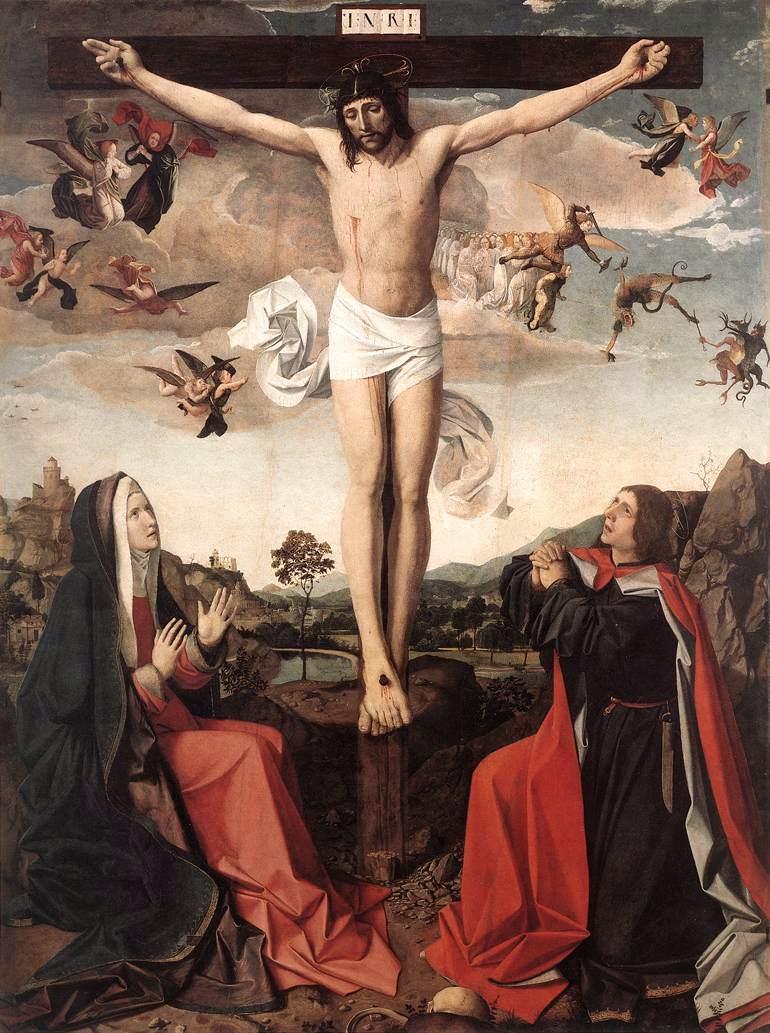
“Calvary” by Josse Lieferinxe, c. 1500
In the ancient world, crucifixions were a dime a dozen. Hardly a day passed without one. Consider these statistics:
- 519 BC: Darius I, king of Persia, crucifies 3,000 of the leading citizens of Babylon.
- 332 BC: Alexander the Great crucifies 2,000 people after invading the city of Tyre.
- 100 BC: Alexander Jannaeus, king of Judea, crucifies 800 Pharisees.
- 71 BC: A great uprising of slaves against the Roman Empire, led by the great gladiator Spartacus, leads to the crucifixion of 6,000 of his followers along a stretch of highway from Capua to Rome, totaling 120 miles.
- 4 BC: Varus, governor of Syria, crucifies 2,000 Jewish rebels who were leading a Messianic revolt.
- AD 70: The Roman general Titus sweeps into the city of Jerusalem, sacks it, and begins crucifying 500 people a day he runs out of wood to make crosses.
Crucifixions happened all the time. In fact, according to one estimate, as many as 30,000 people were crucified just in Israel by Jesus’ day.[1]
This Friday is Good Friday – a day when we commemorate a crucifixion. But with crucifixions being so commonplace in the ancient world, it’s worth it to ask: Why do we commemorate one particular crucifixion? Why don’t we commemorate the many crucifixions of the citizens of Babylon, or of Spartacus’ followers, or of the Jews under Titus’ reign of terror? Why do we commemorate only one crucifixion – Jesus’ crucifixion?
The Mishnah, an ancient compendium of Jewish rabbinical teaching, explains that if a criminal was condemned to execution, which would have included crucifixion, he was to say, “Let my death be atonement for all of my transgressions.”[2] The idea was that if a person’s crimes were so heinous that he was deserving of death, only death could save him from those crimes. Crucifixion, then, was connected not only to punitive punishment, but also to personal atonement.
Jesus’ crucifixion, however, was different. Rather than making recompense for His own sins by His death, Jesus asks for forgiveness for others’ sins: “Father, forgive them, for they do not know what they are doing” (Luke 23:34). And rather than seeking atonement for Himself by His execution, the apostle John says Jesus makes atonement for the world: “[Christ] is the atoning sacrifice for our sins, and not only for ours but also for the sins of the whole world” (1 John 2:2).
This is why we commemorate Jesus’ crucifixion. For we remember not only that Jesus was crucified, but why Jesus was crucified. He was crucified not for His own sins, but for ours. Jesus’ crucifixion did what no other crucifixion could do. It saved us. And that’s worth remembering…and celebrating. And that’s why this Friday is not just any Friday, but a Good Friday.
______________________________
[1] John MacArthur, The MacArthur New Testament Commentary: Matthew 24-28 (Chicago: The Moody Bible Institute, 1989), Matthew 27:27-37.
[2] m. Sanhedrin 6.2.
Christian Persecution Under the Stars and Stripes
 Are rabid secularists persecuting Christians in the United States? This is the question Robert Boston of Salon takes up. His answer is an unambiguous and unapologetic “no way.” He opens his article in an almost combative tenor:
Certain words should not be tossed around lightly. Persecution is one of those words.
Religious right leaders and their followers often claim that they are being persecuted in the United States. They should watch their words carefully. Their claims are offensive; they don’t know the first thing about persecution.
One doesn’t have to look far to find examples of real religious persecution in the world. In some countries, people can be imprisoned, beaten, or even killed because of what they believe. Certain religious groups are illegal and denied the right to meet. This is real persecution. By contrast, being offended because a clerk in a discount store said “Happy Holidays” instead of “Merry Christmas” pales. Only the most confused mind would equate the two.[1]
Boston goes on to rehearse a litany of privileges that religious institutions enjoy in our society along with some examples of what he considers to be true religious persecution:
Go to Saudi Arabia, where it’s illegal to even open a Christian church, and experience the fear of those Christian believers who dare to worship in private homes, aware that at any moment they may be imprisoned.
Visit North Korea, where all religions have been swept away and replaced with a bizarre form of worship of the state and its leader that purports to promote self-reliance but, in reality, merely serves as a vehicle for oppression.
Visit any region under the control of the Taliban, a movement so extreme that, in Afghanistan, they trashed that nation’s cultural heritage by blowing up two sixth-century statutes of Buddha because they were declared false idols by religious leaders who are intolerant of any other faith but Islam.
There is real religious persecution in the world. Right-wing Christians in America aren’t experiencing it.
On the one hand, there are some things to affirm in Boston’s article. First, I agree that it is awfully tough to make the leap from someone wishing a Christian “Happy Holidays” rather than “Merry Christmas” to religious persecution. That is not only a questionable example of persecution, but a silly one. Second, I wholeheartedly and unequivocally affirm that compared to what Christians are experiencing in other countries, Christians who live “in the land of the free and the home of the brave” have it great. There is no reason – ever – for Christians in this country to compare themselves to Christians who are, let’s say, awaiting execution in North Korea.[2]
But…
There’s always a “but,” isn’t there?
For all of Boston’s bravado about how Christians in the States are not persecuted, I’m not sure he really understands Christianity or persecution.
Boston rails against what he calls “right-wing Christians” and “religious conservatives.” Just in case we’re unclear as to what he means, headlining his piece is a picture of Glenn Beck, Phil Robertson, and Michelle Bachmann. His implicit message seems to be that those who claim that Christian persecution is taking place in the States are nothing more than puppets and parrots of conservative political groups. But this is not fair to the breadth or the depth of Christianity. Christian theology is much better defined in terms of “orthodoxy” and “heresy” rather than in terms of “liberalism” and “conservatism.” After all, Christianity is much more concerned with the right teaching of divine truths than with a particular 21st century political ideology. This is why there are Christians who are Republicans and Democrats. No earthly political party can claim a monopoly on the Kingdom of God.
Second, though I understand Boston’s concern with Christians who brandish about the word “persecution” carelessly, I can’t help but suspect that he is guilty of precisely that which he rails against in his article. I find it strange that while writing about Christian persecution, Boston never pauses to consider what Christ has to say on the subject! So let’s do it ourselves. Jesus says, “Blessed are you when people insult you, persecute you and falsely say all kinds of evil against you because of Me” (Matthew 5:11). Notice that Jesus here explains persecution in terms of words rather than actions. Jesus says that people will both insult and tells lies about His followers. There can be little doubt that this does indeed happen – even in the United States. And this, Jesus says, is part of persecution. Thus, Boston’s stipulations on what qualifies as Christian persecution are far too restrictive – at least according to Christ.
I am aware there is quite a gap between the definition of persecution theologically and the definition of persecution popularly. It is dangerous to throw out a word like “persecution” without any sort of background on how this word is used biblically and theologically. Hopefully, the dust up during the Romney campaign over whether or not Mormonism is a cult taught us that not all people define all words the same way.[3] Thus, if we’re going to apply the word “persecution” to anything that happens to Christians in the States, we need to explain what we mean.
Whatever you may think does or does not qualify as persecution, what is most important is how Christians respond to those who are against them. Boston says Christians have reacted to that which they perceive to be persecution with “so much carping.” This, I agree, is tragic. When Christians are persecuted, our response should not be one of carping, whining, or fretting. After all, according to Jesus’ Beatitudes, when we are persecuted, we are not victimized, but “blessed.” This is why, when the apostles experience physical persecution at the hands of the Sanhedrin, they leave “rejoicing because they had been counted worthy of suffering disgrace for the Name” (Acts 5:41).
I like what Robert Morgan of the Huffington Post says about Christian persecution:
The Bible anticipated [persecution] years ago. The founder of Christianity, after all, was tortured to death and His original 12 followers were all persecuted; most were slain. Though His message was a Gospel of peace, His critics nailed Him to a cross but failed to keep Him in the tomb. They hated Him but could not contain Him. They sought to limit His influence, but they only broadened His impact.[4]
Ultimately, no matter how badly Christianity may be persecuted, threatened, belittled, cajoled, and legislatively restricted, it just won’t die. Why? Because its Founder lives.
[1] Robert Boston, “The ultimate guide to debunking right-wingers’ insane persecution fantasies,” Salon (3.16.2014).
[2] Cheryl Chumley, “Kim Jong-un calls for execution of 33 Christians,” Washington Times (3.6.2014).
[3] Richard Oppel & Erik Eckholm, “Prominent Pastor Calls Romney’s Church a Cult,” New York Times (10.7.2011).
[4] Robert Morgan, “The World’s War on Christianity,” Huffington Post (1.14.2014).
David Wise’s “Alternative” Lifestyle

Credit: David Calvert for The New York Times
He’s a husband. He’s a father. He’s a follower of Jesus who can see himself becoming a pastor one day. And, oh yeah, he’s also an Olympic freestyle skier of halfpipe who won that gold. His name is David Wise.
Recently, Skyler Wilder of NBC Sports wrote a profile on Wise in which he made a special note on Wise’s character:
Wise is mature far beyond his years. At only twenty-three years old, he has a wife, Alexandra, who was waiting patiently in the crowd, and together they have a two-year-old daughter waiting for them to return to their home in Reno, Nevada.
At such a young age, Wise has the lifestyle of an adult. He wears a Baby Bjorn baby carrier around the house. He also attends church regularly and says he could see himself becoming a pastor a little later down the road.[1]
When reading such a description of this young man and his family, you can’t help but envision something straight out of a Norman Rockwell painting – except that, as Wilder points out, Wise can “nail two double corks wearing baggy pants.”
What strikes me about Wilder’s profile of Wise, however, is not Wise’s fascinating life, but Wilder’s unique title for his profile: “David Wise’s alternative lifestyle leads to Olympic gold.” Wilder calls Wise’s lifestyle as husband, father, and Christian “alternative.”
When Wilder published his profile on Wise with this headline, almost immediately, people raised concerns and critiques. You can read some here, here, and here.
These concerns and critiques notwithstanding, frankly, I’m okay with the designation of Wise’s lifestyle as “alternative” – not because I like what it says about the values of our society, but because it’s true. Statistically, there can be little doubt that Wise’s lifestyle at Wise’s age is not mainstream. As David Weigel of Slate points out:
Wise got married and had a kid at a far younger age than most people. According to data published by the National Campaign to Prevent Teen and Unplanned Pregnancy, the median age of the American first marriage is 26 and a half. The average age for an American bringing the first child into his/her homes: About 25 and a half. So, yes, David Wise is very good at skiing, and he figured out, as the Internet might refer to it, that whole adulthood thing much faster than the median American or median famous Olympian.[2]
The character Wise has and the lifestyle he lives at the tender age of 23 is far beyond his years. In this sense, it is alternative. But it is also hopeful.
Several years ago, sociologist Rodney Stark wrote a book titled, The Rise of Christianity: How the Obscure, Marginal Jesus Movement Became the Dominant Religious Force in the Western World in a Few Centuries. Stark opens his book with some numbers:
For a starting number, Acts 1:14-15 suggests that several months after the Crucifixion there were 120 Christians … Yet only six decades later, Christians were so numerous that Constantine found it expedient to embrace the church … Goodenough estimated that 10 percent of the empire’s population were Christians by the time of Constantine. If we accepted 60 million as the total population at that time … this would mean that there were 6 million Christians at the start of the fourth century.[3]
The Christian Church grew from 120 to 6 million in just over three centuries. That’s staggering! But how did it happen? Though Christianity’s rise is thanks to multiple factors – not the least of which is the grace of God – one reason Christianity showed such incredible growth is because it offered an alternative. It was different from the rest of the world.
For instance, in the 160’s, and then again in the 260’s, a series of plagues struck the eastern provinces of Roman Empire. These plagues were so devastating that during a smallpox epidemic in 165, a quarter to a third of the population died. When these plagues swept through, most people – scared of becoming infected – took the sick and threw them into the streets to die. But there was one group of people who, rather than casting the sick out, brought the sick in: Christians. Dionysius, the bishop of Alexandria during the second sweep of plagues in the 260’s, writes about how Christians responded to these plagues:
Most of our brother Christians showed unbounded love and loyalty; never sparing themselves and thinking only of one another. Heedless of danger, they took charge of the sick, attending to their every need and ministering to them in Christ, and with them departed this life serenely happy; for they were infected by others with the disease, drawing on themselves the sickness of their neighbors and cheerfully accepting their pains. Many, in nursing and caring for others, transferred their death to themselves and died in their stead.[4]
While everyone else was casting the sick out, Christians were bringing the sick in – many of them dying because of their efforts. Christians offered an “alternative.” And the Church grew.
It is no secret that what Christians teach and the ways in which Christians live is out of step with our society’s Zeitgeist. We are “alternative.” But considering the pain, hopelessness, corruption, despair, emptiness, and oppression that our society’s Zeitgeist reaps (for examples, just look here, here, and here), don’t we need an alternative?
So when someone calls us “alternative,” perhaps we should embrace the distinction. For we do offer an alternative. We offer the alternative of Christ to the mainstream of sin. And when we offer that alternative, we offer hope. And hope is an alternative that our world sorely needs.
[1] Skyler Wilder, “David Wise’s alternative lifestyle leads to Olympic gold,” NBCOlympics.com (2.18.2014).
[2] David Weigel, “Will This Young, Happily Married Olympian Start a New Culture War?” Slate (2.19.2014).
[3] Rodney Stark, The Rise of Christianity: How the Obscure, Marginal Jesus Movement Became the Dominant Religious Force in the Western World in a Few Centuries (San Francisco: Harper Collins, 1997), 5-6.
[4] Dionysius of Alexandria in Rodney Stark, The Rise of Christianity, 82.
A Camel Controversy
 And you thought it was it only impossible for a camel to go through the eye of a needle.
As it turns out, threading camels isn’t the only thing that’s impossible according to some archaeologists. Domesticating them before the tenth century B.C. also turns out to be quite the trick. Writing for the New York Times, John Noble Wilford provocatively declares, “Camels Had No Business in Genesis.”[1] Wilford explains:
There are too many camels in the Bible, out of time and out of place.
Camels probably had little or no role in the lives of such early Jewish patriarchs as Abraham, Jacob and Joseph, who lived in the first half of the second millennium B.C., and yet stories about them mention these domesticated pack animals more than 20 times. Genesis 24, for example, tells of Abraham’s servant going by camel on a mission to find a wife for Isaac.
How does Wilford know that camels had no role in the era of the biblical patriarchs? He cites a study, recently published by two archaeologists from Tel Aviv University, which employed radiocarbon dating to test some camel bones found in the Aravah Valley. This study found the bones to be from the last third of the tenth century B.C., which, Wilford notes, is “centuries after the patriarchs lived and decades after the kingdom of David, according to the Bible.” So there you have it. Thanks to some late breaking bones, Genesis is discredited – at least the parts that talk about camels.
Now, before we fall prey to camel chaos, a few things should be noted. First, the Tel Aviv archaeologists, by declaring that camels could not have been used in the way Genesis 24 describes them, are making an argument from silence. Their assumption runs like this: because we do not have domesticated camel fossils dating before first millennium B.C., there must have been no domesticated camels before the first millennium B.C. The Bible must be wrong. But a lack of evidence does not necessitate a lack of existence. One need to only think back to 1961. This was the year the “Pilate Stone” was discovered at Caesarea Maritima. It had an inscription dedicated to the emperor of Rome at the time, Tiberius Caesar: “To the Divine Augustus Tiberieum: Pontius Pilate, prefect of Judea has dedicated this.” Before this stone was discovered, because there was no hard archaeological evidence of Pontius Pilate, many assumed that Pilate was a fictional character, made up out of the sacred authors’ over-active imaginations. Whoops. So much for that argument from silence.
It should also be noted that the archaeologists who discovered these bones do not even have complete silence in favor of their argument against camels during the time of the biblical patriarchs. They only have archaeological silence. There are extra-biblical references to domesticated camels prior to the first millennium B.C. Titus Kennedy, adjunct professor at Biola University, notes that a camel is mentioned in a list of domesticated animals from Ugarit, dating anywhere from 1950 to 1600 B.C. In an interview with Christianity Today, Kennedy explains:
For those who adhere to a twelfth century B.C. or later theory of domestic camel use in the ancient Near East, a great deal of archaeological and textual evidence must be either ignored or explained away …
[Israel] doesn’t have much writing from before the Iron Age, 1000 B.C. … So there aren’t as many sources to look at. Whereas in Egypt, you have writing all the way back to 3000 B.C. and in Mesopotamia the same thing.[2]
Kennedy concludes that there were not only domesticated camels at the time of the biblical patriarchs, but before the time of the biblical patriarchs. Thus, the biblical record is quite believable. There is no reason that Abraham could not have acquired “sheep and cattle, male and female donkeys, male and female servants, and camels” (Genesis 12:16), just as Genesis says.
Ultimately, the difficulties with the premature conclusions drawn from this discovery reach much deeper than simply whether camels were around in the second millennium B.C. These difficulties are summed up in Wilford’s conclusion:
These anachronisms are telling evidence that the Bible was written or edited long after the events it narrates and is not always reliable as verifiable history. These camel stories “do not encapsulate memories from the second millennium,” said Noam Mizrahi, an Israeli biblical scholar, “but should be viewed as back-projections from a much later period.”
In other words, the Bible cannot be trusted to get its facts straight – at least not all of them. When reading the Bible, then, skepticism must be given preference over faith.
Finally, if I assume camels could not have been in Genesis based on an argument from paleontological silence, it is only reasonable for me to assume that a Savior cannot rise from death based on medical science. After all, doctors have long known that dead people tend to stay that way. Thus, Jesus’ resurrection must have never happened. But if this is true, then my “faith is futile; I am still in my sins … [and] I am to be pitied more than all men” (1 Corinthians 15:17, 19). Wow, that’s a downer.
Let’s hope the archaeologists are wrong on this one. After all, I don’t really like to be pitied.
[1] John Noble Wilford, “Camels Had No Business in Genesis,” New York Times (2.10.2014).
[2] Gordon Govier, “The Latest Challenge to the Bible’s Accuracy: Abraham’s Anachronistic Camels?” Christianity Today (February 2014).
Michael Sam Makes It Public

Credit: cnn.com
“Does the NFL have any gay players?” my wife asked me last Sunday. She was watching a Hallmark Valentine movie where one of the characters, an NFL quarterback, came out as homosexual. “No, sweetie,” I responded. “The NFL does not have any openly gay players. There have been some players who have come out after they left the NFL, but to date, no players currently in the NFL are openly homosexual.”
It didn’t take long for that to change.
The next morning, while I was working out and watching ESPN, there was Michael Sam, former Missouri Defensive End and candidate in the NFL draft, coming out on national TV as a gay football player. “I am an openly, proud gay man,” Sam told ESPN’s “Outside the Lines.” Granted, Sam is not an NFL player…yet. But his prospects are good.
I am surprised – pleasantly so – by how muted the negative response to Sam’s announcement has been. Some journalists have hinted that responses could turn negative, but to date there is no swell of detractors decrying Sam as a dangerous degenerate. By the same token, those who are writing and speaking about him are hailing him as a hero. Brendon Ayanbadejo, a former linebacker who is currently a free agent, was effusive about Sam’s announcement, comparing him to Jackie Robinson and Rosa Parks. To cap off his feelings concerning Sam, he said, “To borrow from Neil Amstrong, this is one small step for gay men and one giant leap for the LGBTQ community.”[1] Juliet Macur of the New York Times wrote a manifesto demanding that an NFL team draft Sam. She begins by writing, “It’s time,” and ends by declaring, “Sam must be drafted. It’s time to move forward. The teams and the league are on the clock.”[2] For Macur, Sam’s status as a future NFL star is not a matter of his talent, but of a moral imperative that says the NFL must have an openly gay player.
For orthodox Christians, all of this can be hard to sort out. On the one hand, there is something to be celebrated here. It is refreshing to see so many display a measured sensitivity to and deep compassion for those with same-sex attractions and those in same-sex relationships. The gay slurs, gay jokes, and gay bashing of yesteryear have drastically dissipated and, for my part, I say, “Good riddance.” Such speech is diametrically opposed to the biblical command to love, which Paul says is the fulfillment and summation of all biblical commandments (cf. Romans 13:8-9). On the other hand, Christians cannot pretend that our society’s sexual free-for-all, which demands not only the toleration of, but the celebration of sexual practices that are far from biblical standards for human sexuality, is nothing more than an issue of civil rights. Whether it’s Michael Sam touting his homosexuality or Richie Incognito and Jonathan Martin exchanging texts about how many women they have slept with and the use of prostitutes,[3] the spacious sexual ethic of our society is simply not something Christians can endorse. Partly because it’s immoral and Scripturally forbidden, yes. But also because it hurts, belittles, and objectifies people, which, in and of itself, is tragic, no matter what your ethical worldview.
Ultimately, the loose sexual standards of our society are nothing new. The path of sexual salaciousness is well worn – not only in twenty-first century America, but in all the societies that have come before her. But we can choose a different path. We can choose the path of sexual commitment in marriage while walking “humbly with our God” (Micah 6:8). I pray that we do. For when we do, we not only live out God’s sexual standard in our commitments, we show God’s lavish love by our humility.
[1] Mike Foss, “Ex-NFL player: Draft prospect who came out is like Jackie Robinson and Rosa Parks,” USA Today (2.10.2014).
[2] Juliet Macur, “It’s Time for the N.F.L. to Welcome a Gay Player,” New York Times (2.9.2014).
[3] Adam H. Beasley, “Texts shed light on relationship between Miami Dolphins’ Jonathan Martin, Richie Incognito,” Miami Herald (2.5.2014).
“Look at me!”
 This past weekend in ABC, I talked about how far too many of us live by the narcissistic credo, “Look at me.” What children will say to their parents at the pool right before they do a flip or a dive is the same thing we want, albeit we may not say so in so many words. Instead, it is our actions – sometimes wild and dramatic; other times passive, yet aggressive – that cry out for people to notice. And oftentimes, our actions produce their desired effect. Oftentimes, people look at us, even if for all the wrong reasons.
Sadly, having others “look at me” is a desire that not only resides in the hearts of people in the world out there; it is a desire that resides in my heart. I want people to take note of who I am and what I do. Whether it’s a Bible study that I lead or a sermon that I preach or a blog that I post, I can quickly become all too curious to know what people think of what I have said or written and if people care. And if they don’t think highly of what I’ve said or written, or if they don’t care, I can easily become hurt. After all, just like so many others, I like to be remembered and recognized. I want people to “look at me.”
One of the most puzzling motifs in the Gospels is what a scholar named William Wrede deemed “the Messianic secret.” The Messianic secret describes those times when, after a particularly profound and revealing utterance or after some miraculous feat, Jesus warns His disciples not to share His identity or actions with anyone else. For instance, after Peter claims Jesus to be “the Christ,” that is, the Messiah, Jesus warns the disciples “not to tell anyone about Him” (Mark 8:29-30).
Wrede claims that, historically, Jesus did not believe Himself to be and did not speak of Himself as the Messiah. Later Christians came to this conclusion quite apart from what Jesus actually said and did. According to Wrede, the Gospel writers made up these Messianic “secrets” and inserted them into the Gospels as an apologetic to argue for Jesus’ Messianic identity.
Not surprisingly, orthodox Christians take a different view of these secretive statements. We believe these statements were not later glosses to create for Jesus a Messianic identity He never claimed, but genuine statements by Jesus concerning who He is and what He had come to do.
But why would He want to keep His grand identity a secret? The general consensus is that Jesus knew many people would misunderstand what it means for Him to be the Messiah, for many of the Jews of that day had visions of the Messiah as a political revolutionary dancing in their heads. Jesus, of course, was no such Christ. He had not come to overthrow a government, but to usher in a Kingdom.
Beyond this, Jesus’ secretive statements also seem to reflect the fulfillment of prophecy. One of the marks of the Messiah, according to Isaiah, is His humility. The Messiah will not clamor to pronounce before the world His identity and power: “He will not shout or cry out, or raise His voice in the streets” (Isaiah 42:2). In other words, the Messiah will not come to this world announcing, “Look at me!”
In a world where we struggle with the desire to be noticed, there is a lesson to be learned from the Messianic secret. Jesus eschewed notice, and yet there has never been anyone more noticeable than Him. His noticeability came through His humility.
Perhaps our noticeability should come the same way. Perhaps rather than shouting “Look at me,” we should practice a gentle humility.
Explaining Our Existence
 I recently came across two articles – both dealing with gender concerns – that caught my attention. The first article is by Lisa Wade of Salon and addresses the deep friendships – or the lack thereof – between men. Wade opens her article:
Of all people in America, adult, white, heterosexual men have the fewest friends. Moreover, the friendships they have, if they’re with other men, provide less emotional support and involve lower levels of self-disclosure and trust than other types of friendships. When men get together, they’re more likely to do stuff than have a conversation …
When I first began researching this topic I thought, surely this is too stereotypical to be true. Or, if it is true, I wondered, perhaps the research is biased in favor of female-type friendships. In other words, maybe we’re measuring male friendships with a female yardstick. It’s possible that men don’t want as many or the same kinds of friendships as women.
But they do. When asked about what they desire from their friendships, men are just as likely as women to say that they want intimacy. And, just like women, their satisfaction with their friendships is strongly correlated with the level of self-disclosure.[1]
Men want friends, Wade contends – real friends, with whom they can share real cares, concerns, and fears. But most do not have these kinds of friends. Why is this? Wade chalks it up to society’s assertions concerning what it means to be a “real man.” She explains:
[Real men] are supposed to be self-interested, competitive, non-emotional, strong (with no insecurities at all), and able to deal with their emotional problems without help. Being a good friend, then, as well as needing a good friend, is the equivalent of being girly.
Real men, our society says, keep their emotions hermetically sealed. This is why so many men eschew forming deep and abiding friendships. But as many men seek to be really masculine through sensitivity sequestration, they only wind up being really isolated.
The second article I found interesting is by Sarah Elizabeth Richards of the New York Times. Richards tells the story of Andy Inkster – a woman who underwent surgery and took testosterone to become a man, but has now stopped taking testosterone because she wants to get pregnant. As it turns out, Andy had trouble getting pregnant and sought fertility treatments from Baystate Reproductive Medicine. Baystate denied her request. She received help from another clinic and got pregnant, but sued Baystate for discrimination.
Such a desire of transgendered people to have children is not unique to Andy:
One study published last year in the journal Human Reproduction of 90 transgender men in Belgium found that 54 percent wished to have children … Other research, published in 2002, by Belgian fertility doctors with Western European transgender women found that 40 percent wanted to have children, and 77 percent felt they should have the option to preserve their sperm before hormone treatment. As fertility technology improves and becomes more widely available, transgender people are realizing that they will have more options in the future.[2]
Transgendered people apparently have a strong desire to have children in biologically traditional ways despite their deep reservations with their biologically assigned genders.
At first glance, these two articles seem to address phenomena on opposite ends of the cultural spectrum. The first has to do with entrenched machismo while the second has to do with blurred gender identity. But for all their differences, there exists a common theological root: the divorce of human existence from divine creation.
Foundational to the Christian conception of the cosmos is the belief that everything came from somewhere. Or, to put it more precisely, Christians believe that everything came from someone. We do not just exist. We were created.
It is from the Scriptural story of creation that we learn not just that we are, but who we are. We are creatures and not the Creator (cf. Genesis 3:5). We are fashioned in the image of God (cf. Genesis 1:27). We are fearfully and wonderfully made (cf. Psalm 139:14), which is to say that God intentionally and lovingly fashioned us to be a certain kind of person, the corruption of sin notwithstanding. In the old “nature versus nurture” debate, the story of creation tells us that nature does indeed shape us, but not by naturalistic means. Rather, we are shaped through nature by the One who made nature.
Both of the articles above exemplify with a convicting candor what happens when people forget this story. Men who try to play the role of the sturdy and strong lone ranger forget the part of the story where God says, “It is not good for the man to be alone” (Genesis 2:18). People who undergo surgeries and treatments in an effort to change their gender forget the part of the story where God revels in how He has created us “male and female” (Genesis 1:27).
The apostle Peter warns there will come a time when people will “deliberately forget that long ago by God’s word the heavens existed and the earth was formed” (2 Peter 3:5). They will forget their existence is a product of God’s creative word. And they will forget their existence is to be guided by God’s sacred Word. May it never be so of us. May we always be able to say: “I believe in God, the Father Almighty, creator of heaven and earth…and of me.”
[1] Lisa Wade, “American men’s hidden crisis: They need more friends!” Salon (12.7.2013).
[2] Sarah Elizabeth Richards, “The Next Frontier in Fertility Treatment,” New York Times (1.12.2014).


 Pastor Zach's Blog