Posts tagged ‘Hope’
Terror Hits Brussels: How Should Christians Respond?

It happened again.
Just four days after Paris terror suspect Salah Abdeslam was captured by Belgian law enforcement officials, two coordinated attacks – one at the airport and another on a subway – were carried out in Brussels at approximately 8 am local time. ISIS is taking responsibility for both.
Most of the scenes on the news right now are coming from the airport attack, and the pictures are ghastly. Physicians treating the wounded are describing severe nail injuries, indicating that the explosives were packed with materials designed to inflict maximum injury. As of the posting of this blog, CNN is reporting the provisional death toll at 34: 14 dead at the airport with 20 people killed in the subway bombing. We do not know whether or not the toll will rise.
At a time like this, it is always worthwhile to pause and reflect on how we, as Christians, are called to respond and react to a tragedy such as this. Christians are, after all, in a unique position to respond and react to tragedy, for our very faith was born out of tragedy, as this Good Friday will remind us. Our faith is rooted in “Christ and Him crucified” (1 Corinthians 2:2) – a gruesome thought if left by itself. So here are a few things to keep in mind.
Pray for Brussels
When terrorists attacked Paris, I wrote, “Pray for Paris.” The first thing we should do in an event like this is pray – always. For the vast majority of us, there is no help we can offer Brussels physically – we are not omnipresent. And there is no way we can thwart another attack in this beleaguered city – we are not omnipotent. So we must entrust Brussels and its future to the One who is omnipresent and omnipotent. We must entrust Brussels and its future to the One who can actually help. Such is the power of prayer. It not only offers real help to hurting people because it turns to a God who is in the business of helping hurting people, it also grows our faith when we cannot take charge of a situation like this because it teaches us to trust the One who is in charge of every situation like this.
Mourn for Brussels
The old saying goes, “Familiarity breeds contempt.” We have become all too familiar with terror attacks. With another one in the news this morning, although we may not be tempted to become outright contemptuous of what has happened, we may be tempted to respond to it with a mild dismissiveness. We see. We react with a bit of a groan. And we move on. I would encourage us to saunter at the scenes from Brussels for a bit. Look at the damage done at the airport. Look at the horrified faces of the people escaping from a bombed subway car. And grieve. Terror may be common nowadays, but that shouldn’t make it any less tragic in our hearts and minds. What has happened in Brussels is worth our grief. It is worth our sadness. It is worth our pain. We worship a Savior who shares in all our pain. He never passes us by “on the other side” (Luke 10:31). We should be willing to share in each other’s pain as well. For when we do, we “carry each other’s burdens” (Galatians 6:2).
Hope for Brussels
Christianity may have been borne out of the tragedy of death, but it is carried forth by the glory of life. This is what this Holy Week is all about – death on a Friday followed by life on a Sunday. The hope we have for Brussels, then, is the hope we have for all the world – that no matter how many people terrorists may kill, they cannot win by death because “death has been swallowed up in victory” (1 Corinthians 15:54). Christ portended our ultimate ends when, on Easter, He conquered His would-be end by walking out of His grave. We now share in the promise that our graves will not be our ends. Resurrection is coming.
One of my favorite Bible stories is the story of Armageddon – that great cosmic battle between good and evil at the end of days. The reason I love it so much is not just because of who wins, but because of how the battle is fought. The forces of evil, John says, are gathered “to the place that in Hebrew is called Armageddon. The seventh angel poured out his bowl into the air, and out of the temple came a loud voice from the throne, saying, ‘It is done’” (Revelation 16:16-17). And that’s the end of the battle. There are no swords drawn. There are no bullets fired. There are no bombs dropped. The forces of darkness combine to bring their worst. But they are no match for God’s simple declaration: “It is done.” In Greek, the declaration is just one word: gegonen. It turns out that even just one little word, to borrow a phrase from Martin Luther, really can fell Satan and his sympathizers.
We live in a world where deranged terrorists wage twisted jihad. But as Christians, we hope for a kingdom where battles are not won by an armed detachment, but by a divine decree: “Gegonen.” “It is done.”
And it will be.
You Didn’t Win Powerball…So Now What?

Credit: New York Daily News
The conversation across from me last Wednesday morning as I was sitting at Starbucks reading and sipping my coffee startled me. Next to me was a table of folks who, from the sound of their conversation, all worked in the same office. As coworkers, they were doing what coworkers should regularly be doing – they were strategizing, they were planning, they were setting goals, and they were developing financial models…for what they would do when they won the $1.5 billion Powerball jackpot.
With Powerball fever sweeping the nation last week with history’s largest ever jackpot up for grabs, these folks sounded like they needed some Tylenol to bring down their temperature. I’m not sure I’ve ever heard a more heated, even if not particularly informed, financial conversation in my life – much less a financial conversation that imagines a 1 in 292,201,338 scenario. Should we take the lump sum or should we take the annuity payments? How do we set up a trust fund since we’re splitting the pot when we win? Should we allow this or that coworker to join our pot?
Oh, if only. But as Daniel Victor of The New York Times points out:
If you printed out the name of every United States resident on individual pieces of paper, put them in a giant bowl and selected one at random, the odds of picking President Obama are not far from the odds of winning the Powerball.[1]
In other words, you are not going to win Powerball.
The way this office pool talked about Powerball, it sounded like all but a sure bet that they were going to be the big winners. But unless they happened to have just come back from Chino Hills, CA, Munford, TN, or Melbourne Beach, FL with just the right ticket in hand, they were not. Last Wednesday was not their day. And today is just another manic Monday at the office for them.
Powerball is an interesting enterprise. On the one hand, I appreciate that it helps fund education, although I can’t help but wonder if there are other, more efficient ways to fund educational programs. On the other hand, I am concerned that, from a systemic perspective, it acts as a regressive tax because it has a disproportionate appeal to lower income households who have big dreams of digging out of financial desperation. Even if it does act as a regressive tax, however, it is important to note that it is a voluntary regressive tax. No one has to buy a ticket. Indeed, the fundamental problem with Powerball is not really with Powerball at all. It’s with us. Far too many of us are quick to disregard the fundamentals of math for a quixotic wish.
“Someone has to win,” I’ve heard time and time again. “And it could be me!” Actually, someone does not have to win. This is precisely why the Powerball jackpot rose as much as it did – because someone did not have to win the jackpot and no one did win the jackpot for ten weeks straight because the odds of winning are so abysmal, they are, for all intents and purposes, at zero. Technically, they’re at .00000034223%. But it still takes a lot of zeroes in that percentage to get to any sort of a number that represents something rather than nothing.
Why in the world would we get so excited over odds like these? What are we thinking?
In one way, we’re not. We’re dreaming. And, if your dreams are anything like mine, dreams do not have to make sense or be rooted in reality. They can be sheer fantasy.
But something more is going on here. For not only are we dreaming, we’re hoping. We’re hoping lightning will strike and we will win. Or, to use the appropriate odds, we’re hoping lightning will strike 246 times and we will win one time. We’re hoping our financial troubles will be over. We’re hoping we’ll be able to quit our jobs and take life easy. We’re hoping to get rich.
The apostle Paul writes quite extensively to Timothy about the dangers associated with riches. Two of his statements are especially striking to me as the fervor over Powerball settles:
Those who want to get rich fall into temptation and a trap and into many foolish and harmful desires that plunge people into ruin and destruction. (1 Timothy 6:9)
And:
Command those who are rich in this present world not to be arrogant nor to put their hope in wealth, which is so uncertain, but to put their hope in God, who richly provides us with everything for our enjoyment. (1 Timothy 6:17)
In the first verse, Paul prohibits hoping for riches. We should not obsess over accumulating treasures on earth because such an obsession is a recipe for depression and, ultimately, for destruction. In the second verse, Paul prohibits hoping in riches. Wealth cannot do what many people think it can do. It certainly cannot solve all your problems, as past lottery winners will tell you.
The problem with the Powerball phenomenon is that its huge jackpots tempt us toward false hope – both for riches and in riches. And even if Powerball itself is nothing more than a silly game, the false hope it tempts us toward is a dangerous disease.
If you want to spend $2 on a ticket for fun, that’s one thing. But you should place about as much hope in that ticket as you do in winning your office fantasy football league where the grand prize is a Nerf football that someone spray painted gold to make it look like a trophy. If your hopes go much further than that, be careful. Your hope is not in a $2 ticket with long odds. Your hope is in Christ.
After all, He’s a sure bet.
_________________________
[1] Daniel Victor, “You Will Not Win the Powerball Jackpot,” The New York Times (1.12.2016).
Pray for Paris
 I first heard the news on the radio when I was driving home from work Friday night. Phrases like “breaking news” and “continuing coverage” caught my attention. As more and more details of the ghastly attacks trickled in from across the Atlantic, I knew it was going to be a long night for the people of Paris. 129 dead. 352 injured, 99 critically. And ISIS was claiming responsibility for the coordinated attacks that hit six targets at once. After opening fire on their victims, all but one of ISIS’s operatives blew themselves up when police approached, hoping to kill even more people with suicide bombings.
Considering these attacks came just days after ISIS was suspected of downing Metrojet Flight 9268 over northern Sinai as it was on its way from Sharm el-Sheikh to St. Petersburg, it is quickly becoming apparent that ISIS will stop at nothing to intimidate the world. As of now, their tactics are working. Many, many people are very, very scared.
As Christians, we know we are commanded to be not afraid. The words of Psalmist come to mind: “God is our refuge and strength, an ever-present help in trouble. Therefore we will not fear, though the earth give way and the mountains fall into the heart of the sea” (Psalm 46:1-2). Logically, we also know that fear does us little good at a time like this. It solves nothing. It changes nothing. It only paralyzes us and clouds our judgment. But at the same time we are called not to fear, we are also called to be in prayer. Indeed, the apostle Paul addresses both fear and prayer when he writes, “Do not be anxious about anything, but in everything, by prayer and petition, with thanksgiving, present your requests to God” (Philippians 4:6). At a time like this, when the world is fearing, we should be praying.
As this tragedy continues to unfold, allow me offer four things for which I think we can and should pray. My hope is that God will not only comfort you as you pray these petitions, but that He will use these petitions to help you process what has happened. After all, what has happened affects not only the city of Paris or the nation of France; it affects the world. Nous sommes tous les Parisiens.
On to the prayers.
Pray for Paris.
In one way, this goes without saying. And, thankfully, it is already happening. A quick check of my Twitter account shows #Prayers4Paris is trending. So pray for the grieving. Pray for the fearful. Pray for the people of a city who are trying to pick up the pieces of an illusion of safety that has just been shattered. Pray for Paris.
But let me take this a step farther. Because as Christians, to pray for Paris means to pray for all of Paris – even for those who support and sympathize with the attackers. Jesus admonishes us to pray not only for those with whom we share a kinship, but even for our enemies: “Pray for those who persecute you” (Matthew 5:44). So pray for ISIS operatives in Paris and, for that matter, all over the world. Pray, yes, that any further plots would be thwarted. But also pray that their hearts would be changed. A changed heart stops evil much better than even the most sophisticated international intelligence operation.
Pray for sobriety.
The shock and sadness of yesterday’s attacks will soon dissolve into political posturing and raw outrage. Rash responses will be given. Foolhardy decisions will be made. We need to stay away from all such impulsiveness.
If history is any indication, I am especially concerned that many will fall into what logicians refer to as the fallacy of composition. This fallacy asserts that if something is true for the part, it must also be true for the whole. So in this instance, if a few radical Muslims who are part of ISIS are terrorists, then it is reasonable to be wary of any Muslim because he or she might be a terrorist.
Don’t fall for – or propagate – this fallacy!
I have many friends who own firearms. They are, of course, very responsible and cautious with their weapons. But every time a mass shooting happens – in Roseburg, in Charleston, in Fort Hood, in Sandy Hook – many of them openly worry that the actions of a few deranged lunatics will affect all firearm owners. They worry that people will take the actions of a few and use it to stifle the whole. And so they lobby not only for their rights as firearm owners, but also for their character as people.
What firearm owners do for each other, Christians can and should do for Muslims. Let’s not lose our ability to think soberly and clearly not only about these attacks specifically, but about Muslims generally. The vast majority of Muslims are people who hold much in common, especially ethically, with Christians. They love their families. They despise promiscuity. And they support traditional values like honesty, hard work, and generosity. Let’s be willing to vouch for the character of Muslims. And let’s be willing to support and love them as people.
Pray for governments.
The French government, the U.S. government, and many other governments across the world have some difficult decisions to make. ISIS must be stopped. Thankfully, God has given governments the authority to do just this. The apostle Paul explains:
He who rebels against the [governing] authority is rebelling against what God has instituted, and those who do so will bring judgment on themselves. For rulers hold no terror for those who do right, but for those who do wrong. (Romans 13:2-3)
Paul says that those who rebel against good order arranged by good governments will bring judgment on themselves. For good governments will seek to avenge and deter – often with force – evil events. The terrorists, then, have every reason to be terrified.
As governments across the world try to discern how to respond to these attacks, pray that their responses would be decisive, measured, and Godly. In short, pray that world governments would act in ways that thwart evil while honoring God’s Word.
Pray, “Come, Lord Jesus.”
Ultimately, we know that governments, though they can do much to suppress evil, cannot stop evil. Only God can do that. In fact, shortly before Paul writes his words concerning government, he writes about God’s final judgment: “Do not take revenge, my friends, but leave room for God’s wrath, for it is written: ‘It is Mine to avenge; I will repay,’ says the Lord” (Romans 12:19). God’s vengeance is the only vengeance that gives victory.
When does God avenge evil? On the Last Day. Then and only then will evil be wiped out once and for all. Until then, attacks will happen. Lives will be lost. Evil will rear its head. And we will “groan inwardly as we wait eagerly for our adoption as sons, the redemption of our bodies” (Romans 8:23). Considering that none of this is pleasant or good, the final prayer of the Bible can be our prayer today: “Come, Lord Jesus” (Revelation 22:20). “Come and wipe out evil. Come and make everything – including those hurting in Paris – new.”
And He will.
A Little Lesson on Divine Providence

Credit: SeniorLiving.org
Last week, in my personal devotions, I read through Numbers 26, which recounts a census taken near the end of Israel’s 40 year wandering through the wilderness. Here’s a taste of the bean counting:
The descendants of Gad by their clans were: through Zephon, the Zephonite clan; through Haggi, the Haggite clan; through Shuni, the Shunite clan; through Ozni, the Oznite clan; through Eri, the Erite clan; through Arodi, the Arodite clan; through Areli, the Arelite clan. These were the clans of Gad; those numbered were 40,500. Er and Onan were sons of Judah, but they died in Canaan. The descendants of Judah by their clans were: through Shelah, the Shelanite clan; through Perez, the Perezite clan; through Zerah, the Zerahite clan. The descendants of Perez were: through Hezron, the Hezronite clan; through Hamul, the Hamulite clan. These were the clans of Judah; those numbered were 76,500. (Numbers 26:15-22)
I won’t blame you if you found yourself skimming over these verses. Biblical censuses and genealogies are items we tend to skip so we can get to the good stuff. Names we don’t know and numbers we don’t care about can quickly lull us to sleep. But as snooze inducing as these stilted sections of Scripture might sometimes feel, my commitment to the inspiration and inerrancy of the Bible still calls me to see God’s merciful hand at work. And God’s merciful hand is indeed at work in Numbers 26.
Numbers 26 represents the second census in this book. The first one is in Numbers 1, near the beginning of Israel’s wilderness wanderings. From Numbers 1 to Numbers 26, approximately 38 years have passed. These years, it should be noted, have not been particularly pleasant ones. There has been grumbling (Numbers 11:1-6; 14:1-4), dissension among Israel’s leaders (Numbers 12), a refusal to enter the land God had promised to Israel (Numbers 13), defeats in battle (Numbers 14:40-45), rebellions (Numbers 16), and plagues (Numbers 21:4-9; 25). This is in addition to the natural and normal difficulties that come with camping out in a desert for decades on end. Yet, by the time all is said and done, the population of Israel between the first census in Numbers 1 and this census in Numbers 26 has remained remarkably stable. The population has decreased by only .3 percent. It turns out that for all the hardship Israel experienced and for all the sin they committed, God, out of His providence, took good care of His people. They endured even when, by all accounts, they should not have.
As remarkable as God’s providential care for Israel over 40 years of wandering in the wilderness was, it pales in comparison to God’s providential care for His Church. Through persecutions, hostilities, scandals, and political and intellectual assaults, the Church has not only endured, it has grown. As this map elegantly visualizes, what began as a band of twelve now claims nearly a third of the world’s population. Forget a .3 percent decrease. How about an 18.3 billion percent increase?
I realize that in our day and age, the remarkable story of Christ’s Church can sometimes be hard to recognize and remember. I was talking to a friend just the other day who wanted to know what we, as Christians, needed to do to beat back the encroachment of secularism. I understand his concern. If you’re not at least a little unsettled by the state and trajectory of our culture, you’re not paying attention. Still, I think secularism has a lot more to worry about than Christianity. After all, secularism can’t claim the history, the increase, or, for that matter, the truth that Christianity can.
In Luke 4, Jesus is preaching in His hometown of Nazareth. His text for the day is from the prophet Isaiah:
The Spirit of the Sovereign LORD is on Me, because the LORD has anointed Me to preach good news to the poor. He has sent Me to bind up the brokenhearted, to proclaim freedom for the captives and release from darkness for the prisoners, to proclaim the year of the LORD’s favor. (Isaiah 61:1-2)
The Jews of Jesus’ day understood Isaiah’s words eschatologically. The believed God would set right what was wrong with the world on the Last Day. This is why, immediately after Isaiah talks about “the year of the LORD’s favor,” he speaks of “the day of vengeance of our God” (Isaiah 61:2). Judgment Day, Isaiah says, is coming. But Jesus, when He preached on these words, interpreted them in a way no one expected. After reading from Isaiah, Jesus announces, “Today this scripture is fulfilled in your hearing” (Luke 4:21). Huh? How could this be? Judgment Day had not yet come. The world had not yet been set right. The poor had not been made rich. Broken hearts remained. Israel was still under captivity to the Romans. Prisons were still open. And the Lord’s favor, though it may have been touted by the Jewish religious leaders as a theological truism, still felt distant as a practical reality. How could Jesus say Isaiah’s words had been fulfilled right then and there? Because Jesus knew the census numbers from Numbers 1 and Numbers 26. Jesus knew that God was taking care of His people even when life felt like a wilderness wandering. Jesus took the long view of history and saw God’s fingerprints all over it. Jesus knew God’s providence. And Jesus knew the setbacks and sin of this world are no match for the promises of God.
May we know what Jesus knew. After all, what Jesus knew not only gives perspective when the world feels tempestuous and hostile, it gives hope.
In Response to ISIS

Credit: The Christian Post
The video was titled, “A Message Signed With Blood to the Nation of the Cross.” In it, 21 Egyptian Christians, dressed in orange jump suits, were gruesomely beheaded by ISIS militants along a beach in Tripoli. One of the final frames of the video zooms in on the waters of the Mediterranean, red with the blood of these martyrs.[1]
Christians aren’t the only targets of ISIS’ rage. Just last week, ISIS released images appearing to show gay men being thrown off buildings only to be stoned after they fell to the ground. A statement released by ISIS explained that the organization is “clamping down on sexual deviance.”[2]
The reaction to such savage killings has understandably been one of untempered ire. Egypt’s president pledged retaliation against ISIS for the slaughter of its Christians. Indeed, Muslims and Christians together are raising a unified chorus of disgust at ISIS’ actions. Andrea Zaki, vice president of the Protestant Churches of Egypt, noted, “With their blood [these martyrs] are unifying Egypt.”[3]
Though the slaughter of Egypt’s Christians has gotten more press than ISIS’ heinous injustices against gay people, both demand a response in addition to whatever political or military responses may be offered in the national and international arenas. Here are two responses that, I believe, are appropriate and important for a moment such as this.
First, we need an anthropological response. After all, whether we are Christian or Muslim, gay or straight, we are all human. Indeed, as Christians, we know and believe that we are all created in God’s image, which affords us not only a shared humanity, but a necessary dignity. This collective humanity and dignity, in turn, involves certain shared hopes and desires. We all desire safety. We all desire respect. We all desire love. When these shared desires are so violently violated, as ISIS has done, basic empathy leads to visceral revulsion. Thus, we can join the world in condemning these acts, if for no other reason than that we are all human.
Second, we also need a theological response. This response is especially urgent because far too many in the broadly secularized West have refused to admit that there are theological drivers behind ISIS’ actions. Writing for The Atlantic, Graeme Wood explains:
We are misled … by a well-intentioned but dishonest campaign to deny the Islamic State’s medieval religious nature … The reality is that the Islamic State is Islamic. Very Islamic. Yes, it has attracted psychopaths and adventure seekers, drawn largely from the disaffected populations of the Middle East and Europe. But the religion preached by its most ardent followers derives from coherent and even learned interpretations of Islam.
Virtually every major decision and law promulgated by the Islamic State adheres to what it calls, in its press and pronouncements, and on its billboards, license plates, stationery, and coins, “the Prophetic methodology,” which means following the prophecy and example of Muhammad, in punctilious detail. Muslims can reject the Islamic State; nearly all do. But pretending that it isn’t actually a religious, millenarian group, with theology that must be understood to be combatted, has already led the United States to underestimate it and back foolish schemes to counter it.[4]
I should point out that parts of Wood’s history of ISIS’ theological origins – especially his claim that ISIS’ theology is of a “medieval religious nature” – are questionable and, thankfully, have been appropriately critiqued. Nevertheless, his basic premise still stands. ISIS is acting in a way that is robustly and rigorously driven by a certain religious understanding. For ISIS, theology is no mere veneer to cover up some naked ambition for power. Theology is at the heart of who they are. Thus, it does us no good, for the sake of some self-imposed, naïve political de rigueur, to pretend that at least some of ISIS’ drivers are not theological.
This is where Christians are in a unique position to lend their voices to the challenges and crises presented by ISIS. For we can offer a better theology than ISIS’ theology. We can rebuke a theology that allows the slaughtering of people with whom they religiously and culturally disagree, as Jesus did with His disciples when they wanted to destroy the Samaritans because they were a people with whom the disciples religiously and culturally disagreed. And when a theology leaves room for stoning those who live outside of traditional sexual ethics, we can say with Jesus, “If any one of you is without sin, let him be the first to throw a stone” (John 8:7).
Blessedly, the parts of this “better theology” I outlined above are ones with which the majority of the Muslim world would agree – because even though this “better theology’s” origins are explicitly Christian, its implications are broadly ethical. And even if ISIS’ understanding of Islamic theology is real, it is certainly not catholic. Plenty – and, in fact, the vast majority – of Muslims share our higher ethical aspirations. Indeed, perhaps what was once a Judeo-Christian ethic can expand into a Judeo-Muslim-Christian ethic.
Ultimately, of course, although theology includes ethics, it is more than just ethical. It is finally soteriological. And this is good. Because this means that even as ISIS continues its campaign of terror, it cannot thwart the promise of God that the faithful who have died at ISIS’ hands are now safe under heaven’s altar. For this we can be thankful. And because of this we can continue to be hopeful.
______________________
[1] Leonardo Blair, “Heartbreaking: Egyptian Christians Were Calling for Jesus During Execution by ISIS in Libya,” The Christian Post (2.18.2015).
[2] Cassandra Vinograd, “ISIS Hurls Gay Men Off Buildings, Stones Them: Analysts,” NBC News (2.15.2015).
[3] Jayson Casper, “Libya’s 21 Christian Martyrs: ‘With Their Blood, They Are Unifying Egypt’” Christianity Today (2.18.2015)
[4] Graeme Wood, “What ISIS Really Wants,” The Atlantic (March 2015).
Humans: Never for Sale

Credit: texasgopvote.com
Shortly before the new year, The New York Times published a short, heartbreaking article featuring stories from U.S. sex trafficking victims. Though there were only two stories, these were all that was needed to shock and grieve their reader. I share one of the two here:
Now 32, Genesis was offered her first hit of crack cocaine by her mother when she was 13. By 18, she had a criminal record. She spent her teenage years in and out of strip clubs before becoming the property of a violent pimp. By 21, Genesis had lost a baby and become addicted to drugs.
For years under a violent trafficker, Genesis said she was never allowed to leave his house. The rooms were bugged, the bathroom had no doors. She said her pimp used to tie her and other women he trafficked to a weight bench, beat them and starve them …
“I didn’t know I was in hell,” she said. “I thought it was just life. Over those years I was held hostage, shot at, beaten with a pistol. And somewhere in my sick mind I thought this is how life is supposed to be.”[1]
If only Genesis’ story was unique. But it’s not. Sex trafficking is a much broader problem. Though it’s hard to track because so many victims of sex trafficking do not report their experiences, the Department of Justice estimates that as many as 300,000 children may become victims of sexual exploitation each year.[2] Even if the numbers are lower, one case of sex trafficking is one too many.
The sadness of human exploitation struck me in a new way as I was reading Revelation 18 in my devotions this past week. John is describing the fall of Babylon, a city symbolic of the world’s evil. John describes the decimation of this world’s systemic sin once and for all:
“Woe! Woe, O great city, O Babylon, city of power! In one hour your doom has come!” The merchants of the earth will weep and mourn over her because no one buys their cargoes any more – cargoes of gold, silver, precious stones and pearls; fine linen, purple, silk and scarlet cloth; every sort of citron wood, and articles of every kind made of ivory, costly wood, bronze, iron and marble; cargoes of cinnamon and spice, of incense, myrrh and frankincense, of wine and olive oil, of fine flour and wheat; cattle and sheep; horses and carriages; and bodies and souls of men. (Revelation 18:10-13)
John’s Babylon sold many things to enrich itself. But most tragically, it sold the “bodies and souls of men.”
John’s Babylon is not far from us. Every time a young lady is prostituted out to the darkest of men, “bodies and souls of men” are sold by pimps – just like in Babylon. Every time a woman performs simulated sex acts at a club for a gaggle of wide-eyed gawkers, “bodies and souls of men” are sold by the adult entertainment industry – just like in Babylon. Every time a person sits hidden behind a flickering computer screen, staring at erotic images of the most carnal of acts, “bodies and souls of men” are sold by the porn industry – just like in Babylon. Every time a scared woman is counseled and even cajoled to abort her baby even though everything inside of her is telling her not to, “bodies and souls of men” are sold by the abortion industry – just like in Babylon.
How sick.
As heart-rending as human trafficking may be, John promises that, mercifully, this sick industry will meet its end. The “bodies and souls of men” will not be sold forever. Babylon will fall. And when Babylon does fall, the merchants who made their money off the pain of people will grieve their destruction and cry, “Woe” (Revelation 18:19)! But those who have been oppressed and sold will celebrate their liberation and shout, “Rejoice” (Revelation 18:20)!
May that day of rejoicing come quickly.
If you need help out of being trafficked, click here.
_______________________
[1] The Associated Press, “Sex Trafficking Shelter Filled With Survivor Tales,” The New York Times (12.29.2014).
[2] William Adams, Colleen Owens, and Kevonne Small, “Effects of Federal Legislation on the Commercial Sexual Exploitation of Children,” Juvenile Justice Bulletin (July 2010).
Tackling Terrorism

Credit: Christian Science Monitor
First it was a chocolatier in Australia. Then it was a school in Pakistan. Terrorist attacks have been headline news this past week.
When an Iranian refugee turned self-styled Muslim cleric named Man Haron Monis barricaded his way inside a Lindt Chocolate Café in Sydney, it took a police raid 16 hours after the siege began to free the hostages trapped inside. Three people, including Monis, died.
When Taliban fighters stormed a crowded school in Peshawar, they managed to kill 145 people over eight hours, 132 of them schoolchildren. Stories are emerging of kids being lined up and shot, or shot as they cowered under their desks. NBC News reports that one teacher was doused with gasoline and burned alive while students were forced to watch.
Once again, we are left grappling with grieving families and terrorized communities. And even though, in both of these instances, the attacks happened across time zones, countries, oceans, and continents, at least a little of the fear there nevertheless comes home to roost here.
This, of course, is exactly what these terrorist organizations want. CNN reports that ISIS is calling on their allies and sympathizers to carry out so called “lone-wolf” attacks in their homelands. They attacks do not have to be big, expensive, and well organized – as were the attacks of 9/11 – they simply have to be frightening. Fear, these criminals know, is a powerful thing.
Certainly, national governments need to put into place policies to try to prevent these attacks. Certainly, law enforcement officials need to have plans in place to deal swiftly and forcefully with any terrorist attack. And certainly, surveillance of and intelligence from terrorist groups and lone wolf sympathizers is needed so governments can know and foil terrorist plots them before they have a chance to carry them out.
But what about us? What about people who are normal, everyday citizens like us who are increasingly frightened that we could be in the wrong place at the wrong time and be mown down by a terrorist attack?
The fact of the matter is this: we cannot control what will happen to us in the future. We do not know whether or not we will fall victim to a terrorist attack. But we can confront and control the fear we feel right now.
The apostle John gives us a simple strategy for dealing with fear: “Perfect love drives out fear” (1 John 4:18). When a mad man or a despicable organization terrifies people with a dastardly deed, what is the best way for the rest of us to respond? By loving those people. Spontaneous tributes to the fallen that have arisen in the wake of these attacks indicate that, already, these communities are banding together to love each other through fear.
As of now, I have not seen any relief efforts that we in the states can participate in to express our love and support to the families of these victims in Australia and Pakistan. But with Christmas fast approaching, my guess is, you know at least one person who, though they may not be terrorized, is fearful in some way. Perhaps you know someone who has lost their spouse this year and is worried about how they will deal with their first Christmas apart from their loved one. Perhaps you know someone who is terminally ill and is facing the very real and understandable fears that come with knowingly being at the end of life. John’s words ring just as true in these cases as they do in cases of terror: “Perfect love drives out fear.”
So love who you can love. For in doing so, you bring peace where there is fear. And in a season when we remember some angels who announced “peace on earth to men” (Luke 2:14) thanks to a “God [who] so loved the world [that] He gave His one and only Son” (John 3:16) so we could “not be afraid” (John 14:27), this is most definitely an appropriate mission.
Robin Williams: 1951-2014

Credit: Ticketmaster
I first heard of Robin Williams’ untimely death thanks to Facebook. My wife Melody was scrolling through her newsfeed when she let out a gasp of disbelief and exclaimed, “Robin Williams died?!” My immediate thought was, “That’s fake.” Celebrity death hoaxes are common, after all. On Facebook alone, I’ve learned of the Rock’s death while filming Fast and Furious 7. I’ve read of Sylvester Stallone’s demise in a snowboarding accident. And I’ve heard that Miley Cyrus took her own life. Of course, none of these death stories are true. But I found out very quickly that Robin Williams’ death story was.
As the world began to grieve, the gruesome details began to emerge. The Marin County, California Police Department held a press conference in which they offered up details – perhaps, too many details – on Williams’ demise. Whatever the gory specifics might be, the overarching cause of death is tragically clear. Robin Williams died by suicide.
Suicide.
Just the word makes people shudder. And ponder. And question.
There are two questions that people often ask me whenever an individual – or, in the case of Robin Williams, a culture – is confronted by the harsh realities of suicide. The first is an explicitly Christian question while the second is more generally transcendent.
First, people ask me, “Can a person who commits suicide go to heaven?”
The short answer to this question is, simply, “yes.” From a theological perspective, all of us commit what I call “slow-motion suicide.” Scripture is clear that “the wages of sin is death” (Romans 6:23). Do we know this? Yes. Do we still sin intentionally and willingly? Yes. Thus, we’re killing ourselves with sin. The only difference between what we do to ourselves and what Robin Williams did last Sunday evening is the speed with which he did it. He took his life quickly. We take our lives bit-by-bit, sin-by-sin. If the person who takes his life in an instant can’t be saved, neither can the person who takes his life over decades. News of a suicide, then, is never an opportunity for judgment, but a call to introspection.
I should add that, when Jesus speaks of His forgiveness, He never singles out suicide as some sort of an unforgivable sin. Jesus declares, “I tell you the truth, all the sins and blasphemies of men will be forgiven them” (Mark 3:28). How many sins does the word “all” include? All of them. Even suicide. Thus, a person who takes his own life can be forgiven by Jesus and saved by Jesus just as well as any other sinner can. If you want to know more about suicide from a theological perspective, you can check out a blog I wrote a couple of years ago here.
Second, people ask me, “Why?” Why would a person who had so much going for him snuff out his life so recklessly?
The question of “why” has become especially acute in Robin Williams’ case because he left no note. Sadly, where facts are in short supply, gossip and speculation are plenty. I would point out, however, that even when a note is left, the question of “why” is still left unanswered. Even if a person writes of “having nothing left to live for,” or how “people will be better off without me,” those left behind still wonder: “Why didn’t he realize that he had so much to live for?” Or, “Why didn’t he realize what his death would do to us – how it would tear us apart?”
I have come to understand that the question of “why,” when it comes to suicide, has no answer – mainly because the suicidal person himself cannot answer the question. The darkness and confusion that surrounds a person when he takes his own life is so deep that genuine reasoning falters under the crushing weight of depression.
So where does all this leave us? Allow me to offer two parting thoughts.
First, a thought to those contemplating suicide: suicide is a lie of Satan. Satan entices people into suicide by making promises to “free you” or “fix you.” But he wants no such thing for you. He only wants to end you. This is why he seeks to either kill us slowly by enticing us into sin after sin or, if he can, he’ll be delighted to kill us quickly at the bottom of the barrel of a gun or by the brink of a blade. So, if you are contemplating suicide, remember: everything it promises is a lie. Get help from someone who will tell you the truth.
Second, a thought to those who have lost loved ones to suicide: life is the truth of our God. God is the master of snatching life out of the jaws of death. He did it with His Son. And He can do it with those who take their own lives. Indeed, on the Last Day, He will do it with all who trust in Him. Wherever Satan peddles his lies, God crushes them with His truth. And His truth is this: by faith in Christ, your loved one is not beyond hope. Suicidal sinners can be saved too.
I’m looking forward to seeing more than a few of them in heaven.
Processing Another Malaysia Airlines Tragedy
Credit: AFP/Getty Images
“Following are images from the scene – warning: GRAPHIC.”[1]
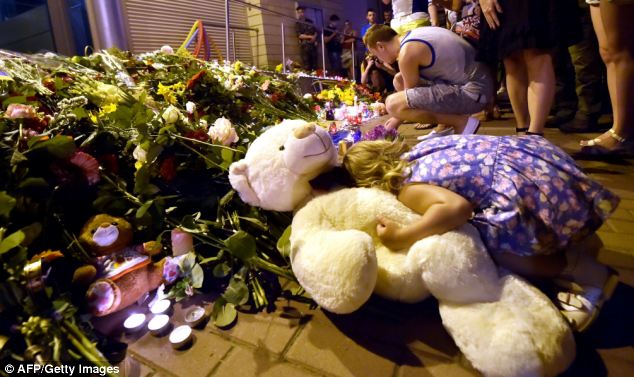
This is the caption that greeted me as I was reading through headlines about the crash of Malaysia Airlines passenger flight MH17, shot down by a surface-to-air missile while flying over Ukraine. The crash scene is gut-wrenchingly sad – dozens of pictures of smoldering wreckage, many of these with portions blurred out to cover up the gruesome sights of human remains. It’s no surprise, then, that before I scrolled through images from the scene posted by Business Insider, they included the above warning.
Regardless of whether this missile strike was an accidental shooting down of an airliner that was thought to be a military transport jet or an intentional targeting of civilians, the precipitating cause in this crisis, according to experts, is Russia’s conflict with Ukraine. The New York Times editorial board posted an excellent opinion piece, calling on Russian President Vladimir Putin to put a stop to not only tragedies like these, but to end a war of his own making against Ukraine:
Growing casualties on the ground, a major escalation of American sanctions against Russia, a military plane shot down and now the appalling destruction of a Malaysian jetliner with 298 people on board, shot by a surface-to-air missile. The Ukrainian conflict has gone on far too long, and it has become far too dangerous.
There is one man who can stop it – President Vladimir Putin of Russia, by telling the Russian-backed separatists in eastern Ukraine to end their insurgency and by stopping the flow of money and heavy weaponry to those groups. But for all his mollifying words and gestures, Mr. Putin has only continued to stoke the flames by failing to shut down those pipelines, failing to support a cease-fire and avoiding serious, internationally mediated negotiations.[2]
Mr. Putin is so obsessed with getting to Ukraine, it seems, that even the tragic loss of a civilian airliner is not too large a price to pay to pacify his Macbethian-style political and empire-building ambitions. But the pictures from this airliner crash are rallying the world into sharp disagreement with the Russian president. This must stop.
Of all the grueling pictures I have seen from this story, the one I posted at the beginning of this blog has perhaps touched my heart most deeply. There was no warning caption of graphic content posted above this image, but there should have been. For far more tragic than smoldering wreckage are the shattered lives of those who have lost loved ones. A girl’s grief is far more explicit than a flaming fuselage.
My parents used to warn me, “Power corrupts.” After following this story, I wish that was all power could do. For whether from the halls of the Kremlin or from an open plane dotted by missiles, in this instance, power didn’t just corrupt. It killed. Is it any wonder that, as Christians, we rejoice in the promise that “all authority in heaven and on earth” has been given to Jesus (Matthew 28:18)? After all, He seems to be the only one who knows how to use it – at least perfectly. For He uses His power not to kill, but to make alive (cf. John 10:10).
May Jesus’ perfect use of power be a comfort and consolation to those who have lost loved ones in this depraved display of aggression.
________________________
[1] Michael B. Kelley, “More Than 300 People Killed As Passenger Plane Shot Down In East Ukraine,” Business Insider (7.17.2014).
[2] The Editorial Board, “Vladimir Putin Can Stop This War,” The New York Times (7.17.2014).
Worst Funeral Ever
 It started with MTV’s “The Real World.” And ever since, television has never been the same. So-called “reality TV” has become a staple of both cable and network prime time lineups. It used to be “Big Brother,” “Survivor,” “The Bachelor,” and “Fear Factor.” Then came reality talent competitions like “American Idol” and “Dancing with the Stars.” These days, shows like “The Biggest Loser” and “The Voice” top the ratings. And now, new to the reality TV field is the surprise hit … “Best Funeral Ever”?
I wish I was making this up, but I’m not. TLC’s newest reality show features over-the-top funerals directed by the over-the-top Golden Gate funeral home in Dallas. The funeral home’s motto describes its philosophy: “You may be in a casket, but it can still be fantastic.” So far, the show has featured a Christmas-themed funeral complete with a mourner dressed as a snowman as well as a funeral for the singer of the Chili’s Baby Back Ribs jingle, Willie McCoy, which boasted a barbeque sauce fountain, ribs for the guests, live pigs, and a coffin shaped like a smoker.
The garishness of these funerals may provide a ratings boost for “Best Funeral Ever,” but its irreverence also invokes deep discomfort. Clinton Yates of the Washington Post lamented, “TLC’s exploitation of how families mourn their dead is shameful in an era in which we can barely focus on keeping each other alive.”[1] Turning mourning into a spectacle just doesn’t seem right.
Of course, there is a reason turning mourning into a spectacle doesn’t seem right. It doesn’t seem right because it isn’t right. Death and the mourning that it brings is an indicator of something gone terribly wrong and tragically awry. This is why death is referred to in the Bible as an “enemy to be destroyed” (1 Corinthians 15:26). Death is no joking matter.
The ancients were well aware of the gravity of death. After all, it was all around them. In first century Rome, the average life expectancy was a mere twenty years. And the Romans hated this. This is why when a person died, he was taken outside the city to be buried. This is why a Roman law mandated, “No body be buried or cremated inside the city.” People did not want to be near death. They did not want to confront the mortality that surrounded them.
But then, something changed. Rather than burying the dead far away from the living, cemeteries began to become a part of the local landscape. As Christians began to build houses of worship, many cemeteries were plotted directly on church grounds. To worship the living God, you would have to walk through the valley of the shadow of death. In our day, we might find this unsettling. But for many early Christians, such a move was intentional. For these Christians believed that death was not only an enemy to be destroyed, but an enemy that would be destroyed. These Christians believed the somber scene of the cemetery was only temporary. Indeed, even the word “cemetery” is from the Greek word for “dormitory” – a place where one dwells only for a time. These cemeteries, then, were not tragically permanent dwellings, but only provisional dormitories. One day, the people buried in them would move out and move on to be with the Lord at the resurrection of the dead. There was no need to be scared of them.[2]
The tragedy of a show like “Best Funeral Ever” is that it replaces resurrection anticipation with TV tawdriness. Snowmen, barbeque fountains, live pigs, and smoker shaped caskets offer little in the way of true and lasting hope.
As Christians, we know that what a funeral needs is not cheap antics, but an empty tomb. It is there that we find cause for real celebration, for it is there that we find God’s promise of life.
[1] Clinton Yates, “‘Best Funeral Ever’: Most frightening reality TV show to date?” Washington Post (1.7.2013).
[2] For a good discussion of how the Christian hope of the resurrection changed ancient views on death, see John Ortberg, Who Is This Man? The Unpredictable Impact of the Inescapable Jesus (Grand Rapids: Zondervan, 2012), 191.


 Pastor Zach's Blog