Posts tagged ‘Hope’
The Parkland Innocents

It happened again, this time at Marjory Stoneman Douglas High School in Parkland, Florida. Near the close of the school day last Wednesday, a gunman opened fire in the high school’s freshman hall, killing 17 and wounding another 14.
The scenes that unfolded in Parkland have become achingly familiar. There were law enforcement officials swarming the campus. There were kids filing out with their hands on their heads. There were paramedics, rushing to stabilize the wounded and, awfully, to confirm the dead.
Besides the horror of the shooting itself, there is the added tragedy that the sheer volume of these kinds of events has, in some ways, deadened their effect on our collective psyche. And yet, long after the SWAT teams and paramedics leave, long after the news crews move on to the next story, and long after the national attention fades, for the students and staff of Marjory Stoneman Douglas High School, the pain and terror of this shooting will remain. Days like these may be forgotten by those who watch them on the news, but they will not be forgotten by those who live through them in real time.
Sadly, these types of tragedies have also become occasions for hot takes filled with political rancor, with those who offer their “thoughts and prayers” being labeled as disingenuous by some while those who argue for a debate on gun control being accused as opportunistic by others. Fights erupt on social media while comfort and aid to victims often get overlooked.
As Christians, we are called to “mourn with those who mourn” (Romans 12:15). It is incumbent upon us, then, to care about and, if opportunities arise, to care for those who are affected. While many in our culture are fighting predictably, we should be thinking critically about what events like these say about and mean for our culture so that we can offer a hopeful voice on behalf of the innocents who have had their lives unjustly extinguished.
According to the liturgical tradition of the Church, this past Wednesday was both Ash Wednesday and the Feast Day of Saint Valentine. Ash Wednesday marks the beginning of the season of Lent, when the Church focuses on Christ’s death and resurrection for us and for our salvation. Saint Valentine was a third-century bishop in Rome who was beheaded for his faith, tradition has it, on February 14, 269.
The death of Saint Valentine reminds us that, all too often, innocents can unjustly lose their lives at the hands of evil perpetrators, as did the innocents in Parkland. The season of Lent promises us, however, that even when innocents are killed, their lives are not ultimately lost. For Lent points us to a moment when an innocent – The Innocent – was unjustly killed on a cross by evil perpetrators. But in this instance, the evil perpetrators didn’t win. The Innocent did when He conquered their cross. And this Innocent promises life by faith in Him to the many innocents who have lost their lives since – be that by beating, by beheading, by blade, or by bullet.
A gunman took the lives of 17 students this past Wednesday. But Jesus has plans to bring their lives back.
A rifleman, it turns out, is no match for a resurrection.
Wall Street’s Wild Week

Credit: Richard Drew / Associated Press
Are we in a bull or a bear market? It’s hard to tell.
Last week was a roller coaster ride for Wall Street, to put it mildly. The Dow Jones opened the week down over 1,100 points on Monday for the single largest one-day drop by raw points, though certainly not by overall percentage. This freefall followed another precipitous drop the previous Friday of over 650 points. On Tuesday, the Dow rebounded by 568 points. But this was followed by another mammoth drop of over 1,000 points on Thursday.
Though the financial ride over these past several days has been bumpy, most economists believe the fundamentals of our economy remain strong. This has not stopped investors from being jittery, however. These kinds of swings are simply too disorienting not to have an effect on investor confidence.
After a financially tense week like this one, it is worth it for those of us who are Christians to remind ourselves of what a proper perspective on money looks like.
On the one hand, we are called, as Christians, to be stewards of money. This means we can earn money, save money, invest money, and, of course, share money! As people who steward money, financial news should be of interest to us. Having at least a passing awareness of what is happening in the stock market, the commodities market, the derivatives market, the futures market, and the many other types of financial markets can help us steward whatever resources God has given us as best as we possibly can.
On the other hand, we are also called, as Christians, not to put our hope in money. For when we put our hope in money, we don’t just manage it wisely; we look to it for our security, our identity, and our future. When we put our hope in money, all it takes is a slide in the stock market for our hope to be shattered and our joy to be sapped. When we put our hope in money, we are putting our hope in something that is volatile instead of in Someone who is solid.
To steward money means we think about the future of our money. To hope in money means we think about our money as the future. But as this latest stock market roller coaster ride has reminded us, hope that is placed in money is no real hope at all. Money can be earned and lost. Investments can rise and fall. Financial futures can soar and sag. Hope that is placed in money will always be a hope that eventually falters. This is why hope does not belong in money. Hope belongs in Jesus. After all, the return on His investment is far better than the return on our investments of a few dividends. The return on His investment of blood is our salvation.
Try finding that payout anywhere else.
You know that it was not with perishable things such as silver or gold that you were redeemed from the empty way of life handed down to you from your ancestors, but with the precious blood of Christ, a lamb without blemish or defect.
(1 Peter 1:18-19)
Christmas When Disaster Strikes
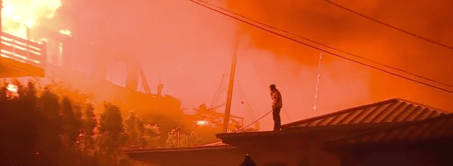
Though wildfires in Southern California are not an unusual occurrence, the ones now tearing through the Los Angeles area are truly historic. Hundreds of thousands residents are under mandatory evacuations, hundreds of thousands of acres have been burned, and many of the fires are not contained. The fires are effortlessly jumping major freeways, including the 405, and engulfing everything in their path.
The stories emerging from the wildfires are heartbreaking. On NBC Nightly News, images and stories of grieving and tearful people who have lost their homes have been commonplace. In one image, a man stands on his roof staring down a massive wildfire with a garden hose in hand. He doesn’t even look hopeful. He knows it’s futile.
Even as I see tears and hear sobs, it is difficult for me to imagine how these people must feel. At a time of year that is known for its bounty of gifts, there are thousands who have suffered the loss of so much.
One of my favorite Christmas carols is “Joy to the World.” Its famously bouncy melody, however, can mask its realistic estimation of the trials of this world:
No more let sins and sorrows grow,
Nor thorns infest the ground;
He comes to make His blessings flow
Far as the curse is found.
This world, the carol concedes, is full of sins, sorrows, and thorns. And yet, the hope of Christmas is that a Savior has been born who “comes to make His blessings flow far as the curse is found.” The tension of this lyric is thick. A catastrophe like the California fires is certainly a result of the curse – a world broken by sin. Natural disasters were never meant to be part of God’s good creation. But God comes into this world, cursed by sin, to make His blessings flow. In other words, even in the midst of the fires, God’s blessings are not withheld, but bestowed. But when you’re fighting a massive fire with a garden hose, God’s blessings can be awfully tough to spot.
Christmas can help us see how God’s blessings arrive, even when all we see is the curse. God’s blessings arrive not in brash and bold and bawdy ways, but in small and poor and humble ways. They arrive in little towns like Bethlehem. They arrive through peasant people like Mary and Joseph. They arrive with a baby who sleeps in some hay. In other words, they arrive in ways that are easy to miss in a world where the curse looms large. But those who take the time to see these blessings cannot help but be changed by them.
One story coming out of the California fires involves a family whose mansion burned to the ground last week. When firefighters ordered an evacuation of the area shortly before the fires engulfed this family’s home, one firefighter asked the homeowner, “If we could save just one thing, what would you want it to be?” The homeowner replied, “Please save my Christmas tree for my kids because it’s got so many memories.” The family no longer has a home. But they still have their tree. They still have a reminder of this season and what it’s all about – the greatest blessing of God’s Son. The curse may have taken this family’s house, but it did not take this family’s Christmas.
He comes to make His blessings flow
Far as the curse is found.
He really does – even if it’s in the smallest of ways.
The Scandals Keep Coming

It’s far better to take refuge in the LORD than to trust any human. It’s far better to take refuge in the LORD than to trust any human leader. (Psalm 118:8-9)
If there were ever words we needed to read, re-read, and take to heart in the chaos of our heady political milieu, it would be these. Our human leaders fail us again and again – time after time, leader after leader, politician after politician.
The latest political failures come conveniently in both a left and a right form – a liberal scandal and a conservative one. On the liberal side, there is U.S. Senator Al Franken from Minnesota, who was revealed to have groped a radio newscaster during a 2006 U.S.O. tour. The senator has issued an apology, but there are already questions boiling under the surface as to whether or not this kind of behavior was common for him.
On the conservative side, there is the candidate for the U.S. Senate, Judge Roy Moore from Alabama, who stands accused making unwanted advances at female teenagers in the early 80s and, according to the two most serious allegations, sexually assaulting one girl who, at the time, was 14 and attacking another girl who, at the time, was 16, by squeezing her neck and attempting to force her head into his groin. Judge Moore was in his 30s when the alleged assaults took place and he has denied the allegations.
Senators Mitch McConnell and Chuck Schumer have called for an investigation of Senator Franken by the Senate Ethics Committee, a move which Senator Franken himself supports. Politicians on both sides of the aisle have called on Judge Moore to drop out of the Alabama Senate race, with some interesting exceptions. Alabama State Auditor Jim Zeigler defended the judge’s alleged actions using what can only be described as a tortured – and, it must be added, an incorrect and incoherent –theological logic, saying:
Take the Bible – Zechariah and Elizabeth, for instance. Zechariah was extremely old to marry Elizabeth and they became the parents of John the Baptist. Also, take Joseph and Mary. Mary was a teenager and Joseph was an adult carpenter. They became parents of Jesus. There’s just nothing immoral or illegal here. Maybe just a little bit unusual.
Alabama Representative Mo Brooks defended Judge Moore more straightforwardly by calculating the political cost of electing a Democrat to the Senate instead of a firebrand conservative like the judge. He said:
America faces huge challenges that are vastly more important than contested sexual allegations from four decades ago … Who will vote in America’s best interests on Supreme Court justices, deficit and debt, economic growth, border security, national defense, and the like? Socialist Democrat Doug Jones will vote wrong. Roy Moore will vote right. Hence, I will vote for Roy Moore.
Whether among Democrats or Republicans, it seems as though the stakes on every election, every seat, every position, and every appointment – yea, every scrap of political power – have become sky high. A national apocalypse, it can feel like, is only one political loss away.
New York Times columnist David Brooks recently bemoaned how our perceived astronomical political stakes have turned politics itself into an idol for many in our society. He wrote:
People on the left and on the right who try to use politics to find their moral meaning are turning politics into an idol. Idolatry is what happens when people give ultimate allegiance to something that should be serving only an intermediate purpose, whether it is money, technology, alcohol, success or politics.
In his column, Mr. Brooks quotes Andy Crouch, who is the executive editor at Christianity Today, and his excellent description of what idols do in his book Playing God:
All idols begin by offering great things for a very small price. All idols then fail, more and more consistently, to deliver on their original promises, while ratcheting up their demands, which initially seemed so reasonable, for worship and sacrifice. In the end they fail completely, even as they make categorical demands. In the memorable phrase of the psychiatrist Jeffrey Satinover, idols ask for more and more, while giving less and less, until eventually they demand everything and give nothing.[1]
This is most certainly true. All idols fail. This means that if we fancy our politicians to be saviors who can rescue us from the wiles of our political opponents and some looming national apocalypse, those for whom we vote will inevitably fail – sometimes modestly by an inability to pass key legislation, and other times spectacularly in some grave moral collapse. Senator Franken and Judge Moore are just the latest examples of this.
David French, in a recent article for National Review concerning the Judge Moore scandal, wrote simply, “There is no way around dependence on God.” These scandals serve to remind us of this profound truth. The fact that our politicians fail should grieve us, as sin always should, but it should not scare us. After all, even if a national apocalypse should come, it is still no match for the Apocalypse, when, instead of a politician, a perfect Potentate will appear to set the world right. That’s not an apocalypse of which to be scared; that’s an apocalypse by which to be comforted. I hope you are.
_____________________________
[1] Andy Crouch, Playing God: Redeeming the Gift of Power (Downers Grove, IL: InterVarsity Press), 56
Sutherland Springs, Texas
I am growing weary of the phrase “active shooter situation.” Whenever I hear the phrase, I know what it means. It means more bodies counted. It means more families shattered. It means more communities terrified. It means more tranquility robbed. It means more tears shed. It means more loss endured.
This time, an active shooter situation came for Sutherland Springs, Texas – a town that, admittedly, although I’ve heard of it and live right up the road from it in San Antonio, I had to look up on Google Maps to jog my memory as to its precise location.
The numbers out of Sutherland Springs are awful. 26 people have been killed, including several children, the youngest of which was only 18 months old, and nearly two dozen more have been injured after a gunman opened fire at the First Baptist Church there during its morning worship service. It is the deadliest mass shooting at a house of worship in American history and the deadliest mass shooting period in Texas’ history.
So, once again, we pray. And, once again, we grieve. And, once again, we hope this will be the last mass shooting. And, once again, we know that, in spite of our hopes, it probably will not be. Though law enforcement officials have not yet discerned a definite motive, we know that the prospect of fame, even if it comes in the form of infamy, the chance at revenge, or the allure of making one’s voice heard through bullets seems to be so enticing that it overwhelms even the most basic of moral instincts – the moral instinct to celebrate and protect life.
As with other tragedies, people want to know why and how this could have happened. Why would a man who lived in New Braunfels drive 45 minutes south to open fire on a country Baptist congregation? How did no one see this coming? How do we protect ourselves when so many places in our communities and neighborhoods, simply by virtue of the fact that we live in a free society, are soft targets for people with evil intent?
One of the blessings of being a part of a church family is that, if the church family is healthy, it tends to feel safe. It is a safe place for people to worship with their families. It is a safe place to make friends and grow in relationships. It is a safe place to turn when a sickness strikes or a loved one is lost in order to receive prayers and support. It is a safe place to process struggles and ask questions about faith and God. But this feeling of safety has been severely tested by this tragedy.
It is important to remember that this feeling of safety that can sometimes seem so indigenous to some churches was not – and still is not – a normal feature of families of faith. Churches all across the world are being bombed, shot up, and terrorized because of their confession of Christ. The apostle Paul, in Romans 8:36, writes about what it was like to be a member of a church in the first century when he quotes Psalm 44:22: “For Your sake we face death all day long; we are considered as sheep to be slaughtered.” This does certainly not sound safe. Yet, what makes Paul’s words especially poignant at a time like this are their context. Paul begins by asking:
Who shall separate us from the love of Christ? Shall trouble or hardship or persecution or famine or nakedness or danger or sword? As it is written: “For Your sake we face death all day long; we are considered as sheep to be slaughtered.” No, in all these things we are more than conquerors through Him who loved us. (Romans 8:35-37)
Even the sword of a Roman soldier – and, yes, even the bullet from an assailant’s rifle – cannot separate us from the love of Christ. We are, Paul says, more than conquerors of those things because Christ loves us through those things.
Jesus once said, “My friends, do not be afraid of those who kill the body and after that can do no more” (Luke 12:4). A shooter at a church in Sutherland Springs killed some bodies – but he can do no more. So, we should not be afraid. Why? Because there was a moment in history when instead of a mass murderer mowing down dozens of people with an assault rifle, a mass of murderers brutally executed one man on a cross. But their murder didn’t take. Because three days later, He came back. The murders of the congregants at the First Baptist Church in Sutherland Springs won’t take either. Because one day – on the Last Day – these worshipers will come back when the One who once rose Himself will return to raise them – and us.
The worship service that those congregants were participating in yesterday morning at 11:30 – singing God’s praises and hearing God’s Word – didn’t end when a gunman opened fire and the victims drew their final breaths. It just moved. It just moved to a place around a throne where there sits a Lamb of God who takes away every sin by His death and grants eternal life by His life. And one day, we’ll join them around that same throne. May that day come quickly.
Maranatha.
Praying for Las Vegas

Credit: David Becker / Getty Images
This morning, stories of heroism are already emerging. On NBC’s Today, an eyewitness described police officers and military trained personnel standing up during the shooting while everyone else was crouching down, looking for the injured so that they could render immediate aid. These brave souls put their own lives at risk for the sake of those who were in danger of losing theirs.
Certainly, this will be a story that dominates our headlines and, in one way or another, messes with our heads and hearts. It is difficult to fathom how evil could move someone to commit an indiscriminate act of mass murder like this. It is chilling to imagine what it must have been like to be there.
Right now, on this dark morning, there are two things for us, as a people, to do together. First, we should pray. We should pray for the families of loved ones who have lost their lives. We should pray for the medical professionals who, right now, are tending to many who are critically injured in level one trauma centers. We should pray for law enforcement as they seek to unravel what has happened. And we should pray for Las Vegas. Here is yet another community that has been marred and scarred by tragedy.
Second, as a part of our prayers, we should not forget to give thanks. We should not forget to give thanks for the heroes proven in a terrible time of deadly strife. We should not forget to give thanks for those who risked their own lives to place their fingers in the bullet holes of the wounded. We should not forget to give thanks for those who were willing to sacrifice their own lives to save the lives of others.
As a Christian, I know that salvation never comes without sacrifice. This is what makes the message of the cross both awful and wonderful all at the same time. The cross is the place where the Son of God was unjustly murdered. That is awful. But the cross is also the place where I was graciously given life. And that is wonderful – and the reason I have hope.
At the Mandalay Bay, the unthinkably awful happened. But even the unthinkably awful cannot undo, or even outdo, the bravery of the heroes who were willing to sacrifice themselves for the sake of others. So, for the wounded and grieving I pray. And, for the heroes of this morning I give thanks.
I hope you will join me in doing the same.
Predictions Come and Predictions Go

Ludwig Ferdinand Schnorr von Carolsfeld, Apocalypse, 1831
Well, things are still here.
There was some doubt as to whether or not they would be, at least in the mind of one man named David Meade. Mr. Meade is a self-styled “Christian numerologist” who believed this past Saturday would bring a super-sign that would mark the beginning of the end of the world. He based his prediction on the number 33:
“Jesus lived for 33 years. The name Elohim, which is the name of God to the Jews, was mentioned 33 times [in the Bible],” Meade told The Washington Post. “It’s a very biblically significant, numerologically significant number. I’m talking astronomy. I’m talking the Bible…and merging the two.”
And September 23 is 33 days since the August 21 total solar eclipse, which Meade believes is an omen.
Mr. Meade also pointed to a mythical planet named Nibiru, which he said would pass by the earth, causing all sorts of calamities.
The difficulties with Mr. Meade’s odd eschatologizing are legion. For starters, by one count, the Hebrew word for “God,” Elohim, doesn’t appear in the Bible 33 times, but in the Old Testament 2,570 times! Mr. Meade’s count isn’t even close. And the planet Nibiru, which was supposed to be central to his apocalyptic super sign, according to NASA scientists, doesn’t even exist.
Of course, whenever anyone – even if they are someone as obscure as Mr. Meade – makes this kind of sensationalistic prediction, reporters rush to interview Christian leaders to ask for their take on the prediction. In this instance, thankfully, the leaders who they interviewed responded, to paraphrase, “Give me a break.”
Unfortunately, implausible apocalyptic predictions have become something of a matter of course for some who love to traffic in the dramatic. In 2011, it was Harold Camping who predicted that the rapture would occur on May 21. But predictions like these go back much further than that. One of the earliest ballyhooed apocalyptic predictions dates all the way back to the end of the fourth century, when the church father Martin of Tours announced that the Antichrist had already been born and that the world would end by 400. 1,617 years later, we’re still waiting.
One problem with predictions like these is that they have the effect of discrediting the Christian message because those who trumpet them attach them to the Christian message. And when these predictions inevitably fail, other parts of Christianity begin to look suspect.
Another problem with predictions like these is how they tend to portray the end times. These predictions tend to focus so much on the destruction of earth that they forget about the return of Christ. Mr. Meade, in his prediction, highlighted things like “volcanic eruptions, tsunamis, and earthquakes,” but he seemed to overlook the thrilling trumpet call, the breathtaking new Jerusalem, and the joyous resurrection to everlasting life.
The return of Christ, for those who trust in Him, is not meant to terrifying, but encouraging. In one way, then, we should feel a twinge of disappointment that Mr. Meade wasn’t right. For when Christ returns, all the depravity, devastation, despair, and death will be set right, which, for all the charms of this world, makes what comes next something I am looking forward to and praying for.
So, although I would never be so bold as to try to chronologize the end times, I do pray that Jesus will come. Mr. Meade’s prediction doesn’t have to be right for that prayer to be good.
Maranatha!
Physician-Assisted Suicide and Who We Really Are

Physician-assisted suicide has gained limited acceptance in many regions of the country because it has been peddled, in part, as an option for those suffering from the excruciating pain of certain types of terminal illnesses. Supervised suicide was sold as a way to alleviate physical misery. A new study published in The New England Journal of Medicine, however, suggests that the actual reasons people choose assisted suicide are quite different from that of physical suffering. One of the researchers in the study, Madeline Li, explains that many people consider assisted suicide because of:
…what I call existential distress. [For some people,] their quality of life is not what they want. They are mostly educated and affluent – people who are used to being successful and in control of their lives, and it’s how they want their death to be.
In one instance cited in this study, a marathon runner found herself confined to her bed because of cancer. She wanted to take her own life because “that was not how she saw her identity,” Li explained. In another case, a university professor wanted to die because, according to Li, “he had a brain tumor, and he didn’t want to get to the point of losing control of his own mind, [where he] couldn’t think clearly and couldn’t be present.”
This study reveals that physician-assisted suicide can turn out to be not so much a palliative response to physical pain, but an angry response to the loss of how we see ourselves. A marathon runner wants to end her life when she can longer run marathons. A university professor sees no reason to live if he is no longer able to think at the level he once was. It turns out that when people lose what gives them their identities, they often lose the very will to live.
If nothing else, this study should serve as a warning concerning the dangers of finding your meaning, purpose, and identity in something you are or in something you do, for these types of identities can all too easily be shattered by the wily ravages of this world and this life. This is why, as Christians, we are called to find who we are in Christ.
When a rich man comes to Jesus in Mark 10 and asks Him, “What must I do to inherit eternal life?” Jesus responds by citing a sampling of the Ten Commandments: “You shall not murder, you shall not commit adultery, you shall not steal, you shall not give false testimony, you shall not defraud, honor your father and mother.” When the man boasts to Jesus, “All these I have kept as a little boy,” Jesus responds, “One thing you lack. Go, sell everything you have and give to the poor, and you will have treasure in heaven. Then come, follow Me.” The rich man, the story says, “went away sad, because he had great wealth.” It turns out that this man found his meaning, purpose, and identity in his wealth. And when Jesus asked him to give up the source of his earthly identity, he could not – even to follow Jesus eternally. May we never make the same devastating mistake.
Physician-assisted suicide carries with it a whole host of ethical problems, including the temptation to place profits over people. Just last week, The Washington Times reported on a doctor who claimed that some Nevada insurance companies refused to cover certain life-saving treatments he requested for his patients because they were too expensive. Instead, these companies offered to help his patients end their lives. If this story is true, such a practice is nothing short of appalling. But sadly, far too many people do not need a creepy suggestion from a greedy insurance company to consider taking their own lives. They only need to be so turned in on who they are in this life that they forget about who they are in Christ.
Suicide may be some people’s answer to a loss of identity. But suicide cannot give someone a new identity. It cannot give someone hope. Only Jesus can do that. So let us find ourselves in Him.
“I consider that our present sufferings are not worth comparing with the glory that will be revealed in us.” (Romans 8:18)
Reflections on London

As I finish my preparations for worship at Concordia tomorrow, I do so knowing that people across the world are hurting tonight as terrorists have launched an attack yet again, this time in London.
As I’ve been reflecting on another tragic night, I cannot help but hold out hope. Here’s why. Terrorists strike. They quickly detonate a bomb, or mow down people using a car. Terrorists strike. Our God, however, does something more. He abides. He abides with us to comfort us in our distress. He abides with us to dry our eyes when they are filled with tears. He abides with us to give us strength when we are weak. Terrorists strike. Our God abides.
And abiding is better.
Abiding is better because it outlasts a strike. Abiding is better because long after terrorists disappear into the shadows to plan their next sinister attack, our God remains by the sides of those who have lost loved ones. Abiding is better because long after the police clear, loved ones are laid to rest, and today’s tragic story gets coopted by the next big tragic story, our God will not forget the events of this night.
One of my favorite hymns is “Abide with Me.” Two of its verses are especially poignant to me tonight. The first of these verses is for those who are mourning losses in these attacks. The hymn reminds us of how Christ’s abiding presence can comfort us in our loss:
Come not in terrors, as the King of kings;
But kind and good, with healing in Thy wings;
Tears for all woes, a heart for every plea;
Come, Friend of sinners, and abide with me!
In a world of terror, we do not need Christ to be our terrible Judge. Instead, we need Him to be our gentle Healer. May Christ begin the healing process in all those who are grieving.
The second of the verses reminds us of the hope that we have for the lost:
I fear no foe, with Thee at hand to bless;
Ills have no weight, and tears no bitterness:
Where is death’s sting? Where, grave, thy victory?
I triumph still if Thou abide with me.
Terrorists struck tonight. And with them, death struck. But when Christ abides with us, we triumph.
Terrorism doesn’t stand a chance.
Praying for London.
Terror in Manchester

Terror struck again, this time at an Ariana Grande concert in Manchester, England. What began as a night of fun for fans of the pop music diva ended with 22 dead, many of them children, and 59 others wounded when a suicide bomber detonated himself in the middle of the concert arena. ISIS quickly claimed responsibility for the attack, which was carried out by 22-year-old Salman Abedi who seems to have become radicalized after travelling to Syria.
Once again, the world is left struggling with what can only be described as a senseless and ghastly act of violence. As I have after other similar attacks, I want to offer a few thoughts on how to process yet another week marred by a terrorist’s malice. Here are three things to consider.
Sin is real.
In general, we want to believe that people are good. Sure, there may an occasional evil outlier, but, overall, we like to assume that people are hardwired for goodness. The steady stream of terrorist attacks, however, indicates differently. Indeed, the tragedy in Manchester was the most widely reported terrorist attack of last week, but three additional attacks were also launched this past week – one in Egypt, another in the Philippines, and yet another in Indonesia. Heinous acts of evil are rampant. Sin is all too real.
It is true that the vast majority of people, thankfully, will never be party to a terrorist plot. Every one of us, however, will struggle with some kind of sin. Whether it be the sin of deception, or lust, or pride, or anger, none of us can escape the sirens of our sinister sides. Because we live in a broken world, we have to live with the sad fact that the sin of terrorism will continue to be “out there.” But because we ourselves are broken people, we also have to live with the sad fact that we will continue to struggle with sin in us. The apostle Paul is right when he writes, “For all have sinned” (Romans 3:23). Sin is real and is everywhere.
Righteousness is real.
We may struggle against sin, but we also yearn for righteousness. We recoil in disgust against terrorism precisely because we know it’s wicked and we yearn for what is right. But how do we know what is right and that terrorism is wrong? Paul explains that, even if we do not know God, we know what is right and wrong because God has written righteousness on our hearts: “When [people], who do not have the law, do by nature things required by the law, they are a law for themselves, even though they do not have the law. They show that the requirements of the law are written on their hearts” (Romans 2:14-15). This is why, in the face of evil, we appeal to and press toward righteousness.
Justice is coming.
In his famous “I Have a Dream” speech, Martin Luther King Jr. declared, “We refuse to believe that the bank of justice is bankrupt.” At a time when racism was rampant, Dr. King believed justice would ultimately triumph. And although racism still spreads its ugly tentacles through our society, justice has been slowly but surely bludgeoning the evil of racism over the 54 years since Dr. King’s speech. What is true of racism is also true of ISIS and other organizations like it. The evil of ISIS is simply no match for the justice of God. ISIS may delight in the death of the innocent, but a day will come when “there will be no more death” (Revelation 21:4), for “death will be swallowed up in victory” (1 Corinthians 15:54) through Christ. Indeed, Christ has already defeated death by His resurrection. And because of Christ’s resurrection, those who lose their lives in Him do not lose their lives forever. Death, for them, is but a pause in the drumbeat of life. Their resurrections are soon to come when Jesus comes.
So after a week when a terrorist did his worst, we can take comfort in the biblical promise of everlasting life. To quote the poet and pastor John Donne:
One short sleep past, we wake eternally
And death shall be no more; Death, thou shalt die.


 Pastor Zach's Blog