
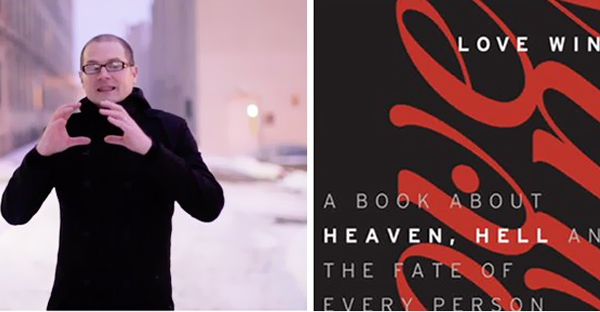
 I was curious, so I checked. It’s number one in Amazon’s “Religion and Spirituality” section and number three in Amazon’s overall list of the top 100 books. To say Rob Bell’s newest opus, Love Wins, has made a splash is like saying our recent recession was an economic hiccup. Both are understated. Because of its meteoric rise to the top of national book sales, the pastors at Concordia feel it is important to address what Rob teaches in this book. Here is what you need to know upfront: Concordia’s pastors do not believe that Love Wins presents true biblical or Christ-centered doctrine. In fact, we believe it presents false doctrine that is dangerous and confusing, leading people away from Christ rather than toward Him. If this is all you want or need to know, there is no need to read the balance of this blog. If you want to know why we believe this book presents false doctrine, read on.
The blogs and reviews of Rob’s new book are legion, and so my goal in this blog is not to try to break through the cacophony of clamor surrounding the book’s release. That’s a far too ambitious – and, I might add, unrealistic – goal. But neither do I intend my review to simply be another voice added to the many shouts either celebrating or decrying Rob’s book. Instead, my review is more of a personal sort. I am a pastor. And already, I am receiving questions from people I know and love about Rob’s book. And I am concerned. I am concerned about Rob. I remember him in his earlier years. To this day, I have never heard a finer sermon on Leviticus 16 than the one he preached. And the picture he painted of Ephesus, the Roman emperor Domitian, and John’s Revelation still grips me – and gives me hope – every time I think about it. In fact, I still have a copy of that sermon…on cassette tape! I’m having a hard time understanding what happened to Rob theologically. I am concerned about him. But I am also concerned about the people with whom I am talking. The people who are questioning. The people who are confused. The people who are wondering, “Is this book true?” If this is you, then I mean this blog for you. And though my words may be pointed, they are not meant to be vicious. Rather, they are written in love and a concern for the truth, for “love rejoices with the truth” (1 Corinthians 13:6). And I believe that, finally, the truth will carry the day. For I, like Rob Bell, believe that love wins.
Deconstructing theology is dangerous business. And yet, it’s something people – especially so-called “postmodern” thinkers – love to do. After all, it’s fun to pile on top of certain theological presuppositions and assertions and expose the discontinuities in them, especially if these presuppositions and assertions are widely regarded as traditional and orthodox. And it is this is this deconstructionist method that Rob employs in Love Wins. Consider this quote:
Millions have been taught that if they don’t believe, if they don’t accept in the right way, that is, the way the person telling them the gospel does, and they were hit by a car and died later that same day, God would have no choice but to punish them forever in conscious torment in hell. God would, in essence, become a fundamentally different being to them in that moment of death, a different being to them forever. A loving heavenly father who will go to extraordinary lengths to have a relationship with them would, in the blink of an eye, become a cruel, mean, vicious tormenter who would ensure that they had no escape from an endless future of agony.
If there was an earthly father who was like that, we would call the authorities. If there was an actual human dad who was that volatile, we could contact child protective services immediately.
If God can switch gears like that, switch entire modes of being that quickly, that raises a thousand questions about whether a being like this could ever be trusted, let alone be good. (pages 173-174)
The logic seems, well, logical enough. If God loves us and wants salvation for us, how could He abandon his pursuit of us upon our deaths and consign us to eternal torment? That’s not a loving God! Therefore, goes Rob’s argument, God must allow people the opportunity to repent (though he never uses the word) even, perhaps, after death. Or at least that’s what he tantalizingly infers!
But let’s apply Rob’s same deconstructionist enterprise to his own argument. Rob solves the difficulty of the God who pursues us in the life and judges us in the next by appealing to God’s generous love – a love generous enough to allow for our free will, now on earth and then in eternity:
To reject God’s grace, to turn from God’s love, to resist God’s telling, will lead to misery. It is a form of punishment, all on its own.
This is an important distinction, because in talking about what God is like, we cannot avoid the realities of God’s very essence, which is love. It can be resisted and rejected and denied and avoided, and that will bring another reality. Now and then.
We are that free. (page 176)
So, Rob says I am free – free to “trust God’s retelling of my story” (page 173), as he puts it, and free to reject it. And not only am I free to trust and reject now on earth, but “now and then,” even into eternity. On the one hand, this is quite an enticing prospect because it allows me to trust in God’s retelling of my story even after I die. So if I mess it up here, I need not worry. I get another shot at trusting God on the flipside. It is important to note that Rob’s concern here is fundamentally a therapeutic utilitarianism. The kind of God who would do something as psychologically stressful as consigning people to an eternal hell simply won’t work! Indeed, Rob states this explicitly: “This is the problem with some Gods – you don’t know if they’re good, so why tell others a story that isn’t working for you” (page 181)? The problem is that Rob’s version of God and the gospel doesn’t work either! After all, what happens if I mess up on the flipside? What happens if I trust God’s retelling of my story in this age, but then use the generous freedom that Rob claims love requires to reject God’s retelling of my story in the age to come? Do I slip the surly bonds of heaven and wind up in a hell of my own making? And what if I trust in God’s retelling again? Is it back to heavenly bliss? And then what if I reject it…again? And then trust it…again? Am I stuck in a vicious volley between heaven and hell for all eternity? That certainly doesn’t sound very “heavenly.” In fact, that sounds like what I struggle with right now! That sounds like Paul’s exposition on every Christian’s age old struggle: “I do not understand my own actions. For I do not do what I want, but I do the very thing I hate” (Romans 7:15). Where’s the hope in that?
The freedom that love brings is only good if it is exercised with the sovereign prerogative that God has. In other words, love without God’s sovereign prerogative is impotent. It cannot do what it desires. It cannot, to use Rob’s book title, “win.” And indeed, love that allows this kind of freedom isn’t even really love. For it simply allows us to do what we please. Who actually loves like this – even here, even now? Love demands that when you see a child chasing his ball onto the interstate, you curb his freedom and tug him back. Love demands that heaven is an age when we are not only free to live with God, but have also been tugged, or, more biblically, “chosen” by God (cf. Ephesians 1:3-14). Love and freedom are not synonymous nor are they inextricable concomitants of each other. That is why God does away with people who persistently demand their freedom. For they cannot demand their freedom to God without demanding their freedom from God. These are the people who go to hell.
To allow me the eternal freedom to trust or reject God’s retelling of my story is only to allow me the eternal opportunity to make myself unspeakably miserable. And I’m not sure that’s a good opportunity. Because I already know what I’d choose…again and again and again. For I’m not truly free. I’m a slave to sin. And so I will always choose wrongly. As the Reformers put it, “We are unable to stop sinning.” I will always fall for the illusion that freedom from God presents rather than the joy that freedom in Christ brings. This is why God coopted my slavery to sin and set me free, only to make me a slave again, this time to righteousness – not out of some sort of sinister divinely wrought determinism, but for the sake of Christ: “Having been set free from sin, you have become slaves of righteousness” (Romans 6:18). This is the good news – that God does not leave things up to us. No, He loves us far too much to do that. And so He conquers sin, death, and the devil, and gives us His righteousness, apart from and in spite of our terrible choices.
Whatever so-called “problems” and questions Rob Bell may try to solve and answer in his book, he only succeeds in creating more problems and begging more questions. Not only that, but he finally replaces the good news with something that is neither good, for it leaves us in an eternal state of struggling against our own wills, nor is it news, for this struggle is much older than any twenty-four news cycle. So, whatever supposed “problems” my “traditional” story of the gospel may have (which I am not convinced there are problems, just paradoxes), this I know: When it comes to a love that is broad enough to allow me my own, dangerous freedom, “the good news is better than that” (page 191).
