Posts tagged ‘Gospel’
Waiting To Be Adopted

15-year-old Davion Only with his caseworker
Credit: Tampa Bay Times
It’s heartwarming and heartbreaking all at the same time. 15-year-old Davion Only attended St. Mark Missionary Baptist Church in St. Petersburg, Florida on a recent Sunday with a request: “Somebody, anybody, please adopt me.” Lane DeGregory of the Tampa Bay Times sets the scene of this boy’s dark past:
Davion Navar Henry Only loves all of his names. He has memorized the meaning of each one: beloved, brown, ruler of the home, the one and only.
But he has never had a home or felt beloved. His name is the last thing his parents gave him.
He was born while his mom was in jail. He can’t count all of the places he has lived.
In June, Davion sat at a library computer, unfolded his birth certificate and, for the first time, searched for his mother’s name. Up came her mug shot: 6-foot-1, 270 pounds – tall, big and dark, like him. Petty theft, cocaine.
Next he saw the obituary: La-Dwina Ilene “Big Dust” McCloud, 55, of Clearwater, died June 5, 2013. Just a few weeks before.[1]
It’s hard to imagine how this young man’s childhood could have been more heart-rending.
By Davion’s own admission, he has had rage problems in the past. His caseworker once took him to a picnic hosted by an organization devoted to helping foster kids find permanent homes, but he lashed out – throwing chairs and pushing people away. But the death of his mother changed him:
When he learned his birth mother was dead, everything changed. He had to let go of the hope that she would come get him. Abandon his anger. Now he didn’t have anyone else to blame.
“He decided he wanted to control his behavior and show everyone who he could be,” [his caseworker] said.
So someone would want him.
The only thing more heartbreaking than the story of Davion’s past is that state of Davion’s present, encapsulated in this one line: “So someone would want him.”
There’s a reason the Bible often uses adoption as a descriptor for the Gospel. Paul writes, “But when the fullness of time had come, God sent forth His Son, born of woman, born under the law, to redeem those who were under the law, so that we might receive adoption as sons” (Galatians 4:4-6). Elsewhere in his writings, Paul makes it clear that God’s adoption of us as His children is in no way based on our desirability. Quite the contrary. Paul minces no words explaining just how undesirable we are: “None is righteous, no, not one; no one understands; no one seeks for God. All have turned aside; together they have become worthless; no one does good, not even one” (Romans 3:10-12). Our adoption as God’s children is not based on our desirability, but on His grace.
The Gospel, then, is this: We do not have to wait for someone to want us. For we know that someone does want us – so much, in fact, that He’s willing to die for us.
Lane DeGregory’s article ends with this postscript: “At publication time, two couples had asked about Davion, but no one had come forward to adopt him.” Praise be to God that when we are slow to adopt, our Lord is not. He signed the papers for us 2,000 years ago.
[1] Lane DeGregory, “An orphan goes to church and asks someone, anyone to adopt him,” The Tampa Bay Times (10.15.2013).
You Don’t Want To Be Number One

“Moses with the Tablets of the Law” by Rembrandt, 1659
Credit: Wikipedia
Idolatry is rampant in our society. And this is no surprise. After all, people have loved to worship, serve, and trust in gods of their own making for millennia now. From money to sex to power to education to an obsession with whatever rights we think we’re supposed to have, we have no shortage of gods on hand and in our hearts. And idolatry begins when we are young.
I remember a chapel service I conducted for a childcare center at the church I used to serve. I was talking to the kids about the First Commandment, which I paraphrased like this: “God is number one.” It was with this paraphrase that I heard a little two year old voice pipe up from the back of the room: “No!” the voice protested, “I’m number one!” I was taken aback. So I tried to clarify: “You are special and important,” I said, “But God is number one. He’s number one over everything.” The voice, however, wasn’t buying it. “No! I’m number one!” it fired back.
By the end of my chapel message, it was almost comical. Whenever I said, “God is number one,” this little voice would respond, “No! I’m number one!” It seems the idolatrous desire to take God’s place is ingrained in us from the earliest of years.
Martin Luther comments on the First Commandment:
Now this is the work of the First Commandment, which enjoins, “Thou shalt have no other gods.” This means, “Since I alone am God, thou shalt place all thy confidence, trust, and faith in Me alone and in no one else.”[1]
I love how Luther describes the spirit of the First Commandment not in terms of obedience, but in terms of faith. In the First Commandment, Luther explains, God invites us to trust in Him rather than in the idols we make for ourselves. Why? Because the idols we make for ourselves take from us, hurt us, and condemn us. The true God, however, gives to us, blesses us, and saves us. Idols pain us. The true God comforts us.
The pain of idolatry becomes especially acute when the idols we make for ourselves happen to be ourselves. When we are our own gods, we are inevitably left disparaging and hating ourselves, for we fail ourselves and find that we are not the kinds of gods we need ourselves to be.
The First Commandment, then, is not just a dictate, but a promise – a promise that we do not have to worry about running everything as number one gods. The real God already has that number one spot – and all the responsibility and peril that comes with it – covered. So don’t just obey the First Commandment, have faith in the One who issues it. For it is only by faith that this commandment is kept.
[1] Martin Luther, Luther’s Works, vol. 44, J. J. Pelikan, H. C. Oswald & H. T. Lehmann, eds. (Philadelphia: Fortress Press, 1966), 30.
The Value of Patience

Credit: baycitizen.org
I am not a patient person. I wish I was, but I’m not sure I really have the patience to learn patience.
The other day I had to go to the DMV to get a registration sticker for my truck. I had renewed my registration online some two months earlier, but my registration sticker never came. When I called inquiring about my vehicle registration, they informed me that the sticker must have gotten lost in the mail and that it was my responsibility to drive to a DMV office and purchase a replacement sticker.
So that’s what I did.
When I arrived, I found two lines. One line took care of vehicle registration renewals and the other line took care of everything else. I was hoping I could wait in the registration renewal line, but because I was not renewing my registration and instead getting a replacement sticker, I had to wait in the other line. Did I mention that the other line was longer and moving much slower?
After over an hour waiting in line, I finally got my sticker. It took less than a minute. Needless to say, I walked out with less than a smile on my face.
I am not a patient person. God, however, is patient. The Bible regularly celebrates God’s patience: “The LORD is compassionate and gracious, slow to anger, abounding in love” (Psalm 103:8). Rather than getting upset easily and quickly, God’s patient love prevails.
For all of God’s patience, it is important to note that even His patience does not last forever. When Israel rebels against God for centuries in wickedness, God warns: “You have rejected me … You keep on backsliding. So I will reach out and destroy you; I am tired of holding back” (Jeremiah 15:6). God will only tolerate unrepentant sin for so long. Such sin will eventually lead to divine judgment. Thus, although we are called to trust God’s patience, we should not try God’s patience.
I got frustrated because I had to wait an hour to get my vehicle registration sticker at the DMV. God has been waiting thousands of years so more and more people might repent and trust in Him. And if God is can wait that long for us, maybe I can wait a little longer for others.
Righteous
 This weekend in worship and ABC, we learned about the doctrine of justification which teaches that our righteousness before God is not a product of ourselves and our works; rather, it is a free gift from God, given to us by the work of Christ on the cross. As the apostle Paul writes, “[We] are justified freely by [God’s] grace through the redemption that came by Christ Jesus” (Romans 3:24).
Throughout the history of the Church, some have tried to undercut this doctrine of God’s work with human works. The Pelagians, for instance, taught that by obeying God’s commands, people could gain favor in God’s sight. The Synergists taught that justification was not a gift of God’s righteousness exclusively, but a comingling of God’s righteousness with human righteousness. In the face of such unbiblical teachings, Martin Luther offers this important reflection on justification as God’s work and not as ours:
The world wants to win heaven from our Lord God by right, although He is causing the message to be proclaimed aloud throughout the world that He wants to give it to us for nothing. He says: “I want to be your God; out of grace and for nothing I want to save you … I will not let you win heaven from Me. Therefore make no other gods, do not invent things that you do for yourself … Do not begin with your good works; allow Me to have mercy on you.” It certainly is a shame that people must accuse us being unwilling to accept heaven for nothing, nay, of actually wanting to earn it and of proposing to give to God, to Him who desires to offer everything to us in plenty. Such fools are we: we want to give what we ought to take.[1]
We bring nothing to our righteous standing before God – no good work, no pious thought, no warm heart. Instead, God supplies any and all righteousness we need through His Son. This is the doctrine of justification. This is the promise of the gospel. And this is the cornerstone of our faith.
May we never seek to add our works to God’s work. After all, it is God’s work – and His work alone – that saves us.
[1] Martin Luther, What Luther Says, Ewald M. Plass, comp. (St. Louis: Concordia Publishing House, 1959), §2207.
The Bible Is All About ___________
 The Bible is all about __________.
How you fill in this blank makes a big difference in how you approach not only the Bible, but your life as a believer in Christ.
I have no doubt that most Christians would fill in the blank with “Christ.” After all, a respectably orthodox theology demands no other answer. “The Scriptures…testify about Me,” Jesus declares (John 5:39). But what we say about the Bible and what we want to know from the Bible are often two very different things.
I once had a lady who felt the need to give me some preaching advice following one of my sermons. “The problem with you,” she began, “is that you always end your sermons the same way: by talking about Jesus. I already know what Jesus did,” she continued. “I want to hear about what I need to do to live a better and successful life!” She expressed publicly the way a lot of people feel secretly. To learn about Jesus is fine and good, but what we really want is to learn about ourselves – how we can be successful.
Tullian Tchividjian, pastor of Coral Ridge Presbyterian Church, calls such a desire “reading the Bible narcissistically.” He explains:
We often read the Bible as if it were fundamentally about us: our improvement, our life, our triumph, our victory, our faith, our holiness, our godliness. We treat it like a book of timeless principles that will give us our best life now if we simply apply those principles. We treat it, in other words, like it’s a heaven-sent self-help manual…Even our devout Bible reading can become fuel for our own narcissistic self-improvement plans, the place we go for the help we need to “conquer today’s challenges and take control of our lives.”[1]
But this is not the purpose of the Good Book. The Bible is not about us being better. It’s about Jesus being perfect.
“But what about me?” someone may protest. “I have concerns I need answered! And they’re not just concerns about how I can go to heaven after I die, they’re concerns about how to deal with things while I’m still alive!”
This is where we can modify how we fill in the blank a little bit. Because the Bible is indeed all about Jesus. But Jesus came for us. Jesus lived for us. Jesus died for us. And Jesus rose for us. The Bible is all about Jesus who just happens to be for us.
Tchividjian continues:
The Bible is one long story of God meeting our rebellion with His rescue; our sin with His salvation; our failure with His favor; our guilt with His grace; our badness with His goodness.
The problem with the way so many people approach the Bible is that they skip over Jesus to get to themselves. The Bible is indeed about us, but it’s about us in light of Jesus. And it is when we read the Bible in light of Jesus that we discover that we are more deeply sinful than we ever thought, unable to improve our lives under our own power and will, and Jesus is more magnificently gracious than we ever imagined, able to save us from our sin and our selves. You see, Jesus is not only the key to reading the Bible correctly, He is the key to reading ourselves correctly – as sinners in need of a Savior. It is when we see Him as the center of the Scriptures that we find we need Him as the Savior of our lives.
[1] Tullian Tchividjian, “Reading The Bible Narcissistically,” The Gospel Coalition (6.10.2013).
Sharing the Gospel…Even When It’s Hard
 How far would you go to share the gospel? Paul’s words in 1 Corinthians 9 constitute a rallying cry to “pull out all the stops,” as it were, to get the gospel to those who need to hear it:
Though I am free and belong to no man, I make myself a slave to everyone, to win as many as possible. To the Jews I became like a Jew, to win the Jews. To those under the law I became like one under the law (though I myself am not under the law), so as to win those under the law. To those not having the law I became like one not having the law (though I am not free from God’s law but am under Christ’s law), so as to win those not having the law. To the weak I became weak, to win the weak. I have become all things to all men so that by all possible means I might save some. I do all this for the sake of the gospel, that I may share in its blessings. (1 Corinthians 9:19-23)
Paul’s call to “become all things to all men…for the sake of the gospel” has been a topic of many a conversation about what is involved in showing and sharing God’s love to a world that is hostile to the exclusive claims of Christ. Though many things could be said about proclaiming the gospel in a world like this, there is one thing in particular that I would focus on in this post: Proclaiming the gospel to a world adverse to its message often involves pain.
Proclaiming the gospel involves much more than just being familiar enough with the culture around you to speak the gospel in a way that is intelligible to that culture, it involves enduring persecution from that culture when it takes umbrage with the gospel’s message. This was certainly the case with Paul. Paul writes, “To the Jews I became like a Jew, to win the Jews” (verse 20). To become like a Jew was no easy task for Paul, especially since his Jewish comrades considered his message of a crucified Messiah blasphemous. And the punishment for speaking blasphemy was nothing less than a beating. This is why Paul writes in 2 Corinthians 11:24: “Five times I received from the Jews the forty lashes minus one.” Interestingly, a compendium of Jewish rabbinical teaching called the Mishnah considers lashes to be only a secondary punishment for blasphemy. The primary punishment was that of being cut off from the Jewish people. The rabbis wrote, “All those who are liable to extirpation who have been flogged are exempt form their liability to extirpation” (Mishnah Makkot 3:15). The primary punishment for blasphemy, then, was that of being excommunicated from the Jewish community, but if a person could not stand the thought of excommunication, he could instead choose to be lashed. Paul chose the lashes over the shunning. But why? It certainly wasn’t because he took any particular pride in being a Jew by birth. Paul says of his Jewish pedigree: “I consider everything a loss compared to the surpassing greatness of knowing Christ Jesus my Lord, for whose sake I have lost all things. I consider them rubbish, that I may gain Christ” (Philippians 1:8). Paul chose the lashes because he could not stand the thought of being excommunicated by his Jewish comrades. After all, such excommunication would spell the end of his efforts “to win the Jews” (verse 20). Paul was so desperate to share the gospel with his Jewish community, he was willing to be beaten within inches of his death to do so.
The apostle Peter writes, “To this you were called, because Christ suffered for you, leaving you an example, that you should follow in His steps” (1 Peter 2:21). Sometimes, becoming “all things to all men…for the sake of the gospel” means suffering for the sake of the gospel. By the Spirit’s enabling, may we be prepared to face adversity and pain to share and spread God’s message and power of salvation!
Weekend Extra – It’s Crystal Clear!
 In 2008, the Pew Forum on Religious and Public Life conducted one of the largest surveys ever of Americans’ religious beliefs. Though it found that 92 percent of people believe in God, when asked to specify who God is or make hard and fast distinctions between their faith systems and the faith systems of other religions, respondents struggled. Instead, most Americans have an increasingly nonexclusive attitude when it comes to faith. 70 percent of people surveyed believe that many paths lead to God. Gregory Smith, a research fellow at the Pew Forum, explains: “Even though Americans tend to take religion quite seriously and are a highly religious people, there is a certain degree of openness and a lack of dogmatism in their approach to faith and the teachings of their faith” (“Most Americans Believe in Higher Power, Poll Finds,” Washington Post, 9.24.08).
In all honesty, the Pew Foundation’s survey offers no real surprises. Though it is one of the largest surveys ever conducted, the results are a dime a dozen. Survey after survey has demonstrated that, though most Americans are “spiritual” and believe in “God,” they have no real cohesive doctrinal system nor do they subscribe wholeheartedly to an external source of authority such as the Bible. People claim to be spiritual, but their spirituality is fuzzy.
Long before researchers were around to conduct in-depth surveys on people’s religious attitudes, the apostle Paul foresaw that such misguided faith would be the order of the day for many: “The Spirit clearly says that in later times some will abandon the faith and follow deceiving spirits and things taught by demons” (1 Timothy 4:1). In a world which subscribes to fuzzy spirituality, Paul seeks to inject some clarity from the Holy Spirit: “The Spirit clearly says…” True faith in God is never ill-defined. It is as clear as the Gospel itself. Indeed, according to Paul, a faith that does not find its clarity vis-à-vis the Gospel is not a faith in God, but a faith from demons. And for the nebulous faiths of demons, Paul warns, “some will abandon the faith.” Two things are notable in this phrase. First, the Greek word for “abandon” is apostesontai, from which we get our English word “apostasy,” a word which, etymologically, means “to stand apart.” Paul’s argument, then, is that standing apart from faith in Christ means standing with demons. Second, the arthrous phrase “the faith” reminds us that, quite distinct from the popular conception that many faiths lead to God, there is only one true faith – faith in Jesus Christ.
What is the way out of the fuzzy spirituality which plagues our culture? Paul cites two remedies. First, fuzzy spirituality must be remedied by the Gospel: “This is a trustworthy saying that deserves full acceptance (and for this we labor and strive), that we have put our hope in the living God, who is the Savior of all men, and especially of those who believe” (1 Timothy 4:9-10). Hope in the living God and His Savior, Jesus Christ, leads to salvation. Period. Of this we can be clear and sure. No nebulous spirituality can promise salvation like the Gospel can. It can only conjure up shady specters of possible hereafters. Second, fuzzy spirituality must be remedied by the authority of Scripture: “Devote yourself to the public reading of Scripture, to preaching and to teaching” (1 Timothy 4:13). The Gospel is revealed in, by, and through the pages of Scripture. Thus, if we desire clarity on the Gospel specifically and theology generally, we turn to Scripture and submit to its authority and believe its promises. With the Gospel and Scripture in our hearts and hands, clarity is given to things spiritual, with even more clarity being promised in eternity: “Now we see but a poor reflection as in a mirror; then we shall see face to face. Now I know in part; then I shall know fully, even as I am fully known” (1 Corinthians 13:12). Praise be to God for the clarity which comes from our Creator!
Want to learn more on this passage? Go to
www.ConcordiaLutheranChurch.com
and check out audio and video from Pastor Tucker’s
message or Doctor Player’s ABC!
Weekend Extra – The Gift of the Gospel
 In the book of Esther, the good queen Esther foils a plot by the evil Haman to exterminate the Jews after Haman becomes enraged when one Jew in particular, Mordecai, refuses to bow down and pay him homage. Being an egomaniac, Mordecai’s insult infuriates Haman so much that “he scorned the idea of killing only Mordecai. Instead Haman looked for a way to destroy all Mordecai’s people, the Jews, throughout the whole kingdom of Xerxes” (Esther 3:6). When Mordecai learns of Haman’s nefarious intentions, he calls Esther, a relative of his and also a Jewess, and pleads with her to go entreat the king for the lives of the Jews. But Esther knows that such a request cannot be made without peril:
All the king’s officials and the people of the royal provinces know that for any man or woman who approaches the king in the inner court without being summoned the king has but one law: that he be put to death. The only exception to this is for the king to extend the gold scepter to him and spare his life. (Esther 4:11)
To approach the king, Esther’s will have to put her life on the line. But with great courage, Esther approaches the king uninvited:
Esther put on her royal robes and stood in the inner court of the palace, in front of the king’s hall. The king was sitting on his royal throne in the hall, facing the entrance. When he saw Queen Esther standing in the court, he was pleased with her and held out to her the gold scepter that was in his hand. So Esther approached and touched the tip of the scepter. Then the king asked, “What is it, Queen Esther? What is your request? Even up to half the kingdom, it will be given you.” (Esther 5:1-3)
With the king’s words, Esther can take comfort in the fact that her life is no longer in danger. For the king has spared her life and has even offered to grant her request, whatever it may be. “It will be given you,” the king says. The story finds its happy ending when Esther requests a banquet with Haman and the king only to foil Haman’s plot against the Jews. Providentially, the king was willing to give Esther her banquet which she leveraged to save her people.
“It will be given you.” These are not only the words of a king. These are also the words of the gospel. For the gospel is a gift. Jesus promises: “Ask and it will be given to you” (Matthew 7:7). And the greatest gift that Jesus has given to humanity, of course, is His own death and resurrection. For this gift brings our salvation.
In our reading from this past weekend from Revelation 19, we catch a breathtaking glimpse of the end of time when Satan is finally conquered the Church is wed to Christ once and for all. The song of praise at this wedding is beautiful:
Hallelujah! For our Lord God Almighty reigns. Let us rejoice and be glad and give him glory! For the wedding of the Lamb has come, and his bride has made herself ready. Fine linen, bright and clean, was given her to wear. (Revelation 19:6-8)
A Church once stained by the sin and depravity of her people is now arrayed in “fine linen, bright and clean.” How does she obtain such linen? It is “given her to wear.” Even at the end of time, God’s gospel goes on. The church does not earn her linens, nor does she merit them; rather, they are given to her.
Just as the bride of the king was given life by an extended gold scepter, the bride of Christ is given life by His arms, extended on a cross. And when Jesus extends His arms on a cross, He does so with a promise on His lips: “It will be given you! Forgiveness will be given you! Life will be given you! Salvation will be given you! Fine linen of holiness, unsoiled by sin will be given you! It will be given you!” This is why, on the Last Day, when the wedding of the Lamb of God to His Church finally arrives, we will be stained no more by sin. For Christ will have given us all we need – even perfection into eternity. It will be given you. What a gift!
Want to learn more on this passage? Go to
www.ConcordiaLutheranChurch.com
and check out audio and video from Pastor Hower’s
message!

Sermon Extra – The Heart of the Gospel
 “But now a righteousness from God, apart from law, has been made known, to which the Law and the Prophets testify. This righteousness from God comes through faith in Jesus Christ to all who believe” (Romans 3:21-22).
More magnificent words have nary been written. Paul’s words in these verses constitute the heart and soul of the gospel. Because Paul’s words are so foundational to everything we believe, teach, and confess as Christians, I thought for this week’s “Extra,” I would simply take some time to briefly unpack some key phrases, specifically in verse 22.
From God…
This phrase describes the source of righteousness. A Christian’s righteousness is not of his own making or doing. Rather, it is “from God.” A Christian knows that, apart from God, “There is no one righteous, not even one” (Romans 3:10), “for all have sinned and fall short of the glory of God” (Romans 3:23). Thus, in order for someone to be declared “righteous,” that righteousness must come from somewhere else, or, more accurately, from someone else. Paul declares that this “someone else” is God.
Through faith…
This phrase describes the application of righteousness, that is, how God’s righteousness gets from God to us. Some people try to apply God’s righteousness to themselves by ascending to God via nebulous mysticism or good works or deep knowledge. But Paul’s answer of how God’s righteousness gets applied to us involves no steep ascent to the Divine through various contortions of the soul, body, or mind. Rather, the way that God’s righteousness gets applied to us is through faith. And for Paul, faith is simple trust – trust that God is indeed righteous and trust that God indeed wants to share His righteousness with us as a completely free gift, apart from any merit or worthiness on our parts.
In Christ…
This phrase describes the object of righteousness. The object of righteousness – the One to whom we look to see God’s righteousness on display – is Jesus Christ. He is the epitome and the embodiment of God’s righteousness. Indeed, He is God’s righteousness come to earth. Thus, if we do not trust in Christ, we cannot receive God’s righteousness. Much debate has swirled around this phrase as it appears in Greek: dia pisteos Iesou Christou. Grammatically, this phrase can be translated in one of two different ways. One the one hand, it can be translated as above: “through faith in Jesus Christ.” This takes the phrase Iesou Christou as an objective genitive. In other words, Jesus Christ is the object of our faith. But this phrase can also be translated as a subjective genitive: “through the faithfulness of Jesus Christ.” Here, Jesus becomes the subject of the faith. Although grammatically, the former is probably to be preferred, theologically, both are important. For we must have faith in Christ for God’s righteousness to be applied to us. But God’s righteousness cannot be applied to us through Christ unless Christ is righteous, that is, faithful (cf. Hebrews 3:6)! Thus, we have faith in the faithful Christ.
To all who believe…
This phrase describes the destination of righteousness. That is, God desires that His righteousness find its destination in every person. It is important to understand that God’s righteousness is undiscriminating. He does not desire to give it to one person while desiring to withhold it from another. Thus, anyone can receive God’s righteousness, no matter how wicked, debase, or depraved they might be. No one need remain outside the grasp of God’s righteousness. This is why we share the gospel of God’s righteousness.
This, then, is the gospel: that God gives to us His righteousness through faith because of the faithfulness of Jesus to anyone who believes that His righteousness is for them. This is the gospel that the Christian church has stewarded for some 2,000 years. And who knows? We may be stewarding it for some 2,000 more. By God’s grace, may we steward it well. For it is the most precious treasure to humankind. For it is the message of our forgiveness, life, and salvation. And there can be no greater treasure than that.
Want to learn more on this passage? Go to
www.ConcordiaLutheranChurch.com
and check out audio and video from Pastor Zach’s
message or Pastor Hower’s ABC!
Pondering Christ’s Passion
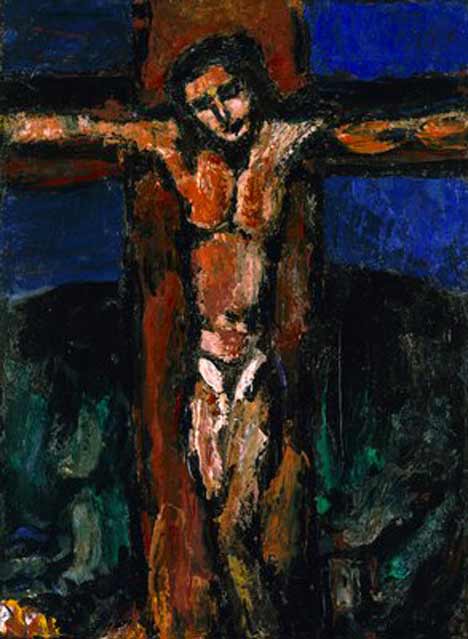 It is a traditional devotional practice during the season of Lent for Christians to take some time to reflect on Christ’s sacrifice for us on the cross. As we are in the midst of this special season, I thought it would be appropriate to share with you some selections from Martin Luther’s Meditation on Christ’s Passion from 1519. This meditation was one of Luther’s favorites. At one point he called it his “very best book.” Indeed, it is a brilliant reflection as Luther focuses with laser like clarity on Christ’s sacrifice.
As you read these words, I would encourage you to notice the way in which Luther draws a sharp distinction between God’s Law and God’s Gospel. God’s Law is expressed in a way that is harsh and inescapable. Luther’s expression and condemnation of our sinfulness might sound shocking, but it is certainly Scriptural. But Luther does not leave us in despair. With the heart of a pastor, he points us to the sacrifice of Christ and gloriously sets forth for us how it is all-sufficient for our sin.
And so I invite you to ponder now on Christ’s holy Passion. May this reflection be a blessing to you.
They contemplate Christ’s passion aright who view it with a terror-stricken heart and a despairing conscience. This terror must be felt as you witness the stern wrath and the unchanging earnestness with which God looks upon sin and sinners, so much so that he was unwilling to release sinners even for his only and dearest Son without his payment of the severest penalty for them. Thus he says in Isaiah 53:8, “I have chastised him for the transgressions of my people.” If the dearest child is punished thus, what will be the fate of sinners? It must be an inexpressible and unbearable earnestness that forces such a great and infinite person to suffer and die to appease it. And if you seriously consider that it is God’s very own Son, the eternal wisdom of the Father, who suffers, you will be terrified indeed. The more you think about it, the more intensely will you be frightened.
You must get this thought through your head and not doubt that you are the one who is torturing Christ thus, for your sins have surely wrought this. In Acts 2:36–37, St. Peter frightened the Jews like a peal of thunder when he said to all of them, “You crucified him.” Consequently three thousand alarmed and terrified Jews asked the apostles on that one day, “O dear brethren, what shall we do now?” Therefore, when you see the nails piercing Christ’s hands, you can be certain that it is your work. When you behold his crown of thorns, you may rest assured that these are your evil thoughts, etc.
We must give ourselves wholly to this matter, for the main benefit of Christ’s passion is that man sees into his own true self and that he be terrified and crushed by this. Unless we seek that knowledge, we do not derive much benefit from Christ’s passion.
After man has thus become aware of his sin and is terrified in his heart, he must watch that sin does not remain in his conscience, for this would lead to sheer despair. Just as our knowledge of sin flowed from Christ and was acknowledged by us, so we must pour this sin back on him and free our conscience of it. Therefore beware, lest you do as those perverse people who torture their hearts with their sins and strive to do the impossible, namely, get rid of their sins by running from one good work or penance to another, or by working their way out of this by means of indulgences. Unfortunately such false confidence in penance and pilgrimages is widespread.
You cast your sins from yourself and onto Christ when you firmly believe that his wounds and sufferings are your sins, to be borne and paid for by him, as we read in Isaiah 53:6, “The Lord has laid on him the iniquity of us all.” St. Peter says, “in his body has he borne our sins on the wood of the cross” (1 Peter 2:24). St. Paul says, “God has made him a sinner for us, so that through him we would be made just” (2 Corinthians 5:21). You must stake everything on these and similar verses. The more your conscience torments you, the more tenaciously must you cling to them. If you do not do that, but presume to still your conscience with your contrition and penance, you will never obtain peace of mind, but will have to despair in the end. If we allow sin to remain in our conscience and try to deal with it there, or if we look at sin in our heart, it will be much too strong for us and will live on forever. But if we behold it resting on Christ and see it overcome by his resurrection, and then boldly believe this, even it is dead and nullified. Sin cannot remain on Christ, since it is swallowed up by his resurrection. Now you see no wounds, no pain in him, and no sign of sin. Thus St. Paul declares that “Christ died for our sin and rose for our justification” (Romans 4:25). That is to say, in his suffering Christ makes our sin known and thus destroys it, but through his resurrection he justifies us and delivers us from all sin, if we believe this.
Luther’s Works: American Edition, Volume 42, pages 8-12


 Pastor Zach's Blog