Posts tagged ‘Faith’
Robin Williams: 1951-2014

Credit: Ticketmaster
I first heard of Robin Williams’ untimely death thanks to Facebook. My wife Melody was scrolling through her newsfeed when she let out a gasp of disbelief and exclaimed, “Robin Williams died?!” My immediate thought was, “That’s fake.” Celebrity death hoaxes are common, after all. On Facebook alone, I’ve learned of the Rock’s death while filming Fast and Furious 7. I’ve read of Sylvester Stallone’s demise in a snowboarding accident. And I’ve heard that Miley Cyrus took her own life. Of course, none of these death stories are true. But I found out very quickly that Robin Williams’ death story was.
As the world began to grieve, the gruesome details began to emerge. The Marin County, California Police Department held a press conference in which they offered up details – perhaps, too many details – on Williams’ demise. Whatever the gory specifics might be, the overarching cause of death is tragically clear. Robin Williams died by suicide.
Suicide.
Just the word makes people shudder. And ponder. And question.
There are two questions that people often ask me whenever an individual – or, in the case of Robin Williams, a culture – is confronted by the harsh realities of suicide. The first is an explicitly Christian question while the second is more generally transcendent.
First, people ask me, “Can a person who commits suicide go to heaven?”
The short answer to this question is, simply, “yes.” From a theological perspective, all of us commit what I call “slow-motion suicide.” Scripture is clear that “the wages of sin is death” (Romans 6:23). Do we know this? Yes. Do we still sin intentionally and willingly? Yes. Thus, we’re killing ourselves with sin. The only difference between what we do to ourselves and what Robin Williams did last Sunday evening is the speed with which he did it. He took his life quickly. We take our lives bit-by-bit, sin-by-sin. If the person who takes his life in an instant can’t be saved, neither can the person who takes his life over decades. News of a suicide, then, is never an opportunity for judgment, but a call to introspection.
I should add that, when Jesus speaks of His forgiveness, He never singles out suicide as some sort of an unforgivable sin. Jesus declares, “I tell you the truth, all the sins and blasphemies of men will be forgiven them” (Mark 3:28). How many sins does the word “all” include? All of them. Even suicide. Thus, a person who takes his own life can be forgiven by Jesus and saved by Jesus just as well as any other sinner can. If you want to know more about suicide from a theological perspective, you can check out a blog I wrote a couple of years ago here.
Second, people ask me, “Why?” Why would a person who had so much going for him snuff out his life so recklessly?
The question of “why” has become especially acute in Robin Williams’ case because he left no note. Sadly, where facts are in short supply, gossip and speculation are plenty. I would point out, however, that even when a note is left, the question of “why” is still left unanswered. Even if a person writes of “having nothing left to live for,” or how “people will be better off without me,” those left behind still wonder: “Why didn’t he realize that he had so much to live for?” Or, “Why didn’t he realize what his death would do to us – how it would tear us apart?”
I have come to understand that the question of “why,” when it comes to suicide, has no answer – mainly because the suicidal person himself cannot answer the question. The darkness and confusion that surrounds a person when he takes his own life is so deep that genuine reasoning falters under the crushing weight of depression.
So where does all this leave us? Allow me to offer two parting thoughts.
First, a thought to those contemplating suicide: suicide is a lie of Satan. Satan entices people into suicide by making promises to “free you” or “fix you.” But he wants no such thing for you. He only wants to end you. This is why he seeks to either kill us slowly by enticing us into sin after sin or, if he can, he’ll be delighted to kill us quickly at the bottom of the barrel of a gun or by the brink of a blade. So, if you are contemplating suicide, remember: everything it promises is a lie. Get help from someone who will tell you the truth.
Second, a thought to those who have lost loved ones to suicide: life is the truth of our God. God is the master of snatching life out of the jaws of death. He did it with His Son. And He can do it with those who take their own lives. Indeed, on the Last Day, He will do it with all who trust in Him. Wherever Satan peddles his lies, God crushes them with His truth. And His truth is this: by faith in Christ, your loved one is not beyond hope. Suicidal sinners can be saved too.
I’m looking forward to seeing more than a few of them in heaven.
Why I Don’t Read The Bible Literally (But I Do Take It Seriously)
 It never ceases to amaze me how misunderstood the orthodox Christian belief concerning Holy Scripture is. Even The New York Times can’t seem to figure it out. Take Charles Blow, an op-ed columnist for the Times, who stands stunned at the views of many Americans on the Bible. With a mixture of disbelief and disdain, he reports:
One Gallup report issued last week found that 42 percent of Americans believe “God created humans in their present form 10,000 years ago.”
Even among people who said that they were “very familiar” with the theory of evolution, a third still believed that God created humans in their present form 10,000 years ago.
It’s not clear what the respondents meant by being “very familiar” – did they fully understand the science upon which evolution’s based, or was their understanding something short of that, as in, very familiar with it as being antithetical to creationist concepts?
Whatever the case, on this issue as well as many others in America, the truth is not the light.[1]
Blow goes on to cite people’s opinions on the Bible itself according to this same Gallup pole:
Nearly a third of Americans continue to believe that the Bible “is the actual word of God and is to be taken literally, word for word.”
Furthermore, nearly half believe that it is “the inspired word of God but not everything in it should be taken literally.”
About a fifth of Americans said they believe the Bible is “an ancient book of fables, legends, history, and moral precepts recorded by man.”
The questions Gallup asks concerning the nature and character of the Bible frustrate me. Gallup wants to know, “Do you believe the Bible is the actual word of God and is to be taken literally, word for word?” Personally, I would have to answer “yes” and “no.” Do I believe the Bible is “the actual word of God”? Yes. Do I believe it is to be “taken literally, word for word”? No. But this is not because I want to discredit the Bible’s veracity, authority, or inerrancy. Rather, this is because I follow the Bible’s lead when it interprets itself non-literally in some places. The Bible is full of metaphors, symbols, and other figures of speech as even an elementary reading of it will uncover. One need look no farther than “The LORD is my shepherd” (Psalm 23) to find a metaphor – and a beautiful metaphor, I would add – of Scripture. Thus, I would find myself more at ease with Gallup’s second position: “The Bible is the inspired word of God but not everything in it should be taken literally.”
Blow, however, summarily dismisses this second position:
I am curious which parts would get a pass from most of these respondents and which wouldn’t. Would the origins of the world fall into the literal camp? What about the rules – all or some – in books like Deuteronomy?
Perhaps Blow has not yet discovered the difference between reading something literally and reading something contextually. Just because I don’t practice, for instance, the sacrifices outlined in Deuteronomy doesn’t mean I don’t understand them literally. It just means that I read them in light of Hebrews 10:10: “We have been made holy through the sacrifice of the body of Jesus Christ once for all.” Christ’s sacrifice for sin put an end to all those Old Testament sacrifices for sin. For me to try to follow those laws would be like me taking a ticket for an Elvis concert, going to the venue listed thereon, and expecting a concert usher to let me in! Though I may read the ticket “literally,” that ticket’s time is past. So it is with the Old Testament sacrificial system. Its time too is past because it has been fulfilled by Christ. But that isn’t me reading the Bible non-literally. That’s just me reading the Bible contextually.
I suspect part of the reason Blow disparages option two when it comes to reading and interpreting the Bible is because, for him, only option three, which says the Bible is “an ancient book of fables, legends, history, and moral precepts recorded by man,” is viable. He writes:
I don’t seek to deny anyone the right to believe as he or she chooses. I have at points in my own life been quite religious, and my own children have complicated views about religion. As my oldest son once told me, “I’d hate to live in a world where a God couldn’t exist.”
That is his choice, as it is every individual’s choice, and I respect it.
What worries me is that some Americans seem to live in a world where facts can’t exist.
Facts such as the idea that the world is ancient, and that all living things evolved and some – like dinosaurs – became extinct. Facts like the proven warming of the world. Facts like the very real possibility that such warming could cause a catastrophic sea-level rise.
Ah yes, facts. Facts like the Bohr model of the atom or the rallying cry of biogenetics: “Ontogeny recapitulates phylogeny.” Oh, wait. Those “facts” turned out to be not quite as factual as we once thought. Contrary to Blow, I’m not so sure that a great uprising of people who want facts to not exist is the problem. The problem is there are people who disagree with him on what the fullness of the facts are and how the data that form the facts should be interpreted. Now, I’m not saying these other people are correct on the facts. I’m just saying these other people with other thoughts on what the facts are that contradict Blow’s thoughts on what the facts are not necessarily rejecting facts themselves.
Blow says he is “both shocked and fascinated by Americans’ religious literalism.” I don’t think he even understands what “religious literalism” is. Nor do I think he understands that many serious people of faith understand and trust the Bible theologically, morally, and historically without always reading it literally. No wonder he’s so shocked and fascinated. He simply doesn’t understand. Then again, I’m not so sure he wants to.
__________________________
[1] Charles Blow, “Religious Constriction,” The New York Times (6.8.2014).
Not Just Any Old Crucifixion
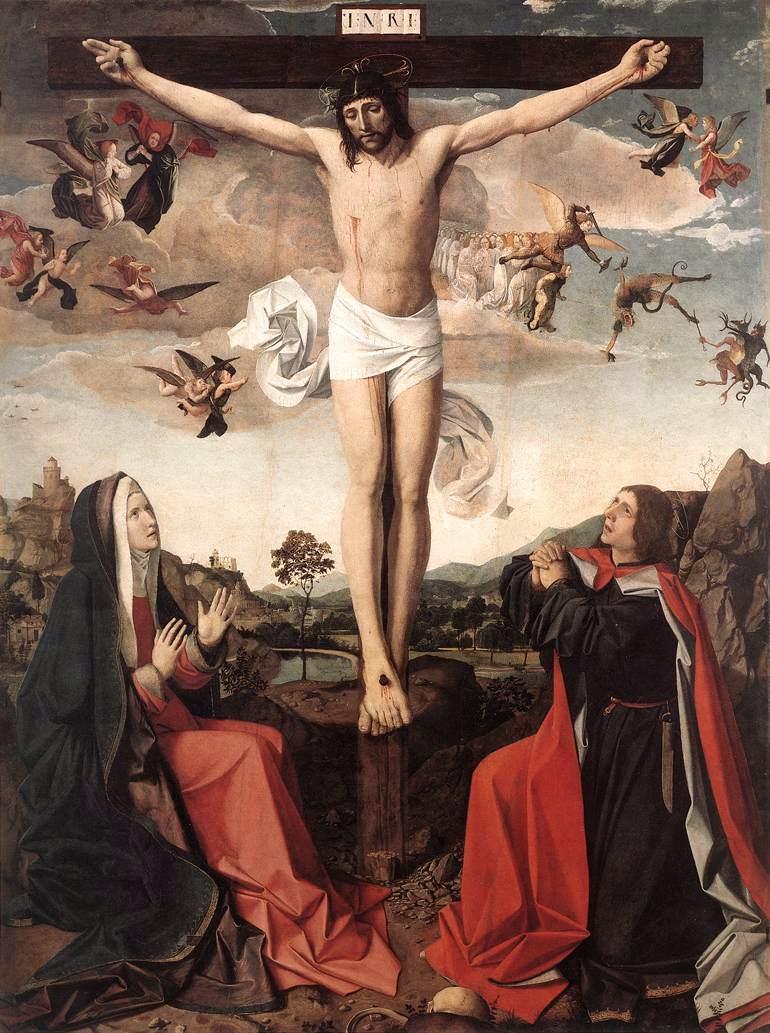
“Calvary” by Josse Lieferinxe, c. 1500
In the ancient world, crucifixions were a dime a dozen. Hardly a day passed without one. Consider these statistics:
- 519 BC: Darius I, king of Persia, crucifies 3,000 of the leading citizens of Babylon.
- 332 BC: Alexander the Great crucifies 2,000 people after invading the city of Tyre.
- 100 BC: Alexander Jannaeus, king of Judea, crucifies 800 Pharisees.
- 71 BC: A great uprising of slaves against the Roman Empire, led by the great gladiator Spartacus, leads to the crucifixion of 6,000 of his followers along a stretch of highway from Capua to Rome, totaling 120 miles.
- 4 BC: Varus, governor of Syria, crucifies 2,000 Jewish rebels who were leading a Messianic revolt.
- AD 70: The Roman general Titus sweeps into the city of Jerusalem, sacks it, and begins crucifying 500 people a day he runs out of wood to make crosses.
Crucifixions happened all the time. In fact, according to one estimate, as many as 30,000 people were crucified just in Israel by Jesus’ day.[1]
This Friday is Good Friday – a day when we commemorate a crucifixion. But with crucifixions being so commonplace in the ancient world, it’s worth it to ask: Why do we commemorate one particular crucifixion? Why don’t we commemorate the many crucifixions of the citizens of Babylon, or of Spartacus’ followers, or of the Jews under Titus’ reign of terror? Why do we commemorate only one crucifixion – Jesus’ crucifixion?
The Mishnah, an ancient compendium of Jewish rabbinical teaching, explains that if a criminal was condemned to execution, which would have included crucifixion, he was to say, “Let my death be atonement for all of my transgressions.”[2] The idea was that if a person’s crimes were so heinous that he was deserving of death, only death could save him from those crimes. Crucifixion, then, was connected not only to punitive punishment, but also to personal atonement.
Jesus’ crucifixion, however, was different. Rather than making recompense for His own sins by His death, Jesus asks for forgiveness for others’ sins: “Father, forgive them, for they do not know what they are doing” (Luke 23:34). And rather than seeking atonement for Himself by His execution, the apostle John says Jesus makes atonement for the world: “[Christ] is the atoning sacrifice for our sins, and not only for ours but also for the sins of the whole world” (1 John 2:2).
This is why we commemorate Jesus’ crucifixion. For we remember not only that Jesus was crucified, but why Jesus was crucified. He was crucified not for His own sins, but for ours. Jesus’ crucifixion did what no other crucifixion could do. It saved us. And that’s worth remembering…and celebrating. And that’s why this Friday is not just any Friday, but a Good Friday.
______________________________
[1] John MacArthur, The MacArthur New Testament Commentary: Matthew 24-28 (Chicago: The Moody Bible Institute, 1989), Matthew 27:27-37.
[2] m. Sanhedrin 6.2.
A Camel Controversy
 And you thought it was it only impossible for a camel to go through the eye of a needle.
As it turns out, threading camels isn’t the only thing that’s impossible according to some archaeologists. Domesticating them before the tenth century B.C. also turns out to be quite the trick. Writing for the New York Times, John Noble Wilford provocatively declares, “Camels Had No Business in Genesis.”[1] Wilford explains:
There are too many camels in the Bible, out of time and out of place.
Camels probably had little or no role in the lives of such early Jewish patriarchs as Abraham, Jacob and Joseph, who lived in the first half of the second millennium B.C., and yet stories about them mention these domesticated pack animals more than 20 times. Genesis 24, for example, tells of Abraham’s servant going by camel on a mission to find a wife for Isaac.
How does Wilford know that camels had no role in the era of the biblical patriarchs? He cites a study, recently published by two archaeologists from Tel Aviv University, which employed radiocarbon dating to test some camel bones found in the Aravah Valley. This study found the bones to be from the last third of the tenth century B.C., which, Wilford notes, is “centuries after the patriarchs lived and decades after the kingdom of David, according to the Bible.” So there you have it. Thanks to some late breaking bones, Genesis is discredited – at least the parts that talk about camels.
Now, before we fall prey to camel chaos, a few things should be noted. First, the Tel Aviv archaeologists, by declaring that camels could not have been used in the way Genesis 24 describes them, are making an argument from silence. Their assumption runs like this: because we do not have domesticated camel fossils dating before first millennium B.C., there must have been no domesticated camels before the first millennium B.C. The Bible must be wrong. But a lack of evidence does not necessitate a lack of existence. One need to only think back to 1961. This was the year the “Pilate Stone” was discovered at Caesarea Maritima. It had an inscription dedicated to the emperor of Rome at the time, Tiberius Caesar: “To the Divine Augustus Tiberieum: Pontius Pilate, prefect of Judea has dedicated this.” Before this stone was discovered, because there was no hard archaeological evidence of Pontius Pilate, many assumed that Pilate was a fictional character, made up out of the sacred authors’ over-active imaginations. Whoops. So much for that argument from silence.
It should also be noted that the archaeologists who discovered these bones do not even have complete silence in favor of their argument against camels during the time of the biblical patriarchs. They only have archaeological silence. There are extra-biblical references to domesticated camels prior to the first millennium B.C. Titus Kennedy, adjunct professor at Biola University, notes that a camel is mentioned in a list of domesticated animals from Ugarit, dating anywhere from 1950 to 1600 B.C. In an interview with Christianity Today, Kennedy explains:
For those who adhere to a twelfth century B.C. or later theory of domestic camel use in the ancient Near East, a great deal of archaeological and textual evidence must be either ignored or explained away …
[Israel] doesn’t have much writing from before the Iron Age, 1000 B.C. … So there aren’t as many sources to look at. Whereas in Egypt, you have writing all the way back to 3000 B.C. and in Mesopotamia the same thing.[2]
Kennedy concludes that there were not only domesticated camels at the time of the biblical patriarchs, but before the time of the biblical patriarchs. Thus, the biblical record is quite believable. There is no reason that Abraham could not have acquired “sheep and cattle, male and female donkeys, male and female servants, and camels” (Genesis 12:16), just as Genesis says.
Ultimately, the difficulties with the premature conclusions drawn from this discovery reach much deeper than simply whether camels were around in the second millennium B.C. These difficulties are summed up in Wilford’s conclusion:
These anachronisms are telling evidence that the Bible was written or edited long after the events it narrates and is not always reliable as verifiable history. These camel stories “do not encapsulate memories from the second millennium,” said Noam Mizrahi, an Israeli biblical scholar, “but should be viewed as back-projections from a much later period.”
In other words, the Bible cannot be trusted to get its facts straight – at least not all of them. When reading the Bible, then, skepticism must be given preference over faith.
Finally, if I assume camels could not have been in Genesis based on an argument from paleontological silence, it is only reasonable for me to assume that a Savior cannot rise from death based on medical science. After all, doctors have long known that dead people tend to stay that way. Thus, Jesus’ resurrection must have never happened. But if this is true, then my “faith is futile; I am still in my sins … [and] I am to be pitied more than all men” (1 Corinthians 15:17, 19). Wow, that’s a downer.
Let’s hope the archaeologists are wrong on this one. After all, I don’t really like to be pitied.
[1] John Noble Wilford, “Camels Had No Business in Genesis,” New York Times (2.10.2014).
[2] Gordon Govier, “The Latest Challenge to the Bible’s Accuracy: Abraham’s Anachronistic Camels?” Christianity Today (February 2014).
Angry At A God Who Isn’t There
 The other day I heard the story of a distressed parent. Their son had gone away to college as a Christian and had returned as an atheist. They wanted to know what they could do to bring their son back into the fold.
Honestly, hearing this boy’s story distressed me. After all, nothing less than this young man’s very salvation is at stake. I was tempted to break out into a rant about how far too many colleges and universities deliberately and relentlessly undermine faith while uncritically peddling a deluded vision of a far-flung utopian secular humanistic paradise, but I stopped myself and instead asked a simple question: “Why? Why did your son become an atheist? Was it because of something he heard in some class from a professor, or was it because of something else – something deeper?”
Many atheists like to present themselves as cool and collected, calmly examining empirically verifiable data and coming to the inevitable and emotionally detached conclusion that there is no God. But the reality of atheism is far less viscerally clean.
A couple of years ago, Joe Carter penned an article for First Things titled, “When Atheists Are Angry At God.” In it, he notes a strange phenomenon: many people who do not believe in God find themselves angry at God:
I’ve shaken my fist in anger at stalled cars, storm clouds, and incompetent meterologists. I’ve even, on one terrible day that included a dead alternator, a blaring blaring tornado-warning siren, and a horrifically wrong weather forecast, cursed all three at once. I’ve fumed at furniture, cussed at crossing guards, and held a grudge against Gun Barrel City, Texas. I’ve been mad at just about anything you can imagine.
Except unicorns. I’ve never been angry at unicorns.
It’s unlikely you’ve ever been angry at unicorns either. We can become incensed by objects and creatures both animate and inanimate. We can even, in a limited sense, be bothered by the fanciful characters in books and dreams. But creatures like unicorns that don’t exist – that we truly believe not to exist – tend not to raise our ire. We certainly don’t blame the one-horned creatures for our problems.
The one social group that takes exception to this rule is atheists. They claim to believe that God does not exist and yet, according to empirical studies, tend to be the people most angry at Him.[1]
But why is this? Why would people who don’t believe in God become angry at God? Carter goes on to cite Julie Exline, a psychologist at Case Western Reserve University:
Studies in traumatic events suggest a possible link between suffering, anger toward God, and doubts about God’s existence. According to Cook and Wimberly (1983), 33% of parents who suffered the death of a child reported doubts about God in the first year of bereavement. In another study, 90% of mothers who had given birth to a profoundly retarded child voiced doubts about the existence of God (Childs, 1985). Our survey research with undergraduates has focused directly on the association between anger at God and self-reported drops in belief (Exline et al., 2004). In the wake of a negative life event, anger toward God predicted decreased belief in God’s existence.
In other words, atheism is not as viscerally clean as many atheists would like to have you believe. Atheism is not always the product of cool, clean, detached observation of empirically verifiable date. Instead, atheism is often the product of not disbelief in God, but rebellion against God because a person feels slighted by God in some way. Atheism, although it may hide between a veneer of intellectualism, is also heavily emotional. It’s hardly a wonder that the Psalmists says of the atheist: “The fool says in his heart, ‘There is no God’” (Psalm 14:1). Atheism is not just a matter of the head. It’s also a matter of the heart.
I never quite did get to the root of the atheism of my friend’s son. But I suspect it was more than just some smooth-talking college professor that led him down the road to unbelief. That’s why, when sharing my faith, I not only try to speak to a person’s head; I try to minister to his heart.
[1] Joe Carter, “When Atheists Are Angry At God,” First Things (1.12.2011).
It’s Not Tricky … It’s Really Not
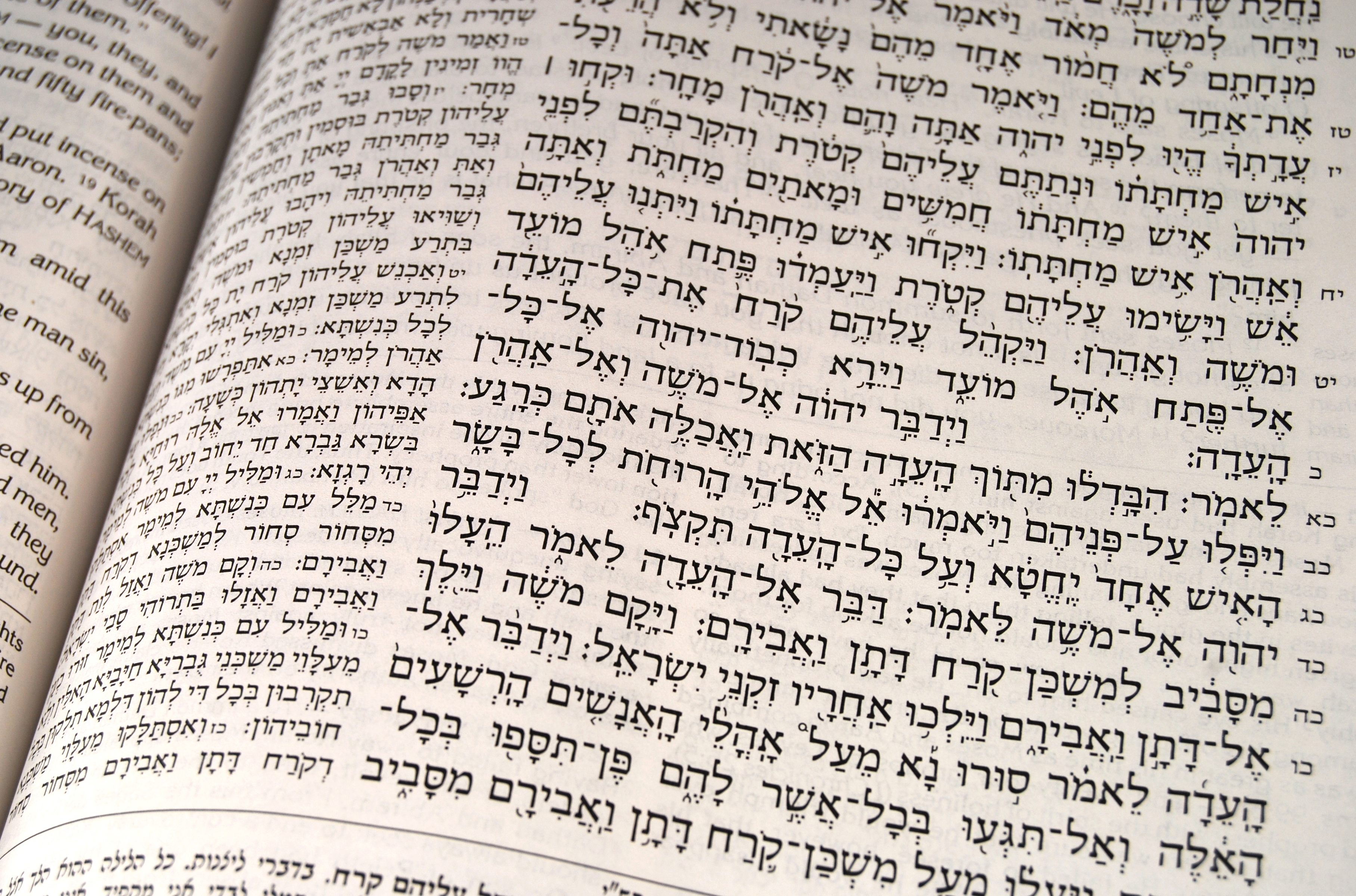 It seems like it’s been happening to me a lot lately.
The other day on the radio, I heard a commercial for “The Biblical Money Code,” a program that claims to be able to make millions for the person who follows it:
Imagine if you had a secret code for making money … a code buried deep within biblical text. A code that certain investment titans have quietly exploited to amass billions. And what if this code could be used by you, today, to unlock vast amounts of wealth — safely and ethically.[1]
Now, forget the fact that what the Bible has to say about money is about as straightforward and sharp as it can be. For instance: “No one can serve two masters. Either he will hate the one and love the other, or he will be devoted to the one and despise the other. You cannot serve both God and Money” (Matthew 6:24). Forget the fact that God nowhere promises that you can or will amass billions. Forget the fact that the Bible doesn’t even find it particularly desirable that a person would amass billions. All of what’s in this program has to be in the Bible. You just have to unlock the code.
But that’s not the only biblical “code” I’ve run across recently.
The other day, I received an email from a friend claiming the prophet Muhammad was identified by name in the Old Testament. Where? Song of Songs 5:16: “His mouth is sweetness itself; he is altogether lovely. This is my lover, this my friend, O daughters of Jerusalem.” How does this refer to Muhammad? The Hebrew word for “altogether lovely” is machamadim, which sounds like “Muhammad.” Now, forget the fact that, in context, this is a statement by a wife about her husband. Forget the fact that machamadim is a Hebrew word and Muhammad is an Arabic name. Forget the fact that there is nothing in this verse that would indicate this is a prophetic statement. These two words sound similar, so they must be related. You just have to unlock the code.
But that’s not the only biblical “code” I’ve run across recently.
I remember a conversation I had with some Mormon friends about the kingdoms of glory in the afterlife. “We can enter a telestial, terrestrial, or celestial kingdom,” my friends explained. From where do they get this? 1 Corinthians 15:40 (KJV): “There are also celestial bodies, and bodies terrestrial: but the glory of the celestial is one, and the glory of the terrestrial is another.” Now, forget the fact that Paul’s point here is not to talk about afterlife destinations, but to speak of the kind of body we will receive at the resurrection of the dead, as he makes abundantly clear at the conclusion of his argument:
So will it be with the resurrection of the dead. The body that is sown is perishable, it is raised imperishable; it is sown in dishonor, it is raised in glory; it is sown in weakness, it is raised in power; it is sown a natural body, it is raised a spiritual body. (1 Corinthians 15:42-44)
Forget the fact that this verse doesn’t even mention telestial bodies. Forget the fact that no one in the Church interpreted this verse in this way before Joseph Smith. Paul has to be talking about different afterlife destinations. You just have to unlock the code.
With so many so-called “religious experts” peddling so many biblical codes, it is worth it to remind ourselves of the principle of perspicuity. Perspicuity is from a Latin word meaning “clearness.” And classically, the Church has ascribed this characteristic to Holy Writ. The Lutheran dogmatician Francis Pieper summarizes biblical perspicuity thusly: “The perspicuity of Scripture consists in this, that it presents, in language that can be understood by all, whatever men must know to be saved.”[2] Pieper goes on to note that Scripture testifies to its own perspicuity in places like Psalm 19:7: “The statutes of the LORD are trustworthy, making wise the simple.” One can be simple intellectually and still gain wisdom from Scripture, for Scripture is clear. Understanding the Good Book does not take a Ph.D. in theology.
Now, this is not to say that every verse of the Bible is equally easy to understand. No less than the great preacher Chrysostom explains that some parts of the Bible can indeed be difficult to interpret:
Let us suppose … rivers … are not of the same depth. Some have a shallow bed, others one deep enough to drown one unacquainted with it. In one part there are whirlpools, and not in another … Why then art thou bent on drowning thyself in those depths?[3]
Chrysostom compares different parts of Scripture to different rivers. Some parts are shallow and easy to navigate. Other parts are deeper and more difficult to wade through. But though some parts of Scripture are richly deep, none are nefariously tricky. In other words, the biblical authors are not trying to hide things from us with a code, but reveal things to us under the guidance of God’s Holy Spirit.
The long and short of biblical perspicuity, then, is this: finding codes, mysteries, and secrets that cater to our sinful lusts like greed, play “sound like” games with words across languages, and rip words out of a text and shoehorn them into meaning something which, contextually, they clearly do not and cannot mean are not only not biblical, they’re evil. God wants us to understand and follow His Word – not be confused by it and misinterpret it.
So the next time you open your Bible, don’t pull out your decoder ring, pull out your reading glasses. They’ll work much better. And you’ll be much more edified.
[1] “The Biblical Money Code,” newsmax.com
[2] Francis Pieper, Christian Dogmatics, vol. 1 (St. Louis: Concordia Publishing House, 1950), 320.
[3] John Chrysostom, A Select Library of the Nicene and Post-Nicene Fathers of the Christian Church, series 1, vol. 13, P. Schaff, ed. (New York: Christian Literature Company, 1889), 507.
Righteousness from God

“Crucifixion of Jesus of Nazareth” by Marco Palmezzano, ca. 1490
Credit: Wikipedia
Because the gospel is the crux of our Christian faith, we can never ponder it, speak of it, or write about it too much. This is why I was delighted to stumble across this passage from Ezekiel while reading devotionally a few days ago:
The righteousness of the righteous man will not save him when he disobeys, and the wickedness of the wicked man will not cause him to fall when he turns from it. The righteous man, if he sins, will not be allowed to live because of his former righteousness. If I tell the righteous man that he will surely live, but then he trusts in his righteousness and does evil, none of the righteous things he has done will be remembered; he will die for the evil he has done. (Ezekiel 33:12-13)
What a beautiful explanation of the gospel and what kind of righteousness saves. Ezekiel is clear: you cannot be saved by your own righteousness! Indeed, even if you act righteously, just one evil act erases all memory of your righteousness. As James writes: “For whoever keeps the whole law and yet stumbles at just one point is guilty of breaking all of it” (James 2:10). To receive salvation, you need another kind of righteousness that is not your own. You need a righteousness that comes from God. The apostle Paul brings clarity to what kind of righteousness this is: “But now a righteousness from God, apart from law, has been made known, to which the Law and the Prophets testify. This righteousness from God comes through faith in Jesus Christ to all who believe” (Romans 3:21-22).
Besides reminding us that our own righteousness does not and cannot save us, Ezekiel’s words also remind us that the gospel is not confined to the New Testament. In both Testaments, the message of the gospel is consistent: it is God’s righteousness, not our own, that saves us. As God promises through the prophet Isaiah, “I am bringing My righteousness near, it is not far away; and My salvation will not be delayed.”
Jesus – More Than Just God
 Was Jesus really human?
These days, this question does not get asked a lot. Rather, people wonder whether or not Jesus was God. And time and time again, people come to the conclusion that Jesus is not, was not, and, indeed, could not have been God. Take, for instance, Reza Aslan, author of the bestseller Zealot: The Life and Times of Jesus of Nazareth. In an interview with NPR about his book, Reza summarizes his position on Jesus’ divinity:
If you’re asking if whether Jesus expected to be seen as God made flesh, as the living embodiment, the incarnation of God, then the answer to that is absolutely no. Such a thing did not exist in Judaism. In the 5,000-year history of Jewish thought, the notion of a God-man is completely anathema to everything Judaism stands for. The idea that Jesus could’ve conceived of Himself — or that even His followers could’ve conceived of Him — as divine, contradicts everything that has ever been said about Judaism as a religion.[1]
There’s no way, Reza says, Jesus’ followers could have considered Him to be divine. He was only a man who led a failed revolution as a failed run-of-the-mill Messiah.
In my studies for a class I’m teaching on Galatians, I came across some terrific commentary from the second-century church father Tertullian on Galatians 4:4-5. The apostle Paul writes in these verses: “But when the time had fully come, God sent His Son, born of a woman, born under law, to redeem those under law, that we might receive the full rights of sons.” Tertullian comments on Paul’s phrase “born of a woman”:
To what shifts you resort, in your attempt to rob the syllable “of” of its proper force as a preposition, and to substitute another for it in a sense not found throughout the Holy Scriptures! You say that He was born through a virgin, not of a virgin, and in a womb, not of a womb.[2]
In Tertullian’s day, there were people trying to rob Jesus not of His divinity, but of His humanity. A group of called the Docetists considered everything corporeal to be evil while holding anything non-corporeal to be good. They thus denied that the non-corporeal God of the universe would ever dare to take on corporeal human flesh. This group taught that though Jesus may have been born “through” Mary, he was not born “of” Mary. In other words, He did not take on human flesh as a genuine offspring of a genuine human mother. Rather, He merely passed through Mary as an immaterial God and received nothing concrete from her. Indeed, the Docetists taught that though Jesus may have appeared to be a physical being, He was not. In fact, the very name “Docetist” comes from the Greek word meaning, “to appear.” Jesus, then, was simply an apparition – divine, yes, but certainly not a corporeal human.
Tertullian has no time for such teaching concerning Christ. He says that Docetists “murder truth”[3] and vigorously makes the case for Christ’s humanity. Thus, the problem in the early Church was not that some denied Jesus’ divinity, but that many denied His humanity! Reza has the problem exactly backwards.
Ultimately, to deny Jesus’ humanity or His divinity is to deny Him. Paul is crystal clear concerning the person of Christ: He is God’s Son and He is born of a woman. He is both God and man. Any other or lesser confession of Christ simply will not do.
[1] “Christ In Context: ‘Zealot’ Explores The Life Of Jesus,” NPR (7.15.2013).
[2] Tertullian, On the Flesh of Christ 20.
[3] Tertullian, On the Flesh of Christ 5.
You Don’t Want To Be Number One

“Moses with the Tablets of the Law” by Rembrandt, 1659
Credit: Wikipedia
Idolatry is rampant in our society. And this is no surprise. After all, people have loved to worship, serve, and trust in gods of their own making for millennia now. From money to sex to power to education to an obsession with whatever rights we think we’re supposed to have, we have no shortage of gods on hand and in our hearts. And idolatry begins when we are young.
I remember a chapel service I conducted for a childcare center at the church I used to serve. I was talking to the kids about the First Commandment, which I paraphrased like this: “God is number one.” It was with this paraphrase that I heard a little two year old voice pipe up from the back of the room: “No!” the voice protested, “I’m number one!” I was taken aback. So I tried to clarify: “You are special and important,” I said, “But God is number one. He’s number one over everything.” The voice, however, wasn’t buying it. “No! I’m number one!” it fired back.
By the end of my chapel message, it was almost comical. Whenever I said, “God is number one,” this little voice would respond, “No! I’m number one!” It seems the idolatrous desire to take God’s place is ingrained in us from the earliest of years.
Martin Luther comments on the First Commandment:
Now this is the work of the First Commandment, which enjoins, “Thou shalt have no other gods.” This means, “Since I alone am God, thou shalt place all thy confidence, trust, and faith in Me alone and in no one else.”[1]
I love how Luther describes the spirit of the First Commandment not in terms of obedience, but in terms of faith. In the First Commandment, Luther explains, God invites us to trust in Him rather than in the idols we make for ourselves. Why? Because the idols we make for ourselves take from us, hurt us, and condemn us. The true God, however, gives to us, blesses us, and saves us. Idols pain us. The true God comforts us.
The pain of idolatry becomes especially acute when the idols we make for ourselves happen to be ourselves. When we are our own gods, we are inevitably left disparaging and hating ourselves, for we fail ourselves and find that we are not the kinds of gods we need ourselves to be.
The First Commandment, then, is not just a dictate, but a promise – a promise that we do not have to worry about running everything as number one gods. The real God already has that number one spot – and all the responsibility and peril that comes with it – covered. So don’t just obey the First Commandment, have faith in the One who issues it. For it is only by faith that this commandment is kept.
[1] Martin Luther, Luther’s Works, vol. 44, J. J. Pelikan, H. C. Oswald & H. T. Lehmann, eds. (Philadelphia: Fortress Press, 1966), 30.
Is Christianity Dying?
 It was quite a byline: “‘Protestant’ is no longer America’s top religious umbrella brand. It’s been rained out by the soaring number of ‘Nones’ – people who claim no faith affiliation.” When Cathy Lynn Grossman, religion editor for USA Today, penned these words for her article, “As Protestants decline, those with no religion gain,”[1] they served as yet another sobering statistical reminder concerning the decline of Christianity in America. More and more people, it seems, are simply not concerned with matters of faith.
But not so fast. At least if you believe Ed Stetzer, president of Lifeway Research, who explains the statistical shift in the “nones” like this:
“Cultural Christians” mark “Christian” on a survey rather than another world religion because they know they are not Hindu, Jewish, etc., or because their family always has. “Churchgoing Christians” identify as such because they occasionally attend worship services. On the other hand, “conversion Christians” claim to have had a faith experience in which they were transformed, resulting in a deeply held belief. The recent growth in “nones,” I believe, comes primarily from cultural and churchgoing Christians shifting to the category no longer using a religious identification.[2]
Stetzer surmises that more and more people are increasingly feeling at liberty to publicly admit what many of them already privately suspected: that Christianity is not a tenable way to view of the world and so there is no reason to be overly concerned with what this faith – or any other faith, for that matter – teaches and preaches. And because there is no longer the social stigma attached to being irreligious that there once was, these people feel comfortable designating their faith commitment as “none.”
So what does all this tell us? I would offer two thoughts on this data.
First, this data is a good reminder that, contrary to the gleeful predilections of naysayers, Christianity is not on the brink of extinction. On April 8, 1966, TIME Magazine famously carried a cover story titled, “Is God Dead?” where eminent theologians opined on the possibility of doing theology without God. Christianity, it seemed to these scholars, was on the decline while secularism was on the rise. The “nones” were on the ascendancy and would shortly squelch the relic religious commitments of the Dark Ages. But those relic religious commitments to a God from ages past stubbornly refused to die. Christianity did not fall flat. And Christianity will not fall flat. As the above statistics intimate and as Ed Stetzer explains, it’s not that Christianity in America is declining per se, it’s that people are becoming more honest about what they actually believe.
Second, this data reminds us that Christianity and culture don’t mix quite as well as some might have previously thought and others might currently wish. The desire to have a culturally Christian nation didn’t work so well in the first century as the nascent Christian Church was belabored and bludgeoned by the Roman Empire and it doesn’t work so well in the twenty-first century in a secular society that disparages and derides the Christian faith. This should not come as a surprise. Christianity and culture will always be at odds with each other, for the perfect law of God and the sinful sensibilities of men can never coalesce.
Ultimately, this tendentious relationship between Christianity and culture should clarify our mission. For all too often, the Christian mission has been reduced and relegated to little more than that of fighting culture wars in hopes of forcibly shaping society. However, such efforts have proven largely futile. Yes, there are times when Christians need to stand up for the truth in society. And no, I do not have any problem with Christians lobbying governing officials on issues of moral import – issues such as abortion or caring for the poor. These things are indeed important. But in order to win on Christian positions, we must first win over people. After all, people hold positions. Positions do not hold people. If you don’t win over a person, you won’t win on a position.
Finally, even if things seem grim in society, take heart! Persecution, ridicule, and mockery from without the Church and scandal, avarice, and pride from within the Church have not been able to destroy a faith founded by an itinerant preacher from the backwaters of Galilee. I have a feeling some statistics about Christianity’s decline aren’t going to be able to take it down either.
[1] Cathy Lynn Grossman, “As Protestants decline, those with no religion gain,” USA Today (10.9.2012).
[2] Ed Stetzer, “Column: Christianity isn’t dying,” USA Today (10.18.2012).


 Pastor Zach's Blog