Posts tagged ‘Faith’
A Little Lesson on Divine Providence

Credit: SeniorLiving.org
Last week, in my personal devotions, I read through Numbers 26, which recounts a census taken near the end of Israel’s 40 year wandering through the wilderness. Here’s a taste of the bean counting:
The descendants of Gad by their clans were: through Zephon, the Zephonite clan; through Haggi, the Haggite clan; through Shuni, the Shunite clan; through Ozni, the Oznite clan; through Eri, the Erite clan; through Arodi, the Arodite clan; through Areli, the Arelite clan. These were the clans of Gad; those numbered were 40,500. Er and Onan were sons of Judah, but they died in Canaan. The descendants of Judah by their clans were: through Shelah, the Shelanite clan; through Perez, the Perezite clan; through Zerah, the Zerahite clan. The descendants of Perez were: through Hezron, the Hezronite clan; through Hamul, the Hamulite clan. These were the clans of Judah; those numbered were 76,500. (Numbers 26:15-22)
I won’t blame you if you found yourself skimming over these verses. Biblical censuses and genealogies are items we tend to skip so we can get to the good stuff. Names we don’t know and numbers we don’t care about can quickly lull us to sleep. But as snooze inducing as these stilted sections of Scripture might sometimes feel, my commitment to the inspiration and inerrancy of the Bible still calls me to see God’s merciful hand at work. And God’s merciful hand is indeed at work in Numbers 26.
Numbers 26 represents the second census in this book. The first one is in Numbers 1, near the beginning of Israel’s wilderness wanderings. From Numbers 1 to Numbers 26, approximately 38 years have passed. These years, it should be noted, have not been particularly pleasant ones. There has been grumbling (Numbers 11:1-6; 14:1-4), dissension among Israel’s leaders (Numbers 12), a refusal to enter the land God had promised to Israel (Numbers 13), defeats in battle (Numbers 14:40-45), rebellions (Numbers 16), and plagues (Numbers 21:4-9; 25). This is in addition to the natural and normal difficulties that come with camping out in a desert for decades on end. Yet, by the time all is said and done, the population of Israel between the first census in Numbers 1 and this census in Numbers 26 has remained remarkably stable. The population has decreased by only .3 percent. It turns out that for all the hardship Israel experienced and for all the sin they committed, God, out of His providence, took good care of His people. They endured even when, by all accounts, they should not have.
As remarkable as God’s providential care for Israel over 40 years of wandering in the wilderness was, it pales in comparison to God’s providential care for His Church. Through persecutions, hostilities, scandals, and political and intellectual assaults, the Church has not only endured, it has grown. As this map elegantly visualizes, what began as a band of twelve now claims nearly a third of the world’s population. Forget a .3 percent decrease. How about an 18.3 billion percent increase?
I realize that in our day and age, the remarkable story of Christ’s Church can sometimes be hard to recognize and remember. I was talking to a friend just the other day who wanted to know what we, as Christians, needed to do to beat back the encroachment of secularism. I understand his concern. If you’re not at least a little unsettled by the state and trajectory of our culture, you’re not paying attention. Still, I think secularism has a lot more to worry about than Christianity. After all, secularism can’t claim the history, the increase, or, for that matter, the truth that Christianity can.
In Luke 4, Jesus is preaching in His hometown of Nazareth. His text for the day is from the prophet Isaiah:
The Spirit of the Sovereign LORD is on Me, because the LORD has anointed Me to preach good news to the poor. He has sent Me to bind up the brokenhearted, to proclaim freedom for the captives and release from darkness for the prisoners, to proclaim the year of the LORD’s favor. (Isaiah 61:1-2)
The Jews of Jesus’ day understood Isaiah’s words eschatologically. The believed God would set right what was wrong with the world on the Last Day. This is why, immediately after Isaiah talks about “the year of the LORD’s favor,” he speaks of “the day of vengeance of our God” (Isaiah 61:2). Judgment Day, Isaiah says, is coming. But Jesus, when He preached on these words, interpreted them in a way no one expected. After reading from Isaiah, Jesus announces, “Today this scripture is fulfilled in your hearing” (Luke 4:21). Huh? How could this be? Judgment Day had not yet come. The world had not yet been set right. The poor had not been made rich. Broken hearts remained. Israel was still under captivity to the Romans. Prisons were still open. And the Lord’s favor, though it may have been touted by the Jewish religious leaders as a theological truism, still felt distant as a practical reality. How could Jesus say Isaiah’s words had been fulfilled right then and there? Because Jesus knew the census numbers from Numbers 1 and Numbers 26. Jesus knew that God was taking care of His people even when life felt like a wilderness wandering. Jesus took the long view of history and saw God’s fingerprints all over it. Jesus knew God’s providence. And Jesus knew the setbacks and sin of this world are no match for the promises of God.
May we know what Jesus knew. After all, what Jesus knew not only gives perspective when the world feels tempestuous and hostile, it gives hope.
What I Write, How I Write It, and Why

Credit: zen / Foter / CC BY-NC-SA
I write my message on issues. I craft my message on hunches. I hope with my message to make a difference.
These past few weeks have presented me with no shortage of blog-worthy issues to write about. Bruce Jenner became Caitlyn Jenner. The Supreme Court legalized same-sex marriage nationwide. On the heels of a horrific racist shooting in Charleston, a fight erupted over whether and how to display the Confederate flag. And a secret video of a Planned Parenthood executive talking casually about abortion and the sale of aborted fetal tissue was posted on YouTube. It’s been a busy few weeks.
As I’ve been thinking about the crush of big stories that have occupied my thoughts, something struck me regarding two of the stories about which I had written. When writing about the Supreme Court’s ruling on same-sex marriage, my tone was gentle and measured – concerned about ethics, but much more focused on people. When writing about Planned Parenthood, my tone was considerably more straightforward and even somewhat brash. Why?
I write my message on issues. I craft my message on hunches. I hope with my message to make a difference. I just had a hunch that the legalization of same-sex marriage needed to be handled more delicately and interpersonally than the revelation that Planned Parenthood is allegedly selling aborted organs for possible profit. So I crafted my message accordingly.
Ontologically, of course, what advocates of same-sex marriage and Planned Parenthood promote is very similar. Both tout what one author has referred to as “erotic liberty” – that is, freedom to have sex with whom you want, when you want, and how you want without having to consider or confront the natural and reasonable entailments sex brings with it. Sexual desire and autonomy, in this view, cannot be impeded by gender or pregnancy.
But even though these two issues share a great deal in common ontologically, they are perceived in very different ways epistemologically in our broader culture. In other words, the nature of these things in and of themselves may be quite similar, but how people think and talk about these things is very different.
When it comes to same-sex marriage, there is a tension between what people know and what they believe. Most people know that Christianity places certain ethical restrictions on sexual expression. But many cannot bring themselves to believe that these ethical restrictions are reasonable or loving. In a world where it is increasingly difficult – and, I would add, unnecessary and unreasonable – not to have friends, relatives, coworkers, or, at the very least, acquaintances who are in same-sex relationships, believing that such relationships deserve anything less than a full-throated endorsement is a hard pill for many to swallow. After all, so many of these relationships seem healthy and loving. So even if many know what Christianity teaches about sexual intimacy, they have a hard time believing it’s right.
Likewise, when it comes to Planned Parenthood and abortion, there is also a tension between what people know and what people believe. In this instance, however, the tension is inverted. The problem is not so much with what people intuitively believe as it is with what people intellectually know. Most people – regardless of their political sensibilities – can’t help but be viscerally repulsed by Planned Parenthood executives who talk casually about a “‘less crunchy’ technique to get more whole specimens” of aborted organs for medical research and how, when performing an abortion, you have be “cognizant of where you put your graspers, you try to intentionally go above and below the thorax … I’m going to basically crush below, I’m gonna crush above, and I’m gonna see if I can get it all intact.” It is hard to escape a nagging belief that this is not an outright assault against human dignity and life. This is why, when I address abortion, I quickly strip away sterile terms like “dilation,” “curettage,” “aspiration,” “evacuation,” and “Intrauterine Cranial Decompression” to write in frank and sometimes startling terms about what abortion really is: the ending of life in utero. Intuitively, people already believe this. I want people to intellectually know, however, just how grave the situation really is with Planned Parenthood.
In the case of same-sex marriage, people often know what Christianity says about sexual ethics, they just have a hard time believing it. When it comes to Planned Parenthood’s practices, there are a great number of people, including those who publicly support abortion, who believe what Planned Parenthood has done is wrong. They just don’t always know how to express their concerns in ethically rigorous ways.
It is this distinction between knowing and believing that shapes how I have written over these past few weeks. When I write about same-sex marriage, I know I am diving into deeply held and tender beliefs about love. So I address these beliefs tenderly. When I write about Planned Parenthood, I know I am up against a whole host of euphemisms meant to obscure what people actually know about abortion. So I cut through the euphemisms with candor. In the first instance, I’m trying to persuade people to believe a little bit differently. In the second instance, I’m trying to bring attention to something I think people need to know more about.
When we address today’s cultural issues as Christians, it is important to ask ourselves: What are we trying to do? Are we trying to change a belief? Are we trying to share important knowledge? And how do the ways in which we address broad concerns actually make things better?
Though my approach to addressing society’s issues du jour is by no means exhaustive or comprehensive, I hope it proves helpful – at least in a limited way. Frankly, it is born out of a concern that, all too often, when addressing cultural controversies, many of us who are Christians wind up doing little more than beating our chests in self-righteous indignation at our culture’s ills. The problem is, even if this makes us feel better, it does nothing to make our world better. Our world needs gentle persuasion when it believes wrongly. It needs frank facts when it lacks knowledge. But most of all, it needs people who are devoted not only to being right about issues, but to doing good for our world. This is why Jesus, during His earthly ministry, wasn’t just right in what He said, He was righteous in how He said it. And thanks to Him, the world has never been the same.
May Jesus’ legacy be evident in our lives.
Obergefell v. Hodges
 When the Supreme Court ruled on Obergefell v. Hodges[1] a little over a week ago, the verdict was not a surprise, but the reaction was fierce. Facebook profiles and even the White House went rainbow. Crowds gathered to celebrate and shed tears of joy. Others were not nearly so jubilant. Jonathan Saenz, President of Texas Values, issued this statement:
This decision is the most egregious form of judicial activism of our time, overriding the votes of over 50 million voters, including millions in Texas. The freedom to democratically address society’s most fundamental institution is central to ordered liberty. The Court has taken that freedom from the people.
This decision has no basis in the text of the Constitution and will never be accepted by millions of Americans and Texans that understand that marriage, by nature and God’s design, can only be the union of a man and woman, husband and wife, mother and father. No decision by five judges can ever alter this fundamental truth.[2]
As Christians, it can be hard to know what to say or where to stand. The day the Supreme Court’s decision came down, I offered some initial reflections with the promise of more to come. These are those further reflections. Though these reflections will not address every concern, they will hopefully give us a way to begin to think theologically and pastorally about what has transpired and help us live together peacefully and in love.
What Scripture Says
As I said in my original blog on the Supreme Court’s decision, we need to remain committed to what Scripture says about all our relationships and, specifically, those that are deeply intimate in nature. But we also must remember that our understanding of Scripture can prove fallible. It is easy to fall prey to foolish and sloppy readings of what the Bible has to say on sexual ethics, making assumptions that are based more in our cultural biases than in careful exegetical study. As William Eskridge explains in an article for The New York Times:
Biblical support for slavery, segregation and anti-miscegenation laws rested upon broad and anachronistic readings of isolated Old Testament passages and the Letters of Paul, but without strong support from Jesus’ teachings in the Gospels … The current … view that God condemns “homosexual behavior” and same-sex marriages comes from the same kind of broad and anachronistic scriptural readings as prior support for segregation.[3]
Although Eskridge’s assumed contradiction between what Jesus taught and what the rest of the Bible has to say is problematic, he does have a point: we have not always gotten things right.
So how do we avoid misreading Scripture on gay marriage? To begin with, we must never handpick proof texts without context. Arguments made in this way against gay marriage are not only not persuasive theologically, they’re also not solid methodologically. A better hermeneutical case for traditional marriage can be made by looking at the sweep and scope of Scripture. Scripture begins (Genesis 2:24) and ends (Revelation 19:7) with the wedding of a bride and her groom. Jesus affirms both God’s creational and eschatological pattern for this staid institution as one that involves a husband and a wife (Matthew 19:4-6). Furthermore, when this pattern for marriage is abandoned, the results never seem to be good (e.g., Genesis 29:30; 1 Kings 11:1-4; Proverbs 6:32; 1 Corinthians 5:1-2).
The Bible does not seem to be nearly so concerned with condemning gay marriage specifically as it is with affirming God’s design for marriage generally – and not just because deviating from God’s design is morally wrong, though, in fact, it is, but because it is personally hurtful. Marriage has not only a moral design; it has a compassionate intent. This is why God institutes it as gracious gift (cf. Genesis 2:18). The biblical authors do not want people to miss out on God’s gracious gift by not receiving it as God intended it.
How We Say What Scripture Says
When speaking about same-sex marriage, we must stop embracing and employing over-the-top rhetoric. A pastor who threatens, even if figuratively, to immolate himself if the Supreme Court allows for nationwide gay marriage sounds, and perhaps is, insane. A preacher who drops the Supreme Court’s ruling to the ground while holding up the Bible in the middle of his sermon may garner some applause from the faithful, but such grandstanding does nothing to contribute to civil and important conversation.
I can’t help but wonder if the reason we are sometimes tempted by such silly stunts is because we live with a kind of Chicken Little apocalypticism. We really are afraid the sky is falling. But it is not.
Chief Justice John Roberts, in his dissenting opinion, writes:
The Court today not only overlooks our country’s entire history and tradition but actively repudiates it, preferring to live only in the heady days of the here and now. I agree with the majority that the “nature of injustice is that we may not always see it in our own times.” … As petitioners put it, “times can blind.” … But to blind yourself to history is both prideful and unwise.
This is well stated. As Justice Roberts notes, the ethical stances of yesteryear are by no means unimpeachable, but they are also not meant to be thoughtlessly discardable in an assumed inexorable evolutionary advancement toward ethical nirvana. C.S. Lewis would remind us that there is a “great cataract of nonsense that pours from the press and the microphone of [our] own age.”[4] In other words, we’re not as enlightened or as advanced as we think we are.
Thus, we need not fear. What is happening now does not mean the sky is falling. It simply means that history is marching – sometimes wisely and sometimes foolishly. Waiting and watching to see what comes of “the heady days of the here and now” is a much smarter – and, I would add, much less stressful – option than opining about the doom and gloom that lurks around the corner.
Religious Liberty and Pastoral Care
Sadly, the Supreme Court’s decision does raise real concerns over religious liberty. In the majority opinion, Justice Kennedy addresses these concerns, writing:
It must be emphasized that religions, and those who adhere to religious doctrines, may continue to advocate with utmost, sincere conviction that, by divine precepts, same-sex marriage should not be condoned. The First Amendment ensures that religious organizations and persons are given proper protection as they seek to teach the principles that are so fulfilling and so central to their lives and faiths, and to their own deep aspirations to continue the family structure they have long revered.
Justice Kennedy’s synopsis of the First Amendment is interesting – and troubling. He sees the First Amendment as protection to “teach the principles that are so fulfilling and so central to … lives and faiths.” This is well and good. But what happens when teaching faith translates into living faith? What happens when those living their faith intersect with others who do not share their faith? Does religious protection now extend only to what one says?
The dissenting justices are rightfully skeptical of the majority’s nod to and definition of religious liberty. Justice Thomas Roberts warns:
Religious liberty is about more than just the protection for “religious organizations and persons … as they seek to teach the principles that are so fulfilling and so central to their lives and faiths.” … Religious liberty is about freedom of action in matters of religion generally, and the scope of that liberty is directly correlated to the civil restraints placed upon religious practice.
It is not just paranoid, martyrly Christian activists who have concerns about the narrowing parameters for religious liberty; it is a sitting justice of the Supreme Court. So how are we to respond?
I would argue that the best way to respond to threats against religious liberty is not politically, but pastorally. This is not to say that Christians should never be involved in politics; it is only to say that politics must take the backseat to love. So rather than offering a political strategy, allow me to share a few pastoral thoughts.
What makes same-sex marriage an ethically thorny issue is that it simultaneously aches for something that deserves our compassion while also promoting something that calls for our repudiation. On the one hand, the desire to marry someone to whom you are attracted, whether that person is of the same or opposite sex, represents an ache for companionship. This is why, in the majority opinion, Justice Kennedy writes:
From their beginning to their most recent page, the annals of human history reveal the transcendent importance of marriage. The lifelong union of a man and a woman always has promised nobility and dignity to all persons, without regard to their station in life. Marriage is sacred to those who live by their religions and offers unique fulfillment to those who find meaning in the secular realm. Its dynamic allows two people to find a life that could not be found alone, for a marriage becomes greater than just the two persons. Rising from the most basic human needs, marriage is essential to our most profound hopes and aspirations.
Such an ache for companionship not only ought to be acknowledged, it ought to be affirmed by all Christians. God did, after all, create us as relational beings (cf. Genesis 2:18). Desire for companionship, regardless of whether you are gay or straight, is perfectly normal and natural.
At the same time the Bible affirms the human ache for companionship, however, it also puts boundaries on how such companionship is expressed erotically and, ultimately, maritally. Again and again, the Bible calls upon us to control our desires – erotic and otherwise (cf. James 1:14-15). Though such a call runs quite contrary to the spirit and sensibilities of our age, Christians must continually uphold this call in their speaking and living.
Tragically, many Christians have spent so much time proclaiming that people must control their desires that they have forgotten to empathize with them in their loneliness. People who are romantically attracted to the same sex have much deeper and more profound needs than just sex. They, like everyone, need love, which we must be prepared to show, lest we defy the command of Christ: “By this all men will know that you are My disciples, if you love one another” (John 13:35).
Ultimately, we must never forget that same-sex marriage involves people. Indeed, though nearly everyone knows the Supreme Court has now legalized nationwide same-sex marriage, few know the particulars of the plaintiff who brought the case. Jim Obergefell married John Arthur three months and 11 days before John died. Jim knew their marriage would not last long because, when they wed, John was in the dying throws of ALS. Jim brought a case to the Supreme Court because he wanted to be listed as the surviving spouse on John’s death certificate in Ohio, a state that heretofore did not allow for gay marriage. Their story, then, is not just about gay marriage. It’s also about sickness, sadness, and caregiving – all universal themes to the human experience. Even as we express concerns over same-sex marriages, we must also recognize that the people in them do things that are noble and hold values that we share.
Decrying same-sex marriage with protests, rallies, and votes will not change hearts. Love, however, just might. So let’s focus on what people actually need – not a vote against them, but love for them. In today’s milieu of broad and fierce political support for same-sex marriage, it is probably our only option. But that’s okay. Because it just so happens that it’s also our best option.
_________________________________
[1] Obergefell v. Hodges, 576 U.S. (2015).
[2] William Eskridge cited by David Walls, “Supreme Court’s Marriage Ruling Is Egregious Attack On Democracy, Will Never Be Accepted,” Texas Values (6.26.2015).
[3] William Eskridge, “It’s Not Gay Marriage vs. the Church Anymore,” The New York Times (4.25.2015).
[4] C.S. Lewis, “Learning in War-Time,” The Weight of Glory, Walter Hooper, ed. (San Francisco: HarperSanFrancisco, 2001), 59.
The Shifting Moral Tide
 A couple of weeks ago, it was the Pew Foundation’s report on the decline of those who self-identify as “Christian” that left the faithful rattled. Last week, Gallup published survey on Americans’ moral attitudes that, once again, shook Christians. Gallup reports:
Americans are more likely now than in the early 2000s to find a variety of behaviors morally acceptable, including gay and lesbian relations, having a baby outside of marriage and sex between an unmarried man and woman. Moral acceptability of many of these issues is now at a record-high level.[1]
In the scope of fifteen years, the percentage of people who believe gay and lesbian relations are morally acceptable has gone up 23 percent. 61 percent of people now believe having a baby outside of marriage is morally acceptable compared to 45 percent fifteen years ago. Support for polygamy has more than doubled: only 7 percent believed it was morally acceptable 15 years ago compared to 16 percent today. And the case for doctor-assisted suicide is gaining traction. 56 percent of people now find it morally credible. According to this report, only two issues have seen their moral favorability decline over the past fifteen years. Fewer people now believe the death penalty and medical testing on animals are morally acceptable.
In some ways, this survey is merely a lagging indicator of a moral revolution that has already taken place. Frank Newport, who wrote the article on Gallup’s findings, explains:
Americans are becoming more liberal on social issues, as evidenced not only by the uptick in the percentage describing themselves as socially liberal, but also by their increasing willingness to say that a number of previously frowned-upon behaviors are morally acceptable.
Notice that Newport explicitly locates the change in Gallup’s poll in what people are willing to say. This poll does not measure what people may have already believed. If our own president is any indication, people may believe something is morally acceptable long before they are willing to publicly admit it, especially when what they believe is controversial.
So what are we to make of this tide of evolving moral sentiment? If this poll is indeed a lagging indicator of what people already believe and how people are already living, I would suggest this survey represents as much of a human desire for catharsis as it does a shifting of the moral tide. After all, when people do not live up to a given moral standard – which has been happening for a long time – they have two options. First, they can bring their lives into alignment with the moral standard in question. Second, they can bring the moral standard in question into alignment with the way they are already living. Option one is challenging because it demands change and effort. Option two is cathartic because it makes people feel better about what they’re already doing. This, I suspect, plays a large part in why so many are so willing to shift their standards. They don’t want to feel bad because their lives don’t measure up to a given moral standard, so they just change the standard so it no longer makes them feel guilty. Our shifting moral standards have become therapeutic comforts.
There is, of course, a third option for morality and life. This option admits our lives will never measure up to any moral standard – at least not any moral standard worth having – and so the way to address our shortfalls and shortcomings is not by shifting moral standards, but by repentance. This is the way of the cross. And this is the way our world needs.
We can try to live up to transcendent moral standards, but we will always fail. We can try to change transcendent moral standards, but history will only mark us as deluded. So we must repent. And we must be forgiven. Because forgiveness is what we need – even when it’s forgiveness for when we immorally shift our moral standards.
____________________________________
[1] Frank Newport, “Americans Continue to Shift Left on Key Moral Issues,” Gallup.com (5.26.2015)
Common Question: How Were People Who Lived Before Jesus Saved?
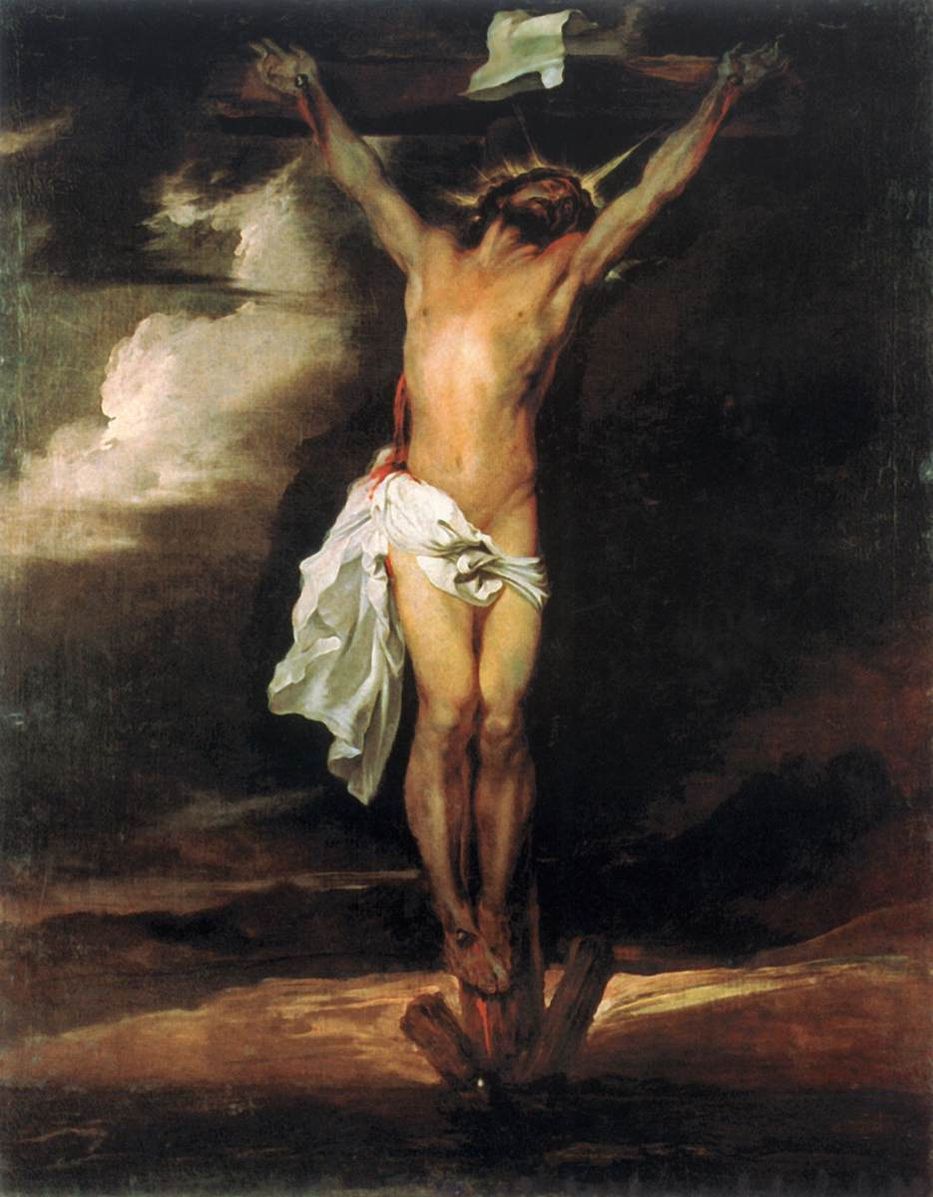
Credit: Anthony van Dyck, 1622
Last weekend at the church where I served, we talked about Jesus’ audacious claim that faith in Him and Him alone is the way to salvation. “I am the way and the truth and the life,” Jesus says. “No one comes to the Father except through Me” (John 14:6).
The truth that salvation is through faith in Christ alone raises a perennial theological question – one that, once again, came to my attention in an email I received after last weekend’s services: If people can be saved only by faith in Christ, how were those people who lived before Christ saved?
At the heart of this question lies an assumption – that people before who lived before Christ were somehow saved in a different way than those who lived after Him. The apostle Paul, however, would beg to differ. He points to one of the most famous characters in the Old Testament, Abraham, and specifically asks the question, “How was Abraham saved?” His answer is unmistakably clear:
Consider Abraham: “He believed God, and it was credited to him as righteousness.” Understand, then, that those who believe are children of Abraham. The Scripture foresaw that God would justify the Gentiles by faith, and announced the gospel in advance to Abraham: “All nations will be blessed through you.” So those who have faith are blessed along with Abraham, the man of faith. (Galatians 3:6-9)
Paul announces, “Here is how Abraham, perhaps the most famous character in the Old Testament, was saved: by faith.” How does Paul know this? Genesis 15:6, of course: “Abram believed the LORD, and He credited it to him as righteousness.” Importantly, Paul says that God “announced the gospel in advance to Abraham.” In other words, before Jesus came to save sinners, God announced that Jesus would come to save sinners. For example, the prophet Isaiah, some 700 years before Jesus’ advent, speaks of a servant who will be sent by God to take away the sins of the world:
Surely He took up our infirmities and carried our sorrows, yet we considered Him stricken by God, smitten by Him, and afflicted. But He was pierced for our transgressions, He was crushed for our iniquities; the punishment that brought us peace was upon Him, and by His wounds we are healed. (Isaiah 53:4-5)
So how were people saved, forgiven, and made righteous before Jesus? By believing that Jesus would come to save, forgive, and make them righteous. How are people saved, forgiven, and made righteous now? By believing that Jesus has come to save, forgive, and make them righteous. In other words, people both before Jesus had come and now that Jesus has come are saved in the same way. They are saved by Jesus.
Oftentimes, people harbor a misconception that people who lived before Christ were saved by following God’s Law while people living after Christ’s advent are now saved through faith in Him. Nothing could be further from the truth. People have always and only been saved by Jesus Christ and His work, even as Jesus Himself says: “I am the way and the truth and the life. No one comes to the Father except through Me.” God’s gospel has always been the only plan for our salvation.
If your life is anything like mine, plans are constantly changing. While writing this blog, I had to move an appointment because things on my calendar changed. Last week, as I was coming home from a trip to Dallas with some friends, we got a flat tire and plans, due to circumstances beyond our control, changed – we got home later than we expected. Plans are constantly changing. And oftentimes, it can be frustrating.
The promise of the gospel is that even if our plans change, God’s plans are sure and certain. The plan for our salvation always was, is, and will continue to be Jesus. There’s no need to look for another plan.
Thoughts on Christianity and Secularism
 It’s hard to deny that secularism is on the ascendency in America. Indeed, even if one points to the fact that roughly the same number of adults believe in God now as did in 1947, secularism’s intellectual and cultural capital in broader society has steadily increased. As James Davison Hunter deftly notes, the raw numbers of a thing don’t always indicate the influence of a thing. He explains:
With cultural capital, it isn’t quantity but quality that matters most. It is the status of cultural credentials and accomplishment and status is organized between the “center” and the “periphery.” The individuals, networks and institutions most critically involved in the production of a culture operate in the “center” where prestige is the highest, not on the periphery, where status is low.
And so, USA Today may sell more copies of newspapers than the New York Times, but it is the New York Times that is the newspaper of record in America because it is at the center of cultural production, not the periphery, and its symbolic capital is much higher.[1]
Secularism’s proponents may not be large in number, but a great number of them are certainly at the center of our cultural production. And they are working hard to move Christians to the periphery. Even more, secularists are working hard to shift the center of Christianity itself to something that is closer to their way of thinking, even if it is not in perfect alignment with it. This is why there are great numbers of what could be called “secular Christians” who, though they may pay certain homage to the artifacts of their faith, are largely either politely mute or openly in disagreement with much of what historic Christianity confesses.
So how are Christians who are more traditionally orthodox in their confessions to respond?
In my sermon two weeks ago, I outlined three ways that Christians have sought to respond to secularism’s inroads over the past few decades. They are worth rehearsing here.
The first is that of capitulating. There are some Christians who, be it happily or reticently, capitulate to many of secularism’s tenets. These are the “secular Christians” of whom I spoke above. So, for example, one of secularism’s primary tenets is tolerance, or, stated more forcefully, relativism. In secularism’s creed, one religion’s claims cannot be truer than another religion’s claims unless, of course, that religion’s claims conflict with the claims of secularism. Christians who capitulate to the secular tenet of tolerance may speak of their personal path to God as through Christ, but will deny that Christ’s claims are exclusively true for everyone. There must be other, equally true, paths available to these people. These Christians thus capitulate to secularism’s tenets of tolerance and relativism.
The second response to secularism’s inroads is that of cloistering. There are some Christians who, horrified at secularism’s ascendency, immerse themselves in a Christian culture that breezily and probably unknowingly separates itself from broader culture with its many secular entailments by creating its own subculture. The Christians listen to Christian music, read Christian books, and frequent Christian businesses while looking with skepticism at what they perceive to be the irreversible corruption of broader cultural trends. They cloister themselves off in hopes of maintaining more “traditional” values.
The third response to secularism’s inroads is that of conquering. Christians who conquer are fully engaged in what is popularly known as “the culture wars,” launching a virulent apologetic against everything from abortion to gay marriage to Hollywood. They hope that if they can just take these institutions – as well as their sympathizers – down, usually by political means, a sanctified sanity will be restored to the culture-at-large.
I must say that I am largely disappointed by all three of these strategies for stemming secularism’s tide. I think each of these strategies, though they may have certain useful elements that should be retained, are largely ineffective and theologically anemic. Indeed, Scripture already outlines a strategy for engaging secularism in all its forms and with all its tentacles – that of converting. Simply stated, Christians are to seek opportunities to present Christ’s claims to as many as possible so that as many as possible – including secularists – may come to faith.
One of my favorite insights concerning secularism and conversion comes from Søren Kierkegaard, who wrote:
The world and Christianity have completely opposite conceptions. The world says of the apostles, of the Apostle Peter as their spokesman, “He is drunk,” and the Apostle Peter admonishes, “Become sober.” Consequently the secular mentality considers Christianity to be drunkenness, and Christianity considers the secular mentality to be drunkenness. “Do become reasonable, come to your senses, try to become sober.” Consequently the secular mentality considers Christianity to be drunkenness, and Christianity considers the secular mentality to be drunkenness.[2]
Here, Kierkegaard uses Peter’s speech in Acts 2 as a case study in just how far apart secularism and Christianity really are. Somewhat hyperbolically, Kierkegaard says they “have completely opposite conceptions.” So how does Peter counter the “completely opposite conception” of the secularism of his day? In Kierkegaard’s paraphrase, he admonishes the secularists, “Become sober.” In the Bible’s text, he says:
“Repent and be baptized, every one of you, in the name of Jesus Christ for the forgiveness of your sins. And you will receive the gift of the Holy Spirit. The promise is for you and your children and for all who are far off – for all whom the Lord our God will call.” (Acts 2:38-39)
Peter calls for conversion. And “those who accepted his message were baptized, and about three thousand were added to their number that day” (Acts 2:41).
Peter’s call to conversion, it seems, worked. Perhaps his call still ought to be our strategy – no matter how secular our age.
__________________________________
[1] James Davison Hunter, To Change The World (New York: Oxford University Press, 2010), 37.
[2] Cited in Lee C. Barrett & Jon Stewart, Kierkegaard and the Bible: The New Testament (Burlington, VT: Ashgate Publishing Company, 2010), 89, ftn. 62
Why Fifty Shades of Grey is Black and White
 Coming to a theatre near you this Friday, just in time for Valentine’s Day: 110 minutes of expectation and titillation wrapped in the package of a movie based on a best-selling novel. E.L. James’ Fifty Shades of Grey has been widely panned by literary critics. Jesse Kornbluth, writing for the Huffington Post, admits, “As a reading experience, Fifty Shades of Grey is a sad joke, puny of plot, padded with conversations that are repeated five or six times and email exchanges that are neither romantic nor witty.”[1] A quick tour through a few of the novel’s more infamous lines quickly reveals just how bad the writing really is:
- His voice is warm and husky like dark melted chocolate fudge caramel…or something.
- My subconscious is furious, medusa-like in her anger, hair flying, her hands clenched around her face like Edvard Munch’s Scream.
- Finally, my medulla oblongata recalls its purpose. I breathe.[2]
If you think the line, “Finally, my medulla oblongata recalls its purpose, I breathe” makes for a good novel, in the timeless words of the professor from Waterboy, “There’s something wrong with your medulla oblongata.” I’ve never read either of these authors, but something tells me E.L. James makes Danielle Steele look downright Shakespearean. Something also tells me that when James was writing her novel, clicks on Thesaurus.com went through the roof. Yet, over 10 million copies of this stilted, silly prose have been sold worldwide.
In all honesty, though the awful writing really does bother me, there is a much more sinister side to Fifty Shades of Grey – something that deserves serious theological reflection. This novel unashamedly, unabashedly revels in its sexual depravity. It is a sick foray into all sorts of sexual sin. Some reviewers have gone so far as to call it “mommy porn.”[3] The overarching plot line explores the sexually abusive relationship between a wealthy 27-year old entrepreneur named Christian Grey and a 21-year old college senior named Ana Steele. Christian warns Ana that he is not “a hearts and flowers kind of guy” and introduces her to his room full of BDSM toys. It is their masochistic sexual encounters that form the meat of the novel. Indeed, reports indicate that in the 110-minute movie version, over 20 minutes are devoted to sex scenes.[4] And people have worked themselves into a flurry of anxious anticipation to see them.
Let me cut through the grey and be black and white for a moment: You should not go see this movie. You should not read the book. That’s the bottom line of this blog. You don’t need to encounter the explicit contents of this book and movie firsthand to know its implications are evil. Allow me to give you three reasons why I believe this.
1. Fifty Shades of Grey robs people – and especially women – of their dignity.
I myself do not know all the illicit details of the sexual encounters between Christian and Ana, nor do I care to. But I do know that BDSM – whether it be in a novel, in a movie, or in real life – is an affront to basic human dignity. Tying up another person and calling them all sorts of nasty names, as is common in these types of sexual encounters, cannot be anywhere near what God had in mind when He designed sex so “two [could] become one flesh” (Genesis 2:24). In fact, the description of the righteous woman in Proverbs 31 haunts me as I think about the relationship peddled by this book: “Strength and dignity are her clothing, and she laughs at the time to come” (Proverbs 31:25). Ana is robbed of both her strength and dignity in this story. May what is fiction never become what is reality.
One additional note on this topic: even if you are married and trust each other implicitly, BDSM still degrades the divine design for human sexuality. It simply does not square with what Paul writes concerning the marital relationship: “Husbands, love your wives and do not be harsh with them” (Colossians 3:19). Sex and marriage need tenderness.
2. Fifty Shades of Grey portrays people as little more than the sum of their desires.
Somehow, we have bought into this myth that if we do not indulge whatever sexual desires, fantasies, dreams, or fetishes we might have, we are not being true to ourselves. We are repressing ourselves. First, allow me to say a word about our feckless use of the word “repression.” Repression is when a person pushes something – usually a memory – out of their conscious awareness as a defense mechanism against the pain it causes. Repression often requires psychological help. Suppression, on the other hand, is when a person consciously chooses not to indulge a particular appetite. Repression is almost always dangerous. Suppression, on the other hand, can often be good. For example, I have often desired to try to take out the 72-ounce steak at the Big Texan Steak Ranch in Amarillo, but I have suppressed myself. Why? Because there is no way that would be good for me. I also sometimes desire to sleep in rather than to get up early to work out. But I suppress my sleep and get up. Why? Because I know working out is good for me.
Just because we desire something doesn’t make it good or good for us. This is why the apostle Peter warns: “Dear friends, I urge you, as aliens and strangers in the world, to abstain from sinful desires, which war against your soul” (1 Peter 2:11). You are more than the sum of your desires. And you are most true to yourself not when you’re following every whim and desire, but when you’re following Jesus.
3. Fifty Shades of Grey gives false hope for a happy ending.
Perhaps what disturbs me most about Fifty Shades of Grey is not its graphic descriptions of bizarre sexual encounters, but the arc of the broader plot line over the whole Fifty Shades trilogy. In volume two, Christian and Ana get married. By the end of volume three, the reader learns the couple has two children. Christian, it seems, has been tamed. And even though it’s left unspoken, the emotion of the ending is clear: “And they lived happily ever after.”
Here’s the problem with this ending: if the first part of the story is true, the last part cannot be. The Fifty Shades trilogy tells the story of light being born out of darkness. It tells the story of tender love emerging out of sadomasochism. In real life, however, this does not happen – at least not in the way Fifty Shades presents it. Evil does not wake up one morning and decide, “I’m going to birth something good.” No. Evil begets evil. If you don’t believe me, read up on the doctrine of original sin. The only way for good to emerge from evil is not by evil’s behest, but by evil’s demise. Jesus didn’t come and ask evil to be a little better. He came and nailed it to a cross. There’s where the hope for a “happily ever after” ending is. Not in some accidental stumbling of righteousness out of wickedness.
I hope this is enough – if you were thinking about seeing the movie or reading the book – to stop you. Researching the story and thinking through its repercussions is certainly enough for me. And I also hope this is enough – if you’re trapped in a real-life abusive relationship – for you to get the help you need to get out. You’re too fearfully and wonderfully made not to.
_______________________________
[1] Jesse Kornbluth, “‘Fifty Shades Of Grey’: Is The Hottest-Selling Book In America Really Just ‘S&M For Dummies?’” Huffington Post (3.12.2012)
[2] Brenton Dickieson, “50 Shades of Bad Writing,” A Pilgrim in Narnia (9.21.2012).
[3] Julie Bosman, “Discreetly Digital, Erotic Novel Sets American Women Abuzz,” The New York Times (3.9.2012).
[4] Jess Denham, “Fifty Shades of Grey movie banned in Malaysia for being ‘more like pornography than a film,’” The Independent (2.5.2015).
Following Jesus Day By Day
 I’ve watched the scenario play out again and again. A young Christian man is climbing the ladder of success. But then something snaps. The trappings of success begin to strangle his heart. And he decides to give it all up. His job. His house. His source of income. Traditional means of supporting his family. He gives it all up and announces, “I am going to stop trying to manage, control, and plan for everything my life and just follow Jesus one day at a time.”
Now, on the one hand, I respect and admire this deeply. This kind of decision brings into crystal clarity the trappings of an affluent life. The truth is, we don’t need the stuff we have. And when we treat it like we do need it, we break the First Commandment. We turn the stuff we have into an idol we trust.
In his book Radical, David Platt paints a picture of an Asian house church that haunts me:
Despite its size, sixty believers have crammed into it. They are all ages from precious little girls to seventy-year-old men. They are sitting either on the floor or on small stools, lined shoulder to should, huddled together their Bibles in their laps. The roof is low, and one light bulb dangles from the middle of the ceiling as the sole source of illumination.
No sound system.
No band.
No guitar.
No entertainment.
No cushioned chairs.
No heated or air-conditioned building.
Nothing but the people of God and the Word of God.
And strangely, that’s enough.
God’s Word is enough for millions of believers who gather in house churches just like this one. His Word is enough for millions of other believers who huddle in African jungles, South American rain forests, and Middle Easter cities.
But is His Word enough for us?[1]
I sure do hope His Word is enough for us. Because if it’s not, the Church has lost her foundation, her purpose, her uniqueness, and her hope. God’s Word must be enough.
I say all this so that you do not misunderstand what I am about to write.
I have no inherent problem with people who want to follow Jesus day by day with nothing but the shirts on their backs. I am concerned, however, that the impetus for following Jesus in this way is sometimes based on a misreading of what Jesus actually says. When it comes to trusting Jesus day by day, Jesus explains:
Therefore I tell you, do not worry about your life, what you will eat or drink; or about your body, what you will wear. Is not life more important than food, and the body more important than clothes? Look at the birds of the air; they do not sow or reap or store away in barns, and yet your heavenly Father feeds them. Are you not much more valuable than they? Who of you by worrying can add a single hour to his life? And why do you worry about clothes? See how the lilies of the field grow. They do not labor or spin. Yet I tell you that not even Solomon in all his splendor was dressed like one of these. If that is how God clothes the grass of the field, which is here today and tomorrow is thrown into the fire, will He not much more clothe you, O you of little faith? So do not worry, saying, “What shall we eat?” or “What shall we drink?” or “What shall we wear?” For the pagans run after all these things, and your heavenly Father knows that you need them. (Matthew 6:25-32)
Jesus is clear. We need not worry about tomorrow. Tomorrow will take care of itself.
There is a difference, however, between worrying about tomorrow and planning for tomorrow. One is discouraged. The other is encouraged. Jesus tells a story about ten virgins who bring oil lamps waiting for a groom to show up for a wedding party. But five of the ten did bring enough oil for their lamps. Do you know what Jesus calls those five? “Foolish” (Matthew 25:3). Why? Because they did not plan. The book of Proverbs includes admonitions to plan (Proverbs 21:5; 24:27; 27:23-27) and God Himself plans (Jeremiah 29:11-13). Jesus’ ministry is intricately planned as can be seen from His passion predictions (Matthew 16:21; 17:22-23; 20:17-19; Mark 8:31; 9:31; 10:32-34; Luke 9:18-22, 9:44, 18:31-33) and His training of the disciples for the mission of the Church (Matthew 4:19). Thus, not worrying about tomorrow does not preclude planning for tomorrow.
So, to my friends who have jettisoned plans to follow Jesus day by day, I say, “Blessed are you.” But remember that a time may come when planning, once again, becomes salutary. And if you’re worried that your plans may somehow be out of step with God’s will, you do not need to be afraid. After all, “Many are the plans in a man’s heart, but it is the LORD’s purpose that prevails” (Proverbs 19:21).
If your plans go awry, the Lord will get you back on track. He has promised to. You can plan on it.
_____________________________________
[1] David Platt, Radical: Taking Back Your Faith From the American Dream (Colorado Spring: Multnomah Books, 2010), 26.
Must Christianity Change or Die?

Credit: Rudy Tiben
Sometimes, it can feel as though the sky is falling and the bottom is dropping out all at the same time. It seems like I can go barely a day without reading a dire report on church attrition, especially among the younger generation. Between high school and turning 30, 43 percent of once-active young adults stop attending church.[1] As of 2012, almost one-third of young adults were unaffiliated with a religious institution.[2] In one survey, researchers found that nearly one-third of young adults left the Christian faith because of its “negative teachings” related to gays and lesbians.[3]
Such gloomy statistics lead to predictable calls to fix the Church by changing its teachings, lest the next generation, discontent with the Church’s antiquated morals, leave her altogether. Take, for instance, this call from popular Christian blogger Rachel Held Evans:
Young adults perceive evangelical Christianity to be too political, too exclusive, old-fashioned, unconcerned with social justice and hostile to lesbian, gay, bisexual and transgender people …
Young evangelicals often feel they have to choose between their intellectual integrity and their faith, between science and Christianity, between compassion and holiness …
The evangelical obsession with sex can make Christian living seem like little more than sticking to a list of rules, and … millennials long for faith communities in which they are safe asking tough questions and wrestling with doubt …
What millennials really want from the church is not a change in style but a change in substance.[4]
Evans’ last line is striking to me. In response to changing cultural norms, Evans maintains that the Church must change the substance of her message. In the words of the famed Episcopalian bishop John Shelby Spong, “Christianity must change or die.”[5] How must Christianity change? Evans offers some suggestions:
We want an end to the culture wars. We want a truce between science and faith. We want to be known for what we stand for, not what we are against.
We want to ask questions that don’t have predetermined answers.
We want churches that emphasize an allegiance to the kingdom of God over an allegiance to a single political party or a single nation.
We want our LGBT friends to feel truly welcome in our faith communities.
We want to be challenged to live lives of holiness, not only when it comes to sex, but also when it comes to living simply, caring for the poor and oppressed, pursuing reconciliation, engaging in creation care and becoming peacemakers.
Evans’ words here are fascinating – and confusing – to me because, understood one way, they are commendable, orthodox, and necessary. But understood another way, they are deeply troubling. For instance, if a “truce between science and faith” means understanding the respective spheres of each and welcoming scientific discovery while at the same time remaining faithful to Scripture’s narrative, I’m onboard. If, however, it means dumping the historicity of Scripture’s creation account, I’m troubled. If having “our LGBT friends feel truly welcome in our faith communities” means showing love, compassion, and going out of our way to listen and learn from the LGBT community, I’m more than all for it. If it means calling what is sinful, “just,” I’m troubled. Sadly, I can’t help but think that, all too often, it’s the latter understandings of these statements that are insinuated. Otherwise, it is feared, a whole generation of young people will leave the Church.
But is this really the case?
Take Rob Bell. Here is a man who has, at least in part, bought into Spong’s motto, “Christianity must change or die.” In his book, What We Talk About When We Talk About God, Bell asks candidly, “Can God keep up with the modern world?”[6] He fought to build a community – Mars Hill Church in Grand Rapids – that would lead the way in this new Christianity. Until he left. In an interview with Oprah, he says his Sunday mornings are now regularly filled with he and his 13-year-old son surfing.[7] Rob Bell was leading a changed church. But even a changed church wasn’t enough to keep Bell around. And he isn’t the only one.
For decades now, churches that have changed the substance of the Christian faith have not been gaining members, but losing members. And now, even as young people are leaving traditional churches, they are not joining these changed churches. They are leaving altogether.[8]
It would seem that if a church is willing to “get with the times,” so to speak, and embrace our culture’s zeitgeist, its pews should be filled to overflowing with the ranks of the enlightened, all breathing a collective sigh of relief that, finally, the offensive, narrow, bigoted Christianity of yesteryear has been relegated to the scrap heap of history. But this has not happened.
The problem with changing the faith of the Church – even the parts of the faith that are not particularly palpable to our modern ears – is that such changes inevitably displace Christianity’s eschatological hope with an evolutionary drum.
What do I mean?
Whether it’s the so-called “war” between science and faith, or the question of gay marriage, or the role of politics in faith, many Christians have simply traded one side of Rachel Held Evans’ despised culture war for the other. They desire to evolve beyond what they perceive as a restrictive, judgmental, intellectually archaic Christian faith. So they laugh at those who take Genesis’ creation account historically, or cry “bigotry” against those who express concern with gay marriage, or look down on those who argue for a more traditionally moral politics. These are old ways that must be done away with, they think.
But what happens is that they become so animated by grievances from the past and trying to right them right now that they forget about – or at least relegate to the background – any sort of ultimate hope for the future. They wind up fighting for a certain kind of culture rather than finding their hope in a different type of Kingdom. They become so obsessed with what’s next that they forget about what’s last.
When you dispel the Christian faith down to nothing more than a fight for this or that cause célèbre, more often than not, you end up with nothing – or at least with nothing that can’t be found elsewhere. And why would anyone go somewhere for something they can get anywhere? This is why changing Christianity’s substance doesn’t gain people; it only loses them.
So what course of action can a Christian take? In a world full of cultural convolution, Christianity’s answer is elegantly simple: “Stand firm in the faith … Do everything in love” (1 Corinthians 16:13-14). Don’t change the faith. Love others. That’s it. And really, who can improve on that? Some things don’t need to change.
_____________________
[1] Melissa Stefan, “Have 8 Million Millennials Really Given Up on Christianity?” Christianity Today (5.17.2013).
[2] Vern L. Bengtson, Families and Faith: How Religion is Passed Down Across Generations (New York: Oxford University Press, 2013), 148.
[3] “A Shifting Landscape: A Decade of Change in American Attitudes about Same-Sex Marriage and LGBT Issues,” Public Religion Research Institute (2.26.2014).
[4] Rachel Held Evans, “Why millennials are leaving the church,” cnn.com (7.27.2013).
[5] John Shelby Spong, Why Christianity Must Change Or Die (San Francisco: Harper Collins, 1999).
[6] Rob Bell, What We Talk About When We Talk About God (New York: Harper Collins, 2014), 8.
[7] “Super Soul Sunday: Oprah Goes Soul to Soul with Rob Bell,” Oprah.com.
[8] Rod Dreher, “The Dying (No, Really) Of Liberal Protestantism,” The American Conservative (7.25.2013).
Finding Our Place: Navigating Unionism and Sectarianism
 Last week, I was answering some questions for a friend who is studying to become a pastor. His professor had given him two questions for me to answer as part of assignment. One of the questions really struck me: Where do you think Lutheranism fits within the wider Christian community?
This is an important question. After all, for some, it is not evident that Lutheranism does fit within the wider Christian community – at least in a way that encourages engagement with and learning from that community. Last week, I watched with an aching heart as some of my Lutheran brothers in ministry harshly and sometimes sarcastically criticized some of my other Lutheran brothers for engaging with and learning from people outside of my Lutheran community. These criticisms reminded me of how important questions about where Lutherans fit in the Church with a capital “C” really are.
In order to explore these questions, I think it’s important to note the Lutheran identity at its best is a confessional Lutheran identity. The word “confessional” is rooted in the Greek word homologeo, which means, “to say the same thing.” To be a confessional Lutheran, then, means to say the same thing as Jesus and His Word. It means to be devoted to a clear and accurate declaration and explanation of the gospel and sacred Scripture, which, I should point out, can be found in our community’s confessional documents.
When engaging the Christian community at large, this devotion to the gospel and Scripture means two things. First, it means that Lutherans eschew unionism. Unionists are those who conceal differences between Christian communities and pretend that all – or most all – Christians say the same thing about Jesus and His Word. At the same time confessional Lutheranism guards against unionism, however, it also stands against sectarianism. In other words, though Lutherans do not paper over differences between their confession of faith the confessions of other Christian communities, they also celebrate and affirm areas of agreement. Thus, Lutherans are very much a part of the wider Christian community, for they share many of the same theological commitments.
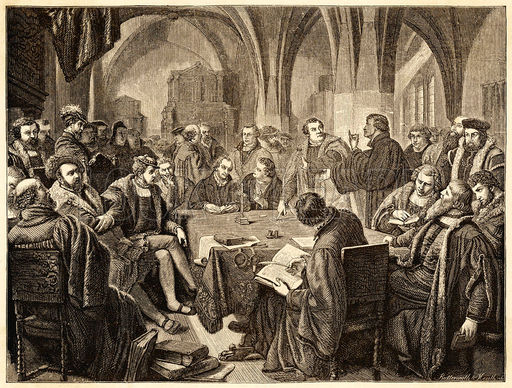
The most famous historical test case for the kind of confessional Lutheranism that abjures both unionism and sectarianism came in 1529 when Martin Luther and Huldrych Zwingli met at Marburg to discuss areas of agreement and disagreement between their two reforming movements. At Marburg, they discovered they agreed on fourteen articles of faith spanning from the nature of the Trinity to justification by faith to the role of governing authorities. But they could not agree on one point: the character of Christ’s presence in the Lord’s Supper. The dispute was formally summarized like this:
We all believe and hold concerning the Supper of our dear Lord Jesus Christ that both kinds should be used according to the institution by Christ; also that the mass is not a work with which one can secure grace for someone else, whether he is dead or alive; also that the Sacrament of the Altar is a sacrament of the true body and blood of Jesus Christ and that the spiritual partaking of the same body and blood is especially necessary for every Christian. Similarly, that the use of the sacrament, like the word, has been given and ordained by God Almighty in order that weak consciences may thereby be excited to faith by the Holy Spirit. And although at this time, we have not reached an agreement as to whether the true body and blood of Christ are bodily present in the bread and wine, nevertheless, each side should show Christian love to the other side insofar as conscience will permit, and both sides should diligently pray to Almighty God that through His Spirit He might confirm us in the right understanding. Amen.[1]
This is a masterful statement. Luther and Zwingli carefully avoid unionism by clearly, winsomely, concernedly, and lovingly explaining where they disagree, but are also in no way sectarian, for they commit themselves to “show Christian love” and “diligently pray to Almighty God that through His Spirit He might confirm us in the right understanding.” In other words, they unreservedly confess their positions while humbly asking the Lord to show them if and where they could be out of step with His Word. Here is confessional Lutheranism at its finest.
In a culture where truth is often either relegated to relativity or regarded as unimportant, confessional Lutheranism has not only much to say, but a time-tested strategy to offer. The ability to stand up for truth against error while also standing with the truth wherever it can be found is sorely needed not only in the Church, but in our world. So, as a confessional Lutheran, I will continue to be honest about areas of disagreement. But I will also never forget to look for areas of agreement. Finally, I will pray that those areas of agreement would continue to increase among others and myself until we all agree with Jesus. For agreeing with Him is what matters most.
__________________________________
[1] Martin Luther, Luther’s Works, vol. 38, J. J. Pelikan, H. C. Oswald & H. T. Lehmann, eds. (Philadelphia: Fortress Press, 1971), 88–89.


 Pastor Zach's Blog