Posts tagged ‘Faith’
Comfort in Stormy Times: Reflections on Hurricane Matthew

The people of Florida are picking up the pieces. Along with the people of Georgia. And the people of the Carolinas. And the people of Cuba. And the people of Haiti. As Hurricane Matthew churned its way through the Caribbean and up the east coast, it left a path of destruction in its wake. In Florida, mandatory evacuations were issued before the storm. Grocery store shelves were stripped bare. Gas stations were pumped dry.
It could have been worse. They eye of Hurricane Matthew skirted much of the eastern seaboard, sparing these regions from what could have been even greater damage. But even if things were not as bad as they could have been, this storm was still a whopper. For a brief time, Hurricane Matthew reached Category 5 status, making it the first storm to reach a hurricane’s most powerful potential since Hurricane Felix in 2007.
Whenever a natural disaster of this magnitude strikes, it presents a unique set of struggles and questions. When we suffer a man-made disaster in a shooting or in an accident or even in a terrorist attack, we can point to the source of the calamity and explain that the person who created the catastrophe is unstable or incompetent or even evil. When a hurricane strikes however, there is no one from whom we can demand a mea culpa, save nature and nature’s God. And such a mea culpa is tough to come by.
So how are we to process this disaster? Here are a few things to keep in mind.
We cannot control everything.
In an election year such as this one, it is easy to live under the illusion that we wield a great amount of power and authority. We do, after all, have a say – even if it is a small one – in who the leader of the free world should be. But for every bit of control we think we have, there are so many things that simply fall outside our hands. Hurricanes are one of these things. We can forecast them, but we cannot steer them. They strike where they may. They strike with the energy that water temperatures give to them. The smallness of our power when compared to the scope of something like the weather should lead us to marvel at the bigness of God’s creation. There is still so much we cannot tame.
We can help others.
Though we do not have power over all things, this does not mean that we can help in some things – like in hurricane relief. My congregation, Concordia Lutheran in San Antonio, has set up a relief fund to help those in Haiti. We are exploring opportunities to help those in other areas as well. You can donate by clicking here. Part of our calling as Christians is to be a neighbor to those in need. Being neighborly need not be constrained by proximity, nationality, economy, or any other earthly barrier. To help others is to love Christ! Rolling up our sleeves by opening up our pocketbooks is a great way to get involved.
There is someone who is in control.
In a world that seems shaky, it is important that we remind ourselves that just because we are not in control does not mean that everything is out of control. Christian theologians will often describe God as omnipotent, a word that means “all power.” In other words, God has all control. When a storm like Matthew strikes, it serves us well to consider the many instances in Scripture that remind us that God, quite literally, guides the weather. In the case of His disciples, Jesus saves them from a storm on the Sea of Galilee by calming it with just a word. In the case of Jonah, God saves him with a storm that forces some sailors he is with to toss him overboard so God can send a giant fish to take the prophet where he needs to be. In the words of the Psalmist, God can also save people through storms as they seek refuge in Him: “God is our refuge and strength, an ever-present help in trouble. Therefore we will not fear, though the earth give way and the mountains fall into the heart of the sea” (Psalm 46:1-2). God, then, does not use storms in the same way in every instance. Sometimes, He saves us from storms as weather patterns change. Other times, he saves us with storms as these trials turn us toward Him. Still other times, He gives us strength to make it through storms, even if they hit us straight on.
Ultimately, it is important to remember that no matter what storms – whether they be literal or figurative – this world may bring, we have assurance in them because of Christ. When Christ was on the cross, the Gospel writers tell us that “darkness came over all the land” (Matthew 27:45). In other words, it stormed. But what looked like a storm of death became a storm that gave way to life three days later. Jesus overcame the storm of the cross so that we would never be lost to the storms caused by sin. For even if a storm takes lives, as did Hurricane Matthew, we can be assured that those who die in Christ go to a place where there is “a sea of glass, clear as crystal” (Revelation 4:6). In other words, in heaven, the weather is a flat calm. There, every storm has been conquered by Christ.
With the extent of the damage from Hurricane Matthew just now becoming clear, there is still a lot – economically, emotionally, and theologically – to sort through. But this much is clear: God does not abandon us in storms like these. He is there. And He cares.
Is Being Christian the Same as Being Religious?

Last week, as I was going for my morning run, listening to music, a song with this lyric started playing on my Pandora station:
I still hate religion. Why you think I’m a Christian?
I’ve heard this distinction between religion and Christianity used before used by pastors, pew sitters, and Christian artists alike. This Christian artist explained the distinction between religion and Christianity as he continued:
The peace between God’s been broke for my sinning.
Religion is man using his good deeds tryin’ to close the distance.
But we could never reach Him,
Only Jesus came to get His men.
Religion, according to this artist’s definition, is people trying to reach God by their works. Christianity, on the other hand, is God reaching people in Christ.
Now, it is most certainly true that trying to reach God by means of your own works – regardless of your religious affiliation – is a futile effort. And it is true that the hallmark of the Christian faith is that rather than waiting for us to reach up to Him, God has reached down to us in the person and work of Jesus Christ. Still, exegetically, this kind of distinction between religion and Christianity troubles me because religion is not so widely panned in the Bible like it is in this song. If you ask the brother of Jesus what he thinks of religion, he will tell you:
Religion that God our Father accepts as pure and faultless is this: to look after orphans and widows in their distress and to keep oneself from being polluted by the world. (James 1:27)
If you ask the apostle Paul about the importance of religion, he will explain:
If a widow has children or grandchildren, these should learn first of all to put their religion into practice by caring for their own family and so repaying their parents and grandparents, for this is pleasing to God. (1 Timothy 5:4)
In both instances, religion is cast in a positive light. Religion, at least according to Scripture, is not always bad.
But my concern with the distinction often drawn between religion and Christianity is not only exegetical. It is also missional.
If a non-believer asks a Christian whether or not he is religious and he responds by saying something like, “No, I’m not religious; I’m a Christian,” he is really doing little more than pulling a bait and switch in his witness. Here’s why.
For most people, the word “religion” carries with it particular connotations. People who attend worship services are religious. People who read holy books are religious. People who pray regularly are religious. And Christians do – or at least should be doing – all these things. So for a Christian to claim that he is not religious sounds like little more than a verbal sleight of hand to an unbeliever. To say that you are not religious because you are a Christian probably sounds to someone who is not a Christian like a distinction without much of a difference.
Rather than quibbling over whether or not Christianity is a religion, perhaps it’s time for us to explain to people who are not religious why we are religious in the way that we are. After all, Christianity, even as a religion, is utterly unique. Most other religions are generally concerned with making people better by means of their own efforts. Christianity, by distinction, is concerned with making people righteous by the merits of Christ’s death and resurrection. The difference in Christianity is not found in whether or not it can be classified as a religion. The difference in Christianity is found in what it confesses about God and His Son, Jesus Christ. This is what we ought to be emphasizing.
Allow me to offer one additional thought on the uniqueness of Christianity. Jesus was clear that people would know who His followers were not because of some semantic game that distinguishes Christianity from religion, but because of their love (John 13:35). Unfortunately, whether they are called “religious” or “Christian,” people who claim to follow Jesus are not always known for their love. They’re known for their self-righteousness. They’re known for their hypocrisy. They’re known for their raging fury at our secularized culture. If this is what believers in Christ are known for, it matters little whether people think we are “religious” or “Christian.” People’s opinion of us, no matter which word is used, will remain negative.
In some instances, a person’s opinion of Christianity may be negative simply because he doesn’t like Christ and His teaching. Jesus Himself taught us to expect hatred from others when He said to His disciples, “If the world hates you, keep in mind that it hated Me first” (John 15:18). Sometimes, we are hated through no fault of our own. But let’s do everything we can to ensure that a person’s opinion of Christianity is negative because of Christ and not because we are acting foolishly, selfishly, arrogantly, and sinfully. Let’s do everything we can to instead be known for our love. Because then, whether people think of us as “religious” or “Christian,” they will ultimately move past us altogether and look to Christ Himself. And that’s the goal. He’s the goal.
The goal is not a game with words. The goal is to point people to the Word.
Terror Hits Brussels: How Should Christians Respond?

It happened again.
Just four days after Paris terror suspect Salah Abdeslam was captured by Belgian law enforcement officials, two coordinated attacks – one at the airport and another on a subway – were carried out in Brussels at approximately 8 am local time. ISIS is taking responsibility for both.
Most of the scenes on the news right now are coming from the airport attack, and the pictures are ghastly. Physicians treating the wounded are describing severe nail injuries, indicating that the explosives were packed with materials designed to inflict maximum injury. As of the posting of this blog, CNN is reporting the provisional death toll at 34: 14 dead at the airport with 20 people killed in the subway bombing. We do not know whether or not the toll will rise.
At a time like this, it is always worthwhile to pause and reflect on how we, as Christians, are called to respond and react to a tragedy such as this. Christians are, after all, in a unique position to respond and react to tragedy, for our very faith was born out of tragedy, as this Good Friday will remind us. Our faith is rooted in “Christ and Him crucified” (1 Corinthians 2:2) – a gruesome thought if left by itself. So here are a few things to keep in mind.
Pray for Brussels
When terrorists attacked Paris, I wrote, “Pray for Paris.” The first thing we should do in an event like this is pray – always. For the vast majority of us, there is no help we can offer Brussels physically – we are not omnipresent. And there is no way we can thwart another attack in this beleaguered city – we are not omnipotent. So we must entrust Brussels and its future to the One who is omnipresent and omnipotent. We must entrust Brussels and its future to the One who can actually help. Such is the power of prayer. It not only offers real help to hurting people because it turns to a God who is in the business of helping hurting people, it also grows our faith when we cannot take charge of a situation like this because it teaches us to trust the One who is in charge of every situation like this.
Mourn for Brussels
The old saying goes, “Familiarity breeds contempt.” We have become all too familiar with terror attacks. With another one in the news this morning, although we may not be tempted to become outright contemptuous of what has happened, we may be tempted to respond to it with a mild dismissiveness. We see. We react with a bit of a groan. And we move on. I would encourage us to saunter at the scenes from Brussels for a bit. Look at the damage done at the airport. Look at the horrified faces of the people escaping from a bombed subway car. And grieve. Terror may be common nowadays, but that shouldn’t make it any less tragic in our hearts and minds. What has happened in Brussels is worth our grief. It is worth our sadness. It is worth our pain. We worship a Savior who shares in all our pain. He never passes us by “on the other side” (Luke 10:31). We should be willing to share in each other’s pain as well. For when we do, we “carry each other’s burdens” (Galatians 6:2).
Hope for Brussels
Christianity may have been borne out of the tragedy of death, but it is carried forth by the glory of life. This is what this Holy Week is all about – death on a Friday followed by life on a Sunday. The hope we have for Brussels, then, is the hope we have for all the world – that no matter how many people terrorists may kill, they cannot win by death because “death has been swallowed up in victory” (1 Corinthians 15:54). Christ portended our ultimate ends when, on Easter, He conquered His would-be end by walking out of His grave. We now share in the promise that our graves will not be our ends. Resurrection is coming.
One of my favorite Bible stories is the story of Armageddon – that great cosmic battle between good and evil at the end of days. The reason I love it so much is not just because of who wins, but because of how the battle is fought. The forces of evil, John says, are gathered “to the place that in Hebrew is called Armageddon. The seventh angel poured out his bowl into the air, and out of the temple came a loud voice from the throne, saying, ‘It is done’” (Revelation 16:16-17). And that’s the end of the battle. There are no swords drawn. There are no bullets fired. There are no bombs dropped. The forces of darkness combine to bring their worst. But they are no match for God’s simple declaration: “It is done.” In Greek, the declaration is just one word: gegonen. It turns out that even just one little word, to borrow a phrase from Martin Luther, really can fell Satan and his sympathizers.
We live in a world where deranged terrorists wage twisted jihad. But as Christians, we hope for a kingdom where battles are not won by an armed detachment, but by a divine decree: “Gegonen.” “It is done.”
And it will be.
Christianity, Culture, and Comparison
 There can be little doubt that Christianity is losing its place of primacy in American culture. According to a survey conducted last year by the Pew Research Center, Americans are becoming increasingly less religious and less willing to affiliate themselves with any particular religious tradition. As The Washington Post reports:
The “nones,” or religiously unaffiliated, include atheists, agnostics and those who say they believe in “nothing in particular.” Of those who are unaffiliated, 31 percent describe themselves as atheists or agnostics, up six points from 2007.[1]
A six-point increase of the religiously unaffiliated in eight years is not only statistically significant, it is an irreligious coup d’état. Consider this, also from The Washington Post: “There are more religiously unaffiliated Americans (23 percent) than Catholics (21 percent) and mainline Protestants (15 percent).”
Even among those who self-identify as religious, identifying as a faith does not necessarily correlate to the practice of that faith. One of the most striking demographic factoids of this presidential election cycle has been how evangelicals who attend church more frequently differ substantially in their candidate preferences from those who attend church less frequently.
Clearly, the religious terrain of America is experiencing tectonic shifts. What was once America’s so-called “moral majority” is now an apprehensive minority. So what is the way forward?
Myriads of options have been proposed and tried. Some people want to fight the secularizing spiral of American culture while others are more amicable to bargaining with and even capitulating to it. Still others, such as Rod Dreher, argue for a limited withdrawal from American culture, eschewing what they see as the culture’s inherently dangerous facets and foci. In many ways, these tensions and postures toward the broader culture are nothing new, as a read through H. Richard Niebuhr’s famous book, Christ and Culture, will reveal.
As worthy of discussion as all of these options may be, in this post, I would propose that it is just as important that we look at what we should not do as it is that we look at what we should do. Here’s why.
At the root of our anxiety over shrinking Christian cultural influence is our penchant to compare. We look at the political arena and we notice that we don’t wield the power we once did. And we compare the influence we had to the power we have. Or we look at demographic studies and we begin to notice that non-believers are on the increase while we’re on the decrease. And we compare the assembly of the despisers to the flock of the convinced.
Martin Luther has some great guidance when we are tempted toward comparison:
They surpass us by so many thousands, and all that we have seems to recede into nothing. But do not compare yourselves with them. No, compare yourselves with your Lord, and it will be wonderful to see how superior you will be … They would easily overcome us, but they cannot overcome that Christ who is in us.[2]
Comparing ourselves with the world as a starting place for responding to the world is dangerous business. It can lead us to an arrogant triumphalism if the world seems to be persuaded to our side. But it can also lead to an angry despair if the world rejects us. It is little wonder that the apostle Paul once wrote, “We do not dare to classify or compare ourselves with some who commend themselves” (2 Corinthians 10:12). If we are to compare ourselves with anyone or anything, it should be with the One who reminds us that even if we are a “little flock” in this age (Luke 12:32) – with little power, little influence, and little prestige – we are a “multitude that one one can count” (Revelation 7:9) in the next.
What strikes me about so many of our responses to Christianity’s diminishing cultural influence is not that they are wrong per se, but that they flow from the wrong place – they flow from anxious comparisons that grumble over Christianity’s diminishing cultural capital rather than from faith in Christ’s commandments and promises.
Perhaps it’s time to work less out of fear and more out of faith. Perhaps it’s time to stop comparing and start trusting – not because the decline of Christianity isn’t sad, but because the victory of Christ is certain.
_________________________
[1] Sarah Pulliam Bailey, “Christianity faces sharp decline as Americans are becoming even less affiliated with religion,” The Washington Post (5.12.2015).
[2] Martin Luther, Luther’s Works, vol. 30 (St. Louis: Concordia Publishing House, 1967), 289
Pain, Suffering, and Morality
 I’ve been doing a fair amount of thinking lately on suffering and its effect on faith. In one way, I can’t help but believe and even assert that there is every reason to question God in the face of great suffering. Elie Wiesel’s gut-wrenching account of his time in a Nazi concentration camp comes to mind not only as a natural response to pain and suffering, but as a needed one:
Never shall I forget that night, the first night in camp, that turned my life into one long night seven times sealed. Never shall I forget that smoke. Never shall I forget the small faces of the children whose bodies I saw transformed into smoke under a silent sky. Never shall I forget these flames that consumed my faith forever.[1]
Elie’s description of his first night in a concentration camp should arouse in us nothing other than horror, grief, and sympathy. Although I don’t know precisely how I would react to such an experience, I would be naïve to think that Elie’s reaction could never be my reaction. The scene is just too jarring. The brutality is just too disgusting. The deaths are just too agonizing. I too could question God.
And yet…
Some did not respond to the concentration camps the way Elie Wiesel did. One survivor of the camps, Alex Seidenfeld, in an interview with the Associated Press, said simply, “We stayed alive. We survived. How could this have happened without the almighty?”[2]
Elie looked at all those who died and asked, “How can God be?” Alex looked at all those who survived and asked, “How can God not be?” Elie looked at all those who died and angrily shouted, “God didn’t stop this!” Alex looked at all those who survived and declared, “But God did save some of us from this!”
The question of where God is in the face of suffering is really a question of God’s role in the midst of suffering. Is God’s role to stop us from suffering or to save us through suffering? In one sense, it is both. But the first role, at least according to Scripture, doesn’t find its full expression until later, at the end of days.
Ultimately, I would argue that, even if God does not stop all suffering, it is difficult to surmise from the existence of suffering that God does not exist. C.S. Lewis famously explains why:
My argument against God was that the universe seemed so cruel and unjust. But how had I gotten this idea of just and unjust? A man does not call a line crooked unless he has some idea of a straight line. What was I comparing this universe with when I called it unjust? … Of course I could have given up my idea of justice by saying it was nothing but a private idea of my own. But if I did that, then my argument against God collapsed too – for the argument depended on saying that the world was really unjust, not simply that it did not happen to please my private fancies. Thus in the very act of trying to prove that God did not exist – in other words, that the whole of reality was senseless – I found I was forced to assume that one part of reality – namely my idea of justice – was full of sense.[3]
C.S. Lewis puts his finger on the reality that the problem we have with suffering is that we believe and perceive that it is, in some sense, wrong. It is unjust. But if we reject God, we lose the privilege of saying that anything is wrong or unjust because, without God and His ordering of the universe, standards of organized morality disappear into the ether of a universe that coalesced around the free-for-all of chance. This world and all that is in it, to borrow a phrase from the famous atheist philosopher Bertrand Russell, is nothing more than “the outcome of accidental collocations of atoms.”[4] In this view, suffering exists in the same way that a ball that lands on black 22 on a roulette wheel exists. It just happens to happen sometimes. There is nothing more to be said about it, at least not morally.
Arguing against a moral God in light of what is perceived to be immoral suffering, then, is an argument that collapses on itself. You can’t argue against God using a framework that has its basis in God. Either suffering just is, or it is somehow just wrong. To question how there can be a good God who allows bad things assumes that, even if implicitly, there is a God and that, in some regard, He is not playing by His own rules, or at least by what we perceive to be His rules. If this is the case, it may be fair to ask Him, “Why?” But, as a Christian, I would propose that it might be even better to ask Him for help. From what I hear, even if God doesn’t always stop suffering, He is quite adept at blessing people in suffering.
_____________________
[1] Elie Wiesel, Night (New York: Hill and Wang, 2006), 33.
[2] Aron Heller, “Observant survivors keep the faith after Holocaust,” The World Post (1.26.2016).
[3] C.S. Lewis, Mere Christianity (New York: Harper Collins Publishers, 1980), 38
[4] Bertrand Russell, “A Free Man’s Worship,” The Collected Papers of Bertrand Russell, vol. 12 (London: Routledge, 1985).
Faith and Morality
 On this blog, I have written at length on moral issues. I believe, quite firmly, that morality has a helpful role to play in the public square and, therefore, moral questions should be discussed and debated and moral standards should be regarded as useful and necessary for and in society. For all my support public morality, however, there is a part of public morality that I find terrifying. Here’s what I mean.
There can be little doubt that the experiment of societal moral relativism has failed. Throwing off the shackles of a transcendent and traditional morality for a culturally conditioned and convenient one that ultimately assumes that there is only amorality never got us Thomas Hobbes’ Epicurean dream. It just left us Adolf Hitler’s Third Reich nightmare. Leviathan, it turns out, wasn’t nearly as competent to do its job as Hobbes thought.
Moral relativism, then, can be quite deadly. It does no society any good because, by definition, it is utterly individualistic. And individuals, left to their own devices, seem to come up with awfully immoral relative moralities. A traditional and transcendent morality is needed to order society in such a way that we do not (A) wind up killing each other, and (B) actually do some things that are helpful for each other. For these reasons, as well as for many others, public morality is needed.
But at the same time a traditional and transcendent public morality is needed, it is also terrifying.
Once a month, I teach a Bible study at a local business. This year, I am working through the book of James when, a while back, I came to these famous words:
What good is it, my brothers, if a man claims to have faith but has no deeds? Can such faith save him? Suppose a brother or sister is without clothes and daily food. If one of you says to him, “Go, I wish you well; keep warm and well fed,” but does nothing about his physical needs, what good is it? In the same way, faith by itself, if it is not accompanied by action, is dead. (James 2:14-17)
As a Lutheran, James’ trumpeting of moral works as important to faith can sometimes arouse in me an almost allergic reaction! As an avid reader of all things Pauline, I know that works do not help faith. Indeed, I know that works can actually be in opposition to faith:
[We] know that a person is not justified by the works of the law, but by faith in Jesus Christ. So we, too, have put our faith in Christ Jesus that we may be justified by faith in Christ and not by the works of the law, because by the works of the law no one will be justified. (Galatians 2:16)
“Faith” and “works,” Paul says, do not mix when it comes to salvation.
Of course, James’ point is not that works somehow help faith when it comes to salvation, but that faith results in works that flow from salvation. A saving faith, James argues, is inevitably an active faith. Indeed, James would go so far to argue that a saving faith that is not an active faith is not even faith. To quote his brother’s words: “By their fruit you will recognize them” (Matthew 7:16). A faith that does not result in moral works does not exist. Such a faith is a myth that belongs on the shelf with unicorns, leprechauns, and that time your mom told you that if you swallow your gum, it will stay in your stomach for seven years.
This is why, at the same time I believe public morality is needed, I am also terrified by it. A faith without moral works is impossible. James says so. Christians should not be frightened, therefore, to declare moral works as “necessary” to faith. What is frightening, however, is that the inverse does not hold true. Moral works may be necessary to faith, but faith is not necessary for moral works. One can be very moral and still be very damned. And herein lies the good and the bad of public morality. Public morality helps others. It may even help you. But it doesn’t help you before God. Only faith can help you before the Almighty.
Even as I continue to argue for the merits of public morality if for no other reason than that I’m not a big fan of the Third Reich, I will continue to serve proudly as a pastor to point people toward faith in Jesus Christ. I like morality that comes from faith a lot better than morality that is divorced from faith. The second morality may be nice for society, but the first receives a “well done” in eternity.
Justice Antonin Scalia: 1936-2016
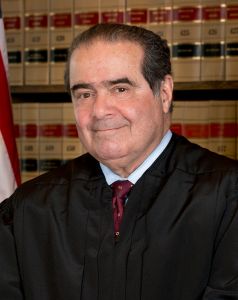 He was a man who combined a first-class intellect with a caustic whit. The world lost not only a legal titan, but a brilliant mind when Justice Antonin Scalia passed away. Sadly, some cheered his death in a macabre display of twisted politically-driven hatred. Others – even those who disagreed with him politically and legally – were far more charitable.
Justice Scalia was fiercely devoted to Constitutional originalism. He defined his originalism this way:
The Constitution that I interpret and apply is not living but dead, or as I prefer to call it, enduring. It means today not what current society, much less the court, thinks it ought to mean, but what it meant when it was adopted.[1]
His originalism came out in many ways, especially in his dissents. His famous 2001 dissent in PGA Tour, Inc. v. Casey Martin, for instance, is the stuff of legend. Mr. Martin was a golfer who wanted to participate in the PGA Tour, but could not because had a degenerative leg disorder that prevented him from walking any considerable distance. PGA rules required golfers to walk all 18 holes. He sued the PGA under The Americans with Disabilities Act. The high court ruled in his favor, noting, contrary to the PGA’s assertion, that using a golf cart does not “fundamentally alter the nature of the competition,” but its majority opinion did not find favor with Justice Scalia who believed the Court should not get involved in defining what does and does not constitute actual golf. In a sarcastic dissent, he wrote:
It has been rendered the solemn duty of the Supreme Court of the United States, laid upon it by Congress in pursuance of the Federal Government’s power “[t]o regulate Commerce with foreign Nations, and among the several States,” U. S. Const., Art. I, §8, cl. 3, to decide What Is Golf. I am sure that the Framers of the Constitution, aware of the 1457 edict of King James II of Scotland prohibiting golf because it interfered with the practice of archery, fully expected that sooner or later the paths of golf and government, the law and the links, would once again cross, and that the judges of this august Court would some day have to wrestle with that age-old jurisprudential question, for which their years of study in the law have so well prepared them: Is someone riding around a golf course from shot to shot really a golfer? The answer, we learn, is yes. The Court ultimately concludes, and it will henceforth be the Law of the Land, that walking is not a “fundamental” aspect of golf.[2]
No other Justice could turn the legal into the comedic the way Justice Scalia did.
At the same time Justice Scalia was a legal scholar, he was also a devoted Catholic. In a speech at a Living the Catholic Faith Conference, he rumbled:
God assumed from the beginning that the wise of the world would view Christians as fools…and he has not been disappointed.…If I have brought any message today, it is this: Have the courage to have your wisdom regarded as stupidity. Be fools for Christ. And have the courage to suffer the contempt of the sophisticated world.[3]
Justice Scalia’s call to endure scoffing from others for the sake of faith in and a witness to the gospel is quintessentially Christian. It is also, I would add, experientially true. After all, Justice Scalia himself had to endure countless questions – not all of which were inappropriate, but many of which were the product of a secular skepticism – about his faith and the ways in which he exercised it.
Of course, Justice Scalia did and does have his supporters – including some of those who most vehemently disagreed with him during his life. In a remembrance penned by Ruth Bader Ginsburg, one of the Supreme Court’s most liberal justices, she wrote of Justice Scalia:
He was a jurist of captivating brilliance and wit, with a rare talent to make even the most sober judge laugh. The press referred to his “energetic fervor,” “astringent intellect,” “peppery prose,” “acumen,” and “affability,” all apt descriptions. He was eminently quotable, his pungent opinions so clearly stated that his words never slipped from the reader’s grasp … It was my great good fortune to have known him as working colleague and treasured friend.[4]
For all of their political and legal differences, these two justices were best friends. And it is here that we find one of Justice Scalia’s most important legacies. Justice Scalia was strongly opinionated. He did not mince words concerning his legal or theological views. There was no question as to where he stood. But at the same time he was intellectually rigorous as a justice and theologically rigorous as a Catholic, he was also relationally generous. He befriended and loved even some of those with whom he vehemently disagreed.
From prostitutes to adulterers to tax collectors to religious elites, there was once another man who behaved similarly. He too could be known for His “peppery prose.” “You snakes! You brood of vipers!” He once thundered, “How will you escape being condemned to hell” (Matthew 23:33)? But the same people He thundered against in His words, He also died for on a cross. He was most certainly intellectually and theologically rigorous. Indeed, he was more: He was intellectually and theologically perfect. But He was – and is – also relationally generous. And somehow, the two went and worked together for us and for our salvation.
Justice Scalia leaves behind an impressive professional legacy. And he will continue to be criticized – sometimes thoughtfully and sometimes angrily – for many things. But beyond his professional legacy is his personal example of how intellectual and theological rigor can go hand in hand with relational generosity. They went hand in hand in him. And in this, Justice Scalia reflected how they go hand in hand in Christ.
At Justice Scalia’s funeral this past Saturday, his son, the Reverend Paul Scalia, began his homily:
We are gathered here because of one man, a man known personally to many of us, known only by reputation to many more; a man loved by many, scorned by others; a man known for great controversy and for great compassion … That man, of course, is Jesus of Nazareth.[5]
In his son’s mind, Justice Scalia’s greatest legacy is found not in what his father accomplished, but in how his father reflected Christ – even if imperfectly. This is why, for Reverend Scalia, Justice Scalia’s funeral was not about Justice Scalia. It was about Jesus.
May we be about Jesus too.
________________________
[1] NPR Staff, “Originalism: A Primer On Scalia’s Constitutional Philosophy,” npr.org (2.17.2016).
[2] PGA Tour, Inc. v. Casey Martin, 532 U.S. 661 (2001) (Scalia, J., dissenting)
[3] Ken McIntyre, “The Wit and Wisdom of Scalia: Nine Zingers,” Newsweek (2.14.2016).
[4] Marina Fang, “Ruth Bader Ginsburg Remembers Antonin Scalia, Her Dear Friend And Sparring Partner,” Huffington Post (2.14.2016).
[5] Julie Zauzmer, “A moving homily for Justice Scalia by his son, Rev. Paul Scalia,” The Washington Post (2.20.2016).
Honor, Dignity, Victimization, and Power
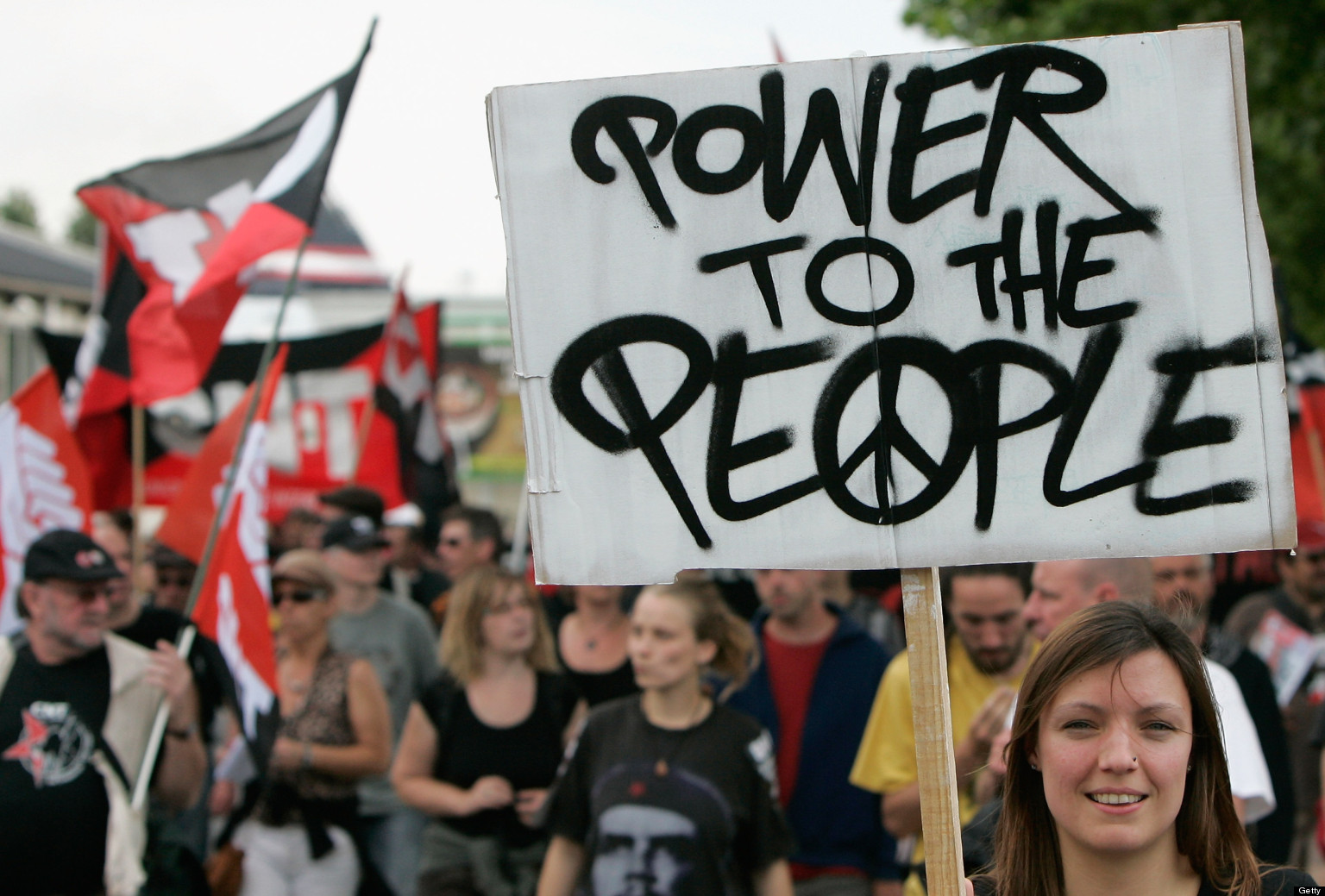
Credit: Franck Prevel/Getty Images
It doesn’t take much to offend people these days. Sometimes, it doesn’t take anything at all. This is what Bradley Campbell and Jason Manning argue in their paper, “Microaggression and Moral Cultures.”
Campbell and Manning cull their definition of what constitutes a microaggression from Derald Wing Sue, professor of counseling psychology at Columbia University. Microaggressions are:
The brief and commonplace daily verbal, behavioral, and environmental indignities, whether intentional or unintentional, that communicate hostile, derogatory, or negative racial, gender, and sexual orientation, and religious slights and insults to the target person or group.[1]
Two things are especially notable in Wing Sue’s definition. First, microaggressions can be either “intentional or unintentional.” What counts is not what a sender intends, but what a receiver perceives. Second, words like “indignities,” “hostile,” and “derogatory” in Wing Sue’s definition cast microaggressions in a vocabulary of victimization. Microaggressions, no matter how pint-sized they may seem, are really part of a broader caste system that relentlessly oppresses certain groups of people. The cry of those who perceive themselves as having been microaggressed, then, is really the cry of those who have been systemically victimized by this system and its cultural and socioeconomic assumptions.
Interestingly, Campbell and Manning argue that, for all the complaining that the microaggressed may do about being victimized, our newfound concern with microaggressions actually encourages a culture of victimization rather than discouraging it:
Victimization [is] a way of attracting sympathy, so rather than emphasize their strength or inner worth, the aggrieved emphasize their oppression and social marginalization … We might call this moral culture a culture of victimhood because the moral status of the victim … has risen to new heights.
In an article for the Atlantic, Conor Friedersdorf cites one example of a blossoming culture of victimization in an exchange between two students at Oberlin College. In the exchange, a white student invites a Hispanic student to a game of fútbol who takes offense at the invitation, writing on an Oberlin blog devoted to calling out microaggressions:
Who said it was ok for you to say futbol? … White students appropriating the Spanish language, dropping it in when convenient, never ok. Keep my heritage language out your mouth![2]
A big blow up and a public shaming over a single word. Welcome to the world of microaggressions.
Of course, things were not always this way. Before there was a culture of victimization, Campbell and Manning point out that there was a culture or honor. In this culture:
One must respond aggressively to insults, aggressions, and challenges or lose honor. Not to fight back is itself a kind of moral failing … Because insulting others helps establish one’s reputation for bravery, honorable people are verbally aggressive and quick to insult others.
After a culture of honor came a culture of dignity, where:
People are said to have dignity, a kind of inherent worth that cannot be alienated by others … Insults might provoke offense, but they no longer have the same importance as a way of establishing or destroying a reputation for bravery. It is commendable to have a “thick skin” that allows one to shrug off slights and even serious insults.
Though vestiges of these cultures of honor and dignity remain (compare Campbell and Manning’s definition of a culture of honor with some of the things Donald Trump has said in his presidential campaign and you’ll quickly realize that even though honor culture is on the decline, it is certainly not dead), they are quickly losing ground to a culture of victimization.
But why?
The answer seems to be “power.” Victimization, in our culture, can often be the fastest track to status and power, just as, in previous ages, honor and dignity were inroads to influence. For instance, in recent clashes over same-sex marriage, many in favor of the institution claim discrimination and victimization while many against same-sex marriage claim discrimination and victimization as well. Both groups hope that, by portraying themselves as aggrieved, oppressed, and victimized, they can engender sympathy and, ultimately, the upper hand in this debate. In other words, both sides are hoping to gain cultural capital, or power, by means of their own victimization.
Certainly, not all instances – indeed, not even most instances – of victimization represent grabs for power. One thinks of those who are sexually assaulted or emotionally abused. Such tragic examples of victimization have nothing to do with power. Rather, they represent grave injustices and deserve our prayers, our sympathy, and our action. But in cases of microaggressions and similar self-declared cries of victimization, for all their claims of powerlessness, they often turn out to be nothing more than cynical means of leveraging power.
It is here that we find that, for all of their differences, the cultural systems of honor, dignity, and victimization hold something in common: they are all means to an end of power. And this is where all of these systems run into trouble.
In His ministry, Jesus sometimes fought for honor, sometimes upheld human dignity, and sometimes embraced victimization. But His goal was not that of gaining power. When Jesus fought for honor, it was the honor of God Himself for which Jesus fought, refusing to allow the religious elites of His day to honor God with their lips while blaspheming Him in their hearts (cf. Matthew 15:8). When Jesus upheld dignity, it was the dignity of the ridiculed and marginalized He championed, like the time He rescued a woman caught in adultery from being stoned (cf. John 8:2-11). And when Jesus allowed Himself to be victimized on a cross, He did so not as a backdoor to power, but in order to ransom us from our sin (cf. Mark 10:45). Jesus, it turns out, picked up on elements from each of these cultures without endorsing the shared goal of all of these cultures. He used honor, dignity, and victimization as ways to love people rather than dominate them.
Like Jesus, His followers should feel free to fight for honor, uphold human dignity, and even see themselves, in some instances, as victimized. But none of these cultural constructs, in the economy of Christ, should be methodically used as mere means to power. Rather, they are to be used to love others.
So for whose honor will you fight? And whose dignity will you champion? And how can your victimization lead to someone else’s restoration? Rather than eschewing these cultural constructs altogether, let’s use them differently. Let’s use them for love. For when we use these things for love, even if we do not gain power culturally, we exercise power spiritually. And that’s a better kind of power anyway.
__________________________________________
[1] Bradley Campbell & Jason Manning, “Microaggression and Moral Cultures,” Comparative Psychology 13 (2014): 692-726.
[2] Conor Friedersdorf, “The Rise of Victimhood Culture,” The Atlantic (9.11.2015).
The Problem with Pep Rallies

Credit: Mark J. Terrill, AP
It’s still thirteen and a half months away, but with the way it’s being covered – and with the ratings that CNN scored last week when it hosted the second of the Republican primary presidential debates – you’d think the presidential election of 2016 was right around the corner.
As we rush headlong into another presidential election cycle, we see all the typical trappings of what have become nothing short of political and journalistic rituals. We have a conservative action group that has launched a set of attack ads against Republican frontrunner Donald Trump. On the Democratic side, controversy has boiled over concerning the relative dearth of Democratic primary debates as compared to the number of Republican primary debates and how this favors Democratic frontrunner Hillary Clinton. As for the media, they are busy fact checking everything every candidate says. And then there are the rallies – the never ending rallies in every state and in what seems to be every American city.
Rallies, of course, are great when a politician wants to solidify his or her base of supporters. Rallies also incite and excite a candidate’s supporters to vote. Rallies, in a democratic election system like ours, are necessities.
Unfortunately, in our culture, we have taken what works well during an election cycle and have applied it, without much critical thought, to many different areas of life, including in our use of social media. Many of the posts I see on social media are meant to rally people who agree with one point of view by belittling and demeaning those who hold a differing point of view. Such posts follow a predictable pattern. First, an article, a meme, or even an out and out diatribe is posted that espouses the utter rightness of one point of view while attacking those who hold an opposing point of view as nothing less than reprobates. Second, people “pile on,” as it were, by posting comments. Third, anyone who dares to disagree with the view expressed in the initial post by posting a critical comment is harangued and attacked. Finally, nothing changes. People who agree with the sentiment expressed in the initial post still agree. And people who disagree still disagree.
We need a better way.
When posting on social media, it is time for us to start asking ourselves a question: in this post, am I trying to rally people or persuade them? The goal of persuasion is, in its strictest sense, to change someone’s mind on a particular position. In a broader sense, persuasion can also seek to engender empathy from someone who disagrees with a particular position. Even if someone does not agree with me on a particular position, I still deeply appreciate it when they at least understand why I think what I think, just as, I assume, other people appreciate it when I understand why they think what they think.
The trouble with persuading people is that it is much more difficult than rallying them. Rallying people usually only needs a stake in the ground and a line in the sand. Persuading people often needs tortured, lengthy nuanced arguments about a particular position. Rallying people can make a person feel good because, when others express agreement with a particular point, the rallier is quickly assured that he or she is not alone. Persuading people can often feel much lonelier because it does not provide a common enemy against whom you and those who agree with you can join forces, but it also does not provide the kind of toleration and capitulation that your opponents might ultimately desire. Rallying people can be done in minutes. After all, social media posts can go viral in nearly no time at all. Persuading people takes relationship building, trust, and, usually, hours, months, and even years worth of conversations. And even then, sometimes, people remain unpersuaded.
All this is to say that I can see the appeal of rallying people around a particular position. And, at times, rallies are necessary and desirable – especially in the face of a heinous evil that will not be persuaded, so it must be defeated. The problem is, as a long-range strategy, rallying doesn’t solve much. It may engender excitement and incite anger. It may get out a vote to defeat an opponent. But it doesn’t change a heart.
We, as Christians, believe there are certain things the world needs to believe. We want the world to be persuaded to believe these things. Thus, particularly as we post on issues that have to do with our faith, we need to eschew the easy way of the rally and instead choose the harder way of persuasion. After all, eternal truth is at stake. And, in many instances, so are people’s souls.
So think before you post. As Christians, we don’t want to just lambast those who might disagree with us, we want to show, with nuanced and thoughtful compassion, why people can, and should, agree with Christ. After all, Christ has persuaded us. Why would we want to do anything less than persuade others?
A County Clerk, Gay Marriage, and What’s Right
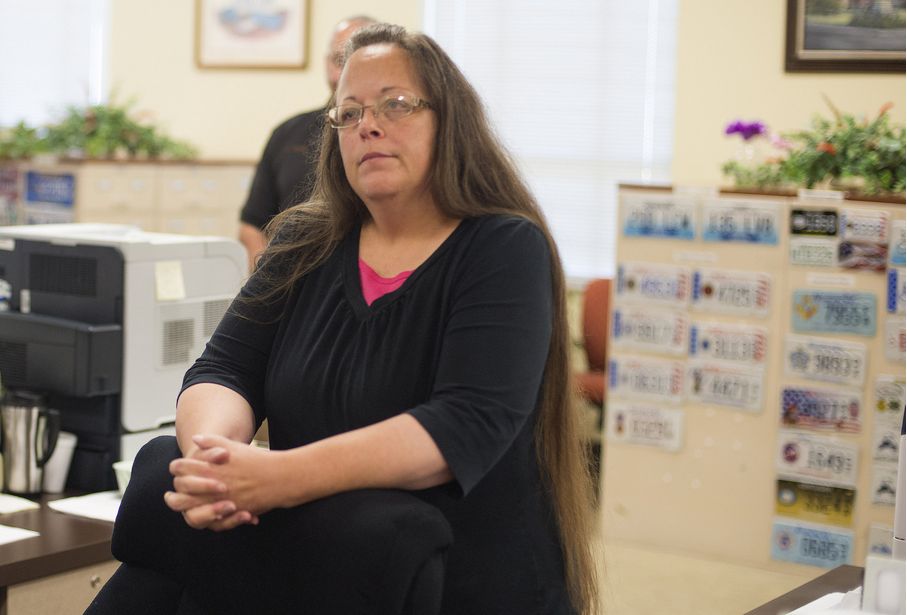
Credit: Ty Wright/Getty Images
It’s not often a small town county clerk becomes a household name. But Kim Davis has managed to pull of just such a feat after going to jail last week for refusing to issue marriage licenses from her office. The Washington Post reports:
The Kentucky clerk drew headlines for refusing to issue marriage licenses to all couples, gay and straight, after the Supreme Court ruled earlier this summer that same-sex couples have the right to marry. An Apostolic Christian, Davis has said it would violate her faith to put her name on a marriage license for two people of the same sex.
She was sued by several gay couples and was ordered by [Judge] Bunning to begin issuing the licenses this week. When Davis defied the judge’s order, the couples asked for Davis to be held in contempt and fined.
But Bunning decided to jail Davis, saying fines would not be sufficient to compel compliance because Davis’s supporters could raise money on her behalf.
“The idea of natural law superseding this court’s authority would be a dangerous precedent indeed,” Bunning said.[1]
Not surprisingly, demonstrators, both in support and in protest of Mrs. Davis, gathered outside the courthouse where she was sentenced:
Ashley Hogue, a secretary from Ashland, held a sign outside the courthouse that read, “Kim Davis does not speak for my religious beliefs.”
“This is so ugly,” she said, wiping away tears. “I was unprepared for all the hate.”
Demonstrator Charles Ramey, a retired steelworker, downplayed the vitriol.
“We don’t hate these people,” he said, holding a sign that read, “Give God his rights.” “We wouldn’t tell them how to get saved if we hated them.”[2]
On the one hand, I am somewhat puzzled why Mrs. Davis, if she could not in good conscience carry out one of the duties for which state taxpayers are compensating her, did not simply resign her position. After all, for Mrs. Davis to refuse to issue marriage licenses not only to same-sex couples, but to all couples, and to make it incumbent on the clerks who work for her to follow suit hardly seems the best way to handle a personal religious objection, as Ryan T. Anderson, a senior research fellow at the Heritage Foundation, makes clear in this thoughtful article. Mrs. Davis explains her reasoning in the USA Today article: “‘If I left, resigned or chose to retire, I would have no voice for God’s word,’ calling herself a vessel that the Lord has chosen for this time and place.” Her explanation begs the question: would she really have no voice for God’s Word if she was not a county clerk? Couldn’t she be a witness for Christ in ways that involve less emotional, political, and rhetorical volatility than refusing to issue marriage licenses? And what does she do when she has to perform other duties that could – and perhaps should – violate her conscience, such as legally licensing divorces for couples who are not splitting for biblically appropriate reasons? I’m not sure I completely understand Mrs. Davis’ thinking.
On the other hand, I am also not unsympathetic to her plight. Here is a government worker who was thrown in jail because she, in her vocation, was seeking in some way to abide by what God’s Word says about sexual boundaries. A Christian theology of work says that no matter what we do, we ought to view ourselves as “working for the Lord, not for men” (Colossians 3:23). Mrs. Davis seems to be trying to put this theological truism into everyday practice. I should also note that she does not appear to have arrived at her practice of refusing to issue marriage licenses lightly. Her conversion to Christianity came on the heels of a history littered by broken marriages and broken hearts. Since her conversion, however, she has maintained a strong stance on biblically informed sexual standards.
This is one of those theologically, ethically, legally, and relationally thorny situations that seems to be increasingly common in our day and age. As Christians, how do we respond? Is Kim Davis right? Or should she resign if she cannot, in good conscience, issue marriage licenses?
In the book of Daniel, we meet a man who, like this county clerk, held a government job. Indeed, he held a very prominent government job. Under the reign of the Persian king Darius, this man Daniel “so distinguished himself among the administrators and the satraps by his exceptional qualities that the king planned to set him over the whole kingdom” (Daniel 6:3). Daniel’s upward mobility, it seems, was virtually limitless until, one day, as he went about carrying out his duties, the laws of the land changed in a way that violated his conscience:
The administrators and the satraps went as a group to the king and said: “O King Darius, live forever! The royal administrators, prefects, satraps, advisers and governors have all agreed that the king should issue an edict and enforce the decree that anyone who prays to any god or man during the next thirty days, except to you, O king, shall be thrown into the lions’ den. Now, O king, issue the decree and put it in writing so that it cannot be altered – in accordance with the laws of the Medes and Persians, which cannot be repealed.” So King Darius put the decree in writing. (Daniel 6:6-9)
As a worshiper of the God of Israel, Daniel could not, in good conscience, follow the king’s edict to pray only to the king – even though he was serving the king as a public official. So what does Daniel do?
Now when Daniel learned that the decree had been published, he went home to his upstairs room where the windows opened toward Jerusalem. Three times a day he got down on his knees and prayed, giving thanks to his God, just as he had done before. (Daniel 6:10)
I have sometimes wondered why Daniel didn’t try to negotiate some sort of compromise. Couldn’t he have stayed downstairs in a private room to pray to the true God rather than going upstairs and kneeling before an open window so everyone below would know exactly what he was doing? Couldn’t he have simply put off praying altogether in order to comply with the edict without committing idolatry against his God? After all, the edict was only in place for thirty days. In this instance, Daniel, according to his conscience, could do neither. He had to live out his faith, even if his faith was in conflict with his vocation as a public official and his status as a citizen of Persia.
You probably know the rest of the story. Daniel’s sentence was not just a jail cell, but a lions’ den. Daniel was willing to go to his death for his confession of faith. But, miraculously, “God sent His angel, and he shut the mouths of the lions” (Daniel 6:22).
It’s not difficult to draw parallels between Daniel’s story and Mrs. Davis’ story, save that we do not yet know how Mrs. Davis’ story will end. For us who are looking on, there are a couple of lessons I think we can take away from Daniel’s story. First, Daniel’s refusal to obey Darius’ edict had nothing to do with a political victory and everything to do with theological fidelity. I fear that, all too often, we can prioritize the politics of an issue like gay marriage specifically over a biblical theology of what marriage is generally. Any stand that we make must never be simply for the sake of winning a political battle, but for the sake of staying true to God’s Word. If people perceive that our theology is being leveraged merely as a means to political power, they have every right to be cynical of us and even angry at us. I’m fine if people, as I’m sure they did when Daniel was willing to be thrown to the lions, question our sanity, but we must never give people a reason to question our spiritual sincerity. Second, Daniel served and supported his governing authorities in every way he could until he couldn’t. This couldn’t have been easy for him. The Persians, after all, were pagans who shared none of Daniel’s theological commitments. But rather than fighting them, Daniel supported them in his work. He took a contrarian stand only when it was theologically necessary. I worry that, because of the deep suspicion and animosity that plagues our political system, we have become so devoted to fighting with each other on every front that we have lost our ability to take credible stands on the most important fronts. This is not to say that we can never be engaged in the political process – we do live in a democratic republic, after all – but it is to say that our governing authorities are first and foremost gifts from God to be supported by our prayers rather than political enemies to be bludgeoned by our anger.
As I think about Mrs. Davis’ predicament, I can appreciate her stand. My prayer for her, however, as she remains steadfast in her opposition to a Supreme Court ruling, is that she also proves stalwart in her commitment to love those with whom she disagrees. A strong stand may be good in the face of a morally untenable court decision. And she has decided to take one. But love – even when it’s love for the gay couple that comes walking through the door of the county clerk’s office – is absolutely necessary for Godly, gracious relationships. I hope she’s decided to give that.
______________________________
[1] James Higdon and Sandhya Somashekhar, “Kentucky clerk ordered to jail for refusing to issue gay marriage license,” The Washington Post (9.3.2015).
[2] Mike Wynn and Chris Kenning, “Ky. Clerk’s office will issue marriage licenses Friday – without the clerk,” USA Today (9.3.2015).


 Pastor Zach's Blog